

Note: This article contains affiliate links. If you click on these links and make a purchase, I may earn a small commission at no extra cost to you. This helps support my research and content. Read my full affiliate disclosure here.
If your lawn is prone to scorch, overstimulation, or lives in a drought-prone area, selecting a low nitrogen lawn fertilizer can help maintain steady growth without pushing turf into weak flushes. The right formulation supplies other essential nutrients while keeping nitrogen low so you avoid excess top growth, reduce mowing frequency, and limit stress during hot weather. This guide covers five shortlisted low nitrogen options that suit a range of turf types and maintenance goals. We evaluated each pick on how it releases nutrients, how balanced the formula is, and how easy it is to apply and maintain in real garden conditions. Read on for practical notes to match a product to your lawn situation.
Top Picks at a Glance
| Best Overall The best all-around choice for most situations | Yard Mastery Stress Blend Granular Lawn Fertilizer (7-0-20, 18 lb) |  |
| Best Quality Built to a higher standard if you want something more solid | Simple Lawn Solutions 3-18-18 Liquid Lawn Food (32 oz) with Hose-End Sprayer |  |
| Best Budget The cheapest option that still gets the job done reliably | Milorganite Slow-Release Organic Fertilizer, 5 lb |  |
| Most Popular A crowd favorite that many people choose with confidence | Milorganite 6-4-0 Slow-Release Fertilizer, 32 lb (with Feeding Tips Brochure) |  |
| Best Seller A high-volume bestseller chosen again and again | Simple Lawn Solutions 0-0-25 High Potassium Liquid Lawn Food (32 fl oz) |  |
Yard Mastery Stress Blend Granular Lawn Fertilizer (7-0-20, 18 lb)

| Analysis (N-P-K) | 7-0-20 |
|---|---|
| Iron | 3% |
| Form | Granules |
| Coverage | 6000 |
| Unit Count | 288 Ounce |
This Yard Mastery Stress Blend is a granular summer lawn fertilizer formulated to give stressed turf a boost of potassium and iron while supplying a modest amount of nitrogen. You apply it at the recommended 3 lbs per 1,000 sq ft and water it into the turf within 48 hours, which makes it a straightforward step in a summer care routine: spread evenly, sweep off hard surfaces, then irrigate. Notable features include the 7-0-20 N-P-K ratio that prioritizes potash for stress tolerance, 3% iron for quicker greening, and a Bio-Nite component intended to support soil biology. Practically, the bag covers about 6,000 sq ft and the product stores well if kept dry. Limitations are the low nitrogen if you expect a strong growth response and the need to avoid over-application on walkways to prevent staining. For summer use it shines when you want to help heat- or drought-stressed lawns recover and hold color without provoking excessive top growth.
Best for: Homeowners who prioritize maintaining turf health and color in summer heat and want a targeted, low-growth fertilizer to relieve stress without pushing excessive shoot growth.
Less Ideal for: Those seeking a high-nitrogen feed for rapid green-up or for overseeding programs that require a balanced starter fertilizer.
- High potassium content (20% potash) to help turf tolerate heat and stress
- Includes 3% iron for faster color recovery without heavy nitrogen-driven growth
- Granular form is easy to apply with broadcast or drop spreaders and stores well when dry
- Designed coverage of about 6,000 sq ft per 18 lb bag simplifies planning for medium yards
- Low nitrogen (7%) so it will not produce strong rapid growth when greening is desired
- Requires watering within 48 hours and careful sweeping to avoid staining hard surfaces
Verdict: Choose this fertilizer if you need a summer-ready, potassium-forward granular product to help a heat-stressed lawn regain color and resilience without encouraging lush, rapid growth.
Simple Lawn Solutions 3-18-18 Liquid Lawn Food (32 oz) with Hose-End Sprayer

| Item Form | Liquid |
|---|---|
| Specific Uses For Product | Lawn |
| Application Method | Spray |
| Coverage | 3,200 square feet |
| Target Species | all grass types |
This 3-18-18 liquid lawn food is designed to boost root development and overall turf hardiness by delivering a high-phosphorus, high-potassium feed in a ready-to-apply hose-end format. You typically mix and spray it on actively growing lawns to help establish new turf, correct phosphorus or potassium deficiencies, or support lawns facing environmental stress. The included hose-end sprayer simplifies application and the stated coverage of 3,200 square feet per bottle makes it practical for medium-sized yards. Because the formula is low in nitrogen it will not drive excessive top growth, which is useful when you want roots and stress tolerance rather than rapid shoot development. Limitations to consider are that visible improvements from phosphorus and potassium can be subtle and slow to appear, and the product is intended for use only on actively growing grass so timing matters. For a long-term fertility program you will still want to use it alongside a regular lawn fertilizer schedule tailored to your soil test results.
Best for: Homeowners who prioritize strengthening roots and establishing new or stressed lawns and who want a simple, ready-to-use liquid treatment that fits into a practical lawn care routine.
Less Ideal for: Gardeners seeking a fast green-up or rapid top growth response or those who need an all-in-one high-nitrogen feeding for frequent mowing cycles.
- High phosphorus and potassium ratio supports root establishment and turf hardiness
- Comes with an attached hose-end sprayer for easy, even application
- Covers up to 3,200 square feet per bottle when applied with the included sprayer
- Low nitrogen formula reduces excessive top growth while focusing on root development
- Effects from phosphorus and potassium are often subtle and not immediately visible
- Intended for use only on actively growing turf so seasonal timing is important
Verdict: Choose this product if your main goal is to build stronger roots and improve turf establishment with a convenient hose-end liquid feed.
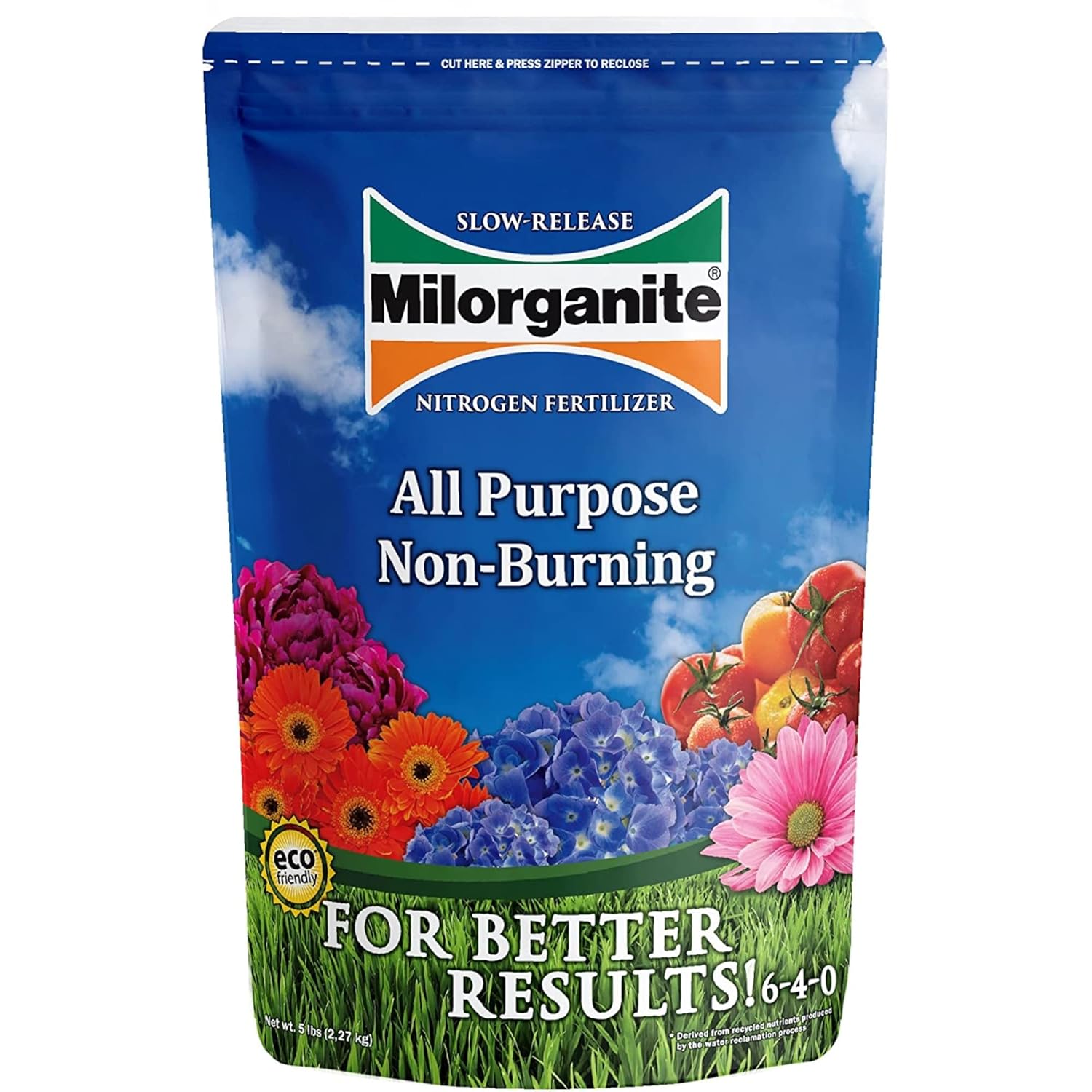
Milorganite Slow-Release Organic Fertilizer, 5 lb
| Item Form | Granules |
|---|---|
| Specific Uses For Product | Lawns, Flowers and Gardens |
| Coverage | 390 Square Feet |
| Ingredients | Nitrogen |
Milorganite is a granular, slow-release organic fertilizer formulated to feed lawns and garden plants for about 8 to 10 weeks per application. It is typically broadcast by hand or with a spreader and does not require immediate watering in, making it easy to fit into routine maintenance. Notable features include a low-salt formula that greatly reduces the risk of burning turf, organically complex iron that greens grass without staining hard surfaces, and about 85% organic matter that helps improve soil structure over time. The product covers roughly 390 square feet from a 5 pound bag and is positioned as safe for use on lawns, shrubs, flowers, trees, and edible gardens. Limitations are that nutrient release is gradual, so it is not a quick fix for severe nitrogen deficiency, and the bag has an earthy odor at first that some pets may find attractive until it dissipates or is watered in. For someone managing Empire Zoysia, use on the recommended schedule and expect steady, low-risk green-up rather than instant color change.
Best for: Gardeners who prioritize steady, low-risk nutrient delivery and soil health and who prefer a hands-off feeding schedule for fine-textured lawns like Empire Zoysia.
Less Ideal for: Homeowners wanting rapid color correction or fast-acting synthetic nitrogen boosts should choose a quick-release fertilizer instead.
- Slow-release nitrogen feeds lawns for 8–10 weeks reducing application frequency
- Low salt formulation minimizes risk of burning sensitive turf like Zoysia
- Provides organically complex iron that greens grass without staining concrete
- High organic matter improves soil structure and water retention over time
- Slow-release action means it will not correct severe yellowing immediately
- Initial earthy odor that may attract some pets until it is watered in or dissipates
Verdict: Choose Milorganite for Empire Zoysia when you want a safe, slow-release organic feed that greens turf steadily without burning or staining.
Milorganite 6-4-0 Slow-Release Fertilizer, 32 lb (with Feeding Tips Brochure)

| Item Form | Pelletized |
|---|---|
| Application Method | Broadcast, Rotary or Manual |
| Coverage | 2,500 Square Feet |
| Specific Uses For Product | Lawns, Flowers and Gardens, Education |
Milorganite 6-4-0 is an organic, pelletized slow-release fertilizer intended for routine lawn and garden feeding. It is typically broadcast with a rotary or manual spreader and provides nitrogen slowly over 8 to 10 weeks, which reduces the need for frequent applications and lowers burn risk. The product contains organically complex iron for greening without the strong staining associated with iron salts and is low in soluble salts, so it performs well in warm or drier conditions. The 32 lb bag covers roughly 2,500 square feet and comes with a printed feeding and spreader tips brochure to simplify seasonal timing and application rates. Because it is made from heat-dried microbes, it also adds organic matter to improve soil structure in heavy clay or sandy soils. Limitations are that nutrient release is gradual so it is not suited to quick color fixes or rapid turf recovery, and users seeking tightly controlled N-P-K ratios or fast-acting synthetic performance may prefer a different product.
Best for: Buyers who want a low-maintenance, environmentally minded fertilizer that steadily feeds established lawns and mixed garden beds with minimal risk of burn and fewer repeat applications.
Less Ideal for: If you need rapid turf recovery, immediate color correction, or precise synthetic nutrient control for athletic fields or newly sodded lawns, choose a fast-release or specialty fertilizer instead.
- Slow-release nitrogen feeds lawns and plants for 8–10 weeks, reducing application frequency
- Low-salt formulation minimizes fertilizer burn and streaking in hot or dry conditions
- Organically complex iron promotes deep greening without heavy staining of concrete
- Pelletized form works with broadcast, rotary, or manual spreaders for easy application
- Adds organic matter that can improve drainage and soil structure in clay or sandy soils
- Not fast-acting, so it will not deliver an immediate green-up after application
- Contains biosolids which some buyers may prefer to avoid for personal or local reasons
Verdict: Pick this if you want a reliable, low-salt slow-release fertilizer that feeds lawns and gardens for weeks with minimal maintenance.
Simple Lawn Solutions 0-0-25 High Potassium Liquid Lawn Food (32 fl oz)

| Item Form | Liquid |
|---|---|
| Application Method | Spray |
| Coverage | 3,200 square feet |
| Target Species | all grass types |
| Unit Count | 32 Fluid Ounces |
This 0-0-25 liquid from Simple Lawn Solutions is a high-potassium turf fertilizer designed to be applied with the included hose-end sprayer. It supplies potassium without added nitrogen or phosphorus, so it is useful when you want to correct or maintain potassium levels without stimulating lush growth. Typical use is a summer or fall application to improve stress tolerance and support enzyme and carbohydrate functions in grass. The ready-to-use sprayer makes coverage straightforward and the bottle claims it treats up to about 3,200 square feet per tank setting. Practical benefits are targeted nutrition for potassium-deficient lawns, compatibility with any grass type, and a liquid format that distributes evenly when applied correctly. Important limitations are that potassium responses are often subtle and not immediately visible, and this product does not replace a complete fertilizer where nitrogen or phosphorus is needed. Also results depend on proper application with the hose sprayer and existing soil nutrient levels.
Best for: Gardeners who prioritize evidence-backed, targeted nutrient corrections for lawn stress tolerance and want a simple, low-fuss liquid potash to add to an existing care plan.
Less Ideal for: Homeowners seeking an all-in-one feeding that quickly greens and thickens turf or those who prefer granular fertilizers and detailed soil-testing driven blends.
- High 25% potassium formulation targets potassium deficiency and turf hardiness
- Includes ready-to-use hose-end sprayer for even liquid application
- Suitable for all common grass types, simplifying compatibility concerns
- Covers up to roughly 3,200 square feet per sprayer use
- No nitrogen or phosphorus, so it will not green-up or promote growth where those nutrients are lacking
- Visible improvement can be slow because potassium effects are often subtle
Verdict: Choose this concentrated liquid if you need a straightforward potassium boost to improve turf hardiness without adding nitrogen or phosphorus.
Choosing the Right Low Nitrogen Lawn Fertilizer: Key Factors to Consider
Nitrogen Level and Ratio
Low nitrogen fertilizers differ by how little nitrogen they deliver and how that nitrogen is balanced against phosphorus and potassium. For established lawns you want enough nitrogen to maintain color without pushing excessive blade growth. A lower first number in the N-P-K ratio reduces mowing needs and lowers drought stress because the plant invests less in leafy growth.
Also consider the ratio across applications. If you plan multiple light feedings through the season, cumulative nitrogen matters more than a single application. Gardeners with shade or reduced irrigation should lean toward the lowest workable nitrogen rates to avoid disease and thinning from repeated flushes.
Release Method and Timing
How the product releases nutrients affects both safety and effectiveness. Slow-release or coated granules give a steady supply and reduce burn risk compared with quick-release soluble fertilizers. They also lengthen the interval between applications, which is useful for low-maintenance yards.
Water-soluble low nitrogen formulations can be useful for precision feeding or spot treatments but demand careful timing and irrigation management. Match the release method to your watering routine and seasonal goals so nutrients are available when roots can use them rather than lost to runoff or leaching.
Secondary Nutrients and Micronutrient Content
Turf needs more than nitrogen for resilience. Potassium supports drought and wear tolerance while phosphorus aids root development in some soils. Micronutrients like iron, manganese, and zinc influence color and disease resistance. A low nitrogen product that includes these elements can keep turf healthy without relying on high nitrogen rates.
If your soil test shows deficiencies, prioritize formulas that address those gaps. If you do not have a recent test, choose balanced low nitrogen mixes that supply common micronutrients to avoid subtle chronic deficiencies that reduce vigor over time.
Application Convenience and Spreader Compatibility
Practical application details often determine whether a low nitrogen program succeeds. Granular size, dust levels, and clear spreader settings make it straightforward to apply a consistent rate across a lawn. Some low nitrogen products come in sizes and packaging that fit common broadcast or drop spreaders, while powdered or very fine-grain formulas can clog equipment or create uneven distribution.
Consider how easy the product is to measure and store. Resealable bags and labeled rates for common home spreaders reduce guesswork. Also think about whether you need a product that is forgiving to slight overapplication; slow-release formulas usually tolerate minor errors better than fast-release types.
Turf Safety and Climate Suitability
Low nitrogen choices are often driven by climate and turf species. In hot, dry regions, reducing nitrogen helps prevent scorch and conserves water by limiting shoot growth. In cool-season turf areas, low nitrogen during summer dormancy helps avoid weak regrowth. Safety also includes how a product behaves at high temperatures and under limited irrigation.
Look for formulations and application windows that align with your local climate and grass type. A product that is turf-safe in one region may not be ideal elsewhere if it lacks needed micronutrients or if its release profile does not match local watering patterns.
Environmental Impact and Runoff Risk
Fertilizer choice affects more than just lawn appearance. Low nitrogen formulations reduce the risk of nitrogen runoff that can harm waterways, especially when paired with slow-release chemistry. Products that include water-insoluble nitrogen components or are designed for minimal leaching are preferable near slopes, driveways, or water features.
Also consider label guidance on buffer zones and recommended irrigation after application. Following recommended rates and choosing the right chemistry helps minimize nutrient loss and protects local ecosystems while still supporting healthy turf.
When to Use Low Nitrogen Lawn Fertilizer
Low nitrogen formulations are appropriate when you need to limit top growth, reduce mowing, or protect turf during heat and drought. They are also a good choice if you mow infrequently or if your lawn sits on shallow soil where rapid, lush growth would stress roots.
Use low nitrogen feeds in mid-to-late summer for cool-season grasses and during active but non-flush growth periods for warm-season species. They also work well for maintenance passes between heavier feeding windows when the goal is steady color and resilience rather than rapid recovery.
- Prefer in drought-prone or heat-exposed lawns
- Use for lawns where frequent mowing is impractical
- Good for maintenance feeding between heavier seasonal treatments
How Soil Testing Shapes Your Plan
A soil test is the best indicator of whether a low nitrogen product alone will meet your lawn's needs. Test results show available phosphorus, potassium, and pH, which guide whether you need a straight low nitrogen blend or a more balanced formula with added potassium or micronutrients.
If the test shows adequate phosphorus and potassium, a lean feed focused on slow-release nitrogen and iron may suffice. When deficiencies appear, choose a formula that corrects those gaps so your turf does not trade color for long-term weakness.
- Test every 2 to 4 years for established lawns
- Match product micronutrients to soil test deficiencies
- Adjust application timing based on pH and nutrient availability
Application Tips to Avoid Scorch and Waste
Calibrate your spreader before the first application and follow labeled rates carefully. Overapplication, even of low nitrogen products, can cause localized burning or uneven color. Spread in overlapping passes and avoid applying on extremely hot days or before heavy rain.
If using a soluble low nitrogen product, water in lightly to move nutrients into the root zone but avoid washing them away. For coated or slow-release granules, do not irrigate heavily immediately unless the label recommends it; these products are designed to release over time with routine moisture.
- Calibrate spreader and use consistent overlap
- Avoid application during heat spikes or heavy rainfall
- Water according to label directions to reduce runoff
Combining Low Nitrogen Feeds with Cultural Practices
Low nitrogen feeding works best alongside proper mowing height, adequate but not excessive irrigation, and periodic aeration. Deeper mowing and less frequent clipping encourage stronger root systems, which complement low nitrogen inputs by improving nutrient uptake efficiency.
For lawns with compaction or minor thinning, pair low nitrogen programs with spot overseeding and targeted soil amendments rather than increasing nitrogen. That approach builds long-term vigor without sacrificing the benefits of controlled nitrogen.
- Mow at recommended heights for your grass species
- Aerate compacted lawns before feeding when possible
- Use targeted overseeding instead of heavier nitrogen rates
Seasonal Timing and Scheduling
Plan low nitrogen applications to fit seasonal growth patterns. For cool-season lawns, taper nitrogen in summer and resume moderate feeding in early fall when roots regain activity. For warm-season grasses, use low nitrogen through late spring into summer, then increase potassium or micronutrient focus during stress periods.
Spacing applications to match slow-release intervals reduces the chance of cumulative overfeeding. Keep a simple calendar so you track when last application occurred and what the product's effective window is.
- Use low nitrogen in stress-prone seasons
- Follow release interval guidance to avoid overlap
- Keep records of application dates and product types
How We Chose the Best Low Nitrogen Lawn Fertilizer
We focused on formulations and performance traits that matter in everyday lawn care with limited nitrogen targets. Key evaluation criteria included nutrient profile completeness, release mechanism, application flexibility, turf safety, and packaging or handling that affects homeowner use. Nutrient profile completeness assessed whether important secondary and micronutrients were present to support root health and color without relying on high nitrogen. Release mechanism focused on whether the fertilizer is slow-release, coated, or water-soluble, and how that influences feeding consistency and scorch risk. Application flexibility covered granule size, spreader compatibility, and ease of measuring for common yard sizes. Turf safety looked at burn risk under heat and drought and compatibility with common grass species. Packaging and handling considered resealable bags, dust control, and clear labeling for N-P-K ratios and spreader settings. We excluded high-nitrogen turf starters, products marketed primarily for rapid greening, and mixes that require complex activation or specialist equipment. The shortlist favors products that deliver measured, repeatable results for gardeners seeking controlled growth, longer windows between mowings, and reduced stress during summer conditions.
FAQ
Will a low nitrogen fertilizer keep my lawn green?
Often yes. Low nitrogen formulas that include iron or other color-enhancing micronutrients can maintain a desirable green without promoting rapid blade growth. Results depend on soil fertility and timing.
How often should I apply low nitrogen fertilizer?
It usually depends on the product's release profile. Slow-release options can be applied less frequently, often every 6 to 12 weeks, while soluble low nitrogen feeds may require more regular, lighter applications. Always follow label directions.
Can I use low nitrogen fertilizer after overseeding?
It depends. New seedlings often benefit from a bit more available nitrogen to establish, so many gardeners use a starter formula when overseeding and then switch to low nitrogen maintenance once turf is established.
Is low nitrogen fertilizer better for drought-prone areas?
Usually yes. Reducing nitrogen limits lush top growth that increases water demand and susceptibility to heat stress. Pair low nitrogen feeding with deep, infrequent watering for best results.
Will low nitrogen products prevent thatch buildup?
They can help because slower shoot growth produces fewer clippings, which reduces organic matter accumulation on the surface. However, thatch dynamics also depend on soil biology, mowing practices, and aeration, so additional cultural steps may be required.
Final Verdict
Prioritize a low nitrogen product that fits your lawn's climate, grass type, and soil test results. Focus on release method, secondary nutrients, and application convenience to balance color, resilience, and maintenance effort. If you want minimal mowing and lower scorch risk, choose steady-release formulas and pair them with proper mowing and watering habits for the most reliable results.
