

Note: This article contains affiliate links. If you click on these links and make a purchase, I may earn a small commission at no extra cost to you. This helps support my research and content. Read my full affiliate disclosure here.
If your outdoor water supply has weak flow, a standard sprinkler can sputter, deliver patchy coverage, or clog easily. Choosing a low water pressure garden sprinkler tuned to lower PSI makes a big difference in how evenly lawns and beds get water and how much time you spend hand-fixing dry spots. This guide walks you through the top shortlisted options for low-pressure setups and explains the practical differences that matter in an everyday garden. We evaluated spray reach, water efficiency, and durability so you can pick a sprinkler that suits your yard layout, hose length, and watering schedule. Read on for clear, gardener-focused guidance before you pick a model.
Top Picks at a Glance
| Best Quality Built to a higher standard if you want something more solid | Eden Adjustable 4-Way Mini Turbo Oscillating Sprinkler with Quick Connect Starter Set |  |
| Best Value The sweet spot between price and what you get | BILAL Metal Spot Rotary Sprinkler (2-Pack) |  |
| Best Budget The cheapest option that still gets the job done reliably | Drivstraw Plastic 360° Low-Pressure Garden Sprinkler |  |
| Highest Rated A top-rated pick with lots of positive feedback | SYOOY 360° Metal Spot Sprinkler (Circular) |  |
| Most Popular A crowd favorite that many people choose with confidence | Rocky Mountain Goods Rotary Circle Sprinkler (plastic) |  |
| Best Seller A high-volume bestseller chosen again and again | Gilmour Square Pattern Stationary Spot Sprinkler |  |
Eden Adjustable 4-Way Mini Turbo Oscillating Sprinkler with Quick Connect Starter Set

| Maximum Pressure | 125 psi |
|---|---|
| Maximum Flow Rate | 12.56 liters per minute |
| Inlet Connection Size | 0.5 inches |
| Material Type | Acrylonitrile Styrene |
This Eden mini turbo oscillating sprinkler brings the performance of a larger oscillating head into a compact, easy-to-position unit. It sprays from a set of 16 clog-resistant nozzles and is adjustable in four ways: width, length, flow, and a full 360 degree rotation so you can target narrow strips or broad lawn areas up to roughly 4,069 sq. ft. The turbo-drive motor maintains smooth operation across low and high water pressures while the integrated flow control dial lets you fine-tune output to avoid runoff or overspray. Practical touches include a heavy weighted H-shaped base for stability, a water filter to reduce nozzle clogs, and a quick-connect starter kit with a swivel to prevent hose kinks and allow fast tool swaps. Because the body is molded ABS plastic, it is lightweight and rustproof but not as heavy-duty as metal-drive commercial heads, so it is best for residential yards rather than heavy professional use. The included quick-connect and replacement filter make maintenance straightforward for regular seasonal watering routines.
Best for: Home gardeners who want precise, easy-to-adjust watering for mixed lawns, flower beds, and narrow strips and who value straightforward setup and low maintenance guided by other shoppers' positive experiences.
Less Ideal for: Large commercial lawns or contractors who need metal gear-drive durability and maximum long-term wear resistance.
- Adjustable width, length, flow, and 360° rotation for precise coverage of different lawn shapes
- Turbo-drive motor for consistent operation at low and high water pressures
- Includes quick-connect starter set and swivel to prevent hose kinks and simplify tool changes
- Weighted H-shaped base and impact-resistant ABS shell provide stable, rustproof performance
- Inline filter and clog-resistant nozzles reduce maintenance and nozzle blockages
- Plastic construction is less durable than metal gear-drive sprinklers for heavy commercial use
- Coverage claims apply under ideal conditions and may be lower on low-pressure systems
Verdict: Choose this Eden mini turbo oscillating sprinkler if you want a compact, highly adjustable residential sprinkler with reliable performance and easy quick-connect setup.
BILAL Metal Spot Rotary Sprinkler (2-Pack)

| Maximum Pressure | 80 psi |
|---|---|
| Inlet Connection Size | 0.75 inches |
| Number of Items | 2 |
| Item Highlight | Gentle water flow for small area coverage up to 30FT |
The BILAL Metal Spot Rotary Sprinkler is a small, heavy-alloy rotary head sold in a two-pack for spot and small-area lawn watering. It connects to any US-standard 3/4-inch garden hose and spins to deliver a 360 degree, gentle rain-like pattern; coverage is adjustable by changing water pressure and is advertised to reach about a 30 foot diameter. The metal construction and included rubber O-rings reduce the risk of breakage and leaking compared with plastic heads, and the sprinkler operates at low working pressures (15 to 80 PSI) so it works with weaker house pressures and gravity-fed systems. Practical uses are watering small lawns, garden beds, patios, and greenhouse plots where a soft, even spray is preferred. Limitations: the unit is intended for spot coverage rather than large lawns, spray distance varies with available pressure, and fine adjustment of arc or radius is limited compared with larger rotor or oscillating systems. For someone optimizing water delivery under low pressure, these metal rotating heads offer durability and predictable, gentle coverage for small zones.
Best for: A buyer who wants a tough, no-nonsense sprinkler that performs reliably on low household pressure and is focused on efficient, gentle watering of small lawns, beds, or patio areas.
Less Ideal for: People needing broad, adjustable coverage for large lawns or precise zone control should choose larger rotary or sprinkler systems instead.
- Durable metal alloy construction resists cracking and rust compared with plastic heads.
- Works at low pressures (rated 15–80 PSI) suitable for weak household or gravity-fed systems.
- Fits standard 3/4-inch GHT hoses for easy hookup without adapters.
- Produces a gentle 360° rotary spray that mimics rain for even, non-erosive watering.
- Sold as a two-pack for covering multiple small zones or having a spare on hand.
- Designed for small-area spot coverage so it is not appropriate as a single solution for large lawns.
- Limited control over spray radius and arc compared with adjustable rotor or impact sprinklers.
Verdict: Choose this two-pack metal rotary sprinkler when you need durable, low-pressure spot watering that delivers gentle, rain-like coverage for small areas.
Drivstraw Plastic 360° Low-Pressure Garden Sprinkler

| Material | PP plastic |
|---|---|
| Spray radius | Approximately 4-7 meters |
| Rotation | 360-degree adjustable |
| Number of pieces | 1 |
This compact Drivstraw rotary sprinkler provides adjustable 360-degree coverage for lawns, flower beds, and small to medium garden areas that have low water pressure. It connects to a standard hose and the rotatable head lets you set spray angle and radius to target specific areas without wasting water. The unit is made of PP plastic, which keeps it lightweight and resistant to routine outdoor use, and the manufacturer rates its effective spray reach at about 4 to 7 meters, suitable for modest yards. Because it is designed for low-pressure operation, it can maintain coverage where larger impact sprinklers struggle and helps reduce water use. Limitations are its simple plastic construction and small size, which make it less durable than metal alternatives and less suited to large lawns or very high-frequency commercial use. Installation is tool-free and straightforward, making it a practical, low-cost option for homeowners managing tight budgets and limited water pressure.
Best for: Budget-minded gardeners with low household water pressure who need an affordable, easy-to-install sprinkler for small to medium garden areas.
Less Ideal for: People with large turf areas, commercial properties, or those who want a heavy-duty, long-lasting metal sprinkler should consider larger or metal models instead.
- Operates effectively at low water pressure for water-saving irrigation.
- 360-degree rotatable head for customizable coverage and angle control.
- Simple tool-free installation that connects to a standard garden hose.
- Lightweight plastic construction resists rust and is easy to move between zones.
- Plastic construction is less impact- and UV-resistant than metal sprinklers over many seasons.
- Small size and radius limit suitability for large lawns or commercial watering.
Verdict: A very affordable, easy-to-use sprinkler that delivers adjustable 360-degree coverage and works well where water pressure is low.
SYOOY 360° Metal Spot Sprinkler (Circular)

| Material Type | Metal |
|---|---|
| Maximum Pressure | 71.12 psi |
| Inlet Connection Size | 0.75 inches |
| Coverage | Up to 30ft diameter |
The SYOOY 360° metal spot sprinkler is a compact, all‑metal sprinkler head that converts a standard garden hose into a fountain‑style 360‑degree emitter for spot watering. You set it in the lawn or garden and control coverage by water pressure and placement rather than fiddly adjustments. Built from zinc alloy, it is more durable than plastic heads and intended for outdoor exposure. It produces an even, circular spray that is well suited to patchy turf, new seed, flower beds, and patios where you need gentle, water‑saving coverage. Installation is straightforward: attach the 0.75‑inch inlet to a standard hose and vary pressure to change radius. Limitations include no sector adjustment or pattern control and reliance on water pressure to set range, so it is not ideal for irregularly shaped beds or precision irrigation. Also it is a single head best used for small to medium areas rather than replacing a multi‑zone sprinkler system.
Best for: Buyers who want a low‑cost, durable, easy‑to‑use sprinkler for spot watering small lawns, seed patches, patios, or garden beds and prefer simple setup over adjustable features.
Less Ideal for: People needing precision watering for irregularly shaped beds, multi‑zone irrigation, or long‑distance coverage should consider adjustable or pop‑up sprinkler options.
- Heavy‑duty metal construction for better outdoor durability than plastic heads
- 360° circular spray provides even, fountain‑like watering for small patches
- Simple hose connection and no complex adjustments make setup fast
- Water‑saving gentle spray suitable for new seed and sensitive plants
- No adjustable spray sector or pattern control for irregular areas
- Range depends entirely on water pressure so coverage can vary
Verdict: A rugged, budget‑friendly metal spot sprinkler that delivers simple, even 360° watering for small lawns and garden patches.
Rocky Mountain Goods Rotary Circle Sprinkler (plastic)
| Material Type | Plastic |
|---|---|
| Maximum Flow Rate | 2 gpm |
| Style Name | Rotary |
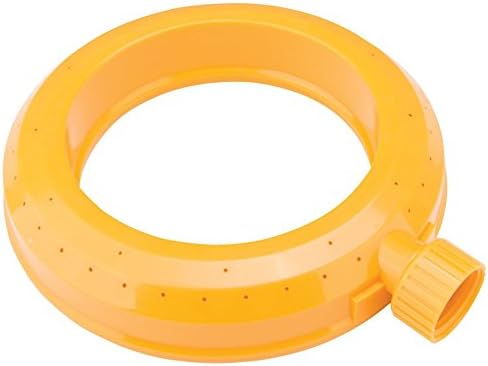
This rotary circle sprinkler is a basic, budget-friendly option for watering new sod and medium-sized lawns. Made from high-impact plastic, it is lightweight and easy to move so you can position it where young grass needs the most attention. The sprinkler throws water up to about 30 feet across, producing a fixed, consistent spray pattern that helps establish even moisture without complicated settings. It is rated to run with both low and high household water pressure and has a modest maximum flow rate of 2 gpm, which helps keep water use reasonable. Because it is a straightforward rotary head with no adjustable diffusers or multiple spray modes, you trade advanced customization for simplicity and reliability. Expect good performance for regular coverage on a budget, but plan to reposition it for irregular lawn shapes or to avoid overwatering in one spot.
Best for: Homeowners laying or caring for new sod who want an inexpensive, no-frills sprinkler that is easy to move and use regularly.
Less Ideal for: People with large or unusually shaped lawns who need adjustable spray patterns or automated coverage should consider more versatile sprinkler heads or timed systems.
- Covers up to 30 foot diameter suitable for establishing new sod
- High-impact plastic resists outdoor wear while keeping cost low
- Works with low and high household water pressure for flexible use
- Fixed spray style with no adjustable patterns limits fine-tuning of coverage
Verdict: A low-cost, easy-to-use rotary sprinkler that reliably wets new sod across a roughly 30-foot area without fuss.
Gilmour Square Pattern Stationary Spot Sprinkler

| Material Type | Metal |
|---|---|
| Maximum Flow Rate | 0.5 gpm |
| Inlet Connection Size | 0.5 inches |
The Gilmour Square Pattern Stationary Spot Sprinkler is a simple, heavy-duty metal sprinkler designed for spot-watering small lawn areas, new seed, and trouble spots where a full-coverage sprinkler is overkill. It produces a gentle, fountain-like spray that covers roughly a 30 by 30 foot square, and its stationary design makes setup straightforward: attach to a standard 1/2-inch inlet and place where you need targeted coverage. Metal construction gives the head stability and durability compared with plastic alternatives, and the unit performs well where water pressure is limited because it is tuned for low flow and a maximum flow rate of 0.5 gpm. The trade-offs are that it is not adjustable to larger arcs or rotating coverage, so it works best as a focused spot sprinkler rather than a whole-lawn solution, and it lacks features like adjustable distance or oscillation. For routine targeted watering and seed establishment in low-pressure systems, it is a dependable, no-frills choice.
Best for: Buyers who prioritize reliability and simple, targeted watering in lawns or garden patches with limited water pressure and who prefer a durable, low-maintenance sprinkler.
Less Ideal for: Those who need wide-area or adjustable rotating coverage for larger lawns or who want programmable or multi-pattern sprinklers.
- Metal construction for durability and stability
- Designed for low water pressure areas and low flow operation
- Simple stationary design is easy to position for targeted watering
- Gentle fountain-like spray suitable for new seed and delicate areas
- Fixed square pattern and non-rotating head limits coverage flexibility
- No built-in distance adjustment or pattern customization
Verdict: A durable, low-flow stationary sprinkler built to deliver dependable, targeted watering in low-pressure systems.
Choosing the Right Low Water Pressure Garden Sprinkler: Key Factors to Consider
Spray Reach and Pattern Coverage
How far a sprinkler will throw water and the shapes it can make matters more with low pressure than with full-flow systems. Low-pressure units should be able to cover a lawn strip or bed with fewer repositionings because each move costs time and can disturb planted areas.
Look for models that specify throw distance at low PSI and offer adjustable arcs or multiple pattern options. A sprinkler that can move between a narrow strip and a wider fan without needing more flow will reduce setup complexity and ensure consistent moisture across the planting area.
Water Efficiency and Flow Control
Low-pressure sprinklers need to use the limited flow available without wasting water through misting or runoff. Systems that offer flow control, pressure compensation, or low-flow nozzles let you match output to the water supply and soil infiltration rate.
Efficient sprinklers apply water slowly and evenly so the soil can absorb it. That reduces pooling and runoff on slopes or compacted soils. For watering schedules, an efficient design may also shorten total watering time because it avoids repeated short cycles to correct dry spots.
Adjustability and Ease of Aiming
Practical adjustments are essential when pressure is low because fine-tuning the arc, radius, and spray type compensates for weaker streams. Controls should be easy to reach and operate without tools so you can tweak settings as plants grow or as seasons change.
Aiming options include rotating heads with adjustable stops, interchangeable nozzles, or single-knob pattern selection. Consider how easy it is to make small changes without moving the sprinkler's mount, especially in beds with delicate plants or in lawns where repeated foot traffic causes wear.
Clog Resistance and Serviceability
Garden water often carries small debris, sand, or minerals that cause blockages in fine nozzles. Low-pressure sprinklers that include simple filters, larger orifice sizes, or easily removable nozzle assemblies will run longer between cleanings.
Also check how easy it is to access and clean internal parts. A design that allows you to flush the head or swap nozzle inserts in the field avoids downtime and maintains consistent spray patterns with minimal effort.
Mounting Stability and Placement Options
At low pressure, even small shifts in a sprinkler's angle or height can create uneven coverage. Look for sturdy mounting options such as solid lawn spikes, weighted bases, or low-profile stands that resist tipping or sinking into soft soil.
Flexible placement matters when you need to water narrow strips, containers, or raised beds. Some designs allow quick changes between a spike, a short riser, or an elevated stake so you can position spray above low plants or under overhanging foliage.
Materials and Weather Resistance
Because these sprinklers often stay outdoors for long stretches, materials and construction affect longevity. UV-stabilized plastics, brass fittings where the hose attaches, and corrosion-resistant internal components reduce the chance of leaks and brittle failures.
Check for durable seals and hose connectors that clamp tightly without cracking. Robust construction lowers the need for frequent replacements and keeps performance consistent across seasonal temperature swings.
Why Low-Pressure Sprinklers Behave Differently
Sprinklers built for low-pressure systems trade raw throw distance for steady, gentle output. Rather than relying on high PSI to atomize water, they use larger orifices, pressure-compensating mechanisms, or slower rotation speeds to keep droplets intact and avoid misting. The result is less evaporation and better absorption in many soil types.
- Larger droplet size reduces wind drift and evaporation
- Slower rotation yields more overlap between passes for even coverage
- Pressure-compensated nozzles maintain pattern at varying flow rates
Matching Sprinkler Type to Garden Layout
Not every low-pressure sprinkler is ideal for every space. Oscillating heads can cover rectangular lawns efficiently, while rotating or fan-head designs are better for oddly shaped beds or narrow strips. For mixed landscapes, choose a design that adjusts easily between narrow and wide settings so you do not need multiple devices.
- Rectangular lawns: oscillating or multi-slot fans work well
- Narrow strips: targeted fan or rotary heads reduce waste
- Raised beds and containers: low-profile or adjustable-angle heads prevent overspray
Installation Tips for Low-Pressure Systems
Keep hose runs as short as practical and avoid unnecessary long lengths that reduce available flow. Use a straight hose connection without tight coils and consider a wider-diameter hose if you need to run multiple sprinklers from one spigot. Ensure fittings seal cleanly; a small leak near the tap lowers the pressure at the sprinkler head noticeably.
When anchoring a sprinkler, set it at the intended final height and angle and then test coverage before pegging it permanently. If you see misting or short spray, try a different nozzle size or reduce the arc. Regularly check and clear inlet filters to maintain consistent output.
- Minimize hose length and avoid sharp bends
- Use the correct hose diameter for multiple heads
- Verify fittings and test coverage before final placement
Maintenance Routines That Extend Performance
A short maintenance routine preserves coverage and reduces surprise dry patches. Flush the sprinkler and hose at the start of the season to remove sediment. Inspect nozzles monthly during periods of heavy use and remove mineral buildup with a soft brush or soak in a mild vinegar solution if needed.
Store removable heads or delicate components during freezing weather. Replace small seals or O-rings at the first sign of leakage instead of tightening connections repeatedly, which can crack fittings and create leaks that degrade pressure.
- Seasonal flush to clear sediment
- Monthly nozzle checks and gentle cleaning
- Replace seals at first sign of leaks
How We Chose the Best Low Water Pressure Garden Sprinkler
We focused on real-world usability in low-pressure garden systems rather than unverified product claims. Selection began by filtering for sprinklers specifically designed or rated to operate under reduced flow and low PSI. We excluded high-pressure-only designs, units that require special pumps, and any models lacking clear flow or pressure specifications. Key evaluation criteria included spray reach and pattern control so sprinklers can cover typical lawn widths without multiple repositionings; water efficiency and flow modulation to reduce run time and avoid runoff; build quality and clog resistance for use with untreated garden hoses and well water; ease of setup and adjustment because many gardeners need simple, repeatable settings; and stability and mounting options to perform on soil, lawn spikes, or small stands. We prioritized products that offer clear adjustment mechanisms and parts that are easy to clean in the field. Finally, we removed options with consistently poor user reports about leaking fittings, quickly worn nozzles, or vague installation guidance.
FAQ
Will a low-pressure sprinkler work with well water or a drip system?
Often it will work better with a shallow-well supply than high-pressure heads, but performance depends on the well pump output and pipe friction. Low-pressure sprinklers are designed to run on reduced PSI, but you should check the sprinkler's minimum flow rating and compare it to your well output. They are not a replacement for a drip system, which uses a different delivery method and is better for individual plants and beds.
How can I increase coverage without raising pressure?
You can increase coverage by using a sprinkler head with a wider throw at low PSI, shortening hose runs, or switching to a different nozzle size that produces a longer stream at reduced pressure. Also consider repositioning to reduce overlap gaps rather than trying to force more distance from a single head.
Do I need to filter the water feeding a low-pressure sprinkler?
Filtering is recommended if your water contains sand, grit, or mineral particulates. A small inline filter or a sprinkler with an integrated screen protects nozzles and reduces clogging, which is particularly important when the system lacks the force to clear deposits during operation.
Can I use multiple low-pressure sprinklers on one spigot?
You can run multiple heads if the combined flow requirement stays within your source capacity. Using more sprinklers reduces pressure at each head, so balance the number of devices against the spigot output and consider sequential watering or a wider hose to maintain better flow.
What nozzle types are best for windy conditions?
Choose larger-droplet outputs like low-pressure rotary or fan nozzles because they are less likely to drift. Misting or fine-spray heads will lose effectiveness in wind, so opt for patterns that create heavier droplets and more targeted coverage.
Final Verdict
For gardens on weak water supplies, prioritize sprinklers that are explicitly designed for low pressure with clear flow and throw specifications. Focus on models that balance spray reach with water-efficient delivery, offer easy adjustment for arc and radius, and are simple to service in the field. Expect tradeoffs between absolute distance and evenness of coverage: a gentle, consistent spray usually beats a farther but uneven throw. Choose the design that fits your layout and maintenance preferences and plan for periodic cleaning to keep performance steady.
