

Note: This article contains affiliate links. If you click on these links and make a purchase, I may earn a small commission at no extra cost to you. This helps support my research and content. Read my full affiliate disclosure here.
Picking the right manure for your home garden changes how well beds hold moisture, feed plants, and build long-term soil life. Different manures vary in nutrient balance, weed seed content, and how quickly they break down, so choosing one that fits your plot size, crops, and composting plans matters. This guide walks you through seven shortlisted manures suited to home garden use and explains the practical tradeoffs gardeners face. We evaluate each pick on nutrient profile and handling attributes, plus decomposition behavior and weed/seed risk, so you can match a manure to your beds and planting schedule.
Top Picks at a Glance
| Best Overall The best all-around choice for most situations | BRUT Worm Farms Cow Compost — 10 Quart Bag |  |
| Best Quality Built to a higher standard if you want something more solid | Espoma Organic Chicken Manure Granules, 3.75 lb |  |
| Best Value The sweet spot between price and what you get | Black Kow Composted Cow Manure Fertilizer, 8 qt |  |
| Best Budget The cheapest option that still gets the job done reliably | Happy Bunny Farms Chicken Manure Pellet Crumbles, 1.5 lb |  |
| Highest Rated A top-rated pick with lots of positive feedback | Earth Science Premium Earthworm Castings, 3 lb |  |
| Most Popular A crowd favorite that many people choose with confidence | Brut Organic Worm Castings, 5 lb |  |
| Best Seller A high-volume bestseller chosen again and again | Black Kow Composted Cow Manure, 35 lb Bag |  |
BRUT Worm Farms Cow Compost — 10 Quart Bag

| Unit Count | 192 Ounce |
|---|---|
| Volume | 10 quarts |
| Brand Name | BRUT WORM FARMS |
| UPC | 860000284295 |
Brut Cow Compost is a ready‑to‑use bagged cow manure compost aimed at improving soil fertility and structure. It is made from 100% composted cow manure that has been finely sifted, which makes it easy to mix into potting mixes, top‑dress containers, or incorporate into garden beds. Notable features include an OMRI listing for organic use, a nutrient profile with nitrogen, calcium and iron, and a low‑odor, non‑burning formula that is safe around seedlings and houseplants. In practice the compost increases microbial activity and helps retain moisture, so plants show healthier foliage and better growth when used regularly. The 10 quart bag is convenient for small gardens, potted plants, or spot treatments without handling bulk loads. Limitations are the modest volume per bag for larger beds and the product is a general amendment rather than a complete, balanced fertilizer, so heavier feeding or specific NPK management may still be needed for high‑demand crops.
Best for: Gardeners who want an easy, certified organic soil amendment to boost soil life and moisture retention in containers, small beds, or targeted spots without handling raw manure.
Less Ideal for: People establishing large garden plots or those seeking a complete NPK fertilizer for heavy feeding crops should consider bulk compost or supplemental fertilizers instead.
- OMRI‑listed organic compost safe for edible and ornamental plants
- Finely sifted, low‑odor formula suitable for indoor use and seedlings
- Adds organic matter and beneficial microbes to improve moisture retention and soil structure
- Versatile application as top dressing, mix‑in amendment, or container soil enhancer
- Small 10 quart volume requires multiple bags for larger garden projects
- Not formulated as a balanced complete fertilizer for high‑demand crops
Verdict: A compact, OMRI‑listed bag of finely composted cow manure that reliably adds organic matter and microbial life to containers and small garden beds.
Espoma Organic Chicken Manure Granules, 3.75 lb

| Item Form | Granules |
|---|---|
| Application Method | Scatter around plants |
| Target Species | Flowers, Vegetables, Trees, Shrubs |
| Specific Uses For Product | Gardening, Organic, Plant Food |
Espoma Organic Chicken Manure is a ready-to-use, granulated poultry manure fertilizer aimed at home gardeners who want an organic nitrogen-rich soil amendment. With a 5-3-2 NPK analysis and added calcium, it is scattered around the plant drip line and watered in to release nutrients; the granulated, heat-treated form makes application tidy and eliminates the need for mixing. It is labeled for monthly use on vegetables and for seasonal use on trees and shrubs, which makes it practical for routine feeding of tomatoes, peppers and other vegetable beds. The product is registered for organic production and contains no fillers, so you get mostly poultry manure rather than blended proprietary mixes. Because it is dehydrated and granulated there is minimal odor and easier storage than fresh manure, but nutrient levels are moderate so heavy-feeding crops may need larger or repeated applications. Also it does not supply specific micronutrient balances or slow-release polymers, so pairing it with a balanced organic program will give best results.
Best for: Gardeners who prioritize certified organic inputs and want a simple, easy-to-apply manure fertilizer for regular feeding of vegetable beds and common garden plants.
Less Ideal for: Growers seeking a single-product, high-analysis or slow-release fertilizer for intensive commercial production should consider concentrated or formulated alternatives.
- Certified for organic gardening and made from dehydrated poultry manure
- Granulated, heat-treated form is easy to apply and has lower odor than fresh manure
- Straightforward 5-3-2 NPK plus calcium provides usable nitrogen for vegetables
- Ready-to-use with no mixing required and simple scatter-and-water application
- Moderate nutrient analysis may require more frequent applications for heavy feeders
- Does not list a full micronutrient profile or slow-release formulation
Verdict: A simple, certified organic chicken manure in granule form that makes monthly feeding of vegetable beds easy and low-odor.
Black Kow Composted Cow Manure Fertilizer, 8 qt

| Item Form | Granules |
|---|---|
| Unit Count | 256 Fluid Ounces |
| Included Components | Cow Manure |
| Mixing Ratio | 1:1 |
Black Kow composted cow manure is a ready-to-use organic soil amendment formulated to improve moisture retention, aeration, and nutrient availability in planting areas. Gardeners typically mix it into raised bed soil before planting or use it as a top dressing and it can also be brewed into compost tea using the 1:1 mixing ratio supplied. The product is granular and contains beneficial microbes that help convert nitrogen into plant-available forms, so it feeds slowly without burning young roots. Practical benefits for raised vegetable beds include better water-holding in sandy mixes and improved crumb structure in heavier soils, which helps root development and reduces nutrient leaching. Important limitations are that nutrient content is not given as an N-P-K analysis and dosing is less precise than bagged balanced fertilizers, so heavy feeders may still need supplemental fertilizers. The safety notes mean you should handle with gloves and a mask and avoid direct contact with edible harvests immediately after fresh application.
Best for: Home gardeners building or refreshing raised vegetable beds who want an affordable, organic soil conditioner to improve texture, water retention, and microbial activity.
Less Ideal for: Gardeners who need a precise, high-analysis fertilizer program for heavy-feeding crops or who prefer fully screened, potting-grade composts for container vegetables.
- Organic composted manure improves soil structure and moisture retention
- Contains beneficial microbes that help make nutrients available to plants
- Versatile use as soil amendment, top dressing, or compost tea ingredient
- Granular form is easy to mix into raised bed mixes and garden soil
- No detailed N-P-K nutrient breakdown provided for precise feeding
- May require supplementary fertilizer for heavy-feeding vegetables
Verdict: A budget-friendly organic soil amendment that improves structure and moisture retention in raised vegetable beds while supplying slow-release nutrients.
Happy Bunny Farms Chicken Manure Pellet Crumbles, 1.5 lb

| Item Form | Pellets, crumbles |
|---|---|
| Specific Uses For Product | Plant Fertilizer, Plant Growth, Root Development, Soil Conditioning |
| Unit Count | 24 Ounce |
| Ingredients | Chicken manure |
This 1.5 lb bag of chicken manure crumbles is a straightforward organic fertilizer for vegetable gardens, containers, and raised beds. The 5-4-3 NPK mix supplies steady nitrogen, phosphorus, and potassium to support leafy growth, root development, and flowering, while the crumble/pellet form makes it easy to scatter or work into the topsoil. It is best used as a top dressing around established plants or lightly incorporated into potting mixes and garden beds following package directions. Because it is natural chicken manure it also helps improve soil structure and encourages microbial activity over time. The small bag size is convenient for trialing on a few beds or for gardeners managing limited space, but you will need multiple bags for larger vegetable plots. Application requires attention to rates to avoid over-fertilizing young seedlings and vegetable transplants.
Best for: Home gardeners on a budget who want an organic, easy-to-apply fertilizer for small vegetable beds, containers, or to test on a few plots before committing to larger quantities.
Less Ideal for: People managing large allotments or commercial vegetable plots who need bulk fertilizer or a concentrated product for widespread application.
- Balanced 5-4-3 NPK formula suited to general vegetable garden needs
- Organic chicken manure ingredient that improves soil structure and microbial activity
- Crumble/pellet form is easy to apply as a top dressing or to mix into soil
- Small 1.5 lb bag is convenient for containers, raised beds, or trial uses
- Small bag size means higher cost per square foot for larger gardens
- No additional amendments or buffering indicated for use around sensitive seedlings
Verdict: A small, ready-to-use organic chicken manure crumble that gives budget-minded vegetable gardeners an easy way to boost soil fertility in containers and small beds.
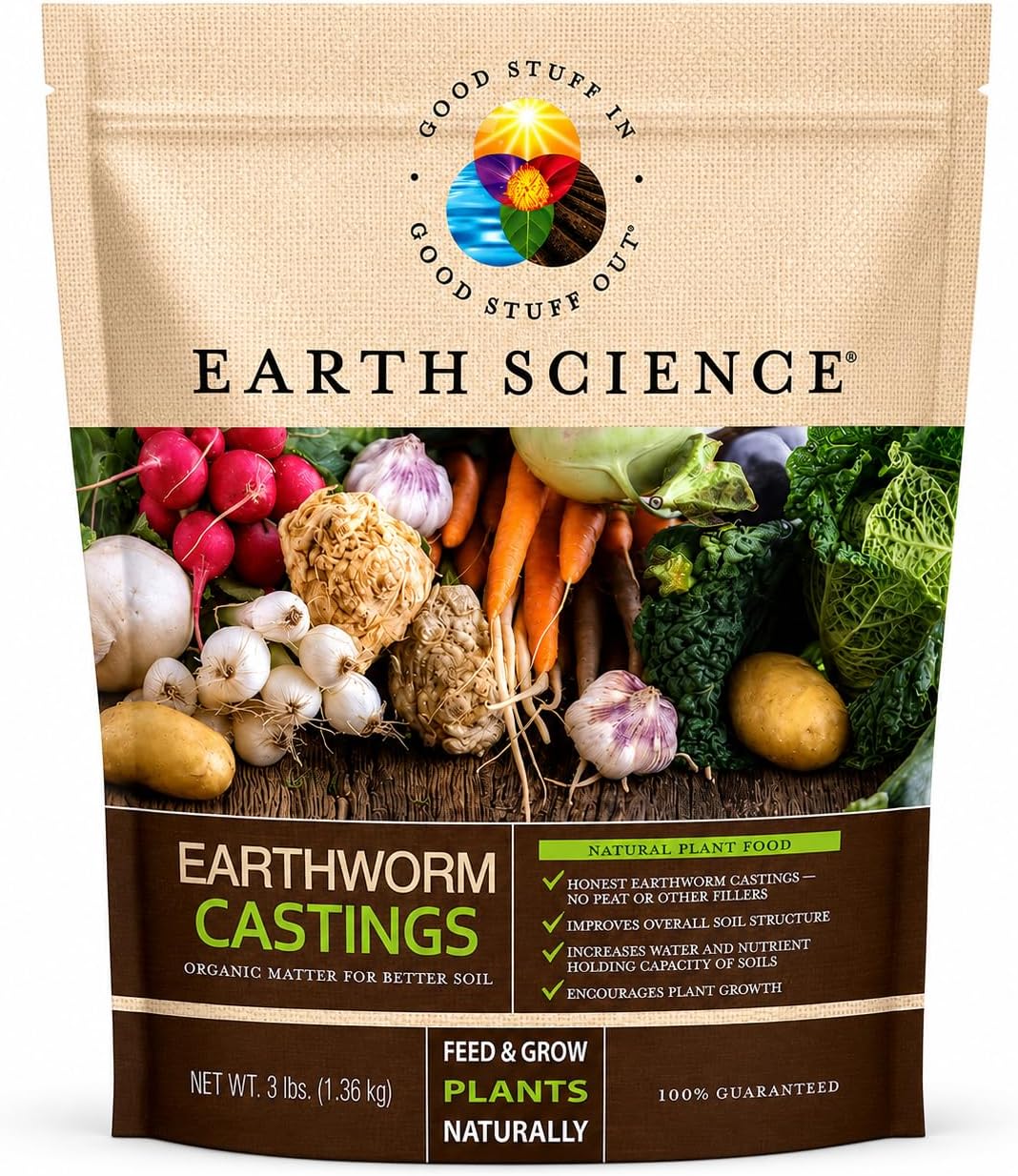
Earth Science Premium Earthworm Castings, 3 lb
| Item Form | Granules |
|---|---|
| Specific Uses For Product | Organic,Plant Food,Plant Growth |
| Coverage | Medium |
| Target Species | gardens, flower beds, fruits, trees, shrubs |
| Mixing Ratio | 1:4 |
Earth Science Premium Earthworm Castings are a pure vermicompost product intended to enrich garden and potting soils. Gardeners typically use it as a top dressing, mixed into potting mixes at about 1:4 castings to soil, or incorporated into garden beds at 1/4 to 1/2 inch and watered in; it can also be brewed as compost tea. The castings add organic matter that helps soil retain moisture, supports beneficial microbes, and can reduce compaction by improving aggregation. Practical benefits include a straightforward application for vegetables, flower beds, trees, and shrubs and the flexibility to use in pots, compost piles, or on lawns. The product is free of fillers and presented as a slow-release, natural fertilizer rather than a quick synthetic boost, so expect gradual improvements over weeks to months rather than immediate greening. Because this is a small, concentrated pouch, frequent reapplication during the growing season is recommended for larger beds or heavy-feeding crops.
Best for: Gardeners who prioritize dependable, natural soil improvement for organic vegetable beds and potted edibles and prefer steady, biology-driven results over quick chemical fixes.
Less Ideal for: Growers who need rapid, high-N fertilizer responses for a single fast-growing crop or who require large-volume amendments for extensive beds without frequent reapplication.
- 100% vermicompost with no peat or fillers
- Versatile uses: top dressing, potting mix amendment, compost tea, and compost layering
- Improves soil structure and water retention while feeding beneficial microbes
- Slow-acting nutrient release not suited for immediate greening or fast corrective feeding
Verdict: Use this pure earthworm castings product when you want a reliable, natural soil conditioner that builds long-term fertility for an organic vegetable garden.
Brut Organic Worm Castings, 5 lb

| Item Form | Granules |
|---|---|
| Specific Uses For Product | Gardening,Organic |
| Target Species | All plants |
| Mixing Ratio | 1:5 |
Brut Organic Worm Castings function as a concentrated, natural soil amendment you mix into potting mixes or top-dress garden beds and raised beds. Typical use is mixing at the recommended 1:5 ratio for new indoor plants, sprinkling a cup around established houseplants, or working into outdoor planting holes and beds according to the brand directions. The product is OMRI/CDFA listed and produced in controlled conditions, which supports consistent nutrient content and beneficial microbial life that help roots establish, improve soil structure, and increase moisture retention without burning plants. Practical benefits for raised garden beds include improved aeration, slow-release nutrients, and a boost in microbial activity that supports long-term fertility. Limitations are that it is not a complete NPK fertilizer for immediate heavy feeding needs and larger beds require significant quantities to hit the suggested per-square-foot rates, so frequent applications or bulk purchases may be needed for big projects.
Best for: Gardeners who prioritize dependable, organic soil improvement for raised beds and container gardens and prefer predictable, low-risk amendments that support long-term soil health.
Less Ideal for: Those needing immediate, high-NPK feeding for heavy-feeding crops or gardeners who want to amend very large beds without buying supplemental bulk material.
- Certified organic and produced indoors for consistent purity
- Rich in beneficial microbes that improve soil structure and plant vigor
- Easy-to-use granular form suitable for mixing or top-dressing
- Not a standalone high-NPK fertilizer for rapid nutrient correction
- Five-pound bag may be small for large raised beds and repeated seasonal use
Verdict: Use this OMRI/CDFA-listed worm castings product to reliably build long-term fertility and microbial health in raised beds and containers.
Black Kow Composted Cow Manure, 35 lb Bag

| Item Form | Bagged |
|---|---|
| Specific Uses For Product | Flower Gardens |
| Target Species | houseplants, tomatoes |
| Mixing Ratio | 0.5-0.5-0.5 |
Black Kow Composted Cow Manure is a ready‑to‑use, bagged compost that supplies slow‑release nutrients and organic matter to garden soils and containers. It is typically used by mixing into garden beds, topping containers, or even as a planting medium for heavy feeders like tomatoes by cutting the bag and planting directly. The product lists a mild nutrient ratio (0.5-0.5-0.5), so it won’t burn roots and is safe for houseplants and sensitive crops. Practical benefits include improved soil structure, moisture retention, and a steady nutrient supply without the need for frequent feeding. The bagged form keeps handling tidy and makes it straightforward for small to medium gardens. Limitations are that nutrient levels are low compared with formulated fertilizers, so heavy feeders may need supplemental fertilizer for peak production, and the bag size means repeated purchases for larger landscapes. Expect a gradual improvement rather than immediate, high‑N growth spurts.
Best for: Buyers who want a low‑risk, easy way to add organic matter and gentle nutrition to flower beds, containers, and vegetable starts without the worry of burning plants.
Less Ideal for: Gardeners needing a high‑concentration fertilizer for rapid, high‑yield production or those managing very large landscapes where bulk amendments are more economical.
- Composted manure provides slow‑release nutrients that reduce burn risk
- Improves soil structure and moisture retention as organic matter
- Bagged format is clean and easy to handle for small gardens and containers
- Listed safe for houseplants and suitable for direct planting of tomatoes
- Low N‑P‑K analysis means additional fertilizer may be needed for heavy‑feeding crops
- 35 lb bag may be insufficient for large yards requiring repeated purchases
Verdict: A safe, easy organic amendment for gardeners who want steady soil improvement and low‑risk feeding for beds and containers.
Choosing the Right Manure for Home Garden: Key Factors to Consider
Nutrient Content and Release Pattern
Manure varies in nitrogen, phosphorus, and potassium and in how quickly those nutrients become available. Fresh or high-nitrogen manures can burn seedlings if applied fresh, while well-aged or composted manures release nutrients gradually over weeks to months.
Understanding the release pattern helps you time applications around planting and choose between immediate-feed needs and longer-term soil building. If you grow heavy feeders like tomatoes or squash, a manure higher in available nitrogen may be useful when well-aged or mixed into compost first.
Organic Matter and Soil Structure Benefits
One of the main reasons gardeners use manure is to add organic matter, which improves water retention, aeration, and microbial life in the root zone. Different manures contribute varying amounts of fibrous material that change soil porosity and moisture-holding capacity.
Consider how much structural improvement your beds need. Sandy soils benefit noticeably from manures that add stable humus and fine fiber. In heavier soils, select manures that break down without creating a dense, waxy layer that can impede drainage.
Weed Seed and Pathogen Risk
Untreated or minimally composted manures can contain viable weed seeds and pathogens that cause plant disease or human health concerns. Heat from proper composting reduces these risks by killing seeds and pathogens, while raw manures or fresh spreadings are more likely to harbor them.
For vegetable gardens and areas used for direct human contact, choose manures that have been thermally treated or composted long enough to reduce seed viability and pathogen load. If you must use fresher materials, avoid applying them directly to root crops or edible parts close to harvest.
Odor, Neighbor Considerations, and Handling
Manure odor varies by animal source and treatment. Poultry and pig manures often have stronger smells than well-aged cow or horse manure. In a home garden setting odors matter for comfort and neighbor relations, and the physical form impacts how you move and apply the material.
Look for products described as composted or screened and consider bagged options if you need easier handling. Also plan for gloves, masks, and wheelbarrow space when using larger volumes.
Decomposition Rate and Timing
How quickly a manure breaks down affects when you can plant and how often you need to reapply. Fast-decomposing manures release nutrients quickly but may require more frequent replenishing. Slow-decomposing manures act as long-term soil conditioners but provide nutrients more gradually.
Match decomposition rate to your garden calendar. If you need quick green growth in a short season, choose a faster-release material that is safe for seedlings. For building soil over seasons, pick a sturdier, slower-degrading option.
Application Method and Compatibility With Garden Beds
Different garden setups need different application approaches. Raised beds and containers require lighter, screened materials to avoid compaction, while in-ground beds can handle chunkier manures that will be dug in and composted in place.
Consider how much incorporation is realistic with your tools. Some manures are designed for top-dressing while others must be tilled in and composted first. Compatibility with mulches and cover-crop rotations is also important for seasonal planning.
How Manure Improves Microbial Life
Manure is a food source for soil microbes, and adding it encourages a more active and diverse soil biology. As microbes break down the organic compounds, they release nutrients in plant-available forms and help build stable humus that holds moisture and nutrients.
- Microbial activity increases nutrient cycling and disease suppression over time
- Composted manures tend to foster a steadier microbial community than raw applications
Timing Applications Around Vegetable Planting
Plan manure applications so nutrient release matches crop demand. Apply and mix composted material into beds in late fall or early spring, giving it time to settle. Avoid fresh manures within a few weeks of planting seedlings to prevent root burn and pathogen exposure.
- Top-dress with finished composted manure midseason for a gentle nutrient boost
- Incorporate well-aged manure in fall to improve soil structure before spring planting
Using Manure in Containers and Raised Beds
Containers and raised beds need lighter, screened manures mixed with high-quality potting or garden soil. Heavy or chunky manure can compact containers and reduce drainage. For deep raised beds, a layered approach with composted manure mixed into the top 6 to 8 inches works best.
- Blend screened manure with potting mix in a ratio that maintains aeration
- Avoid raw manure in containers due to salt and fresh-nitrogen concentration
Composting Manure Safely at Home
Composting manure with carbon-rich materials like straw or leaves balances nitrogen and raises pile temperature, which reduces pathogens and weed seeds. Turn the pile regularly and monitor moisture so temperatures stay in the effective range for pathogen reduction. If you lack space or time for active composting, allow freshly applied manure to age for several months before using it in vegetable beds to minimize risks.
- Aim for a mix of roughly three parts carbon to one part fresh manure by volume
- Keep compost moist but not waterlogged to promote even heating
Legal and Environmental Considerations
Check local guidelines about manure use and manure runoff, especially if your property slopes toward waterways. Overapplication can lead to nutrient leaching and local water quality issues, so match application rates to crop needs and soil tests when possible. Using manure as a soil amendment is a sustainable practice when done in moderation, with attention to timing, incorporation, and buffer zones near drains or streams.
- Avoid applying manure before heavy rain events to reduce runoff risk
- Use buffer strips and avoid direct application near water bodies
How We Chose the Best Manure for Home Garden
We started by prioritizing product characteristics that matter in small-scale gardening and backyard beds. Selection filtered for manures that are commonly available to home gardeners and that have clear labeling or known source material. Key evaluation criteria included nutrient composition and release rate to judge how well the manure feeds common vegetables and ornamentals; pathogen and weed seed risk to protect young transplants; odor and handling to reflect the realities of working in close residential spaces; organic matter and soil-building potential to assess long-term benefits; and ease of application and incorporation for typical backyard tools and timelines. We excluded bulk farm-only materials that are impractical to source or handle for a home gardener and any manure with unclear source or treatment claims. Final picks emphasize balanced nutrient supply, low weed-seed risk, manageable odor, and straightforward application for raised beds, in-ground rows, and container mixes.
FAQ
Can I use fresh manure directly in my vegetable beds?
Fresh manure often contains high available nitrogen and potential pathogens, so it is generally inadvisable for direct use in beds for immediate vegetable planting. If you must use fresh material, compost it first or apply it well in advance of planting and avoid direct contact with edible parts.
How long should manure compost for safe home garden use?
Manure should compost until the pile has reached sustained high temperatures and the material looks dark and crumbly, which often takes several months. Exact timing depends on pile size, turning frequency, and moisture, but allowing at least three to six months is common for effective pathogen and seed reduction.
Will manure make my soil too rich and encourage leaf over fruit?
Excessive nitrogen can favor leafy growth over fruiting if not balanced with other nutrients. Choosing a manure with an appropriate nitrogen level and timing applications to plant developmental stages helps avoid foliage-dominant growth.
Is all manure safe for use around children and pets?
No. Raw manure can contain pathogens that are a risk around children and pets. Use well-composted products for areas with frequent human or pet contact and follow basic hygiene like handwashing after garden work.
How much manure should I apply to a raised bed?
Application rates depend on the manure type and condition. As a general rule, incorporate a modest layer of well-composted manure into the top 6 to 8 inches of soil or mix 10 to 20 percent composted manure by volume into potting mixes. Adjust by crop needs and soil test results.
Final Verdict
Choose manure based on the balance between immediate nutrient needs and long-term soil-building goals. Prioritize composted or heat-treated manures for vegetable beds to reduce weed and pathogen risks, and match decomposition rate to your planting schedule. For home gardens, handling and odor often matter as much as nutrient numbers. Focus on organic matter contribution, safe application timing, and compatibility with your beds or containers to get steady improvements without unintended problems.
