

Note: This article contains affiliate links. If you click on these links and make a purchase, I may earn a small commission at no extra cost to you. This helps support my research and content. Read my full affiliate disclosure here.
Moss on roof tiles traps moisture, accelerates wear, and makes gutters work harder. Picking the right moss killer for roof tiles matters because treatments behave differently on clay, concrete, and slate tiles, and weather and roof pitch affect how long protection lasts. This guide covers the top shortlisted products suitable for roof use and explains how we judged them across kill speed, residual protection, safety for roofing materials, and application ease. Read on to understand which product traits matter most for your roof and how to apply treatments safely.
Top Picks at a Glance
| Best Overall The best all-around choice for most situations | Wet & Forget Xtreme Reach Hose-End Cleaner, 48 oz |  |
| Best Quality Built to a higher standard if you want something more solid | Lilly Miller Moss Out! Granular Moss Killer for Roofs and Structures, 6 lb |  |
| Best Value The sweet spot between price and what you get | Lilly Miller Moss Out for Roofs and Walks, Ready-to-Spray 27 fl oz |  |
| Best Budget The cheapest option that still gets the job done reliably | Safer Brand Moss and Algae Killer and Surface Cleaner, 32 oz Hose Sprayer |  |
| Highest Rated A top-rated pick with lots of positive feedback | Wet & Forget Outdoor Cleaner Concentrate, 64 fl oz |  |
| Most Popular A crowd favorite that many people choose with confidence | Wet & Forget Outdoor Cleaner Ready-to-Use, 64 oz |  |
| Best Seller A high-volume bestseller chosen again and again | 30 SECONDS Outdoor Cleaner 2-Pack with Hose-End Sprayer |  |
Wet & Forget Xtreme Reach Hose-End Cleaner, 48 oz

| Item Form | Liquid |
|---|---|
| Item Volume | 48 fluid ounces |
| Surface Recommendation | Glass |
| Specific Uses For Product | All Purpose |
Wet & Forget Xtreme Reach is a 48 oz hose‑end cleaner made for treating moss, mold, mildew, and algae on roofs and other exterior surfaces without scrubbing. The bottle attaches to a garden hose and has a jet tip that can spray up to 30 feet for high or hard‑to‑reach areas and a fan tip for large flat surfaces like driveways and patios. It is bleach‑free and formulated to work gradually as wind and rain carry the product and lift stains; green growth often fades within a few weeks while darker or long‑established stains can take months to fully clear. One bottle covers up to about 2,000 sq ft depending on surface porosity and stain severity. The main advantages are easy application and reduced ladder work, but the gradual action means you need patience and may require repeat yearly treatments for persistent infestations. Also take care to avoid runoff into water features and follow surface and weather recommendations for best results.
Best for: Homeowners who want a low‑effort, ladder‑minimizing way to control roof and siding moss and algae and who prioritize easy application over fast results.
Less Ideal for: People needing immediate, dramatic removal of deeply rooted stains or professional roof restorers who require fast, aggressive treatments.
- Hose‑end nozzle sprays up to 30 ft for treating second‑story siding and roofs without ladders
- Bleach‑free formula safe for common outdoor surfaces including roofs, siding, decks, and concrete
- Fan tip option speeds coverage of large surfaces like driveways and patios
- Covers up to 2,000 square feet per bottle under typical conditions
- Works gradually so heavy or long‑standing black stains can take many months to disappear
- Effectiveness depends on weather and may require repeat annual applications
Verdict: Choose this hose‑end treatment if you want a bleach‑free, easy application that reduces ladder work and keeps roofs and siding clear over time.
Lilly Miller Moss Out! Granular Moss Killer for Roofs and Structures, 6 lb

| Item Form | Granule |
|---|---|
| Coverage | 6000 square feet |
| Active Ingredients | Zinc Sulfate Monohydrate |
| Unit Count | 96 Ounce |
Lilly Miller Moss Out! is a zinc sulfate monohydrate granular formula designed to kill existing moss on roofs, patios, sidewalks, brick and unpainted cement. You can apply it dry from the container or dissolve it in water and spray, which makes it flexible for spot treatments or larger surfaces; the package directions recommend 6 lb per 6,000 sq ft or 6 lb mixed into about 20 gallons of water for spray application. The product is non-staining and described as non-corrosive to galvanized gutters, so it is suitable where runoff onto metal gutters is a concern. It works best when applied before a period of rain or during active moss growth and may require repeat treatments for heavy infestations. Safety instructions warn to protect plants below treated areas and to avoid contamination of lawns or shrubs. This is a straightforward, no-frills option for knocking back moss across hard surfaces, but it requires careful handling around plantings and attention to application timing for best results.
Best for: Buyers seeking a proven, simple-to-use treatment to remove moss from roofs and hard surfaces who prioritize predictable results and conservative, established approaches.
Less Ideal for: People who need an all-purpose lawn-safe moss treatment for turf or who prefer organic or non-chemical methods should consider other options.
- Works on a variety of hard surfaces including roofs, patios, sidewalks and unpainted cement
- Can be applied dry or mixed with water for spray application, offering flexible use
- Non-staining and reported non-corrosive to galvanized gutters
- Covers a large area when used at the recommended rate
- Contains zinc sulfate which requires care to avoid contact with desirable plants and runoff
- May need repeated applications for heavy or persistent moss growth
Verdict: A reliable granular zinc sulfate treatment for quickly reducing moss on roofs and hard surfaces when applied with care and proper timing.
Lilly Miller Moss Out for Roofs and Walks, Ready-to-Spray 27 fl oz
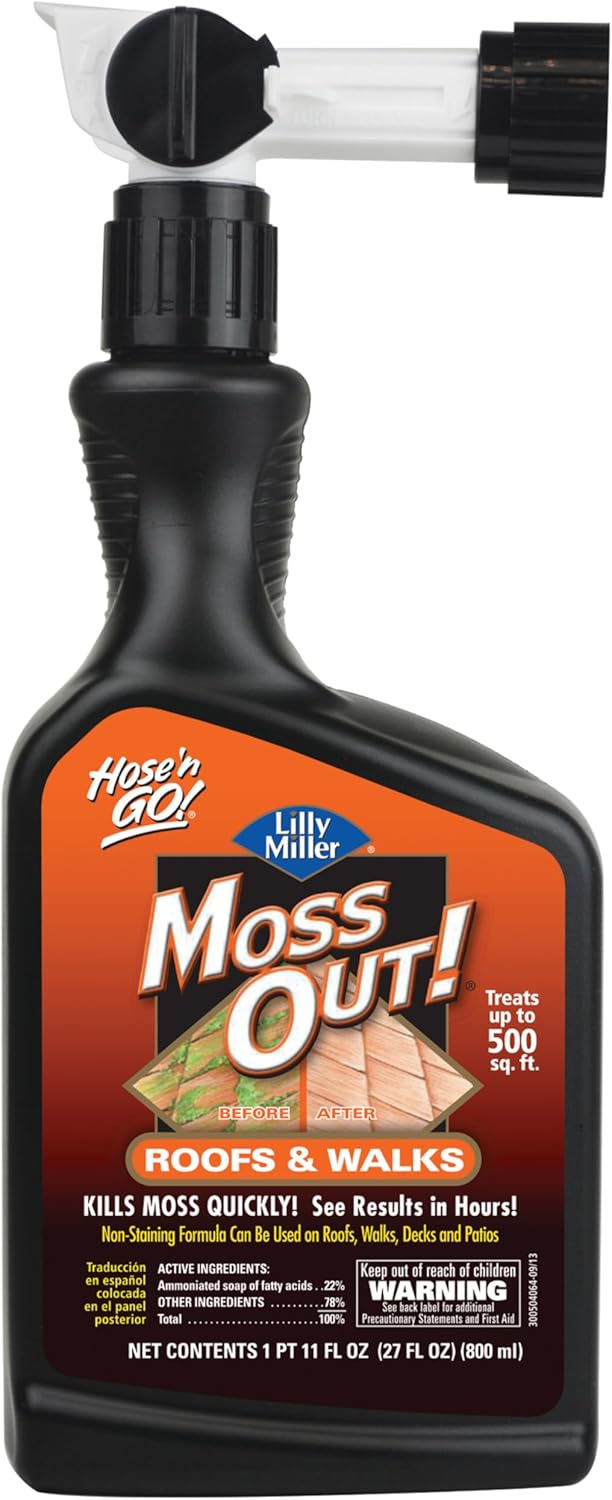
| Unit Count | 27 Ounce |
|---|---|
| Item Form | Liquid |
| Coverage | 500 square feet |
| Spray Range | up to 25 feet |
Lilly Miller Moss Out is a ready-to-use hose-end moss killer designed to kill moss on contact across hard outdoor surfaces. You attach the included nozzle to a garden hose, spray treated areas up to about 25 feet away, and see moss die back in hours with dead material that can be brushed or hosed off. The formula is non-staining for shingles and masonry, specifically made for roofs, walks, patios and unpainted cement, and one application is claimed to last up to a year. Practical benefits include quick coverage without mixing, an easy hose connection for faster application over larger paved areas, and a labeled coverage of roughly 500 sq ft per bottle. Important limitations are safety precautions and runoff concerns around plants and lawns since it can harm vegetation, and treated surfaces may be slippery until rinsed. For heavy or deeply rooted moss on very large paved areas you may need multiple bottles or repeat treatments to maintain results.
Best for: Gardeners looking for a low-effort, no-mix solution to remove moss from paved surfaces and roofs who prioritize convenience and straightforward application.
Less Ideal for: Those who need a plant-safe or eco-friendly option for use near lawns, flower beds, or sensitive landscaping should choose a more targeted or non-chemical approach.
- Ready-to-use hose-end applicator for fast, no-mixing application
- Non-staining formula safe for shingles and common hard surfaces
- Covers up to 500 square feet per bottle for quick treatments
- Visible results in hours allowing easy removal of dead moss
- Can harm surrounding plants and lawns if it contacts vegetation
- Safety hazards require protective gear and careful handling
Verdict: A convenient ready-to-spray option that quickly kills moss on paved surfaces and roofs with minimal setup, making it a practical pick for budget-aware users who want fast results.
Safer Brand Moss and Algae Killer and Surface Cleaner, 32 oz Hose Sprayer

| Unit Count | 32 Fluid Ounces |
|---|---|
| Item Form | Spray |
| Coverage | 500 square feet |
This ready-to-use moss and algae killer connects to a garden hose and sprays a potassium-salts formula meant for roofs, decks, siding, walkways, lawns and other exterior surfaces. Typical use is simple: attach the bottle to a hose, apply to affected areas, wait for the product to kill visible growth, then rinse if desired. Notable features include the hose-sprayer delivery for quick coverage, OMRI listing for organic-compliant use, and a claimed coverage of about 500 square feet per 32 oz bottle. In practice the product is convenient for spot treatments and for users who want a chemical option that fits organic guidelines. Limitations are that it is a one-shot RTU volume that may not be enough for large roofs and it can irritate skin or eyes so protective gear is needed during application. Also, because it attaches to a hose the spray pattern and pressure depend on your water supply, so achieving even coverage on steep roof sections may require care.
Best for: Homeowners looking for an affordable, easy-to-apply solution to remove moss and algae on small roof areas or for spot treatments who prefer an OMRI-listed product and minimal prep work.
Less Ideal for: Those needing to treat large roof surfaces in a single application or professional roof cleaners who require concentrated formulations and higher-volume coverage.
- Ready-to-use hose sprayer makes application quick and does not require mixing
- OMRI listed formulation suitable for organic gardening contexts
- Covers up to 500 square feet from a single 32 oz bottle
- Effective active ingredient (potassium salts of fatty acids) targets moss and algae
- 32 oz volume may be insufficient for full roof treatments on medium to large homes
- Spray pattern and pressure vary with household water supply, affecting coverage consistency
- Can cause skin or eye irritation and requires protective equipment during use
Verdict: A budget-friendly, ready-to-use hose sprayer that makes spot and small-area roof moss removal fast while remaining OMRI-listed for organic use.
Wet & Forget Outdoor Cleaner Concentrate, 64 fl oz

| Formulation | Concentrate |
|---|---|
| Dilution ratio | 1 part to 5 parts water |
| Coverage per bottle | 375 – 1,125 sq ft |
| Active ingredient | Alkyl dimethyl benzyl ammonium chloride |
Wet & Forget Outdoor Cleaner Concentrate is a pump-sprayer-ready solution for treating moss, algae, and mildew on roofs, siding, decks, and other hard, sealed surfaces without scrubbing or power washing. Mix one part concentrate with five parts water, apply to a dry, debris-free surface in mild weather, and let wind and rain gradually lift stains over weeks to months. Green growth typically fades in one to two weeks while heavier black roof stains can take several months or longer to clear. The formula is bleach-free and non-acidic, so it is gentler on shingles and painted surfaces than harsh bleach-based cleaners, but you must avoid runoff into waterways and follow the guidance to rinse plants before and after treatment. Coverage estimates (375 to 1,125 sq ft per bottle) depend on stain severity and surface porosity, and treated areas may need annual reapplication. Expect a slow, low-effort approach rather than immediate results, which is useful when you prefer a maintenance-friendly option that minimizes hands-on cleaning and roof abrasion.
Best for: Homeowners who want a low-effort, maintenance-focused solution to control moss and algae on roofs and other sealed outdoor surfaces and who are willing to wait for gradual results.
Less Ideal for: People who need fast, immediate stain removal or who prefer a single-visit, aggressive method like power washing or strong bleach treatments.
- Concentrated formula stretches to treat several hundred square feet when diluted
- No scrubbing or power washing required so it reduces roof wear
- Bleach-free and non-acidic, gentler on shingles and painted surfaces
- Works gradually with wind and rain so minimal active labor is needed
- Cleaning is slow on heavy or long-established black roof stains and can take months to fully clear
- Must avoid application near water bodies and follow plant flushing instructions to prevent environmental harm
Verdict: Choose this concentrate if you want a gentle, low-labor way to clear and control roof moss and algae over time.
Wet & Forget Outdoor Cleaner Ready-to-Use, 64 oz

| Unit Count | 64 Ounce |
|---|---|
| Item Form | Liquid |
| Coverage | 60 – 180 square feet |
| Included Components | Remote Trigger |
Wet & Forget Outdoor Cleaner is a ready-to-use spray intended for treating green and black stains from moss, mold, mildew, and algae on small outdoor surfaces. You apply it with the included trigger sprayer to a dry surface on a cool, calm day and then let weather do the work; green stains often fade in 1 to 2 weeks while heavier black stains can take several months to a year. The formula is bleach-free and non-acidic, which makes it safe for many materials such as concrete, planters, statues, headstones, and outdoor furniture when used as directed. Its practical benefits are ease of use and low physical effort since there is no scrubbing, rinsing, or pressure washing required, and a single treatment can keep surfaces cleaner for up to a year. Important limitations are the slow cleanup time on roofs and heavily stained areas and the need to avoid runoff into water bodies and to rinse plants nearby before and after application. Coverage varies widely with severity and porosity, so expect to repeat applications for large or long-established infestations.
Best for: Buyers who prioritize an easy, low-effort solution to reduce moss and algae on roof surfaces and other outdoor features and who prefer proven user-accepted products that are gentle on surfaces.
Less Ideal for: Homeowners who need an immediate or fast-acting roof treatment or who require a product with explicit roofing certification and rapid kill times.
- Ready-to-use trigger sprayer for quick, no-mixing application
- Bleach-free, non-acidic formula safe for many surfaces when used properly
- Requires no scrubbing, rinsing, or pressure washing
- Can keep treated surfaces cleaner for up to a year with periodic re-application
- Works slowly on heavy or long-established stains, sometimes taking months to fully clear
- Coverage range is broad and depends heavily on surface porosity and stain severity
- Requires careful application to avoid runoff into ponds, lakes, or plants
Verdict: Choose this bottle if you want a gentle, no-scrub outdoor cleaner that gradually removes moss and algae with simple spray-and-wait application.
30 SECONDS Outdoor Cleaner 2-Pack with Hose-End Sprayer

| Unit Count | 128 Fluid Ounces |
|---|---|
| Included Components | 64oz bottles with hose-end attachment (2 pack) |
| Item Form | Spray |
| Coverage | 600 square feet |
| Active Ingredients | Vinyl |
30 SECONDS Outdoor Cleaner is a spray concentrate sold as a two-bottle pack with a hose-end sprayer for easy application. It is designed to clean algae, mold, mildew and moss stains on hard surfaces such as asphalt driveways, concrete, brick, siding and decks. To use you mix the concentrate 1:1 with water in the refill bottle, attach the included hose-end sprayer, spray the affected area, let it sit briefly, then rinse with water—no pressure washer or heavy scrubbing required. The formula is marketed as safe for lawns and plants when used as directed, and the labeled coverage of about 600 square feet per bottle makes it practical for treating medium-sized driveways and repeat touch-ups. Limitations to note are that this is a chemical surface cleaner rather than a long-term moss prevention system and results can vary with moss thickness and weather; heavily rooted moss may need repeat treatments or mechanical removal first. Follow label directions and safety guidance to protect skin and eyes.
Best for: Buyers who want a low-effort way to remove moss and surface staining from an asphalt driveway without renting or using a pressure washer and who prefer clear label instructions and predictable application steps.
Less Ideal for: People seeking a preventative long-term moss control program or those who prefer entirely non-chemical or manual-only solutions for heavy moss infestations.
- Includes hose-end sprayer for quick, one-person application from a garden hose
- Ready-to-use concentrate that covers about 600 sq ft per bottle for efficient treatment
- Formulated to remove moss, algae, mold and mildew from many outdoor hard surfaces
- Label guidance states it is safe for lawns and plants when used as directed
- Not a one-time fix for deeply rooted moss; dense infestations may require repeat treatments or physical removal
- Contains active chemicals so protective gear and careful handling are required
Verdict: A convenient, hose-applied cleaner that removes moss stains on driveways quickly for homeowners who want an easy, low-effort fix.
Choosing the Right Moss Killer for Roof Tiles: Key Factors to Consider
Kill Speed and Visible Results
How quickly a treatment browns and collapses moss matters for scheduling and follow-up work. Fast-acting formulas let you see results within days, which is useful if you plan to rinse, brush, or perform minor repairs soon after treatment. Slower-acting products may take longer to show effects but sometimes rely on systemic action that reduces regrowth.
Consider the time window when you can safely leave the product on the tiles without heavy rain or foot traffic. Faster products reduce the waiting period but may require stricter runoff precautions during the active phase.
Residual Protection and Regrowth Delay
A single kill followed by rapid reestablishment is frustrating and wastes effort. Residual protection describes how long the treatment continues to inhibit new moss spores after the initial kill. Some formulations include agents that remain active on the surface to slow re-colonization for months, while others simply kill existing growth and need repeated applications.
When evaluating residual performance, think about local climate and shade. Shady, humid roofs with nearby trees benefit most from longer-lasting treatments because spore pressure is higher and moisture returns quickly after rainfall.
Compatibility With Tile Materials
Roof tiles can be made of clay, concrete, slate, or composite materials, each with different porosity and surface chemistry. An aggressive chemical can discolor, etch, or otherwise damage delicate materials, while an unsuitable formulation may be ineffective on dense, glazed surfaces.
Read product guidance about tile types and test treatments in a small, inconspicuous area if unsure. Compatibility also covers any effect on roof coatings or sealants; choose a product that will not strip protective finishes if that is a concern for your roof.
Application Method and Safety From a Roof
Applying treatments on a ladder or low-pitch roof requires products that can be sprayed or painted safely and that do not make surfaces dangerously slippery. Pump-spray, hose-end, or concentrated solutions that mix with water all present different handling profiles.
Consider ergonomic factors: weight of containers, need for a ladder stabilizer, and whether you can do the work yourself. Safety also includes instructions about avoiding contact with skin, eyes, and breathing in sprays, plus protocols for windy conditions to prevent drift to plants or neighbors.
Runoff and Environmental Considerations
Roof treatments will wash off into gutters, soil, and nearby planting beds. Runoff risk affects nearby vegetation, fish-bearing streams, and storm drains. Some formulations biodegrade quickly and have lower plant toxicity, while others require careful containment and rinsing.
Plan for dry weather after application when possible, divert runoff from sensitive areas, and consider physical barriers or temporary covers for vulnerable plants. Look for products with clear runoff guidance and lower environmental persistence if you have gardens or water features downslope from the roof.
Stain Potential and Aesthetic Outcomes
Some moss-killing treatments can leave dark staining or lightened patches on tiles as the organic material decays or as the chemical reacts with the surface. For visible roofs this affects curb appeal and may require post-treatment cleaning or gentle brushing.
If the visual outcome matters, prioritize products that advertise low staining or provide clear cleaning steps after moss dies. Test in a small area and allow enough time for decay before attempting any cleaning to avoid spreading loosened material.
Preparation Before Treatment
Prep work reduces the chance of damage and makes treatments more effective. Clear gutters and remove loose debris so water can drain freely and the product can reach moss-covered tiles evenly. Trim back overhanging branches where possible to reduce shade and future moss pressure.
Inspect the roof for loose or cracked tiles and note any delicate areas before applying chemicals. Protect nearby plants and covers with plastic sheeting or water barriers, and plan to apply on a calm, dry day to limit drift and immediate runoff.
- Clear loose moss and debris by hand or with a soft brush before treatment when safe to do so
- Cover or water nearby shrubs to dilute potential runoff exposure
- Wear protective gear and secure ladders; consider a spotter for safety
Application Techniques for Roof Use
Choose an application method that matches the product label and your roof access. Hose-end sprayers are convenient for larger roofs but may overspray; pump sprayers give better control but involve more handling. Concentrates require accurate mixing to avoid under- or over-dosing.
Work from the top of the roof down so runoff carries the product away from treated areas. Avoid applying before forecasted heavy rain; many formulas need several hours to bind to the moss and begin working. Follow label dwell times before rinsing or brushing.
- Test a small area and note how quickly discoloration appears
- Apply evenly in overlapping passes to avoid streaks
- Rinse only when the label permits and when runoff can be contained
Mechanical Removal Versus Chemical Treatment
Mechanical removal, such as gentle brushing or scraping, is useful for heavy mats of moss but can damage tiles if done aggressively. Chemical treatments soften and kill moss, often making mechanical removal easier after the product has taken effect. Combining both approaches is common: kill first, then remove dead material cautiously.
If you plan to remove loosened moss, wait until the dead material is dry and crumbly. Use soft-bristled brushes and avoid pressure washing on most tile types because high pressure can lift or crack tiles and force water under them.
- Use gentle tools and avoid metal scrapers on delicate tile surfaces
- Plan removal for calm, dry days to limit mess and runoff
- Reserve high-pressure cleaning for durable, manufacturer-approved tiles only
Preventing Recurrence
After treatment and any cleaning, take steps to reduce the conditions that encourage moss. Improve sunlight exposure by trimming branches, increase airflow with pruning, and keep gutters clean to reduce persistent moisture. Periodic inspection and targeted touch-ups are more effective than repeated full-roof applications.
Consider installing zinc or copper strips at the ridge where appropriate; metal ions released in rain can slow moss growth. These are a preventative measure and should be used in line with local building practices and material compatibility.
- Schedule annual roof checks in spring and autumn
- Clear gutters after leaf season to reduce persistent damp spots
- Address localized shading or water pooling that promotes moss
Protecting Plants and Water Features
Plan for containment because runoff from roof treatments can affect gardens and water features. Use temporary barriers, divert downspouts, or drape vulnerable beds with plastic during and shortly after application. Water features and ponds are particularly sensitive; avoid any runoff into these areas.
If accidental runoff reaches plants, rinse foliage thoroughly with clean water when safe to do so according to the product instructions. For large or persistent exposures, consult local extension guidance for remediation options.
- Divert downspout flow during application
- Create shallow catchment with sandbags or temporary channels
- Have clean water on hand to flush accidental contact
How We Chose the Best Moss Killer for Roof Tiles
We focused on treatments that are explicitly formulated for use on roof tiles and that balance quick moss control with safe, long-term roofing care. Selection criteria emphasized kill speed, residual protection against regrowth, compatibility with common tile materials, and ease and safety of application from a roof or ladder. We also considered weather stability-how well a product holds up through rain and sun in the days after application-and runoff management to reduce risk to plants and drains. Excluded products included general-purpose garden sprays not rated for overhead or roofing use, mechanical methods alone without a chemical or biological treatment, and options that required professional-only application. Final picks reflect products that meet practical homeowner needs: they can be applied from a ladder or low-pitch roof, are formulated to minimize tile staining or pitting, and provide measurable residual effect against regrowth. These filters align with the scoring metrics used in the product cards below.
FAQ
How soon after application will moss start to die?
It often depends on the formulation. Many fast-acting treatments show visible browning within 24 to 72 hours, while slower-acting or systemic products may take a week or more. Local temperature and moisture influence the response time.
Can I pressure wash roof tiles after using a moss killer?
Pressure washing can remove dead moss but may damage certain tile types or force water under tiles. Wait until the product has finished working and the moss is dry, then use gentle brushing or low-pressure rinsing unless the tile manufacturer approves high-pressure cleaning.
Will a moss killer harm my nearby plants or lawn?
Some formulations can harm plants if runoff reaches them. Choose products with lower plant toxicity when protecting gardens, follow label containment advice, and rinse any accidentally exposed foliage with clean water when safe to do so.
How often should treatments be repeated to prevent regrowth?
Frequency depends on residual protection and site conditions. In shady, damp environments you may need touch-ups every 6 to 12 months, while sunnier, drier roofs often go longer between treatments. Inspect periodically and treat small re-colonized patches early.
Are there environmentally friendly moss control options for roofs?
Yes. Some biological or less persistent chemical options reduce environmental persistence and plant toxicity. Their effectiveness and longevity vary, so weigh the tradeoff between environmental impact and the need for longer residual control.
Final Verdict
Choose a moss-killing approach that matches your roof material, access, and local conditions. Prioritize treatments that balance quick visible control with enough residual protection to limit repeat work, while ensuring the formula is safe for your tile type and nearby plants. Prepare the roof and surrounding area before application, follow label safety and runoff guidance, and plan follow-up inspections and minor maintenance to keep moss from returning.
