

Note: This article contains affiliate links. If you click on these links and make a purchase, I may earn a small commission at no extra cost to you. This helps support my research and content. Read my full affiliate disclosure here.
Moss on paths makes surfaces slippery and can break down paving materials over time. Picking the right moss killer for paths matters because some treatments act fast but offer only temporary control, while others leave a residual barrier that slows reestablishment. This guide covers the top short‑list options gardeners commonly use on walkways, patios, and gravel runs and explains practical differences that affect application, safety, and longevity. Below you will find the five top picks for treating moss on paths, plus the evaluation criteria we used and clear guidance to help you choose the best approach for your situation.
Top Picks at a Glance
| Best Overall The best all-around choice for most situations | Resolva Path & Drive Weedkiller RTU 3L |  |
| Best Quality Built to a higher standard if you want something more solid | Scotts MossEx 3-in-1 Ready-Spray, 32 fl. oz. |  |
| Best Budget The cheapest option that still gets the job done reliably | Safer Brand Moss and Algae Killer and Surface Cleaner, 32 oz Hose Sprayer |  |
| Highest Rated A top-rated pick with lots of positive feedback | Lilly Miller Moss Out Concentrate for Roofs and Walks, 54 fl oz |  |
| Most Popular A crowd favorite that many people choose with confidence | Wet & Forget Outdoor Cleaner Ready-to-Use, 64 oz |  |
Resolva Path & Drive Weedkiller RTU 3L

| Unit Count | 101.44 Fluid Ounces |
|---|---|
| Item Form | Liquid |
| Coverage | Broad-spectrum coverage |
| Active Ingredients | Pelargonic acid |
Resolva Path & Drive is a ready-to-use liquid herbicide formulated to clear weeds, moss and algae from paths, drives, patios and gravel. It contains pelargonic acid and claims visible effects within hours, making it useful for quick spot treatments where vegetation is unwanted. The bottle is designed for spray application; good coverage of leaves and stems is required and the directions recommend up to 100 ml per m2 with repeat treatments at 2–4 week intervals if regrowth occurs. Practical benefits include broad-spectrum activity on hard surfaces, immediate re-entry once the spray has dried, and use year-round outside stipulated winter blackout dates. Important limitations are that it is a contact, non-systemic product so persistent root regrowth can happen and repeat applications may be necessary, and it must be applied carefully to avoid contaminating water or desirable plants. Users should follow safety instructions closely and avoid treating in windy conditions to prevent drift.
Best for: Gardeners who need a straightforward, ready-to-use solution to clear moss and surface weeds from paths and drives and value fast visible results without mixing chemicals.
Less Ideal for: Those seeking a long-term systemic soil treatment for deep-rooted weeds or users who need to treat areas directly adjacent to ponds or watercourses without buffer measures.
- Fast visible action on moss and surface weeds within hours
- Ready-to-use liquid requires no mixing or dilution
- Broad-spectrum effect that also reduces algae on hard surfaces
- Can be applied year-round outside specified restricted dates
- Contact action only so roots may survive and repeat treatments are often needed
- Requires careful application to avoid runoff or contamination of water bodies
Verdict: A simple, ready-to-use spray that gives fast surface control of moss and weeds on paths and drives when you need quick, visible results.
Scotts MossEx 3-in-1 Ready-Spray, 32 fl. oz.

| Unit Count | 32 Fluid Ounces |
|---|---|
| Coverage | 500 square feet |
| Item Form | Spray |
| Active Ingredients | Potassium Salts with Fatty acids |
Scotts MossEx 3-in-1 Ready-Spray is a hose-connected liquid moss killer designed for fast, broad-area treatment of lawns, roofs, patios, sidewalks, and other outdoor surfaces. You apply it by attaching the bottle to a garden hose and spraying while keeping the nozzle moving for even coverage. The active ingredients are potassium salts with fatty acids, and the formula is fast-acting with visible effect in hours and is labeled non-staining on concrete and similar surfaces. Its ready-to-use hose applicator makes large or awkward areas simple to treat without mixing, and one 32 fl. oz. bottle covers roughly 500 square feet, which suits spot treatments and small to medium patches. Limitations to note are application temperature recommendations and safety: do not use on lawns above 85°F and wear eye protection and gloves because it can irritate skin and eyes. Also, it will control moss and related organisms but does not replace cultural fixes such as improving drainage or shade management for long-term moss prevention.
Best for: Homeowners who want a straightforward, performance-focused kill of moss and surface algae without mixing chemicals and who need a product that treats medium-sized areas quickly.
Less Ideal for: Gardeners seeking a long-term cultural solution to moss caused by shade or drainage problems or those who prefer organic, non-chemical approaches.
- Hose-end ready formula for quick, no-mix application
- Fast-acting results with visible control within hours
- Non-staining formulation safe for concrete and many hard surfaces
- Covers up to about 500 sq. ft. from a single 32 fl. oz. bottle
- Contains irritants that require protective eyewear and gloves during application
- Not intended as a long-term solution for underlying lawn issues like poor drainage
Verdict: If you want a fast, no-mix hose-end treatment that quickly knocks back moss and algae on lawns and hard surfaces, this ready-spray delivers reliable, visible results.
Safer Brand Moss and Algae Killer and Surface Cleaner, 32 oz Hose Sprayer

| Unit Count | 32 Fluid Ounces |
|---|---|
| Item Form | Spray |
| Coverage | 500 square feet |
This ready-to-use moss and algae killer connects to a garden hose and sprays a potassium-salts formula meant for roofs, decks, siding, walkways, lawns and other exterior surfaces. Typical use is simple: attach the bottle to a hose, apply to affected areas, wait for the product to kill visible growth, then rinse if desired. Notable features include the hose-sprayer delivery for quick coverage, OMRI listing for organic-compliant use, and a claimed coverage of about 500 square feet per 32 oz bottle. In practice the product is convenient for spot treatments and for users who want a chemical option that fits organic guidelines. Limitations are that it is a one-shot RTU volume that may not be enough for large roofs and it can irritate skin or eyes so protective gear is needed during application. Also, because it attaches to a hose the spray pattern and pressure depend on your water supply, so achieving even coverage on steep roof sections may require care.
Best for: Homeowners looking for an affordable, easy-to-apply solution to remove moss and algae on small roof areas or for spot treatments who prefer an OMRI-listed product and minimal prep work.
Less Ideal for: Those needing to treat large roof surfaces in a single application or professional roof cleaners who require concentrated formulations and higher-volume coverage.
- Ready-to-use hose sprayer makes application quick and does not require mixing
- OMRI listed formulation suitable for organic gardening contexts
- Covers up to 500 square feet from a single 32 oz bottle
- Effective active ingredient (potassium salts of fatty acids) targets moss and algae
- 32 oz volume may be insufficient for full roof treatments on medium to large homes
- Spray pattern and pressure vary with household water supply, affecting coverage consistency
- Can cause skin or eye irritation and requires protective equipment during use
Verdict: A budget-friendly, ready-to-use hose sprayer that makes spot and small-area roof moss removal fast while remaining OMRI-listed for organic use.
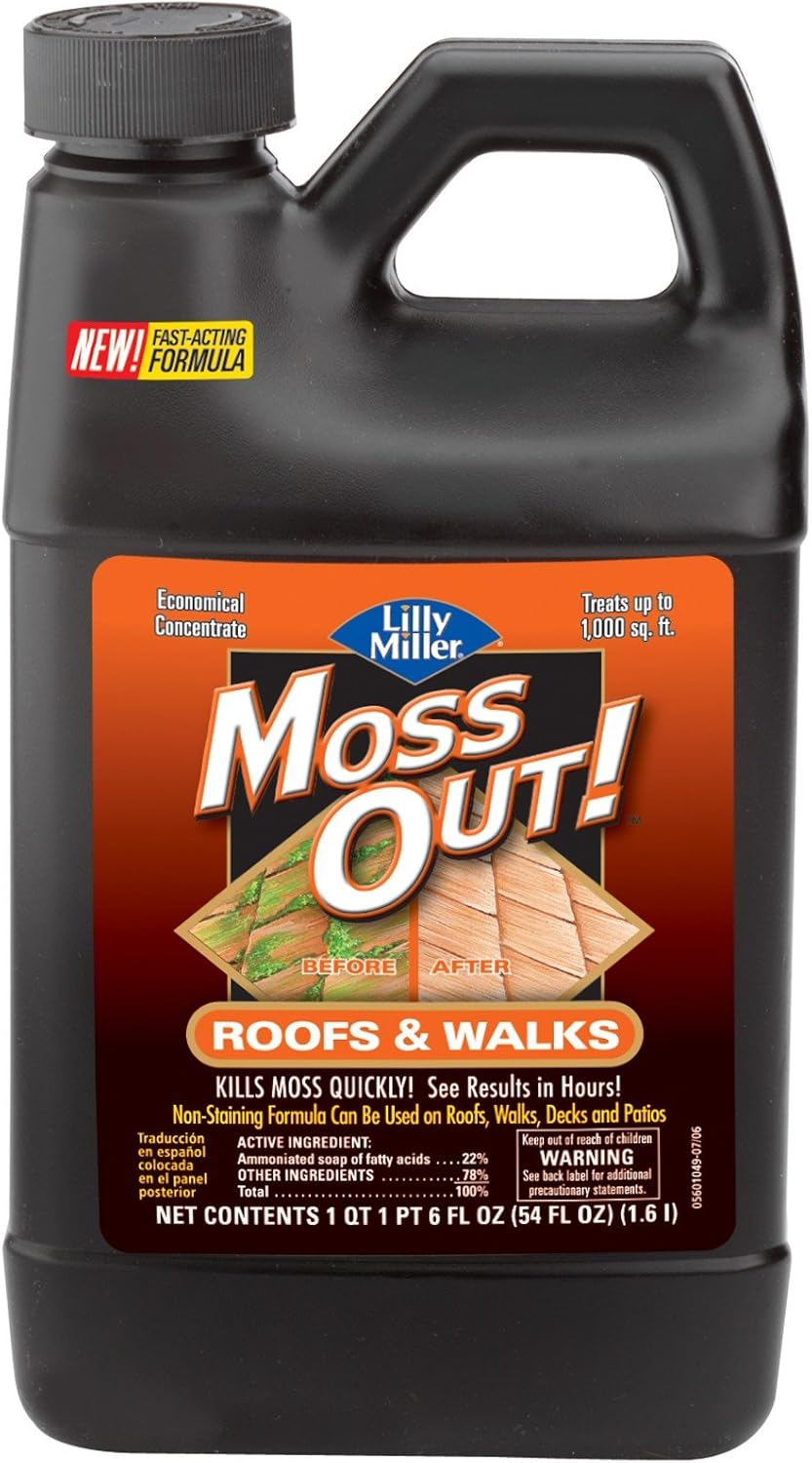
Lilly Miller Moss Out Concentrate for Roofs and Walks, 54 fl oz
| Unit Count | 54 Fluid Ounces |
|---|---|
| Coverage | 1000 square feet |
| Item Form | Liquid |
| Active Ingredients | Ammonium soaps of fatty acids |
Lilly Miller Moss Out is a concentrated liquid treatment designed to kill moss on roofs, sidewalks, decks and patios and to leave surfaces largely stain-free. You dilute the concentrate per directions, apply it to the affected area and allow it to work before rinsing residual material. The formula uses ammonium soaps of fatty acids, which the manufacturer markets as nonstaining on common surfaces such as concrete, wood and shingles, and one 54 fl oz jug covers roughly 1,000 square feet when mixed. Practical benefits include avoiding aggressive cleaning methods like pressure washing and an application that can protect surfaces for months. Important limitations are that it must be diluted correctly and handled with basic safety precautions around children and pets, and heavy or long-established moss may require repeat treatments or some mechanical removal first. For straightforward moss on hardscape or roofing, it provides a conservative, surface-safe option for maintenance-focused gardeners.
Best for: Homeowners and maintenance-minded gardeners who want a surface-safe, preventive moss treatment for paths, patios and roofs and prefer a product that reduces the need for aggressive cleaning.
Less Ideal for: People needing an instant one-and-done solution for very deep or thick moss infestations or those unwilling to follow dilution and safety instructions.
- Concentrated formula covers up to 1,000 square feet when diluted
- Nonstaining on concrete, wood and shingles when used as directed
- Designed to extend the life of roofs and outdoor surfaces by removing moss
- Liquid concentrate is easy to mix and apply with standard garden sprayers
- Requires correct dilution and safety handling to avoid eye or skin contact
- May need repeat applications or mechanical removal for heavy, established moss
Verdict: A reliable, surface-safe concentrate for routine moss removal and prevention on paths and other outdoor hard surfaces.
Wet & Forget Outdoor Cleaner Ready-to-Use, 64 oz

| Unit Count | 64 Ounce |
|---|---|
| Item Form | Liquid |
| Coverage | 60 – 180 square feet |
| Included Components | Remote Trigger |
Wet & Forget Outdoor Cleaner is a ready-to-use spray intended for treating green and black stains from moss, mold, mildew, and algae on small outdoor surfaces. You apply it with the included trigger sprayer to a dry surface on a cool, calm day and then let weather do the work; green stains often fade in 1 to 2 weeks while heavier black stains can take several months to a year. The formula is bleach-free and non-acidic, which makes it safe for many materials such as concrete, planters, statues, headstones, and outdoor furniture when used as directed. Its practical benefits are ease of use and low physical effort since there is no scrubbing, rinsing, or pressure washing required, and a single treatment can keep surfaces cleaner for up to a year. Important limitations are the slow cleanup time on roofs and heavily stained areas and the need to avoid runoff into water bodies and to rinse plants nearby before and after application. Coverage varies widely with severity and porosity, so expect to repeat applications for large or long-established infestations.
Best for: Buyers who prioritize an easy, low-effort solution to reduce moss and algae on roof surfaces and other outdoor features and who prefer proven user-accepted products that are gentle on surfaces.
Less Ideal for: Homeowners who need an immediate or fast-acting roof treatment or who require a product with explicit roofing certification and rapid kill times.
- Ready-to-use trigger sprayer for quick, no-mixing application
- Bleach-free, non-acidic formula safe for many surfaces when used properly
- Requires no scrubbing, rinsing, or pressure washing
- Can keep treated surfaces cleaner for up to a year with periodic re-application
- Works slowly on heavy or long-established stains, sometimes taking months to fully clear
- Coverage range is broad and depends heavily on surface porosity and stain severity
- Requires careful application to avoid runoff into ponds, lakes, or plants
Verdict: Choose this bottle if you want a gentle, no-scrub outdoor cleaner that gradually removes moss and algae with simple spray-and-wait application.
Choosing the Right Moss Killer for Paths: Key Factors to Consider
Contact Speed and Visible Control
How quickly a product causes moss to brown and detach matters when you need paths safe from slipperiness. Fast-acting contact treatments can show browning within hours, which is useful for high-traffic areas where you need immediate results.
However, rapid visual control does not guarantee long-term suppression. Some chemistries act quickly but leave spores or rhizoids viable, meaning moss can rebound. Consider whether you want immediate cosmetic improvement, rapid hazard reduction, or both when weighing contact speed.
Residual Protection and Re-treatment Interval
Residual protection is the period after application during which moss struggles to reestablish on the treated surface. Longer residual activity reduces how often you need to re-treat paths, which matters for maintenance time and cost.
Look for information on how long a product maintains activity under UV exposure and rain. On exposed paths, expect shorter protection intervals than in shaded, sheltered areas. Also consider whether a product requires follow-up mechanical removal of dead growth to allow the residual barrier to work more effectively.
Surface Compatibility and Staining Risk
Paths are made from a range of materials-concrete, flagstone, clay pavers, gravel, and natural stone-and not all moss treatments are safe for every substrate. Some formulations can bleach or etch porous stone or discolor softer pavers.
Before treating an entire path, test a small, inconspicuous area and read label guidance on contact time and rinsing. Choosing a surface-compatible option prevents costly damage and preserves the look of hard landscaping.
Application Method and Coverage Accuracy
How a product is delivered affects practicality. Ready-to-use sprays offer convenience but may be more expensive per area. Concentrates require mixing but often give better value for larger paths. Hose-end applicators and pump sprayers can speed coverage but vary in mixing accuracy.
Consider the width and length of your paths, whether you need to treat tight joints or uneven surfaces, and whether you prefer minimal setup. Coverage accuracy also affects how evenly the moss is controlled and how much runoff you generate.
Environmental Precautions and Nearby Plants
Runoff from moss treatments can affect adjacent plants, lawns, and aquatic features. Products differ in toxicity to non-target plants, aquatic invertebrates, and pets. Pay attention to buffer zone recommendations and rinsing instructions.
For paths near garden beds or water, choose treatments with lower runoff risk or plan temporary protective measures like wetting and covering nearby soil. Responsible use reduces unintended harm while keeping walkways clear.
Post-treatment Cleanup and Mechanical Removal
Killing moss is often only part of the job. Dead moss can form a compacted mat or leave residue in joints that traps moisture and encourages regrowth. Mechanical removal-sweeping, power-washing, or scraping-after treatment improves long-term results.
Think about whether you can follow up with physical cleanup: some treatments loosen moss for easy brushing, while others require waiting longer before removal. Plan a post-treatment routine to restore path texture and reduce future re-colonization.
When to Treat Paths for Moss
Timing treatment for moss depends on weather and path use. Treat during a dry window so the product can work without immediate heavy rain washing it away, but avoid the hottest midday sun which can increase evaporation and reduce contact time. Early spring and early autumn are often good windows when moss is actively growing but rain is not constant.
Also consider foot traffic. Apply treatments during a low-use period, and keep people and pets off the path until the product has had time to act and any dead moss has been cleared.
- Choose a dry period with temperatures above the minimum listed on the product label.
- Avoid application right before heavy rain or irrigation.
- Schedule follow-up cleaning for when dead moss is easiest to remove.
Safe Preparation and Spot Testing
Before full-scale application, prepare the area by removing loose debris and sweeping the path. This helps the treatment contact live moss rather than dirt or leaf litter. Do a spot test on an inconspicuous section to confirm there is no staining or surface damage.
Wear basic protective gear such as gloves and eye protection, and keep pets and children away from treated areas until the product is dry and any recommended re-entry times have passed.
- Clear leaves and loose organic matter first.
- Test a small area for staining or surface reaction.
- Follow label instructions for personal protective equipment.
Mechanical Options to Pair with Chemical Treatments
Mechanical control makes chemical treatments more effective. Brushing, scraping between joints, or using a stiff broom removes bulk moss and exposes remaining live tissue to the product. For stubborn patches, follow chemical application with power-washing at a moderate pressure to avoid damage to mortar or soft stone.
Pairing methods reduces the amount of chemistry needed and improves long-term control by removing spores and organic matter that would otherwise shelter regrowth.
- Brush or scrape after treatment when moss is brittle.
- Use moderate pressure when power-washing to protect joints.
- Dispose of removed moss away from beds and watercourses.
Managing Runoff and Protecting Nearby Plants
Plan treatments so runoff does not reach garden beds, lawns, or storm drains. Use low-volume application methods and avoid treating immediately upslope of sensitive plantings. If runoff is unavoidable, consider temporary barriers or absorbent materials to capture excess solution.
Read label recommendations for buffer distances and rinsing. In many cases, a quick rinse of adjacent foliage will limit exposure and reduce risk to non-target plants.
- Avoid applying on steep slopes above planted areas.
- Use containment or absorbent barriers if necessary.
- Rinse non-target foliage promptly when required by the label.
Seasonal Maintenance to Prevent Reinfestation
After initial treatment and cleanup, simple seasonal maintenance reduces the chance of moss returning. Improve drainage along paths, trim overhanging vegetation to increase light and airflow, and clear organic debris regularly. Addressing the environmental conditions that favor moss is often more effective than repeated chemical treatments alone.
A short maintenance routine in spring and autumn keeps joints free of compacted organic matter and preserves the effectiveness of any residual protection from prior applications.
- Trim shade-casting plants to increase sunlight on paths.
- Keep gutters and adjacent beds tidy to prevent leaf buildup.
- Check and repair uneven areas where water pools.
How We Chose the Best Moss Killer for Paths
We shortlisted products based on attributes that directly affect how well a treatment performs on walkways and similar surfaces. Key evaluation criteria included contact efficacy, which measures how quickly visible moss browns and dies after application; residual protection, which assesses how long treated areas resist reinfestation; surface compatibility, ensuring the formula can be used safely on concrete, stone, brick, and gravel without staining or etching; and application practicality, which covers ease of mixing, delivery options, and the ability to treat narrow or uneven paths. We also considered environmental profile and runoff risk, favoring options with clear usage instructions and minimizing harm to adjacent plantings, pets, and local water features. We excluded products intended only for lawn broadcast or indoor use and any treatments lacking clear instructions for hard-surface path applications. The resulting picks are treatments that balance speed of control, lasting effect, and real-world application needs for maintaining safe, moss-free walkways.
FAQ
Can I use a moss killer for paths on all types of paving?
It depends. Many treatments are safe on concrete, brick, and dense stone, but porous or soft natural stone and some clay pavers can stain or etch. Always test a small area and follow label guidance for surface compatibility.
How soon can I walk on a path after treatment?
Re-entry times vary by product, but many require only that the treatment dries and visible residue is no longer wet. Check the instructions for specific re-entry guidance and keep children and pets off the area until it is safe.
Will killing moss damage the path surface?
Most modern moss treatments are formulated not to damage hard surfaces when used as directed, but extended contact or overdosing can cause staining or mild etching on sensitive materials. Spot testing and following application rates reduces this risk.
Is mechanical removal necessary after using a moss killer?
Mechanical removal is recommended for best results. Dead moss can remain in joints and trap moisture, so sweeping, scraping, or power-washing after the moss has died helps restore surface texture and delays regrowth.
How often will I need to reapply a moss treatment on paths?
Reapplication frequency depends on the product's residual protection and site conditions like shade and moisture. In favorable exposure and drainage, treatments might last many months; in shaded, wet sites you may need to re-treat annually or seasonally.
Are there less toxic options for treating moss on paths?
Yes. Some products rely on biodegradable or less persistent active ingredients and are labeled for minimal environmental impact, but they may act more slowly or need more frequent reapplication. Consider site sensitivity and follow all safety instructions.
Final Verdict
For keeping walkways safe and attractive, prioritize treatments that balance quick contact control with meaningful residual protection while matching the material of your path. Combine careful application with spot testing, runoff management, and a plan for mechanical cleanup to maximize effectiveness. In practice, the best choice depends on how quickly you need results, how often you want to re-treat, and the surrounding landscape conditions.
