

Note: This article contains affiliate links. If you click on these links and make a purchase, I may earn a small commission at no extra cost to you. This helps support my research and content. Read my full affiliate disclosure here.
Picking the right mulch can change how often you deal with insect pests in garden beds, borders, or around trees. The right material reduces attractive habitat for problem bugs, keeps soil conditions steady, and supports beneficial predators that help control pests naturally. This guide shortlists top mulch options for keeping bugs away and explains how each choice affects pest pressure, moisture, and soil life. We evaluated each mulch against practical gardener needs like pest resistance and durability to help you choose a product that fits your site and maintenance style. Read on for clear criteria and guidance to match mulch to the insects you want to deter.
Top Picks at a Glance
| Best Overall The best all-around choice for most situations | Cedarcide Insect-Repelling Cedar Granules (8 lb, 4-pack option) |  |
| Best Quality Built to a higher standard if you want something more solid | GranuCide Cedar Granules (8 lb) |  |
| Best Value The sweet spot between price and what you get | Wood Smith USA 100% Natural Cedar Shavings Mulch (8 Quart) |  |
| Best Budget The cheapest option that still gets the job done reliably | Wood Smith USA 100% Natural Cedar Chips, 4 Quart Bag |  |
| Highest Rated A top-rated pick with lots of positive feedback | Capital Forest Products Cedar Mulch 3.0 Cu Ft |  |
| Most Popular A crowd favorite that many people choose with confidence | Cedarcide Original Cedar Granules (8 lb) |  |
| Best Seller A high-volume bestseller chosen again and again | Cedarcide Cedar Granules Insect Repellent, 2 Bags (16 lbs) |  |
Cedarcide Insect-Repelling Cedar Granules (8 lb, 4-pack option)

| Manufacturer | Cedarcide |
|---|---|
| Material | 100% natural cedar shavings |
| Recommended reapply interval | Every 4–6 weeks |
| Effective against | Mosquitoes, fleas, ants, mites, chiggers |
Cedarcide cedar granules are a simple, chemical-free option for reducing insects around outdoor spaces by releasing the natural aroma of cedarwood. You use them by sprinkling granules around foundations, along fences, in flower beds, in potted plants, or across lawns; the product description recommends reapplying every 4 to 6 weeks or after heavy rain. Notable features are the 100 percent natural cedar composition, family and pet-safe formulation, and documented third-party testing for pests such as fleas, ants, mosquitoes, mites, and chiggers. Practical benefits include an easy, low-effort barrier for perimeter treatment and the ability to use the granules indoors in sachets for closets or houseplants. Limitations are that effectiveness depends on placement and weather so results are not instantaneous or absolute, and regular reapplication is needed to maintain protection; this is a preventative supplemental measure rather than a one-time fix for heavy infestations.
Best for: Gardeners who want a low-maintenance, natural perimeter repellent and prioritize family and pet safety for routine outdoor pest control.
Less Ideal for: If you need immediate elimination of an active infestation or a long-lasting, chemical treatment, choose a targeted insect control product or professional service instead.
- 100% natural cedar granules provide a nonchemical repellent option
- Safe for families and pets when used as directed
- Versatile application: use outdoors around foundations, beds, lawns and indoors in sachets
- Simple to apply and suitable for regular perimeter maintenance
- Third-party testing reported for common pests including fleas, ants and mosquitoes
- Requires reapplication every 4–6 weeks and after heavy rain to remain effective
- Not a standalone solution for severe infestations or active nests
Verdict: A safe, low-effort natural barrier for routine insect control around lawns and garden edges.
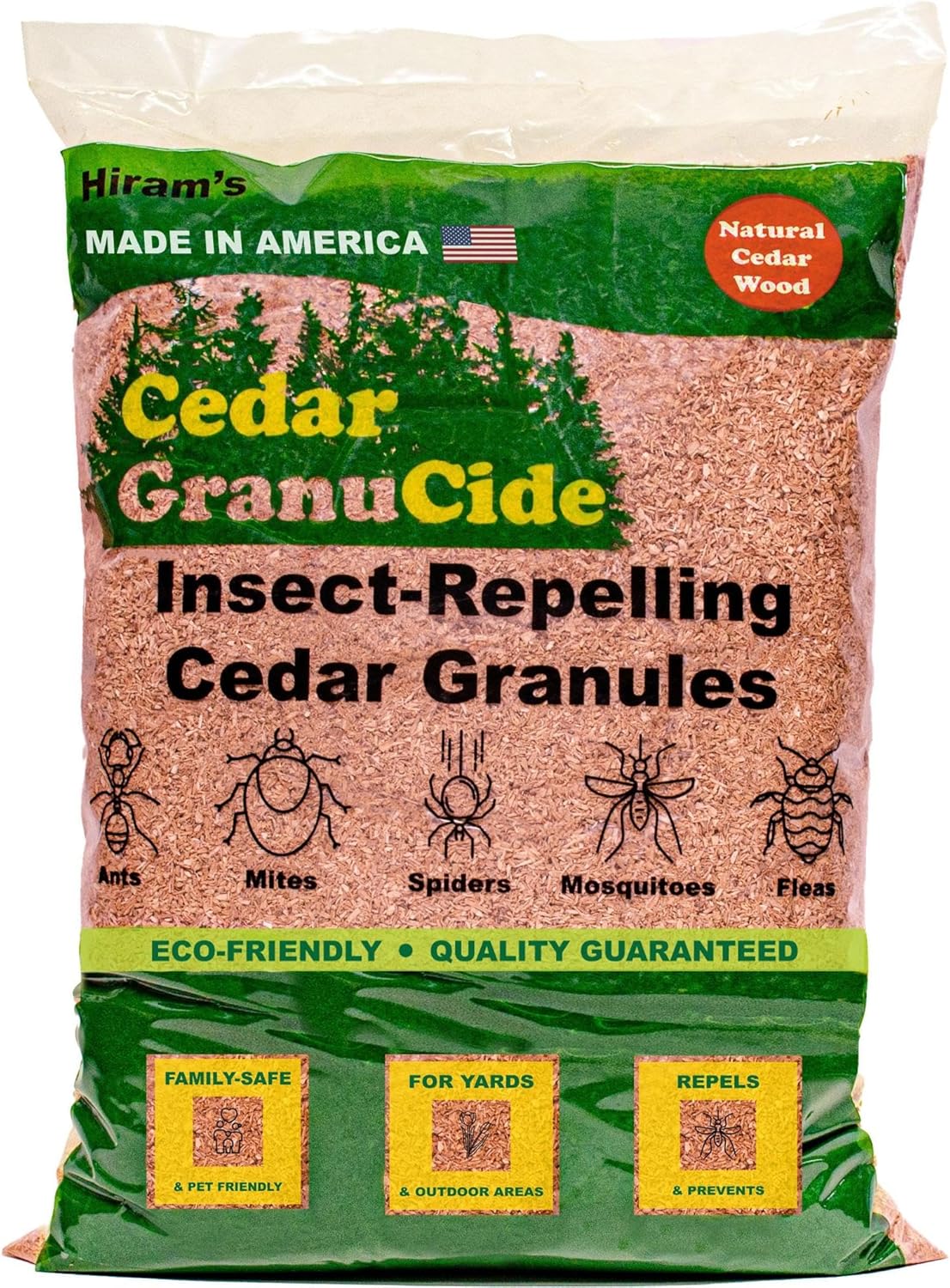
GranuCide Cedar Granules (8 lb)
| Ingredients | 100% cedar granules |
|---|---|
| Directions | Sprinkle in indoor and outdoor areas such as potted plants, gardens, lawns, patios, and perimeters |
| Made in | America |
| Weight | 8 pounds |
GranuCide Cedar Granules are coarse cedar chip shavings sold as an easy-to-use, chemical-free option for deterring insects around yards, patios, and potted plants. You apply them by sprinkling a thin layer around garden beds, along foundations, in planters, or inside sheds where pests congregate. The product is made from untreated Pacific Northwest cedar and emits a natural aroma that repels mosquitoes, ants, spiders, fleas, chiggers and other common garden pests without pesticides. As a mulch the granules also serve decorative and moisture-conserving purposes while being safe for children and pets. Limitations to expect are that the scent fades with time and rain so reapplication is necessary after heavy watering or storms, and a single 8 lb bag covers a modest area compared with larger bulk mulches. For someone focused on nonchemical, maintenance-light pest reduction, the granules offer a low-risk, dual-purpose solution that is straightforward to use and fits small to medium areas where targeted insect control is desired.
Best for: Gardeners who prioritize effective, low-toxicity pest control and want a simple mulch-based solution for small to medium beds and container plantings.
Less Ideal for: Homeowners who need wide-area or long-lasting insect control without reapplication or those who prefer a fully maintenance-free approach.
- 100% natural untreated cedar provides a nonchemical insect deterrent
- Pleasant aroma that repels a broad list of common garden pests
- Safe for use around children and pets when applied as directed
- Also functions as a decorative mulch that helps retain soil moisture
- Scent and repellent effect diminish over time and after heavy watering requiring periodic reapplication
- 8 lb bag is relatively small so multiple bags are needed for larger beds
Verdict: Choose these cedar granules when you want a pet-safe, chemical-free mulch that reduces common garden pests while also improving soil cover.
Wood Smith USA 100% Natural Cedar Shavings Mulch (8 Quart)

| Brand Name | Wood Smith USA |
|---|---|
| Item Type Name | Cedar Mulch |
| Volume | 8 quarts |
| Unit Count | 297.84 Ounce |
This 8-quart bag of 100% natural cedar shavings is a lightweight, versatile mulch useful for potted plants, hanging baskets and small garden beds. In practice it is most often used as a top layer to help the soil retain moisture and to reduce surface evaporation around plants like dahlias. The shavings also provide a mild cedar scent that can mask odors in animal bedding or planters and can be repurposed for sachets. Because the product is a natural shredded wood material, particle size varies and it will break down over time, slowly adding organic matter but requiring occasional replenishment. It is easy to spread by hand in small areas but the 8-quart volume is modest, so multiple bags are needed for larger beds. Note the safety warning about wood dust when cutting or sanding it; that is not relevant for normal mulching but matters if you process the material. Overall this is a practical, odor-mitigating mulch for gardeners who want a natural, aromatic option for containers and small dahlia plantings.
Best for: Gardeners who grow dahlias in containers or maintain a few small beds and want an easy-to-apply, natural mulch that helps retain moisture and adds a mild cedar aroma.
Less Ideal for: Those needing to cover large in-ground dahlia plots or who prefer uniform, long-lasting commercial mulches designed for bulk landscape use.
- 100% natural cedar provides a subtle scent that helps mask odors in planters and animal bedding
- Lightweight shavings hold surface moisture and reduce evaporation for potted plants and small beds
- Hand-packed 8 quart bag is convenient for container gardeners and hanging baskets
- Shavings break down over time and contribute organic matter to the soil
- Modest 8-quart volume means you will need several bags to cover larger dahlia beds
- Shredded particle size is variable, which may lead to uneven coverage compared with uniform mulches
Verdict: A convenient small-bag natural cedar mulch that helps container and small-bed dahlias retain moisture while adding a pleasant cedar scent.
Wood Smith USA 100% Natural Cedar Chips, 4 Quart Bag

| Brand Name | Wood Smith USA |
|---|---|
| Unit Count | 148.92 Ounce |
| Number of Packs | 1 |
| Volume | 1 |
These 100% natural cedar chips are a lightweight, aromatic mulch sold in a 4-quart bag that works best as a top dressing for potted plants, hanging baskets, and small garden patches. The cedar scent helps deter some insects and can freshen indoor potting mixes, while the chips also help retain surface moisture and reduce light reaching weed seeds. Because the bags are hand sifted and packed, quality is generally consistent for small jobs, and the product is easy to spread with minimal tools. The obvious limitation is the small volume — a single 4-quart bag covers only a very small area, so multiple bags are required for beds or larger weed-control projects. The chips are also coarse compared with fine mulches, so they are better for decorative surface cover than for forming a dense, weed-suppressing mat. Handle the product carefully to avoid inhaling dust and follow guidance if using around animals.
Best for: Buyers looking for an inexpensive, small-quantity mulch to refresh pots, hanging planters, or to try cedar for insect control in limited areas.
Less Ideal for: Gardeners who need to cover large beds or who want a fine-textured mulch for dense weed-smothering should choose larger bulk bags or finer mulches instead.
- Natural cedar composition that repels some insects and adds a pleasant scent
- Small 4-quart bag useful for potted plants, hanging baskets, and spot treatments
- Helps retain surface moisture and reduces light to surface weed seeds
- Hand-sifted and hand-packed for generally consistent small-batch quality
- Very small volume so not cost-effective for large beds
- Coarse chip size offers less dense weed suppression than finer mulches
Verdict: A handy, low-cost 4-quart cedar chip bag for small-scale potting and spot weed control where you want a natural scent and insect-repellent benefits.
Capital Forest Products Cedar Mulch 3.0 Cu Ft

| Unit Count | 1 Count |
|---|---|
| Manufacturer | CAPITAL FOREST PRODUCTS |
| Item model number | CFD_1301215 |
| UPC | 742638888222 |
This cedar mulch is a straightforward, naturally aromatic ground cover intended for garden beds, foundations, and patios. Made from processed cedar, it lays down easily to help block light, reduce weed germination, slow erosion, and hold soil moisture for planted areas. Typical use is spreading a 2 to 3 inch layer around perennials, shrubs, and foundation plantings where weed suppression and moisture retention are priorities. The cedar material also gives a clean, natural appearance and a pleasant scent while resisting rapid decomposition compared with some softer mulches. Limitations are that cedar does not form the tight mat that some synthetic weed barriers provide and will need occasional replenishing as it breaks down and settles; it also does not replace mechanical weeding or pre-emergent herbicides in heavy weed situations. For gardeners seeking a low-maintenance, natural mulch that contributes to healthier soil and fewer surface weeds, this is a reliable choice.
Best for: Gardeners who prioritize a durable, natural mulch to reduce weeding and conserve moisture around beds and shrubs and who prefer a low-maintenance, long-lasting organic option.
Less Ideal for: People who need an immediate, maintenance-free impermeable barrier against weeds or who prefer a non-organic, permanent solution for high-traffic mulched areas.
- Natural cedar composition helps suppress weed germination and retain soil moisture
- Pleasant cedar scent and attractive natural appearance for beds and foundations
- Resists rapid breakdown compared with softer mulches, so it lasts longer between refreshes
- Helps reduce erosion on slopes and around plantings when applied evenly
- Does not form a solid barrier like landscape fabric and will require periodic top-up
- May be less effective alone against aggressive perennial weeds without additional control methods
Verdict: Choose this cedar mulch if you want a natural, longer-lasting organic layer that reduces surface weeds and helps retain soil moisture in garden beds.
Cedarcide Original Cedar Granules (8 lb)

| Unit Count | 128 Ounce |
|---|---|
| Item Form | Granules |
| Target Species | Insects |
| Special Features | Weather-Resistant |
| Active Ingredients | cedar granules |
Cedarcide Original Cedar Granules are loose cedar shavings you spread around lawns, flower beds, patios, and foundations to create an insect-repelling barrier. The granules release a natural cedar aroma that interferes with insect pheromones and is claimed to deter mosquitoes, fleas, ants, chiggers, mites, and spiders. Typical use is simple: sprinkle by hand or with a spreader, focus on perimeters, planters, and high-traffic outdoor living areas, and reapply every 4 to 6 weeks or after heavy rain. Notable features include 100 percent cedar content, weather-resistant formulation, and suitability for indoor uses like sachets for closets or potted plants. Practical benefits are a low-toxicity alternative to chemical sprays, easy application across large areas, and dual indoor/outdoor versatility. Limitations are that effectiveness depends on coverage and reapplication frequency, it is not a kill-on-contact insecticide so results can be gradual, and very wet conditions or heavy foot traffic will shorten the interval between treatments.
Best for: Buyers who prioritize low-toxicity, natural pest control and want an easy-to-use product to reduce nuisance insects around lawns, beds, and patios while keeping children and pets safe.
Less Ideal for: People who need fast knockdown or long-term insect elimination without frequent maintenance should consider conventional insecticides or targeted baits instead.
- 100% natural cedar granules provide a chemical-free repellent option
- Easy to apply by hand or with a seed/spreader and suitable for both indoor and outdoor uses
- Weather-resistant formulation intended for outdoor perimeter and garden use
- Requires regular reapplication (every 4–6 weeks or after heavy rain) to maintain effect
- Works as a repellent rather than an immediate insect kill so results may be gradual
Verdict: A simple, family- and pet-safe cedar-based repellent that lets you reduce outdoor nuisance insects without synthetic chemicals.
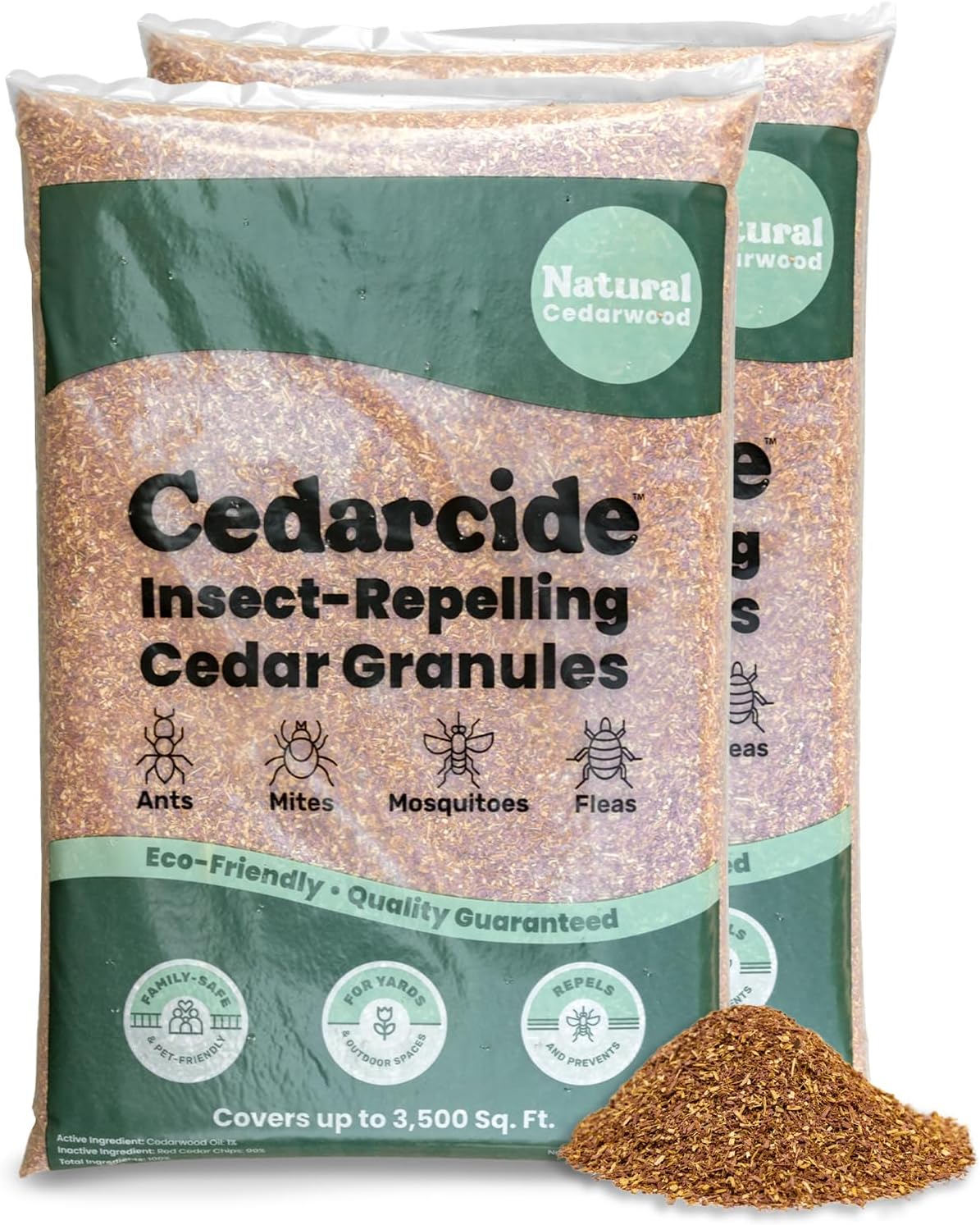
Cedarcide Cedar Granules Insect Repellent, 2 Bags (16 lbs)
| Ingredients | cedar granules |
|---|---|
| Reapply | Every 4–6 weeks |
| Area of use | Lawns, gardens, outdoor |
| Family Safe | Yes |
| Pet Safe | Yes |
Cedarcide cedar granules are a simple, chemical-free option for reducing mosquitoes, fleas, ants, chiggers and similar pests around lawns, beds and foundations. You spread the granules by hand or with a seeder along borders, under shrubs, around patios and near entry points to create a fragrant barrier; reapplication is recommended every 4 to 6 weeks or after heavy rain. Because the product is 100% cedar shavings, the active effect comes from the wood aroma interfering with insect pheromones rather than toxic ingredients, which makes it suitable for yards where children and pets play. Practical benefits include easy application, multiple indoor and outdoor uses (sachets for closets or in plant pots), and a low environmental footprint from sustainably sourced cedar. Limitations are that results are gradual and variable by pest and weather, a single bag covers a limited area so larger properties require multiple bags, and cedar scent may be noticeable to people who prefer no fragrance.
Best for: Homeowners who want a low-toxicity, maintenance-friendly mulch that adds insect-repelling benefit across typical yard and garden areas while prioritizing safety for children and pets.
Less Ideal for: People dealing with severe infestations who need fast, high-efficacy control or those who need an odorless mulch solution.
- Made from 100% natural cedar shavings so no synthetic insecticides are applied to the lawn
- Safe for use around families and pets when applied as directed
- Versatile placement: lawns, flower beds, foundations, patios and indoor sachets
- Simple application with hand-spreading or a seed spreader and predictable 4–6 week reapplication interval
- Effectiveness is weather-dependent and may be inconsistent against heavy infestations
- Requires regular reapplication and multiple bags for larger yards
- Distinct cedar aroma may be noticeable or unwanted by some users
Verdict: Choose these cedar granules if you want a natural, family-safe mulch that helps repel common yard insects with simple, repeatable applications.
Choosing the Right Mulch for Keeping Bugs Away: Key Factors to Consider
Pest Resistance
How unattractive a mulch is to unwanted insects and slugs matters first because some materials provide hiding spots or food that encourage infestations. Materials with coarse textures or low organic food value are less likely to shelter beetles, earwigs, or slugs. Consider that fresh wood chips and inorganic mulches often deter crawling pests, while fine-textured, high-organic mulches can become refuges.
Also think seasonally. A mulch that deters pests in summer might behave differently in wet spring conditions. Choosing the right thickness and keeping mulch pulled back from stems and trunks reduces accidental sheltering close to plants.
Moisture Management
Mulch strongly influences soil moisture, and moisture levels in turn affect insect activity. Mulches that hold too much water can create breeding or overwintering habitat for pests such as fungus gnats or certain beetles, while mulches that dry quickly may reduce slug and snail activity. Aim for a material and application depth that balances water retention for plant roots without creating persistently soggy pockets.
Placement and grading also matter. Properly graded beds that shed surface water and a thinner layer near crowns or trunks cut down on damp refuges that attract pests.
Breakdown Longevity
How quickly a mulch decomposes affects both maintenance frequency and pest dynamics. Fast-breaking organic mulches add nutrients but require frequent replenishment and can temporarily attract decomposer insects. Slow-to-break materials maintain a stable surface and are less likely to produce the soft, moist microhabitats many pests favor.
Consider how often you want to refresh beds and whether you want the mulch to contribute significantly to soil organic matter. A balance between longevity and soil-building can be struck by mixing types or alternating materials from year to year.
Support For Beneficials
Not all insects are bad. Many predators and pollinators need suitable habitat or access to the soil. Choose mulches that allow beneficial predators to hunt and do not create a biological dead zone. Open-structured materials let predators move through the bed, while some dense layers can block ground beetles and parasitoids.
Also consider flowering cover crops or low-growing groundcovers at bed edges to supply nectar for beneficials rather than relying on mulch to provide all habitat.
Ease Of Application And Maintenance
Practicality affects real-world choices. Heavy or bulky materials can be hard to spread, while very fine mulches can blow or compact. A mulch that is easy to apply, redistribute, and top up will more likely be used correctly over time, reducing patchy areas where pests can establish.
Think about composting or disposal needs as well. Some mulches require periodic turning or removal, while others can be left in place for years with minor top-ups.
How Mulch Type Changes Pest Behavior
Different mulch materials change the physical environment at the soil surface and therefore how insects use that space. Coarse, chunky materials create openings that are less attractive to soft-bodied pests, while fine, compacted layers can hold moisture and shelter decomposers and detritivores.
Understanding those differences helps match the mulch to the pest problem you face. For example, if slugs are a primary issue, choose a material and depth that discourages continuous moisture and provide dryer corridors for plants.
- Coarse materials reduce continuous damp microhabitats.
- Fine mulches hold moisture and can attract decomposers.
- Inorganic mulches eliminate organic food sources but affect soil temperature.
Placement and Bed Preparation Best Practices
Even the best pest-resistant mulch will fail if applied incorrectly. Clear debris and weeds before laying mulch so you do not trap existing eggs or larvae. Keep mulch a few inches away from plant stems and tree trunks to avoid creating moist contact zones that invite pests and disease.
Aim for an even layer at the recommended depth. Too thin and weeds and pests can still move through. Too thick and you risk excessive moisture retention and reduced oxygen at the soil surface.
- Remove old dense mulch layers before applying a new one.
- Maintain a mulch-free collar around stems and trunks.
- Refresh top-dressing yearly or as needed based on decomposition.
Seasonal Considerations and Timing
Timing your mulching can influence pest cycles. Applying mulch in late spring after soil has warmed may reduce the chances of creating a damp, cool environment that certain pests favor in early season. In climates with wet springs, delaying heavy mulching until after major rains can help avoid trapping moisture.
In colder climates, some gardeners use mulch for winter insulation but then remove or thin layers in spring to prevent overwintering pests from emerging in close proximity to plants.
- Mulch after soil warms in spring to deter cool-season pests.
- Thin or remove layers in spring when overwintering insects become active.
- Top-up in late summer if decomposition has reduced coverage.
Combining Mulches and Integrated Pest Strategies
A single mulch type does not have to carry all the burden. Combining mulches or alternating materials can give you durability in high-traffic zones and soil-building benefits where you want organic matter. Use physical controls, such as traps or barriers, and encourage beneficial insects to complement the mulch choice.
Cultural tactics like reducing excess irrigation, removing plant debris, and promoting predators often have a bigger long-term effect on pest pressure than any single mulch choice.
- Mix coarse mulch at the outer bed with finer compost nearer plants if you need both deterrence and fertility.
- Use barrier strips of grit or gravel where slugs and snails are a major problem.
- Encourage predators with habitat features and avoid broad-spectrum insecticides that disrupt biological control.
Safety, Sourcing, and Environmental Considerations
Think about where mulch materials come from and whether they contain contaminants, treated wood, or invasive plant parts. Avoid mulches that include freshly treated or painted wood, and be cautious with unprocessed yard waste that might harbor pest eggs or weed seeds.
Consider the ecological trade-offs of inorganic versus organic materials. Inorganic mulch can reduce pest sheltering but does not contribute to soil organic matter. Choose materials that fit your environmental goals and local regulations.
- Inspect source material for herbicide contamination or weed seed.
- Avoid treated lumber products in edible garden areas.
- Prefer locally sourced materials to reduce transport impacts.
How We Chose the Best Mulch for Keeping Bugs Away
We focused on attributes that directly affect how mulch interacts with insects and the garden ecosystem. Key evaluation criteria included pest resistance, which measures how unattractive the material is to common nuisance insects and slugs; moisture management, since overly wet mulch can invite pests while dry mulch can repel some species; longevity and breakdown rate, which determine how often you must refresh the layer; impact on beneficial insects and soil biology, to avoid choices that harm natural predators; and ease of maintenance and application for typical home gardeners. Products were excluded if they were clearly labeled for decorative use only with no pest-related performance claims or if they required specialist installation beyond normal garden work. We also filtered out materials that consistently create overly damp conditions or known sheltering zones for pests. The final shortlist balances deterrence with soil health, practical upkeep, and season-long performance.
FAQ
Can mulch attract more bugs to my garden?
Mulch can attract certain insects if it creates moist, sheltered microhabitats or provides organic food. Choosing coarser materials, maintaining proper depth, and keeping mulch away from stems reduces that risk.
Will using mulch stop slugs and snails completely?
Mulch can help reduce slug and snail activity by altering moisture and shelter options, but it rarely eliminates them entirely. Combining mulch choices with physical barriers and reduced nighttime watering is usually more effective.
Is inorganic mulch better for pest control than organic mulch?
Inorganic mulches often discourage pests because they do not provide food or cozy shelter, but they do not improve soil organic matter. The best choice depends on whether pest control or soil-building is your priority.
How thick should I lay mulch to avoid creating pest habitat?
Aim for a layer that conserves moisture for roots without becoming a soggy blanket. Typically a few inches is enough for many materials; avoid excessively deep piles that remain wet and compacted.
Can mulch harm beneficial insects?
Some dense, impenetrable mulch layers can restrict ground-dwelling predators. Select open-structured materials in areas where you want beneficials to move freely and provide additional habitat like flowering edges to support predators.
Final Verdict
When choosing mulch for keeping bugs away, prioritize materials that reduce shelter and excessive moisture while allowing beneficial predators access to the bed. Balance pest resistance with how much you want the mulch to contribute to soil health and how often you want to maintain the beds. Tradeoffs are inevitable: longer-lasting, inorganic options may deter pests better but do not build soil, while organic mulches add fertility but can require more management. Use placement, timing, and complementary cultural controls to get the best results for your garden.
