

Note: This article contains affiliate links. If you click on these links and make a purchase, I may earn a small commission at no extra cost to you. This helps support my research and content. Read my full affiliate disclosure here.
Ants in turf can damage root zones, disturb soil, and make outdoor spaces unpleasant. Picking the right natural ant killer for lawns matters because treatments sit directly on grass, and gardeners need something that reduces colonies without harming beneficial insects, pets, or turf health. This guide covers seven carefully shortlisted natural options that are practical for lawn use, and it explains how we judged them. We evaluate each option for how well it controls established colonies, how it affects lawn safety and beneficials, and how easy it is to apply. Read on to see the top natural approaches and find the one that fits your lawn care priorities.
Top Picks at a Glance
| Best Overall The best all-around choice for most situations | EcoVenger Ant Killer & Nest Treatment, 32 oz |  |
| Best Quality Built to a higher standard if you want something more solid | EcoVenger Roach & Ant Killer 64 oz — Plant‑Derived Indoor/Outdoor Spray |  |
| Best Value The sweet spot between price and what you get | Sunday Ant Adios Outdoor Ant Killer Granules (2 lb, 2-pack) |  |
| Best Budget The cheapest option that still gets the job done reliably | Harris Diatomaceous Earth Crawling Insect Killer, 8 oz |  |
| Highest Rated A top-rated pick with lots of positive feedback | Geomust Diatomaceous Earth with Peppermint Oil, Food Grade Insect Killer, 1 lb |  |
| Most Popular A crowd favorite that many people choose with confidence | Wondercide Outdoor Pest Control Spray — 32 oz Ready-to-Use |  |
| Best Seller A high-volume bestseller chosen again and again | Garden Safe Crawling Insect Killer Diatomaceous Earth, 4 lb |  |
EcoVenger Ant Killer & Nest Treatment, 32 oz

| Unit Count | 32 Fluid Ounces |
|---|---|
| Item Form | Spray |
| Target Species | Odorous House Ants, Fire Ants, Roaches, Fleas, Spiders |
| Active Ingredients | Citronella Oil, Geraniol, Cedarwood oil, Sodium Lauryl Sulfate |
EcoVenger Ant Killer is a plant-extract spray formulated to kill house ants on contact, treat fire ant mounds, and leave a residual barrier that deters re-entry for up to four weeks. You use it like a standard ready-to-use spray: spot-treat visible trails, spray around entry points and saturate mound tops or nest openings to reach the colony. Notable features include a citronella/cedarwood/geraniol active blend, a user-friendly trigger sprayer and claims of university testing and professional use. In practice the product offers fast knockdown for foraging ants and the ability to deliver treatment down tunnels using the spray wand, which helps target queens in mounds. The botanical formulation is marketed as non-staining and safe to use around pets and children when directions are followed, and the light citrus scent dissipates quickly. Limitations are that efficacy details beyond labeled target species rely on manufacturer testing and heavier infestations may need repeated treatments or perimeter work; the nozzle has delicate parts so care is needed when handling.
Best for: Homeowners who prioritize effective, fast-acting ant control but want a pet- and child-friendly botanical option for indoor and outdoor use.
Less Ideal for: People needing an industrial-strength chemical treatment for very large or persistent infestations or those who prefer products supported by multiple independent field trials.
- Kills odorous house ants on contact and eradicates fire ant mounds when applied to the colony
- Botanical active ingredients (citronella, geraniol, cedarwood) offer a lower-toxicity alternative to conventional pesticides
- Provides residual repellency for up to four weeks to help prevent re-entry
- Suitable for indoor and outdoor use and formulated to be non-staining on carpets and fabrics
- Nozzle contains delicate parts that can be damaged and may require careful handling
- Manufacturer efficacy claims are based on internal or cited studies rather than independent third-party field trials
Verdict: A fast-acting, plant-powered ant spray that balances quick colony knockdown with a formulation designed for use around pets and children.
EcoVenger Roach & Ant Killer 64 oz — Plant‑Derived Indoor/Outdoor Spray

| Active ingredients | Geraniol, Cedarwood Oil, Peppermint Oil, Sodium Lauryl Sulfate |
|---|---|
| Residual protection | Up to 4 weeks |
| Intended use | Indoor and outdoor crawling insects |
| Volume | 64 oz |
EcoVenger Roach & Ant Killer is a large‑volume, plant‑derived spray formulated to deliver fast knockdown and lasting deterrence against roaches, ants, and common crawling pests. You use it like a conventional ready‑to‑spray insecticide: apply directly on visible insects, around entry points, and along perimeters to flush and repel pests. Notable features include botanical active ingredients (geraniol, cedarwood and peppermint oils), a water‑based nonstaining formula, and a pleasant peppermint scent that dissipates quickly. The formula is designed for both residential and commercial settings where vacancy is undesirable, so you can treat kitchens, dining areas, and outdoor perimeters without evacuating the space. Practical benefits are immediate contact kill plus residual protection for up to four weeks, suitability for sensitive areas because it lacks synthetic pyrethroids, and safety testing that supports use around children and pets. Important limitations are that efficacy against large or hidden infestations may require repeated treatments or integrated measures, and the nozzle contains delicate parts that need careful handling.
Best for: Buyers who prioritize effective, fast pest control but want to avoid harsh synthetic chemicals and need a solution safe for use around family and pets in lawns and nearby entry areas.
Less Ideal for: People seeking a single‑application cure for long‑standing, heavy infestations or those who prefer granular baits or professional fumigation methods.
- Plant‑derived active ingredients provide knockdown and residual repellency without synthetic pyrethroids
- Water‑based, low‑odor formula suitable for use in kitchens and other sensitive indoor areas
- Works as both a contact killer and a perimeter deterrent offering up to four weeks of protection
- Large 64 oz volume is convenient for treating indoor hotspots and outdoor perimeters without frequent refills
- Nozzle has delicate parts that can be damaged and may need replacement
- May not eliminate well‑established, hidden infestations on a single treatment
Verdict: Choose this product if you want a performance‑focused, natural spray that quickly kills and deters ants and roaches while staying safe for use around lawns, kitchens, and family areas.
Sunday Ant Adios Outdoor Ant Killer Granules (2 lb, 2-pack)

| Active Ingredient | Spinosad |
|---|---|
| Quantity | 2 lb. bag (per unit) |
| Coverage | Up to 4,000 sq. ft. |
| Organic Gardening | Approved |
Sunday Ant Adios is a ready-to-use granular treatment formulated with spinosad to reduce foraging ants, earwigs, cutworms, and similar crawling insects in outdoor spaces. You broadcast the granules around lawn edges, along foundations, and near garden beds where ants forage; the product claims coverage up to about 4,000 square feet per 2 lb bag and gives results within days to a couple of weeks. Notable features are its biologically derived active ingredient and organic gardening approval, which make it suitable to use around fruits, vegetables, and ornamentals when label directions are followed. The granules are odor-free and designed for low-fuss application without mixing or special equipment. Limits to expect: it is not intended for fire ant mound treatments and control is not instant for every colony since it targets foragers and takes time to reduce populations. Also, granules offer spot and perimeter control rather than systemic protection of plants, so follow-up applications or integrated baiting may be needed for heavy infestations.
Best for: Gardeners who prioritize effective, garden-safe pest control and want a low-effort granular option to protect vegetable beds and surrounding lawn areas.
Less Ideal for: People needing immediate knockdown of large or established ant mounds or those who want a spray or bait system for continuous, long-term colony suppression.
- Uses spinosad, a biologically derived active ingredient approved for organic gardening
- Ready-to-use granules require no mixing or special equipment
- Odor-free formulation suitable for use near edible gardens when label directions are followed
- Coverage stated up to 4,000 sq ft per 2 lb bag for perimeter and spot treatments
- Not labeled for fire ant mound treatment
- Works by reducing foraging activity so visible results can take several days to weeks
Verdict: Choose this if you want a garden-safe, ready-to-use granular treatment that reduces foraging ants around vegetable beds without harsh fumes.
Harris Diatomaceous Earth Crawling Insect Killer, 8 oz

| EPA registration | No. 3-18 |
|---|---|
| Active ingredient | 100% freshwater diatomaceous earth |
| Intended use | Indoor & outdoor |
This ready-to-use diatomaceous earth product provides a non-chemical way to control ants and other crawling pests around the home. You apply the fine powder in cracks, along baseboards, near entry points, or in crawlspaces using the included puffer tip for targeted placement. The diatomaceous earth works mechanically by abrading insect exoskeletons and causing dehydration, so insects that contact the dust typically die within 48 hours. Because the material is 100% freshwater diatomaceous earth with no additives and is EPA registered, it is a good fit when you want a low-toxicity option usable near people and pets when directions are followed. It stays effective indefinitely as long as it stays dry, making it a convenient barrier treatment in attics, basements, garages, and around foundations. Limitations are that it must remain dry to work and it is a contact-only control method, so heavy infestations or nesting insects may require repeated application or combined methods for faster results.
Best for: Practical households that prioritize low-toxicity, long-lasting ant control and want a simple, targeted treatment they can apply themselves around entry points and inside cracks.
Less Ideal for: People facing severe or widespread infestations who need rapid knockdown or prefer liquid chemical treatments should consider professional services or a different product.
- 100% freshwater diatomaceous earth with no additives for a non-chemical control option
- Built-in puffer tip allows precise application into cracks and crevices
- Remains effective indefinitely when kept dry, providing long-lasting barrier protection
- Mechanically kills a wide range of crawling insects including ants, roaches, fleas, and bed bugs
- Only effective on insects that contact the powder and must stay dry to work
- Not a fast-acting spray alternative for large, established infestations
Verdict: Choose this product if you want a low-toxicity, long-lasting mechanical barrier to control ants and other crawling insects around the home.
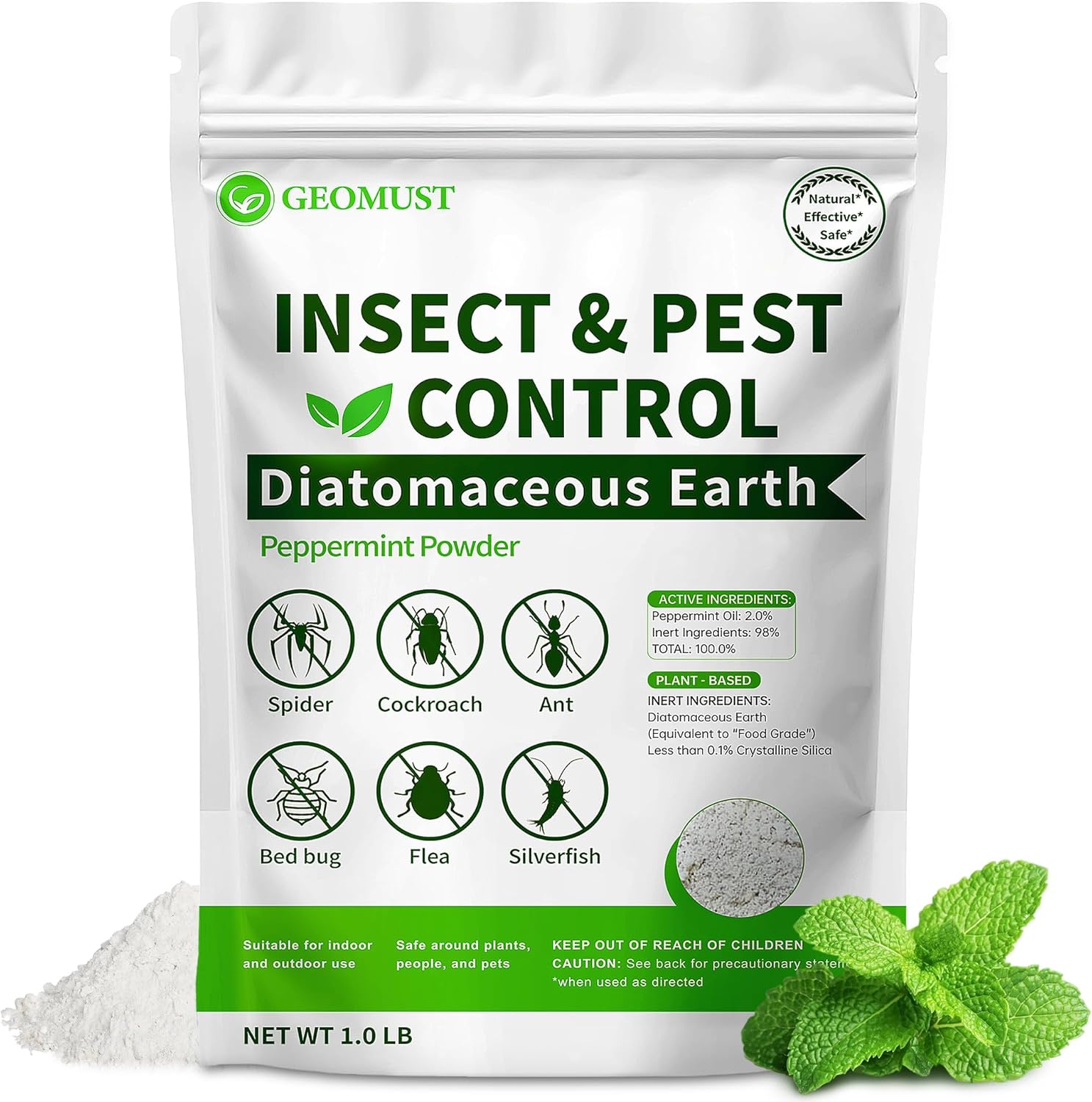
Geomust Diatomaceous Earth with Peppermint Oil, Food Grade Insect Killer, 1 lb
| Item Form | Powder |
|---|---|
| Target Species | Ants; Cockroaches; Fleas; Bed Bugs; Silverfish; Insects |
| Unit Count | 16 Ounce |
| Ingredients | Diatomaceous Earth; Peppermint Oil |
This Geomust product is a food-grade diatomaceous earth powder mixed with peppermint oil intended to control ants, roaches, fleas, bed bugs, silverfish and other crawling pests. You apply the dry powder to cracks, baseboards, entry points and around foundations or garden areas where insects travel; it works by dehydrating and abrading insect exoskeletons rather than poisoning them. The added peppermint oil gives a fresh scent and may help deter insects in treated zones. Because the formula is inert and labeled food grade it is suitable for use where households want a nonchemical option and safer handling around people and pets when used as directed. It must be kept dry to remain effective and its effects are contact-based, so it requires placement where insects will cross and occasional reapplication after cleaning or moisture exposure. For heavy, established infestations you may need repeated treatments or to combine this with exclusion and sanitation measures.
Best for: Homeowners who prioritize a low-toxicity, maintenance-friendly approach to crawling pests and want a straightforward, preventive product to use around living spaces and garden edges.
Less Ideal for: People needing a fast-acting or broad-spectrum solution for large, active infestations where immediate reduction is required.
- Food-grade diatomaceous earth provides a nonchemical, physical mode of kill safe for many home environments when used as directed
- Peppermint oil adds a pleasant scent and may increase deterrent effect in treated areas
- Versatile for indoor and outdoor use around baseboards, entry points, and garden perimeters
- Long-lasting when kept dry and simple to apply as a powder barrier
- Needs to stay dry and only works on insects that contact the powder, so wet areas reduce effectiveness
- Not an instant knockdown for heavy infestations and may require repeated applications or complementary controls
Verdict: Choose this if you want a simple, food-grade, nonchemical powder to prevent and reduce crawling pests with safe indoor and outdoor use when kept dry.
Wondercide Outdoor Pest Control Spray — 32 oz Ready-to-Use

| Format | Pre-mixed, hose-end spray |
|---|---|
| Active ingredients | Cedarwood Oil 12.63%, Sesame Oil 2.73% |
| Coverage | Up to 5,000 sq ft (general); 2,500 sq ft (ticks/mosquito repel) |
Wondercide Ready-to-Use Outdoor Pest Control is a hose‑end spray designed for treating yards up to 5,000 sq ft for general pests and 2,500 sq ft for ticks and mosquito repellency. You attach the bottle to a garden hose, sweep the nozzle across lawns, patios, and foundation lines, and the cedarwood‑based formula delivers quick coverage with no dry time required. Notable features include plant-powered active ingredients (cedarwood and sesame oils), ready-to-use convenience, and instructions for both active infestations and preventative maintenance. Practical benefits are that it is safe to use around people and pets when directions are followed, residues are reported to be non-harmful to pollinators, and the hose attachment makes treating large areas fast. Important limitations are that effectiveness depends on water pressure, walking speed, and weather, heavy rain may require reapplication, and spraying in temperatures above 90°F or direct sun can cause plant burn. Users who need an all‑season, high‑durability pesticide for heavy infestations should plan on repeated applications and follow label precautions to protect sensitive plants.
Best for: Buyers who prioritize effective, plant‑based mosquito and tick control for medium to large yards and want a fast hose‑attached solution that is safe around families and pets when used as directed.
Less Ideal for: Gardeners who need a single, long‑lasting professional‑grade pesticide for severe, persistent infestations or who cannot reapply after rain should consider alternative, heavier‑duty treatments.
- Ready-to-use hose-end applicator for fast coverage of large yards
- Plant-based active ingredients (cedarwood and sesame oils) that target common yard pests
- No dry time required so kids and pets can re-enter treated areas quickly
- Covers up to 5,000 sq ft for general pest control and 2,500 sq ft for ticks/mosquito repellency
- May cause phytotoxic burning if applied in direct sun or temperatures above 90°F
- Performance depends on water pressure and user walking speed which can lead to uneven coverage
- Heavy rain can wash it away and requires reapplication
Verdict: If you want a fast, family- and pet-friendly plant‑based spray to reduce mosquitoes and ticks across a medium to large yard, this ready‑to‑use hose‑end formula delivers practical, repeatable results.
Garden Safe Crawling Insect Killer Diatomaceous Earth, 4 lb

| Item Form | Powder |
|---|---|
| Target Species | Insects |
| Active Ingredients | Silicon Dioxide |
| Specification Met | EPA |
Garden Safe Crawling Insect Killer is a powdered diatomaceous earth formulation intended for outdoor, plant-side use to control crawling pests. It is applied as a thin dust to soil around plants or directly onto insects where the fine granules abrade and absorb oils from exoskeletons, causing dehydration and death. Typical uses include edging vegetable beds, dusting under potted plants, and treating areas where ants, fleas, cockroaches, beetles, and mealybugs are active. The product is labeled for organic gardening and meets EPA specification guidance, so it is a low-chemical option for routine garden pest control. Practical benefits are persistence in dry, calm conditions and a non-spray, hands-on application that targets contact exposures. Important limitations are that it must stay dry to remain effective, can be dusty to apply so ventilation and a mask are advised, and it is not effective against insects that are not contacted by the dust or for wood-destroying beetles and certain ant species listed on the label. Follow label directions and reapply after heavy rain or disturbance for continued protection.
Best for: Gardeners who prefer practical, low-chemical pest control and want a contact-based solution for crawling insects around plants and beds.
Less Ideal for: People seeking a fast-acting, systemic treatment for flying pests or infestations inside structures should consider other control methods.
- Works by physical action so no chemical insecticides are required
- Approved for use in organic gardening and meets EPA specification guidance
- Can be applied directly to soil and plants to target crawling pests
- Long-lasting when kept dry and undisturbed
- Ineffective if the treatment area becomes wet or is washed away
- Creates airborne dust during application so respiratory protection is recommended
Verdict: A practical, organic-friendly diatomaceous earth powder for gardeners who want a non-chemical contact treatment for crawling garden pests.
Choosing the Right Natural Ant Killer for Lawns: Key Factors to Consider
Active Ingredient and Mode of Action
Knowing what the active ingredient does is the first step to choosing an effective natural ant control for lawns. Some botanical extracts and baits disrupt ant feeding or act as repellents rather than killers; others attract workers who carry material back to the colony. For lawns you want an approach that targets the colony rather than only repelling workers away from visible mounds. Consider whether the ingredient is contact-based, stomach poison, or bait that requires worker transfer. Each mode affects how quickly colonies shrink and whether retreatment will be necessary.
Also think about persistence. Natural ingredients vary in how long they stick around on grass blades or in soil. Short-lived contact solutions may need repeated applications but limit residual exposure. Baits that transfer into the nest can be slower but are often more thorough at reducing colony size.
Lawn Safety and Phytotoxic Risk
Turfgrass can be sensitive to concentrated formulations, surfactants, or oils that can scorch blades or stress seedlings. When selecting a natural ant killer for lawns, evaluate label guidance on turf compatibility and recommended dilution rates. Products marketed as natural still sometimes advise testing on a small patch first. Apply during cooler parts of the day and avoid treating newly sodded or overseeded areas unless the product explicitly permits it.
Consider pet and child activity on treated areas. Even natural ingredients can irritate or upset sensitive animals if applied at high strength. Choose options with clear re-entry times, rinse recommendations, or those that bind quickly to soil rather than staying on grass blades to reduce short-term contact risks.
Effectiveness Against Lawn-Forming Ant Species
Different ant species behave differently in turf. Some build conspicuous crater mounds while others create diffuse networks under the grass. A product that works well on surface mounds may be less effective on subterranean or evenly distributed colonies. Assess whether the natural method has documented performance on the kinds of ants common in your region and lawn type.
Also consider the colony structure. Large, multi-queen colonies often require more persistent or systemic approaches to reduce worker numbers sustainably. For scattered nuisance workers, a fast contact solution can provide quick relief, but for long-term control you may need a baiting strategy that reaches the queens.
Application Method and Practicality
How the product is applied affects both effectiveness and ease of use on a lawn. Granular baits can be broadcast with a spreader or applied by hand, while liquids may require a hose-end sprayer or pump sprayer. Some natural products need mixing, agitation, or specific nozzle settings to avoid uneven coverage. Consider whether you have the right equipment and whether the application pattern fits your lawn layout.
Also factor in how often follow-up treatments are needed and whether reapplication windows are compatible with other lawn care tasks like fertilizing or irrigation. Simpler application routines increase the chance of correct use and consistent results.
Weather and Rainfastness
Lawn applications are exposed to irrigation and rain, which can wash away or dilute treatments. Natural options vary in how quickly they become rainfast or how they bind into the turf canopy or soil. Choose solutions with clear guidance on rain windows and irrigation timing to avoid wasted product or unintended runoff.
Timing treatments during dry spells, or after mowing, can improve uptake for baits and reduce immediate loss for contact sprays. If heavy rain is forecast, delay application or choose a formulation noted for better residual hold in turf settings.
Non-target and Beneficial Insect Considerations
Lawns host a range of beneficial soil organisms and predatory insects that contribute to a balanced turf ecosystem. Even natural formulations can impact surface-active insects, pollinators visiting nearby plants, or soil microfauna. Select approaches that minimize exposure to beneficials by targeting ant foraging behavior rather than broad-spectrum contact activity.
Placement and timing can reduce non-target effects. Baits placed along ant trails or applied directly to mounds lower risk to unrelated insects. Applying treatments when non-targets are less active, such as early morning or late evening, also helps protect beneficial populations.
When to Use Baits Versus Contact Treatments
Baits are generally the best choice when you want colony-level control because foraging workers transport bait back to the nest. They work slowly but can reach the queen and brood, producing longer-lasting reductions in worker numbers. Use baits when you can observe ant trails or active foraging from a central nest.
Contact treatments act quickly to knock down visible workers and surface mounds but may not affect the colony core. They are useful for immediate nuisance control or when safety concerns make baiting impractical. In many lawn situations, a combined approach-spot contact treatment for visible mounds followed by baiting along trails-gives the best balance of speed and durability.
- Use baits for persistent or widespread colonies
- Reserve contact treatments for active, visible mounds
- Combine methods for both quick relief and long-term reduction
Applying Treatments Safely Around Pets and Children
Minimize exposure by applying products when pets and children are not on the lawn and allowing any recommended re-entry interval to pass. For pet-safe approaches, choose formulations that bind into the soil or are placed in tamper-resistant bait stations rather than loose granules where curious animals could sample them.
Rinse equipment thoroughly after use and store all materials out of reach. If a topical household remedy is used, avoid high-concentration applications and keep treated areas under observation until dry or settled.
- Follow label re-entry times
- Prefer bait stations where possible
- Keep pets off treated areas until product is dry or settled
Timing Treatments with Lawn Care Tasks
Coordinate ant control with mowing, irrigation, and fertilization. Apply baits when ants are actively foraging, often in cooler parts of the day, and avoid applying liquid treatments right before heavy irrigation or predicted rain. Mow a day or two before application to reduce thatch and improve bait visibility and contact.
Avoid treating immediately after overseeding or when seedlings are vulnerable. If you need to manage ants in a recently seeded lawn, choose the gentlest labeled option and test on a small area first.
- Mow before baiting to increase visibility
- Avoid treatment before heavy irrigation or rain
- Delay in newly seeded or sodded areas unless label permits
Spot-Treatment Techniques for Large Lawns
On larger properties it is inefficient and unnecessary to treat every square foot. Walk the lawn to find active mounds and major ant trails, then apply baits or spot sprays only where activity is concentrated. This conserves product and reduces non-target exposure.
For sprawling turf, consider a perimeter bait strategy where you place small bait points along logical transit routes rather than broadcasting across the entire lawn. Reassess treated zones weekly and retreat only when activity resumes.
- Target visible mounds and major trails
- Use perimeter baiting for large areas
- Re-check treated zones weekly
Eco-Friendly Yard Practices That Reduce Ant Pressure
Cultural practices can make lawns less attractive to large ant populations. Reduce excess thatch and avoid overwatering, both of which create favorable microhabitats for ants. Keeping groundcover, mulch, and debris away from turf edges reduces nesting sites next to the lawn.
Encouraging biodiversity in adjacent beds and maintaining healthy turf density makes it harder for ant colonies to establish extensive networks. Minimal, targeted chemical use combined with improved cultural care reduces long-term reliance on repeated treatments.
- Control thatch and avoid overwatering
- Keep mulch and debris away from turf edges
- Promote dense, healthy turf to resist nesting
How We Chose the Best Natural Ant Killer for Lawns
We prioritized solutions that are appropriate for application on turf and that balance colony control with lawn safety. Evaluation focused on measurable, garden-relevant criteria: speed of colony reduction, residual lawn safety, impact on non-target beneficial insects and soil life, and practical ease of application and follow-up. We considered formulation type and how it behaves when applied to grass, including runoff risk and rainfastness. Our process excluded harsh synthetic insecticides and products explicitly intended for indoor or structural use. We looked for natural active ingredients or methods that are commonly recommended for outdoor lawn use and that have a record of usable application instructions. We also filtered out options that require specialized equipment or professional-only permits. The final short list emphasizes real-world usability, safety for common lawn users like families and pets, and documented effectiveness against common turf-infesting ant species.
FAQ
Are natural ant killers safe for pets on lawns?
Many natural options pose lower acute toxicity than synthetic insecticides, but safety varies by formulation and concentration. Look for products with clear pet re-entry guidance, use bait stations when possible, and follow label instructions carefully. If a pet ingests product, contact a veterinarian.
How long does it take for a bait to reduce ant colonies?
Baits often take several days to a few weeks to noticeably reduce visible worker activity because they rely on foragers transporting material back to the nest. The timeframe depends on colony size, bait attractiveness, and how readily workers accept the bait.
Will natural treatments harm earthworms or soil microbes?
Many natural treatments are formulated to minimize soil-life impacts, but some contact solutions or concentrated oils can affect surface-active organisms if overapplied. Follow dilution and application instructions, and avoid broadcast overuse to reduce potential effects on beneficial soil fauna.
Can I use natural ant treatments on newly seeded or sodded lawns?
New turf is more sensitive to phytotoxicity and disturbance. Avoid strong treatments during the establishment phase unless the product explicitly allows use on new seed or sod. When in doubt, test on a small patch and choose gentler baiting approaches.
How often should I reapply treatments during the season?
Reapplication depends on the method and activity levels. Contact treatments may require repeat applications every one to two weeks for persistent activity, while effective baits can provide longer control but may need follow-up if new colonies nearby move into the area. Monitor and treat based on observed activity.
Do weather and irrigation affect natural ant control?
Yes. Heavy rain and frequent irrigation can reduce the effectiveness of both baits and contact sprays by washing them off turf or diluting active ingredients. Apply treatments when a dry window is expected and follow label guidance on rainfastness and irrigation timing.
Final Verdict
Prioritize treatments that match your lawn situation and tolerance for short-term disruption. For lasting colony reduction, baiting approaches that reach the nest are usually the best choice, while contact options provide quick relief for visible mounds. Balance effectiveness against lawn safety, non-target impacts, and practicality of application when you choose a natural ant killer for lawns. Focus on minimizing exposure to pets and beneficials, time treatments with weather and mowing, and use spot applications on larger properties. That approach helps you achieve dependable control while protecting turf health and the yard ecosystem.
