

Note: This article contains affiliate links. If you click on these links and make a purchase, I may earn a small commission at no extra cost to you. This helps support my research and content. Read my full affiliate disclosure here.
If you want to stop carpenter ant activity without relying on harsh synthetic insecticides, selecting the right natural carpenter ant killer matters. Ants nesting in wall voids and structural wood behave differently than surface-feeding insects, so effective solutions need good nest reach, lasting action, and options that work around pets and children. This guide covers the top shortlisted natural treatments that gardeners and homeowners use for indoor and perimeter control, and explains the practical tradeoffs you should weigh. Below we summarize why each product made the list and outline the evaluation criteria used, including application type, residual protection, and safety considerations for occupied homes. Read on to match a natural approach to your infestation type and treatment zone.
Top Picks at a Glance
| Best Overall The best all-around choice for most situations | GoneNaturally Peppermint Oil Ant Killer Spray (16 oz) |  |
| Best Quality Built to a higher standard if you want something more solid | EcoVenger Ant & Crawling Insect Killer Spray, 16 oz (Plant-Based) |  |
| Best Value The sweet spot between price and what you get | Mighty Mint Peppermint Oil Insect Repellent Spray, 1 Gallon |  |
| Best Budget The cheapest option that still gets the job done reliably | Harris Diatomaceous Earth Crawling Insect Killer, 8 oz |  |
| Most Popular A crowd favorite that many people choose with confidence | Mighty Mint Peppermint Oil Insect Repellent Spray, 16 oz |  |
GoneNaturally Peppermint Oil Ant Killer Spray (16 oz)

| Ingredients | Peppermint Oil |
|---|---|
| Net volume | 16 oz |
| Indoor/outdoor | Indoor and Outdoor |
| Made in | USA |
This peppermint oil ant killer is a plant-based, ready-to-use spray made to kill and repel common household ants including carpenter ants. You spray directly on ants and along entry points such as doorways, windowsills, baseboards and foundation lines to remove visible workers and disrupt scent trails that attract the rest of the colony. It is formulated to dry quickly with no sticky residue and is marketed as safe around kids and pets when used as directed, though the instructions advise keeping cats and confined animals out of rooms until treated surfaces are dry. The product works as an immediate contact killer and short-term perimeter barrier; repeated treatments are recommended for persistent infestations and after rain. Practical benefits include an easy spray application with a fresh peppermint scent and no bait stations to set up or monitor. Important limitations are that it is not a one-time colony elimination like slow-acting baits and requires follow-up applications for full control of nests that are not directly contacted.
Best for: Homeowners who prefer a plant-based, easy-to-use spray to knock down visible ants and create a temporary perimeter barrier without setting baits, and who are willing to follow a short reapplication routine.
Less Ideal for: People seeking a single-application solution to eradicate a large established nest or those who want a long-term, maintenance-free colony elimination method.
- Plant-based peppermint oil formula that kills on contact and repels follow-up trails
- Ready-to-use spray requires no mixing or bait stations
- Safe for use indoors and outdoors when directions are followed
- Dries quickly with no sticky residue and leaves a light natural scent
- Acts as a contact killer and perimeter repellent but will not eliminate a distant nest without repeated applications
- Requires reapplication after rain and for ongoing infestations
Verdict: A user-friendly peppermint oil spray that quickly kills ants on contact and repels follow-up trails, ideal for homeowners wanting a natural, no-bait immediate solution.
EcoVenger Ant & Crawling Insect Killer Spray, 16 oz (Plant-Based)

| Unit Count | 16 Fluid Ounces |
|---|---|
| Item Form | Spray |
| Target Species | Odorous House Ants, Fire Ants, Roaches, Fleas, Spiders |
| Active Ingredients | Citronella Oil, Geraniol, Cedarwood Oil, Sodium Lauryl Sulfate |
| Liquid Volume | 480 ml |
EcoVenger Ant & Crawling Insect Killer is a ready-to-use, botanical spray designed to eliminate ants and other crawling pests quickly while leaving a light citrus/woody scent. In practice you spray active ants and their trails for immediate knockdown and treat entry points, baseboards, and mounds to create a residual barrier that the manufacturer says lasts up to four weeks. The formula lists plant-derived actives such as geraniol, citronella and cedarwood oils rather than traditional neurotoxic insecticides, which makes it suitable for use around homes with pets when directions are followed. Notable features include fast kill times (claims of house ants in about a minute and fire ants in minutes), a non-staining finish safe for carpets and fabrics, and a fine spray nozzle for targeted treatment. Limitations: botanical products can require thorough application to reach nests and deep queen chambers, so severe infestations may need repeat or professional intervention; effectiveness versus every species and in every environment will vary compared with conventional synthetics. For pet-safe indoor control and perimeter work this provides a practical, lower-toxicity option with measurable residual effects.
Best for: Buyers who prioritize effective, lower-toxicity pest control for indoor use around pets and family and want a product that acts fast and leaves a short-lived pleasant scent.
Less Ideal for: People facing very large or established colonies who need a single heavy-duty chemical solution or those who prefer synthetic pesticides for guaranteed uniform efficacy across all pest species.
- Plant-based active ingredients suitable for homes with children and pets when used as directed
- Fast on-contact knockdown of ants and other crawling pests according to product claims
- Leaves no oily residue and is labelled non-staining for use on carpets and fabrics
- Provides residual repellency for up to four weeks when applied to trails and entry points
- May require thorough application into nest chambers for complete colony elimination, which can be labor-intensive
- Performance can vary by species and infestation severity compared with conventional chemical pesticides
Verdict: A fast-acting, plant-based spray that delivers pet-friendly indoor ant control with several weeks of residual protection.
Mighty Mint Peppermint Oil Insect Repellent Spray, 1 Gallon

| Volume | 128 oz |
|---|---|
| Ingredients | Water, Glycerin, Polyglycerol Oleate, Soap, Peppermint Oil |
| Use areas | Indoor / Outdoor |
| Scent | Peppermint |
Mighty Mint’s 1-gallon peppermint oil spray is a plant-based insect repellent intended for broad indoor and outdoor use. The product is supplied as a large ready-to-use bottle with a detachable nozzle for spraying around entryways, baseboards, patios, and gardens or for refilling smaller spray bottles. Its formula lists peppermint oil along with water, glycerin, and soap, so it works by delivering a strong peppermint scent that repels spiders, ants, roaches and similar pests without synthetic pesticides. Practical benefits include the large 128 oz volume for extended coverage and a scent that many households find more pleasant than chemical sprays. The label notes it is safe for use around people and pets when used as directed, and the concentrate-style packaging simplifies repeat applications. Limitations to keep in mind are that it is a deterrent rather than a lethal insecticide, so it may not eliminate established infestations, and effectiveness can vary by pest and environmental conditions. Users should follow safety directions and reapply after heavy rain or watering for outdoor use.
Best for: Buyers who prioritize safer, plant-based pest control and want a proven, widely used product with visible social proof for routine outdoor and perimeter pest prevention.
Less Ideal for: People facing severe infestations who need a fast-acting, residual insecticide or professional pest control should consider stronger, targeted treatments instead.
- Large 128 oz ready-to-use gallon provides long-lasting coverage and value
- Plant-based formula using peppermint oil rather than synthetic pesticides
- Versatile for indoor and outdoor application and can refill smaller bottles
- Pleasant mint scent that is less intrusive than chemical alternatives
- Designed as a repellent and deterrent so it may not eradicate heavy or established infestations
- Performance can be inconsistent depending on pest type and weather conditions
Verdict: Choose this gallon peppermint spray if you want a plant-based, widely adopted repellent for routine outdoor perimeter and home pest prevention.
Harris Diatomaceous Earth Crawling Insect Killer, 8 oz

| EPA registration | No. 3-18 |
|---|---|
| Active ingredient | 100% freshwater diatomaceous earth |
| Intended use | Indoor & outdoor |
This ready-to-use diatomaceous earth product provides a non-chemical way to control ants and other crawling pests around the home. You apply the fine powder in cracks, along baseboards, near entry points, or in crawlspaces using the included puffer tip for targeted placement. The diatomaceous earth works mechanically by abrading insect exoskeletons and causing dehydration, so insects that contact the dust typically die within 48 hours. Because the material is 100% freshwater diatomaceous earth with no additives and is EPA registered, it is a good fit when you want a low-toxicity option usable near people and pets when directions are followed. It stays effective indefinitely as long as it stays dry, making it a convenient barrier treatment in attics, basements, garages, and around foundations. Limitations are that it must remain dry to work and it is a contact-only control method, so heavy infestations or nesting insects may require repeated application or combined methods for faster results.
Best for: Practical households that prioritize low-toxicity, long-lasting ant control and want a simple, targeted treatment they can apply themselves around entry points and inside cracks.
Less Ideal for: People facing severe or widespread infestations who need rapid knockdown or prefer liquid chemical treatments should consider professional services or a different product.
- 100% freshwater diatomaceous earth with no additives for a non-chemical control option
- Built-in puffer tip allows precise application into cracks and crevices
- Remains effective indefinitely when kept dry, providing long-lasting barrier protection
- Mechanically kills a wide range of crawling insects including ants, roaches, fleas, and bed bugs
- Only effective on insects that contact the powder and must stay dry to work
- Not a fast-acting spray alternative for large, established infestations
Verdict: Choose this product if you want a low-toxicity, long-lasting mechanical barrier to control ants and other crawling insects around the home.
Mighty Mint Peppermint Oil Insect Repellent Spray, 16 oz
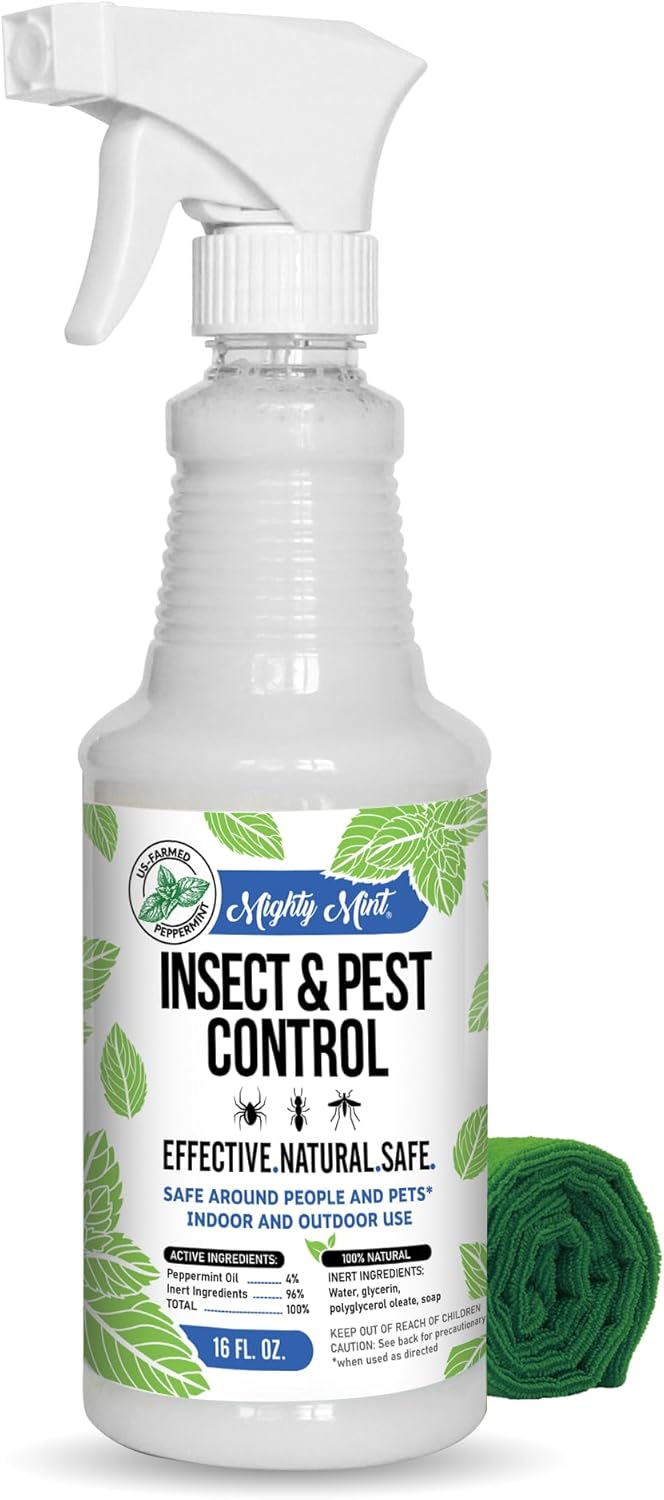
| Ingredients | Water, Glycerine, Polyglycerol oleate, Soap, Peppermint oil |
|---|---|
| Use Areas | Indoor / Outdoor |
| Size | 16 oz |
Mighty Mint is a plant-based, ready-to-use spray that uses concentrated peppermint oil to repel a broad range of household and patio pests. You apply it directly to problem areas such as baseboards, entryways, patios and around outdoor seating; the manufacturer recommends shaking and spraying until surfaces are covered and repeating applications two or more times per week for best results. Notable features include a peppermint-only scent profile, a formulation that avoids synthetic fragrances and the convenience of a 16 oz spray bottle for targeted spot treatments. Practical benefits are that it is safe to use around people and pets when dry and does not leave obvious stains on most surfaces, and the scent can make treated areas smell fresher than chemical alternatives. Important limitations are that it is a repellent rather than a pesticide so it works by discouraging pests rather than killing them, effectiveness depends on regular reapplication and it should not be applied when pollinators are present or to skin or food-contact surfaces.
Best for: Buyers who prioritize natural, low-toxicity solutions and want a targeted spray to reduce insects around patios and entryways while keeping family and pets in mind.
Less Ideal for: Anyone needing a one-time extermination or long-term residual pesticide for severe infestations should consider professional treatments or products formulated to kill pests rather than repel them.
- Plant-based peppermint formula that avoids synthetic fragrances
- Ready-to-use spray for quick, targeted indoor and outdoor applications
- Safe for people and pets when used as directed and allowed to dry
- Nonstaining on most surfaces and leaves a fresh mint scent
- Repels rather than kills insects so regular reapplication is needed to maintain protection
- Strong peppermint concentration may bother scent-sensitive individuals and requires keeping children and pets away until dry
Verdict: Choose Mighty Mint when you want a pet-friendly, plant-based spray to reduce patio and entryway insects with a fresh peppermint scent.
Choosing the Right Natural Carpenter Ant Killer: Key Factors to Consider
Mode of Action and Nest Reach
Carpenter ants nest inside wood and wall voids, so a product's ability to reach established galleries is the single most important factor. Contact-only botanicals can kill workers on sight but may not eliminate the queen or satellite nests. Baiting approaches using slow-acting, naturally derived insecticides allow workers to carry active ingredients back to the nest, which increases the chance of colony suppression.
When evaluating mode of action, consider whether the formulation is labeled for interior voids, exterior perimeter treatments, or both. Liquid concentrates that can be injected or foam formulations that expand into cavities often achieve better nest penetration than surface sprays alone. For outdoor use, systemic treatments around tree cavities and landscape timbers may reduce reinfestation from outside nest sites.
Application Method and Practicality
How you can apply a natural remedy affects both effectiveness and likelihood you will follow through with treatment. Ready-to-use sprays and aerosols are convenient for spot treatments and visible trails, but they may lack the residual carry needed to reach hidden nests. Concentrated liquids that mix in a pump sprayer, injection foams, and granular baits require more setup yet often give better coverage of galleries and perimeters.
Think about where ants are active: interior skirting boards, attics, crawlspaces, or exterior decking. Some natural options are safe for treated wood but not recommended for indoor use around ventilation intakes. Also check whether equipment like an injection nozzle or a foam applicator is included or required. Ease of application influences how thoroughly you can treat suspected galleries and monitor results over follow-up visits.
Residual Protection and Reapplication Needs
Residual control is crucial for carpenter ants because new workers and scouts continually probe the structure. Natural actives vary widely in how long they remain effective on surfaces or in baits. Oils and botanicals can break down faster in sunlight and rain, while some botanical-derived active ingredients have demonstrated longer residuals when formulated for structural use.
Expect to re-treat according to label directions, especially after heavy rain on exterior treatments. Longer residuals reduce the frequency of follow-up applications and the chance of reinfestation from nearby colonies. Match the residual profile to your site: short residuals can be acceptable for targeted nest injections, while perimeter treatments benefit from longer-lasting formulations.
Safety Around People, Pets, and Plants
One reason gardeners choose natural carpenter ant killers is to reduce exposure risks. However, natural does not automatically mean harmless. Essential oil concentrates can cause irritation to skin and respiratory tracts, and some botanical actives can be phytotoxic when applied directly to certain plants.
Review labeled restrictions for indoor use, food preparation surfaces, and proximity to livestock or pollinator-attractive plants. Choose formulations with clear dilution guidance and measures for minimizing non-target exposure, such as using bait stations, targeted injections, or perimeter barriers rather than broad broadcasts. Consider wearing simple protective gear during application and keeping children and pets away until treated areas dry or until label-specified re-entry times.
Inspection, Monitoring, and Follow-up
Treating carpenter ants is rarely a single-step process. Proper inspection to find entry points, galleries, and satellite nests improves treatment targeting. After initial application, monitor activity at trail sites, galleries, and damaged wood. Use sticky monitors or simple visual checks to judge whether workers return.
Plan for scheduled follow-up treatments if activity persists. Many natural approaches require multiple applications spaced to coincide with worker movement patterns. Good records of where and when you applied product help refine subsequent treatments and reduce unnecessary reapplication. Also inspect and address moisture issues that attract carpenter ants, such as leaking gutters or wood-to-soil contact, because treatment alone will not prevent reinfestation if habitat factors remain unchanged.
Environmental Durability and Weather Considerations
Outdoor carpenter ant control must withstand rain, sun, and seasonal temperature swings. Some natural actives are rapidly degraded by UV light or washed away by rain, reducing field efficacy. Others are formulated with carriers or microencapsulation to improve durability on exterior surfaces.
When selecting a product, note whether it is rated for exterior perimeter use and how long labels claim protection after application. Time outdoor treatments for dry weather windows and follow up after heavy rain. For climates with long wet seasons, choose approaches that emphasize nest-directed treatments or baiting rather than surface residuals alone.
Identifying Carpenter Ant Activity
Recognizing carpenter ant signs helps target natural treatments effectively. Look for smooth, clean galleries in damaged wood, piles of coarse frass near galleries, and worker traffic along baseboards or along wooden exterior features. Unlike termites, carpenter ants do not eat wood; they excavate it to create nests, so detecting wood shavings and the locations of worker trails points toward active galleries.
A focused inspection of attic eaves, soffits, window frames, and deck posts often reveals primary nest sites. Outdoors, check tree cavities, stumps, and siding gaps. Knowing where ants are entering the structure lets you decide between direct nest injection, perimeter baiting, or surface treatments using natural actives.
- Frass piles indicate internal excavation and help locate galleries.
- Worker size and behavior can suggest whether you are dealing with carpenter ants versus other species.
- Follow trails back to source areas before applying broad sprays.
Natural Baits Versus Contact Treatments
Natural baits rely on foraging workers to carry an active back to the nest, which can suppress colony members including the queen. Baits often use slow-acting, low-toxicity actives paired with attractive food matrices. They are a strategic choice when you can locate trails and bait in protected stations away from pets and children.
Contact treatments such as botanical sprays or soaps kill ants on contact and can reduce visible activity quickly. However, they may not reach the nest and therefore often require follow-up work. Many gardeners use a combined approach: bait to treat the colony and targeted contact treatments to clean up persistent surface activity.
- Use bait stations for safer placement and to prevent non-target access.
- Contact sprays are useful for visible trails but expect to recheck treated sites.
Treating Inside Wall Voids and Structural Wood
When nests are inside walls or structural timber, getting product into the gallery is key. Foam injectors or low-pressure sprayer tips can deliver natural formulations into crevices and voids. Some natural options are specifically labeled for crack-and-crevice injection and come with applicators that fit small openings.
Take care when drilling or injecting into structural members. Minimize damage by targeting visible entry points and use small-diameter injection ports where possible. If you are unsure about structural integrity, consult a building professional before aggressive cavity treatments.
- Use applicators designed for crack-and-crevice work to limit overspray.
- Avoid broadcast spraying on finished interior surfaces unless the product label allows it.
Managing Moisture and Habitat Drivers
Addressing moisture problems and wood contact with soil is an essential companion to any treatment. Carpenter ants prefer damp or decayed wood, so repairing leaks, replacing rotted boards, and improving ventilation reduces habitat suitability. Remove wood debris and stack firewood away from foundations to lower the chances of new colonies starting near your house.
Improved drainage and routine exterior inspections minimize conditions that attract colonies. Natural treatments control existing ants, but habitat modification reduces long-term reoccurrence.
- Fix roof leaks, poor flashing, and gutter issues promptly.
- Eliminate wood-to-soil contact and remove old stumps or debris near foundations.
Safety Practices for Home Use
Even natural actives require safe handling. Read and follow label directions carefully for mixing ratios, protective equipment, and re-entry intervals. Use bait stations to reduce exposure risk, and keep containers sealed and stored away from children and pets.
Ventilate treated indoor spaces and avoid applying botanical sprays near open food surfaces. For outdoor perimeter work, avoid treating flowering plants and keep applications on non-plant surfaces when labels indicate potential phytotoxicity.
- Wear gloves and eye protection when mixing concentrated products.
- Keep pets and children out of treated areas until dry or until label-specified times have passed.
How We Chose the Best Natural Carpenter Ant Killer
We selected products that address carpenter ant behavior in real homes and outdoor perimeters while keeping formulations based on natural active ingredients. Our editorial filters prioritized methods that reach nests hidden in wood and wall voids, methods that are practicable for homeowners to apply, and options that balance efficacy with minimized non-target risk. Evaluation criteria included mode of action and nest access, how long residual activity lasts on treated surfaces, labeled safety precautions and suitability for homes with pets or children, clarity of application instructions, and formulation stability for storage and repeated use. We excluded treatments that rely on unverified home remedies or proprietary blends with no listed active botanical agents. We also excluded products that require specialized professional-only equipment. The final shortlist favors products that provide clear directions for locating and treating galleries, supply repeat-application guidance, and include realistic expectations about how long control will take for established nests. These criteria align with practical needs when managing structural wood-infesting ants in and around houses.
FAQ
How long does it take for a natural treatment to eliminate a carpenter ant colony?
Treatment time varies. Baiting approaches may take days to weeks because workers must carry material back to the nest, while contact sprays can reduce visible activity immediately but may not eliminate the queen. Plan for monitoring and possible follow-up treatments over several weeks.
Are natural carpenter ant killers safe to use around pets and children?
Many natural products have lower mammalian toxicity than conventional insecticides, but they are not risk-free. Follow label directions, use bait stations or targeted injections, and keep pets and children away from treated areas until re-entry times have passed.
Can I use natural treatments on structural wood without damaging finishes?
Some natural formulations are suitable for crack-and-crevice work and will not harm finished surfaces when applied carefully. Always test a small inconspicuous area first and follow label instructions to avoid staining or phytotoxic effects.
Should I treat trees and stumps near my house?
Treating nearby trees, stumps, and landscape timbers can reduce sources of carpenter ant colonies. Focus on removing damaged wood and treating active nest sites rather than broad area sprays to limit impact on beneficial insects and reduce reinfestation risk.
When should I call a professional for carpenter ant control?
Consider professional help if you cannot locate the nest, if infestation is extensive across multiple areas, or if structural damage is evident. Professionals can inspect wall voids and access nesting sites safely while advising on structural repairs.
Final Verdict
Prioritize treatments that reach the nest and fit your home safety needs. Natural options can work well when you match mode of action to the infestation: baits for colony-level control and targeted injections or foams for nest galleries. Balance application convenience with residual needs and plan for inspection and follow-up. If you are dealing with interior nests or extensive structural activity, choose approaches that allow direct delivery into voids and pair treatment with moisture and wood-repair measures. Taking that combined approach gives the best chance of long-term control while minimizing risk to people, pets, and beneficial insects.
