

Note: This article contains affiliate links. If you click on these links and make a purchase, I may earn a small commission at no extra cost to you. This helps support my research and content. Read my full affiliate disclosure here.
Picking the right natural fertilizer for crops matters for yield, soil biology, and long-term field health. You want amendments that deliver the nutrients your plants need while building soil structure and microbial life, not quick fixes that harm soil over time. This guide shortlists seven practical options suited to crop production and explains how they behave in real planting situations. Each choice was evaluated for nutrient content, ease of use, and effects on soil biology. Read on to see the top picks and the criteria we used to judge them before you select the best fit for your acreage or market garden.
Top Picks at a Glance
| Best Overall The best all-around choice for most situations | Down To Earth Organic Vegetable Garden Fertilizer 4-4-4, 5 lb |  |
| Best Quality Built to a higher standard if you want something more solid | Down To Earth Bio-Live Organic Starter & Transplant Fertilizer, 5-4-2 (4 lb) |  |
| Best Value The sweet spot between price and what you get | Jobe's Organics Granular Tomato & Vegetable Fertilizer, 4 lb |  |
| Best Budget The cheapest option that still gets the job done reliably | True Organic Blood Meal — High‑Nitrogen Organic Fertilizer, 3 lb |  |
| Highest Rated A top-rated pick with lots of positive feedback | Wiggle Worm Pure Worm Castings Organic Fertilizer, 4.5 lb |  |
| Most Popular A crowd favorite that many people choose with confidence | Dr. Earth Organic Tomato, Vegetable & Herb Fertilizer (64 oz) |  |
| Best Seller A high-volume bestseller chosen again and again | Miracle-Gro Shake 'N Feed Tomato, Fruit & Vegetable Plant Food (1 lb) |  |
Down To Earth Organic Vegetable Garden Fertilizer 4-4-4, 5 lb

| Item Form | Granules |
|---|---|
| Specific Uses For Product | Vegetables, greens, tomatoes, herbs |
| Application Method | Apply directly to the soil or mix into garden beds |
| Mixing Ratio | 4-4-4 |
This granular fertilizer is formulated to feed vegetables, herbs and greens with a balanced 4-4-4 NPK and a slow-release profile that supplies nutrients over time. It is applied by distributing into the planting hole, mixing into topsoil, or working into raised beds at planting and during the season for maintenance. Notable features include all-natural ingredients sourced from plant, marine and mineral resources and OMRI-friendly formulation that supports organic gardening and beneficial soil life. Practically, the slow-release granules reduce the need for frequent feeding and help avoid nutrient spikes that can stress plants. The 5 lb unit is convenient for small to medium beds but means frequent repurchasing for larger plots. While it is versatile across vegetables and herbs, gardeners who need rapid corrective feeding for a specific deficiency will still need a targeted amendment or foliar feed in addition to this product.
Best for: Gardeners who prioritize steady, reliable plant performance and want an organic, low-maintenance fertilizer for raised beds and small plot vegetable production.
Less Ideal for: Growers managing large acreage or those needing immediate corrective nutrient treatments should look for bulk or fast-acting specialty products instead.
- Balanced 4-4-4 NPK suitable for overall vegetable development
- Slow-release granular formula for sustained feeding
- Made from all-natural ingredients and compatible with organic systems
- Easy to apply directly to soil or mix into raised beds
- Small 5 lb size may require frequent replacement for larger gardens
- Not formulated for quick correction of specific nutrient deficiencies
Verdict: Choose this product when you want an organic, slow-release 4-4-4 fertilizer that delivers steady nourishment for productive vegetable beds.
Down To Earth Bio-Live Organic Starter & Transplant Fertilizer, 5-4-2 (4 lb)
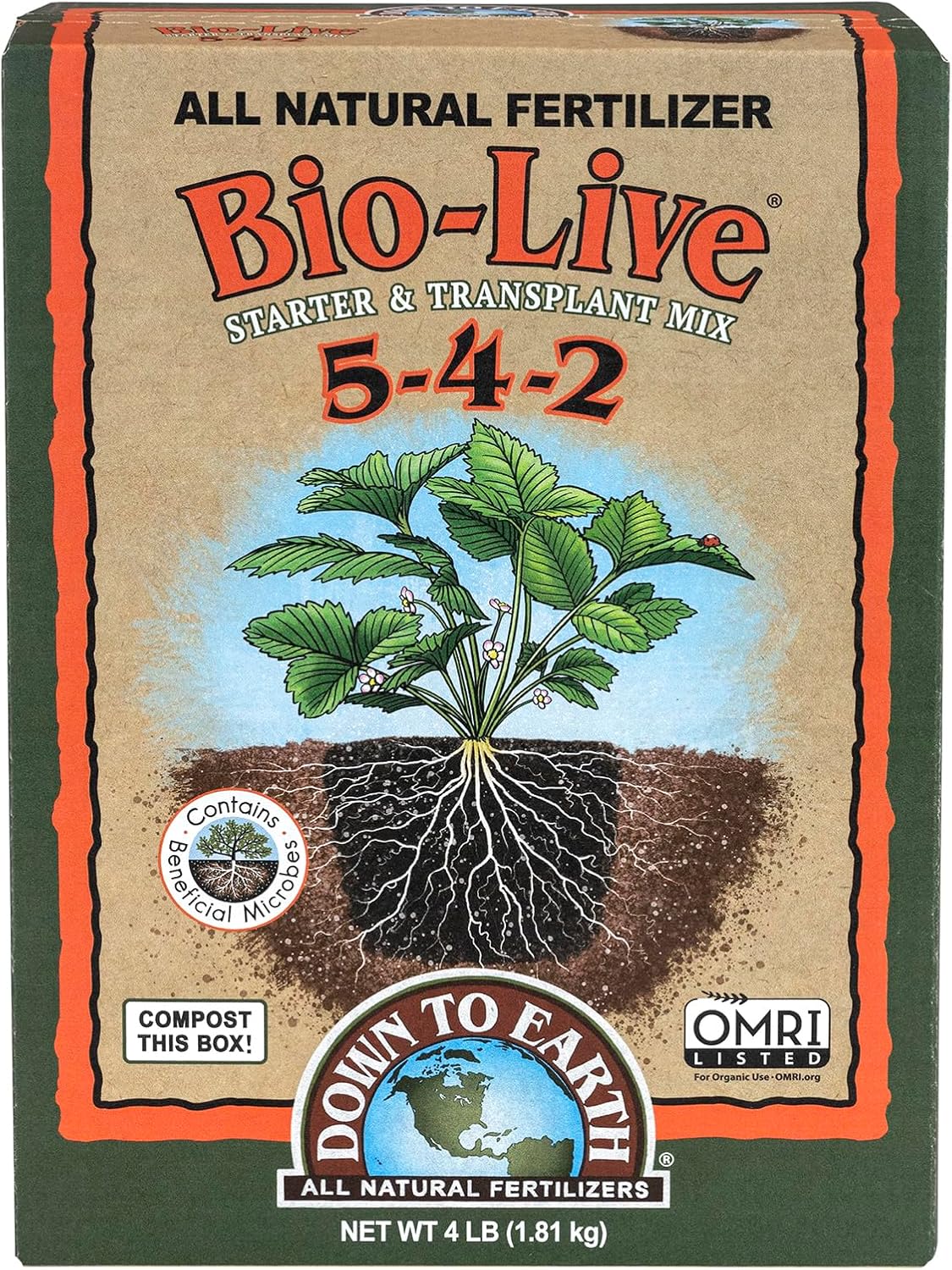
| Item Form | Powder |
|---|---|
| Application Method | soil drench |
| Coverage | 80 square feet |
| Mixing Ratio | 5:4:2 |
| Specific Uses For Product | Plant Growth |
Down To Earth Bio-Live is a granular organic starter and transplant mix designed to be worked into potting soil, garden beds, or soilless mixes to promote root development and early vigor. It combines marine- and plant-based meals with langbeinite, humates, seaweed, mycorrhizal fungi, and beneficial bacteria so planted roots make direct contact with both nutrients and inoculants. Typical use is pre-plant incorporation for containers or garden transplants and occasional soil drenches; the package lists a 5:4:2 mixing ratio and coverage around 80 square feet for the 4 lb unit. The practical benefits are stronger root colonization, improved early growth for seedlings and transplants, and organic nutrient sources that work with soil biology rather than supplying quick-release salts. Limitations to note are that it is not water soluble and must be mixed into the medium for best effect, the beneficial microbes have limited shelf life so storage matters, and the 4 lb box covers a modest area so larger container programs will need multiple units or larger sizes.
Best for: Serious container gardeners and vegetable growers who prioritize long-term plant performance and want an organic starter mix that strengthens roots and soil biology before planting.
Less Ideal for: Gardeners who need an immediate soluble fertilizer for foliar feeding or quick correction of nutrient deficiencies should consider a water-soluble product instead.
- Includes mycorrhizal fungi and beneficial bacteria to boost root colonization
- Uses marine and plant meals plus seaweed and humates for slow organic nutrition
- OMRI-listed formulation suitable for organic container growing
- Designed for pre-plant incorporation so nutrients and inoculants contact roots directly
- Not water soluble so cannot be used as a quick liquid feed
- Contains perishable microbes that lose efficacy after about two years if not stored properly
Verdict: Choose this product if you want an organic starter fertilizer that builds strong root systems and soil biology for better container plant performance.
Jobe's Organics Granular Tomato & Vegetable Fertilizer, 4 lb

| NPK | 2-5-3 |
|---|---|
| Item Form | Granules |
| Target Species | Vegetable and tomato |
| Unit Count | 64 Ounce |
Jobe's Organics granular fertilizer is a simple, slow-release feed designed specifically for tomato and vegetable beds. You apply the granules around plants every 4 to 6 weeks during the growing season to supply roots with nitrogen, phosphorus, and potassium in a 2-5-3 ratio aimed at fruiting and root development. The formula derives nutrients from bone meal and processed poultry manure and includes calcium and other micronutrients, which helps reduce blossom end rot and supports solid fruit set. Because it is OMRI listed it fits into organic vegetable production and is safe to use around children and pets when applied as directed. Practical gardeners will appreciate the measured, low-mess granular format and the moderate coverage for small to medium plots. Limitations are that it is not a fast-acting soluble feed for immediate correction and the 4 lb bag covers only a modest area, so larger vegetable gardens will need larger or repeated purchases.
Best for: Gardeners who prioritize organic, low-maintenance feeding for home vegetable and tomato beds and who want a measured, slow-release product for steady crop development.
Less Ideal for: Growers who need rapid correction of nutrient deficiencies or who manage large-scale vegetable plots and prefer concentrated or high-coverage fertilizers.
- OMRI listed for use in certified organic vegetable production
- Balanced 2-5-3 NPK with added calcium and micronutrients to support fruiting and root health
- Slow-release granular form feeds roots over time and reduces risk of over-fertilizing
- Easy to measure and apply for small to medium garden beds
- Not a quick soluble feed for immediate nutrient correction
- 4 lb bag provides only moderate coverage for larger vegetable gardens
Verdict: A reliable OMRI-listed granular feed that delivers balanced, slow-release nutrition ideal for home tomato and vegetable gardens.
True Organic Blood Meal — High‑Nitrogen Organic Fertilizer, 3 lb

| Item Form | Granules |
|---|---|
| Unit Count | 48 Ounce |
| Mixing Ratio | 12-0-0 |
| Specific Uses For Product | Agriculture, Gardening |
True Organic Blood Meal is a simple, single-ingredient granular fertilizer that supplies a concentrated source of nitrogen for leafy, heavy-feeding vegetables and ornamentals. It is typically applied to soil in spring and fall or worked into potting mixes for container crops to encourage rapid green growth. The product is made from blood meal and labeled with a 12-0-0 analysis, so it delivers mostly nitrogen without added phosphorus or potassium. Practical benefits include easy application, suitability for both beds and containers, and an organic input that supports soil microbial activity rather than introducing synthetic chemicals. The 3 lb bag is sized for small to medium gardens and the stated coverage gives a clear guideline for treating around 100 sq ft. Important limitations are that it only supplies nitrogen so it should be paired with a balanced fertility plan for blooms or root development, and like all high-nitrogen amendments it can burn plants if overapplied or placed in direct contact with roots. For risk-averse gardeners, following the mixing ratio and recommended timing will help get vigorous foliage without surprises.
Best for: Gardeners who prioritize predictable, organic nitrogen boosts for leafy crops and want a straightforward product with established application timing and coverage guidance.
Less Ideal for: Growers seeking an all-in-one fertilizer for blooms, fruits, or complete feeding regimes should choose a balanced or blended product instead.
- High nitrogen content (12-0-0) that rapidly promotes leafy growth
- Single-ingredient blood meal with no synthetic additives
- Suitable for both in-ground beds and container plants
- Clear coverage guidance for planning applications
- Provides only nitrogen so additional nutrients are needed for flowering and fruiting
- Risk of root burn if overapplied or placed in direct contact with plant roots
Verdict: Use this concentrated organic blood meal when you need a reliable, high-nitrogen boost to rapidly green up heavy-feeding vegetables and leafy plants.
Wiggle Worm Pure Worm Castings Organic Fertilizer, 4.5 lb

| Item Form | Granules |
|---|---|
| Specific Uses For Product | Soil Conditioning |
| Target Species | Houseplants, vegetables, flowers |
| Unit Count | 72 Ounce |
Wiggle Worm Pure Worm Castings are finely screened, 100% worm castings sold in a resealable 4.5 lb pouch for easy use around the garden or in containers. You sprinkle a small handful or up to a half cup around transplants, work a bit into planting holes, or mix one part castings to four parts potting soil for container plants. The material is odorless and non-burning so it is safe for vegetables, flowers, houseplants, and established perennials. Notable features include OMRI listing for organic use, a mineral-dense formula that supports microbial activity, and a multi-screened product that is free of debris and worm eggs. Practically, that means faster nutrient uptake from water-soluble forms, improved soil aeration and water retention, and a low-risk way to boost root health without synthetic fertilizers. Limitations are mostly practical: the 4.5 lb bag is small for larger beds or repeated top-dressing on lawns, and results are gradual rather than instant like some high-N synthetic feeds. The pouch is convenient for storage but you will need larger quantities for expansive gardens.
Best for: Buyers who prefer low-risk, natural soil amendments and want an easy-to-use organic option for containers, vegetables, and ornamental beds that supports long-term soil health.
Less Ideal for: Gardeners who need a quick, high-nitrogen boost or those with large lawns and beds who would prefer bulk-sized amendments for cost efficiency.
- OMRI listed organic product safe for certified organic gardens
- 100% pure, finely screened castings with minimal debris
- Odorless and non-burning so safe for seedlings and houseplants
- Improves soil structure, microbial activity, and water retention
- Small bag size may not be economical for large beds or frequent top-dressing
- Provides gradual, long-term nutrition rather than a fast-acting nutrient spike
Verdict: Choose this product if you want a proven, OMRI-listed pure worm casting that's safe and effective for building healthy soil in containers and small to medium garden beds.
Dr. Earth Organic Tomato, Vegetable & Herb Fertilizer (64 oz)

| Unit Count | 64 Ounce |
|---|---|
| Item Form | Granules |
| Specific Uses For Product | Organic |
| Target Species | Herb |
| Coverage | Medium |
This granular organic fertilizer is designed to boost vegetable and herb production by supplying balanced nutrients and soil biology support. It is typically broadcast into beds, mixed into potting mixes, or applied at planting and midseason for a nutritional lift; the manufacturer recommends reapplying every six weeks for containers. Notable features include a fully organic ingredient list, fast but sustained nutrient release, and a blend of probiotic microbes plus ecto and endo mycorrhizae intended to improve nutrient uptake and drought tolerance. In practice that means healthier root systems and potentially better yields and flavor in crops like cucumbers when used as part of an organic program. Limitations are that it is a medium coverage product in a 64 ounce bag so larger plots will need more frequent purchases, and it contains phosphorus so local runoff rules should be checked before use. Follow the directions for pH and application timing to avoid overapplication in small containers.
Best for: Gardeners who prioritize organic soil health and want a single, biology‑focused fertilizer to support vegetables like cucumbers in beds or containers.
Less Ideal for: Large‑scale growers seeking a bulk, high‑coverage fertilizer or those who must avoid phosphorus due to local regulations should consider other options.
- 100 percent organic formula suitable for certified organic gardens
- Contains beneficial microbes and eight strains of mycorrhizae to support root health and nutrient uptake
- Granular form releases nutrients quickly and continues feeding for several months
- Works for beds, raised planters and containers and can be used at planting, transplanting or midseason
- Bag is medium coverage so not economical for very large vegetable plots
- Includes phosphorus which may be restricted in some local jurisdictions
Verdict: Choose this product if you want an organic, microbe‑rich granular fertilizer that supports root health and steady feeding for cucumber and other vegetable plantings.
Miracle-Gro Shake 'N Feed Tomato, Fruit & Vegetable Plant Food (1 lb)

| Item Form | Granules |
|---|---|
| Target Species | Tomato, Fruit & Vegetable Plant Food |
| Unit Count | 16 Ounce |
| Item Type Name | Continuous Release Plant Food Plus Calcium |
| Coverage | Full |
Miracle-Gro Shake 'N Feed Tomato, Fruit & Vegetable is a granular, continuous-release fertilizer aimed at vegetable gardens and container-grown edibles. You apply it dry to the soil surface or mix it into potting mix at planting, then water to activate feeding that lasts up to three months. The formula includes natural ingredients that feed soil microbes and added calcium to strengthen cell walls and reduce common calcium-related disorders in fruiting crops. For container cucumbers this product provides steady nutrition without weekly liquid feeding and is simple to dose at planting or between seasons. Limitations include the fixed N-P-K profile and that it is not water-soluble for immediate foliar feeding, so rapid correction of major nutrient deficiencies will require a soluble supplement. It also requires correct incorporation or surface application and watering to avoid uneven distribution in small pots. Overall it is a low-effort option to keep container cucumbers producing through a season when used alongside regular watering and good potting mix.
Best for: Gardeners who want a low-maintenance fertilizing routine for container-grown cucumbers and value steady month-to-month feeding over frequent liquid feeds.
Less Ideal for: Growers who need rapid correction of a diagnosed nutrient deficiency or who prefer precise, water-soluble dosing for each watering cycle.
- Continuous-release granules feed plants for up to three months reducing application frequency
- Contains calcium to help prevent blossom end rot and improve fruit quality
- Formulated for fruits and vegetables and suitable for both in-ground and container use
- Feeds soil microbes via natural ingredients which can improve root health and nutrient availability
- Not water-soluble so it will not correct acute nutrient deficiencies quickly
- Fixed formulation may not match specific soil test recommendations for containers
Verdict: A convenient, slow-release granular feed that keeps container cucumbers nourished for months with minimal fuss.
Choosing the Right Natural Fertilizer for Crops: Key Factors to Consider
Nutrient Balance and Release Timing
Crop responses depend on both the quantity and timing of nutrient release. Natural fertilizers vary from quickly soluble sources to slow-release organics that mineralize over weeks or months. Matching a fertilizer's release curve to crop uptake reduces leaching and ensures nutrients are available when plants need them most.
Consider whether your crop needs an immediate nitrogen boost for leafy growth or a longer steady supply. Also think about phosphorus and potassium availability and whether the amendment supplies micronutrients. Planning fertility around planting, peak growth, and harvest windows will improve nutrient use efficiency.
Soil Biology and Organic Matter Benefits
Many natural fertilizers do more than feed plants; they feed soil life. Materials that add organic matter support microbial communities that cycle nutrients, improve aggregation, and enhance water-holding capacity. Over time, this builds tilth and reduces the need for frequent inputs.
Evaluate how an amendment affects soil structure and biology. High-carbon materials may immobilize nitrogen temporarily, while microbially active inputs can accelerate nutrient turnover. Choose fertilizers that complement your soil management goals, whether rebuilding degraded fields or maintaining already healthy soil.
Application Practicality for Field Use
How easy a fertilizer is to handle at farm scale affects labor, timing, and cost. Dry, pelletized, or granulated materials are often spreadable with standard broadcast or box spreaders. Liquid or slurry products require pumps and calibration. Some materials need pre-composting or blending to be safe and effective.
Consider storage space, equipment compatibility, and worker safety. The effort and tools required to apply an amendment determine whether it will be used correctly and consistently throughout the season.
Consistency, Quality Control, and Source Variability
Natural products can vary by batch, season, and supplier. Consistent nutrient content and predictable behavior reduce guesswork in fertility programs. Materials with certificates of analysis or clear sourcing practices are easier to manage across multiple plantings.
Where variability is high, plan for in-field testing and smaller trial rates. Reliable quality control helps you refine rates and avoid surprises like salt spikes or uneven crop response.
Environmental Impact and Food-Safety Risks
Natural does not always mean risk-free. Some organic amendments can carry pathogens, weed seeds, or heavy metals if not processed properly. Runoff potential, salt index, and odor also matter for neighboring fields and markets.
Select materials with acceptable contaminant levels and consider appropriate application timing to minimize runoff and food-safety concerns. Composting, testing, and adhering to best-management practices reduce environmental and market risks.
Cost, Availability, and Local Suitability
Practical fertility choices must be available and affordable in your region. Transport costs can make otherwise ideal amendments impractical for distant farms. Local availability also affects consistency and the ability to source the same material each season.
Factor in application frequency and long-term benefits; some higher-cost amendments can pay back through improved soil health and reduced future inputs. Balance short-term budget constraints with long-term agronomic results.
Matching Fertilizer Type to Crop Needs
Different crops and production systems have distinct nutrient priorities. Leafy vegetables often need steady nitrogen early, while fruiting crops require balanced phosphorus and potassium through flowering and fruit set. Grain crops may benefit from staged nitrogen applications timed to tillering and grain fill.
Start by mapping your crop's critical growth stages and peak nutrient demands. Use soil tests to identify baseline fertility and tailor the natural fertilizer choice and application schedule to fill specific gaps rather than applying blanket rates.
- Estimate peak uptake periods for primary nutrients.
- Use side-dress or split-application strategies where quick-release nutrients are required.
- Rely on soil tests and tissue tests to refine timing and rates.
Application Methods That Work at Scale
Popular application methods for natural fertilizers include broadcasting dry granules, banding concentrated materials near the seed row, incorporating composts, and applying liquid extracts through irrigation systems. Each method has tradeoffs for labor, placement accuracy, and nutrient availability.
For field crops, calibrated broadcast spreaders and coulter-injection for liquids can deliver uniform rates across acres. For smaller plots, hand-held spreaders and side-dressing with a hoe remain practical. Choose a method that matches your equipment and keeps nutrient placement consistent.
- Broadcasting is fastest but less precise for placement.
- Banding near roots increases efficiency for immobile nutrients like phosphorus.
- Liquid or soluble amendments can be applied through fertigation where irrigation infrastructure exists.
Composting and On-Farm Processing
On-farm composting transforms raw organic materials into stable, pathogen-reduced amendments that feed soil life. Compost adds organic matter, improves structure, and supplies a broad spectrum of nutrients. Proper composting requires temperature control, turning, and monitoring moisture and carbon-to-nitrogen ratios.
Processing manure, crop residues, and food waste into usable compost reduces waste and creates a local fertility source. However, compost nutrient concentrations are usually lower than concentrated fertilizers, so application volumes and logistics must be planned accordingly.
- Monitor pile temperatures to ensure pathogen kill.
- Aim for a well-aged compost to avoid nitrogen immobilization.
- Test finished compost for nutrient content before field application.
Integrating Cover Crops and Green Manures
Cover crops and green manures are living fertilizers that add nitrogen, organic matter, and root structure when terminated and incorporated. Leguminous covers fix atmospheric nitrogen, while grasses and brassicas contribute biomass that feeds soil microbes.
Select cover species that fit your rotation and termination window. The timing of incorporation affects when nutrients become available to the following cash crop, so plan cover crop termination to align with nutrient release needs.
- Use legumes to increase nitrogen without external inputs.
- Mix species to balance biomass production and soil benefits.
- Terminate at a stage that balances biomass and nutrient availability.
Testing and Adjusting Your Program
Regular soil and tissue testing helps you track nutrient status and the long-term effects of natural fertilizers. Tests reveal deficiencies, excesses, and trends in organic matter so you can adapt the program season to season.
Start with a baseline soil test, then monitor occasionally after key seasons. Adjust rates, application timing, and product choice based on measured responses rather than assumptions.
- Take tests from representative zones across fields.
- Compare results year-to-year to track improvements in organic matter.
- Use tissue tests during critical growth stages to fine-tune applications.
How We Chose the Best Natural Fertilizer for Crops
We prioritized criteria that reflect how natural fertilizers perform in working crop systems. First, nutrient profile and release rate were assessed to prefer sources that match common crop demands and offer predictable release timing. Second, soil biology impact was considered, favoring materials that feed microbes and improve structure rather than just supplying soluble salts. Third, ease of application and handling in field-scale operations was weighed, including whether the material is spreadable, compatible with common equipment, and safe to store. Fourth, consistency and variability were evaluated so gardeners can expect repeatable results across seasons. Finally, environmental and agronomic risks were filtered out; materials with high salt load, heavy metal concerns, or persistent odors that impede use on market or home sites were excluded. Excluded from consideration were synthetic or lab-formulated fertilizers and any material with documented contamination risks. The resulting shortlist focuses on natural amendments that combine usable nutrient content, positive soil biological effects, manageable application, and predictable field performance.
FAQ
How soon will crops respond after applying a natural fertilizer?
Response time depends on the material and nutrient form. Soluble natural fertilizers can show plant responses within days to weeks, while high-carbon or slow-mineralizing amendments may take several weeks to months as microbes break them down.
Can I use natural fertilizers instead of synthetic inputs for high-yielding crops?
Often you can, but it depends on yield goals and timeline. Natural amendments build soil health and supply nutrients, but they may require different timing or larger application volumes to match immediate nutrient demands of high-yield systems.
Are there contamination risks with natural fertilizers?
Yes. Untreated manures, biosolids, or poorly processed amendments can contain pathogens, weed seeds, or heavy metals. Use properly composted materials, test suspect inputs, and follow food-safety and environmental best practices.
How do I choose application rates for natural materials?
Base rates on soil test results and the nutrient concentration of the material. Because natural products can vary, use certificates of analysis where available and start with conservative trial rates while monitoring crop response.
Will natural fertilizers reduce the need for irrigation?
Materials that increase soil organic matter can improve water-holding capacity, which may reduce irrigation frequency over time. Immediate effects depend on the amendment and how much organic matter is added relative to field capacity.
Final Verdict
Selecting the best natural fertilizer for crops means balancing immediate nutrient needs with long-term soil health. Prioritize materials with an appropriate nutrient release pattern for your crop, a positive effect on soil biology, and a practical application method that fits your operation. Accept tradeoffs between speed and soil-building benefits. For many growers, combining targeted natural amendments with cover crops and compost provides predictable fertility while improving the field over seasons. Focus on testing and consistency to refine your approach and choose confidently for your production goals.
