

Note: This article contains affiliate links. If you click on these links and make a purchase, I may earn a small commission at no extra cost to you. This helps support my research and content. Read my full affiliate disclosure here.
If you need to remove unwanted turf without relying on synthetic herbicides, choosing the right natural grass killer matters for both results and soil health. In gardens, beds, and small clearance areas, the wrong product can scorch desirable plants or leave persistent residues in the soil. This guide covers six shortlisted natural options selected for their track record in killing grass while minimizing harm to surrounding plants and microbes. We evaluate each option on effectiveness, application safety, and how it interacts with soil and desirable vegetation. Read on to find the right approach for targeted turf control and safer site cleanup.
Top Picks at a Glance
| Best Overall The best all-around choice for most situations | Spruce Weed & Grass Killer Kit with Power Wand and 64 oz Refill |  |
| Best Quality Built to a higher standard if you want something more solid | Ortho GroundClear Weed & Grass Killer with Comfort Wand, 1.1 gal |  |
| Best Value The sweet spot between price and what you get | Spruce 64 oz Ready-to-Use Weed & Grass Killer Refill |  |
| Best Budget The cheapest option that still gets the job done reliably | Bonide Captain Jack's Deadweed Brew Ready-to-Use Spray, 32 oz |  |
| Highest Rated A top-rated pick with lots of positive feedback | Simply Vinegar Industrial Strength 49% Vinegar, 1 Gallon (Pack of 2) |  |
| Most Popular A crowd favorite that many people choose with confidence | Ortho GroundClear Weed & Grass Killer with Comfort Wand, 1 gal. |  |
Spruce Weed & Grass Killer Kit with Power Wand and 64 oz Refill

| Unit Count | 64 Fluid Ounces |
|---|---|
| Coverage | 1 bottle treats up to 400 weeds. |
| Item Highlight | Pet Safe Weed Killer Spray, Reusable Weed Sprayer, 2 AA Batteries Included |
| Item Form | Multiple |
This Spruce kit combines a 64 oz no-mix herbicide and a battery-powered wand to deliver quick, targeted spot treatments for broadleaf and grassy weeds. The ready-to-use formula is based on water, essential oils, and a surfactant so you do not measure or dilute anything before applying. The powered wand makes precise application easier for cracks, edges, and beds and comes with batteries to get started. Spruce claims visible leaf darkening within an hour and complete death by 24 hours, which is useful when you want fast results without systemic herbicides. The bottle is refillable and the reusable sprayer is rated for multiple years of use, reducing single-use waste. Important limitations are that it is non-selective so you must avoid desirable plants and grass, and best performance requires a dry, calm day above 60°F with no rain expected; users should follow the prime-and-aim instructions to get consistent spray. For gardeners seeking a pet-safe, quick-acting natural alternative for spot control, this kit is a practical choice.
Best for: Gardeners who want a fast, low-fuss natural spot-treatment for weeds and small grassy patches and who value precision application and reusable equipment.
Less Ideal for: People who need broad lawn-wide selective control or who cannot avoid treating near prized plants should choose a different product or method.
- Ready-to-use no-mix formula eliminates measuring and diluting
- Visible results often within 1 hour and full kill by 24 hours
- Battery-powered wand provides precise spot application for cracks and edges
- Formulated with water and essential oils and labeled safe around people and pets when used as directed
- Refillable bottle and reusable sprayer designed for multiple years of use
- Non-selective formula will damage nearby desirable plants if oversprayed
- Requires dry, calm conditions above 60°F and a rain-free period for best results
Verdict: A convenient, fast-acting natural spot treatment that pairs a refillable herbicide bottle with a powered wand for precise weed and grass control.
Ortho GroundClear Weed & Grass Killer with Comfort Wand, 1.1 gal

| Item Form | Liquid |
|---|---|
| Liquid Volume | 1.1 gallons |
| Coverage | non-selective broad spectrum coverage |
| Item Highlight | Kills Dandelions, Chickweed, Crabgrass, Moss & More |
Ortho GroundClear is a 1.1 gallon ready-to-use weed and grass killer designed for landscape and hardscape spot treatment. The formula is non-selective and OMRI listed, so it kills a broad range of weeds and grasses on contact and shows visible browning in about 15 minutes, becoming rainproof roughly two hours after drying. The included Comfort Wand makes it easy to aim at weeds growing in cracks, along walkways, or inside beds without needing separate spray equipment. It is best used when weeds are small and actively growing; perennial or established weeds may need repeat applications. Important practical limits are that it will damage desirable plants on contact and is not for use on lawns or edible plants, so careful aiming is required. For gardeners wanting quick, reliable knockdown of unwanted plants in non-lawn areas, this product delivers convenience and fast results, but precision during application and occasional retreatment on tough weeds are part of using it effectively.
Best for: Gardeners who need a powerful, fast-acting solution to clear weeds from patios, driveways, and landscape beds and who prioritize performance and convenience over selective control.
Less Ideal for: People who need a selective lawn herbicide or who maintain mixed beds with many desirable plants where accidental contact is likely.
- Fast visible results in about 15 minutes on many annual weeds
- Ready-to-use with an ergonomic Comfort Wand for precise spot application
- Becomes rainproof approximately two hours after drying
- OMRI listed, indicating suitability for some organic production systems
- Non-selective formula will damage any desirable plants it contacts
- Perennial or established weeds may require multiple treatments
Verdict: Choose this for fast, ready-to-use broad-spectrum weed knockdown in hardscapes and landscape beds when quick, reliable performance is the priority.
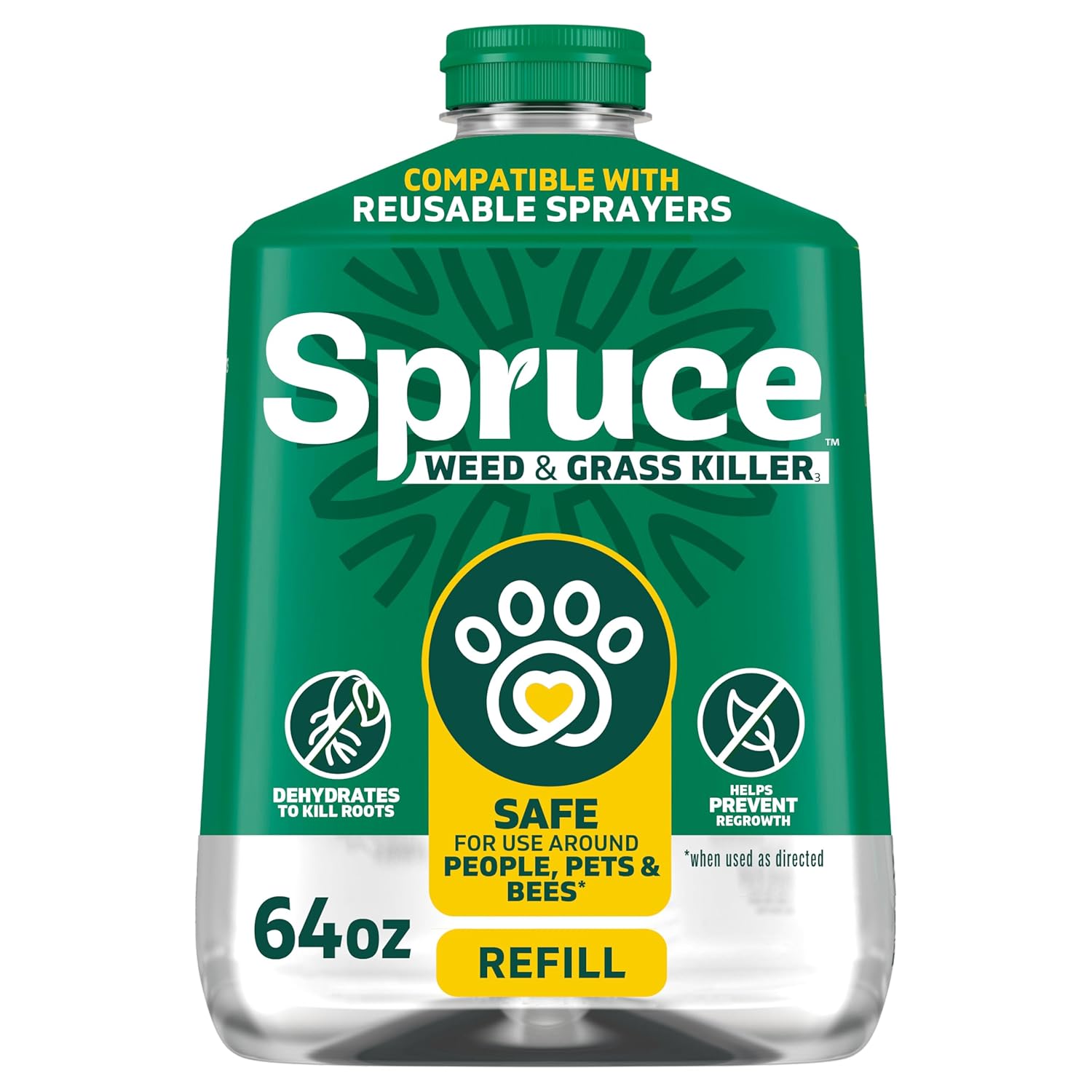
Spruce 64 oz Ready-to-Use Weed & Grass Killer Refill
| Unit Count | 64 Fluid Ounces |
|---|---|
| Item Form | Spray |
| Coverage | 1 bottle treats up to 400 weeds |
| Active Ingredients | Sodium Lauryl Sulfate, Geraniol, Cornmint Oil |
This Spruce 64 oz refill is designed to replenish the Snap & Spray kit so you can spot-treat weeds without mixing or pouring. It uses a water-based formula with essential oils and a surfactant that works on contact to dehydrate and kill broadleaf and grassy weeds, with visible leaf darkening or wilting in about an hour and complete death often by 24 hours. The refill snaps into the existing Spruce sprayer for quick replacement and a single bottle claims to treat up to 400 weeds, which makes it convenient for regular upkeep of driveways, pavers, mulch beds, and cracks. It is labeled safe for use around people and pets when used as directed and becomes rainproof about 10 minutes after application, which helps with short-term weather interruptions. Limitations include that it is non-selective so avoid spraying desirable plants or lawns, and results may be slower or require reapplication on well-established perennial weeds or in cool conditions below the recommended temperature range.
Best for: Gardeners who want a low-fuss, refillable natural-based solution to spot-treat weeds around hardscape and beds and who prioritize easy, mess-free refills and predictable short-term results.
Less Ideal for: Homeowners seeking a lawn-safe herbicide or a systemic long-term perennial root killer should look for a product formulated specifically for selective lawn treatments or systemic control.
- Ready-to-use refill eliminates mixing and pouring for faster applications
- Plant-based active ingredients and surfactant for contact dehydration of weeds
- Snaps into Spruce Snap & Spray handle for quick, mess-free swapping
- Rainproof within 10 minutes to reduce loss from light showers
- One 64 oz bottle claims coverage up to 400 weeds for efficient maintenance
- Non-selective formula that will damage desirable plants and lawns if oversprayed
- May require repeat applications on deep-rooted or mature perennial weeds
Verdict: Choose this refill if you want a convenient, ready-to-use natural spray that snaps into a reusable sprayer for fast spot control of weeds on driveways, pavers, and beds.
Bonide Captain Jack's Deadweed Brew Ready-to-Use Spray, 32 oz

| Unit Count | 32 Ounce |
|---|---|
| Item Form | Spray |
| Coverage | Annual |
| Active Ingredients | Herbicide |
Bonide Captain Jack's Deadweed Brew is a ready-to-use spray formulated to quickly kill common broadleaf weeds and grasses in gardens and hardscape areas. The product is marketed for visible spot treatment around flower beds, vegetable gardens, driveways, sidewalks, patios, and gravel where you need fast weed control without mixing concentrates. Notable features include an easy trigger nozzle, organic-friendly formulation approved for organic gardening, and activity at temperatures down to about 40°F. In practice the spray delivers visible wilting within hours and becomes rainproof once dry, so treated areas hold results after light moisture. Because it is non-selective you must avoid spraying desirable plants and follow label safety instructions. The 32-ounce bottle is convenient for spot treatments but may be small for larger lawns or heavy infestations, so budget-minded users should plan quantities accordingly. For gardeners wanting quick, organic-compatible spot control with minimal setup, this is a practical option.
Best for: Gardeners looking for an affordable, no-mix spot treatment to quickly remove visible weeds around beds, paths, and hard surfaces while keeping to organic-friendly products.
Less Ideal for: Homeowners who need a selective lawn-only herbicide or who plan to treat large acreages where concentrated products would be more economical.
- Ready-to-use spray requires no mixing and is simple to apply for spot treatments
- Approved for organic gardening so it fits organic-maintenance plans
- Fast-acting formula shows results within hours and becomes rainproof after drying
- Works at temperatures as low as 40°F enabling early- and late-season use
- Non-selective formula can damage desirable plants if oversprayed
- 32 oz bottle may not cover large lawns or heavy weed infestations
Verdict: A handy, organic-approved ready-to-use spray for budget-conscious gardeners who want quick spot control of visible weeds without mixing chemicals.
Simply Vinegar Industrial Strength 49% Vinegar, 1 Gallon (Pack of 2)

| Concentration | 49% Vinegar |
|---|---|
| Size | 128 oz |
| Material Feature | Biodegradable Warning |
| Manufacturer | Pure Origin Products |
Simply Vinegar 49% is a concentrated industrial-grade vinegar intended for heavy-duty cleaning and outdoor use. Sold in one-gallon containers, it is designed to be diluted for tasks that need strong acidity, such as stripping grime, removing mineral deposits, and spot treating persistent organic buildup. Notable features are its 49 percent acetic acid concentration and a formula free of bleach, dyes, and added chemicals, which makes its action straightforward and predictable. For outdoor weed control, the high concentration provides fast desiccation of foliage when applied directly, and a small amount diluted appropriately yields many gallons of working solution compared with household vinegar. Practical benefits include reduced packaging waste and consistent performance from batch to batch thanks to domestic manufacturing. Important limitations are that it is hazardous if mishandled, not for food use, and can damage desirable plants and some surfaces on contact, so careful mixing, targeted application, and protective equipment are essential.
Best for: Buyers who prioritize a dependable, concentrated natural option for tough outdoor and cleaning jobs and who plan to handle and dilute strong acids safely.
Less Ideal for: Casual gardeners or users who prefer ready-to-use, low-risk products or who lack protective gear and experience working with concentrated acids.
- Very high 49% acetic acid concentration provides rapid, powerful acidity for heavy-duty cleaning and plant desiccation
- Free of bleach, dyes, and added chemicals, giving a simple biodegradable formula
- Concentrated gallon size yields many gallons of working solution when diluted, reducing storage needs
- Made in the USA with consistent manufacturing for predictable batch-to-batch performance
- Hazardous at full strength and not safe for food use, requiring gloves and eye protection
- Can harm desirable plants, stained surfaces, and some finishes on contact
Verdict: A reliable, high-strength concentrated vinegar for users who need consistent, powerful natural cleaning or targeted plant desiccation when handled with proper safety.
Ortho GroundClear Weed & Grass Killer with Comfort Wand, 1 gal.

| Item Form | Spray |
|---|---|
| Coverage | 5120 square feet |
| Liquid Volume | 128 fluid ounces |
| Active Ingredients | Ammonium Nonanoate |
Ortho GroundClear is a one-gallon ready-to-use weed and grass spray designed for spot treatment around walkways, driveways and landscape beds. The formula contains ammonium nonanoate and is OMRI listed for organic use, so it works on contact and browns most weeds within hours with visible effects in about 15 minutes. The included Comfort Wand lets you aim the spray precisely at unwanted plants to avoid desirable vegetation. It becomes rainproof about two hours after drying, which helps protect your application from light rain. Coverage is listed at 5,120 square feet so a single bottle will treat multiple small areas. Limitations: perennial or well-established weeds may need repeat applications and the product is not for use on lawns or desirable plants; users must avoid drift and keep children and pets out of treated areas until dry. For buyers who prefer an OMRI-listed, contact-based natural option, this product delivers quick, targeted control with straightforward use.
Best for: Buyers who want a natural, OMRI-listed contact weed killer for quick, targeted removal in hardscapes and landscape beds and who prioritize proof of effectiveness before committing to larger treatments.
Less Ideal for: Gardeners looking to treat or renovate turf or those who need a systemic long-term solution for deep-rooted perennials should choose a different product.
- OMRI listed active ingredient suitable for organic production contexts
- Fast visible results in about 15 minutes after application
- Comfort Wand enables precise, targeted spraying to minimize contact with desirable plants
- Becomes rainproof roughly two hours after drying to protect results
- Large 1 gal ready-to-use container covers up to 5,120 sq ft for multiple spot treatments
- Contact herbicide action means established perennials may require several treatments
- Not safe for use on lawns or desirable plants and requires care to avoid drift
Verdict: A fast, OMRI-listed contact spray that gives quick, targeted control of surface weeds in landscapes and hardscapes.
Choosing the Right Natural Grass Killer: Key Factors to Consider
Active Ingredient and Mode of Action
Know what actually kills the grass. Natural options use different active modes, such as acetic acid that burns foliage, citric acid or soap formulations that disrupt cell membranes, or physical methods that remove roots. Understanding the mode of action matters because some approaches only desiccate aboveground growth and allow regrowth from rhizomes or stolons, while others weaken roots and reduce regrowth probability.
Matching the mode of action to the grass species and the depth of the root system will change outcomes. For example, tough warm-season grasses with deep, creeping roots often need treatments that affect root vigor or multiple repeat applications to exhaust energy reserves. Also consider whether the active ingredient is neutralized quickly in soil or can persist and affect the next planting.
Selectivity and Risk to Nearby Plants
Natural does not mean selective. Many natural grass killers are nonselective and will damage any green tissue they contact. When treating patches near desirable lawns, flower beds, or vegetable plantings, plan for physical barriers, spot treatment methods, or hand removal to protect nearby plants.
Assess how easily the product can be applied in a controlled way. Liquid sprays and volatile acids carry higher drift or splash risk, while gels, foams, or brush-on pastes allow more precise placement. Consider wind conditions, proximity of low-growing plants, and whether you can safely water or irrigate after treatment without moving the active material.
Soil Health and Microbial Effects
Gardeners often choose natural paths to protect soil life. Some natural herbicides temporarily lower microbial activity or alter soil pH where applied. Others are broken down rapidly by microbes and sunlight, leaving little lasting impact. Think about whether you plan to replant the treated area with ornamentals or vegetables and how soon.
If immediate replanting is planned, choose treatments with minimal soil persistence or remove treated soil top layers after the grass has died. In larger clearances, consider amending with compost or allowing a rest period so soil biology can recover before introducing sensitive transplants.
Number of Applications and Timeframe
Many natural solutions require repeat treatments to reach the same level of control as synthetic herbicides. Some approaches show visible browning within days but need follow-up to kill roots, while others take weeks to cause plant decline. Factor in how quickly you need the area cleared and your willingness to monitor and reapply.
If you are working on a seasonal schedule, plan applications well before planting or hardscaping deadlines. For eradication of aggressive perennial grasses, multiple applications spaced over several weeks or months may be necessary to prevent regrowth from underground parts.
Application Method and Equipment
Consider what you have on hand and what the job demands. Small patches are often best handled with hand tools and targeted topical treatments, while larger areas benefit from pump sprayers, wipers, or foam applicators designed to limit drift. Some natural concentrates need dilution and careful mixing; others are ready-to-use liquids or gels.
Think about cleaning requirements and storage safety. Equipment that is hard to clean can carry residues to other areas, so dedicate or thoroughly rinse sprayers used with stronger acids or oil-based extracts. Also plan for safe disposal of emptied containers or leftover concentrate according to local recommendations.
Post-treatment Site Management
After grass has been killed, the way you handle the site affects how quickly it can be repurposed. Dead grass can form a mulch layer that inhibits planting unless removed. Removal methods include raking, sod cutting, or rototilling, depending on scale and desired finish.
If you plan to seed or install new plants, test soil and amend where necessary. For replanting with sensitive species, allow a waiting period or remove the topsoil if the treatment had notable soil impact. For permanent hardscape installation, ensure all root material is removed to prevent regrowth beneath structures.
When to Use Natural Grass Killers Instead of Physical Removal
Hand-pulling, sod cutting, and solarization are effective for some jobs but are labor intensive for large patches or deeply rooted grasses. Natural treatments are a pragmatic choice when physical removal is impractical or when you need to kill turf in awkward spots such as between paving stones, along fences, or beneath established shrubs where digging would damage desirable roots.
Use chemical-free options when soil preservation is a priority or when you need to avoid disturbing neighboring plantings. For small, targeted areas, natural killers can reduce back strain and speed up site prep while still aligning with low-toxicity gardening practices.
- Best for hard-to-reach patches and edges
- Useful when you want to avoid major soil disturbance
- Suitable for gardeners prioritizing lower chemical persistence
Application Timing and Weather Considerations
Timing affects outcomes. Apply on dry, calm days when plants are actively growing so herbicidal action moves into tissues. Avoid application before rain unless the product label indicates rainfast times, because rainfall can wash away surface-active treatments before they act.
Temperature matters too. Very hot weather accelerates desiccation but may increase volatilization or risk to nearby plants. Cooler, cloudy conditions can slow visible results and may require follow-up. Plan treatments when you can monitor results and reapply if needed.
- Choose calm, dry conditions to reduce drift
- Avoid rain within the product's rainfast window
- Consider the grass growth stage for best uptake
Preparing the Site Before Treatment
Clear debris and mow or trim tall growth if needed so the active product reaches fresh foliage. Removing litter improves contact and helps you see treated areas for targeted follow-up. For dense mats, slight raking can improve spray penetration but avoid exposing bare soil that you plan to keep intact.
Protect desirable plants with physical barriers or by wetting their foliage and covering it temporarily if necessary. Mark treatment zones clearly so you do not overlap into beds or newly seeded areas.
- Mow or trim for better coverage
- Use shields or cardboard to protect nearby plants
- Mark and map treatment areas before applying
Safe Handling and Personal Protection
Even natural active ingredients can irritate skin, eyes, or respiratory systems. Wear protective gloves, eye protection, and a mask when mixing strong concentrates or applying acids. Wash hands and exposed skin after handling and clean equipment promptly to prevent unintended contact.
Keep pets and children away from treated zones until surfaces have dried and any residue has been neutralized per product guidance. Store concentrates securely away from food and garden supplies.
- Use gloves and eye protection for concentrated solutions
- Avoid inhaling sprays or mists
- Keep treated areas off-limits until dry
Transitioning the Area to New Plantings
Once the grass has died, decide whether to remove the dead vegetation or leave it as mulch. For seeding, cleared soil with removed dead matter gives better seed-to-soil contact. For beds, leaving mulch can conserve moisture but may slow root establishment for new transplants.
If the chosen treatment has any soil persistence, allow a recovery window or blend in fresh topsoil before planting sensitive species. Test a small transplant area first if you are unsure how the site will respond.
- Remove dead turf for seeding or fine-textured plantings
- Allow a recovery period for soil-active treatments
- Add compost or topsoil to improve establishment if needed
How We Chose the Best Natural Grass Killer
We prioritized products and approaches that deliver practical turf removal while limiting ecological impact. Selection began with broad candidate types commonly used by gardeners, then filtered for methods with verifiable active mechanisms that remove grass top-growth and reduce regrowth. We excluded experimental homebrew mixes with no reproducible results and any treatments known to leave long-lasting soil phytotoxicity. Key evaluation criteria included kill effectiveness on established grass species, speed of visible results, residual impact on soil biology and subsequent planting, application safety for surrounding ornamentals and edibles, and ease of controlling spread during application. We also considered required application frequency and how weather affects performance in typical garden conditions. Sources included manufacturer usage directions, extension-service guidance, and practical gardening reports to assess real-world behavior. Treatments that required specialized equipment or posed elevated drift risk were deprioritized. The final list reflects options that balance reliable turf removal with lower environmental risk for small-scale garden and landscape work.
FAQ
Are natural grass killers safe for vegetable gardens nearby?
Often they are safer than synthetic herbicides, but safety depends on the active ingredient and application control. Use targeted application methods and protect nearby edible plants with barriers. If the product affects soil, wait the recommended period before planting edibles.
How soon can I replant after using a natural grass killer?
It depends on the treatment. Some foliar desiccants break down quickly and allow replanting in days, while soil-active options may require a waiting period or removal of the top layer. Check product guidance and consider a small test planting first.
Will a single application kill deeply rooted or creeping grasses?
Usually no. Deeply rooted or rhizomatous grasses often need repeated applications or combined mechanical removal because single foliar treatments may not fully exhaust root reserves.
Can I use household vinegar to kill grass?
Household vinegar can burn foliage but often lacks concentration to kill roots, especially in mature turf. Stronger acetic acid formulations can be effective but carry higher risk of harming nearby plants and soil, so apply with care.
What is the best way to limit drift during application?
Choose a low-drift applicator such as a foam brush or wiper for spot treatments, apply on calm days, and avoid spray nozzles that create fine mist. Physical shields and careful distance from desirable plants further reduce accidental contact.
Do natural grass killers leave long-term residues in soil?
Most natural actives degrade relatively quickly, but persistence varies by chemistry and dose. Oils and some salts can temporarily alter soil properties. When in doubt, allow a recovery period or mix in fresh organic matter before planting.
Final Verdict
For gardeners seeking to remove unwanted turf while minimizing ecological impact, prioritize the active mode of action, application precision, and soil effects. Expect tradeoffs: gentler, low-persistence options often need more applications, while more aggressive natural chemistries increase risk to nearby plants. Decide first how soon and how thoroughly you need the area cleared, then choose an approach that matches that timeline and your tolerance for follow-up work. With careful timing, proper protection for adjacent plantings, and appropriate site cleanup, natural grass killers can be an effective part of a low-toxicity garden plan.
