

Note: This article contains affiliate links. If you click on these links and make a purchase, I may earn a small commission at no extra cost to you. This helps support my research and content. Read my full affiliate disclosure here.
Keeping the strip along a fence clean changes how your yard looks and how the fence performs. When grass and weeds crowd fence posts and rails they can trap moisture, hide rot, and make mowing harder. Choosing the right grass killer for a fence line matters because you need targeted control that prevents regrowth without harming nearby plants or lawn. This guide covers our shortlist of the top options for fence-line use and explains the practical differences that matter in a real garden. We evaluated each product for how easy it is to apply along narrow edges, how long the barrier lasts, and how safe and predictable it is near desirable plants. Read on to understand the tradeoffs and find the most appropriate control approach for your fence line needs.
Top Picks at a Glance
| Best Overall The best all-around choice for most situations | Compare-N-Save Glyphosate Concentrate Grass & Weed Killer, 2.5 Gallon |  |
| Best Quality Built to a higher standard if you want something more solid | Spectracide Weed & Grass Killer Ready-to-Use (32 fl oz, Pack of 2) |  |
| Best Value The sweet spot between price and what you get | RM43 Total Veg Control Glyph Imazapyr Weed Preventer, 32 oz |  |
| Best Budget The cheapest option that still gets the job done reliably | Ortho GroundClear Year-Long Vegetation Killer2 Concentrate, 32 fl oz |  |
| Highest Rated A top-rated pick with lots of positive feedback | RM43 Total Vegetation Control 43% Glyphosate Plus Weed Preventer, 2.5-Gallon |  |
| Most Popular A crowd favorite that many people choose with confidence | Spectracide Weed & Grass Killer with AccuShot Power Sprayer, 1.33 Gal |  |
| Best Seller A high-volume bestseller chosen again and again | Roundup Weed & Grass Killer with Comfort Wand, 1.33 gal. |  |
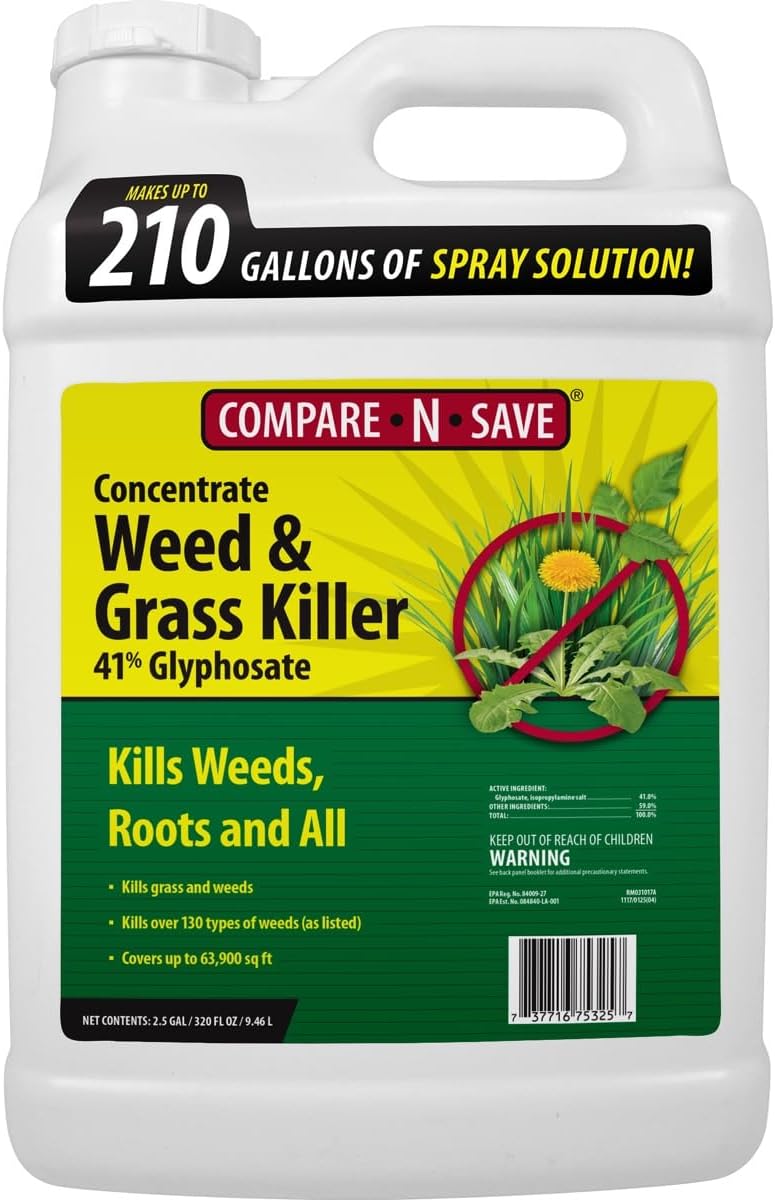
Compare-N-Save Glyphosate Concentrate Grass & Weed Killer, 2.5 Gallon
| Liquid Volume | 2.5 gallons |
|---|---|
| Active Ingredients | glyphosate |
| Coverage | 630000 square feet |
| Item Form | Spray |
This 2.5 gallon concentrate is built for clearing persistent grass and weeds along fence lines, driveways, and other nonlawn areas. Mix with water to create ready-to-use spray; the label recommends 1.5 ounces per gallon for general control and a higher rate for tough perennials, and a single application typically shows visible browning in 2 to 4 days. Because glyphosate is absorbed through foliage and moves to the root, it provides reliable kill-to-root performance, making it useful for lawn renovation, brush control, and preparatory clearing before planting. The product makes a large volume of spray so one container treats a lot of area without repeated trips to the store. Important limitations are that it will kill any green plants it contacts and offers no residual prevention of new growth, so careful targeting and following safety directions are required when used near desirable plants or edible gardens. Apply on calm, warm days and follow label instructions for mixing, rainproof time, and replanting intervals.
Best for: Gardeners and homeowners who need a proven, high‑volume herbicide to clear fence lines, driveways, and areas for lawn renovation and want a product that kills to the root with minimal repeat applications.
Less Ideal for: People who need a selective lawn-safe option or who want a product that prevents future weed growth should consider alternative or residual herbicides.
- Concentrated formula makes up to 210 gallons of ready-to-use spray for large coverage
- Contains 41% glyphosate for effective translocated kill to roots of most annual and perennial weeds
- Works quickly with visible results in 2 to 4 days and rainproof in about 2 hours
- Versatile for fence lines, driveways, garden preparation, brush control, and stump treatment
- Nonselective and will kill any green plant it contacts, requiring careful application
- No residual activity so it will not prevent future weed germination
Verdict: A concentrated, fast-acting glyphosate solution designed to clear fence lines and large areas effectively with one strong application.
Spectracide Weed & Grass Killer Ready-to-Use (32 fl oz, Pack of 2)

| Item Form | Spray |
|---|---|
| Coverage | 320 square feet |
| Liquid Volume | 32 fluid ounces |
| Active Ingredients | Herbicide |
Spectracide Weed & Grass Killer is a ready-to-use trigger-sprayer herbicide formulated to deliver visible results in as little as three hours and to be rainfast in about 15 minutes. It is non-selective and designed for spot or area cleanup on patios, walkways, driveways, around foundations, and for lawn renovation where you want to remove existing turf and weeds. The spray acts through foliar contact and translocates to roots so treated plants die down rather than just yellowing briefly. Practical benefits include easy application from the built-in sprayer, no mixing required, and rapid effectiveness that lets you see progress the same day. Because it has no soil activity you can replant ornamentals after a day and wait seven days before reseeding turf. Important limitations are that it will kill any vegetation it touches so careful masking of desirable plants and calm, low-wind conditions are required to avoid drift, and it is not for selective spot treatment within a healthy lawn. As a fast, simple option for clearing unwanted growth prior to renovation or cleanup, it is convenient but demands cautious application near desirable plants.
Best for: Buyers who want a quick, no-mix solution to clear large patches of weeds and prepare areas for lawn renovation or hardscape cleanup while minimizing application hassle.
Less Ideal for: Gardeners seeking a selective lawn weed killer or those needing a product for frequent spot treatments within established turf should consider alternatives.
- Ready-to-use sprayer requires no mixing and is easy to apply
- Visible results in as little as three hours and rainfast in 15 minutes
- Translocates to roots to kill entire plant rather than only foliage
- No soil activity so nearby untreated plants are not affected
- Non-selective formula will kill any plants it contacts, requiring careful protection of desirable vegetation
- Not suitable for spot-treating weeds in a lawn because it will damage grass where applied
Verdict: An easy, fast-acting ready-to-use spray that quickly removes weeds and grass for cleanups and lawn renovation with minimal prep.
RM43 Total Veg Control Glyph Imazapyr Weed Preventer, 32 oz

| Unit Count | 32 Ounce |
|---|---|
| Item Form | Spray |
| Coverage | 4324 square foot |
| Liquid Volume | 0.25 gallons |
RM43 Total Veg Control combines two herbicides plus a surfactant to deliver long-lasting bare-ground control for noncrop areas. It is formulated for spot treatments around fence rows, gravel driveways, farm buildings and other places where no vegetation is desired. A 32 oz bottle makes up to about 5 gallons of spray solution and is labeled to treat roughly 4,324 square feet. The formula is rainfast in two hours and the product claims prevention of new growth for up to 12 months, which is useful for low-maintenance driveway and roadside applications. Important practical points are clear directions to avoid desirable plants and to apply only where you want no vegetation; there are no post-application entry restrictions once the spray has dried. On the downside this is a nonselective, persistent herbicide so it is not suitable for areas adjacent to turf or ornamentals and requires careful application to avoid runoff or drift. Protective handling and adherence to label directions are essential when using it on gravel driveways and similar sites.
Best for: Buyers who need a high-performance, long-lasting solution to keep gravel driveways and other noncrop areas free of weeds and brush with minimal repeat applications.
Less Ideal for: Homeowners who need selective control near lawns, gardens, trees or ornamentals should choose a more targeted product or consult a professional applicator.
- Combination of two active herbicides plus surfactant for strong, long-lasting control
- Covers approximately 4,324 sq ft per bottle when mixed as directed
- Rainfast in about two hours so treated areas are less affected by short-term rain
- Labeled for use on noncrop areas and makes up to about 5 gallons of spray solution for spot work
- Nonselective and persistent so it can damage desirable plants if misapplied
- Contains concentrated active ingredients that require careful protective handling
Verdict: Choose RM43 Total Veg Control when you want a powerful, long-lasting bare-ground herbicide to keep gravel driveways and similar noncrop areas clear of vegetation for up to a year.
Ortho GroundClear Year-Long Vegetation Killer2 Concentrate, 32 fl oz

| Liquid Volume | 32 fluid ounces |
|---|---|
| Coverage | 300 square feet |
| Item Form | Liquid |
| Active Ingredients | Imazapyr; Isotropylamine Salt; Pelargonic Acid |
Ortho GroundClear is a fast-acting concentrate designed for homeowners who need long-term suppression of weeds and grasses on hardscape areas. Mix 24 fl. oz. per gallon of water and apply with a tank sprayer to driveways, patios, gravel, fence lines, and other spots where you do not want any plant growth. The formula starts working immediately and becomes rainproof in about an hour, so light showers shortly after application are less likely to reduce effectiveness. A single 32 fl. oz. bottle makes roughly 1.33 gallons of spray and can treat about 300 to 400 square feet depending on label directions. Active ingredients include imazapyr and pelargonic acid, giving both systemic and contact action for thorough kill and up to 12 months of prevention. Important limitations are that it is non-selective so it will kill desirable plants on contact and must be used only where no vegetation is wanted, and it requires careful handling and follow of safety instructions. For budget-focused buyers it delivers long coverage per bottle, reducing how often you need to reapply compared with short-term products.
Best for: Homeowners who need a low-cost, long-lasting herbicide to keep driveways, patios, walkways, and gravel areas free of weeds without frequent reapplication.
Less Ideal for: Gardeners who need to selectively remove weeds from planted beds or who prefer ready-to-use sprays for spot treatments should look for a selective or RTU product instead.
- Year-long prevention of regrowth reduces frequency of reapplication
- Fast-acting and rainproof in about one hour so treatments hold up in changing weather
- Concentrate format treats several hundred square feet from one bottle
- Effective on hardscape and gravel where no plants are desired
- Non-selective formula will damage or kill any desirable plants it contacts
- Requires mixing and a sprayer rather than ready-to-use convenience
Verdict: If you want one concentrated bottle that treats several hundred square feet and keeps hardscape areas weed-free for up to a year, this product delivers strong long-term value.
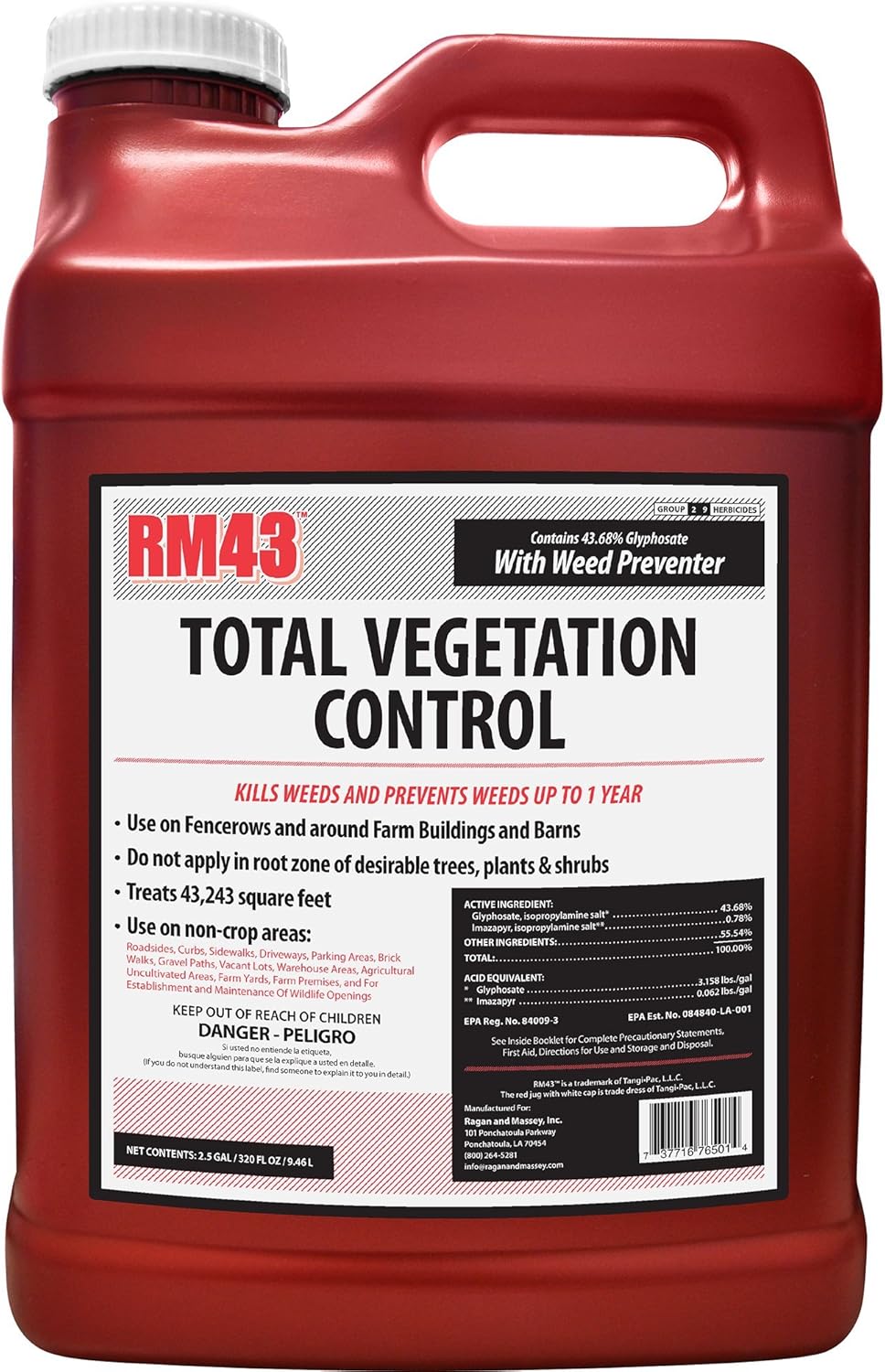
RM43 Total Vegetation Control 43% Glyphosate Plus Weed Preventer, 2.5-Gallon
| Unit Count | 320 Fluid Ounces |
|---|---|
| Liquid Volume | 320 fluid ounces |
| Coverage | 243 243 square feet |
| Active Ingredients | Glyphosate isopropylamine salt, Imazapyr isopropylamine salt |
RM43 Total Vegetation Control is a concentrated 2.5‑gallon herbicide intended for killing existing growth and preventing regrowth for up to a year on areas where no vegetation is desired. You mix it into spray solution and apply to hardscape edges, gravel driveways, fence rows, and around buildings as either spot treatments or blanket applications on bare ground. The formula pairs glyphosate and imazapyr with a surfactant so it kills grasses, broadleaf weeds, vines, brush and some woody growth and becomes rainfast in about two hours. Practical benefits for driveway use include long residual control that reduces repeat spraying and a large coverage rate that treats many square feet from one container. Important limitations are that it is for non‑crop areas only and will damage desirable plants if sprayed over roots or drift occurs, and the active ingredient blend makes it persistent so care is required where you may later want vegetation to return. Follow label directions for mixing, application timing and safety precautions when using near soil that will be planted later.
Best for: Gardeners, property owners, and maintenance crews who prioritize strong, long‑lasting weed eradication on gravel driveways and other non‑crop hardscape areas and want to minimize repeat applications.
Less Ideal for: Homeowners planning to replant treated areas soon or those needing selective weed control near desirable plants should choose a less persistent or more targeted product.
- Combination of glyphosate and imazapyr for both knockdown and long residual control
- Concentrated 2.5‑gallon container covers large areas without frequent refills
- Rainfast in about two hours so light rain soon after application is less likely to reduce effectiveness
- Suitable for total vegetation control on gravel driveways, fence rows and other non‑crop areas
- Persistent active ingredients that can prevent desirable vegetation from reestablishing for an extended period
- Not safe for use where desirable plant roots may be exposed or where drift could contact nearby plants
Verdict: Choose RM43 when you need a single, heavy‑duty application that delivers broad spectrum kill and up to a year of weed prevention on gravel driveways and other non‑crop surfaces.
Spectracide Weed & Grass Killer with AccuShot Power Sprayer, 1.33 Gal

| Unit Count | 170 Fluid Ounces |
|---|---|
| Item Form | Spray |
| Coverage | 1 gallon |
| Active Ingredients | Diquat Dibromide 0.12%, Fluazifop-p-butyl 0.06%, Dicamba 0.04% |
Spectracide Weed & Grass Killer pairs a concentrated non-selective formula with a battery-powered AccuShot sprayer to clear weeds from driveway cracks, patios and around foundations. The product is used by aiming and spraying foliage until leaves are covered; the active ingredients move through the leaf to the root and can show visible die-back in as little as three hours. The AccuShot wand is extendable and provides continuous spray without manual pumping, which improves accuracy for narrow cracks and reduces hand fatigue during larger jobs. It is rainproof within 15 minutes, so treated areas are protected quickly. Practical benefits include fast results that let you replant or resume use of the area within a day and a reusable sprayer for follow-up applications. Important limitations are that the herbicide is non-selective so it will kill any plant it contacts, it requires careful handling and PPE to avoid skin or eye exposure, and the sprayer runs on four AA batteries that must be replaced periodically. Follow label directions to avoid runoff into water.
Best for: Buyers who want a fast, no-nonsense solution for weeds growing in driveways and hard surfaces and who prioritize tools with clear user feedback and proven results.
Less Ideal for: Gardeners who need a selective lawn-safe treatment, people unwilling to follow pesticide safety precautions, or those treating areas adjacent to water features.
- AccuShot battery-powered wand gives continuous spray for accurate application in tight cracks
- Formula moves through foliage to kill weeds down to the root with visible results in about three hours
- Rainproof after 15 minutes so treatments are not easily washed away by brief showers
- Covers approximately 300 square feet per gallon, suitable for multiple crack-treatment sessions
- Non-selective herbicide will damage any desirable plants it contacts
- Sprayer requires four AA batteries and occasional replacement to maintain function
- Product is toxic to aquatic life and must not be used near water or allowed to run off
Verdict: A fast-acting, easy-to-aim non-selective herbicide with a battery-powered wand that is well suited to reliably clear weeds from driveway cracks and other hard surfaces.
Roundup Weed & Grass Killer with Comfort Wand, 1.33 gal.

| Item Form | Liquid |
|---|---|
| Coverage | 400 sq. ft. |
| Liquid Volume | 1.33 gallons |
This Roundup package pairs a 1.33 gallon liquid formulation with a Comfort Wand for easier spraying around beds, walkways, and foundations. It is formulated to kill common broadleaf weeds and grasses down to the root, with visible wilting in hours and rainfast protection in about 30 minutes, so treated areas are less likely to wash away after a brief rain. The wand offers one-touch continuous spray, which reduces hand fatigue during spot treatments and makes edging and targeted applications simpler than using a separate sprayer. Coverage is listed at about 400 sq. ft., appropriate for small yards, beds, or multiple spot-treatment sessions. Important limitations are that this is a nonselective herbicide so it will damage desirable plants if contacted and the product directions include replanting wait times of 1 to 30 days depending on use. Users should follow label precautions about keeping people and pets away until spray has dried and applying only in calm conditions to avoid drift.
Best for: Buyers who want a straightforward, ready-to-use herbicide for targeted spot treatments and edging where quick, reliable weed control is the priority and minimizing application fuss matters.
Less Ideal for: Large properties or users who need selective lawn-safe control should consider professional application methods or products formulated specifically for turf.
- Fast visible results in hours and rainproof in as fast as 30 minutes
- Comfort Wand with one-touch continuous spray reduces hand fatigue and improves targeting
- Kills a wide range of broadleaf weeds and grasses to the root
- Ready-to-use liquid requires no mixing and covers up to 400 sq. ft.
- Nonselective formula will damage desirable plants if contacted
- Container and wand limit treatment area per refill compared with larger tank sprayers
Verdict: A convenient, ready-to-use herbicide with a Comfort Wand that delivers fast, reliable spot control of broadleaf weeds and grasses for homeowners who want an easy, low-fuss solution.
Choosing the Right Grass Killer for Fence Line: Key Factors to Consider
Application Accuracy
On a fence line you are treating a narrow, linear area often bordered by desirable turf or plantings. A product with good application accuracy lets you hit only the grass and weeds next to the fence without spraying lawn or flower beds. This reduces the risk of damage and avoids extra cleanup. Methods that help accuracy include wands with shut-off valves, adjustable nozzles, and formulations that cling to foliage rather than drifting.
Accuracy also affects how many passes you need to make. If you can apply in a single controlled pass, the job is faster and less likely to cause accidental overspray. For irregular fence shapes, consider tools that provide a narrow, concentrated pattern or allow spot treatment so you can follow posts and rails precisely.
Duration of Control
How long a product suppresses new grass growth determines how often you must re-treat. For fence-line work, longer-lasting control reduces maintenance visits along that narrow strip and keeps the area tidy through the growing season. Some products provide a residual barrier that slows regrowth, while others only kill existing shoots and require follow-up.
Longer duration is helpful where seeds or runners constantly invade from adjacent turf or weedy areas. However, longer persistence can increase the risk to nearby desirable plants if not applied carefully, so factor duration together with application accuracy and buffer management when deciding.
Non-Target Safety
Fence lines frequently border lawn, flower beds, shrubs, or young trees. Non-target safety refers to how likely the product is to harm those desirable plants from spray drift, root uptake, or runoff. Products with low volatility and low soil mobility are generally safer adjacent to ornamentals. Also consider whether a product requires a dry period after application or specific buffer distances from desirable vegetation.
Readability of label directions and clear guidance about sensitive plants matter here. Safer options let you treat right up to posts and rails when used correctly, reducing the need for shielding or physical barriers that complicate fence-line work.
Ease of Use
Fence-line tasks are often done by homeowners rather than professionals, so handling matters. Ease of use covers packaging and delivery systems, clarity of mixing instructions, weight and balance of sprayers, and whether the product works with common garden tools. Ready-to-use sprayers or concentrates that fit standard hose-end devices can speed the job. Ergonomics and storage friendliness are also practical concerns for seasonal use.
Easy products reduce mistakes like over-application and help you maintain consistent outcomes across the length of the fence. Also consider cleanup and disposal instructions because some formulations require careful handling after use.
Treatment Speed
Time spent per linear foot is an underrated factor when tackling long fence runs. Treatment speed depends on spray pattern, concentration, and how many passes are required for thorough coverage. A product that allows a wider yet controllable swath will shorten the job without sacrificing accuracy. Conversely, highly precise spot sprays can be slow but necessary where there are many adjacent plants.
Think about the tradeoff between speed and precision for your specific fence: a long perimeter without sensitive borders prioritizes speed, while fences through garden beds prioritize precise, slower applications.
Environmental and Weather Considerations
Weather affects both efficacy and safety. Wind increases drift, rain can wash away treatments or spread active ingredients into the soil, and temperature extremes alter plant uptake. Choose a product whose label guidance matches your local conditions and plan applications for calm, dry periods. Also consider soil type and slope; sandy soils and steep grades increase the risk of runoff to lower areas.
Environmental considerations also include whether the active ingredient breaks down quickly or persists in soil and water. For fence-line work near water features or sensitive habitat, select options with clearer environmental guidance and lower mobility to reduce unintended impacts.
Best Application Techniques for Narrow Edges
Treating a fence line requires consistent, repeatable strokes. Use a wand or nozzle that creates a narrow fan or cone and move at a steady pace to avoid puddling. For posts and rails, pause briefly to get full contact on vertical surfaces where grass may climb.
Shielding is useful when ornamentals are close. A simple cardboard or plastic barrier can block spray drift while you work, and hand-held shields are especially helpful when laboring around gates or decorative plants.
- Keep nozzle parallel to the ground and move steadily to lay down an even application.
- Treat early in the morning or late afternoon when winds are lower.
- Use gloves and eye protection and follow label PPE recommendations.
Organic and Non-chemical Options for Fence-line Control
If you prefer to avoid synthetic herbicides along a fence, mechanical and cultural tactics can be effective. Regular string-trimming, hand-pulling, and installing a narrow gravel or mulch strip create physical barriers to regrowth. Solarization with clear plastic over small infested areas can weaken perennial grasses over weeks in hot weather.
Acetic acid and high-concentration vinegar products deliver quick foliar burn on contact but usually lack residual control and may require frequent re-treatment. These options work best on young, actively growing weeds and where you can avoid splash to desirable plants.
- Install a mulch or gravel band to reduce seedling establishment.
- Use a non-selective organic spray only when nearby plants are protected.
Managing Regrowth and Follow-up Schedules
Plan follow-up treatments based on the product's expected duration of control and the growth rate of nearby grass. Short-duration products may need repeat applications every few weeks during peak growth, while residual products can suppress regrowth for months.
Monitor the fence line monthly during the growing season and spot-treat any new shoots early. Regular trimming between treatments reduces competition and makes subsequent applications more effective.
- Mark treated sections to avoid over-application on repeat visits.
- Combine mechanical trimming with chemical control for longer-lasting results.
Protecting Desirable Plants and Soil Health
Keep concentrated product and runoff away from beds and young trees. Use targeted application tools and consider physical barriers where root systems are close to the fence line. If soil health is a priority, choose methods with lower soil persistence and follow label instructions about buffer zones and replanting timelines.
After any chemical treatment, avoid tilling that could bring buried residues into contact with new roots. Where possible, reseed or plant only after the recommended waiting period to reduce stress on new plants.
- Rinse sprayers away from garden beds and collect rinse water for proper disposal per directions.
- Consider spot treatments rather than broad swaths near sensitive plants.
How We Chose the Best Grass Killer for Fence Line
We prioritized products that deliver predictable, controllable results specifically when treating narrow areas along fences. The editorial filters emphasized targeted application methods, persistence of control along a narrow strip, and reduced off-target movement. We also looked for formulations and delivery systems that make straight-line work easier, such as hose-end sprayers, ready-to-use wands, or concentrate dilution clearances. Evaluation criteria focused on four concrete dimensions: application accuracy for narrow edges, duration of control to limit repeat treatments, non-target safety when used near ornamental plantings and lawn, and handling convenience for homeowners doing fence-line work. We excluded broad broadcast-only solutions that are impractical for a fence edge and any products requiring professional licensing or equipment. Products that rely on unclear labeling about drift or buffer zones were also removed from consideration. The remaining picks represent options that balance effective grass suppression with real-world fence-line usability.
FAQ
How close to a fence post can I apply a grass killer safely?
You can usually treat right up to a post if you use a narrow, controlled spray and follow the product label. Take extra care if the post sits in or near planting beds, and use a shield to prevent drift onto desirable plants.
Can I use a non-selective grass killer along a fence without harming adjacent lawn?
Non-selective products will damage turf if they contact it, so they are best for narrow strips where you can avoid overspray or for areas where you want permanent removal. Use precision application tools to protect adjacent lawn.
How long after treatment should I expect to see results?
Visible dieback often appears within a few days to two weeks depending on product type and weather. Systemic products that move into roots may take longer to fully kill mature perennial grasses.
What is the best time of day to treat a fence line?
Apply on calm, dry mornings or late afternoons when winds are low and plants are actively transpiring. Avoid application before rain or during hot mid-day heat that can increase volatility and reduce effectiveness.
Are there safer options if my fence is next to a vegetable garden?
Yes. Use mechanical removal, a physical mulch strip, or spot-treat with short-residual products while shielding the garden. Follow label guidance about buffer zones and avoid using persistent chemistries near edible plantings.
Final Verdict
When selecting a grass killer for fence line work, prioritize application accuracy and non-target safety first, then consider how long you want control to last. Faster treatments save time on long runs, while longer-residual options reduce repeat visits but require more careful application. Balance your need for speed, precision, and environmental caution. Pick the method that matches the sensitivity of nearby plantings and the length of fence you must treat, and plan regular monitoring to catch regrowth early.
