

Note: This article contains affiliate links. If you click on these links and make a purchase, I may earn a small commission at no extra cost to you. This helps support my research and content. Read my full affiliate disclosure here.
When grass pushes up through driveway cracks and along edges it can undermine paving, create slipping hazards, and steal visual curb appeal. Choosing the right grass killer for driveway use matters because some products damage concrete or kill nearby plants while others fail to stop re-sprouting at the root. This guide covers seven shortlisted options suited to driveway situations and explains how we judged kill speed, root control, and surface safety. Read on to see which product characteristics matter for durable results and safer application.
Top Picks at a Glance
| Best Overall The best all-around choice for most situations | Ortho GroundClear Weed & Grass Killer with Comfort Wand, 1 gal. |  |
| Best Quality Built to a higher standard if you want something more solid | Spectracide Weed & Grass Killer Concentrate, 1 Gallon |  |
| Best Value The sweet spot between price and what you get | Roundup Weed and Grass Killer III Ready-to-Use Trigger Spray, 30 oz |  |
| Best Budget The cheapest option that still gets the job done reliably | Ortho GroundClear Super Weed & Grass Killer with Comfort Wand, 0.5 gal | 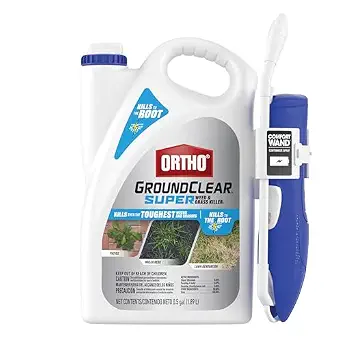 |
| Highest Rated A top-rated pick with lots of positive feedback | RM43 Total Vegetation Control 43% Glyphosate Plus Weed Preventer, 2.5-Gallon |  |
| Most Popular A crowd favorite that many people choose with confidence | Spectracide Weed & Grass Killer with AccuShot Power Sprayer, 1.33 Gal |  |
| Best Seller A high-volume bestseller chosen again and again | Roundup Weed & Grass Killer4 Refill, 1.25 gal |  |
Ortho GroundClear Weed & Grass Killer with Comfort Wand, 1 gal.

| Item Form | Spray |
|---|---|
| Coverage | 5120 square feet |
| Unit Count | 128 Fluid Ounces |
| Active Ingredients | Ammonium Nonanoate |
Ortho GroundClear is a one-gallon ready-to-use weed and grass spray designed for spot and surface treatment on driveways, walkways, patios, and landscape beds. The formula absorbs on contact and shows visible browning in about 15 minutes, becoming rainproof roughly two hours after drying, which helps when weather is unpredictable. The included Comfort Wand makes it easy to aim at weeds growing between gravel and pavers without soaking surrounding surfaces. It is OMRI Listed, so it can fit into some organic-minded maintenance routines. Coverage is large for a single container, and the product lists ammonium nonanoate as the active ingredient, which works by contact so small or actively growing weeds are best treated. Because it is a contact herbicide, perennial or well-established weeds may need repeat applications or mechanical removal for full control, and care is required to avoid spray drift onto desirable plants. Follow safety directions and keep pets and children away until treated areas are dry.
Best for: Homeowners who want a practical, hands-on solution to remove weeds from gravel driveways and hardscapes and who prioritize quick, targeted results with minimal setup.
Less Ideal for: People seeking a long-term systemic control for deep-rooted perennial weeds or a total lawn herbicide should consider systemic products or integrated mechanical removal instead.
- Fast visible results on contact, often browning in about 15 minutes.
- Comfort Wand enables precise targeting in gravel joints and along edges.
- Becomes rainproof in approximately 2 hours, reducing loss from unexpected rain.
- OMRI Listed, compatible with some organic production standards.
- Contact-only action means deeper or perennial roots may require multiple applications.
- Spray can damage nearby desired plants if not applied carefully.
Verdict: A fast, ready-to-use contact spray with a comfort wand that makes quick, precise weed control on gravel driveways simple and practical.
Spectracide Weed & Grass Killer Concentrate, 1 Gallon

| Unit Count | 128 Fluid Ounces |
|---|---|
| Coverage | Non-selective broad spectrum coverage |
| Item Form | Liquid |
Spectracide Weed & Grass Killer Concentrate is a liquid, nonselective herbicide intended for spot treatments where you need to remove unwanted weeds and grasses down to the root. You mix the concentrate with water in a tank sprayer and apply to fully cover target leaves; the formula is rainproof after about 15 minutes and can show visible dieback in as little as three hours. Practical benefits include a long coverage yield from the one-gallon bottle and the ability to replant in treated areas after a day, which is useful for renovating small hardscape edges, beds and fence lines. Important features are the fast rainfast action, root-killing activity and clear label directions for application rates (7 fl oz per gallon covers about 300 sq ft). Limitations are that it is nonselective so you must shield desirable plants from drift and it is meant for spot or targeted use rather than blanket lawn treatment, and it requires a sprayer and careful handling to avoid accidental damage.
Best for: Gardeners who want a fast, reliable concentrate for targeted weed removal around hardscape, beds, and fence lines and who are comfortable mixing and applying herbicides carefully.
Less Ideal for: Those who need selective lawn weed control, prefer ready-to-use products, or who lack a sprayer and prefer minimal chemical handling.
- Concentrate stretches one gallon into many treatments, making it cost-effective for spot work
- Rainproof in about 15 minutes so light showers soon after application do not ruin results
- Kills weeds and grasses down to the root for longer-lasting control
- Visible results in as little as three hours and treated areas can be replanted after one day
- Nonselective formula will damage desirable plants if sprayed or drifted onto them
- Requires mixing and a tank sprayer rather than ready-to-use convenience
Verdict: A practical, fast-acting concentrate for targeted weed and grass removal when you need quick, root-killing results around hardscape and beds.
Roundup Weed and Grass Killer III Ready-to-Use Trigger Spray, 30 oz

| Unit Count | 30 Fluid Ounces |
|---|---|
| Item Form | Liquid |
| Coverage | 3000 sq. ft. |
This Roundup ready-to-use trigger spray is designed to kill weeds and grass on contact and down to the root, making it a straightforward option for clearing driveways, walkways, gravel and mulched beds. The 30-ounce bottle uses a foaming spray so you can see where you applied product and the formula is rainproof in about 10 minutes, with visible wilting in roughly six hours and complete kill within one to two weeks. Typical use is simply shaking, attaching the sprayer, and thoroughly coating leaves and stems while avoiding desirable plants and windy conditions. The practical benefits are ease of use with no mixing, clear coverage from the foam, and fast action suitable for spot treatments and cracks in hard surfaces. Important limitations are that it is a nonselective herbicide so care is required to avoid contact with wanted plants and to keep people and pets away until sprays dry; safety precautions and temperature recommendations should be followed. For someone focused on efficient, no-fuss elimination of weeds on driveways and similar areas, this is an effective, ready-made solution.
Best for: Homeowners or property maintainers who want a quick, no-mix solution to remove weeds and grass from driveways, cracks, and other hardscape areas with minimal setup.
Less Ideal for: Gardeners who need a selective product to remove weeds without risking nearby ornamentals or those who prefer organic or non-glyphosate options.
- Ready-to-use trigger bottle requires no mixing for fast spot treatment
- Foaming spray makes treated areas easy to see for accurate application
- Rainproof within 10 minutes so treatment is less likely to be washed away
- Visible wilting in about 6 hours and full kill to the root within one to two weeks
- Covers up to 3000 sq. ft. per bottle according to product specs
- Nonselective herbicide that will damage any desirable plants it contacts
- Requires safety precautions and keeping people and pets away until dry
Verdict: A ready-to-use, fast-acting spray that efficiently eliminates weeds and grass on driveways and hard surfaces with visible results in hours.
Ortho GroundClear Super Weed & Grass Killer with Comfort Wand, 0.5 gal

| Unit Count | 64 Fluid Ounces |
|---|---|
| Item Form | Spray |
| Coverage | Broad spectrum coverage |
| Liquid Volume | 0.5 gallons |
Ortho GroundClear Super Weed & Grass Killer is a ready-to-use spray intended for spot treatment of weeds and grasses in landscape beds, along walkways, driveways, and around structures. The bottle’s attached Comfort Wand delivers a continuous spray for targeted application, which helps avoid overspray on nearby plants. The formula combines a contact ingredient for rapid burn-down with systemic actives that penetrate to the root, so you can see visible effects within hours and full control in days to a couple of weeks. It is rainfast in about 15 minutes, so treatments hold up quickly after application. Practical benefits include ease of use without mixing, broad-spectrum control of common tough weeds, and suitability for prepping areas for renovation. Important limitations are that it is nonselective so care is required near desirable plants, it should not be used on edible crops, and protective gear is recommended during application because of the herbicidal strength.
Best for: Homeowners who want an easy, no-mix solution to remove persistent weeds from landscape beds, hardscapes, and around structures and who prioritize quick, visible results with precise application.
Less Ideal for: Gardners maintaining vegetable beds, pollinator or mixed planting areas where nonselective chemistry risks desirable plants, or users seeking an organic or granular spot-treatment method.
- Ready-to-use spray needs no mixing and the attached Comfort Wand enables targeted continuous application
- Dual-action formula gives quick visible burn-down and systemic root kill for longer control
- Rainfast in 15 minutes so treatments are less likely to wash off in light showers
- Nonselective herbicide that can damage desirable plants if not applied carefully
- Not labeled for use on edible crops so unsuitable for vegetable gardens
Verdict: Choose this ready-to-use spray when you need fast, targeted knockdown and root-level control of tough weeds in landscape beds without mixing or special equipment.
RM43 Total Vegetation Control 43% Glyphosate Plus Weed Preventer, 2.5-Gallon

| Unit Count | 320 Fluid Ounces |
|---|---|
| Liquid Volume | 320 fluid ounces |
| Coverage | 243 243 square feet |
| Active Ingredients | Glyphosate isopropylamine salt, Imazapyr isopropylamine salt |
RM43 Total Vegetation Control is a concentrated 2.5‑gallon herbicide intended for killing existing growth and preventing regrowth for up to a year on areas where no vegetation is desired. You mix it into spray solution and apply to hardscape edges, gravel driveways, fence rows, and around buildings as either spot treatments or blanket applications on bare ground. The formula pairs glyphosate and imazapyr with a surfactant so it kills grasses, broadleaf weeds, vines, brush and some woody growth and becomes rainfast in about two hours. Practical benefits for driveway use include long residual control that reduces repeat spraying and a large coverage rate that treats many square feet from one container. Important limitations are that it is for non‑crop areas only and will damage desirable plants if sprayed over roots or drift occurs, and the active ingredient blend makes it persistent so care is required where you may later want vegetation to return. Follow label directions for mixing, application timing and safety precautions when using near soil that will be planted later.
Best for: Gardeners, property owners, and maintenance crews who prioritize strong, long‑lasting weed eradication on gravel driveways and other non‑crop hardscape areas and want to minimize repeat applications.
Less Ideal for: Homeowners planning to replant treated areas soon or those needing selective weed control near desirable plants should choose a less persistent or more targeted product.
- Combination of glyphosate and imazapyr for both knockdown and long residual control
- Concentrated 2.5‑gallon container covers large areas without frequent refills
- Rainfast in about two hours so light rain soon after application is less likely to reduce effectiveness
- Suitable for total vegetation control on gravel driveways, fence rows and other non‑crop areas
- Persistent active ingredients that can prevent desirable vegetation from reestablishing for an extended period
- Not safe for use where desirable plant roots may be exposed or where drift could contact nearby plants
Verdict: Choose RM43 when you need a single, heavy‑duty application that delivers broad spectrum kill and up to a year of weed prevention on gravel driveways and other non‑crop surfaces.
Spectracide Weed & Grass Killer with AccuShot Power Sprayer, 1.33 Gal

| Unit Count | 170 Fluid Ounces |
|---|---|
| Item Form | Spray |
| Coverage | 1 gallon |
| Active Ingredients | Diquat Dibromide 0.12%, Fluazifop-p-butyl 0.06%, Dicamba 0.04% |
Spectracide Weed & Grass Killer pairs a concentrated non-selective formula with a battery-powered AccuShot sprayer to clear weeds from driveway cracks, patios and around foundations. The product is used by aiming and spraying foliage until leaves are covered; the active ingredients move through the leaf to the root and can show visible die-back in as little as three hours. The AccuShot wand is extendable and provides continuous spray without manual pumping, which improves accuracy for narrow cracks and reduces hand fatigue during larger jobs. It is rainproof within 15 minutes, so treated areas are protected quickly. Practical benefits include fast results that let you replant or resume use of the area within a day and a reusable sprayer for follow-up applications. Important limitations are that the herbicide is non-selective so it will kill any plant it contacts, it requires careful handling and PPE to avoid skin or eye exposure, and the sprayer runs on four AA batteries that must be replaced periodically. Follow label directions to avoid runoff into water.
Best for: Buyers who want a fast, no-nonsense solution for weeds growing in driveways and hard surfaces and who prioritize tools with clear user feedback and proven results.
Less Ideal for: Gardeners who need a selective lawn-safe treatment, people unwilling to follow pesticide safety precautions, or those treating areas adjacent to water features.
- AccuShot battery-powered wand gives continuous spray for accurate application in tight cracks
- Formula moves through foliage to kill weeds down to the root with visible results in about three hours
- Rainproof after 15 minutes so treatments are not easily washed away by brief showers
- Covers approximately 300 square feet per gallon, suitable for multiple crack-treatment sessions
- Non-selective herbicide will damage any desirable plants it contacts
- Sprayer requires four AA batteries and occasional replacement to maintain function
- Product is toxic to aquatic life and must not be used near water or allowed to run off
Verdict: A fast-acting, easy-to-aim non-selective herbicide with a battery-powered wand that is well suited to reliably clear weeds from driveway cracks and other hard surfaces.
Roundup Weed & Grass Killer4 Refill, 1.25 gal

| Unit Count | 160 Fluid Ounces |
|---|---|
| Coverage | 375 square feet |
| Item Form | Spray |
| Active Ingredients | Triclopyr, Fluazifop P-Butyl, Diquat Dibromide |
This 1.25 gallon Roundup Weed & Grass Killer4 refill is designed to be poured into an empty spray container to treat weeds and grassy weeds around beds, walkways, driveways, foundations, and other hardscape edges. It contains multiple active ingredients that attack broadleaf weeds and grasses to the root and promises visible wilting within hours and rainproofing in as fast as 30 minutes, which makes it convenient when weather windows are short. The refill covers about 375 square feet and is intended for use in and around established plantings when applied carefully to avoid drift onto desirable plants. Practical benefits include fast action, the ability to replant some areas within a specified wait period, and compatibility with the brand’s comfort wand refills so you avoid frequent repurchasing of small bottles. Important limitations are that it is a nonselective herbicide so it will damage desirable plants if misapplied and treated areas should be kept clear of people and pets until spray dries; follow label directions closely for safe use and replanting intervals.
Best for: Buyers who prioritize reliable, fast-acting weed control for routine maintenance of beds, edges, and hardscape areas and who follow label directions to minimize risk.
Less Ideal for: Gardeners who need selective control inside densely planted flower beds or who prefer organic or nonchemical weed management methods.
- Kills a broad range of weeds and grasses to the root, including dandelion and crabgrass
- Fast visible results in hours and becomes rainproof in about 30 minutes
- Large 1.25 gal refill reduces need for frequent repurchases and covers roughly 375 sq ft
- Formulated to refill compatible spray wand for easy application around beds and hardscapes
- Nonselective formula that will harm desirable plants if it drifts or is oversprayed
- Requires careful handling and adherence to label safety and replanting intervals
Verdict: Choose this refill if you want a fast, proven, large-format herbicide that quickly kills tough weeds and grasses and refills a compatible spray wand for area-wide maintenance.
Choosing the Right Grass Killer for Driveway: Key Factors to Consider
Kill Speed
How quickly you see leaves yellow and die matters when you need a neat driveway fast. Fast-acting contact formulas can brown foliage within days, giving a visible result that shows the treatment is working. However, rapid top-kill does not always mean the root system is dead. For driveway use, fast visible action is helpful for confirming placement, but it should be paired with other qualities that reduce return growth. Consider how long you can leave treated areas undisturbed and whether quick results will interfere with follow-up cleanup or sealing work.
Root Control and Regrowth Prevention
The real test for driveway applications is whether the product suppresses regrowth from rhizomes, stolons, or persistent crowns. Products that only scorch leaves often allow plants to resprout from roots, meaning you will need repeat treatments or mechanical removal. Look for formulas or methods known to translocate active ingredients into the root zone or that include surfactants to improve plant uptake. Effective root control cuts down on repeat work and reduces the need for ongoing spot treatments along edges and in cracks.
Compatibility With Driveway Surfaces
Driveways include concrete, asphalt, pavers, and mortar joints, and some chemistries or additives can discolor or weaken these materials. Surface-safe products minimize staining and avoid damaging sealants or joint material. Consider whether overspray or drips will contact surrounding finishes and how runoff behaves after rain. Choosing a product labeled safe for the surface types you have will protect pavement integrity and curb appeal.
Precision and Application Control
Driveway infestations are often narrow lines or patches, so precise application reduces waste and crop injury to nearby plants. Delivery methods such as targeted foam, gel, or narrow-spray wands help place product where it belongs. Walk-behind or hand-spray options that allow low-pressure, accurate placement are valuable for crack and edge work. Good precision also lowers the chance of runoff onto desirable turf or landscapes.
Residual Effects and Environmental Persistence
Some treatments leave residual activity in the soil that prevents new seedlings from establishing for weeks or months. That can be useful for long-term suppression in cracks but may inhibit desired plants if soil is later amended or if adjacent planting is planned. Consider the tradeoff between longer residual control and the desire to plant or repair joints. Also factor how quickly the active ingredient breaks down with weather, sunlight, and microbial action in your region.
Ease of Use and Safety
Application difficulty, required safety gear, and cleanup matter for homeowners. Concentrates that require measuring and mixing add steps and increase the chance of error. Ready-to-use formulations or simple hose-attach options reduce setup time and make spot treatment practical. Safety instructions and precautions affect where and when you can treat, particularly near pets, children, or planted borders. Look for clear label guidance on re-entry intervals and runoff precautions.
Preparing Driveway Areas for Treatment
Clear loose debris, moss, and surface soil before applying any product so the active ingredient contacts green tissue and root crowns. Use a stiff broom or pressure wash at low settings to remove dirt from cracks and joints, but allow the area to fully dry before treatment if the product requires dry foliage.
Mark and protect nearby plantings with wet rags or cardboard to avoid accidental contact. If you plan to reseal or repair joints after vegetation removal, schedule treatments far enough ahead to confirm the plants are dead to reduce the chance of trapped moisture causing issues under sealant.
- Brush or blow loose material out of joints for better product contact
- Keep washwater and runoff away from garden beds
- Treat when no rain is forecast for at least 24 hours
Application Methods Suitable for Cracks and Edges
Not all application methods are equally useful for driveway situations. Hand-spray wands, bottle-tip applicators, and brush-on gels let you coat individual stems and crowns without drenching adjacent surfaces. Hose-end sprayers cover larger areas quickly but can be harder to control in narrow joints.
For stubborn clumps inside wider cracks, a targeted application directly onto crowns works better than a broadcast spray. Some gardeners prefer granular spot treatments for enclosed joints where overspray is a concern, while others use mechanical removal followed by a directed treatment to the remaining roots.
- Use low-volume, high-precision applicators for edges
- Consider brush-on or gel formulas for very narrow joints
- Avoid high-pressure sprays that create drift
Timing Treatments for Best Results
Treat when plants are actively growing and daytime temperatures are within the range specified on the product label. Active growth helps move systemic ingredients into root systems, improving long-term control. Avoid very hot, drought-stressed days when foliar uptake is reduced.
Seasonally, late spring through early fall is generally most effective for most weeds. For perennial grasses that resprout from roots, treat during growth flushes rather than during dormancy for better translocation.
- Apply during active growth for improved root uptake
- Avoid treatments before heavy rain
- Repeat treatments may be necessary for deeply rooted species
Post-Treatment Care and Cleanup
After the foliage dies back, remove dead plant material to keep joints clear and reduce the chance of organic buildup. For paving repairs or resealing, ensure vegetation is fully dead and roots removed before applying new materials. Some residual effect will persist in soil, so avoid planting immediately in treated cracks.
Rinse equipment and store products according to label directions. Dispose of rinsate and leftover product responsibly and follow local guidelines for hazardous materials if applicable.
- Wait until plants are brown and brittle before scraping
- Keep pets and children off treated areas for the timeframe on the label
- Do not sweep treated debris into garden beds
Natural and Nonchemical Options for Driveway Vegetation
If you prefer nonchemical approaches, physical removal, boiling water, or repeated mechanical scraping can control small infestations. Hand-pulling or using a crack weeder works for shallow-rooted annual grasses, but persistent perennials often regrow unless roots are removed.
Thermal methods such as steam or flame weeding can be effective when used carefully on paved surfaces, but they require caution to avoid scorching nearby plants or damaging certain sealants. Mulching adjacent beds and improving edge barriers will reduce reinvasion from surrounding soil.
- Boiling water kills top growth but may require repeat treatments
- Mechanical removal works well for shallow-rooted weeds
- Thermal tools need operator skill and safety precautions
How We Chose the Best Grass Killer for Driveway
We focused on products that are practical for treating grass on paved surfaces and narrow edge lines while minimizing harm to surrounding landscape. Our evaluation emphasized fast visible kill, root system control to reduce regrowth, and compatibility with common driveway materials such as concrete, asphalt, and pavers. Application ease and the ability to target only problem areas were weighed, since many driveway spots require precision rather than broad spraying. Longevity of effect was assessed by looking at how well a product limits regrowth without repeated heavy applications. We excluded products intended only for turf renovation, broad lawn herbicide programs, or those labeled exclusively for agricultural use. Final selections favored formulas and delivery methods that balance efficacy with surface safety and predictable results in typical residential driveway conditions.
FAQ
Can I use a regular lawn herbicide on driveway cracks?
Often lawn herbicides are formulated for broadcast use and may not be ideal for cracks. They can be less precise and may contain additives not suited to paved surfaces. Choose a product or application method designed for targeted spot work on hardscapes for better control and less risk to nearby plants.
How long after treatment should I remove dead grass from cracks?
Wait until foliage is brown and brittle before scraping or brushing out debris, typically several days to a few weeks depending on kill speed. Removing material too soon can leave roots in place and allow regrowth.
Will runoff from driveway treatments harm nearby garden beds?
Runoff can carry active ingredients into adjacent soil and harm desirable plants. Avoid applying before rain, protect nearby beds during application, and use precision applicators to minimize overspray.
Are there surface stains or damage risks when using driveway grass treatments?
Some formulations and additives can discolor sealants or reactive surfaces. Use products labeled safe for your driveway material and test in a small, inconspicuous area first if staining is a concern.
How many treatments are usually needed to stop regrowth?
It depends on species and root depth. Shallow annual grasses may be controlled with a single correct application, while perennial grasses with deep roots often need follow-up treatments or mechanical removal to prevent recurrence.
When is the best season to treat grass in driveways?
Treat during active growth, typically late spring through early fall in most climates. Treating during growth flushes increases uptake and improves the chance of reaching root systems.
Final Verdict
For driveway vegetation, prioritize products and methods that combine reliable root control with precise placement and surface compatibility. Fast leaf kill helps you see results, but long-term suppression comes from translocation into roots or consistent mechanical removal. Balance residual control with plans for any future sealant work or planting near treated joints. Focusing on kill speed, surface safety, and application precision will help you pick the right approach for durable, low-maintenance driveways.
