

Note: This article contains affiliate links. If you click on these links and make a purchase, I may earn a small commission at no extra cost to you. This helps support my research and content. Read my full affiliate disclosure here.
Ants are social insects that hide nests in walls, lawns, and under patios, so surface sprays that only repel rarely stop a problem for long. Choosing the right non repellent ant killer means selecting products that worker ants pick up and carry back to the colony, interrupting brood care and killing queens rather than merely shunting activity to another area. This guide covers six shortlisted non repellent ant killers suitable for indoor and outdoor infestations, and it explains the practical differences that matter in real garden and home situations. Below we evaluate each option on how well it attracts foragers, how quickly it controls colonies, and how safe and easy it is to use in occupied yards and living spaces. Read on to find the approach that matches your infestation type and site constraints.
Top Picks at a Glance
| Best Overall The best all-around choice for most situations | Fipronil Plus-C Insecticide Concentrate, 16 oz |  |
| Best Quality Built to a higher standard if you want something more solid | BASF PT Alpine Pressurized Insecticide Spray, 14 oz |  |
| Best Value The sweet spot between price and what you get | Syngenta Advion Ant Gel Bait, 30 g |  |
| Highest Rated A top-rated pick with lots of positive feedback | Syngenta Advion Ant Gel Bait, 4 x 30 g Tubes with Plungers and Tips |  |
| Most Popular A crowd favorite that many people choose with confidence | Syngenta Advion Ant Gel (4 Tubes, 30 g each) |  |
| Best Seller A high-volume bestseller chosen again and again | TERRO Liquid Ant Bait Stations, 18 Count (3 Pack) |  |
Fipronil Plus-C Insecticide Concentrate, 16 oz

| Unit Count | 16 Fluid Ounces |
|---|---|
| Item Form | Spray |
| Target Species | Insects |
| Active Ingredients | Fipronil |
| Specification Met | EPA |
Fipronil Plus-C is a concentrated insecticide intended for pump or backpack sprayer use to treat cracks, voids, ant trails, foundations and other localized pest harborage sites. The formula uses 0.65% fipronil with a cellulose entrapment technology that improves residual life and reduces breakdown from UV and microbes, so a single application can provide weeks to months of control. Typical use is mixing the measured concentrate into water (built-in chamber for accurate dosing) at maintenance or higher rates depending on infestation severity, then applying as spot or crack-and-crevice treatments rather than broad surface spraying. For German cockroaches it acts as a transferable active ingredient that insects pick up and carry to nestmates, which helps collapse colonies over days. Important limitations are that it is a concentrated professional-style product requiring careful mixing and protective measures, it is toxic to birds and aquatic life so outdoor use needs caution, and it is not intended as a full surface spray or for every ant or spider species listed on the label.
Best for: Buyers who prioritize fast, long-lasting control and are comfortable using concentrated treatments and sprayers to knock down and eliminate established infestations.
Less Ideal for: Casual users who want ready-to-use aerosols, those unable to follow mixing and safety directions, and homeowners with ponds or habitats for birds and aquatic life.
- Professional-grade active ingredient effective for colony elimination via transfer
- Cellulose entrapment technology extends residual control and reduces breakdown
- Built-in measuring chamber simplifies accurate dilution for sprayers
- Versatile for indoor cracks/voids and targeted outdoor spot treatments
- Concentrate requires careful mixing and protective equipment for safe use
- Toxic to birds, fish and aquatic invertebrates so cannot be applied near water
- Not formulated for broad surface spraying and excludes some ant and spider species from control
Verdict: Choose this concentrate when you need a professional-strength, transferable insecticide that delivers long-lasting, colony-level control for heavy German cockroach infestations.
BASF PT Alpine Pressurized Insecticide Spray, 14 oz

| Item Form | Spray |
|---|---|
| Target Species | Insects, Ants, Cockroaches, Fruit Flies, Spiders |
| Special Features | Fast-Acting, Long-Lasting |
| Active Ingredients | Dinotefuran 0.5% |
| Liquid Volume | 14 fluid ounces |
The BASF PT Alpine pressurized insecticide is a performance-focused ready-to-use aerosol designed for quick knockdown of ants, cockroaches, spiders and other pests. It uses dinotefuran 0.5% as a non-repellent active ingredient so insects do not avoid treated areas, which helps brood or hidden pests come into contact with the product. Typical use is crack-and-crevice or spot treatments in and around homes, apartments or commercial food-handling areas where label directions allow. The can is easy to apply for targeted treatments and the formula is described as both fast-acting and long-lasting, which makes it useful for rapid suppression followed by residual control. Important limitations are that effectiveness requires direct contact at time of application and the product must be used according to label restrictions for indoor food areas and state regulations. Because it is an aerosol pressurized can, careful application and ventilation are needed and it is not a broadcast granular or bait solution for continuous perimeter protection.
Best for: Buyers who prioritize fast, professional-style control and need a non-repellent spray for targeted indoor or perimeter crack-and-crevice treatments.
Less Ideal for: Homeowners seeking a long-term broadcast perimeter solution or bait-based ant management should consider granular or bait products instead.
- Non-repellent dinotefuran formulation helps pests contact treated areas rather than avoiding them
- Ready-to-use aerosol is convenient for spot and crack-and-crevice treatments
- Broad-spectrum label for many crawling and flying pests including ants and cockroaches
- EPA specification met and described as fast-acting with residual control
- Requires direct contact with pests at time of application for best knockdown
- Pressurized aerosol format is not suitable for continuous perimeter broadcasting or baiting strategies
Verdict: Choose this non-repellent, dinotefuran aerosol when you need rapid, professional-style knockdown and residual control in targeted crack-and-crevice or spot treatments.
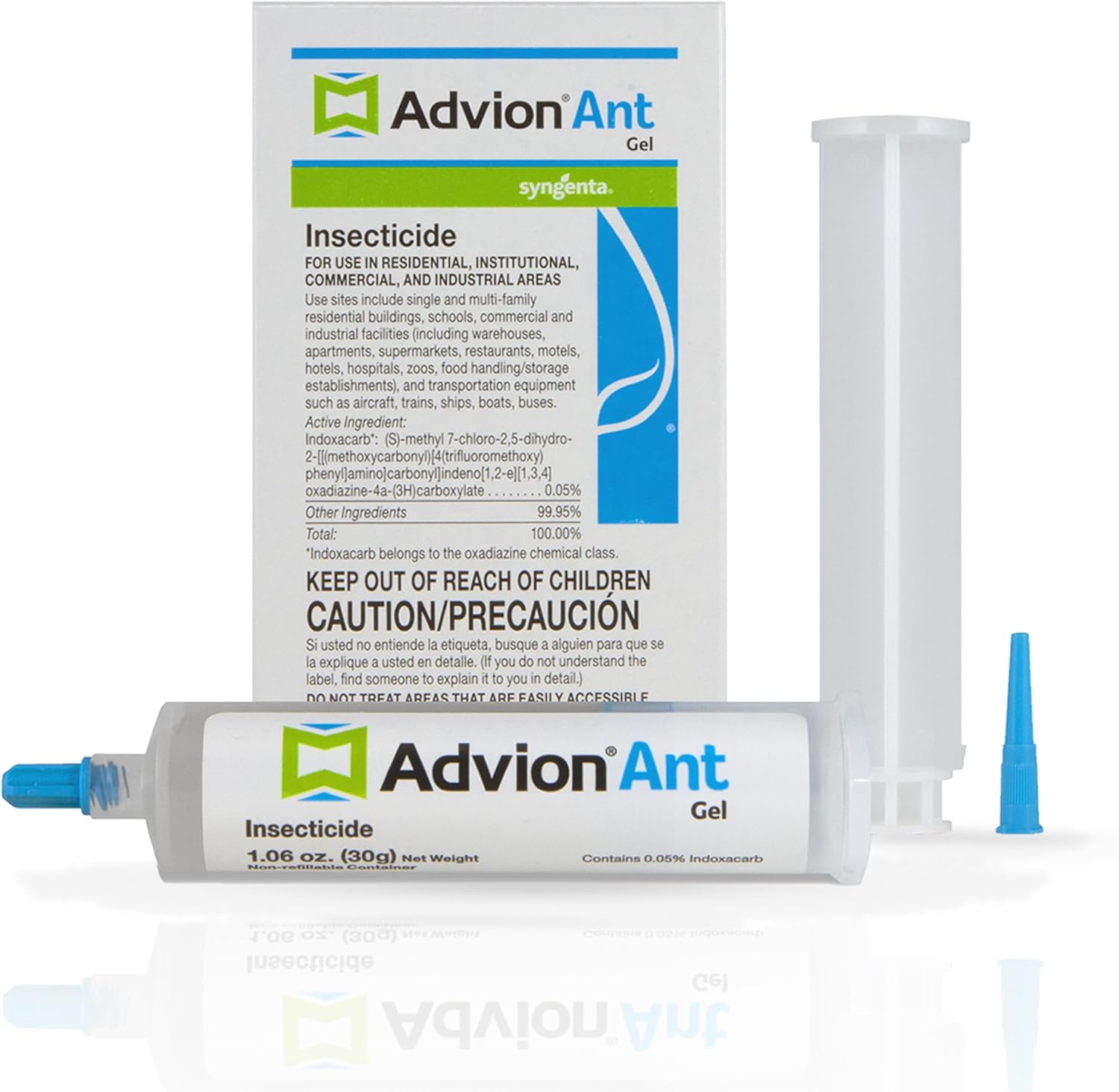
Syngenta Advion Ant Gel Bait, 30 g
| Item Form | Gel |
|---|---|
| Target Species | Insects |
| Active Ingredients | Indoxacarb |
Advion Ant Gel is a concentrated, professional-style ant bait formulated around indoxacarb and a highly palatable gel matrix to lure foraging ants and carry toxicant back to the colony. You apply small dabs of the translucent, nonstaining gel in ant trails, near nesting sites, or in voids where ants forage; workers feed on the gel and transfer it through trophallaxis, which helps suppress entire colonies rather than just worker ants. The formulation is touted for lasting integrity with low odor and high attractiveness to sweet-feeding species, so you do not need frequent reapplication in protected spots. Because it is a targeted bait rather than a broadcast insecticide, it is practical for spot treatments in kitchens, pantries, and around baseboards as well as sheltered outdoor locations. Important limits are that it is a bait product requiring worker-mediated distribution so results are not instant and indoor use requires keeping it away from children and pets.
Best for: Buyers who prioritize effective colony-level control and want a concentrated, professional-style bait for spot treatments inside homes or in sheltered outdoor locations.
Less Ideal for: People needing immediate knockdown of visible ants or those who require a product for widespread outdoor perimeter treatments should consider different control methods.
- Contains indoxacarb, a potent active ingredient with a unique mode of action
- Highly palatable, translucent gel that attracts sweet-feeding ants
- Maintains formulation integrity for extended periods in sheltered application sites
- Suitable for indoor and sheltered outdoor spot treatments
- Relies on worker feeding and transfer so colony elimination can take several days to weeks
- Not intended for broad outdoor broadcast use or exposed wet areas
Verdict: Choose Advion Ant Gel when you want a high-performance, worker-transferred bait that targets colonies rather than just knocking down visible ants.
Syngenta Advion Ant Gel Bait, 4 x 30 g Tubes with Plungers and Tips

| Item Form | Gel |
|---|---|
| Target Species | ant |
| Active Ingredients | Indoxacarb |
| Specification Met | EPA |
Advion Ant Gel is a concentrated, non-repellent gel bait intended for targeted ant control. It is applied in small spots or lines along active trails, in cracks and crevices, and beneath appliances where foragers feed and carry the bait back to the nest. The 0.05% indoxacarb formulation is designed to be highly attractive to sugar-seeking ants and to pass through worker-to-worker and worker-to-queen transfer for broader colony suppression. Syringes include plungers and tips for precise placement, making it easy to reach concealed areas without excess mess. Practical benefits include suitability for indoor and outdoor use and a bait matrix that encourages feeding rather than repelling ants, which speeds up colony-level control when ants accept it. Limitations are that it targets foraging ants specifically so success depends on correct placement and continued monitoring, and it is not a residual spray substitute for broad perimeter treatments.
Best for: Buyers who prioritize fast, colony-level control and will place bait strategically and monitor results; good for homeowners or pros focused on targeted treatments rather than broad sprays.
Less Ideal for: People wanting a one-time broad residual treatment or those unwilling to inspect and reapply bait as needed should consider other treatment formats.
- Non-repellent indoxacarb formula encourages foragers to feed and transfer bait into the colony
- Includes plungers and application tips for precise, low-mess placement
- Suitable for both indoor and outdoor use so you can treat trails and nests in multiple locations
- Gel form lets you place small doses in cracks, crevices, and other hidden spots
- Effectiveness depends on correct placement and ant species feeding preferences
- Requires monitoring and reapplication for complete control of large or multiple nests
Verdict: Choose Advion Ant Gel when you want a professional-strength, non-repellent bait that encourages worker feeding to eliminate entire ant colonies.
Syngenta Advion Ant Gel (4 Tubes, 30 g each)

| Unit Count | 4.23 Ounce |
|---|---|
| Included Components | 4 Tubes x 30-Grams, 1 Plunger and 2 Tips |
| Item Form | Gel |
| Active Ingredients | 0.05% indoxacarb |
| Target Species | Insects |
Advion Ant Gel is a user-friendly gel bait intended to control common household and structural ant species by exploiting worker foraging behavior. You apply small spots or short lines of the odorless gel along active trails, in cracks and crevices, and near entry points; foraging workers consume the bait and carry it back to the nest where it is shared, helping to eliminate the queen and other nestmates. The kit ships with four 30 g tubes plus an applicator plunger and tips for precise placement, which makes targeting tight spaces straightforward. Its non-repellent formula with 0.05% indoxacarb is formulated to be attractive to a range of species including Argentine and carpenter ants, and it is labeled for both indoor and outdoor use. Limitations to note are that it is a chemical bait so safety precautions are needed around children and pets and efficacy depends on ants accepting the bait matrix versus other available food sources.
Best for: Homeowners and renters who want a targeted, easy-to-apply solution to eliminate established ant infestations and prefer a bait that works via worker-mediated transfer to treat whole colonies.
Less Ideal for: People seeking non-chemical or immediate-contact kill methods or those who need a one-time spray rather than ongoing baiting strategies should consider other options.
- Non-repellent gel formulation designed for worker ants to feed and transfer bait to the colony
- Includes four 30 g tubes plus a plunger and application tips for precise placement
- Labelled for both indoor and outdoor use, suitable for common pest species
- Odorless formula that is easy to place along trails, cracks, and crevices
- Contains a chemical active ingredient so it must be kept away from children and pets
- Effectiveness depends on ants preferring the bait over other available food sources
Verdict: Choose Advion Ant Gel when you want a precise, bait-based solution that encourages workers to carry poison back to the nest for colony-level control.
TERRO Liquid Ant Bait Stations, 18 Count (3 Pack)

| Unit Count | 18 Count |
|---|---|
| Item Form | Liquid |
| Target Species | Insects |
| Active Ingredients | Sodium Tetraborate Decahydrate (Borax) |
| Specification Met | EPA |
TERRO Liquid Ant Bait Stations are compact, ready-to-use traps that use a sweet liquid bait containing borax to attract foraging ants and carry the poison back to the colony. Typical use is placing the small stations along baseboards, in corners, behind appliances, or on counters where you see ant trails; no mixing or setup is required beyond opening the tab. The kit includes 18 bait stations (three packs of six) and the liquid formula is kept from drying by the sealed station design so it stays attractive for extended periods. Practical benefits include quick visible reduction in worker ants within a few days and the potential to eliminate the colony if placements are maintained until the bait is gone. Limitations: it is for indoor use only and works on ants that take sweet baits, so species that prefer greasy or protein foods may be less affected; results can take up to two to four weeks for full control and you should remove competing food sources for best results.
Best for: Homeowners or renters who want a low-effort, evidence-backed way to target kitchen ant trails and remove colonies without sprays, and who prefer products with a strong track record and social proof.
Less Ideal for: People needing immediate knockdown of visible ants or those dealing with species that avoid sweet baits should consider fast-acting sprays or alternative bait types instead.
- Ready-to-use stations require no mixing or tools
- Sealed liquid design resists drying so bait remains attractive over time
- Attracts worker ants that share bait, which can eliminate the colony
- Includes multiple stations for widespread placement around a kitchen
- Indoor-only product not formulated for outdoor use
- Relies on ants accepting a sweet bait so may be less effective on non-sugar-seeking species
Verdict: A ready-to-use, proven liquid bait kit that targets kitchen ant trails and can eliminate colonies with minimal effort.
Choosing the Right Non Repellent Ant Killer: Key Factors to Consider
Bait Attractiveness and Palatability
How attractive the bait matrix is to local ant species determines whether worker ants will take it back to the nest. Different species prefer sweet, greasy, or protein baits, so a product that matches the target species increases the chance of colony-wide uptake.
Palatability also affects how long workers will feed on a bait before showing sickness cues that could cause rejection. A highly palatable formula encourages repeated feeding visits and improves the odds that the toxicant gets distributed to queens and larvae.
Active Ingredient Mode of Action
Non repellent formulas rely on active ingredients or slow-acting toxins that do not immediately repel foragers. Understanding the mode of action helps set expectations for how quickly visible ant activity will decline and whether secondary transfer within the colony is likely.
Products with delayed mortality allow foragers to return to the nest and share the toxicant through trophallaxis and grooming, which increases colony mortality. Rapid-acting contact toxicants may reduce visible trails quickly but often fail to reach the queen, so they are not true non repellent solutions.
Placement and Application Sites
Where you apply or place bait affects both safety and effectiveness. Indoor placements should avoid areas accessible to children and pets while remaining near ant activity zones such as baseboards, kitchens, and wall voids. Outdoor placements need protection from rain and sprinkler runoff and should be positioned along travel routes or near nest entrances.
Ease of deployment matters for gardeners. Bait stations, granular placements, and ready-to-use station formats each have tradeoffs in terms of exposure risk and longevity. Choose a delivery method that fits the treatment area and the level of control you need.
Residual Longevity and Weather Resistance
For outdoor infestations, the bait or applied material must remain attractive and active long enough for foragers to repeatedly feed and transport it. Formulations that break down in sun or rain reduce the window for colony uptake.
Longer residual activity can be helpful for sustained control, but overly persistent materials near sensitive plantings may raise stewardship concerns. Balance longevity with the site conditions where you will deploy the product.
Safety, Handling, and Non-Target Risk
Non repellent products still contain active ingredients that can be hazardous if misused. Readability of label instructions, clarity of placement guidance, and availability of secure station formats reduce accidental exposure to pets, children, and beneficial insects.
Consider the likelihood of non-target contact in your garden or home and choose products and placements that minimize that risk while allowing ants unimpeded access to the bait.
Identifying the Ant Species and Infestation Type
Knowing which ant species you are dealing with helps select the bait type and placement strategy. Pavement ants, odorous house ants, carpenter ants, and sugar ants have different foraging behaviors and food preferences, so a quick field ID will guide whether a sweet, protein, or greasy bait is most appropriate.
- Look for trail patterns and time of day when ants forage to infer species behavior.
- Inspect nearby nesting sites such as soil mounds, wall voids, or rotting wood to determine infestation type.
- Collect a few specimens in a sealed container or take clear photos to help with identification if needed.
Indoor Versus Outdoor Treatment Strategies
Indoor and outdoor infestations demand different placement and moisture management. Indoors, bait stations and discreet gel placements along baseboards reduce exposure to inhabitants while keeping bait along ant trails. Outdoors, use protected stations or place granular baits in dry, shaded spots where workers regularly travel.
- Indoors prioritize secure stations and keep bait away from food prep areas.
- Outdoors protect bait from rain and direct sunlight to maintain attractiveness.
- Treating points of entry such as door thresholds and utility conduits can reduce re-infestation pressure.
Timing Treatments for Best Results
Apply baits when ants are actively foraging and when alternative food sources are limited. For many species this means early morning or late evening and outside of heavy rainfall or irrigation cycles. Seasonal behavior also matters; summer and fall foraging intensity often increases bait uptake compared with cooler months.
- Avoid placing baits near competing food sources like pet bowls or open compost.
- Reapply or refresh stations only according to label instructions and when bait becomes depleted or contaminated.
- Monitor activity for several weeks; colony reduction can take days to several weeks depending on species and bait transfer.
Combining Non Repellent Baits with Cultural Controls
Non repellent baits work best as part of an integrated approach that reduces nesting opportunities and access to food. Seal cracks and crevices, store food in sealed containers, and reduce moisture sources that attract ants. Removing competing food lowers alternative food options and improves bait acceptance.
- Repair leaky pipes and trim vegetation away from foundations to reduce ant pathways.
- Keep outdoor garbage and compost enclosed to limit attractants.
- Use exclusion techniques such as door sweeps and sealing utility penetrations to complement baiting efforts.
How We Chose the Best Non Repellent Ant Killer
We prioritized products that use non repellent active ingredients or bait matrices that are designed to be undetectable to foraging ants, ensuring transfer back to nests. Selection criteria focused on factors that predict colony-level control in real-use conditions rather than just short-term surface knockdown. We reviewed label directions, persistence data, and typical application scenarios to assess likely performance. Key evaluation dimensions included bait acceptance and palatability, residual activity that allows ants to carry toxicants through the colony, speed of colony reduction in common species, user safety and placement flexibility for indoor and outdoor use, and packaging and application practicality for homeowners and gardeners. We excluded contact-only repellents and treatments that rely solely on surface avoidance because those do not achieve colony elimination. Products that required professional-only application or had restricted-use labels were also excluded from consideration. The goal was to highlight options a gardener can reasonably apply or place themselves and that align with the practical needs described above.
FAQ
How long does a non repellent bait take to eliminate an ant colony?
It depends on species, colony size, and bait uptake. Visible trail reduction can occur in a few days, but complete colony elimination often takes one to several weeks as the toxicant spreads internally.
Are non repellent baits safe to use around pets and children?
Many products are formulated for home use and come in tamper-resistant stations, but safety depends on correct placement and following label directions. Keep stations out of reach and choose secure delivery formats when pets or children are present.
Can non repellent baits be used in vegetable gardens or near edible plantings?
Exercise caution near edible plants. Use bait stations placed away from harvestable areas and follow label instructions regarding proximity to food crops. If the label prohibits use near edibles, choose alternative placements outside the garden bed.
Will using non repellent baits prevent ants from returning long term?
Baits can eliminate existing colonies, which reduces immediate re-infestation risk. Long-term prevention depends on excluding new colonies, reducing attractive resources, and using monitoring to treat new activity early.
Do weather conditions affect bait performance outdoors?
Yes. Rain, irrigation, and intense sun can degrade bait attractiveness and active ingredient persistence. Place baits in shaded, dry micro-sites and follow reapplication guidance when stations become wet or depleted.
Final Verdict
Non repellent ant killers are a practical choice when your goal is colony-level control rather than temporary trail removal. Prioritize bait acceptance, appropriate placement, and safety when selecting a product. Expect treatment to take days to weeks and combine baiting with cultural exclusion to lower the chance of reinfestation. Focus on the factors most relevant to your situation: choose a bait type that matches local species, place stations where foragers travel but people and pets cannot access them, and monitor activity so you can refresh treatments if needed. With a targeted approach you can remove colonies effectively without relying on repellents that simply move ants around.
