

Note: This article contains affiliate links. If you click on these links and make a purchase, I may earn a small commission at no extra cost to you. This helps support my research and content. Read my full affiliate disclosure here.
Growing healthy, straight, flavorful carrots starts with the soil you feed them. The right organic fertilizer for carrots supplies slow-release nutrients, builds structure in loose beds, and avoids excess nitrogen that can fork or produce lush tops at the expense of roots. This guide covers seven carefully shortlisted organic fertilizers suitable for carrot beds of different sizes and growing situations. We evaluate each option on nutrient profile, ease of application, effect on soil texture and biology, and how well it supports consistent root development. Read on to find the approach that fits your garden and growing goals.
Top Picks at a Glance
| Best Overall The best all-around choice for most situations | Down To Earth Organic Vegetable Garden Fertilizer 4-4-4, 5 lb |  |
| Best Quality Built to a higher standard if you want something more solid | Big A Carrot Organic Vegetable Fertilizer (13.5 oz) |  |
| Best Value The sweet spot between price and what you get | Jobe's Organics Granular Tomato & Vegetable Fertilizer, 4 lb |  |
| Best Budget The cheapest option that still gets the job done reliably | Miracle-Gro Organic Liquid Plant Food, 32 fl. oz. |  |
| Highest Rated A top-rated pick with lots of positive feedback | Wiggle Worm 100% Pure Organic Worm Castings Fertilizer, 30 lb |  |
| Most Popular A crowd favorite that many people choose with confidence | Dr. Earth Organic Tomato, Vegetable & Herb Fertilizer (64 oz) |  |
| Best Seller A high-volume bestseller chosen again and again | Neptune's Harvest Fish & Seaweed Liquid Fertilizer (2-3-1) 36 oz |  |
Down To Earth Organic Vegetable Garden Fertilizer 4-4-4, 5 lb

| Item Form | Granules |
|---|---|
| Specific Uses For Product | Vegetables, greens, tomatoes, herbs |
| Application Method | Apply directly to the soil or mix into garden beds |
| Mixing Ratio | 4-4-4 |
This granular fertilizer is formulated to feed vegetables, herbs and greens with a balanced 4-4-4 NPK and a slow-release profile that supplies nutrients over time. It is applied by distributing into the planting hole, mixing into topsoil, or working into raised beds at planting and during the season for maintenance. Notable features include all-natural ingredients sourced from plant, marine and mineral resources and OMRI-friendly formulation that supports organic gardening and beneficial soil life. Practically, the slow-release granules reduce the need for frequent feeding and help avoid nutrient spikes that can stress plants. The 5 lb unit is convenient for small to medium beds but means frequent repurchasing for larger plots. While it is versatile across vegetables and herbs, gardeners who need rapid corrective feeding for a specific deficiency will still need a targeted amendment or foliar feed in addition to this product.
Best for: Gardeners who prioritize steady, reliable plant performance and want an organic, low-maintenance fertilizer for raised beds and small plot vegetable production.
Less Ideal for: Growers managing large acreage or those needing immediate corrective nutrient treatments should look for bulk or fast-acting specialty products instead.
- Balanced 4-4-4 NPK suitable for overall vegetable development
- Slow-release granular formula for sustained feeding
- Made from all-natural ingredients and compatible with organic systems
- Easy to apply directly to soil or mix into raised beds
- Small 5 lb size may require frequent replacement for larger gardens
- Not formulated for quick correction of specific nutrient deficiencies
Verdict: Choose this product when you want an organic, slow-release 4-4-4 fertilizer that delivers steady nourishment for productive vegetable beds.
Big A Carrot Organic Vegetable Fertilizer (13.5 oz)

| Item Form | Granules |
|---|---|
| Specific Uses For Product | Growing vegetables and fruits |
| Application Method | Directly to the soil before seeding |
| Target Species | Fruits, Vegetables |
| Unit Count | 13.5 Ounce |
This is an organic granular fertilizer formulated mainly for carrots and other root vegetables but labeled for use across vegetables and fruits. You apply it directly to the soil before sowing seeds so nutrients are available to developing roots; the highly soluble granules mean the key elements dissolve and reach roots quickly. The formula highlights nitrogen, phosphorus, calcium, magnesium and added kelp for trace minerals and growth stimulation, which should support larger, flavorful roots when paired with good soil and watering. Because it is designed as a pre-seeding soil treatment, it works best as part of a planting routine rather than as a foliar feed or quick fix for nutrient deficiencies. The 13.5 ounce unit is a concentrated home-garden size suitable for several small beds but may require repeated applications or multiple bags for large plots. Clear directions to apply before seeding make it straightforward for gardeners aiming for performance from carrots and similar crops.
Best for: Gardeners who prioritize crop performance and want an organic, kelp-enhanced soil starter for carrots and other root vegetables; ideal for growers who plan fertilizer into their pre-seeding routine.
Less Ideal for: People seeking a liquid or foliar feed for rapid correction of deficiencies or those managing very large vegetable plots who need bulk quantities per season.
- Organic formulation with added kelp for trace minerals and growth stimulation
- Highly soluble granules for quick nutrient availability to roots
- Includes primary and secondary nutrients (N, P, Ca, Mg) tailored for root vegetable development
- Sold in a single 13.5 ounce package that may be small for larger garden areas
Verdict: If you want an organic, kelp-boosted pre-seeding fertilizer to maximize carrot and root-vegetable performance in small to medium beds, this product delivers targeted nutrients in a quick-release granular form.
Jobe's Organics Granular Tomato & Vegetable Fertilizer, 4 lb

| NPK | 2-5-3 |
|---|---|
| Item Form | Granules |
| Target Species | Vegetable and tomato |
| Unit Count | 64 Ounce |
Jobe's Organics granular fertilizer is a simple, slow-release feed designed specifically for tomato and vegetable beds. You apply the granules around plants every 4 to 6 weeks during the growing season to supply roots with nitrogen, phosphorus, and potassium in a 2-5-3 ratio aimed at fruiting and root development. The formula derives nutrients from bone meal and processed poultry manure and includes calcium and other micronutrients, which helps reduce blossom end rot and supports solid fruit set. Because it is OMRI listed it fits into organic vegetable production and is safe to use around children and pets when applied as directed. Practical gardeners will appreciate the measured, low-mess granular format and the moderate coverage for small to medium plots. Limitations are that it is not a fast-acting soluble feed for immediate correction and the 4 lb bag covers only a modest area, so larger vegetable gardens will need larger or repeated purchases.
Best for: Gardeners who prioritize organic, low-maintenance feeding for home vegetable and tomato beds and who want a measured, slow-release product for steady crop development.
Less Ideal for: Growers who need rapid correction of nutrient deficiencies or who manage large-scale vegetable plots and prefer concentrated or high-coverage fertilizers.
- OMRI listed for use in certified organic vegetable production
- Balanced 2-5-3 NPK with added calcium and micronutrients to support fruiting and root health
- Slow-release granular form feeds roots over time and reduces risk of over-fertilizing
- Easy to measure and apply for small to medium garden beds
- Not a quick soluble feed for immediate nutrient correction
- 4 lb bag provides only moderate coverage for larger vegetable gardens
Verdict: A reliable OMRI-listed granular feed that delivers balanced, slow-release nutrition ideal for home tomato and vegetable gardens.
Miracle-Gro Organic Liquid Plant Food, 32 fl. oz.

| Item Form | Liquid |
|---|---|
| Application Method | Soak the soil around each plant |
| Liquid Volume | 32 |
| Mixing Ratio | 2:1 |
| Ingredients | 1(N)-0.5(P)-1(K) |
Miracle-Gro Organic Liquid Plant Food is a ready-to-mix, plant-based fertilizer designed for regular feeding of houseplants, container plants and in-ground garden beds. The concentrate is diluted with water (manufacturer directions call for 2 capfuls per gallon for outdoor use and 1 capful per gallon for some indoor uses) and applied by soaking the soil around each plant. It is OMRI listed and made from about 94% plant-based ingredients, which makes it suitable for gardeners looking for an organic option that acts quickly. Practical benefits include easy mixing, clear dosing lines on the cap, and broad compatibility with flowers, vegetables, herbs and potted plants. Because it is a liquid feed you can see effects faster than slow-release granules and it is convenient for regular fortnightly or weekly feedings during the growing season. Limitations are that you must mix and apply frequently to maintain results and a single 32 fl. oz. bottle yields a finite amount of diluted solution, so heavier feeders or larger plots may need multiple bottles over a season.
Best for: Gardeners who want an affordable, certified organic liquid fertilizer that is simple to mix and use regularly on houseplants, containers, and small vegetable or flower beds.
Less Ideal for: People managing large landscape areas or heavy-feeding vegetable plots who prefer low-maintenance, slow-release options that require fewer applications.
- OMRI listed and made with about 94% plant-based ingredients
- Liquid concentrate mixes easily and feeds plants quickly when watered in
- Clear dosing instructions and cap markings simplify dilution
- Suitable for indoor and outdoor use across flowers, vegetables, herbs and shrubs
- Requires frequent reapplication compared with slow-release fertilizers
- A single 32 fl. oz. bottle may not be economical for large gardens
Verdict: A practical, OMRI-listed liquid concentrate that delivers plant-based nutrition quickly and is best for gardeners who will feed regularly on containers and small beds.
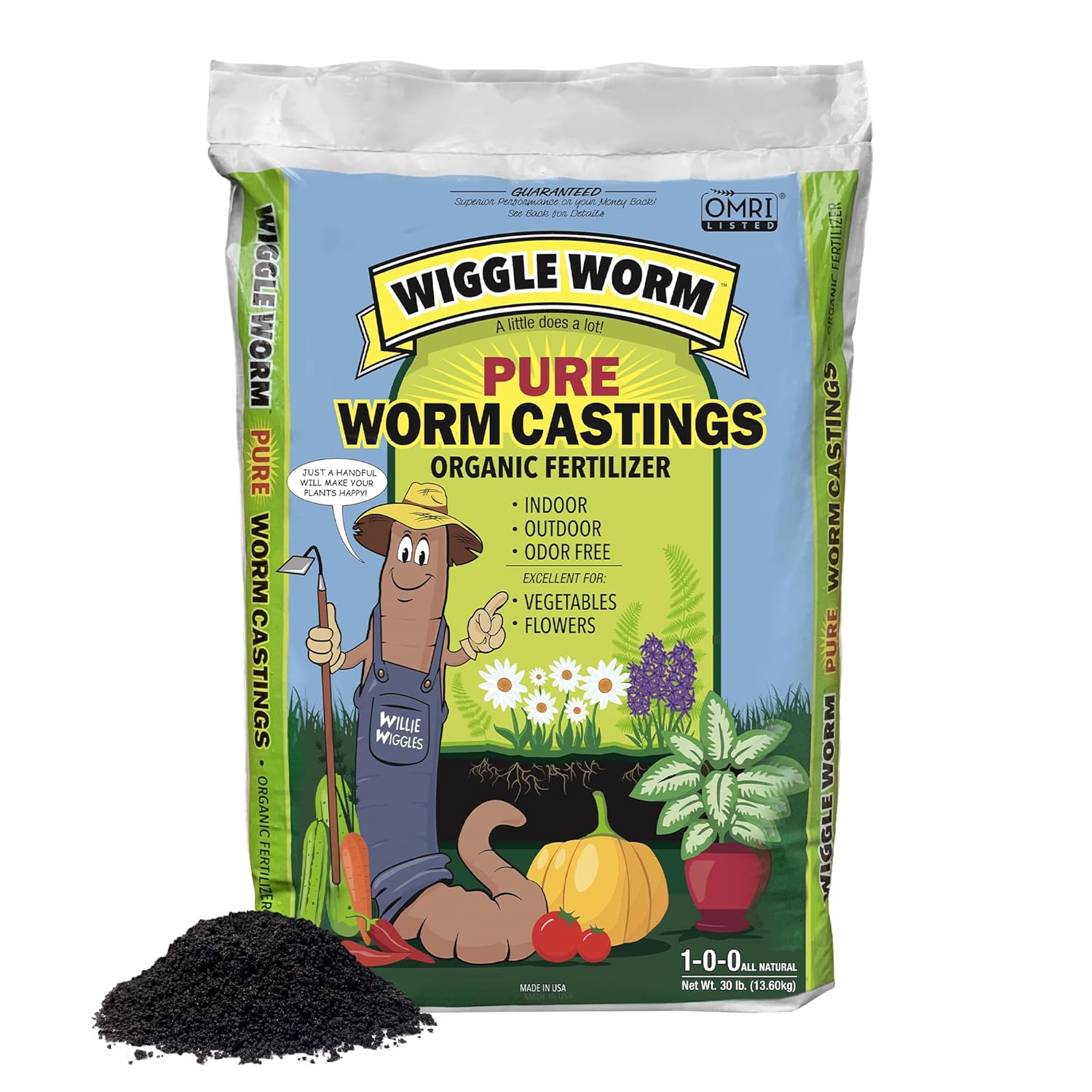
Wiggle Worm 100% Pure Organic Worm Castings Fertilizer, 30 lb
| Item Form | Granules |
|---|---|
| Specific Uses For Product | Soil Conditioning |
| Unit Count | 480 Ounce |
| OMRI Listed | Yes |
Wiggle Worm Pure Worm Castings are a straightforward organic soil amendment designed to strengthen soil biology and feed vegetable beds without risk of burning roots. Typically used as a top dressing, mixed into potting mixes, or added to planting holes, the product supplies water-soluble nutrients plus slow-release minerals and beneficial microbes that support root development and improved water retention. Notable features include OMRI listing for organic use, a screened product free of bedding and eggs, and clear application guidance for containers, raised beds, lawns, and transplanting. Practical benefits for a vegetable garden are faster nutrient uptake, better soil aeration, and reduced need for frequent synthetic feedings. The main limitations are that it is a low-NPK, gentle amendment rather than a complete, high-nitrogen fertilizer and you need to apply periodically or combine with higher-nutrient feeds for heavy-feeding crops. For gardeners focused on building long-term soil health it is a reliable, low-risk addition but expect incremental improvements rather than instant, dramatic growth spurts.
Best for: Gardeners who prioritize dependable, organic soil-building products for vegetables and want a safe, no-risk amendment to improve long-term fertility and plant health.
Less Ideal for: Growers who need a quick, high-nitrogen boost for leafy heavy feeders or those seeking a single-product, complete fertilizer solution should look elsewhere.
- OMRI listed and made from 100% screened worm castings suitable for organic vegetable gardens
- Boosts soil microbial activity and improves aeration and water retention
- Odorless and non-burning so safe for direct use around roots and in containers
- Versatile application: top dress, mix into potting soil, use in planting holes, or brew as tea
- Not a high-NPK fertilizer so may not meet immediate nutrient demands of heavy-feeding crops
Verdict: A reliably safe, OMRI-listed soil builder that steadily improves soil biology and structure for healthier vegetable gardens.
Dr. Earth Organic Tomato, Vegetable & Herb Fertilizer (64 oz)

| Unit Count | 64 Ounce |
|---|---|
| Item Form | Granules |
| Specific Uses For Product | Organic |
| Target Species | Herb |
| Coverage | Medium |
This granular organic fertilizer is designed to boost vegetable and herb production by supplying balanced nutrients and soil biology support. It is typically broadcast into beds, mixed into potting mixes, or applied at planting and midseason for a nutritional lift; the manufacturer recommends reapplying every six weeks for containers. Notable features include a fully organic ingredient list, fast but sustained nutrient release, and a blend of probiotic microbes plus ecto and endo mycorrhizae intended to improve nutrient uptake and drought tolerance. In practice that means healthier root systems and potentially better yields and flavor in crops like cucumbers when used as part of an organic program. Limitations are that it is a medium coverage product in a 64 ounce bag so larger plots will need more frequent purchases, and it contains phosphorus so local runoff rules should be checked before use. Follow the directions for pH and application timing to avoid overapplication in small containers.
Best for: Gardeners who prioritize organic soil health and want a single, biology‑focused fertilizer to support vegetables like cucumbers in beds or containers.
Less Ideal for: Large‑scale growers seeking a bulk, high‑coverage fertilizer or those who must avoid phosphorus due to local regulations should consider other options.
- 100 percent organic formula suitable for certified organic gardens
- Contains beneficial microbes and eight strains of mycorrhizae to support root health and nutrient uptake
- Granular form releases nutrients quickly and continues feeding for several months
- Works for beds, raised planters and containers and can be used at planting, transplanting or midseason
- Bag is medium coverage so not economical for very large vegetable plots
- Includes phosphorus which may be restricted in some local jurisdictions
Verdict: Choose this product if you want an organic, microbe‑rich granular fertilizer that supports root health and steady feeding for cucumber and other vegetable plantings.
Neptune's Harvest Fish & Seaweed Liquid Fertilizer (2-3-1) 36 oz

| Item Form | Liquid |
|---|---|
| Mixing Ratio | 2:3 |
| Specific Uses For Product | Plant Growth |
| Liquid Volume | 946 ml |
Neptune's Harvest Fish & Seaweed Liquid Fertilizer is a concentrated organic plant food that mixes with water for use as a soil drench or foliar feed. It is typically diluted (manufacturer directions give roughly 1 fl oz per gallon for outdoor use and 1 tablespoon per gallon for houseplants) and applied every 1 to 3 weeks depending on the crop. The formula combines hydrolyzed fish and seaweed to deliver nitrogen, micronutrients, and seaweed-derived growth compounds in a plant-ready form, which helps green growth, flowering color, and vegetable flavor. Because it is a liquid concentrate it is easy to measure and applies evenly, and regular use can improve soil biology and structure over time. Limitations are that it is low in phosphorus and potassium relative to some specialty bloom or fruit formulas and it has an odor typical of fish-based fertilizers that some users may find strong. This product suits gardeners who want an effective, organic regular feed that supports both potted houseplants and garden beds.
Best for: Gardeners seeking a reliable, organic everyday fertilizer that simplifies feeding for a mixture of houseplants, vegetables, flowers and shrubs and who value soil health as well as plant vigor.
Less Ideal for: Growers who need a high-phosphorus bloom booster or a fertilizer formulated specifically for fruit set or lawns should look for a targeted specialty product instead.
- Organic concentrate blending hydrolyzed fish and seaweed for plant-ready nutrients
- Versatile application as soil drench or foliar feed for indoor and outdoor plants
- Supports soil biology and structure with regular use
- Easy-to-measure mixing ratios for routine feeding
- Has a strong fish odor that some users may find unpleasant
- Lower phosphorus and potassium compared with specialized bloom or fruit formulas
Verdict: A dependable organic liquid concentrate that provides balanced, plant-ready nutrients and improves soil health for routine feeding of mixed garden and houseplants.
Choosing the Right Organic Fertilizer for Carrots: Key Factors to Consider
Nutrient Balance and Ratios
Nutrient ratios determine how plants allocate energy between tops and roots. Carrots need moderate nitrogen early for steady leaf growth but rely on phosphorus and potassium to develop dense, sweet roots. An organic fertilizer with a balanced N-P-K profile or a blend that emphasizes phosphorus and potassium can help avoid excessively leafy plants and encourage root bulking.
Look for products that list guaranteed analysis or provide a clear breakdown of nutrients. If the fertilizer is raw organic matter, consider how it will mineralize and what supplemental inputs may be needed to meet phosphorus or potassium needs during the root bulking phase.
Release Profile and Timing
Release profile tells you when nutrients become available. Slow-release organic sources feed over weeks to months, reducing the chance of nutrient spikes that can cause forking or bitterness. Fast-release options like compost teas can help seedlings but may need careful timing to avoid stimulating too much top growth.
Plan fertilizer applications to match carrot development: a pre-plant incorporation to build available phosphorus and potassium, then light side-dressing or foliar feeds during active root growth if needed. Knowing whether a product acts quickly or gradually changes how and when you apply it.
Soil Structure and Microbial Benefits
Carrots require loose, well-drained, low-clay soil to form straight roots. Some organic fertilizers also act as soil conditioners, adding organic matter that improves tilth, water retention, and aggregation. Products that encourage microbial activity help mineralize nutrients over time and support a healthier root zone.
Consider amendments that combine nutrient supply with humus-building effects. Over time these choices reduce compaction and support consistent root shape, making future carrot crops easier to grow.
Salt Content and Burn Risk
High soluble salt levels can damage seedlings and concentrate near root tips, causing poor germination, stunted roots, or root burn. Organic fertilizers vary widely in salt index; manures and some composts can be saltier depending on source and processing.
Choose low-salt options for direct seeding and for shallow-rooting carrots. If using higher-salt amendments, apply and water well ahead of seeding to flush salts and allow mineralization to lower burn risk.
Application Method and Practicality
How you apply fertilizer affects root development and garden labor. Granular blends that can be worked lightly into the bed before planting are convenient for direct-sown carrots, while liquid feeds or teas can be used for later-season boosts without disturbing roots. Pelletized or slow-release forms reduce the need for repeated handling, which is helpful in small urban plots or raised beds.
Also consider weight, packaging, and ease of measuring for small patches. Heavy bulk bags are fine for large growers but impractical for a single 4-by-4 raised bed.
Compatibility with Seedlings and Companion Planting
Carrot seedlings are delicate and can be sensitive to concentrated fertilizers. Choose products that are safe to use near young roots or plan application timing to avoid direct contact with seeds. Some organic fertilizers pair well with companion plants that attract beneficial insects or improve soil nitrogen, while others might be too rich and favor leafy neighbors.
Think about the wider bed ecosystem when selecting a fertilizer. Match the product to whether you interplant with onions, lettuce, or legumes, and adjust doses so companions and carrots both thrive without outcompeting one another.
Preparing a Bed for Carrots
Start with a deep, loosened bed free of stones and compacted layers so roots can grow straight down. Work organic matter into the top 8 to 12 inches to improve texture and drainage. Avoid adding fresh high-nitrogen manures right before seeding because they can promote forking and misshapen roots.
Test the soil if possible for pH and available phosphorus and potassium. Carrots prefer slightly acidic to neutral soil; amend pH gradually if needed. Pre-planting fertilizer should focus on building a steady supply of P and K while keeping readily available nitrogen moderate.
- Remove rocks and clods to prevent deformation
- Incorporate well-aged compost rather than fresh manure
- Work in any phosphorus or potassium amendments before planting
Timing Applications Around Carrot Growth Stages
Match fertilizer type and timing to key carrot stages. Pre-plant incorporation feeds root initiation and early bulking. Light side-dressing can be applied mid-season if foliage appears weak or roots lag, but avoid heavy nitrogen at that point.
If you use liquid feeds, apply them sparingly and only after roots are established. Overfeeding after the first 6 to 8 weeks can produce abundant tops and poor root form.
- Pre-plant: incorporate slow-release P and K
- Early growth: minimal nitrogen to support steady leafing
- Mid-season: targeted low-nitrogen side dressing if needed
Low-Salt Strategies for Direct Seeding
When direct seeding carrots, there is little margin for error. Use low-salt fertilizers or apply amendments well ahead of sowing and water thoroughly to leach any soluble salts. Creating a gentle nutrient bank in the soil before planting reduces seedling stress and supports even germination.
If you must use a saltier amendment, mix it with generous compost and avoid placing it in close contact with the seed row. Cover the bed with a light mulch to retain moisture without creating a crust that hinders emergence.
- Pre-wet beds after applying amendments to reduce salt concentration
- Avoid concentrated bands of fertilizer along the seed row
- Use fine-textured, low-salt composts for seedbed preparation
Organic Sources and When to Use Them
Different organic materials release nutrients at different rates. Compost and well-aged manure provide broad soil-building benefits but vary in nutrient content. Bone meal and rock phosphate supply phosphorus more slowly, while kelp and soft rock minerals add trace elements useful for flavor development.
Choose materials based on whether you need immediate nutrient availability or long-term soil improvement. Combining a starter source with a soil-building amendment often gives the best balance for a single carrot season plus future crops.
- Compost: broad benefits and gentle nutrient release
- Bone meal/rock phosphate: longer-term phosphorus
- Kelp/rock minerals: micronutrient boost
Managing Organic Matter for Root Shape
Too much coarse organic matter in the seed zone can lead to irregular roots. Screen compost to remove large chunks and avoid heavy woody amendments in the top few inches. Fine, stable humus supports even root growth and encourages consistent taproot formation.
If your soil is very light and sandy, choose amendments that help retain moisture without creating dense clumps. In heavier soils, prioritize materials that increase aggregation and drainage to let roots expand properly.
- Use fine-textured compost in the seedbed
- Avoid fresh woody mulches mixed into the top planting layer
- Balance moisture retention and drainage according to soil type
How We Chose the Best Organic Fertilizer for Carrots
We focused on practical, garden-tested criteria that matter when feeding root crops. Key evaluation points included nutrient balance and release profile, because carrots need modest nitrogen with adequate phosphorus and potassium to develop strong roots without excessive foliage. Soil-building benefits were weighed, prioritizing amendments that improve structure and microbial activity to maintain loose, friable beds for straight roots. Application method and timing were considered to favor fertilizers gardeners can place appropriately ahead of planting or side-dress without disturbing delicate roots. Salt index and potential for burning were screened to avoid products likely to damage seedlings or tender roots. Availability in small and bulk formats was noted so gardeners with a single raised bed or a larger patch can both find suitable options. We excluded synthetic chemical blends and high-salt industrial fertilizers that can push top growth or harm root quality. Organic-certified and well-described natural amendments were retained. Final selections balanced short-term nutrient availability for a single season with long-term soil improvement to support successive carrot crops.
FAQ
Can I use compost alone to feed carrots?
Often you can, especially if the compost is well-aged and made from diverse inputs. Compost supplies nutrients slowly and builds soil structure, but it may be low in phosphorus or potassium. Test the soil or supplement with a targeted P or K source if needed.
When should I avoid applying organic fertilizer to carrots?
Avoid applying high-nitrogen or fresh manures immediately before seeding because they encourage forking and excessive top growth. Also avoid concentrated applications close to seed rows without mixing the amendment into the bed first.
How do I prevent forks and split roots when fertilizing?
Prevent forks by maintaining loose, stone-free soil and avoiding abrupt nutrient spikes. Use low-to-moderate nitrogen, ensure even moisture, and apply phosphorus and potassium in a way that supports steady root bulking rather than sudden growth surges.
Is foliar feeding useful for carrots?
Foliar feeds can correct minor micronutrient deficiencies and give a gentle boost when roots are established, but they are less effective for supplying the bulk macronutrients carrots need for root bulking. Use them as a supplement rather than the primary nutrient source.
How far ahead of planting should I apply organic amendments?
Apply most organic amendments at least a few weeks ahead so they can integrate and begin breaking down. For materials with higher salt or fresh-manure characteristics, apply several months ahead and water thoroughly to reduce salt stress on seeds.
Do carrots need different feeding in raised beds versus open ground?
Raised beds often warm faster and drain differently, which affects nutrient availability. Because beds can be shallower, focus on fine-textured amendments and avoid heavy or coarse materials in the seed zone. Monitor moisture and adjust application rates accordingly.
Final Verdict
Choosing the right organic fertilizer for carrots is about balancing steady nutrient supply with soil-building benefits while avoiding salt and nitrogen spikes that harm root form. Prioritize products that deliver phosphorus and potassium for root bulking, improve soil texture, and release nutrients at a pace matching carrot development. Consider your bed type, seeding method, and how much hands-on application you prefer. With those priorities in mind, you can select an organic feeding approach that produces straight, flavorful carrots season after season.
