

Note: This article contains affiliate links. If you click on these links and make a purchase, I may earn a small commission at no extra cost to you. This helps support my research and content. Read my full affiliate disclosure here.
If you grow zinnias you want steady, colorful blooms and foliage that resists disease and heat stress. Choosing the right organic fertilizer for zinnias matters because these annuals respond quickly to available nutrients and to how those nutrients are supplied. Slow-release organics feed over time, while faster-acting amendments can jump-start flowering after planting or during peak bloom. This guide covers seven top shortlisted organic fertilizers for zinnias and explains the practical differences that matter in the garden. We evaluate nutrient balance, application method, and how each option behaves in beds, borders, and containers to help you pick the best feeding strategy.
Top Picks at a Glance
| Best Overall The best all-around choice for most situations | Espoma Organic Bloom! Liquid Concentrate Plant Food (16 fl oz) |  |
| Best Quality Built to a higher standard if you want something more solid | BUILDASOIL Organic Vegetable Garden Fertilizer, Craft Blend (3 lb) |  |
| Best Value The sweet spot between price and what you get | Jobe's Organics All-Purpose Granular Fertilizer (16 lb) |  |
| Best Budget The cheapest option that still gets the job done reliably | Down To Earth Organic Vegetable Garden Fertilizer, 4-4-4, 1 lb |  |
| Highest Rated A top-rated pick with lots of positive feedback | Espoma Organic Plant-Tone All-Purpose 5-3-3 Organic Plant Food, 50 lb Bag |  |
| Most Popular A crowd favorite that many people choose with confidence | Jobe's Organics Granular Tomato & Vegetable Fertilizer, 4 lb |  |
| Best Seller A high-volume bestseller chosen again and again | Espoma Flower-Tone Organic Fertilizer, 4 lb. Bag, 2-Pack |  |
Espoma Organic Bloom! Liquid Concentrate Plant Food (16 fl oz)

| Item Form | Liquid |
|---|---|
| Specific Uses For Product | Organic,Plant Food |
| Application Method | water |
| Target Species | flowering plants, annuals & perennials |
| Liquid Volume | 16 fluid ounces |
Espoma Organic Bloom! is a low-analysis liquid concentrate designed specifically to encourage prolific flowering in ornamentals, hanging baskets and garden beds. It mixes with water for routine feedings every 2 to 4 weeks and contains natural proteins, kelp extracts and humic acids in a 1-3-1 NPK balance to support bloom development rather than leafy growth. Because it is a concentrated liquid, small measured doses make it easy to apply through a watering can or hose-end applicator for medium coverage areas. The organic certification means it can be used in certified organic production and avoids synthetic fertilizers, but its low nitrogen content means it will not drive rapid vegetative growth if that is desired. Practical benefits include simple dilution instructions, suitability for containers and in-ground plantings, and a formulation aimed at improving flower size and frequency. Expect steady improvements in bloom performance over the season rather than an immediate dramatic change.
Best for: Gardeners focused on boosting flower production in containers, hanging baskets, and garden beds who prefer an organic, easy-to-mix liquid feed applied on a regular schedule.
Less Ideal for: Growers who need a high-nitrogen feed for rapid leafy growth or those managing very large landscapes where bulk granular fertilizers are more economical.
- Organic certified formulation suitable for organic gardening
- Concentrated liquid mixes with water for convenient routine feedings
- 1-3-1 formulation targets flowering and bud development
- Contains kelp extracts and humic acids to support overall plant vigor
- Low nitrogen ratio so it will not significantly increase leafy growth
- 16 fl oz bottle is best for small to medium gardens and may require repurchasing for larger areas
Verdict: Use this organic liquid concentrate every few weeks to reliably increase bloom size and frequency on flowers and container plants.
BUILDASOIL Organic Vegetable Garden Fertilizer, Craft Blend (3 lb)

| Item Form | Granules |
|---|---|
| Specific Uses For Product | Plant Growth, Soil Conditioning |
| Coverage | Medium |
| Mixing Ratio | 1/4 to 1 cup per 5 gallons of water |
| Unit Count | 48 Ounce |
This BuildASoil Craft Blend is an all-purpose organic granular fertilizer aimed at improving vegetable garden performance and overall soil health. It is typically used as a top dressing, re-amendment, or brewed into a nutrient tea using the suggested ratio of 1/4 to 1 cup per 5 gallons of water. The formula lists a 2-4-2 NPK along with rock dust and calcium, which supports root development, flowering, and nutrient balance for faster visible plant response. Practical benefits include flexible application methods, suitability for both re-amending spent soil and regular feeding, and a composition intended to boost vigor and flower fragrance. The bag size and medium coverage make it convenient for home vegetable plots and raised beds. Important limitations are that specific nutrient analysis beyond NPK is not itemized on the label and the product requires regular application or tea brewing to see results rather than acting as a long-term one-time soil overhaul. Gardeners should also follow the recommended mixing rates to avoid overapplication when using concentrated brews.
Best for: Gardeners who prioritize measurable plant performance and want an organic fertilizer that promotes rapid growth and bloom response in vegetable beds and raised beds.
Less Ideal for: People seeking a single-application, long-term soil conditioner for large landscapes or those who need precise micronutrient analysis for corrective fertilization.
- Balanced 2-4-2 NPK formula suited to fruiting vegetables and flowering
- Contains mineral inputs like rock dust and calcium to support soil biology
- Versatile application: top dressing, soil re-amendment, or brewed nutrient tea
- Organic and GMO-free formulation appropriate for organic vegetable gardening
- Label does not provide a detailed ingredient breakdown or trace nutrient amounts
- Requires repeated applications or brewed teas rather than acting as a single long-term amendment
Verdict: Choose this handcrafted organic blend if you want a performance-focused, versatile fertilizer that boosts vegetable vigor and flowering with repeatable, measurable feeding methods.
Jobe's Organics All-Purpose Granular Fertilizer (16 lb)

| Item Form | Granules |
|---|---|
| Specific Uses For Product | Plant Growth, Root Development, Seed Development, Soil Conditioning |
| Mixing Ratio | 4-4-4 |
| Coverage | Resealable |
This is a straightforward organic granular fertilizer designed for regular feeding of vegetable gardens and other ornamentals. With an NPK of 4-4-4 and ingredients like feather meal, bone meal, and processed poultry manure, it supplies balanced nutrients and some calcium and sulfur for steady growth and improved root development. You apply it to soil every 2 to 3 weeks during the growing season; as a slow-to-release granular it reduces the need for daily attention and lowers the risk of burning when used as directed. The product is OMRI listed for organic gardening and is presented in a resealable bag for tidy storage. Limitations to be aware of are the modest NPK numbers, which mean it is best for maintenance feeding rather than rapidly correcting severe nutrient deficiencies, and the need to reapply frequently compared with longer-term slow-release formulations. For growers wanting an easy, certified-organic feed for vegetables and mixed beds, this covers most bases without complex application methods.
Best for: Home vegetable gardeners and practical growers who prioritize organic inputs and want a simple, repeatable feeding routine to maintain steady plant growth.
Less Ideal for: Growers who need a high-concentration or targeted corrective fertilizer for severe nutrient deficiencies or for single-crop intensive production should consider specialized formulas instead.
- OMRI listed and made from organic-derived sources suitable for certified organic vegetable production
- Balanced 4-4-4 NPK supports foliage, flowers, and fruit development without strong spikes
- Granular, slow-to-release form reduces immediate burn risk and simplifies feeding schedule
- Resealable packaging helps keep product dry and minimizes mess during storage
- Lower nutrient concentrations mean more frequent application or higher volumes are needed for nutrient-poor soils
- Not formulated for a single crop nutrient correction so may be insufficient for plants with specific high-demand deficiencies
Verdict: A reliable, OMRI-listed all-purpose granular fertilizer that gives practical, balanced organic feeding for vegetable gardens with minimal fuss.
Down To Earth Organic Vegetable Garden Fertilizer, 4-4-4, 1 lb

| Item Form | Granules |
|---|---|
| Specific Uses For Product | Organic Gardening, Transplating, Vegetable Gardens |
| Coverage | Full |
| Target Species | vegetable gardens |
| Mixing Ratio | 4-4-4 |
This is a compact, all-natural granular fertilizer designed for vegetable beds, herbs and container-grown edibles. It supplies a balanced 4-4-4 NPK from ingredients like fish bone meal, alfalfa meal, feather meal and seaweed, so it feeds plants gradually and helps build soil biology rather than forcing fast leaf growth. Typical use is top-dressing or incorporating into planting holes and mixing at the suggested ratio for transplants and ongoing feedings. The slow-release nature reduces the chance of nutrient burn and limits leaching, which is practical for small to medium gardens and raised beds. Because it is OMRI-listed and made from recognizable organic inputs it is suitable for gardeners who prioritize natural approaches and pollinator safety. The 1 lb size is convenient to store and reduces waste for hobby plots, but gardeners with larger plots will need larger bags or frequent replenishment. There is no synthetic quick-release boost for urgent corrections, so expect steady improvements over weeks rather than immediate greening.
Best for: Practical home vegetable gardeners on a budget who grow in raised beds, containers, or small plots and prefer an organic, slow-release feed that supports steady, healthy growth.
Less Ideal for: Large-scale growers or anyone needing fast corrective feeding for nutrient-deficient soil should consider bulk or quick-release alternatives.
- Balanced 4-4-4 NPK tailored for vegetables and herbs
- Made from natural ingredients and listed for organic use
- Slow-release granules reduce risk of burn and nutrient leaching
- Small 1 lb package is easy to store and minimizes waste for small gardens
- 1 lb size is too small for larger gardens and requires frequent repurchasing
- Not formulated for rapid nutrient corrections or instant greening
Verdict: A small, organic slow-release fertilizer that fits budget-minded home vegetable gardeners who want steady, natural feeding rather than instant fixes.
Espoma Organic Plant-Tone All-Purpose 5-3-3 Organic Plant Food, 50 lb Bag

| Item Form | Fertilizer |
|---|---|
| Specific Uses For Product | Gardening |
| Target Species | all flowers, vegetables, trees and shrubs |
| Mixing Ratio | 1:1:1 |
Plant-Tone is designed to feed a range of garden plants by releasing nutrients slowly from natural ingredients and a proprietary Bio-tone microbial formula. In practice you apply it around the drip line of flowers, vegetable plants, shrubs or trees in spring and fall, and for annuals and vegetables you can top-dress monthly during the season. The 5-3-3 analysis with 5% calcium supports balanced growth and blossom set while the organic base builds soil biology over time rather than giving an immediate synthetic spike. A 50 lb bag covers large beds and landscape plantings so it is convenient for serious flower-bed upkeep. Limits are that it is not a quick-fix for severe nutrient deficiency and results accumulate over weeks to months, so impatient gardeners may need a faster-acting supplement for rescue feeding. Also being granular, it requires spreading and watering in rather than foliar application.
Best for: Gardeners focused on steady, reliable performance who maintain multiple flower beds or mixed plantings and prefer improving soil health while feeding blooms and foliage.
Less Ideal for: People needing immediate corrective feeding for yellowing or severely deficient plants or those who only want small-quantity, single-plant solutions.
- Organic, slow-release formula that builds soil biology over time
- Broadly suitable for flowers, vegetables, trees and shrubs
- Includes 5% calcium to support bloom and fruit development
- Large 50 lb bag is practical for maintaining multiple flower beds or landscape areas
- Not a rapid corrective feed for acute nutrient deficiencies
- Requires spreading and watering in; not suitable for foliar feeding
Verdict: Choose this if you want a proven organic, slow-release fertilizer that steadily feeds flower beds and builds soil health while supporting blooms.
Jobe's Organics Granular Tomato & Vegetable Fertilizer, 4 lb

| NPK | 2-5-3 |
|---|---|
| Item Form | Granules |
| Target Species | Vegetable and tomato |
| Unit Count | 64 Ounce |
Jobe's Organics granular fertilizer is a simple, slow-release feed designed specifically for tomato and vegetable beds. You apply the granules around plants every 4 to 6 weeks during the growing season to supply roots with nitrogen, phosphorus, and potassium in a 2-5-3 ratio aimed at fruiting and root development. The formula derives nutrients from bone meal and processed poultry manure and includes calcium and other micronutrients, which helps reduce blossom end rot and supports solid fruit set. Because it is OMRI listed it fits into organic vegetable production and is safe to use around children and pets when applied as directed. Practical gardeners will appreciate the measured, low-mess granular format and the moderate coverage for small to medium plots. Limitations are that it is not a fast-acting soluble feed for immediate correction and the 4 lb bag covers only a modest area, so larger vegetable gardens will need larger or repeated purchases.
Best for: Gardeners who prioritize organic, low-maintenance feeding for home vegetable and tomato beds and who want a measured, slow-release product for steady crop development.
Less Ideal for: Growers who need rapid correction of nutrient deficiencies or who manage large-scale vegetable plots and prefer concentrated or high-coverage fertilizers.
- OMRI listed for use in certified organic vegetable production
- Balanced 2-5-3 NPK with added calcium and micronutrients to support fruiting and root health
- Slow-release granular form feeds roots over time and reduces risk of over-fertilizing
- Easy to measure and apply for small to medium garden beds
- Not a quick soluble feed for immediate nutrient correction
- 4 lb bag provides only moderate coverage for larger vegetable gardens
Verdict: A reliable OMRI-listed granular feed that delivers balanced, slow-release nutrition ideal for home tomato and vegetable gardens.
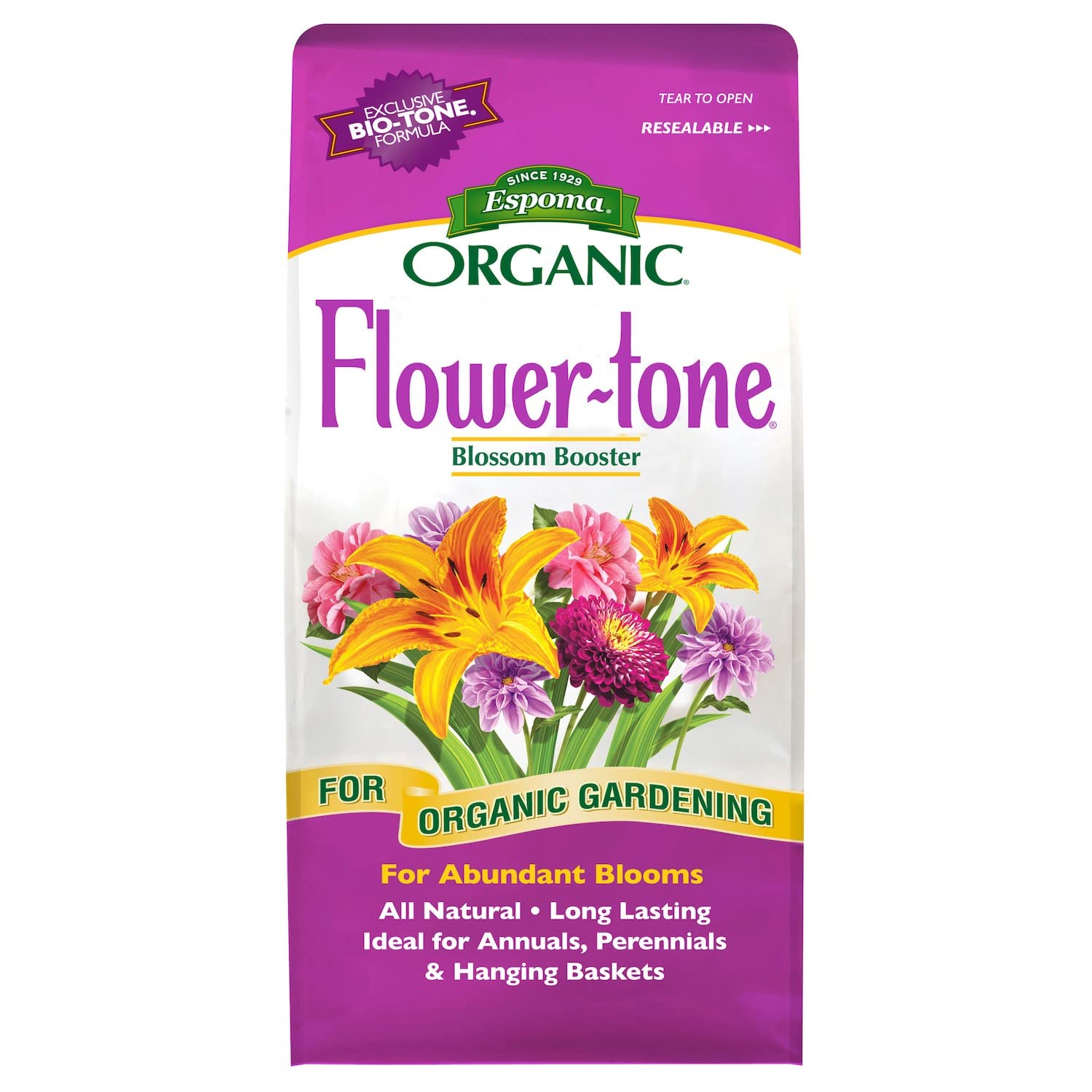
Espoma Flower-Tone Organic Fertilizer, 4 lb. Bag, 2-Pack
| Item Form | Granules |
|---|---|
| Specific Uses For Product | Gardening,Organic,Plant Food |
| Coverage | Medium |
| Target Species | flowers, annuals, perennials, roses |
| Mixing Ratio | 3:4:5 |
Espoma Flower-Tone is an organic granular plant food designed to promote abundant blooms in flowers, perennials, annuals and roses. It is applied directly to the soil around the plant drip line and watered in, with a recommended monthly application during the growing season. The 3-4-5 nutrient ratio with added calcium and the Bio-tone biological formula supply a balanced feed that supports flowering without high nitrogen that would favor foliage over blooms. Because it is granular and labeled for organic gardening, it works well for mixed perennial beds where you want steady, natural nutrient release and compatibility with organic practices. The product comes in convenient 4 pound bags sold as a two-pack for repeat applications. Limitations are that it is a medium-coverage granular feed rather than a fast-acting liquid, so results accumulate over weeks, and you must follow monthly repeat applications for sustained bloom performance.
Best for: Gardeners who want an easy, organic monthly feed to boost blooms in mixed perennial and flower beds and prefer a product that supports soil biology.
Less Ideal for: Growers who need immediate, fast-acting nutrient results or who are managing very large beds where concentrated coverage per application is the priority.
- Organic formula approved for organic gardening and safe for use around flowers and perennials
- Balanced 3-4-5 NPK with added calcium supports bloom production rather than excess leaf growth
- Granular form is easy to apply around drip lines and provides steady nutrient release
- Includes Espoma's Bio-tone biological formula to support soil biology and root health
- Medium coverage means larger beds will require multiple bags for full-season feeding
- Slower to show results compared with liquid or soluble fertilizers
Verdict: A dependable organic granular fertilizer that steadily promotes bigger, healthier blooms in perennial and flower beds when used as a monthly feed.
Choosing the Right Organic Fertilizer for Zinnias: Key Factors to Consider
Nutrient Balance for Flowering
Zinnias need a fertilizer that leans toward phosphorus and potassium relative to nitrogen once seedlings are established. Too much nitrogen encourages lush foliage but reduces flower set. Look for organic sources that provide a clear N-P-K ratio and include bloom-promoting levels of phosphorus to support bud formation.
In practical terms, choose a starter feed with slightly higher nitrogen for young transplants, then switch to a bloom-formula or a steady low-nitrogen organic feed as flowers form. This staged approach helps avoid legginess and maximizes the number and size of blooms.
Release Profile and Timing
How quickly a fertilizer releases nutrients determines how often you need to feed and how stable soil fertility remains. Slow-release organics, such as composted manures or pelletized blends, supply a steady trickle of nutrients over weeks. Liquid or soluble organic feeds act faster and are useful for correcting a deficiency or giving plants a mid-season bloom boost.
Consider your schedule and planting system. If you plant many pots or have limited time, a slow-release granular will reduce repeat applications. If you grow in flushes or want rapid results after a stress event, have a soluble organic fertilizer on hand for foliar or root drench applications.
Application Method and Garden Setup
Zinnias are grown in beds, borders, and containers, and each setting favors different fertilizer forms. Granular or pelletized organics are easy to broadcast in garden beds and can be lightly worked into the topsoil. Liquids and water-soluble feeds are ideal for containers where nutrients wash out with frequent watering and where quick corrections are needed.
Think about ergonomics as well. Handheld spreaders, measuring scoops, and concentrated liquids change how precise your feeding is. Choose a format you will actually use consistently to keep flowering predictable throughout the season.
Impact on Soil Biology
One major advantage of organic fertilizers is their support for soil life. Materials like compost, well-aged manure, and rock meals build microbial activity and organic matter, which improves water retention and nutrient cycling. For annuals like zinnias, richer soil biology supports root health and can reduce disease susceptibility.
If your soil is poor, prioritize fertilizers that add organic matter, not just nutrients. Over time these inputs improve structure and reduce the need for frequent feeding, but they may release nutrients more slowly than synthetic alternatives.
Salt Load and Plant Safety
Some organic fertilizers, particularly concentrated manures and certain seaweed or fish products, can have higher soluble salt contents that stress young roots or container plants. Salt buildup is more likely in small pots and in poorly drained beds. Pay attention to product guidance on dilution and application rates to avoid burn.
When starting seedlings or transplanting, err on the side of lighter feeding and flush containers occasionally to prevent accumulation. Established zinnias tolerate moderate salt levels better, but consistent over-application can reduce vigor and flowering.
Compatibility with Companion Plants and Pollinators
Zinnias are often planted with other annuals and with pollinator-supporting flowers. Choose fertilizers that will not harm nearby herbs, vegetables, or beneficial insects. Water-soluble feeds used as foliar sprays should be plant-safe and applied when pollinators are not active.
Organic granulars that slowly feed the soil are generally pollinator friendly because they do not leave long-lasting residues on blooms. If you use fish or seaweed products, follow label timing to avoid attracting pests or creating strong odors near seating areas.
When to Feed Zinnias During the Season
Start with a light feeding at transplant time to give seedlings enough nitrogen for initial leaf growth. Once zinnias have several sets of true leaves and begin putting up buds, switch to a bloom-focused feed or a balanced low-nitrogen organic application.
Continue feeding on a predictable schedule based on the fertilizer type. Slow-release granules might only need one application at planting, while soluble organics often require feeding every two to four weeks during active bloom.
- Light starter feed at transplant
- Switch to bloom-oriented nutrition once buds form
- Follow product directions for reapplication intervals
Feeding Zinnias in Containers Versus Garden Beds
Containers dry out and lose nutrients faster than in-ground beds, so choose fertilizers that replace what washing and frequent watering remove. Water-soluble organic feeds or frequent light applications work well in pots.
In beds, prioritize adding organic matter at planting to improve long-term fertility. Granular organics mixed into the topsoil provide steady nutrition for multiple plants with fewer applications.
- Containers: use soluble feeds and monitor salt buildup
- Beds: build soil organic matter and use slow-release products
- Adjust schedule based on rainfall and irrigation frequency
Using Compost and Natural Amendments with Fertilizer
Compost is a foundational amendment that enhances soil structure and supplies a broad spectrum of nutrients. Incorporate well-aged compost into planting holes or topdress beds to support zinnias throughout the season.
Combine compost with a targeted organic fertilizer if your soil test shows specific nutrient gaps. Natural amendments like bone meal or kelp can supply phosphorus or trace elements, but they work slowly and are best used as part of an overall soil-building plan.
- Topdress compost annually for sustained fertility
- Use amendments to correct specific deficiencies
- Avoid fresh manure at planting time because of heat and salt risks
Simple Soil Tests and Visual Cues
You do not always need a lab test to make good feeding decisions. Simple soil tests or home test kits can indicate pH and basic nutrient levels. Combine that information with visual cues from plants: pale leaves and reduced blooms suggest nutrient shortages, while rapid leaf growth with few flowers points to excess nitrogen.
Observe bloom size, color saturation, and longevity as indicators of whether your feeding strategy is working. Adjust frequency or switch fertilizer type if flowers are small or sparse despite consistent watering.
- Use home test kits for basic guidance
- Watch leaf color and bloom production for feeding signs
- Adjust feeding type rather than increasing dose if blooms suffer
Organic Feeding Strategies for Cutting Gardens
If you grow zinnias for fresh cutting, prioritize products that extend bloom and support stem strength. Moderate phosphorus and potassium with controlled nitrogen usually encourages long-lasting blooms and sturdy stems for arrangements.
Feed on a schedule that matches harvest frequency. Frequent cutting removes built-up carbohydrates and may require more consistent feeding to sustain continuous bloom production.
- Choose feeds that support stem strength and bloom longevity
- Match feeding frequency to harvest rate
- Monitor regrowth after cutting and adjust nutrition accordingly
How We Chose the Best Organic Fertilizer for Zinnias
We focused on fertilizers that suit zinnias as single-season, heavy-blooming annuals and prioritized real-world garden performance. Evaluation criteria included nutrient balance specific to flowering plants, release profile and longevity, application method suitability for beds and containers, and ingredient transparency so gardeners know what they are adding to soil. We favored products with clear N-P-K ratios that support bloom production while avoiding excessive nitrogen that promotes leafy growth at the expense of flowers. Release profile mattered because zinnias benefit from steady feeding through their bloom period; we looked for both slow-release organics and amendable quick-feed options. Application method was important because many gardeners grow zinnias in compact beds or pots; we considered granular, liquid, and pellet forms for ease of use and accuracy. We excluded synthetically derived fertilizers and blends with unclear source material. We also filtered out options that require complex processing or heavy equipment to apply. The final picks reflect materials and products that are practical for hobby gardeners and small-scale growers who want consistent, bloom-focused nutrition without synthetic inputs.
FAQ
How often should I apply organic fertilizer to zinnias?
It depends on the product. Slow-release granular organics often need one application at planting and maybe a midseason top-up. Soluble organic feeds are commonly applied every two to four weeks during active bloom.
Can I use compost alone for zinnias?
Compost provides steady nutrition and improves soil structure, and in good soils it can be enough. If blooms are sparse or soil is low in phosphorus, supplementing with a targeted organic bloom feed will boost flower production.
Are seaweed and fish emulsion safe for pollinators?
Yes, when used as directed. Liquid seaweed and fish products applied to foliage should be sprayed when pollinators are not active to avoid direct contact. Granular soil applications pose little risk to pollinators.
Will organic fertilizer prevent common zinnia diseases?
Fertilizer alone will not prevent disease. Healthy nutrition and good cultural practices, such as spacing for air circulation, avoiding overhead watering, and proper soil drainage, reduce disease pressure. Some organic inputs can improve plant vigor, which helps resist pathogens.
How do I avoid fertilizer burn in containers?
Use labeled dilution rates for soluble organics and err on the side of lighter feeding with young plants. Periodically flush containers with water to leach excess salts, and choose slow-release granules if you prefer fewer interventions.
Final Verdict
Prioritize fertilizers that match the bloom-focused needs of zinnias: moderate nitrogen for foliage support early on, followed by phosphorus- and potassium-biased feeding for abundant flowers. Consider how you grow zinnias when choosing a format-containers usually need more frequent soluble feeding while beds benefit from soil-building granulars. Balance immediate bloom boosts with long-term soil health and watch plant cues rather than increasing doses. With the right organic feeding strategy you can keep zinnia beds colorful, productive, and resilient across the growing season.
