

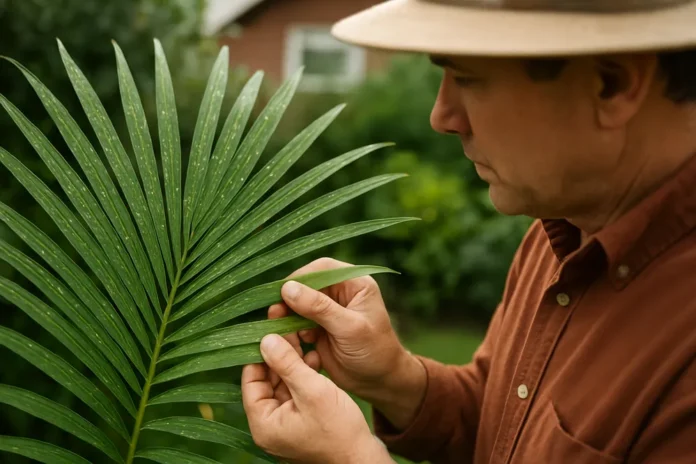
Palm tree leaves usually get white spots from sap-sucking pests, fungal disease, hard water or fertilizer residue, or sun and weather stress. In some palms, small pale speckles can also be a normal part of the leaf surface.
Seeing white spots on a palm can be confusing because several very different problems create a similar pale, dusty, or speckled look. Sometimes the cause is harmless residue or natural leaf texture. Other times it is a sign of spider mites, scale, mealybugs, or a leaf disease that needs attention before the plant weakens.
When I troubleshoot palm tree leaves with white spots, I start by looking at the exact pattern. Are the spots raised or flat? Do they wipe off? Are they clustered along the midrib, scattered like tiny pinpricks, or spread in fuzzy patches? That visual pattern usually tells you far more than the color itself.
The good news is that most causes are manageable once you know what you are looking at. Below, I will walk through the most common reasons palm leaves develop white spots, how to tell them apart, and what to do for each one.
What the White Spots Are Telling You
White spotting is a symptom, not a diagnosis. On palms, that symptom can come from insects feeding on the leaf surface, fungal growth, mineral buildup after watering, chemical residue from sprays, sunscald, cold damage, or even normal waxy coatings. The most useful first question is whether the spots are on the leaf or in the leaf tissue.
- If the white material sits on the surface and rubs off, think residue, mildew, or pests with cottony coverings.
- If the spots are embedded in the leaf and do not wipe away, think feeding damage, sun injury, nutrient stress, or disease lesions.
- If the spots are raised like bumps, scale insects are high on the list.
- If the spotting is fine and dusty with webbing, spider mites are a common culprit.
- If the pattern is symmetrical and appears mostly on older leaves of a specific palm type, it may be a natural trait rather than a problem.
I rarely decide based on one leaf alone. I compare several fronds, including the newest and oldest, because pests and diseases usually spread in patterns, while residue and sun stress often line up with where the plant was watered or exposed.
Common Pest Problems That Cause White Spots
Spider Mites
Spider mites are one of the most common causes of pale stippling on indoor and patio palms. They pierce leaf tissue and suck out juices, leaving tiny white or yellowish specks that can merge into a dull, faded look. You may also see very fine webbing, especially on the undersides of fronds and near leaflet bases.
Mites thrive in hot, dry air, so this is especially common on indoor majesty palms, areca palms, parlor palms, and kentia palms kept near heating vents or in low-humidity rooms. Heavy infestations make fronds look dusty, bronzed, and tired long before people realize insects are involved.
Scale Insects
Scale often appears as small white, tan, or gray bumps attached to leaf stems, midribs, or frond surfaces. Some species look waxy and pale enough to be mistaken for white spots at first glance. Unlike residue, scale does not simply rinse away. You usually have to scrape a bump gently with a fingernail to see that it is an insect.
As scale feeds, it drains energy from the palm and may lead to yellowing, poor growth, sticky honeydew, or black sooty mold. If your palm has white bumps plus a tacky feel, scale is very likely involved.
Mealybugs
Mealybugs show up as white, cottony masses tucked into leaf joints, along stems, and where fronds emerge. On palms, they can be easy to miss until the infestation grows. Their white wax coating may look like random spots from a distance, but up close it has a fluffy or fuzzy texture.
These insects also suck sap and can weaken the palm over time. New growth may come in distorted, and sticky honeydew can attract ants or support mold growth.
- White speckling with webbing suggests spider mites.
- Hard or waxy bumps suggest scale.
- Soft cottony clumps suggest mealybugs.
- Sticky residue often points to sap-sucking insects rather than disease.
Fungal and Mildew Issues to Consider
Fungal issues on palms can create pale lesions, powdery patches, or spotted areas with light centers and darker margins. Powdery mildew is less common on palms than on many ornamentals, but it can happen in stagnant, humid conditions where air circulation is poor. More often, gardeners see leaf spot diseases that begin as small discolorations and slowly enlarge.
White or pale fungal spots usually do not look perfectly clean or sharply painted on. They may have a slightly fuzzy, papery, or corky appearance. In humid weather, older spots sometimes merge and give fronds a blanched, patchy look. Severely affected leaves may yellow or brown around the spots.
Clues That Point Toward Disease
- Spots expand over time instead of staying the same size.
- Lesions may have brown, black, or yellow edges around a pale center.
- Several leaves show random spotting, especially after prolonged wet weather.
- The spotting remains even after gently wiping the leaf surface.
Fungal spotting is more likely when palms are watered overhead late in the day, crowded tightly against other plants, or growing in conditions where leaves stay damp for long stretches. Outdoor landscape palms may also develop leaf diseases after stormy periods.
Residue From Hard Water, Fertilizer, and Sprays
Not every white spot is a health problem. One of the simplest explanations is mineral residue from hard water. If you mist your palm, water with a hose, or use untreated tap water on foliage, dried calcium and magnesium can leave pale spotting or chalky film behind.
Foliar fertilizers, insecticidal soap, neem products, and other sprays can do the same, especially if they dry in bright sun or are mixed a bit too strong. In these cases, the white marks usually sit on the surface and may appear where droplets landed rather than following veins or feeding patterns.
How Residue Usually Looks
- Flat, chalky, or crusty marks on top of the leaf surface
- Ring-shaped or splattered spotting where droplets dried
- Spots concentrated on upper fronds or the side that gets sprayed
- Little to no leaf distortion, webbing, or sticky honeydew
If I suspect residue, I wipe a small test area with a damp soft cloth. When the leaf looks green and healthy underneath, I know I am dealing with a surface issue, not tissue damage.
Sun, Cold, and Environmental Stress
Palms can also develop pale blotches or bleached spotting after abrupt environmental stress. A palm moved from shade to strong sun may show sunscald, especially on tender indoor-grown fronds placed outdoors too quickly. Instead of tidy round dots, sun damage often looks like irregular faded patches or washed-out areas that later turn tan or brown.
Cold injury can create a similar pale, water-soaked, or silvery look at first, followed by browning. Windburn and dry heat can roughen the leaf surface and leave scattered pale flecks, particularly along exposed edges.
When Stress Is the Likely Cause
- Damage appears soon after a move outdoors or a sudden temperature swing.
- The exposed side of the plant looks worse than the protected side.
- Spots are irregular and patchy rather than raised or insect-like.
- Newer leaves formed after conditions improved look healthier.
This kind of damage will not reverse on the affected tissue, but the palm can often outgrow it if conditions stabilize and new growth comes in clean.
Normal Palm Features That Look Like White Spots
Some palms naturally have pale speckling, wax, or tiny scales as part of their normal leaf surface. Certain species show silvery undersides, light freckles, or a bluish white cast from protective wax. Gardeners sometimes panic over these features when the palm is actually healthy.
If the pattern is even, consistent across many leaves, and not associated with decline, distortion, stickiness, webbing, or expanding lesions, normal leaf traits are a real possibility. This is especially true if the palm has looked the same for months and continues to push healthy new fronds.
With unfamiliar palm varieties, I always check whether the pale speckling is identical on both old and new fronds. Uniformity is reassuring. Real pest or disease problems usually look uneven, with some leaves much worse than others.
How to Diagnose the Cause Step by Step
A close inspection usually narrows the cause quickly. You do not need fancy tools, but good light helps. A hand lens is useful if you have one, especially for spider mites and scale crawlers.
- Check whether the white material wipes off with a damp cloth.
- Look at both the top and underside of the fronds.
- Inspect the midrib, leaflet bases, stems, and crown area for bumps, cottony clusters, or webbing.
- Notice whether the spots are flat, raised, fuzzy, chalky, or embedded in the tissue.
- Compare older leaves with newer growth to see whether the problem is active or past damage.
- Think back to any recent changes, including moving the plant, spraying products, cold snaps, or overhead watering.
If the problem is still unclear, take a few close photos in natural light and inspect them enlarged on your phone. Tiny pests often show up better in a photo than they do at arm's length.
How to Fix White Spots on Palm Leaves
If Pests Are the Cause
Isolate indoor palms if possible so pests do not spread. Rinse the foliage thoroughly, especially the undersides. For spider mites, repeated washing combined with higher humidity is often very effective. For scale and mealybugs, manually wipe or remove insects from stems and fronds before using insecticidal soap or horticultural oil.
Expect repeat treatments. Eggs and hidden insects are why one spray rarely solves the problem. Follow label directions carefully, and avoid treating a heat-stressed palm in direct afternoon sun.
If Fungal Spotting Is the Cause
Trim badly damaged fronds if they are mostly spent, but do not remove too much green growth at once. Improve air movement around the plant, water at the soil rather than over the leaves, and avoid crowding. If spotting continues to spread, a labeled fungicide for ornamental foliage plants or palms may help, depending on the disease.
If Residue Is the Cause
Wipe the leaves with a soft damp cloth or rinse them with cleaner water. Distilled, filtered, or rainwater often reduces future spotting on indoor palms. If foliar sprays left the marks, adjust the mix rate, spray timing, or application method next time.
If Sun or Weather Stress Is the Cause
Move potted palms gradually into brighter conditions instead of all at once. Protect tender palms during cold snaps, and keep watering consistent during heat. Damaged tissue will stay marked, but fresh growth should improve once the environment is right.
Change one variable at a time when a palm is stressed. If you spray, repot, fertilize, and move it in the same week, it becomes much harder to tell whether the plant is recovering or reacting.
When to Prune and when to Leave the Leaves Alone
It is tempting to cut off every marked frond, but palms need as much healthy green tissue as possible to stay vigorous. Remove leaves that are mostly brown, heavily infested, or clearly diseased beyond saving. If a leaf is still largely green, it is usually better to keep it while you correct the underlying issue.
Always use clean pruners and avoid over-pruning. Palms do not respond well when too many functional fronds are removed at once, especially if they are already stressed by pests or environmental change.
How to Prevent White Spots From Coming Back
Prevention comes down to steady care and regular inspection. Healthy palms resist stress better, and small pest problems are much easier to control than full infestations.
- Inspect fronds regularly, especially undersides and leaf joints.
- Keep indoor humidity from dropping too low if spider mites are a recurring issue.
- Water the soil directly when possible instead of wetting the foliage.
- Use clean water for misting or leaf rinsing if hard water leaves deposits.
- Space outdoor palms well enough for airflow.
- Quarantine new houseplants before placing them near your palm.
- Avoid overfertilizing, which can stress roots and increase foliar sensitivity.
I have found that a quick weekly look catches most palm problems early. Once you know the normal texture and color of your palm, unusual white spotting stands out much sooner.
When White Spots Mean You Should Act Fast
Some cases deserve quicker attention. If the white spots are spreading rapidly, the palm is losing vigor, new fronds are emerging distorted, or you see heavy pest buildup in the crown, do not wait too long. Crown-centered problems can become serious because palms grow from a single main growing point.
For large landscape palms, widespread spotting high in the canopy, trunk involvement, or major decline may be worth a professional evaluation. It is especially smart to get help if you suspect a disease that could spread to nearby palms or if safe treatment would require climbing or specialized equipment.
FAQ
Can I Just Wipe the White Spots Off My Palm Leaves?
If the spots are residue, mildew, or surface buildup, yes, some may wipe off. If they are insect bumps, feeding damage, or leaf lesions inside the tissue, wiping will not remove the actual problem.
Are White Spots on Palm Leaves Always Spider Mites?
No. Spider mites are common, especially indoors, but white spots can also come from scale, mealybugs, fungal leaf spots, hard water deposits, spray residue, or sun stress.
What Do Mealybugs on a Palm Look Like?
Mealybugs usually look like tiny bits of white cotton tucked into leaf joints, stems, and protected crevices. They are soft and fuzzy rather than flat or chalky.
Will Damaged Palm Leaves Turn Green Again?
No, existing spots or bleached patches usually stay marked. The goal is to stop the cause so that new growth emerges healthy.
Should I Cut Off Every Spotted Palm Frond?
No. Remove fronds that are mostly damaged, heavily infested, or clearly diseased, but keep leaves that are still mostly green because the palm needs them for energy.
Can Hard Tap Water Leave White Spots on Palm Leaves?
Yes. Minerals in hard water often dry as pale specks or chalky film on foliage, especially if you mist regularly or let water dry on the leaves.
Do White Spots Mean My Palm Has a Fungus?
Sometimes, but not always. Fungal issues usually cause spots that stay in the tissue, may spread over time, and can have darker edges or a patchy, papery look.
Is It Safe to Use Neem Oil or Insecticidal Soap on Palms?
Usually yes, if the product label allows it and you apply it correctly. Test a small area first, avoid strong sun or heat, and repeat treatments as directed for pests like scale or mites.
Need the right treatment fast? Read our guide to the best insecticidal soaps, horticultural oils, and palm-safe fungicides so you can choose the right fix with confidence.
