

Note: This article contains affiliate links. If you click on these links and make a purchase, I may earn a small commission at no extra cost to you. This helps support my research and content. Read my full affiliate disclosure here.
You need pest control that protects plants without introducing harsh chemicals into raised beds, containers, or borders. Choosing the right organic insect killer matters because different formulas behave differently on foliage, beneficial insects, and edible harvests. In this guide we shortlisted seven top organic options that work in typical home garden situations and evaluated them on real gardener priorities like knockdown effectiveness and plant safety. Below you will find practical notes on how each type performs and the decision criteria we used to select the top picks.
Top Picks at a Glance
| Best Overall The best all-around choice for most situations | Bonide Captain Jack's Deadbug Brew 16 oz Concentrate |  |
| Best Quality Built to a higher standard if you want something more solid | Bonide Captain Jack's Deadbug Brew Concentrate, 32 oz |  |
| Best Value The sweet spot between price and what you get | Garden Safe Houseplant & Garden Insect Killer, Ready-to-Use, 32 oz |  |
| Best Budget The cheapest option that still gets the job done reliably | STEM Plant-Based Bug Spray for Ants, Roaches and Flies, 12 fl oz |  |
| Highest Rated A top-rated pick with lots of positive feedback | Monterey Spinosad Insecticide, 32 oz (concentrate) |  |
| Most Popular A crowd favorite that many people choose with confidence | Mighty Mint Peppermint Oil Insect Repellent Spray, 16 oz |  |
| Best Seller A high-volume bestseller chosen again and again | Bonide Captain Jack's Ready-to-Use Neem Oil Spray, 32 oz |  |
Bonide Captain Jack's Deadbug Brew 16 oz Concentrate

| Unit Count | 16 Ounce |
|---|---|
| Item Form | Spray |
| Target Species | Insects |
| Active Ingredients | Spinosad (Mixture of Spinosyn A and Spinosad D) |
Bonide Captain Jack's Deadbug Brew is a concentrated spinosad insecticide designed for use on vegetables, fruits, ornamentals, and other garden plants. You mix the 16 fl oz concentrate with water and apply it with a trigger, hand-held, backpack, or hose-end sprayer to target caterpillars, beetles, borers, leaf miners, and similar chewing pests. Because the active ingredient is spinosad, the product is approved for organic gardening and is selective enough that it does not significantly impact many predatory beneficial insects and mites when used as directed. In practical use it provides quick knockdown of listed pests and is suitable for protecting squash and other cucurbits from feeding damage. The main limitations are that it must be mixed and applied correctly following label rates and safety instructions and that repeated broad use can still affect non-target insects if timing and coverage are not careful. For gardeners focused on protecting food crops, it is a straightforward, effective option when integrated with scouting and spot treatments.
Best for: Gardeners who prioritize practical, effective pest control for edible gardens and want an organic-approved concentrate they can mix and apply themselves to protect squash and other crops.
Less Ideal for: Gardeners seeking a ready-to-use spray or those unwilling to follow label mixing and safety instructions should consider alternative formats or professional application.
- Contains spinosad, an active ingredient approved for organic gardening and effective against caterpillars and beetles
- Concentrate mixes with water for use with trigger, backpack, hand-held, or hose‑end sprayers
- Labeled for use on a wide range of vegetables, fruits, and ornamentals including cucurbits
- Designed to minimize impact on many predatory beneficial insects and mites when used as directed
- Requires careful mixing and application per label to avoid harming non-target insects
- Not a residual solution for all pests so repeat applications or scouting are often necessary
Verdict: A practical, organic-approved spinosad concentrate that reliably controls chewing pests on squash and other garden crops when mixed and applied correctly.
Bonide Captain Jack's Deadbug Brew Concentrate, 32 oz

| Unit Count | 32 Ounce |
|---|---|
| Item Form | Liquid |
| Target Species | Insects |
| Active Ingredients | Spinosad |
Bonide Captain Jack's Deadbug Brew is a concentrated spinosad-based insecticide designed for use on vegetables, fruits, flowers, and ornamentals in organic gardens. You mix the concentrate with water and apply it with a trigger, hand-held, backpack, or hose-end sprayer to target caterpillars, beetles, borers, leaf miners, thrips, spider mites and other listed pests. Because the active ingredient is spinosad, the product targets many chewing and some sucking insects while having limited impact on predatory beneficials when used as directed. The concentrate format keeps storage and transport compact and lets you treat multiple beds or trees from one bottle. Important limitations are following label directions closely for application rates and timing and taking normal safety precautions; like all insecticides it will not selectively remove a single pest species and repeated use can require integrated pest management strategies. For gardeners seeking a broadly effective, organic-eligible spray, this is a practical go-to option.
Best for: Gardeners who want a single, broadly effective insecticide approved for organic use to protect vegetables, fruits and ornamental beds and who prefer a concentrate that treats multiple areas.
Less Ideal for: People seeking an immediate-contact knockdown spray for household pests or those unwilling to follow dilution and safety instructions should consider other options.
- Contains spinosad, an organic-approved active ingredient effective against many caterpillars, beetles, borers and leaf-feeding pests
- Concentrate mixes easily with water and works with common sprayers including trigger, backpack and hose-end models
- Approved for use on a wide range of edible and ornamental plants, including vegetables, fruits and ornamentals
- Formulation is designed to have limited impact on predatory beneficial insects when used according to the label
- Requires careful dilution and adherence to label directions for safe and effective use
- Not selective to a single pest species and may require integration with other IPM practices
Verdict: Choose this concentrated spinosad spray if you want a versatile, organic-approved insecticide to protect a wide range of garden plants.
Garden Safe Houseplant & Garden Insect Killer, Ready-to-Use, 32 oz

| Item Form | Spray |
|---|---|
| Target Species | Insects |
| Liquid Volume | 32 fluid ounces |
This ready-to-use Garden Safe spray is a contact insect killer formulated for use on houseplants, ornamentals and edible garden crops. You apply it by spraying the upper and lower leaf surfaces weekly or as needed; the label allows use up to the day of harvest, which makes it practical for vegetable and herb growers. It claims to kill more than 100 listed pests on contact, so it can quickly reduce visible populations of common houseplant pests including spider mites when sprayed thoroughly. Important features include a convenient trigger-spray bottle and instructions for repeated applications up to ten times per season. Be mindful that it is a pesticide with safety precautions: avoid applying in hot weather above 90 F, keep it away from water and bees, and follow first-aid guidance for accidental exposure. For someone who wants an effective, easy-to-use spray to manage outbreaks, this product is a straightforward option, but it requires careful application to protect beneficial insects and aquatic life.
Best for: For practical plant owners who want a simple, grab-and-spray solution to bring down visible pest outbreaks on houseplants and small garden plots without mixing concentrates.
Less Ideal for: Not a good fit for people wanting organically certified or strictly pollinator-safe solutions for flowering plants visited by bees.
- Ready-to-use spray bottle is convenient for spot treatments on houseplants
- Label lists use on edible crops up to day of harvest for flexible garden use
- Fast-acting contact formula that targets over 100 listed insect pests
- Directions support repeat applications (weekly, up to 10 times per season)
- Toxic to aquatic life and bees when directly applied to blooming plants
- Not recommended for use when temperatures exceed 90 degrees Fahrenheit
Verdict: A convenient, ready-to-use spray that quickly reduces common houseplant and garden insect pests and is practical for repeat spot treatments.
STEM Plant-Based Bug Spray for Ants, Roaches and Flies, 12 fl oz

| Active ingredients | Geraniol 6.2%, Lemongrass Oil 0.5% |
|---|---|
| Other ingredients | White Mineral Oil, Isopropyl Myristate, (+)-Ethyl Lactate 93.9% |
| Form | Trigger spray |
| Use | Indoor and outdoor spot treatments |
This STEM bug spray is a trigger-spray insecticide formulated with plant-derived actives such as geraniol and lemongrass oil to kill ants, roaches and flies on contact. It is intended for targeted indoor and outdoor spot treatments: shake, hold about a foot from the insect and spray directly on or where insects congregate. The product’s botanical formula and absence of added dyes or strong chemical fragrances make it a reasonable choice for homes where users prefer less synthetic-smelling options. The trigger bottle gives control for spot application and repeated short bursts, and the directions note it is oil-based so spills should be cleaned promptly. Important limitations are that it is not for spraying on people, pets or plants and requires direct hits for best effect rather than long-range fogging. For persistent infestations you may need supplemental measures because this is designed for surface and contact kills rather than residual baiting or area-wide control.
Best for: Buyers who want an affordable, low-odor botanical spray for quick spot control of common household pests and who prioritize a simple, easy-to-use trigger bottle for targeted treatments.
Less Ideal for: People facing large or hidden infestations who need long-lasting residual control or bait-style solutions should consider professional products or integrated pest control approaches.
- Plant-based active ingredients (geraniol and lemongrass oil) that reduce strong chemical odor
- Trigger-spray bottle for controlled, targeted application
- Labeled for both indoor and outdoor spot treatments when used as directed
- No added dye or fragrance listed, which minimizes residue and scent
- Oil-based formula can leave slippery residue if spilled
- Requires direct spraying of insects for effectiveness and offers limited residual control
- Not safe to spray on people, pets or plants
Verdict: A budget-friendly, low-odor plant-based trigger spray that provides quick, targeted kills of ants, roaches and flies for everyday spot treatments.
Monterey Spinosad Insecticide, 32 oz (concentrate)

| Unit Count | 32 Fluid Ounces |
|---|---|
| Item Form | Oil |
| Target Species | Insects |
Monterey Spinosad is a concentrated, spinosad‑based insecticide designed for home garden use to control caterpillars, leafminers, borers, thrips and many other chewing and crawling pests. Mixed into a trigger, backpack, or hose‑end sprayer, it can be applied to ornamentals, vegetables, lawns, citrus and fruit trees; the concentrate format makes it easy to cover larger areas on a schedule. The product is OMRI listed, fast acting, and practically odorless since spinosad is derived from naturally occurring bacteria. Safety directions on the label are clear and recommend protective clothing and thorough washing after handling. Limitations are that it is a broad contact toxin so beneficial insects like bees and predatory insects can be affected if applied during bloom or while pollinators are active, and you must follow label rates and reentry intervals for edible crops. For gardeners who prioritize reliable, organic‑approved control of chewing insects, this concentrate is a practical tool; those wanting an ant‑specific baiting strategy or systemic option will need a different product.
Best for: Gardeners who want a reliable, organic‑approved concentrate to quickly reduce chewing and boring insect populations across vegetables, ornamentals and fruit trees and who are comfortable following label safety and mixing instructions.
Less Ideal for: People seeking a targeted ant bait or a systemic insecticide for soilborne pests or those who need a product safe to spray during active bloom are better off with specialist ant baits or systemic products.
- OMRI listed for use in organic gardening
- Effective against a wide range of chewing and boring insects including caterpillars and leafminers
- Concentrate format works with trigger, backpack, or hose‑end sprayers for flexible coverage
- Fast acting and essentially odorless when applied properly
- Contact action can harm beneficial insects if applied when pollinators are active
- Requires mixing and careful adherence to label instructions for safe use
Verdict: Choose this OMRI‑listed spinosad concentrate when you need dependable, fast control of chewing garden pests across vegetables, ornamentals and fruit trees.
Mighty Mint Peppermint Oil Insect Repellent Spray, 16 oz
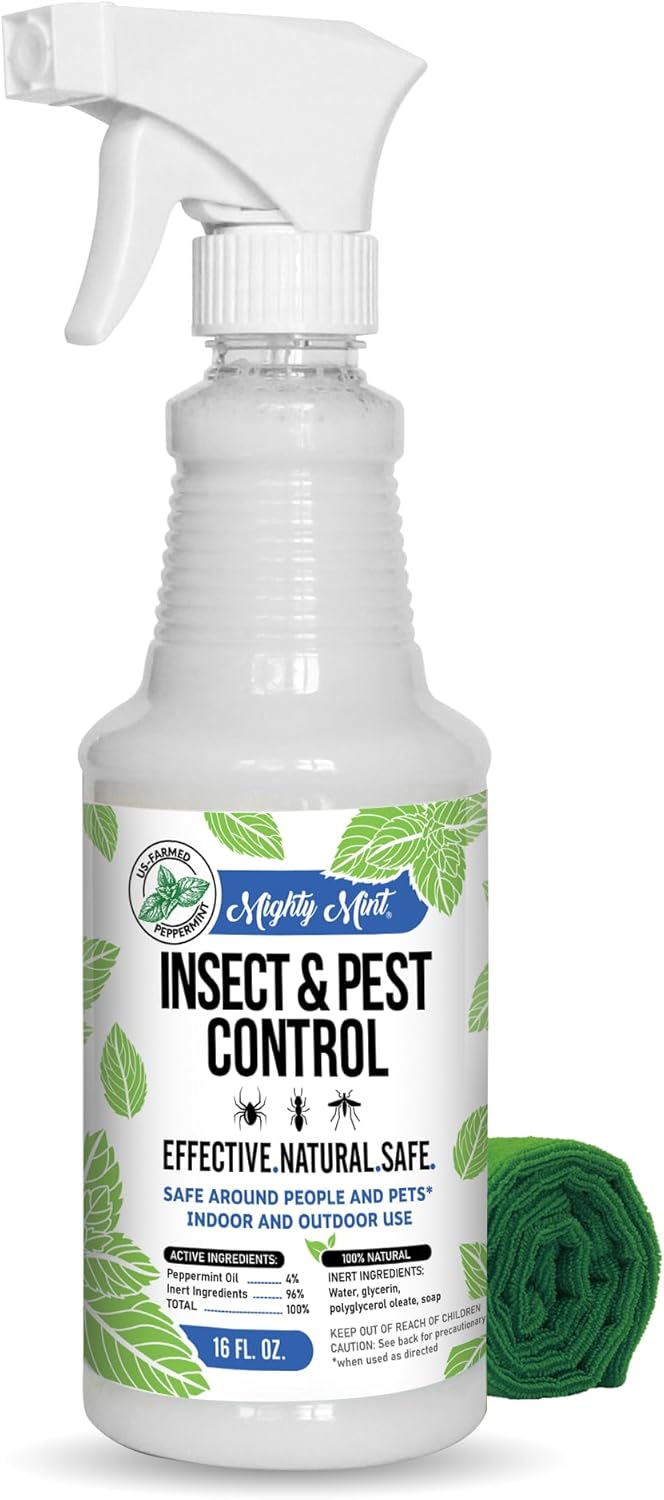
| Ingredients | Water, Glycerine, Polyglycerol oleate, Soap, Peppermint oil |
|---|---|
| Use Areas | Indoor / Outdoor |
| Size | 16 oz |
Mighty Mint is a plant-based, ready-to-use spray that uses concentrated peppermint oil to repel a broad range of household and patio pests. You apply it directly to problem areas such as baseboards, entryways, patios and around outdoor seating; the manufacturer recommends shaking and spraying until surfaces are covered and repeating applications two or more times per week for best results. Notable features include a peppermint-only scent profile, a formulation that avoids synthetic fragrances and the convenience of a 16 oz spray bottle for targeted spot treatments. Practical benefits are that it is safe to use around people and pets when dry and does not leave obvious stains on most surfaces, and the scent can make treated areas smell fresher than chemical alternatives. Important limitations are that it is a repellent rather than a pesticide so it works by discouraging pests rather than killing them, effectiveness depends on regular reapplication and it should not be applied when pollinators are present or to skin or food-contact surfaces.
Best for: Buyers who prioritize natural, low-toxicity solutions and want a targeted spray to reduce insects around patios and entryways while keeping family and pets in mind.
Less Ideal for: Anyone needing a one-time extermination or long-term residual pesticide for severe infestations should consider professional treatments or products formulated to kill pests rather than repel them.
- Plant-based peppermint formula that avoids synthetic fragrances
- Ready-to-use spray for quick, targeted indoor and outdoor applications
- Safe for people and pets when used as directed and allowed to dry
- Nonstaining on most surfaces and leaves a fresh mint scent
- Repels rather than kills insects so regular reapplication is needed to maintain protection
- Strong peppermint concentration may bother scent-sensitive individuals and requires keeping children and pets away until dry
Verdict: Choose Mighty Mint when you want a pet-friendly, plant-based spray to reduce patio and entryway insects with a fresh peppermint scent.
Bonide Captain Jack's Ready-to-Use Neem Oil Spray, 32 oz

| Item Form | Liquid |
|---|---|
| Target Species | Insects |
| Liquid Volume | 32 fluid ounces |
| Active Ingredients | Clarified Hydrophobic Extract of Neem Oil |
This ready-to-use neem oil spray is a multipurpose garden treatment that kills insects at all life stages while also serving as a miticide and preventative fungicide. Packaged in a 32-ounce trigger bottle, it is applied by shaking and thoroughly spraying plant surfaces, including leaf undersides, at the first sign of pests or disease and reapplying every 7 to 14 days as needed. The active ingredient is a clarified hydrophobic extract of neem oil, which is approved for organic gardening and labeled safe to use on vegetables up to the day of harvest. Practical benefits include broad pest coverage (aphids, whiteflies, spider mites and others), disease suppression such as powdery mildew, and convenience from a ready-to-use sprayer. Important limitations are that results are slower than synthetic contact insecticides and application timing matters to avoid leaf burn in full sun; repeated applications may be needed for heavy infestations. Follow label safety directions and keep the product away from children and pets.
Best for: Gardeners who want a single, organic-approved product to manage common vegetable garden pests and fungal problems and who prefer products with strong user feedback.
Less Ideal for: Growers needing rapid knockdown of severe infestations or commercial producers who require fast-acting, high-throughput treatments.
- Kills multiple pest stages including eggs, larvae and adults for more complete control.
- Also acts as a fungicide and miticide so one product covers pests and common fungal issues.
- Ready-to-use trigger bottle requires no mixing and is easy to apply to leaves and undersides.
- Approved for organic gardening and can be used on vegetables up to day of harvest.
- Slower-acting than many synthetic contact insecticides, so it may take several applications to see control.
- Must avoid spraying in peak sunlight to reduce risk of leaf burn.
Verdict: A convenient, organic-approved all-in-one neem spray that controls common vegetable garden pests and fungal issues with minimal fuss.
Choosing the Right Organic Insect Killer: Key Factors to Consider
Active Ingredient and Mode of Action
Knowing the active ingredient and how it affects insects is the first step to choosing an organic insect killer. Some organic actives work on contact to quickly knock down soft-bodied pests like aphids and caterpillars, while others disrupt insect growth or act as stomach poisons when ingested. Match the mode of action to the pest you have; contact sprays are useful for visible infestations, while systemic or translaminar options work better for pests that hide on the undersides of leaves or inside stems.
Also consider resistance management. Rotating between different modes of action over a season reduces the chance a pest population becomes tolerant. Because organic actives tend to be more limited than synthetics, reading labels and alternating products when possible helps maintain long-term control.
Plant Safety and Crop Use
Plant safety determines whether you can treat ornamentals, fruiting crops, herbs, or seedlings without causing burn, stunting, or residue issues. Some organic formulations are gentle enough for delicate foliage and newly transplanted seedlings, while others can cause phytotoxicity in hot sun or on sensitive varieties. Check label instructions for restrictions on use with blooms, young growth, and edible harvests.
Timing also matters for edible crops. Many organic insect killers require a pre-harvest interval or specific drying time before harvesting. Consider whether you need a product labeled for direct use on vegetables and herbs if you grow food, and always follow application rates to minimize stress on plants.
Impact on Beneficial Insects and Pollinators
Protecting pollinators and natural enemies is a core reason gardeners choose organic options, but not all organic insect killers are equally selective. Some act broadly and can kill bees, predatory wasps, lacewings, and lady beetles if applied to open flowers or during peak pollinator activity. Other formulations are more targeted or have application timing recommendations to reduce non-target harm.
Plan applications for early morning or late evening and avoid spraying during bloom where possible. Choose products with shorter residual activity when pollinators are present and prioritize spot treatments that limit exposure to beneficials.
Application Method and Practicality
How you apply a product affects both its effectiveness and how likely you are to use it correctly. Ready-to-use pump sprays are convenient for spot treatments, hose-end sprayers speed up large-area coverage, and concentrates are economical for frequent, large-plot use. Some formulations require thorough coverage of foliage, which can be difficult on tall or dense plants, while systemic options can protect new growth with fewer passes.
Consider storage stability, mixing complexity, and the need for additional equipment. If you garden in containers or have limited water access, choose options that minimize runoff and are easy to rinse-free apply.
Residual Activity and Reapplication Interval
Residual activity determines how often you must reapply to maintain control. Many organic products have shorter residuals than synthetic alternatives, so expect to reapply after rain or heavy irrigation. A shorter residual can be an advantage for limiting exposure to beneficials, but it increases labor and product use.
Look for products that balance adequate persistence with safety. For seasonal pests, a more persistent option can reduce application frequency. For sporadic outbreaks, choose quick-acting, short-residual treatments to limit non-target impacts.
Label Restrictions and Organic Certification
Labels specify legal uses, application rates, pre-harvest intervals, and any certification claims. If you sell produce or strictly maintain an organic garden, check for listing on recognized organic certification lists and confirm allowable use for food crops. Labels also indicate whether a product is allowed in certain greenhouse or high-tunnel settings.
Failing to follow label restrictions can harm plants, pollinators, or violate organic program rules. Treat the label as the final authority when deciding where and how to use a product.
How Organic Actives Work in a Home Garden
Organic insect control relies on a handful of naturally derived actives that act differently on insects. Some coat and suffocate pests, some disrupt nervous systems briefly, and others interfere with molting or digestion. Understanding these differences helps you pick the right approach for the pest and the planting.
In practice, contact treatments work best for active infestations you can see, while systemic or translaminar actions are better for hidden pests. Also factor in environmental conditions, since rain and sun can reduce effectiveness rapidly for surface-acting options.
- Contact actives need thorough coverage to work well
- Systemic options protect new growth without repeated foliar coverage
- Some actives are more compatible with biological control organisms
Timing Treatments to Protect Pollinators
To reduce harm to bees and other beneficial insects, avoid spraying during bloom and apply treatments in the early morning or late evening when pollinators are least active. Spot-treating targeted foliage instead of blanket-spraying entire beds lowers exposure.
Follow label guidance about residual activity and re-entry intervals for treated areas. When possible, remove open flowers before spraying and allow sprays to dry before pollinators become active again.
- Spray outside of peak pollinator hours
- Use spot treatments over broadcast applications
- Avoid spraying open flowers
Safe Use Around Edibles and Young Plants
If you grow vegetables or herbs, choose products specifically labeled for edible crops and observe pre-harvest intervals. Seedlings and newly transplanted plants are more prone to burn, so consider gentler mixes or lower concentrations until plants are established.
Rinse harvested produce if recommended, and avoid foliar applications on fruit close to harvest unless the label permits. When in doubt, test a small area and monitor plants for signs of stress before treating larger sections.
- Check pre-harvest intervals
- Use lower rates on transplants and seedlings
- Spot-test on a small number of plants first
Mixing, Safety Gear, and Application Best Practices
Even organic insect killers require careful handling. Use gloves and eye protection when mixing concentrates, and measure accurately to avoid phytotoxicity. Rinse spray equipment after use to prevent cross-contamination with other garden products.
Calibrate sprayers to deliver a fine, even mist for foliar coverage. For foliar sprays, aim to coat both upper and lower leaf surfaces. For soil-applied or systemic options, follow label instructions for root drench volumes and timing.
- Wear gloves and eye protection when mixing
- Calibrate sprayers for even coverage
- Rinse equipment after use
Managing Resistance and Long-Term Pest Pressure
Rotate between different modes of action when you face recurrent pest pressure, and integrate cultural controls like hand-picking, row covers, and proper sanitation to reduce reliance on chemical treatments. Monitor populations with weekly checks so you can intervene early when numbers rise.
Combining non-chemical methods with targeted organic treatments will lower the chance pests develop tolerance and keeps beneficial insects part of the solution.
- Rotate products with different action modes
- Use cultural controls to reduce pest buildup
- Scout regularly to catch outbreaks early
How We Chose the Best Organic Insect Killer
We focused on performance and garden compatibility when narrowing the field to seven organic insect killers suitable for home gardens. Evaluation criteria included documented pest control effectiveness against common garden pests, contact versus systemic activity, safety for edible plants and pollinators when used as directed, and ease of application for typical backyard gardeners. We also considered persistence on foliage and the required reapplication frequency so that products that needed impractical repeat applications were deprioritized. Formulation type mattered too, because sprays, concentrates, and ready-to-use options behave differently in tight spaces such as containers or greenhouse benches. Products were excluded if they relied on non-organic synthetic actives or required professional licensing to use. We also excluded options that lack clear label instructions for edible crops or pollinator protection. The final shortlist reflects a balance of immediate knockdown, long-term suppression, and minimized non-target impacts, aligning with the scoring criteria used across each pick.
FAQ
Are organic insect killers safe to use on vegetables?
Often yes, but it depends on the product and label directions. Many organic actives are cleared for use on edible crops, though they may require a pre-harvest interval or have application rate limits. Always check the label for explicit edible-crop directions before applying.
Will organic insect killers harm bees and ladybugs?
Many organic options can still impact non-target insects if applied when pollinators are active or to open flowers. Use spot treatments, avoid spraying during bloom when possible, and apply in early morning or late evening to reduce exposure.
How often do I need to reapply organic treatments?
Reapplication frequency varies by active ingredient and weather. Surface-acting products typically need more frequent reapplication, especially after rain, while systemic or longer-residual options require fewer passes. Follow label reapplication intervals and respray after heavy rain as needed.
Can I use organic insect killers in a greenhouse or on seedlings?
Many products are suitable for greenhouse use and seedlings, but some can cause phytotoxicity under high temperatures or on young, tender foliage. Use lower rates for seedlings and ensure good ventilation in enclosed spaces.
How do I protect beneficial predators while treating pests?
Target applications to affected areas, avoid blanket sprays, and time applications when beneficials are less active. Favor products with short residual activity or those demonstrated to be selective for specific pests.
Final Verdict
Choose an organic insect killer by prioritizing the pest you need to control, the sensitivity of the plants you will treat, and the protection of pollinators and beneficial insects. Balance fast knockdown for active outbreaks with longer residuals only when necessary, and favor application methods that fit your garden size and routine. With careful timing, accurate mixing, and integration of cultural controls, you can manage pests effectively while maintaining a healthy garden ecosystem.
