

Note: This article contains affiliate links. If you click on these links and make a purchase, I may earn a small commission at no extra cost to you. This helps support my research and content. Read my full affiliate disclosure here.
If you want to reduce pests without exposing family, pets, or pollinators to harsh chemicals, choosing a non toxic insect killer matters. These products behave differently than conventional insecticides: they rely on baits, botanical actives, mechanical traps, or barrier treatments that minimize environmental residue. That affects where and how you use them in the yard, patio, greenhouse, or inside the house. This guide shortlists seven top options that suit common home and garden situations. We evaluated each item for safety profile, practical effectiveness, and ease of use to help you pick the approach that fits your space and pest problem.
Top Picks at a Glance
| Best Overall The best all-around choice for most situations | Wondercide Flea & Tick Yard Spray (Ready-to-Use, 32 oz) |  |
| Best Quality Built to a higher standard if you want something more solid | Cedarcide Original Bug Spray (16 oz) — Natural Cedar Oil Repellent |  |
| Best Value The sweet spot between price and what you get | Garden Safe Crawling Insect Killer Diatomaceous Earth, 4 lb |  |
| Best Budget The cheapest option that still gets the job done reliably | STEM Plant-Based Bug Spray for Flies, Mosquitoes & Gnats, 10 oz |  |
| Highest Rated A top-rated pick with lots of positive feedback | Geomust Diatomaceous Earth with Peppermint Oil, Food Grade Insect Killer, 1 lb |  |
| Most Popular A crowd favorite that many people choose with confidence | Bonide Captain Jack's Ready-to-Use Neem Oil Spray, 32 oz |  |
| Best Seller A high-volume bestseller chosen again and again | ZEVO Compact Flying Insect Trap with 3 Refill Cartridges |  |
Wondercide Flea & Tick Yard Spray (Ready-to-Use, 32 oz)

| Liquid Volume | 946 ml |
|---|---|
| Item Form | Spray |
| Active ingredient | 12.63% Cedarwood Oil |
| Coverage (fleas/mosquitoes) | Up to 5,000 sq ft |
| Coverage (ticks/mosquito repel) | Up to 2,500 sq ft |
Wondercide Flea & Tick Yard Spray is a ready-to-use hose-end treatment that uses cedarwood and other plant-derived ingredients to kill and repel fleas, ticks, and mosquitoes in the yard. You attach the bottle to a garden hose, turn the sprayer on, and walk steady sweeping passes to treat up to 5,000 sq ft for fleas and mosquitoes or 2,500 sq ft for ticks and mosquito repellency. Notable features include a pre-mixed formula for quick application, a hose-powered sprayer for even coverage, and an ingredient list centered on cedarwood oil that the brand says is safe for pollinators when used as directed. In practice it is convenient for routine maintenance and for reducing pest pressure around foundations, patios, and pet areas without waiting for drying or reentry. Important limitations are sensitivity to high heat or direct sun which can cause plant foliage browning if applied above 90°F and reduced residual effect after heavy rain, which may require reapplication. The product is exempt from EPA registration under FIFRA and carries typical safety instructions to avoid eye contact and keep out of reach of children.
Best for: Buyers who want a convenient, natural-first yard repellent that treats broad outdoor areas and lowers pest pressure around pets and play spaces with minimal setup.
Less Ideal for: Those who need a product that holds up through heavy storms or who require a chemically registered pesticide for regulatory or commercial settings should consider other options.
- Pre-mixed hose-end bottle makes whole-yard treatment fast and easy
- Plant-based active (cedarwood oil) targets fleas, ticks, and mosquitoes
- Covers a large area per bottle (up to 5,000 sq ft for fleas and mosquitoes)
- Formulated to be safe for people, pets, and pollinators when used as directed
- Can cause phytotoxic browning if applied in direct sun or when temperatures exceed 90°F
- Heavy rain or intense irrigation can wash away residue and may require reapplication
Verdict: If you want an easy, plant-powered yard spray to reduce mosquitoes, fleas, and ticks over large lawns while prioritizing pet and pollinator safety, this ready-to-use option delivers fast, low-fuss coverage.
Cedarcide Original Bug Spray (16 oz) — Natural Cedar Oil Repellent

| Ingredients | Cedarwood Oil, Soybean Oil |
|---|---|
| Size | Pint (16 Oz.) |
| Intended use | People, Pets, Home |
Cedarcide Original is a versatile, non-toxic bug spray that uses cedarwood oil and soybean oil to repel and kill fleas, ticks, mosquitoes, ants, mites, chiggers, roaches, and wasps. You can use it directly on skin and clothing for personal protection, lightly mist pets according to directions, or spray indoor surfaces and fabrics to treat or prevent infestations. The formula is fast-acting on contact and leaves a pleasant cedar scent rather than a chemical odor. Practical benefits include simple application, suitability for households with children and pets when used as directed, and lab testing for many common pests. Important limitations are that it is not plant safe so avoid spraying lawns or garden plants, and reapplication is needed every 5 to 7 hours for personal use or more often after getting wet. For outdoor lawn-wide control you would choose their outdoor-specific product instead.
Best for: Buyers who want a balanced, multipurpose, non-toxic indoor repellent for family and pet use and prefer natural ingredients over synthetic insecticides.
Less Ideal for: Those seeking long-lasting, yard-wide mosquito control or a product labeled for direct application on garden plants should look at outdoor-specific treatments instead.
- Plant-based cedarwood formula effective against a broad list of indoor pests
- Safe for people and most pets when used per label directions
- Works on contact and doubles as a repellent with a pleasant cedar scent
- Can be applied to skin, clothing, pet coats, and indoor surfaces
- Not plant safe so should not be used directly on lawns or garden vegetation
- Requires frequent reapplication for personal protection, especially after moisture
Verdict: Choose Cedarcide Original if you want an effective, family-safe, plant-based spray for indoor and personal protection against common biting pests.
Garden Safe Crawling Insect Killer Diatomaceous Earth, 4 lb

| Item Form | Powder |
|---|---|
| Target Species | Insects |
| Active Ingredients | Silicon Dioxide |
| Specification Met | EPA |
Garden Safe Crawling Insect Killer is a powdered diatomaceous earth formulation intended for outdoor, plant-side use to control crawling pests. It is applied as a thin dust to soil around plants or directly onto insects where the fine granules abrade and absorb oils from exoskeletons, causing dehydration and death. Typical uses include edging vegetable beds, dusting under potted plants, and treating areas where ants, fleas, cockroaches, beetles, and mealybugs are active. The product is labeled for organic gardening and meets EPA specification guidance, so it is a low-chemical option for routine garden pest control. Practical benefits are persistence in dry, calm conditions and a non-spray, hands-on application that targets contact exposures. Important limitations are that it must stay dry to remain effective, can be dusty to apply so ventilation and a mask are advised, and it is not effective against insects that are not contacted by the dust or for wood-destroying beetles and certain ant species listed on the label. Follow label directions and reapply after heavy rain or disturbance for continued protection.
Best for: Gardeners who prefer practical, low-chemical pest control and want a contact-based solution for crawling insects around plants and beds.
Less Ideal for: People seeking a fast-acting, systemic treatment for flying pests or infestations inside structures should consider other control methods.
- Works by physical action so no chemical insecticides are required
- Approved for use in organic gardening and meets EPA specification guidance
- Can be applied directly to soil and plants to target crawling pests
- Long-lasting when kept dry and undisturbed
- Ineffective if the treatment area becomes wet or is washed away
- Creates airborne dust during application so respiratory protection is recommended
Verdict: A practical, organic-friendly diatomaceous earth powder for gardeners who want a non-chemical contact treatment for crawling garden pests.
STEM Plant-Based Bug Spray for Flies, Mosquitoes & Gnats, 10 oz

| Net volume | 10 oz |
|---|---|
| Active ingredients | Geraniol 1.47%, Lemongrass oil 0.10% |
| Intended use | Indoor and outdoor spot treatment |
STEM's 10 oz aerosol bug spray is a plant-based insecticide formulated to kill flies, mosquitoes and gnats around the home and patio. You use it like most aerosols: shake well, hold the nozzle 6–12 inches from target areas or visible insects, and mist surfaces or airspace where flying pests congregate. Notable features include geraniol and lemongrass oil as the active ingredients, no added dyes or harsh chemical odors, and directions that allow both indoor and outdoor spot treatments. In practice it is convenient for quick spot kills and temporary control around doorways, windowsills, potted areas and patios. Because it is formulated for people- and pet-occupied spaces when used as directed, it is a reasonable option for households that prefer botanical actives. Limitations are typical for short‑acting aerosols: protection is not long lasting so repeat applications are needed after rain or cleaning, and it is not for direct application to people, pets or edible plants.
Best for: Buyers who want an affordable, plant-based aerosol for quick spot control of gnats and other flying pests around living spaces and patios.
Less Ideal for: People seeking season-long residual protection or professional-grade control should consider products with longer-lasting actives or different application formats.
- Uses plant-based active ingredients (geraniol and lemongrass oil) rather than harsh synthetic chemicals
- Formulated for both indoor and outdoor spot treatments when used as directed
- No added dye or strong chemical fragrance, making indoor use less obtrusive
- Entomologist-tested formulation and clear directions for application
- Effect is short lived compared with long‑lasting residual insecticides
- Not intended for direct use on people, pets or edible plants
Verdict: A budget-friendly, plant-based aerosol that delivers fast, convenient knockdown of gnats and other flying pests for short-term control.
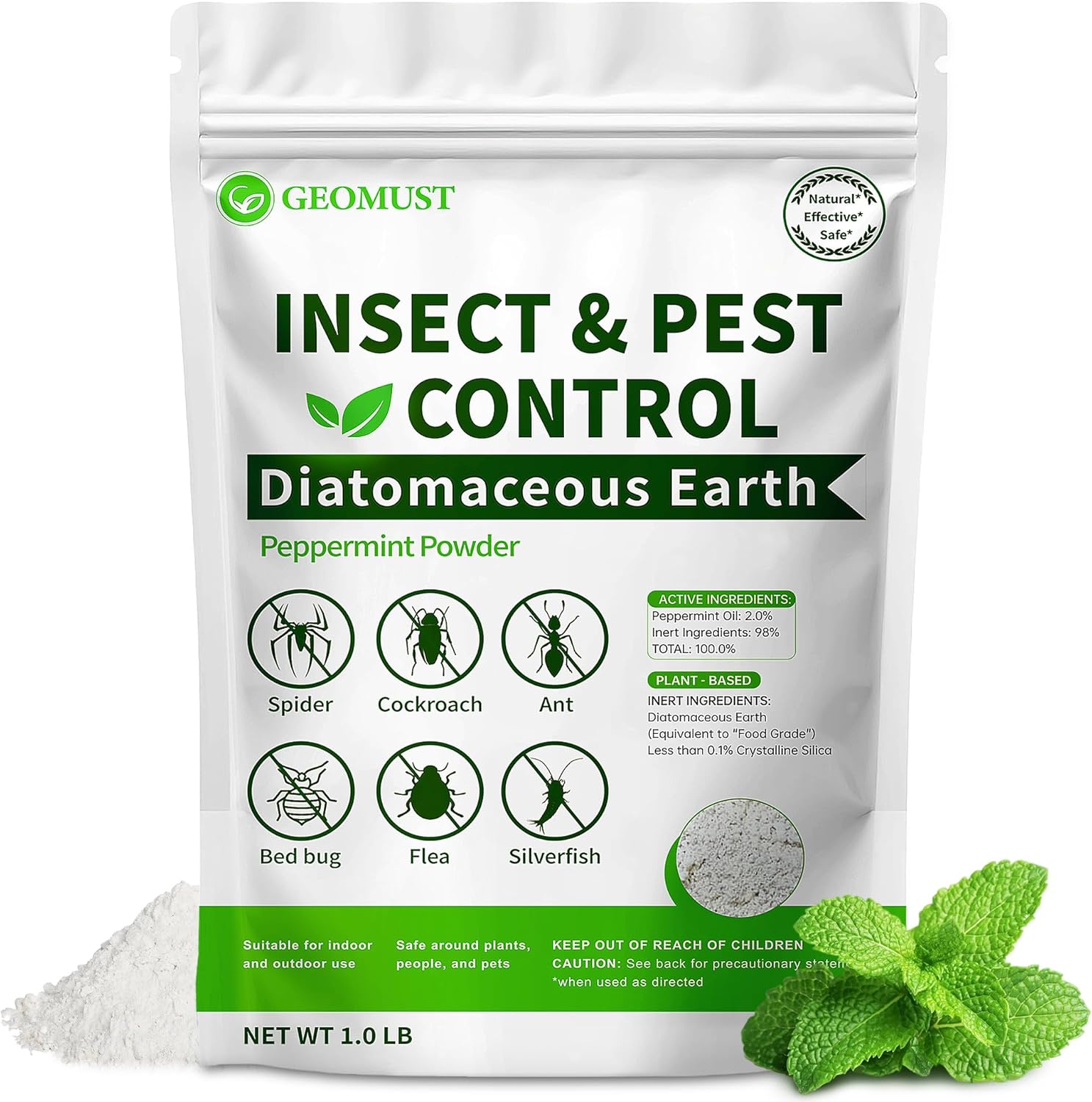
Geomust Diatomaceous Earth with Peppermint Oil, Food Grade Insect Killer, 1 lb
| Item Form | Powder |
|---|---|
| Target Species | Ants; Cockroaches; Fleas; Bed Bugs; Silverfish; Insects |
| Unit Count | 16 Ounce |
| Ingredients | Diatomaceous Earth; Peppermint Oil |
This Geomust product is a food-grade diatomaceous earth powder mixed with peppermint oil intended to control ants, roaches, fleas, bed bugs, silverfish and other crawling pests. You apply the dry powder to cracks, baseboards, entry points and around foundations or garden areas where insects travel; it works by dehydrating and abrading insect exoskeletons rather than poisoning them. The added peppermint oil gives a fresh scent and may help deter insects in treated zones. Because the formula is inert and labeled food grade it is suitable for use where households want a nonchemical option and safer handling around people and pets when used as directed. It must be kept dry to remain effective and its effects are contact-based, so it requires placement where insects will cross and occasional reapplication after cleaning or moisture exposure. For heavy, established infestations you may need repeated treatments or to combine this with exclusion and sanitation measures.
Best for: Homeowners who prioritize a low-toxicity, maintenance-friendly approach to crawling pests and want a straightforward, preventive product to use around living spaces and garden edges.
Less Ideal for: People needing a fast-acting or broad-spectrum solution for large, active infestations where immediate reduction is required.
- Food-grade diatomaceous earth provides a nonchemical, physical mode of kill safe for many home environments when used as directed
- Peppermint oil adds a pleasant scent and may increase deterrent effect in treated areas
- Versatile for indoor and outdoor use around baseboards, entry points, and garden perimeters
- Long-lasting when kept dry and simple to apply as a powder barrier
- Needs to stay dry and only works on insects that contact the powder, so wet areas reduce effectiveness
- Not an instant knockdown for heavy infestations and may require repeated applications or complementary controls
Verdict: Choose this if you want a simple, food-grade, nonchemical powder to prevent and reduce crawling pests with safe indoor and outdoor use when kept dry.
Bonide Captain Jack's Ready-to-Use Neem Oil Spray, 32 oz

| Item Form | Liquid |
|---|---|
| Target Species | Insects |
| Liquid Volume | 32 fluid ounces |
| Active Ingredients | Clarified Hydrophobic Extract of Neem Oil |
This ready-to-use neem oil spray is a multipurpose garden treatment that kills insects at all life stages while also serving as a miticide and preventative fungicide. Packaged in a 32-ounce trigger bottle, it is applied by shaking and thoroughly spraying plant surfaces, including leaf undersides, at the first sign of pests or disease and reapplying every 7 to 14 days as needed. The active ingredient is a clarified hydrophobic extract of neem oil, which is approved for organic gardening and labeled safe to use on vegetables up to the day of harvest. Practical benefits include broad pest coverage (aphids, whiteflies, spider mites and others), disease suppression such as powdery mildew, and convenience from a ready-to-use sprayer. Important limitations are that results are slower than synthetic contact insecticides and application timing matters to avoid leaf burn in full sun; repeated applications may be needed for heavy infestations. Follow label safety directions and keep the product away from children and pets.
Best for: Gardeners who want a single, organic-approved product to manage common vegetable garden pests and fungal problems and who prefer products with strong user feedback.
Less Ideal for: Growers needing rapid knockdown of severe infestations or commercial producers who require fast-acting, high-throughput treatments.
- Kills multiple pest stages including eggs, larvae and adults for more complete control.
- Also acts as a fungicide and miticide so one product covers pests and common fungal issues.
- Ready-to-use trigger bottle requires no mixing and is easy to apply to leaves and undersides.
- Approved for organic gardening and can be used on vegetables up to day of harvest.
- Slower-acting than many synthetic contact insecticides, so it may take several applications to see control.
- Must avoid spraying in peak sunlight to reduce risk of leaf burn.
Verdict: A convenient, organic-approved all-in-one neem spray that controls common vegetable garden pests and fungal issues with minimal fuss.
ZEVO Compact Flying Insect Trap with 3 Refill Cartridges

| Target Species | Fly, Fruit Fly, Gnat |
|---|---|
| Power Source | Electric |
| Unit Count | 4 Count |
| Material Type | Plastic |
The ZEVO Compact Flying Insect Trap is a plug-in indoor unit that attracts fruit flies, gnats, and house flies with blue and UV light and holds them on disposable adhesive cartridges so you can remove and replace refills without touching the insects. Typical use is to place the unit near problem areas such as fruit bowls, trash cans, or houseplants and leave it powered continuously for around-the-clock catch. Notable features include a no-mess adhesive cartridge with a tab for easy disposal, a compact profile for tight spaces, and a quiet, spray-free operation that avoids chemical odors and zapping sounds. In practice it provides consistent passive control for small flying pests and is family-friendly when used as directed. Limitations are that it is designed for indoor spot control of small flies rather than large infestations, and effectiveness depends on correct placement and periodic cartridge replacement roughly every six weeks. The unit requires an outlet and ongoing refill purchases to maintain performance.
Best for: Buyers who want a discreet, low-maintenance indoor solution for everyday small flying pests and prefer nonchemical, quiet options with easy cleanup.
Less Ideal for: People needing fast knockdown for heavy infestations or outdoor/large-area pest control should consider more powerful or whole-home treatments.
- Chemical-free, quiet operation suitable for homes with children or pets
- No-mess disposable adhesive cartridges with tab for easy removal
- Compact plug-in design fits tight indoor spaces near problem sources
- Blue and UV light provides continuous attraction day and night
- Not intended for large infestations or outdoor use
- Requires regular purchase and replacement of proprietary refills
Verdict: Choose this compact plug-in trap if you want a discreet, chemical-free way to reduce fruit flies and gnats in indoor problem spots with minimal fuss.
Choosing the Right Non Toxic Insect Killer: Key Factors to Consider
Safety Profile and Labeling
Look for products that provide clear ingredient lists and explicit instructions for safe use around homes and gardens. Labels that specify non toxic, reduced-risk, or low-toxicity actives should still include first-aid and precaution statements; read these to understand restrictions such as keeping treatments away from water features or fresh produce.
Safety matters because even botanical or microbial options can irritate skin or harm beneficial insects if misapplied. Consider how the product will be used-indoor surfaces, near children and pets, or on flowering plants-and choose formulations and application methods that reduce unwanted exposure.
Target Pest and Mode of Action
Match the control method to the pest biology. Baits work best for crawling insects like ants and cockroaches because they exploit feeding behavior, while traps and light-based attractants are more effective for flying pests. Growth regulators or microbial agents typically target specific life stages and can reduce populations over time rather than produce instant knockdown.
Understanding mode of action also helps protect beneficials. A selective mode will reduce collateral harm to pollinators and predatory insects when used correctly, which is important if you are managing pests in a productive flower bed or vegetable patch.
Application Method and Placement
Consider how the product is applied and whether that suits your garden or home layout. Granular baits, station baits, and gels are useful for targeted indoor or perimeter work. Ready-to-use spray bottles and pump sprayers are convenient for spot treatments in containers or along baseboards. Mechanical devices like sticky traps and light traps require placement where pests travel or congregate.
Ease of placement affects both safety and effectiveness. Products that confine active ingredients to a small station reduce accidental contact, while wide-area sprays may be harder to keep off desirable surfaces.
Impact on Beneficial Insects and Pollinators
If you garden with pollinator-friendly plants or rely on biological control, choose methods that minimize impact on bees, ladybugs, and other beneficials. Avoid broad broadcast treatments during bloom, and favor baiting, traps, or targeted applications that limit exposure to foraging insects.
Timing treatments for early morning or evening and applying where pollinators do not forage are practical steps. For vegetable gardens, prefer products with minimal residual toxicity and short persistence to reduce risk to harvestable crops.
Durability and Frequency of Reapplication
Non toxic options often trade persistent chemical residue for safer profiles, which can mean more frequent reapplication or maintenance. Consider whether you need a quick, short-term knockdown or longer-lasting suppression. Baits may remain attractive for weeks if kept dry, while botanical sprays may require repeat applications after rain or irrigation.
Factor in the time you can commit to follow-up when choosing a product. Durable stations and trap-based solutions can reduce maintenance, while spray-based approaches usually demand a treatment schedule for sustained control.
Practical Household and Garden Compatibility
Think about where you will use the product: kitchen, basement, greenhouse, patio, or garden beds. Indoor settings prioritize low odor and low residue; greenhouse and container gardens need products safe for close plant contact. Consider storage, ease of hiding bait stations from children and pets, and whether the product leaves visible residues on surfaces.
Compatibility also covers how the product interacts with common garden tasks. If you frequently water or mulch, choose formulations that tolerate light moisture or can be reapplied without damaging plants.
Common Non Toxic Methods and How They Work
Non toxic insect control covers several method categories that operate differently in the garden and home. Baits lure and poison specific feeders, traps capture or entangle pests, botanical sprays use plant-derived actives with short persistence, and mechanical exclusion prevents access to food or shelter. Microbial agents and insect growth regulators interrupt development for targeted species.
Knowing how a method works helps set expectations. For example, baits often take days to reduce a colony because the toxicant must be shared among members, while traps can remove visible individuals quickly but may not cut reproduction.
- Baits: targeted for foragers, low non-target exposure when contained
- Sticky and light traps: useful for monitoring and reducing flying pests
- Botanical sprays: quick knockdown with short residual activity
- Mechanical exclusion: long-term prevention when properly installed
- Microbial and growth regulators: selective and slower-acting population control
Using Non Toxic Options Indoors
Indoors, prioritize containment and minimal odor. Station baits, discreet traps, and gel baits are practical because they keep active ingredients confined and limit surface residues. Place them along insect travel paths such as baseboards, behind appliances, or near entry points.
For visible infestations, combine trapping with targeted cleaning to remove attractants. Seal cracks and store food in sealed containers to reduce reinfestation. When spraying inside, choose low-odor botanical formulations and ventilate the space.
- Place stations out of reach of children and pets
- Combine with sanitation and exclusion for best results
- Use traps to monitor whether treatments are working
Garden and Patio Use Without Harming Beneficials
When treating outdoor areas, avoid blanket sprays during bloom and instead focus on targeted treatments to reduce harm to pollinators. Apply baits or traps near pest hotspots such as compost bins, mulch lines, and entryways rather than directly on flowering plants.
Consider timing and microclimate. Early morning or late evening applications reduce exposure to pollinators. Choose products that break down quickly in sunlight and rain to limit environmental accumulation while still controlling pests in the short term.
- Avoid spraying flowering plants during the day
- Place traps in shaded areas where pests prefer to travel
- Rotate tactics to prevent reliance on a single method
Maintenance and Integrated Pest Management Practices
Non toxic products work best as part of an integrated approach. Combine cultural controls, such as removing standing water and decaying vegetation, with targeted non toxic treatments. Regular monitoring with traps helps detect populations early and reduces the need for broader interventions.
Record where and when you place baits or traps so you can evaluate what works. Adjust placement and timing across the season as pests and beneficial populations change.
- Inspect problem areas weekly during peak season
- Use sanitation and habitat modification to reduce food and shelter
- Adjust strategy after heavy rain or seasonal shifts
Safety Tips for Households with Children and Pets
Even products labeled as non toxic can pose risks if accessed directly. Use tamper-resistant bait stations and place traps where curious pets and children cannot reach them. Store unused products in locked cabinets and follow all label instructions for first aid and accidental exposure.
For outdoor use, remove or cover bait stations during play or pet access times. If you have indoor-outdoor pets, confine them during outdoor baiting or use exclusion methods that do not rely on accessible baits.
- Use physical barriers and station covers to limit access
- Clean up spilled bait promptly and dispose of used traps safely
- Follow label guidance for re-entry intervals and surface contact
How We Chose the Best Non Toxic Insect Killer
We shortlisted products that prioritize reduced toxicity to people, pets, and beneficial insects while still delivering practical control. Selection focused on transparent ingredient lists and clear labeling about non toxic or low-toxicity actives. We prioritized options that demonstrated multiple modes of action common to low-toxicity control, such as baiting, exclusion, mechanical capture, botanical insecticides with known safety margins, and microbial or growth-regulator approaches that target pests specifically. Our evaluation emphasized measurable, gardener-relevant criteria: documented safety for indoor use and around pets, demonstrated efficacy against listed pests, ease of application in common garden and household settings, and durable performance or persistence appropriate to the use case. Products lacking clear ingredient disclosure or that relied on broad-spectrum chemical claims were excluded. We also excluded specialty commercial formulations intended only for agricultural or industrial use. The final selection balances low-toxicity profiles with real-world usability across typical home and garden pest issues.
FAQ
Are non toxic insect killers effective for severe infestations?
They can reduce populations, but effectiveness depends on the pest and infestation size. For large, established infestations, expect slower results and plan for repeated treatments and combined cultural controls.
Will botanical sprays harm bees and other pollinators?
Many botanical sprays have short persistence, but they can still harm foraging insects if applied to blooms. Apply them in the evening or target nonflowering parts to reduce risk.
How often do non toxic treatments need to be reapplied?
Reapplication frequency varies by method. Botanical sprays may need repeating after rain, while bait stations and traps can last weeks. Check product guidance and monitor traps to decide timing.
Can I use non toxic insect killers around edible plants?
Some products are formulated for use on edible plants, but you should follow label directions regarding preharvest intervals and application sites. Prefer targeted options with minimal residue for vegetable gardens.
Do sticky traps catch beneficial insects too?
Yes, they can. Place sticky traps strategically away from flowering plants and pollinator flight paths to reduce incidental capture of beneficial species.
Are microbial agents safe for pets?
Many microbial controls have high safety margins for mammals, but follow label instructions. Avoid applying where pets might lick treated surfaces until the product has dried or settled.
Final Verdict
Non toxic insect killers offer practical ways to manage common pests while reducing risk to people, pets, and beneficial insects. Prioritize methods that match the pest biology and the treatment location, balancing immediate control needs with long-term environmental safety. Expect some tradeoffs: safer formulations may require more frequent attention or combined tactics. Choose the approach that fits your routine and garden habits, and use monitoring and exclusion to keep problems from returning.
