

Note: This article contains affiliate links. If you click on these links and make a purchase, I may earn a small commission at no extra cost to you. This helps support my research and content. Read my full affiliate disclosure here.
Picking the right organic phosphorus fertilizer matters because phosphorus drives early-season root growth, seedling establishment, and flowering in established beds. The wrong source or application rate can lock phosphorus in the soil or leave plants undernourished. This guide compares seven carefully shortlisted options that work in vegetable patches, flower beds, containers, and established lawns. We evaluated each product for how it releases phosphorus, how easy it is to apply, and how well it fits common garden soils and planting situations. Read on to understand those tradeoffs and which features matter most for your garden before the product summaries.
Top Picks at a Glance
| Best Overall The best all-around choice for most situations | Espoma Organic Bone Meal Fertilizer 4-12-0, 24 lb bag |  |
| Best Quality Built to a higher standard if you want something more solid | Down To Earth Bone Meal Organic Fertilizer 3-15-0, 5 lb |  |
| Best Value The sweet spot between price and what you get | Espoma Rock Phosphate Organic Plant Fertilizer (7.25 lb) |  |
| Best Budget The cheapest option that still gets the job done reliably | Whitney Farms Organic Bone Meal 6-8-0, 3 lb. |  |
| Highest Rated A top-rated pick with lots of positive feedback | Cronk PuurPhos 500 mL Organic Phosphorus Liquid Fertilizer (0-12-0) |  |
| Most Popular A crowd favorite that many people choose with confidence | Burpee Bone Meal Fertilizer, 3 lb |  |
| Best Seller A high-volume bestseller chosen again and again | Jobe's Organics Granular Bone Meal Fertilizer, 4 lb |  |
Espoma Organic Bone Meal Fertilizer 4-12-0, 24 lb bag

| N‑P‑K | 4-12-0 |
|---|---|
| Item Form | Powder |
| Specific Uses For Product | Gardening, Organic, Plant Food |
| Application Method | Sprinkle on the soil and lightly work in |
Espoma Organic Bone Meal is a powdered, slow-release source of phosphorus with secondary nitrogen and calcium aimed at improving root and bloom development. It is typically used at planting or worked lightly into soil around established bulbs, annuals, and perennials; application instructions recommend sprinkling and mixing into the planting hole or topsoil. The product is 100 percent bone meal with no fillers and is certified for organic gardening, so it fits into organic fertility plans and minimal-input beds. In practice it helps encourage root establishment and stronger flowering when used where phosphorus is needed, and its powder form makes it easy to distribute across planting rows or in seed trenches. Important limitations are that it supplies limited immediate nitrogen and does not address broader macro- and micronutrient needs by itself, so plan a complementary fertility program for leafy growth and long-term soil balance. It also releases nutrients slowly and depends on soil biology and moisture to become available, so results are not instantaneous.
Best for: Gardeners who prioritize reliable, organic nutrient sources and want a dependable phosphorus boost for root and bloom development in potato plantings and other root crops.
Less Ideal for: Growers seeking an all‑in‑one feed or immediate greening should look for a balanced or fast‑acting fertilizer instead.
- 100% natural bone meal with no fillers, suitable for certified organic gardens
- High phosphorus content (4-12-0) supports root development and flowering
- Powder form is easy to spread and incorporate at planting
- Long‑lasting, slow‑release nutrient supply that reduces frequent reapplication
- Provides little immediate nitrogen and does not supply a full NPK balance
- Effectiveness depends on soil biology and moisture so uptake can be slow
Verdict: Choose this bone meal when you want a proven, organic phosphorus boost to support strong roots and better tuber set in potato plantings.
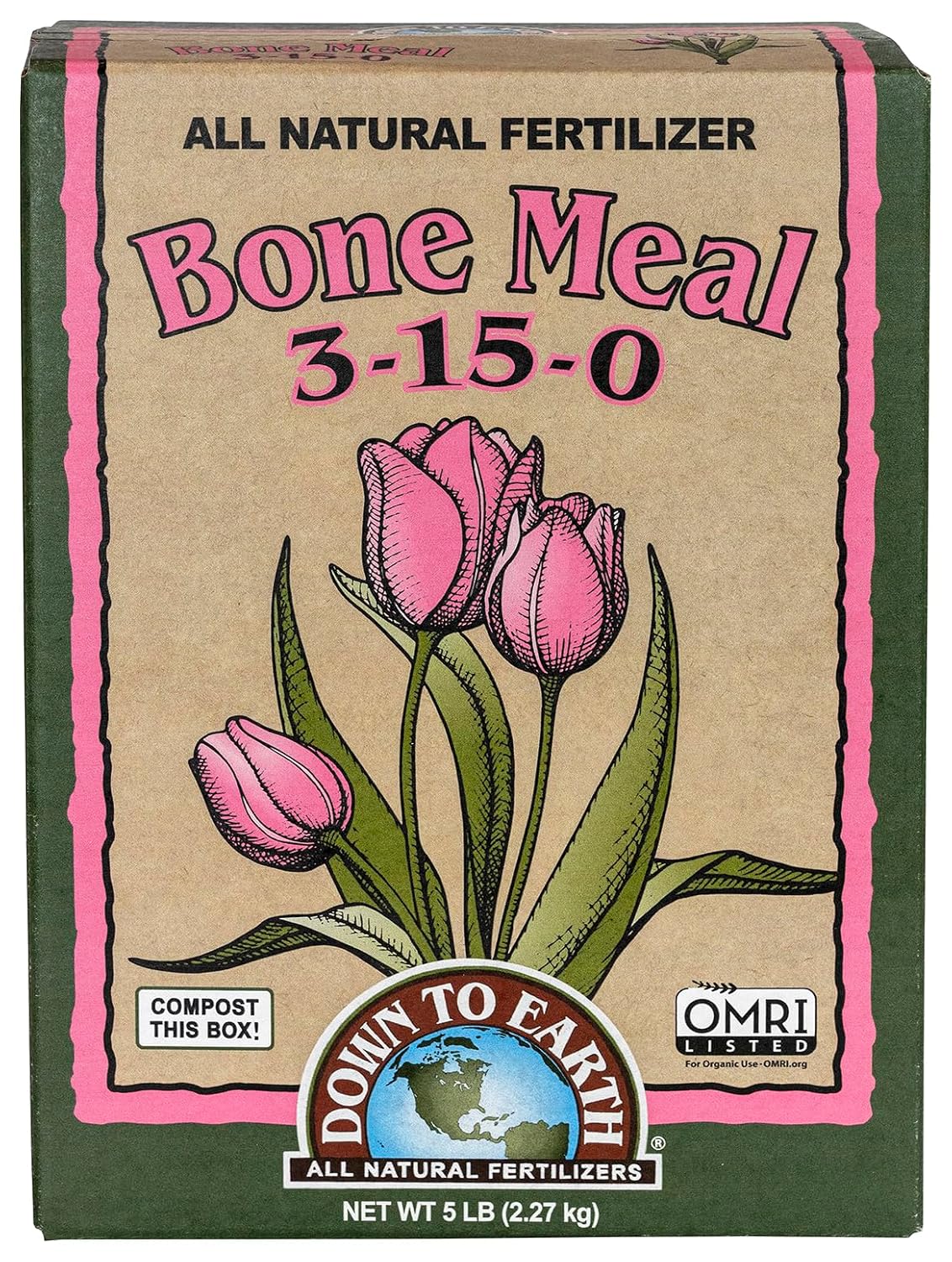
Down To Earth Bone Meal Organic Fertilizer 3-15-0, 5 lb
| Item Form | Granules |
|---|---|
| Specific Uses For Product | Plant Growth, Soil Conditioning |
| Coverage | Medium |
| Target Species | flowering plants, trees, ornamentals, bulbs |
| Mixing Ratio | 3:15:0 |
Down To Earth Bone Meal is an organic granular fertilizer formulated primarily to deliver phosphorus and calcium to flowering plants, bulbs, trees, and ornamentals. Gardeners typically work it into soil at planting or use it as a side dressing every 4 to 6 weeks to encourage strong root establishment and more robust early-season growth. The 3-15-0 N-P-K ratio makes it a targeted phosphorus source, which supports bloom set and root development rather than vegetative green-up. Being OMRI-listed and made from bone meal means it complements organic growing systems and feeds soil biology rather than supplying immediately soluble salts. Practical benefits include improved bulb performance and better root take when transplanting; it is also easy to apply as granules and contains calcium that can help structure soil. Limitations are that phosphorus from bone meal releases relatively slowly and depends on soil biology and pH, so results take time and it is not a quick-fix fertilizer for acute nutrient deficiency. Handle with gloves and keep away from children and pets during storage and application.
Best for: Gardeners focused on improving bloom production and establishing strong roots in bulbs, ornamentals, and transplanted specimens who prefer organic inputs and are willing to wait for biological release.
Less Ideal for: People who need a fast-acting, soluble phosphorus correction or who want an all-in-one NPK quick-feed solution for immediate greening.
- High-phosphorus 3-15-0 formula tailored for blooms, bulbs, and root development
- OMRI-listed material suitable for certified organic growing
- Granular form is easy to work into soil or apply as a side dressing
- Provides calcium in addition to phosphorus which supports soil structure and plant health
- Phosphorus in bone meal releases slowly and depends on soil biology and pH for availability
Verdict: Choose this OMRI-listed bone meal when you want a high-phosphorus organic fertilizer to boost blooms and root establishment in bulbs and ornamentals.
Espoma Rock Phosphate Organic Plant Fertilizer (7.25 lb)

| Item Form | Granules |
|---|---|
| Specific Uses For Product | Organic |
| Application Method | Pelletized |
| Target Species | Flowers |
| Liquid Volume | 7.25 liters |
Espoma Rock Phosphate is a pelletized, organic phosphorus fertilizer intended to correct phosphorus-deficient soils and support root development and blooming. It is applied directly to soil around outdoor flowers and vegetable beds according to package instructions; the pelletized form reduces dust and makes spreading by hand or with a drop spreader straightforward. The product is made from natural phosphate deposits and delivers a steady, long-lasting source of phosphorus rather than a quick-release dose, which is helpful for establishing roots and improving bloom set over a season. Because it supplies phosphorus slowly, results appear gradually and it works best when incorporated into soil or applied well before peak bloom. It does not supply significant nitrogen or potassium, so you will typically use it alongside a balanced fertilizer or compost for complete nutrition. For gardeners who prefer organic inputs and want a low-maintenance phosphorus boost, this product is a practical choice; those needing fast green-up or a complete NPK mix should plan to supplement accordingly.
Best for: Gardeners who prefer organic inputs and want a low-maintenance, steady phosphorus source to improve root development and flowering in outdoor flower or vegetable beds.
Less Ideal for: Growers who need rapid green-up or an all-in-one NPK solution should consider fast-release or balanced fertilizers instead.
- Organic source of phosphorus derived from natural phosphate deposits
- Pelletized form reduces dust and is easy to broadcast by hand or spreader
- Provides slow, long-lasting phosphorus to support root growth and blooming
- Designed for outdoor flowers and vegetable gardens
- Slow-release action means benefits are gradual rather than immediate
- Does not provide notable nitrogen or potassium, so needs pairing with other fertilizers
Verdict: A simple, pelletized organic phosphorus booster that provides a durable, low-maintenance way to improve root strength and blooms in outdoor gardens.
Whitney Farms Organic Bone Meal 6-8-0, 3 lb.

| Item Form | Granules |
|---|---|
| Specific Uses For Product | Plant Growth, Root Development, Soil Conditioning |
| Coverage | Medium |
| Item Weight | 3 pounds |
This 3 lb. bag of Whitney Farms Organic Bone Meal is a simple, ready-to-use phosphorus supplement you spread into planting holes or work into the top 1 to 3 inches of soil at planting time. It is OMRI listed and formulated as a 6-8-0 NPK granule, so it supplies phosphorus and calcium that encourage stronger root systems and better flower set in bulbs such as tulips. Typical use is one application in spring, or spring and fall for bulbs, applying about 1 cup per 30 sq. ft. or 1 tablespoon per 2 sq. ft. The granular form is easy to measure and mixes into backfill or around established plants, and the slow-release nature reduces the need for frequent reapplications. Important limitations are that bone meal works slowly and depends on soil biology to release nutrients, so it is not a fast corrective for severely deficient soils; also it should be kept away from pets and stored dry. For gardeners looking for an organic, targeted phosphorus boost for tulip planting, this is a practical, no-frills option.
Best for: Gardeners planting tulip bulbs who want an inexpensive, organic phosphorus boost applied at planting time and prefer a simple, measured granular amendment.
Less Ideal for: People who need a rapid corrective fertilizer for severely phosphorus-deficient soil or who avoid animal-based amendments should consider alternative products.
- OMRI listed organic bone meal suitable for organic gardens
- 6-8-0 NPK formulation supplies phosphorus and calcium for root and flower development
- Granular form is easy to measure and work into planting holes or soil
- Recommended application rates and seasonal timing provided for bulbs
- Slow-release action requires soil microbes to convert nutrients so results are not immediate
- Contains animal-derived material so it must be stored away from pets and some gardeners may avoid it
Verdict: A budget-friendly, OMRI-listed bone meal that provides a straightforward, slow-release phosphorus boost ideal for improving tulip bulb root and flower development at planting time.
Cronk PuurPhos 500 mL Organic Phosphorus Liquid Fertilizer (0-12-0)

| Item Form | Liquid |
|---|---|
| Specific Uses For Product | House Plants, Indoor Plants, Plant Growth, Seed Development |
| Target Species | Flowers |
| Liquid Volume | 500 ml |
PuurPhos is a concentrated 0-12-0 liquid phosphorus booster intended to strengthen roots and improve bloom and fruit set in flowering plants. It mixes cleanly with water and is sediment-free, so it works well in hand-watering, drip lines, and hydroponic systems without clogging. The formula is derived from upcycled plant materials via a biological extraction, which produces an immediately available orthophosphate that supports energy transfer and bud development. Typical use is during the bloom or fruiting phase as a supplemental feed alongside a base nutrient program or as part of the PuurOrganics lineup. Practical benefits include easy dosing, compatibility with soil, coco, and hydro setups, and an eco-conscious ingredient profile. Important limitations are that it supplies only phosphorus (no nitrogen or potassium), so it must be paired with complementary fertilizers for balanced feeding, and growers should follow recommended rates to avoid localized overapplication in small containers.
Best for: Buyers who prioritize consistent, clean-performing bloom inputs and want a reliable, organics-based phosphorus boost to add into an existing feeding program.
Less Ideal for: Growers looking for an all-in-one base nutrient or those who need large-volume commercial dosing without frequent reordering should consider other options.
- High phosphorus concentration (0-12-0) targeted for bloom and root support
- Fully soluble, sediment-free liquid that mixes cleanly and reduces clogging in irrigation
- Works across soil, coco coir, hydroponic, and organic living systems
- Made from upcycled plant-based materials for a more sustainable ingredient source
- Contains only phosphorus so it cannot supply complete nutrition on its own
- Size is a single 500 mL bottle which may require frequent repurchase for larger grows
Verdict: Choose PuurPhos when you want a clean, high-concentration organic phosphorus boost that reliably improves root and bloom performance across soil, coco, and hydro systems.
Burpee Bone Meal Fertilizer, 3 lb

| Item Form | Powder |
|---|---|
| Specific Uses For Product | Plant Growth, Root Development |
| Coverage | 240 Sqaure Feet |
| Target Species | tomatoes, peppers, and bulbs |
Burpee Bone Meal is a slow-release granular fertilizer designed to boost early root development and flowering in root and bulb crops. Gardeners typically work it into planting holes for bulbs or mix it into soil and potting media when starting seeds or transplanting vegetables like carrots, beets, and onions. The product is OMRI listed for organic gardening and provides phosphorus and calcium that support stronger root systems and better early-season growth. Its fine granular texture makes it easy to apply evenly, and because it breaks down slowly it feeds plants over the season without burning them. Practical benefits include targeted support for root vegetables and an easy application method for beds and containers. Limitations are that it supplies mainly phosphorus and calcium rather than a balanced NPK profile, so it is best used alongside a nitrogen source if foliage development is needed, and results are gradual rather than immediate because of the slow-release nature.
Best for: Gardeners focused on improving root development and bulb planting who prefer organic inputs and want a simple amendment to add at planting or during bed preparation.
Less Ideal for: Growers seeking an all-in-one balanced fertilizer for both foliage and root development or those who need fast-acting, soluble nutrients for immediate correction.
- OMRI listed for organic gardening, suitable for certified organic beds
- Fine granular form that is easy to spread and incorporate
- Provides phosphorus and calcium to encourage strong root and bulb development
- Slow-release action reduces risk of burning plants and supplies season-long support
- Not a complete fertilizer profile so additional nitrogen may be needed for leafy growth
Verdict: A reliable organic bone meal to strengthen roots and jump-start bulbs and root vegetables when added at planting.
Jobe's Organics Granular Bone Meal Fertilizer, 4 lb

| Item Form | Granules |
|---|---|
| Application Method | Soil |
| Unit Count | 64 Ounce |
| Mixing Ratio | 2-14-0 |
Jobe's Organics Granular Bone Meal is a prilled, dust-reduced source of phosphorus and calcium aimed at strengthening root systems and improving blooms and tuber development. It is typically worked into the soil at planting for bulbs or applied around established plants every eight weeks during the growing season to support root- and flower-focused crops. The 2-14-0 NPK profile makes it especially useful where phosphorus is needed, and the granulated form is compatible with spreaders or hand application with minimal mess. Being OMRI-listed and made from 100 percent bone meal means it fits organic garden plans and is safe to use around children and pets when handled properly. Important limitations are that it supplies little to no nitrogen, so it should be paired with a balanced or nitrogen-rich amendment for leafy growth, and local regulations may restrict phosphorus use on lawns or near waterways. Also, results depend on existing soil phosphorus levels so a soil test is recommended before use.
Best for: Gardeners growing bulbs, tubers, flowering vegetables, or onions who want an organic phosphorus boost and prefer a low-dust granular product backed by positive user feedback.
Less Ideal for: Growers who need a complete all-purpose fertilizer for rapid leafy growth or those managing phosphorus-restricted turf or sites near sensitive waterways.
- High phosphorus and calcium content supports strong root development and better blooms
- Granulated prilled form reduces dust and works well with spreaders or hand application
- OMRI-listed and made from 100 percent organic bone meal suitable for organic gardens
- Directions recommend regular application every eight weeks for season-long support
- Contains little to no nitrogen so not sufficient alone for leafy growth
- Phosphorus fertilizers can be restricted in some areas because of runoff concerns
Verdict: A reliable organic bone meal to boost root development and bulb or onion bloom potential when soil phosphorus is needed.
Choosing the Right Organic Phosphorus Fertilizer: Key Factors to Consider
Source and Release Rate
Organic phosphorus comes from several sources such as rock-derived minerals, bone meal, fish-based meals, and composted plant residues. Each source has a different mineralization pathway and timeline. Rock-derived sources may contain phosphorus in less plant-available forms that rely on soil acidity or mycorrhizal fungi to free up nutrients over months or seasons. Bone and fish meals tend to mineralize more predictably in biologically active soils and can support faster root and flower response when microbial activity is high.
Matching release rate to crop needs is critical. Fast-release organics suit short-season crops and early flower set, while slower-release sources are better for long-term soil building. Consider seasonal temperature and soil moisture because microbial activity controls much of the phosphorus release from organic inputs.
Quantity and Guaranteed Analysis
Organic inputs vary widely in their guaranteed phosphorus percentages and in how reliably those numbers translate to plant-available P. A clear guaranteed analysis helps calculate application rates so you avoid under- or over-application. When labels list only crude ranges or vague terms, it becomes harder to dose correctly for starter placements or for established beds.
Gardeners should cross-check label analysis with a soil test to target phosphorus additions. Adding phosphorus to a soil that already tests adequate can be wasteful and may cause fixation issues. Knowing the product's concentration lets you adapt rates between broadcast, banded, and starter applications.
Soil pH and Fixation Risk
Soil pH strongly affects phosphorus availability. In alkaline soils phosphorus tends to precipitate with calcium, while in very acidic soils it can bind with iron or aluminum. Organic sources that depend on microbial mineralization may still be subject to these fixation processes once phosphorus is released.
If your soil tends to lock up phosphorus, choose products and application methods that place P close to roots, such as banding or starter placements. Amending soil pH and boosting biological activity with compost and mycorrhizal-friendly practices will also improve long-term P availability.
Application Method and Timing
How you apply phosphorus affects plant access. Banding or placing a small amount of concentrated phosphorus near seeds or transplants gives earlier uptake than broadcasting a low rate. For containers and small pots, mixing a measured amount into the media or using soluble organic starter solutions helps seedlings and young plants.
Timing matters too. Apply higher starter or root-building phosphorus at transplanting and early vegetative stages, then shift to maintenance inputs for established plants. Over-applying late in the season rarely improves yields and can create nutrient imbalances.
Compatibility With Biological Amendments
Many gardeners rely on beneficial microbes and mycorrhizal fungi to improve nutrient uptake. Some organic phosphorus sources complement these organisms by providing slow-release P that encourages fungal associations. Others release phosphorus more quickly and may reduce the immediate need for mycorrhizal assistance.
When using biological inoculants, select phosphorus sources and placement strategies that do not overwhelm microbial partners. Combining organic P with compost and microbial stimulants helps create a balanced soil food web for steady long-term availability.
Handling, Safety, and Storage
Practical handling matters for home gardeners. Dusty powders can be messy and pose inhalation concerns, while oily or fish-based meals may have strong odors that are unpleasant in small yards. Ease of measuring, resealable packaging, and instructions for safe storage keep the material usable season after season.
Also consider longevity. Some organic phosphorus materials can attract pests if stored improperly. Store in a cool, dry place, use airtight containers when possible, and follow label guidance to maintain product integrity and minimize nuisance issues.
When To Prioritize Fast-Release Phosphorus
Fast-release organic phosphorus is useful when you need quick root stimulation or when planting short-season vegetables and transplants. If soil temperatures are warm and microbial activity is high, these sources can produce measurable benefits in weeks rather than months.
Use starter placements or light topdressings with fast-release materials for seedlings and newly set transplants. Avoid broad heavy applications of fast-release P in beds that already test moderate to high on a soil test.
- Good for seedlings and transplants
- Best used where biological activity is sufficient
- Apply near the root zone rather than broad broadcasting
Integrating Phosphorus Into Organic Fertility Plans
Phosphorus should be one component of a balanced fertility plan that includes nitrogen sources and organic matter. Building soil organic matter improves phosphorus cycling and retention over seasons. Compost, cover crops, and mulches enhance microbial populations that help free organic P.
Plan phosphorus additions based on crop demand and soil test results. For perennial beds and orchards, think long term and use slower-release sources to avoid seasonal spikes in availability.
- Combine P with compost to support microbes
- Match source and timing to crop life cycle
- Use soil tests to avoid unnecessary applications
Application Tips for Containers and Small Spaces
Containers have limited soil volume and different nutrient dynamics than in-ground beds. Phosphorus in containers can be either immediately available if mixed into the media or locked away if added on top and not watered in properly. Mix measured amounts into potting media at planting or use soluble organic starter feeds for fast access.
Because container soils dry and rewet quickly, monitor plant response and avoid over-application. Smaller, more frequent feedings with low to moderate rates are often safer than a single heavy dose.
- Incorporate into media at planting for immediate access
- Use gentler, more frequent feedings to avoid buildup
- Watch plant growth and adjust based on foliage and flowering
How Soil Testing Guides Phosphorus Decisions
A recent soil test is the most reliable way to determine whether you need to add phosphorus and at what rate. Tests show available phosphorus ranges and help prevent needless applications that can be ineffective or harmful to the soil ecosystem.
When tests show low P, target concentrated placements near roots. When tests show adequate P, prioritize building biology and organic matter rather than adding more phosphorus.
- Test every 2 to 4 years for garden beds
- Use targeted placements when tests indicate deficiency
- Adjust overall fertility plan based on long-term results
Mitigating Phosphorus Fixation and Loss
Fixation and loss occur when phosphorus becomes chemically bound in the soil or carried away by erosion. To reduce fixation, place phosphorus near roots with banding or starter applications and avoid broadcasting large doses on high-pH or highly calcareous soils.
Prevent runoff by keeping soil covered with mulch and maintaining good structure. Improving organic matter reduces erosion risk and supports microbial processing that keeps more phosphorus plant-accessible over time.
- Prefer placement over broad broadcasting in problem soils
- Maintain ground cover and mulch to prevent erosion
- Boost organic matter to support phosphorus cycling
How We Chose the Best Organic Phosphorus Fertilizer
We focused on sources and formulations that deliver plant-available phosphorus while fitting organic management practices. Key evaluation criteria included phosphorus availability rate, application versatility, compatibility with soil pH and biology, handling and safety, and clear nutrient labeling. Phosphorus availability rate matters because some organic sources rely on microbial mineralization and release slowly, while others provide quicker plant access. Application versatility included suitability for broadcast, banding, starter solutions, and container mixes. Compatibility with soil pH and biology checked whether the material tends to bind in high-pH soils or benefits from mycorrhizal associations. Handling and safety looked at dust, odor, and ease of measuring for home gardeners. Clear nutrient labeling and consistent guaranteed analysis helped ensure predictable dosing. We excluded synthetic mineral blends and any inputs that do not meet organic standards. Products that were highly specialized for one niche without broader garden use were also filtered out so the list stays practical for typical home growing situations.
FAQ
How quickly will plants respond to organic phosphorus?
Response time varies. In warm, biologically active soils, some organic sources can show benefits in a few weeks. Slower mineralizing materials may take months to influence plant growth, so match the source to crop timing.
Can I use the same phosphorus product in containers and beds?
Often you can, but adjust the rate and placement. Containers need smaller, well-mixed doses or soluble starters, while beds can accept banded or broadcast applications depending on soil test results.
Will adding phosphorus hurt soil biology?
Most organic phosphorus sources support soil biology, especially when combined with compost and organic matter. Overapplication can alter nutrient balances, so follow label analysis and soil test recommendations.
How does soil pH affect phosphorus availability?
Soil pH influences chemical fixation. In alkaline soils phosphorus can precipitate with calcium, and in very acidic soils it can bind with iron or aluminum. Adjusting pH and improving organic matter helps make more phosphorus available.
When should I test my soil for phosphorus?
Test garden beds every two to four years or before major planting changes. Test in the same season each time for consistency, and use results to guide whether to add phosphorus and in what form.
Final Verdict
Choose an organic phosphorus source that matches how quickly you need plants to access phosphorus and how your soil behaves. Prioritize clear nutrient analysis, appropriate release rate, and methods that place phosphorus near roots when fixation risk is present. Balance short-term crop needs against long-term soil building. Use soil tests, placement strategies, and compatible biological amendments to get the most benefit from organic phosphorus inputs and to avoid unnecessary applications.
