

Note: This article contains affiliate links. If you click on these links and make a purchase, I may earn a small commission at no extra cost to you. This helps support my research and content. Read my full affiliate disclosure here.
Picking the right plant food for olive trees makes a real difference in canopy vigor, fruit set and long-term resilience. Olive trees need a mix of available nitrogen, phosphorus and potassium plus micronutrients to support flowering and fruit development without excessive vegetative growth. This guide covers five top plant foods suitable for olive trees, shortlisted for typical home orchards and patio-grown specimens. We evaluate each option across application ease, nutrient profile and suitability for different soil types and tree ages. Read on to find the feeding approach that matches your site, from container olives to established yards.
Top Picks at a Glance
| Best Quality Built to a higher standard if you want something more solid | Growth Technology Olive Focus Liquid Plant Food 1 Litre |  |
| Best Value The sweet spot between price and what you get | HiThrive Olive Tree Liquid Fertilizer, 16 oz |  |
| Best Budget The cheapest option that still gets the job done reliably | GrowThrive Olive Tree Liquid Fertilizer, 10 oz |  |
| Highest Rated A top-rated pick with lots of positive feedback | GARDENWISE Olive Tree Fertilizer (8 fl. oz.) |  |
| Most Popular A crowd favorite that many people choose with confidence | TPS Nutrients Olive Tree Liquid Fertilizer, 8 fl oz |  |
Growth Technology Olive Focus Liquid Plant Food 1 Litre

| Item Form | Liquid |
|---|---|
| Specific Uses For Product | Plant Food |
| Coverage | Medium |
| Target Species | olives |
| Liquid Volume | 1000 ml |
Growth Technology Olive Focus is a liquid plant food made for olive trees and supplied as a 1 litre concentrate. It is mixed 1:1 according to the label and applied as a standard liquid feed to improve tree nutrition during the growing season. The formula is targeted to olives so you can expect nutrients balanced for fruiting and foliage rather than a general-purpose mix. Practical benefits include easy measuring and mixing from the liquid format, medium coverage suitable for individual trees or small groups, and a compact bottle that stores easily. Important limitations are that it is a concentrate so you must follow the mixing ratio carefully to avoid overfeeding, and it is formulated for olives specifically so it is not a multi-purpose fertilizer for other species. Safety guidance notes to keep it away from children and pets and to avoid skin or eye contact. For a conservative gardener looking for a species-specific feed, this product simplifies feeding but requires attention to dosing and timing.
Best for: Buyers who prefer a conservative, species-specific feeding plan for established olive trees and want a straightforward liquid concentrate they can apply on a regular schedule.
Less Ideal for: Gardeners who need a multi-purpose fertilizer for mixed plantings or those unwilling to measure and mix a concentrate regularly.
- Formulated specifically for olive trees which helps match nutrient needs
- Liquid concentrate allows straightforward mixing and even application
- Medium coverage suitable for feeding individual trees or small plantings
- Compact 1 litre bottle is easy to store and transport
- Requires accurate 1:1 mixing so mistakes can lead to over- or under-feeding
- Not intended as a general-purpose fertilizer for other plant types
Verdict: A simple, species-specific liquid concentrate that takes the guesswork out of feeding olive trees when dosed correctly.
HiThrive Olive Tree Liquid Fertilizer, 16 oz

| Item Form | Liquid |
|---|---|
| Target Species | Olive Trees |
| Liquid Volume | 16 fluid ounces |
| Mixing Ratio | 1:16 |
HiThrive Olive Tree Liquid Fertilizer is a concentrated, 2-in-1 plant feed designed specifically for olive trees and intended for regular foliar or soil feeding. You mix one part fertilizer to 16 parts water and apply every 1 to 2 weeks in the growing season or monthly in cooler months. The formula lists macronutrients nitrogen, phosphorus and potassium plus micronutrients such as calcium, magnesium and zinc, so it supports leafy growth, root development and fruit size and flavor. Practical use cases include watering-can root drench, hose-end application, or light foliar spray for quick uptake. The 16 ounce bottle dilutes to about 16 gallons of spray, which is enough for repeated seasonal treatments on a small to medium planting. Important limitations are that the product is a general-purpose liquid feed rather than a slow-release granular option and it requires regular reapplication and correct dilution to avoid overfeeding. Users should follow safety directions and avoid letting the concentrated product contact skin or waterways.
Best for: Home gardeners who want a straightforward, repeatable liquid feed to keep olive trees healthy and productive across seasons and who prefer the flexibility of foliar or hose-end applications.
Less Ideal for: Gardeners looking for a slow-release granular fertilizer or a product specifically formulated to rebuild very poor soils should consider other options.
- Concentrated formula mixes 1:16 to produce about 16 gallons of spray from the 16 oz bottle
- Balanced macro and micronutrient profile targeted to support foliage, roots, and fruit
- Versatile application options: watering can, hose-end sprayer, or foliar spray
- Clear usage schedule for growing and cooler months simplifies feeding routine
- Requires frequent reapplication rather than providing slow-release nutrition
- Not a specialty formulation for soil amendment or long-term nutrient rebuilding
Verdict: A concentrated, easy-to-use liquid feed that gives balanced, season-long nutrient support for olive trees when applied regularly.
GrowThrive Olive Tree Liquid Fertilizer, 10 oz

| Item Form | Liquid |
|---|---|
| Application Method | foliar spray, root drench, direct application |
| Specific Uses For Product | Plant Growth, Root Development, Seed Development, Soil Conditioning |
| Target Species | Olive Tree, Apple Tree, Mango Tree, Citrus, Avocado |
| Mixing Ratio | 1:400 |
This GrowThrive liquid fertilizer is a concentrated, organic formula aimed at improving soil microbial activity, root development, and fruit set for olive trees and similar fruit trees. It is mixed at a low dilution (mixing ratio 1:400) and can be applied as a foliar spray or root drench, which makes it useful for both potted specimens and in-ground trees. The product emphasizes a gentle, microbial probiotic approach to reduce risk of over-fertilization and seedling burn while feeding soil biology to increase nutrient availability. Practical benefits include easy measuring instructions, multiple application options, and compatibility with citrus and other fruit trees. Limitations are the small 10 oz bottle size, which means frequent repurchasing for larger trees or orchards, and the absence of a full nutrient analysis on the label so exact N-P-K strengths are unclear. For gardeners wanting a low-risk, organic liquid feed for olives, this delivers convenient, biology-focused nutrition but is best for small trees or trial use before scaling up.
Best for: Home gardeners on a tight budget who need a gentle, organic liquid feed for one or a few olive trees or other container fruit trees and prefer an easy-to-apply product that supports soil microbes.
Less Ideal for: Owners of large orchards or many mature in-ground trees who need high-volume, fully specified commercial fertilizers.
- Organic microbial probiotic formula that supports soil biology and reduces risk of over-fertilization
- Can be applied as foliar spray or root drench, offering flexible use for pots and garden trees
- Concentrated mixing ratio (1:400) stretches the product for multiple applications
- Designed specifically for olive and other fruit trees to encourage flowering and fruit set
- Small 10 oz bottle may not be economical for larger trees or multiple specimens
- No detailed N-P-K values provided, so exact nutrient content is unclear
Verdict: A small, budget-friendly organic liquid feed that gently boosts soil biology and fruit production for a few olive trees or container fruit specimens.
GARDENWISE Olive Tree Fertilizer (8 fl. oz.)
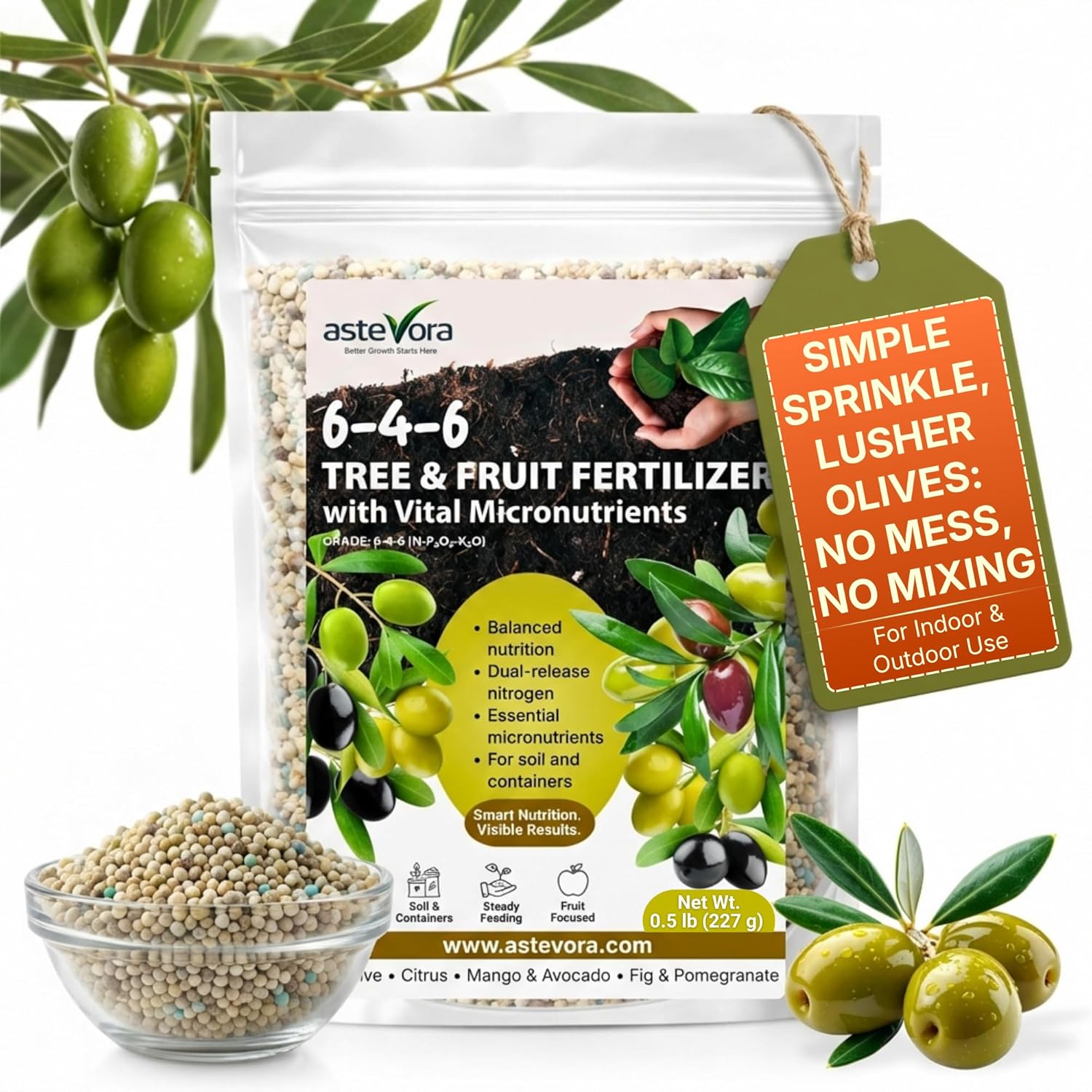
| Item Form | Granules |
|---|---|
| Mixing Ratio | 6:4:6 |
| Specific Uses For Product | Olive tree fertilizer, Plant Growth, Root Development, Seed Development |
| Unit Count | 8 Fluid Ounces |
| Ingredients | NPK, mineral fertilizer, Slow-Release Nitrogen |
This granular 6-4-6 fertilizer is designed for olive and other fruit trees in pots or the ground and delivers both water-soluble and slow-release nitrogen for immediate and sustained feeding. You apply the granules directly to the soil and water them in, which makes dosing straightforward for potted plants and in-ground specimens; the manufacturer recommends feeding containers every 6 to 8 weeks during active growth. The formula includes 1% iron and 1% magnesium plus micronutrients to help maintain leaf color and overall vigor, and the no-mix granules reduce mess compared with liquid feeds. For reliability-minded gardeners, the dual-release N and clear application schedule mean predictable, steady nutrition through the season. Limitations to note are the small 8 fl. oz. unit size, which may require multiple purchases for larger trees or orchards, and the product information does not list complete micronutrient concentrations or an exact application table for mature pomegranate trees specifically.
Best for: Gardeners who prioritize predictable, low-fuss nutrient delivery for single potted fruit trees or a few young in-ground specimens and who want an easy apply-and-water routine.
Less Ideal for: Large-scale growers or those managing multiple mature pomegranate trees who need bulk quantities and detailed application rates for big specimens.
- Dual-release nitrogen combines quick feeding with controlled-release for steady nutrition
- Granular no-mix form is easy to apply and avoids measuring liquids
- Includes iron and magnesium to help maintain deep green foliage
- Clear feeding interval for potted plants (every 6–8 weeks)
- Small 8 fl. oz. unit may be insufficient for mature or multiple trees
Verdict: A compact, easy-to-use granular feed that gives reliable immediate and sustained nutrition for single potted or small-scale fruit trees.
TPS Nutrients Olive Tree Liquid Fertilizer, 8 fl oz

| Item Form | Liquid |
|---|---|
| Application Method | watering can, hose end sprayer, or leaf mister |
| Target Species | Olive Trees |
| Unit Count | 8 Fluid Ounces |
| Mixing Ratio | 1:0 |
This liquid fertilizer is designed for olive trees and delivers balanced nutrition in an easy pour formula that can be applied with a watering can, hose‑end sprayer, or leaf mister. Typical use is regular feeding during routine watering for potted patio trees or landscape plantings to support steady growth, healthy foliage, and root development without excessive vegetative push. The product highlights gentle, targeted nutrients that claim to encourage fruit set and reduce buildup or root stress, which is helpful for maintaining long‑term tree health. The compact 8 ounce bottle is convenient for small containers or trial use; application is simplified by a 1:0 mixing ratio stated in the guide. Limitations include the small unit size if you have multiple plants or larger specimens, and the formula and labeling are targeted to olives so growers should check nutrient balance before applying to other species. For someone optimizing routine care, it is a practical, easy option for occasional feeding of individual potted or young olive trees.
Best for: Buyers who prioritize simple, low‑risk feeding routines for single potted trees or small landscape olives and want a product that is easy to apply during watering.
Less Ideal for: Gardeners managing many plants, larger landscape trees, or those seeking a fertilizer formulated specifically for lavender or other non‑olive species.
- Liquid formula works with watering can, hose‑end sprayer, or leaf mister for flexible application
- Designed to support steady growth, foliage health, and root development in olive trees
- Gentle mix claimed to avoid nutrient buildup or root stress
- Compact 8 fl oz size is convenient for potted trees or trialing a new fertilizer
- Small 8 ounce bottle may not be cost effective for multiple plants or larger trees
- Formulation and labeling are specific to olive trees and not tailored to lavender or other species
Verdict: A handy, easy‑to‑apply liquid fertilizer for gardeners who want straightforward, gentle feeding for a single potted or young olive tree.
Choosing the Right Plant Food for Olive Trees: Key Factors to Consider
Nutrient Ratio and Timing
Olive trees benefit from a balanced N-P-K ratio that supports flowering and fruiting rather than unchecked vegetative growth. A slightly lower nitrogen relative to potassium often helps concentrate energy into flowers and fruit set. Timing of nutrient availability matters: active growth phases in spring and early summer need available nitrogen, while late-season feeding should be limited to avoid tender new shoots before dormancy.
Think about whether a product supplies immediately available nutrients, slow-release forms, or a mix of both. Immediate-release fertilizers give a quick green-up but can require more frequent applications. Slow-release formulations provide steadier nutrition but may not correct acute deficiencies as fast.
Micronutrient Content
Olives commonly show deficiencies in micronutrients such as iron, zinc and boron, which affect fruit set, leaf chlorosis and overall vigor. A plant food that includes chelated iron or zinc is more likely to correct or prevent visible deficiency symptoms in alkaline or calcareous soils.
Look for explicit label statements about micronutrient analysis and the chemical form. Products that omit micronutrients rely entirely on soil reserves and foliar interventions, which can be less predictable in pots or poor soils.
Application Method and Frequency
Gardens and containers call for different feeding routines. Granular and slow-release options suit landscape trees where minimal seasonal attention is preferred, while soluble feeds or liquid concentrates work well for container-grown olives that need more frequent, controlled feeding.
Consider how often you want to apply fertilizer and whether the product fits your watering routine. Ease of measuring, spreading and compatibility with irrigation systems or hose-end feeders affects how consistently you will feed your trees over time.
Soil Interaction and pH Sensitivity
Soil texture and pH influence nutrient availability. In alkaline or calcareous soils common in many olive-growing regions, some micronutrients become less available to roots. Products formulated to perform in higher pH conditions or that include chelated micronutrients reduce the risk of deficiency.
Also consider salt buildup potential. High-salt fertilizers can cause root stress in containers or compacted soils. If your site has poor drainage or saline irrigation water, choose formulations with lower soluble salt indexes and monitor soil salts.
Release Profile and Longevity
Choosing between quick-release and slow-release plant foods affects labor and nutrient delivery. Quick-release fertilizers show fast green-up and can correct short-term shortages but require repeat applications and can increase leaching risk. Slow-release or polymer-coated granules dispense nutrients over months and reduce application frequency, which is useful for established trees in gardens.
For young trees and container specimens, a blended approach – a low-dose slow-release with occasional soluble feeding during active growth – can offer both steady nutrition and the ability to correct deficiencies when needed.
Feeding Schedule for Olive Trees
A simple feeding schedule keeps olives productive without promoting excessive vegetative growth. For most established trees, apply a balanced feed in early spring when new growth begins, then again in late spring or early summer if the product calls for a second dose. Avoid heavy late-season nitrogen applications that push new shoots vulnerable to cold or reduce fruit hardening.
Container-grown olives usually need more frequent, lighter feedings because potting mixes release fewer stored nutrients. Use a diluted soluble feed every 3 to 6 weeks during the active season, combined with a slow-release granule at potting time or early spring to maintain baseline nutrition.
- Early spring: main application to support leaf out and flowering
- Late spring/early summer: optional boost for fruit set if needed
- Avoid high-nitrogen late-summer feedings
Correcting Common Deficiencies
Yellowing leaves with green veins often indicate iron chlorosis, especially on alkaline soils. A foliar iron spray or a soil-applied chelated iron product can reverse symptoms faster than standard granular feeds. Zinc deficiency shows as smaller, distorted leaves or poor fruit set and may require targeted zinc supplements.
If boron deficiency is suspected because of poor fruit set or internal fruit issues, choose a product that lists boron or plan a specific soil/foliar treatment. Always follow label rates for micronutrient applications; overdosing can create new problems.
- Iron: treats chlorosis, often as chelated iron
- Zinc: important for flowering and fruit development
- Boron: critical for fruit set but required in small amounts
Feeding Container Olives Versus In-ground Trees
Containers lose nutrients faster and have limited buffer against pH changes. Use water-soluble feeds on a regular schedule and refresh potting mix or add a slow-release pellet at repotting to restore baseline fertility. Monitor for salt buildup by flushing containers periodically with good-quality water.
In-ground trees benefit from deeper, more infrequent applications. Apply granular feeds under the drip line and work them into the topsoil lightly; this encourages uptake by feeder roots. Mulch helps conserve moisture and moderates soil temperature, which in turn supports steady nutrient uptake.
- Containers: more frequent soluble feeding, watch for salt buildup
- In-ground: deeper, less frequent granular applications under the canopy
- Mulch stabilizes moisture and improves nutrient retention
Organic Versus Synthetic Options
Organic plant foods release nutrients more slowly as microbes break them down, and they often improve soil structure and microbial life. They are less likely to cause nutrient spikes that promote excessive leafy growth, but they may not correct acute deficiencies quickly.
Synthetic fertilizers deliver nutrients in forms that plants can use immediately, which is helpful for quick corrections or when precise N-P-K ratios are required. Many gardeners use a hybrid approach: organic amendments to build soil health and periodic synthetic feeds to manage specific nutrient needs or seasons.
- Organic: gradual release, soil-building benefits
- Synthetic: fast-acting, precise nutrient dosing
- Hybrid approach combines long-term soil health with short-term control
Safety and Environmental Considerations
Avoid over-application, which can lead to salt buildup, root burn and nutrient runoff. Follow label rates and adjust for tree size and soil fertility. For slopes or sites near water bodies, prefer slow-release options or place granular applications away from runoff paths.
Consider pet and child safety when selecting formulations and storage methods. Store fertilizers in a dry, secure place and clean up any spills promptly. When using soluble feeds, rinse equipment and avoid applying before heavy rain to reduce leaching.
- Follow label rates to prevent salt stress
- Use slow-release on slopes or near water
- Secure storage and spill cleanup for safety
How We Chose the Best Plant Food for Olive Trees
We focused on practical, gardener-centered criteria that determine how well a plant food will perform for olive trees in real conditions. Key evaluation dimensions included nutrient ratio and completeness, the presence and form of micronutrients, application method and timing flexibility, suitability across soil pH and texture, and safety for fruit and root systems. We prioritized products that deliver available nitrogen without encouraging excessive leafy growth at the expense of fruiting, and formulations that include boron, iron and zinc when they are supplied in plant-available forms. Ease of application mattered because many home gardeners prefer simple seasonal or slow-release schedules over complex dosing. We excluded blends that are clearly targeted only at high-nitrogen turf use or that lack any micronutrients. We also removed products with unclear label analysis or vague directions. The remaining items met our standards for clear nutrient labeling, gardener-friendly application, and relevance to both container and landscape olive trees.
FAQ
How often should I feed an established olive tree?
Established trees usually need one to two feedings during the active season, typically early spring and optionally late spring. Frequency depends on soil fertility and the product's release profile; slow-release options may only require a single annual application.
Can container olive trees use the same fertilizer as in-ground trees?
They can, but containers need adjustments. Containers benefit from more frequent, diluted liquid feedings and lower total application rates to avoid salt buildup. Adding a slow-release pellet at repotting helps maintain baseline fertility.
What signs indicate my olive needs micronutrients?
Interveinal chlorosis (yellow leaves with green veins) often signals iron deficiency. Small distorted leaves or poor fruit set can point to zinc shortages. If you suspect micronutrient issues, consider a soil test and targeted chelated foliar treatments for faster correction.
Is organic plant food adequate for olive production?
Organic feeds provide steady nutrients and improve soil structure, which benefits olives long-term. However, they release nutrients slowly and may not correct immediate deficiencies. Many gardeners combine organic amendments with targeted soluble feeds when needed.
When is it risky to apply high-nitrogen fertilizers?
High-nitrogen applications late in the season can encourage tender new growth that is vulnerable to cold and can reduce fruiting. Avoid heavy nitrogen after midsummer and follow recommended rates for tree age and size.
Final Verdict
Choosing the right plant food for olive trees comes down to matching nutrient balance, micronutrient needs and release profile to your site and tree age. Prioritize a formula that supplies the right N-P-K ratio for fruiting and includes key micronutrients if your soil is prone to deficiencies. Decide between slow-release convenience for in-ground trees and soluble feeds for containers, and adjust timing to support flowering without triggering late-season vegetative flushes. With those tradeoffs in mind, select a feeding regimen that fits your maintenance style and local soil conditions for healthier trees and better fruit set.
