

Note: This article contains affiliate links. If you click on these links and make a purchase, I may earn a small commission at no extra cost to you. This helps support my research and content. Read my full affiliate disclosure here.
Choosing the right potting soil for seeds shapes the earliest days of your plants. Seed starting mixes behave differently from general potting soil: they need to retain steady moisture, offer light texture for root emergence, and avoid nutrients or salts that can burn tiny roots. In this guide we shortlist seven top potting soils for seeds that perform well in flats, trays, and small pots. Each pick is evaluated on the real factors that matter to growers, including moisture control, drainage, and seedling health. Read on for practical notes that make it easier to pick a mix that gets seedlings off to a vigorous start.
Top Picks at a Glance
| Best Overall The best all-around choice for most situations | Espoma Organic Seed Starter Premium Potting Mix, 16 qt |  |
| Best Quality Built to a higher standard if you want something more solid | Premier Pro Mix BX with Mycorrhizae, 2.8 cu ft |  |
| Best Value The sweet spot between price and what you get | Back to the Roots Organic Expanding Coco Coir Potting Soil Brick |  |
| Best Budget The cheapest option that still gets the job done reliably | Back to the Roots 3-in-1 Seed Starting Mix, 6 Quart Organic Seed Mix |  |
| Highest Rated A top-rated pick with lots of positive feedback | Old Potters Germination Mix (24 qt) — Peat Moss with Fine Perlite & Vermiculite |  |
| Most Popular A crowd favorite that many people choose with confidence | Miracle-Gro Indoor Potting Mix for Seed Starting (2-pack, 8 qt. each) |  |
| Best Seller A high-volume bestseller chosen again and again | Back to the Roots Organic Seed Starting Mix, Expanding 12-Quart Block |  |
Espoma Organic Seed Starter Premium Potting Mix, 16 qt

| Brand Name | Espoma |
|---|---|
| Unit Count | 598.4 Ounce |
| Volume | 16 quarts |
| Model Number | SS16 |
Espoma Organic Seed Starter Premium Potting Mix is designed specifically for germinating seeds and rooting cuttings. The blend of sphagnum peat moss and perlite gives a light, airy texture that helps maintain even moisture while providing good drainage, and the added yucca extract aids wetting. The included MYCO-TONE mycorrhizal inoculant supports early root development, which can improve establishment for vegetables, herbs, and flowers. Because it contains no synthetic fertilizers, it fits organic growing systems and is suitable for transplanting once seedlings need nutrient feed; expect to pot up into a richer potting mix or start feeding when true leaves appear. Practical benefits include easy handling from a 16 quart bag and consistent results for home seed starting. Limitations are that it is a starter medium rather than an all-in-one potting soil, so it lacks sustained fertility for larger pots and frequent repotting or fertilizing will be necessary as plants grow.
Best for: Home gardeners who want a dependable organic seed-starting medium that promotes quick germination and strong early root growth for vegetables, herbs, and flowers.
Less Ideal for: Gardeners seeking an all-purpose potting soil that feeds plants long-term or those who prefer non-peat, fully sustainable mixes for seed starting.
- Light, airy blend of peat moss and perlite for reliable drainage and moisture retention
- Contains MYCO-TONE mycorrhizae to support early root establishment
- Formulated for organic gardening with no synthetic fertilizers or chemicals
- Includes yucca extract to improve wetting and even moisture distribution
- Not formulated to provide long-term nutrients so seedlings need potting soil or feeding after true leaves emerge
- Contains peat moss which is not a renewable resource preferred by some gardeners
Verdict: Choose this organic seed starter if you want a light, mycorrhizae-enhanced mix that reliably promotes germination and early root development.
Premier Pro Mix BX with Mycorrhizae, 2.8 cu ft

| Brand Name | Premier Horticulture |
|---|---|
| Included Components | Pro Mix Loose with Mycorrhizae, 2.8 Cubic Feet |
| Unit Count | 400 Ounce |
| Volume | 2.8 cubic feet |
Premier Pro Mix BX with Mycorrhizae is a peat-based professional growing medium formulated to support vigorous root development by supplying a mycorrhizal inoculum (Glomus intraradices). It is typically used for greenhouse propagation, transplanting seedlings into larger containers, and general potting where improved nutrient and water uptake is desired. The added mycorrhizae can help young plants establish faster and access nutrients more efficiently, which is useful when raising seedlings that will be transplanted. As a commercial-style mix it offers consistent texture and moisture retention compared with plain garden soil, so watering and fertilization are easier to manage. Limitations: it is a peat-based, general-purpose mix rather than a seed-starting specific formula, so it may lack the very fine texture and low nutrient level some seed-start media provide; fine adjustments to fertility and drainage may still be needed depending on seed type. This product is best when you want a reliable professional potting medium that gives seedlings a stronger root advantage before transplanting.
Best for: Gardeners and growers who prioritize seedling and transplant performance and want a professional potting medium that encourages stronger root establishment before moving plants to their final containers.
Less Ideal for: If you need a very fine, low-nutrient seed-starting mix for extremely small seeds or want a non-peat, organic-certified seed medium, this product is not the best choice.
- Contains Glomus intraradices mycorrhizal inoculum to improve root nutrient and water uptake
- Peat-based formula offers consistent texture and good moisture retention for propagation and transplanting
- Designed for professional greenhouse and transplant applications so quality and uniformity are reliable
- Not a dedicated seed-starting mix so particle size and initial nutrient levels may be higher than ideal for very fine-seeded species
- Contains peat which may compact over time and affect long-term drainage
Verdict: Choose this pro-grade peat mix when you want seedlings and transplants to get a measurable root performance boost from added mycorrhizae.
Back to the Roots Organic Expanding Coco Coir Potting Soil Brick

| Item Highlight | 10 lb compressed coco coir brick; peat-free; OMRI Listed |
|---|---|
| Item Type Name | Coconut Coir |
| Volume | 2 cubic feet |
| Brand Name | Back to the Roots |
This compressed coco coir block rehydrates into a light, airy potting medium ideal for seed starting and potting up seedlings. Add water to the 10 lb brick and it expands to roughly 2 cubic feet of fluffy coir that can be used on its own for seed trays or mixed with garden soil to improve drainage and aeration. It is OMRI listed and peat free, so it suits organic workflows and reduces peat use. Practical benefits include easy storage when compressed, consistent pH for general use, good water retention without becoming soggy, and minimal mess compared with loose bagged soil. Limitations are that coco coir is a soilless substrate and lacks nutrients for longer-term growth, so you will need to add starter fertilizer or blend with a compost or potting mix for ongoing feeding; also some gardeners prefer a finer seed-starting mix for very small seeds. For the buyer focused on efficiency, the brick simplifies storage and gives predictable, usable volume when hydrated.
Best for: Gardeners who want a compact, easy-to-store seed-starting medium or a reliable amendment to improve drainage and aeration when potting up seedlings, and who prefer peat-free, organic-friendly options.
Less Ideal for: Growers who want an all-in-one fertilized potting mix or those raising very small seeds that need an ultra-fine, nutrient-rich seed-starting substrate.
- Expands to about 2 cubic feet from a compact, easy-to-store 10 lb brick
- Peat-free and OMRI listed for organic-friendly growing
- Light, airy texture improves aeration and root development
- Consistent, pH-balanced medium suitable for seed starting and potting
- Contains no inherent nutrients so fertilization is required for long-term growth
- May be too coarse for very fine-seeded species without screening or mixing
Verdict: A compact, peat-free coco coir brick that expands into a reliable, easy-to-store seed-starting and potting medium for gardeners who prioritize practicality and organic-friendly inputs.
Back to the Roots 3-in-1 Seed Starting Mix, 6 Quart Organic Seed Mix

| Unit Count | 192 Fluid Ounces |
|---|---|
| Style Name | 3-in-1 Seed Starting Mix |
| Brand Name | Back to the Roots |
This seed starting mix is formulated for beginning gardeners who want an easy, organic option for starting seeds indoors or in small containers. It combines coconut coir, mycorrhizae, dolomitic limestone and moisture-controlling yucca to offer a pH-balanced, peat-free medium that holds moisture without becoming waterlogged. The blend includes worm castings and plant food to support early growth so seedlings can establish quicker and need fewer immediate feedings. Typical uses are seed trays, small pots, and transplanting seedlings to larger containers; the fast-draining texture also helps prevent damping-off when paired with proper watering. Practical benefits include organic ingredients, a peat-free profile for eco-conscious buyers, and built-in nutrients that reduce the need for extra fertilizer in the first weeks. Limitations are the small 6 quart volume, which means one bag covers only a few trays and gardeners starting many seeds will need multiple bags, and the product does not list exact nutrient analysis for tailored fertilization plans.
Best for: Budget-minded beginners and home gardeners who want an easy, organic peat-free mix that supplies initial nutrients for starting seeds in trays and small pots.
Less Ideal for: Commercial growers or gardeners who need large quantities per season or who prefer to custom-blend media with exact nutrient ratios and bulk coverage.
- Peat-free organic blend with coconut coir and mycorrhizae to support root development
- Includes worm castings and starter plant food so seedlings get nutrients early
- Moisture-controlling yucca helps retain water while reducing risk of overwatering
- pH balanced with dolomitic limestone to reduce acidity-related nutrient issues
- Small 6 quart bag provides limited coverage for gardeners starting many seeds
- No detailed N-P-K or nutrient analysis provided for precise fertilization planning
Verdict: A compact, organic seed-starting mix that gives beginners a peat-free, nutrient-ready medium to get seedlings off to a healthy start.
Old Potters Germination Mix (24 qt) — Peat Moss with Fine Perlite & Vermiculite

| Volume | 24 quarts |
|---|---|
| Unit Count | 768 Fluid Ounces |
| pH range | 5.4 – 6.3 |
| Electrical conductivity | 1.0 – 1.5 mmhos/cm |
This germination mix is built for starting seeds and propagating cuttings with consistent results. Its formula is 80–90% finely milled Canadian sphagnum peat moss combined with fine horticultural perlite and vermiculite to provide a balance of moisture retention and aeration that promotes uniform root development. Calcitic and dolomitic limestone are added to hold the pH in the 5.4–6.3 range and a wetting agent helps the medium rehydrate evenly so you avoid dry pockets in small cells or trays. A mild starter nutrient charge and a modest EC (1.0–1.5 mmhos/cm) give seedlings a gentle early feed without burning young roots. The fine texture makes it well suited to both sub-irrigation and overhead watering systems and to use in seed flats, plug trays, and small pots. Be aware the mix is peat-based, so it will compress over time and may hold more water than soilless mixes with higher perlite content, requiring attention to drainage for long-term potting. For reliable, repeatable seed starts this is a practical, no-nonsense choice.
Best for: Gardeners who prioritize consistent, predictable seed starts and propagation results and want a ready-to-use medium that performs across trays and small pots.
Less Ideal for: Growers looking for an entirely peat-free or very fast-draining mix for succulents or long-term container culture should consider alternatives.
- High peat content for even moisture retention and fine texture ideal for seeds and cuttings
- Added fine perlite and vermiculite improve aeration and uniform water holding in trays
- pH balanced with calcitic and dolomitic limestone for consistent nutrient availability
- Wetting agent promotes quick, even rehydration to reduce dry spots in small cells
- Peat-based formulation can compress and retain more water over time compared with higher-drainage mixes
- Contains a light starter charge but not a complete fertilizer for longer-term growth
Verdict: Choose this germination mix when you need a dependable, fine-textured medium that gives repeatable, uniform seed and cutting starts.
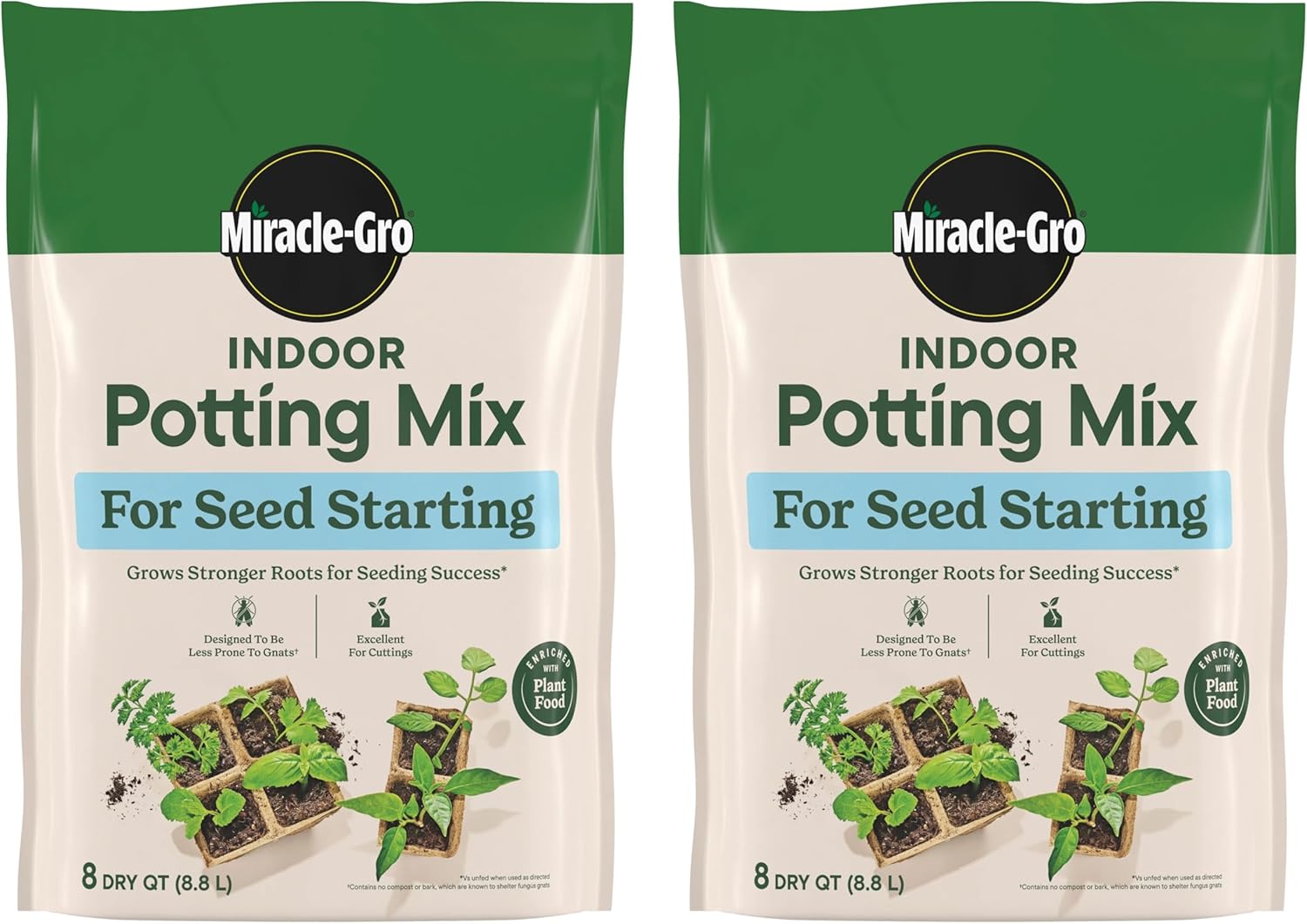
Miracle-Gro Indoor Potting Mix for Seed Starting (2-pack, 8 qt. each)
| Number of Packs | 2 |
|---|---|
| Item Type Name | Potting Mix |
| Unit Count | 512 Ounce |
| Item Highlight | For Starting Vegetable, Flower, and Herb Seeds Indoors |
| Volume | 8 quarts |
This seed-starting potting mix is made for getting vegetable, flower, and herb seeds and leaf or stem cuttings off to a healthy start indoors. The blend is lightweight and enriched with plant food so seedlings develop stronger roots compared with unfed mix when used as directed. It is sold in two 8-quart bags, enough to fill multiple 72-cell trays, and is ready to use straight from the bag in cells or small containers. Notable features include an absence of compost or bark, which the manufacturer says lowers the chance of fungus gnat problems, and a formula aimed at retaining moisture while encouraging root growth. Practical benefits are easier handling, predictable germination medium, and fewer early pest hiding spots than mixes that include compost. Limitations are that it contains fertilizer so you should follow seed packet and safety instructions to avoid overfeeding very young seedlings and take care to avoid inhaling dust when working with dry mix. For growers who want a simple, reliable starting medium this does the job well, but experienced propagators who prefer custom mixes or organic-only components may want to blend their own.
Best for: Buyers who want a low-fuss, store-ready seed-starting medium that helps seedlings establish roots and reduces early gnat problems; ideal for hobbyists and first-time propagators who prioritize predictable results over custom blends.
Less Ideal for: Growers who exclusively use organic potting media or who prefer to formulate highly customized seed mixes should consider alternative or DIY options.
- Lightweight, ready-to-use formula tailored for seed germination and cuttings
- Enriched with plant food to support stronger root development vs unfed mix when used as directed
- Contains no compost or bark, which reduces common fungus gnat habitat in seed trays
- Two 8 qt. bags provide enough volume for multiple 72-cell trays so you can start many seeds at once
- Contains fertilizer which may require careful dosing or delaying additional feeding for sensitive seedlings
- Not formulated as an organic-only mix, so it may not meet strict organic growing preferences
Verdict: A convenient, gnat-reducing seed-starting mix that helps seedlings build stronger roots with minimal setup.
Back to the Roots Organic Seed Starting Mix, Expanding 12-Quart Block

| Volume | 12 quarts |
|---|---|
| Unit Count | 384 Fluid Ounces |
| Item Type | Seed Starting Mix |
| Certification | OMRI listed |
This compressed seed starting mix is a coir-based block that expands to about 12 quarts of loose, ready-to-use seedling soil after adding water. It is formulated with a neutral pH and low electrical conductivity, which helps young roots access nutrients and reduces the risk of fertilizer burn for sensitive seedlings. Typical use is simple: hydrate the compressed block, fluff the medium, fill trays or small pots, and sow seeds for herbs, vegetables, or flowers. The product is OMRI listed and peat free, so it is a sustainable choice for gardeners who prefer organic inputs. Practical benefits include compact storage before use, good water retention with improved aeration for root development, and a consistent medium suitable for beginners or cautious growers who want predictable results. Limitations are that it arrives as a block so you must rehydrate and fluff it before planting and it provides a starting medium rather than long-term potting soil or a complete fertilized mix, so seedlings will need regular feeding or transplanting into richer media as they grow.
Best for: Buyers who want a reliable, beginner-friendly seed starting medium that is organic and easy to store, and who prefer predictable, low-risk results when starting herbs, vegetables, or flowers indoors.
Less Ideal for: Gardeners who need a ready-to-use, nutrient-rich potting mix for mature plants or who prefer pre-fertilized soils for extended container growing.
- Expands to 12 quarts from a compact compressed block for easy storage and transport
- Neutral pH and low electrical conductivity suitable for delicate seedlings
- OMRI listed and peat free for organic and sustainable gardening
- Light, fluffy texture that improves aeration and root development
- Arrives as a compressed block that requires rehydration and physical fluffing before use
- Not formulated as a long-term potting mix so seedlings will need feeding or transplanting later
Verdict: An easy-to-store organic seed starting block that expands into a neutral, seed-safe medium ideal for risk-averse gardeners starting herbs, vegetables, and flowers.
Choosing the Right Potting Soil for Seeds: Key Factors to Consider
Moisture Retention and Water Balance
Seeds and newly germinated seedlings need a consistently moist environment without being waterlogged. A mix that holds water near the seed helps radicles emerge, but too much retained water reduces oxygen at the root zone and increases damping-off risk.
Look for ingredients like coconut coir or finely screened peat alternatives that provide water-holding capacity while still allowing excess to drain. Consider how often you can realistically mist or water; mixes with higher retention reduce the need for constant attention in hot windows or warm trays.
Drainage and Aeration
Good drainage prevents standing water and root rot, while aeration supplies oxygen to developing roots. For seed starting this usually means a light, open structure with coarse particles mixed into the fine seed medium.
Perlite, fine pumice, or coarse sand in small proportions help maintain pore space. An overly compact or dense mix will slow germination and promote fungal issues, so choose a blend that remains fluffy when moistened and allows excess water to pass through the tray.
Particle Texture and Consistency
Particle size affects how easily a seed pushes through the medium and how well roots anchor. Very fine textures can crust and impede emergence, while very coarse textures can leave tiny seeds unsupported and dry.
A uniform, fine-but-not-powdery texture is ideal for most vegetable and flower seeds. Consistency between bags matters too; variable batches force you to adjust sowing depth and watering. For small seeds, err on the finer side with some light coarse components mixed in.
Sterility and Low Salt Content
Fresh potting soil intended for seeds should be free of weed seeds, pathogens, and excess soluble salts. Young roots are sensitive to salts and high starter fertilizer rates can stunt or kill seedlings. Sterile or professionally pasteurized mixes reduce the chance of damping-off and early fungal attacks.
Check product claims about sterilization or low-salt formulas. If a mix is not explicitly low-salt, gardeners should plan on frequent flushes or using cleaner water to avoid accumulation when seedlings are watered.
Nutrient Profile and Starter Fertility
Most seeds do not need significant nutrients to germinate; in fact, high fertilizer levels can damage delicate roots. Seed mixes are typically low in fertility so seedlings rely on seed reserves for the first true leaves. However, a mild, soluble feed after the first set of true leaves helps transplant vigor.
Choose a potting soil for seeds that is low in slow-release fertilizer and labeled for seed starting or seedling use. That keeps the early weeks safe while allowing you to control feeding precisely once the plants are established.
Ease of Use and Rewetting Behavior
Seed starting often involves reusing trays, wetting dry bales, and working at small scale. Some mixes are difficult to rehydrate after storage or become hydrophobic, creating uneven moisture pockets. Others rewet quickly and hold an even moistened state suitable for tray use.
Consider how the mix handles at your scale: does it rehydrate evenly when dampened from below, and does it hold together enough to sow without excessive shifting? A predictable rewetting behavior reduces seedling losses and makes routine bench work smoother.
When to Use a Straight Seed-Starting Mix Versus a Light Potting Blend
A straight seed-starting mix is formulated specifically for germination: very fine, sterile, and low in nutrients. Use these when germinating tiny seeds or starting many trays indoors because they minimize disease risk and give uniform moisture.
Light potting blends include slightly coarser components and a bit more organic matter. They are helpful when you plan to let seedlings grow in the same container until transplant time and need some structure for root anchoring. Match your choice to how long seedlings will remain in their original cells.
- Seed-starting mixes: best for quick germination and early weeks.
- Light potting blends: better if seedlings will stay longer before transplant.
Preparing Trays and Ensuring Even Moisture
Fill trays evenly and firm gently so seeds have contact without being buried. Bottom-watering or capillary mats often give the most consistent moisture without disturbing tiny seeds. If you mist from above, use a fine spray and check for crusting as the surface dries.
Watch for cold bench conditions that slow drying and warm windows that speed it up. Adjust watering frequency rather than changing mixes mid-season; consistent moisture routine is more important than slight differences between similar mixes.
- Use trays with drainage holes and a saucer or bench to catch excess.
- Consider bottom-watering to maintain even moisture without surface disruption.
Dealing with Common Seedling Problems
Damping-off is a common fungal issue that shows as collapsed stems at soil level. Prevention starts with sterile mixes and proper air circulation. Avoid overwatering and improve light and airflow to lower humidity around stems.
Slow germination can be from overly dry mixes, crusted surfaces, or cold temperatures. Lightly cover small seeds with finer mix or vermiculite to keep moisture even. If a mix seems hydrophobic, fully soak it then allow excess to drain before sowing to ensure uniform contact.
- Improve airflow and reduce humidity to prevent fungal collapse.
- Use seed-specific mixes and avoid heavy compost in the tray to lower disease risk.
Transplanting Seedlings Without Shocking Roots
When seedlings develop true leaves and a healthy root mass, move them to their next container. A light potting blend with slightly higher organic matter helps roots expand. Handle cells by the leaves, not the stem, and water well before lifting to keep the root ball intact.
Avoid transplanting into a heavy garden soil directly. Match moisture levels between old and new media to prevent transplant shock and reduce recovery time after moving.
- Move when roots reach the edges of the cell but before they circle tightly.
- Harden off gradually before final outdoor transplant to acclimate seedlings.
Sustainable and Reusable Options for Seed Starting
If you prefer lower peat use, look for coconut coir-based mixes or blends with recycled wood fibers. These alternatives can provide similar moisture retention and are often renewable. Consider mixes that clearly list ingredients so you can evaluate sustainability claims.
For reusing containers, sanitize trays and discard spent surface mix after heavy disease outbreaks. Some gardeners refresh used media by mixing with sterile composted bark and perlite, but this works best when disease was not present and materials are well screened.
- Coconut coir is a common peat alternative with good water retention.
- Sanitize or replace media after diseases to protect future sowings.
How We Chose the Best Potting Soil for Seeds
We focused on attributes that matter to seed starting in home and small-scale greenhouse settings. Our primary filters were moisture retention and drainage balance, because young roots need consistent moisture without sitting in water. Texture and particle size were included to ensure mixes are light enough to allow radicle penetration and airflow. Sterility and low-salt formulations were required to minimize damping-off and nutrient burn in delicate seedlings. Organic matter and amendment transparency were checked to confirm mixes do not contain mature compost or slow-release fertilizers that can harm seeds. Ease of use factors such as ready-to-use consistency and rewetting behavior were assessed for practical handling by gardeners. We excluded heavy garden soils, outdoor bed soil, and mixes designed only for mature container plants. We also eliminated any products that rely on opaque ingredient lists, contain high starter fertilizer, or are unsuited to tray or cell propagation. The resulting shortlist focuses on seed-starting mixes and light potting blends appropriate for seeds and young seedlings.
FAQ
Can I use garden soil to start seeds indoors?
Garden soil is usually too heavy and can contain pathogens and weed seeds. It compacts, drains poorly, and increases damping-off risk. A light, sterile seed-starting mix is safer and more reliable for indoor germination.
How often should I water seed trays?
Frequency depends on tray size, mix, and ambient conditions. Check moisture daily and aim for consistently moist but not saturated media. Bottom-watering or capillary mats reduce disturbance and often require less frequent surface misting.
When should I start feeding seedlings?
Most seedlings do fine without added nutrients until they form their first true leaves. At that point, begin a dilute soluble feed or pot them up into a light potting blend with a mild starter nutrient. Avoid concentrated fertilizers that can burn young roots.
Do seeds need light to germinate in potting soil?
It depends on the species. Many small-seeded flowers and herbs require light at the surface to germinate, while others germinate in darkness. Check seed packet instructions and use a fine surface mix or light covering as recommended.
How can I tell if a seed-starting mix is hydrophobic?
Hydrophobic mixes resist water and form dry patches after storage. To test, place a small amount in a bowl and pour water over it. A good mix will absorb water evenly; a hydrophobic mix will repel water and clump on the surface.
Is peat-free potting soil as effective for seeds?
Peat-free mixes based on coconut coir or composted bark can be effective if they have the right particle size and sterility. The key is even moisture retention and low salts rather than the specific organic base used.
Final Verdict
For seed starting, prioritize a light, sterile mix that balances moisture retention with good drainage. Particle texture and low salt levels are especially important because tiny roots and emerging stems are sensitive to compaction and fertilizer burn. Decide based on how long seedlings will stay in their cells and your watering routine: choose finer, sterile seed mixes for very small seeds and short-term nurseries, or slightly coarser light potting blends if seedlings will grow in place longer. With those priorities, you can confidently pick a potting soil for seeds that gives young plants the best possible start.
