

Note: This article contains affiliate links. If you click on these links and make a purchase, I may earn a small commission at no extra cost to you. This helps support my research and content. Read my full affiliate disclosure here.
Getting the timing and product right for a pre-emergent herbicide matters more than a single application. Applied correctly, a preventive herbicide stops crabgrass seedlings before they emerge, protecting established turf and reducing the need for repeated spot treatments later in the season. In this guide we shortlisted seven top pre-emergent herbicides for crabgrass across common lawn situations, focusing on when to apply and how each fits with different turf types and maintenance routines. Below you will find how we judged products for safety, season-long control potential, ease of application and compatibility with typical lawn care practices, plus practical advice to help you pick the option that fits your yard. Start with the timing guidance to match your local spring conditions before choosing a product from the list.
Top Picks at a Glance
| Best Overall The best all-around choice for most situations | The Andersons Barricade DG Pro 50 lb Granular Pre-Emergent |  |
| Best Quality Built to a higher standard if you want something more solid | The Andersons Barricade Professional-Grade Granular Pre-Emergent Weed Control (40 lb) |  |
| Best Value The sweet spot between price and what you get | Lawn Synergy Safeguard 0-0-7 Pre-Emergent Granules (18 lb) |  |
| Best Budget The cheapest option that still gets the job done reliably | GreenView Crabgrass Control Plus Lawn Food, 13.5 lb |  |
| Highest Rated A top-rated pick with lots of positive feedback | Quali-Pro Prodiamine 65 WDG Pre-Emergent Herbicide, 5 lb |  |
| Most Popular A crowd favorite that many people choose with confidence | Scotts Halts Crabgrass & Grassy Weed Preventer, 10.06 lb |  |
| Best Seller A high-volume bestseller chosen again and again | Scotts Turf Builder Halts Crabgrass Preventer with Lawn Food |  |
The Andersons Barricade DG Pro 50 lb Granular Pre-Emergent

| Item Form | Granule |
|---|---|
| Coverage | 14,200 square feet |
| Active Ingredients | prodiamine |
| Unit Count | 800 Ounce |
The Andersons Barricade DG Pro is a granular pre-emergent weed preventer that uses 0.48% prodiamine to stop germinating crabgrass and over 30 other grass and broadleaf weeds. It is applied evenly across the lawn in early spring or fall and activated by watering, making it suitable for established turf, sports fields, sod farms, and ornamental areas. The DG Pro granular formulation delivers many small particles per square inch for uniform coverage and better contact with the soil compared with coarse granules. Practical benefits include long-lasting prevention when timed correctly, coverage large areas from a single 50 lb bag, and a formulation trusted by turf professionals. Important limitations are that it will not control existing weeds, must be applied before weed germination, and requires attention to label safety guidance because it is an agricultural herbicide. Users should plan timing and application rates for their climate and lawn type to get the intended crabgrass prevention.
Best for: Homeowners or property managers who want a reliable, professional-strength preventive solution for crabgrass across medium to large lawns and turf areas and who plan applications around seasonal germination windows.
Less Ideal for: Gardeners seeking a quick fix for visible weed patches or those who need an all-in-one product that eliminates existing weeds should consider a post-emergent or combination approach instead.
- Contains prodiamine (0.48%) proven to prevent crabgrass and many common weed seedlings
- DG Pro granular formulation provides higher particle density for more uniform soil coverage
- Large 50 lb bag covers up to 14,200 square feet, suitable for big lawns and turf areas
- Designed for use on established turf, sports fields, sod farms, and ornamental beds
- Does not kill existing weeds so a separate post-emergent is needed for current infestations
- Must be applied at the correct pre-emergent timing and activated with water to be effective
Verdict: Choose Barricade DG Pro when you need a professional, granular pre-emergent that reliably prevents crabgrass across large lawns when applied at the correct time.
The Andersons Barricade Professional-Grade Granular Pre-Emergent Weed Control (40 lb)

| Item Form | Granule |
|---|---|
| Coverage | 12880 square_feet |
| Active Ingredients | Herbicide |
| Unit Count | 640 Ounce |
Barricade granular pre-emergent applies as a preventative treatment to stop crabgrass and other common grassy and broadleaf weeds before they emerge. It is typically broadcast across established turf and then watered in so the dispersible granules dissolve and move the active ingredient, prodiamine, into the soil where it blocks weed germination. Notable features include patented DG Technology for rapid granule dissolution and a low active ingredient concentration designed for season-long control with both early spring and fall applications. The large 40 pound bag covers a lot of ground, making it efficient for treating whole yards or multiple applications over seasons. Important limitations are that it will not control weeds already present and proper timing and application rate are essential to avoid reduced lawn safety or subpar performance. Also, being a chemical herbicide, users should follow label safety directions to limit exposure to people, pets, and desirable plants.
Best for: Buyers who prioritize reliable, performance-focused prevention of crabgrass across medium to large lawns and who are comfortable following label directions for timing and application.
Less Ideal for: Gardeners who need to eliminate existing weed growth or who prefer organic or non-chemical weed control methods should consider alternatives.
- Formulated to prevent both grassy and broadleaf weeds including crabgrass
- DG Technology dispersible granules dissolve quickly when watered for faster soil incorporation
- Large 40 lb bag provides wide coverage suitable for whole-yard treatments
- Suitable for early spring and fall pre-emergent timing for season-long control
- Not effective on existing weeds since it is a prevention-only product
- Contains an active herbicide ingredient that requires careful handling and adherence to safety directions
Verdict: Choose Barricade when you want a professional-grade pre-emergent that reliably prevents crabgrass over large lawns with fast-dissolving granules.
Lawn Synergy Safeguard 0-0-7 Pre-Emergent Granules (18 lb)

| Active Ingredient | 0.37% Prodiamine |
|---|---|
| Form | Granules |
| Coverage | 4,500 |
| Potassium | 7% |
Lawn Synergy Safeguard 0-0-7 is a granular pre-emergent that creates a weed barrier when applied and watered in, preventing broadleaf weeds and crabgrass from germinating. It is used by broadcasting the granules over turf or landscape beds at the recommended rate (typically 3–5 lb per 1,000 sq ft) before weeds germinate, then irrigating to activate the product. Notable features include 0.37% prodiamine as the active ingredient and a potassium-rich 0-0-7 formulation that contains no nitrogen or phosphorus. Practical benefits are straightforward: a single preventive application reduces the need for spot treatments and hand pulling, it covers up to about 4,500 sq ft from this 18 lb bag, and it can be applied to both cool- and warm-season lawns following timing guidance. Important limitations are that it will prevent grass seed from establishing, so it is not compatible with overseeding or newly sodded areas, and like all pre-emergents it must be timed correctly to be effective. Users should also follow safety guidance to avoid runoff near water sources.
Best for: Homeowners who want a practical, preventive approach to crabgrass and annual weeds and prefer applying a single broadcast treatment each season to reduce follow-up weeding.
Less Ideal for: People planning to reseed or install new sod within the next several months or those who need a post-emergent solution for existing weed infestations.
- Contains 0.37% prodiamine, a widely used active ingredient for preventing crabgrass and many annual weeds
- Granular form works with standard broadcast spreaders for even, easy application
- Covers approximately 4,500 sq ft from the 18 lb bag, suitable for small to medium lawns
- No nitrogen or phosphorus, so it does not stimulate unwanted top growth at application time
- Prevents grass seed germination so cannot be used before overseeding or new sod
- Must be applied before weed germination window which requires timing attention
Verdict: A reliable granular pre-emergent that makes seasonal crabgrass prevention simple for homeowners who want to minimize follow-up weeding.
GreenView Crabgrass Control Plus Lawn Food, 13.5 lb

| Item Form | Granules |
|---|---|
| Coverage | 5000 |
| Mixing Ratio | 26:0:4 |
| Specific Uses For Product | Lawn |
GreenView Crabgrass Control Plus Lawn Food is a spring turf treatment that combines pre-emergent crabgrass control with a 26-0-4 slow-release fertilizer to feed lawns for up to eight weeks. You apply it with a broadcast or drop spreader to a dry, calm lawn before crabgrass germinates or within four weeks after germination, then water it in or rely on forecasted rain to activate the pre-emergent chemistry. The controlled-release MESA nitrogen formulation promotes steady green-up and deeper roots without a quick surge in growth, while the granular formula spreads evenly for uniform coverage of about 5,000 square feet per bag. Practical benefits include reduced need for repeat applications through the season and improved drought resilience from stronger root development. Important limitations are that it is for seasonal crabgrass prevention rather than curative control of established weeds and you should not reseed or overseed for at least 10 weeks after application, which limits use if you plan lawn renovation soon.
Best for: Homeowners who want an affordable, one-application spring product to prevent crabgrass and maintain steady fertilizer feeding across a medium to large lawn.
Less Ideal for: People needing an immediate curative herbicide for existing crabgrass or gardeners planning to reseed or renovate turf shortly after treatment.
- Provides pre-emergent crabgrass prevention and season-long weed reduction
- Controlled-release nitrogen feeds the lawn for up to eight weeks for steady green-up
- Covers up to 5,000 sq. ft. per bag for medium to large yards
- Granular formula spreads evenly with a standard lawn spreader for uniform application
- Does not kill established crabgrass since it is primarily a pre-emergent
- Not suitable for overseeding or reseeding within 10 weeks after application
Verdict: A budget-friendly spring pre-emergent with slow-release fertilizer that prevents crabgrass and feeds a 5,000 sq. ft. lawn for up to eight weeks.
Quali-Pro Prodiamine 65 WDG Pre-Emergent Herbicide, 5 lb

| Item Form | Granule |
|---|---|
| Coverage | Pre-emergent grass and broadleaf weed control, season long crabgrass control |
| Active Ingredients | Prodiamine 65% |
| Unit Count | 80 Ounce |
Quali-Pro Prodiamine 65 WDG is a professional-grade pre-emergent herbicide designed to prevent crabgrass and a range of annual broadleaf and grassy weeds. Applied as a granular formulation, it is intended for spring or fall use to provide season-long control of target weeds such as annual bluegrass, henbit, chickweed and foxtail. The high active ingredient concentration makes it a good tank-mix partner with fertilizers and iron products for integrated turf programs, and it is labeled for use on turf, landscapes, golf courses and nursery settings. In practice it is used before weed germination and requires proper timing and incorporation into the soil to perform well. Important limitations are that it will not control emerged weeds and safe use requires following label directions for application rates and site restrictions. For gardeners and turf managers who prioritize consistent, preventive crabgrass control, this product delivers a dependable professional option when applied correctly.
Best for: Buyers who need a reliable, preventive solution for crabgrass and annual weeds across turf and landscape areas and who plan applications with proper timing and technique.
Less Ideal for: Home gardeners who want a post-emergent weed killer or those unwilling to follow label application rates and site-specific restrictions should consider other options.
- High concentration of prodiamine (65%) for effective season-long pre-emergent control
- Formulated for multiple use sites including turf, landscapes, nurseries and golf courses
- Compatible with common tank-mix partners like fertilizers and iron solutions
- Granular form is easy to apply with spreaders for uniform coverage
- Does not control weeds that have already emerged so timing is critical
- Requires careful adherence to label directions and site restrictions for safe use
Verdict: Choose this product when you want a dependable, season-long pre-emergent treatment to prevent crabgrass and other annual weeds in turf and landscape settings.
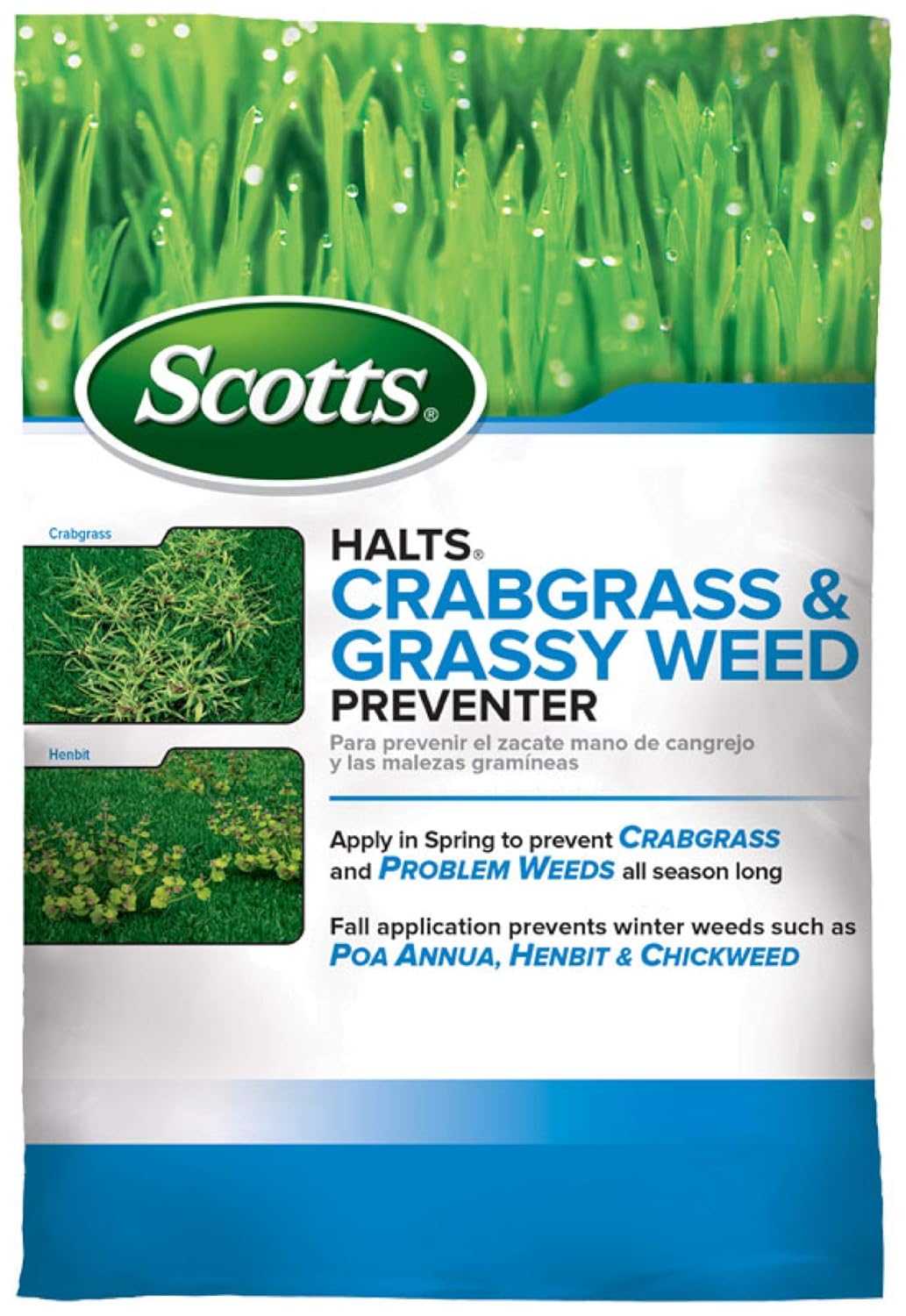
Scotts Halts Crabgrass & Grassy Weed Preventer, 10.06 lb
| Item Form | Granule |
|---|---|
| Coverage | 5000 square_feet |
| Active Ingredients | Pendimethalin 1.71% |
Scotts Halts is a granular pre-emergent weed preventer formulated to stop crabgrass and a range of grassy weeds from germinating when applied to established lawns. You apply it to a dry lawn with a broadcast spreader for even coverage, then water it in as directed so the active ingredient forms a barrier in the topsoil. It treats up to 5,000 square feet per bag and is intended for early spring or fall application to block weeds like foxtail, henbit, chickweed, and Poa annua. Notable features include a long-lasting pre-emergent barrier that is rain and freeze tolerant and a widely used active ingredient, pendimethalin. Practical benefits are straightforward prevention of new weed flushes and a simple spreader-and-water routine that fits into seasonal lawn care. Important limitations are that it does not kill existing mature weeds and is not for newly seeded or sprigged lawns until the label-specified waiting period has passed, so timing and care around seeding are crucial.
Best for: Homeowners who want a proven seasonal prevention product to reduce crabgrass and grassy weed outbreaks and who prefer a simple spreader-and-water routine backed by widespread user adoption.
Less Ideal for: Gardens where you plan to seed or sprig within the next four to five months or turf managers needing a product that eradicates established weeds rather than preventing them.
- Pre-emergent action prevents crabgrass and several grassy weeds before they germinate
- Covers up to 5,000 sq ft per bag for single-season protection
- Rain, snow, or freezing weather after application will not reduce effectiveness
- Granular formula applied with a spreader gives even coverage and easy activation with watering
- Does not control existing mature weeds so must be used before germination
- Not safe for newly seeded or newly sprigged lawns until label waiting periods have passed
Verdict: Choose Scotts Halts when you need a reliable, easy-to-apply pre-emergent to prevent crabgrass and common grassy weeds across a typical residential lawn.
Scotts Turf Builder Halts Crabgrass Preventer with Lawn Food

| Item Form | Granule |
|---|---|
| Coverage | 5000 square feet |
| Fertilizer analysis | 30-0-4 |
| Unit Count | 213.6 Ounce |
Scotts Turf Builder Halts Crabgrass Preventer with Lawn Food is a single-application granular product designed to form a pre-emergent barrier that stops crabgrass and several other grassy and broadleaf weeds from sprouting while supplying fertilizer to green up the lawn. It is typically applied in early spring to a dry lawn using a broadcast or drop spreader and then watered lightly within 2 to 3 days to activate the product. Notable features include its combined pre-emergent chemistry plus a 30-0-4 fertilizer analysis, coverage for 5,000 square feet per bag, and clear spreader settings recommended by the manufacturer for consistent application. Practical benefits are season-long prevention of young crabgrass, faster spring green-up, and the convenience of a one-step prevent-and-feed treatment. Important limitations are that it does not control established or mature crabgrass and must not be used on dichondra or bentgrass; timing and correct watering are essential for effectiveness. Risk-averse gardeners will appreciate the brand guidance on spreader settings and the predictable coverage, but users should follow label directions closely to avoid missed windows or off-target application.
Best for: Homeowners who want a low-risk, proven spring solution to prevent crabgrass while feeding the lawn and prefer clear application guidance and predictable coverage.
Less Ideal for: People needing a post-emergent weed killer for established crabgrass or owners of dichondra or bentgrass lawns who require a different, turf-safe product.
- Combined pre-emergent and fertilizer simplifies spring lawn care with one application
- Manufacturer-provided spreader settings help ensure even, accurate application
- Covers up to 5,000 sq. ft. per bag for single-season protection
- Feeds turf for faster green-up and supports stronger root development
- Does not control existing or mature crabgrass or other established weeds
- Not safe for use on dichondra or bentgrass lawns
Verdict: A straightforward, brand-backed pre-emergent plus fertilizer that reliably prevents crabgrass for homeowners who want a simple one-step spring treatment.
Choosing the Right Pre-Emergent Herbicide for Crabgrass: Key Factors to Consider
Application Timing and Local Phenology
Timing is the single most important factor when using a pre-emergent herbicide for crabgrass. These products prevent seedlings from emerging, so an application too early can fade before peak germination and an application too late will let crabgrass establish. Learn local soil temperature cues and regional phenology: many gardeners use consistent soil temperature thresholds as a practical guide rather than fixed calendar dates.
Incorrect timing increases the chance of failure and can make you rely on post-emergent controls later. For homeowners without soil thermometers, observe natural indicators like flowering forsythia or consistent daytime temps; those signs help align herbicide activity with crabgrass germination in your area.
Active Ingredient and Residual Window
Different active ingredients offer varying lengths of residual control. A longer residual can protect through an extended germination window but may also restrict early-season overseeding or spring renovations. Understand the tradeoff between a product that provides season-long suppression and one intended for a shorter, targeted window.
Residual persistence also affects how often you need to reapply and whether a late summer or fall follow-up is appropriate. Matching the residual window to your lawn's crabgrass pressure and renovation plans reduces unnecessary chemical exposure and aligns control with cultural practices.
Turf Type Compatibility and Safety
Not all pre-emergent herbicides are labeled for every grass species. Some actives can damage certain warm-season or newly established grasses. Check label guidance on safe application rates, maximum single-season rates, and restrictions for newly seeded or sodded lawns. Turf injury risk rises when labels are ignored or when applications occur during stress periods like drought or heat.
Consider the age of your lawn and recent cultural work. If you plan to overseed or have a new lawn, select a product with clear instructions for seeding intervals or choose alternatives compatible with seeding plans to avoid stunting desirable grass establishment.
Formulation and Ease of Application
Pre-emergents commonly come as liquid concentrates, water-dispersible granules, or ready-to-use granules. Liquid formulations can offer uniform coverage with a sprayer but require calibration and mixing. Granular products are often easier for small yards with a broadcast spreader but can clump or leave streaks if spreader settings and speed are inconsistent.
Your choice should match the equipment you already have and your comfort with calibration. Ease of application affects how evenly the active ingredient is distributed, which directly impacts crabgrass suppression uniformity.
Compatibility with Other Lawn Practices
Pre-emergent timing intersects with fertilization, irrigation, mowing height and seeding schedules. Some pre-emergents require watering-in shortly after application to activate the barrier. Fertilizer applied at the same time can shift turf growth and stress levels, influencing turf tolerance. Mowing and irrigation after application should follow label timing to avoid disrupting the barrier.
Planning treatments around your broader lawn calendar prevents conflicts such as seeding restrictions, reentry intervals for pets and people, and unnecessary turf stress. Coordinate herbicide application with spring cultural tasks to maintain lawn vigor while maximizing crabgrass prevention.
Environmental Considerations and Runoff Risk
Pre-emergent herbicides can move off-site with heavy irrigation or rainfall. Consider slope, proximity to storm drains, and nearby garden beds or water features when choosing a product and scheduling application. Labels usually specify buffer zones and maximum irrigation amounts to reduce runoff.
Implement soil-saving practices such as avoiding application before heavy rain, using minimal necessary rates, and following label restrictions to limit environmental impact. For sensitive sites, consider mechanical and cultural controls as part of an integrated approach rather than relying solely on chemical prevention.
When to Apply for Best Crabgrass Prevention
Soil temperature is the most reliable trigger for pre-emergent application because crabgrass germinates in response to warming soils. Many gardeners treat when the top inch of soil consistently reaches a threshold temperature, so track local soil temps with a garden thermometer or use regional extension guidance that ties timing to common flowering events.
If you miss the optimal window, a short-delay follow-up still helps but expect reduced effectiveness. Avoid applying when heavy rain is forecast, since intense runoff can move product away before activation. After application, light irrigation may be recommended to incorporate the material into the soil where seedlings would emerge.
- Use a soil thermometer for repeatable timing.
- Avoid treatment immediately before heavy rain.
- Water-in according to label to activate the barrier.
Overseeding and Seeding Restrictions
Most pre-emergent herbicides restrict seeding windows because they inhibit seed germination for desirable grasses as well as weeds. If you plan to overseed, choose a timing that allows seeding well before or after the pre-emergent window or select products with short residuals that permit earlier seeding.
For renovation projects, hold off on herbicide use until new grass is established and the label allows treatment. Alternatively, complete seeding and establishment first, then use an appropriate post-establishment strategy to manage crabgrass pressure.
- Check label intervals before seeding.
- Plan renovations around residual length.
Watering and Irrigation After Application
Many pre-emergent products require light irrigation to move the active ingredient into the topsoil layer where crabgrass seedlings would emerge. The amount and timing of irrigation vary by formulation; too much water too soon increases runoff risk while too little may reduce efficacy.
In drier regions, plan a controlled irrigation event after application that follows label recommendations. If rain is the likely water source, ensure it will be moderate rather than intense to reduce loss from the target area.
- Follow label water-in instructions precisely.
- Avoid heavy irrigation that causes runoff.
Managing Spot Outbreaks After a Missed Application
If crabgrass appears because pre-emergent application was missed or ineffective, respond with targeted cultural or post-emergent measures appropriate for the extent of infestation. Small patches can be hand-pulled or removed, while larger patches may require targeted herbicide treatments labeled for crabgrass control.
Address underlying lawn health issues that favor crabgrass, such as thin turf, compacted soil, or improper mowing height. Repairing bare spots and improving turf density reduces the likelihood of future outbreaks and reduces reliance on chemical controls.
- Combine spot treatments with lawn renovation in affected areas.
- Improve soil and turf health to reduce recurrence.
Record Keeping and Seasonal Planning
Keeping notes on application dates, soil temperatures, weather conditions after application, and observed control helps refine future timing. Consistent record keeping reveals patterns in crabgrass emergence and helps you choose whether to use a single spring application or follow-up treatments later in the season.
Documenting spreader or sprayer settings and treated area sizes also improves coverage consistency year over year, reducing waste and uneven control.
- Track soil temps and application dates annually.
- Record equipment settings for repeatable coverage.
How We Chose the Best Pre-Emergent Herbicide for Crabgrass
We focused on attributes that matter to gardeners using pre-emergent herbicides specifically to prevent crabgrass. Editorial selection emphasized proven active ingredients for crabgrass control, documented residual activity and label directions for turf types. We compared application flexibility, including liquid versus granular formulations and equipment needs, because those affect accuracy and coverage on different lawn sizes. Safety and turf compatibility were essential filters, so we flagged products with clear label instructions for common cool- and warm-season grasses and for use around ornamentals. We also assessed longevity of control to estimate whether a single spring application is likely to suppress crabgrass through peak germination. Excluded items included post-emergent-only products and generic weed-and-feed mixes that do not offer clear pre-emergent protection against crabgrass. We gave weight to products with straightforward timing windows and measurable coverage rates. The criteria that mattered most were application timing and residual length, turf safety labeling, formulation and ease of spreading or spraying, and the clarity of label instructions for reentry, watering, and overseeding. These dimensions align with the score labels used for each product entry.
FAQ
Can I apply a pre-emergent herbicide and seed my lawn the same spring?
Usually not. Most pre-emergent herbicides inhibit seed germination for a set period. If you plan to seed, choose a product labeled for overseeding or time seeding before the pre-emergent takes effect or after its residual period ends. Always follow label intervals for safe seeding.
How do I know when soil temperature is right for application?
Use a soil thermometer placed at about 1 inch depth and monitor daily. Many gardeners treat when soil reaches a consistent temperature threshold linked to crabgrass germination in their region. Local extension services can provide guidance on typical thresholds for your area.
Will a pre-emergent herbicide harm my flower beds or vegetable garden?
Pre-emergents can affect seeds and small seedlings in beds if they contact treated soil. Avoid applying near planting areas or use physical barriers and targeted applications. Some products have label notes for ornamentals but always read instructions before treating near edible or sensitive plants.
What should I do if heavy rain falls right after application?
If heavy rain occurs immediately after application, some product may run off before activation and effectiveness can be reduced. Check label guidance about retreatment intervals. Where runoff risk is high, postpone applications to a drier window and consider split applications if recommended.
Can pre-emergent herbicides be used on all turfgrass types?
Not all products are labeled for every turf species. Labels specify safe use on common cool- and warm-season grasses and note restrictions. Select a product that lists your turf type and follow recommended rates to minimize injury risk.
Final Verdict
When preventing crabgrass, prioritize correct timing and turf compatibility over chasing broader claims. Choose a pre-emergent with a residual length that matches your seeding and renovation plans, and apply it when soil temperatures indicate forthcoming germination. Balance application ease and coverage needs with label instructions on irrigation and turf safety. A thoughtful approach that coordinates timing, formulation choice, and lawn practices delivers the most reliable crabgrass prevention while protecting desirable grass and the surrounding landscape.
