

Note: This article contains affiliate links. If you click on these links and make a purchase, I may earn a small commission at no extra cost to you. This helps support my research and content. Read my full affiliate disclosure here.
Selecting the right pre-emergent herbicide for lawns matters because timing, turf safety, and coverage determine whether you prevent weeds without stressing grass. Applied correctly, these products create a barrier that stops weed seeds from germinating so established turf can fill in and stay healthy. This guide summarizes seven top pre-emergent options shortlisted for typical lawn situations and walks through the practical considerations gardeners need to choose between them. We evaluate timing, active ingredient behavior, application ease, and turf compatibility to help you pick a product that matches your climate and grass type.
Top Picks at a Glance
| Best Overall The best all-around choice for most situations | The Andersons Barricade DG Pro Granular Pre-Emergent (50 lb) |  |
| Best Quality Built to a higher standard if you want something more solid | The Andersons Barricade Granular Pre-Emergent Weed Control (40 lb) |  |
| Best Value The sweet spot between price and what you get | Yard Mastery 0-0-7 Granular Prodiamine Pre-Emergent Herbicide, 45 lb |  |
| Best Budget The cheapest option that still gets the job done reliably | Hi-Yield Herbicide Granules Weed and Grass Preventer, 4 lb |  |
| Highest Rated A top-rated pick with lots of positive feedback | Quali-Pro Prodiamine Pre-Emergent Herbicide, 5 lb Granules |  |
| Most Popular A crowd favorite that many people choose with confidence | Scotts Halts Crabgrass & Grassy Weed Preventer, 10.06 lb. |  |
| Best Seller A high-volume bestseller chosen again and again | Scotts Halts Crabgrass & Grassy Weed Preventer, 20.12 lb |  |
The Andersons Barricade DG Pro Granular Pre-Emergent (50 lb)

| Item Form | Granule |
|---|---|
| Coverage | 14,200 square feet |
| Active Ingredients | prodiamine |
Barricade DG Pro is a professional-grade granular pre-emergent designed to prevent weed seedlings before they establish in lawns, golf courses, sports fields, and ornamental beds. You broadcast the granules evenly over the target area and water them in to activate the active ingredient prodiamine; coverage for this bag is listed at about 14,200 square feet. The DG formulation produces many small particles for more consistent soil contact, which helps deliver uniform protection against more than 30 grass and broadleaf weeds. Practical benefits include a long window of residual control when applied in early spring or fall and a formulation used by turf professionals that minimizes crop injury when applied as directed. Limitations are that it will not kill existing weeds so you may need to remove or treat active weeds first, and treated turf needs proper timing and watering to get the full preventative effect. Safety precautions and protective gear are required during application.
Best for: Buyers who want a reliable, preventative herbicide for established lawns or larger turf areas and who plan applications on a seasonal schedule with proper watering and safety precautions.
Less Ideal for: Gardeners who need to remove current weed infestations, those with very small lawns who prefer spot treatments, or users unwilling to follow safety directions and application timing.
- Professional-grade prodiamine formulation labeled to prevent over 30 grass and broadleaf weeds
- DG granular formulation yields many small particles for more even soil coverage
- High coverage per bag suitable for large lawns and turf areas
- Works when applied in recommended windows (early spring or fall) and watered in
- Does not control or remove existing weeds since it is strictly a pre-emergent
- Requires correct timing and activation with water for effective prevention
Verdict: A professional-strength granular pre-emergent that delivers broad, season-long weed prevention for large lawns when applied at the correct time.
The Andersons Barricade Granular Pre-Emergent Weed Control (40 lb)

| Item Form | Granule |
|---|---|
| Coverage | 12880 square_feet |
| Active Ingredients | Herbicide (prodiamine 0.48%) |
| Unit Count | 640 Ounce |
This 40 lb Barricade product from The Andersons is a granular pre‑emergent designed to stop common lawn weeds before they emerge. It is applied to established turf and ornamental beds in early spring or fall and must be watered in so the patented dispersible granule technology dissolves and moves the active ingredient into the soil. The formula targets crabgrass, poa annua, goosegrass, henbit and other grassy and broadleaf weeds but will not remove weeds that are already growing. The large coverage per bag makes it practical for bigger yards or routine seasonal treatments, and the small particle size improves uniform coverage. Important practical considerations are following label directions for timing and application rate and taking precautions to avoid contact with skin or inhalation during spreading. This product suits users focused on reliable, preventive control across large areas who are comfortable handling concentrated herbicides and timing applications with the growing season.
Best for: Homeowners and lawn care pros who prioritize preventative, high‑performance weed control for medium to large lawns and who plan applications by season.
Less Ideal for: People seeking a quick fix for current weed infestations or those unwilling to follow herbicide safety and timing guidelines should choose a different product.
- Professional‑grade prodiamine formula for proven pre‑emergent control
- Patented dispersible granule technology that dissolves quickly when watered
- Large 40 lb bag covers up to 12,880 sq ft, suitable for big lawns
- Small particle size promotes more uniform spread and soil incorporation
- Does not kill existing weeds so it needs to be used before weed germination
- Requires careful handling and protective measures due to herbicide exposure risk
Verdict: Choose this product when you need a proven, professional‑grade pre‑emergent that covers large lawns and delivers reliable seasonal prevention.
Yard Mastery 0-0-7 Granular Prodiamine Pre-Emergent Herbicide, 45 lb

| Item Form | Granule |
|---|---|
| Coverage | 15,000 square feet |
| Active Ingredients | .37% Prodiamine |
This Yard Mastery 0-0-7 granular pre-emergent supplies a professional-strength barrier against crabgrass, poa annua and similar annual weeds when applied before germination. You spread it with a broadcast or drop spreader at the recommended rate (commonly 3 lbs per 1,000 sq ft), then water it in to activate the prodiamine; a single application provides roughly three months of protection. Notable features include a large 45 lb bag that covers up to 15,000 sq ft and a granular form that is easy to calibrate with standard spreaders. Practical benefits are straightforward: it reduces seed germination, cuts down on follow-up hand-weeding and fits into routine spring or fall lawn programs. Important limitations are that it is a pre-emergent so it will not control established weeds, application timing matters for effectiveness, and you must follow protective and rate guidance to avoid turf injury or overuse. Follow label directions for grass types and temperature windows to get consistent results.
Best for: Buyers who prioritize efficient, programmatic weed prevention across medium to large lawns and who plan applications around soil temperature windows and spreader calibration.
Less Ideal for: Homeowners who need to remove existing weed infestations or who prefer organic, non-synthetic weed control methods should consider other options.
- Professional-strength active ingredient (0.37% prodiamine) effective against crabgrass and annual bluegrass
- Granular formulation works with common broadcast or drop spreaders for even coverage
- Large 45 lb bag covers up to 15,000 sq ft, reducing the need for multiple purchases
- Provides approximately three months of pre-emergent protection when applied correctly
- Does not control weeds that are already established since it is strictly a pre-emergent
- Requires correct timing and application rate to avoid reduced effectiveness or turf damage
- Contains chemical active ingredient so protective gear and handling precautions are necessary
Verdict: A concentrated, large-format granular pre-emergent for homeowners who want reliable, programmatic prevention of crabgrass and other annual lawn weeds.
Hi-Yield Herbicide Granules Weed and Grass Preventer, 4 lb

| Item Form | Granule |
|---|---|
| Unit Count | 64 Ounce |
| Active Ingredients | Trifluralin |
| Coverage | Full |
Hi-Yield Herbicide Granules is a pendimethalin-based pre-emergent sold in a 4-pound container for treating smaller turf and ornamental areas. It is applied at the start of the growing season to form a barrier that prevents common annual weeds and grasses such as crabgrass from emerging. The granule form makes it easy to broadcast by hand or with a small spreader and it lists coverage as full when used according to label directions. Practical benefits include season-long suppression in treated spots and a simple single-application workflow for beds and small lawn patches. Important limitations are that it is a preventative product so it will not remove established weeds and must be timed properly before germination, and application rates vary by planting type so users must follow the label. For gardeners on a budget, this product offers straightforward protection for small areas without complicated equipment, but it is not a substitute for post-emergent control of existing weeds.
Best for: Gardeners and homeowners who want an inexpensive, easy-to-apply pre-emergent to protect small lawns, flowerbeds, or patch repairs and who prioritize simple seasonal prevention over ongoing weed removal.
Less Ideal for: People needing to remove existing weed infestations or those managing large acreage where a higher-capacity commercial product or professional application would be more efficient.
- Pendimethalin pre-emergent ingredient effective against many annual grasses and weeds
- Granular form is easy to apply by hand or with a small spreader
- Single season prevention when applied at the start of the growing season
- Packaged for small turf and ornamental areas, avoiding waste for small jobs
- Does not control established weeds or broadleaf plants once they have emerged
Verdict: A budget-friendly granular pre-emergent that gives straightforward season-long prevention for small lawns and beds when applied correctly.
Quali-Pro Prodiamine Pre-Emergent Herbicide, 5 lb Granules

| Item Form | Granule |
|---|---|
| Coverage | Pre-emergent grass and broadleaf weed control, season long crabgrass control |
| Active Ingredients | Prodiamine 65% |
Quali-Pro Prodiamine is a granular pre-emergent herbicide designed to prevent germination of common annual grassy and broadleaf weeds across lawns and landscape beds. You apply it before weed seeds germinate in spring or as a fall treatment to build residual control through the growing season. The product contains 65% prodiamine, which is widely used for reliable, long-lasting control of crabgrass, annual bluegrass and several broadleaf weeds, and it mixes readily when tank-mixed with fertilizers or iron. In real-world use it offers predictable, season-long suppression when applied at the labeled rate and incorporated by irrigation or rainfall. Important practical limits are that it is preventive only and will not kill established weeds, and proper timing and rate are essential to avoid reduced effectiveness. For larger areas the 5 lb package covers moderate lawn acreage but may require multiple bags for extensive turf.
Best for: Homeowners and lawn care professionals who prioritize a dependable, season-long preventive solution to keep crabgrass and annual weeds from establishing in turf.
Less Ideal for: Gardeners needing a post-emergent solution for existing weeds or those who prefer liquid ready-to-use products for spot treatments.
- High active ingredient concentration (Prodiamine 65%) for long residual control
- Granular form allows easy broadcast application and tank mixing with fertilizers
- Effective season-long crabgrass and annual weed suppression when applied correctly
- Suitable for spring or fall applications to build preventive control
- Pre-emergent only and will not control established weeds
- 5 lb bag may be insufficient for large lawns without purchasing additional quantity
Verdict: Choose this prodiamine granule when you want a proven, season-long preventive herbicide to reliably stop crabgrass and other annual weeds before they start.
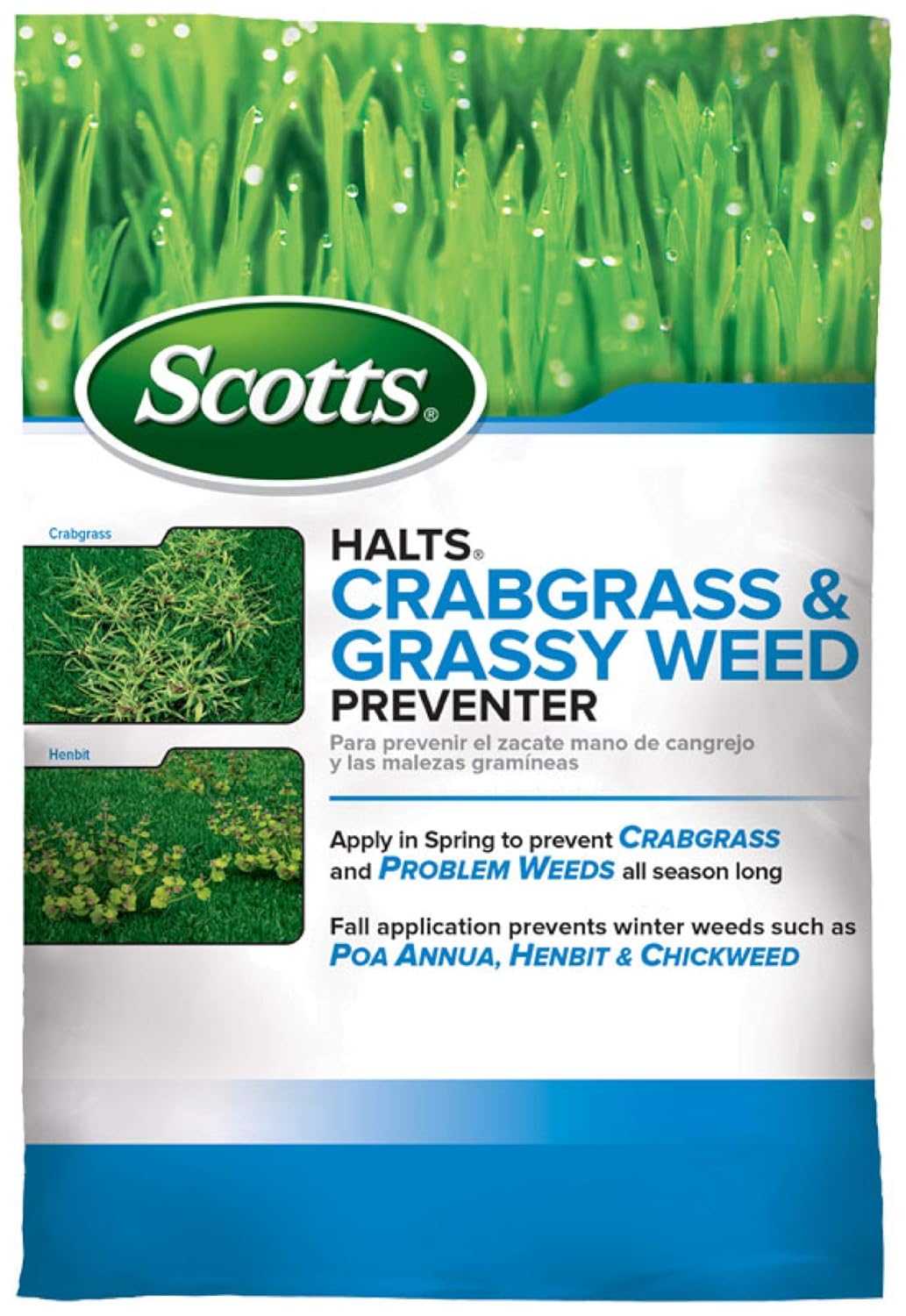
Scotts Halts Crabgrass & Grassy Weed Preventer, 10.06 lb.
| Item Form | Granule |
|---|---|
| Coverage | 5000 square_feet |
| Active Ingredients | Pendimethalin 1.71% |
Scotts Halts is a granular pre-emergent formulated to stop crabgrass and seeded grassy weeds from germinating across established lawns. You apply it dry with a broadcast spreader in early spring or fall, then water it in as directed; the active ingredient pendimethalin forms a soil barrier that prevents weed seedlings from emerging and is advertised as resistant to rain, snow, or freezing after application. This bag treats up to 5,000 square feet and is intended for use on most turf types except Dichondra and Bentgrass. The practical benefits are straightforward: a single timed application protects turf from several common annual weeds without needing spot herbicide treatments, and the granule form makes even coverage with a spreader easy. Important limitations are that it does not kill existing mature weeds and cannot be used on newly seeded or sprigged areas until months later, so timing and measuring lawn area matter. Also repeat applications for certain weeds like goosegrass may be necessary according to label instructions.
Best for: Homeowners who plan lawn care around seasonal timing and want a preventive, low-effort way to stop annual grassy weeds before they emerge.
Less Ideal for: People needing to remove existing weed infestations, those reseeding or establishing new turf within months, or gardeners who require immediate weed knockdown.
- Pre-emergent action prevents crabgrass and listed grassy weeds before they germinate
- Covers up to 5,000 sq ft per bag for single-application protection
- Granule form designed for even spreader application and easy watering activation
- Rain, snow, or freezing after application will not reduce effectiveness
- Does not control existing mature weeds so not useful for established infestations
- Not safe for newly seeded or freshly sprigged lawns for several months
Verdict: Use this granular pre-emergent if you want a seasonal, preventative barrier against crabgrass and common grassy weeds on an established lawn up to 5,000 sq ft.
Scotts Halts Crabgrass & Grassy Weed Preventer, 20.12 lb

| Item Form | Granule |
|---|---|
| Coverage | 10,000 sq. ft. |
| Unit Count | 321.92 Ounce |
Scotts Halts is a granular pre-emergent formulated to prevent germination of crabgrass and other grassy weeds when applied in early spring or fall. You apply it to a dry, established lawn with a broadcast or drop spreader, then water it in as directed; once activated the product forms a chemical barrier in the soil that blocks weed seedlings without killing existing mature weeds. The bag treats up to 10,000 square feet and the label notes it works through normal rain, snow, or freezing temperatures, which reduces timing worries. Important features include clear spreader settings and label guidance about waiting before overseeding or aerifying so that the barrier is not disturbed. Limitations: it does not control existing, mature weeds and must not be used on newly seeded or certain turf types like Bentgrass or Dichondra. Because it lasts seasonally and cannot be applied more than twice a year, planning application timing is necessary for best results.
Best for: A homeowner who prefers a cautious, preventive approach to lawn care and wants a straightforward product to reduce spring crabgrass pressure across a typical yard.
Less Ideal for: Anyone needing a quick cure for established weeds or those planning to overseed or renovate turf within four to five months should consider other solutions.
- Pre-emergent action prevents crabgrass and multiple grassy weeds before they sprout.
- Covers up to 10,000 sq. ft. per bag, suitable for typical residential lawns.
- Granular form is easy to apply with common spreaders and includes recommended spreader settings.
- Performance is not affected by rain, snow, or freezing soon after application, reducing scheduling stress.
- Does not kill existing or mature weeds so it must be combined with other control methods for current infestations.
- Requires waiting period before seeding, sprigging, aerifying, or mowing practices that disturb the soil.
- Not safe for use on certain turf types such as Dichondra and Creeping Bentgrass.
Verdict: Choose Scotts Halts when you want a reliable, easy-to-apply pre-emergent to prevent crabgrass and grassy weeds across a standard residential lawn.
Choosing the Right Pre-Emergent Herbicide for Lawns: Key Factors to Consider
Active Ingredient and Target Weeds
Different active ingredients work against different weed groups and have distinct timing and soil-binding behaviors. Knowing which weeds you need to prevent helps you choose an ingredient with documented control for crabgrass, foxtail, chickweed, or annual bluegrass.
Some actives persist longer in soil and provide extended control, while others break down faster and may require repeat treatments. Understanding the active ingredient also informs compatibility with overseeding or seeding schedules, and whether the product is suitable near ornamental beds or vegetable patches.
Turf Type Compatibility
Cool-season and warm-season grasses have different sensitivities to pre-emergent herbicides. A product labeled safe for Kentucky bluegrass or fescue may not be appropriate for bermudagrass or zoysia, and vice versa. Choose a product with explicit guidance for your grass species to reduce the risk of discoloration, thinning, or growth suppression.
Check label instructions for specific tolerant turf varieties and any recommended rate adjustments. Some formulations offer broader turf safety, which is helpful for mixed-seed lawns or transitional climate zones.
Application Timing and Weather Dependence
Pre-emergent herbicides work by preventing seed germination, so timing is critical. Spring applications are most effective when soil temperatures reach the germination threshold for target weeds, often measured as several consecutive days at or above a specific temperature. Fall treatments target winter annuals and may be recommended in some regions.
Weather influences both timing and effectiveness; heavy rain soon after application can move granules or dilute liquid products, while extended dry spells can limit activation. Choose a product with clear timing windows and flexible reapplication guidance that fits your local climate patterns.
Longevity of Control and Reapplication Needs
Different products provide protection for varying lengths of time. Some deliver a long residual that covers the main germination period with a single application, while others may need follow-up treatments for extended protection.
Longer-lasting products reduce labor and reapplication risk but may limit when you can overseed. Match control duration to your maintenance calendar and be aware of label restrictions about reseeding intervals and maximum seasonal application rates.
Application Method and Equipment Compatibility
Pre-emergent herbicides come in granular and liquid forms, each with practical pros and cons. Granules are often easier for small lawns and require spreader calibration, while liquids can give more uniform coverage on larger areas with a sprayer. Consider spreader or sprayer compatibility, calibration needs, and whether the product requires incorporation with water.
Ease of application affects accuracy, which in turn influences both effectiveness and turf safety. Products with forgiving application rates and clear calibration instructions reduce the risk of over- or under-application.
Environmental Restrictions and Nearby Plantings
Label restrictions often include buffer distances from water, restrictions near vegetable gardens, and precautions for pollinators or sensitive ornamentals. If your lawn borders beds, waterways, or edible plantings, choose a product with an appropriate environmental profile and clear guidance on safe use.
Also consider runoff risk on slopes and any local regulations that govern herbicide use. Following label directions for containment and timing reduces environmental impact and legal risk.
When To Apply Pre-Emergent In Your Lawn
Timing depends on the weeds you want to stop and local soil temperature cues rather than calendar dates. For spring annual grassy weeds like crabgrass, apply when soil temperatures have reached the germination trigger for several days in a row. Many gardeners use a soil thermometer or regional soil temperature maps to decide the window. Fall applications are useful in some regions to prevent winter annuals, but follow label recommendations to avoid interfering with cool-season grass recovery.
- Use a soil thermometer at root depth to track the germination threshold.
- Avoid applying if heavy rain is forecast within 24 hours to prevent runoff.
- Plan applications so they do not conflict with overseeding or core aeration schedules.
Granular Versus Liquid: Practical Pros and Cons
Granular products are convenient for small to medium lawns and can be broadcast with a drop or broadcast spreader. They often do not require immediate irrigation but must be distributed evenly to avoid streaking. Liquids cover large lawns quickly and provide even distribution when sprayed correctly, but they require more equipment and careful calibration.
- Granules: easier for homeowners with a spreader, lower drift risk.
- Liquids: better for even coverage on larger areas but need sprayer setup and consistent walking speed.
- Match the formulation to the lawn size, equipment you own, and your comfort with calibration.
Seeding After Pre-Emergent: Planning Around Reseeding
Most pre-emergents restrict when you can reseed, because they prevent grass seed from establishing the same way they stop weed seeds. If you plan to overseed or establish new turf, pick a product with a reseed-friendly window or delay application until after seedlings are established. Alternatively, choose non-chemical or mechanical approaches to control weeds in areas you will seed.
- Check label for exact reseeding intervals in weeks or months.
- Consider spot-treating established areas and using manual control where you plan to seed.
- Core aeration can sometimes reduce residual effects and improve seed-to-soil contact after label-allowed intervals.
Protecting Adjacent Plants and Waterways
Prevent drift and runoff by following label buffer recommendations and avoiding application before heavy rain. Use physical barriers or hand-apply in sensitive edges near flower beds and vegetable gardens. Some active ingredients bind tightly to soil and pose lower mobility risk, while others can move if improperly applied or if irrigation creates runoff.
- Keep treated granules out of planting beds and garden paths.
- Avoid application within required distances of streams, ponds, or storm drains.
- Follow irrigation instructions to activate product without creating runoff.
Monitoring Results and When To Follow Up
Expect to see fewer new seedlings rather than immediate weed death because pre-emergents prevent germination rather than killing established plants. Monitor the lawn through the germination window and note any bare spots that may need attention after the label-allowed reseeding period. If weeds emerge despite treatment, confirm application timing, coverage, and whether the target species is susceptible to the active ingredient.
- Keep a lawn journal with application dates, weather, and observed weed pressure.
- If coverage was uneven, consider spot-treating with an approved post-emergent following label directions.
- Confirm that the active ingredient is appropriate for the specific weed species present before repeating applications.
How We Chose the Best Pre-Emergent Herbicide for Lawns
We shortlisted products based on criteria that matter to gardeners trying to prevent grassy and broadleaf weeds in turf without harming desirable grass. Our evaluation prioritized active ingredient suitability for common lawn weeds, documented turf safety across cool- and warm-season grasses, and proven timing windows for spring and fall treatments. We also weighed label clarity and application flexibility so users can apply the product at recommended rates for their lawn size. Longevity of control was considered to match planning needs for one- versus multi-application seasons. Excluded items included non-lawn formulations, broad-spectrum post-emergent-only products, and products lacking clear turf safety guidance. The final picks emphasize reliable active ingredients, clear application instructions, and demonstrated performance in preventing weed germination while minimizing turf stress. Scoring aligned with these practical dimensions so gardeners can compare products on the specifics that affect outcomes in real lawns.
FAQ
Can I apply a pre-emergent herbicide before overseeding my lawn?
Usually not immediately. Most pre-emergents prevent seed germination and will inhibit grass seed establishment. Check the product label for the specific reseeding interval; some products allow reseeding after several weeks or require waiting several months.
How do I know when soil temperature is right for application?
Soil temperature at the root zone is the key trigger. Use a soil thermometer and follow label guidance for the temperature that initiates germination of target weeds. Local extension services also publish regional soil temperature thresholds and timing guidance.
Will a pre-emergent herbicide harm my flower beds or vegetable garden?
Many labels restrict use near edible gardens and ornamentals. Some active ingredients bind tightly to soil and pose lower mobility risk, but careless application, drift, or runoff can cause harm. Follow buffer and application instructions to protect adjacent plantings.
How long does a single application usually protect my lawn?
Protection varies by product; some offer several months of residual control while others break down sooner and need follow-up. Longevity depends on the active ingredient, application rate, and local conditions such as rainfall and soil type.
Can I use a pre-emergent repeatedly during the season?
It depends on the product label and cumulative seasonal limits. Some formulations allow multiple applications spaced by specific intervals, while others have a single-season limit. Always follow label directions to avoid turf injury or exceeding recommended rates.
Final Verdict
A good pre-emergent herbicide choice balances the right active ingredient for your target weeds, clear turf compatibility for your grass type, and timing that fits your local climate and maintenance calendar. Prioritize products with label guidance that matches your overseeding and irrigation plans, and choose a formulation that suits your lawn size and equipment. Final selection comes down to tradeoffs: long residuals reduce repeat work but restrict reseeding, liquids give uniform coverage on large lawns but need sprayer care, and granules are simple but require spreader calibration. Use the factors here to match product characteristics to your lawn goals and seasonal schedule so you prevent weeds while keeping turf strong.
