

Note: This article contains affiliate links. If you click on these links and make a purchase, I may earn a small commission at no extra cost to you. This helps support my research and content. Read my full affiliate disclosure here.
If you maintain large hedges, estates, or client properties, the right professional hedge shears change how quickly and cleanly you work. You need tools that hold an edge, resist corrosion, and reduce wrist and shoulder strain during long pruning sessions. This guide highlights the top shortlisted professional hedge shears suited to heavy use and varied shrub types. We evaluated candidates for blade material and geometry, handle ergonomics, and durability under repeated use. Below are our top picks and a clear explanation of the factors that matter when choosing professional-grade shears for demanding pruning tasks.
Top Picks at a Glance
| Best Overall The best all-around choice for most situations | Bahco P51H-SL Professional Hedge Shears, 29" Long Handle, 10 mm Cut Capacity |  |
| Best Quality Built to a higher standard if you want something more solid | FELCO F250-63 26" Swiss Made Hedge Shears with I-Beam Aluminum Handles |  |
| Best Budget The cheapest option that still gets the job done reliably | Fiskars 23" Power-Lever Hedge Shears with Self-Sharpening Blades |  |
| Highest Rated A top-rated pick with lots of positive feedback | Okatsune Precision Hedge Shears, 6-inch Blade, 20-inch Length |  |
| Most Popular A crowd favorite that many people choose with confidence | Corona HS 3950 Extendable Hedge Shear, 10" Blade |  |
| Best Seller A high-volume bestseller chosen again and again | ARS HS-KR1000 Professional Hedge Shears |  |
Bahco P51H-SL Professional Hedge Shears, 29" Long Handle, 10 mm Cut Capacity

| Cutting width | 10 millimeters |
|---|---|
| Blade Type | Bypass |
| Blade Material | High Carbon Steel |
| Handle Material | Rubber |
| Hand Orientation | Ambidextrous |
These Bahco P51H-SL hedge shears are built for precise, repeatable hedge work. The fully hardened high-carbon steel blades are ground for clean cuts and include a partly serrated section to grip tougher stems up to about 10 mm (3/8 inch), which helps prevent slipping when tackling denser growth. Tubular aluminum handles keep the tool light and balanced so you can work longer with less fatigue, and rubber comfort grips plus built-in shock absorbers reduce impact on the hands during repeated cuts. A bolt lock keeps the blades aligned for consistent trimming and simple maintenance. In practice the shears suit both shaping and heavier trimming on formal hedges, shrubs, and small branches; they feel more durable than typical consumer models and are sized for two-handed leverage. Limitations are that the fixed blade capacity restricts use to small-diameter stems and the long handles make the tool less handy for very tight or detailed topiary work where shorter shears or shears with offset blades might be preferable.
Best for: A buyer who wants a durable, pro-grade hedge shear for regular trimming of formal hedges and medium shrubs and values clean cuts and lower fatigue during longer jobs.
Less Ideal for: Not a good fit for gardeners who mainly need a compact tool for fine topiary work or for cutting large woody branches that require loppers or saws.
- Fully hardened high-carbon steel blades for long-lasting sharpness and clean cuts.
- Partly serrated blade section improves grip on tougher stems and reduces slipping.
- Lightweight tubular aluminum handles provide a balanced feel and reduce user fatigue.
- Rubber comfort grips and integrated shock absorbers decrease hand and wrist impact during repeated use.
- Cut capacity is limited to about 10 mm (3/8 inch), so not suitable for thicker branches.
- Long-handle design can be awkward for very tight spaces or intricate topiary detailing.
Verdict: A professional, well-balanced hedge shear that delivers precise, low-fatigue trimming for regular hedge maintenance.
FELCO F250-63 26" Swiss Made Hedge Shears with I-Beam Aluminum Handles

| Blade Length | 10 inches |
|---|---|
| Blade Edge | Beveled Blade, Serrated Base |
| Blade Type | Bypass |
| Handle Material | Aluminum |
| Hand Orientation | Ambidextrous |
These FELCO hedge shears are built for repeat, high-quality cutting: the long I-beam aluminum handles keep weight down while resisting flex, and the chrome-coated high carbon steel bypass blades hold an edge and resist corrosion. The micrometric blade adjustment system lets you fine-tune alignment for clean, consistent cuts and makes blade replacement straightforward, and the integrated grease port simplifies maintenance in the field. Ambidextrous grips and an overall lightweight feel reduce fatigue during long sessions. Because the tool is fully serviceable with replaceable parts, it is designed to be kept in service for years rather than discarded. Limitations to note are the fixed 26" length and manual nature of the shears, which means they are best for straight trimming and shaping rather than tackling very thick branches or hedge profiles that need powered tools.
Best for: Serious gardeners and professional landscapers who prioritize precise, durable hand tools for frequent hedge shaping and want a repairable, long-lived shear.
Less Ideal for: Casual users who only need occasional light trimming or anyone needing a powered solution for very thick branches or high hedges.
- Lightweight I-beam aluminum handles reduce user fatigue while maintaining stiffness
- Chrome-coated high carbon steel blades for edge retention and corrosion resistance
- Micrometric blade adjustment and grease port for precise cutting and easy maintenance
- Ambidextrous design and comfortable phthalate-free grips for extended use
- Fully serviceable construction with replaceable parts extends tool lifetime
- Not suited for cutting very thick branches beyond normal hedge growth
- Fixed 26-inch length limits maneuverability in tight spaces
Verdict: Choose these shears if you want a professional, repairable hedge tool that stays sharp and minimizes fatigue during long trimming sessions.
Fiskars 23" Power-Lever Hedge Shears with Self-Sharpening Blades

| Cutting width | 10 inches |
|---|---|
| Blade Edge | Serrated |
| Blade Type | Bypass |
| Hand Orientation | Ambidextrous |
| Blade Material | Alloy Steel |
The Fiskars 23" Power-Lever Hedge Shears are built to make trimming and shaping hedges easier with a compound lever mechanism that effectively doubles cutting power compared with single-pivot shears. In practice they are used for shaping hedges, trimming decorative shrubs, and slicing through thicker stems that ordinary shears struggle with. The hardened, precision-ground bypass blades include a serrated edge to grip branches and a self-sharpening geometry that keeps the edge working over time while a rust-resistant coating reduces sap buildup. The steel handles with SoftGrip touchpoints and shock-absorbing bumpers reduce vibration and hand fatigue during longer sessions, and the tool’s 23-inch reach gives better leverage without adding much weight. Limitations are its steel-handle construction, which is sturdy but less forgiving than aluminum or fiberglass for very long use, and a fixed blade size that is best suited to hedges and not precise, small-detail pruning.
Best for: Gardeners who want a durable, efficient hedge shear that reduces effort when shaping medium to large hedges and prefer tools that require minimal blade maintenance.
Less Ideal for: People who need a lightweight shear for all-day professional use on large properties or gardeners focused on delicate, detailed pruning in tight spots.
- Compound power-lever multiplies cutting force for easier cuts through thicker stems
- Self-sharpening, precision-ground steel blades with serrated edge for consistent clean cuts
- Rust-resistant blade coating helps prevent sap buildup and improves durability
- SoftGrip touchpoints and shock-absorbing bumpers reduce hand fatigue and vibration
- All-steel handles make the tool heavier and transmit more vibration than composite handles
- Not designed for fine-detail pruning or very tight spaces due to blade length and cutting width
Verdict: Choose these shears if you want a low-maintenance, higher-cutting-power tool that makes shaping medium to large hedges noticeably easier.
Okatsune Precision Hedge Shears, 6-inch Blade, 20-inch Length

| Cutting width | 6 inches |
|---|---|
| Blade Edge | Straight |
| Blade Type | Bypass |
| Hand Orientation | Ambidextrous |
| Blade Material | Alloy Steel |
These Okatsune hedge shears are a precision tool built for repeatable, clean cuts on hedges and shaped shrubs. They use hot hammer-forged Yasuki alloy steel blades in a 6-inch cutting width paired with a 20-inch overall length, which gives good reach while keeping the tool maneuverable for detailed shaping. The bypass blade geometry and straight edge produce smooth cuts that reduce tearing on foliage, and the ambidextrous steel handles make the shears usable by either hand without awkward ergonomics. Because the tool is all-steel construction it feels robust and delivers consistent performance over long seasons of regular use, though the lack of wooden or rubber grip means vibration dampening is minimal. These are not a multi-tool for heavy woody pruning but they excel at finishing work, topiary shaping, and routine hedge maintenance where clean, accurate cuts matter. Expect minimal maintenance other than occasional sharpening and lubrication to keep the forged blades at peak performance.
Best for: A gardener or professional who prioritizes reliability and precision for regular hedge maintenance and topiary finishing work and values a durable, all-steel tool that holds an edge.
Less Ideal for: Casual users who want a cushioned grip for comfort during long sessions or anyone needing a shears for heavy woody pruning should consider other tools.
- Hot hammer-forged Yasuki alloy steel blades for long-lasting sharpness and cutting power
- Bypass, straight-edge blades deliver clean, precise cuts for shaping and finishing work
- Ambidextrous design usable by left- or right-handed gardeners
- All-steel construction offers durable, professional-grade feel and consistent performance
- Handles are steel without visible cushioning so prolonged use can transmit more vibration than tools with vibration-absorbing grips
- Not optimized for cutting thick, woody branches beyond light hedging and shaping
Verdict: Choose these Okatsune shears if you need a professional, reliable pair of hedge shears that deliver clean, repeatable cuts for detailed shaping and regular maintenance.
Corona HS 3950 Extendable Hedge Shear, 10" Blade
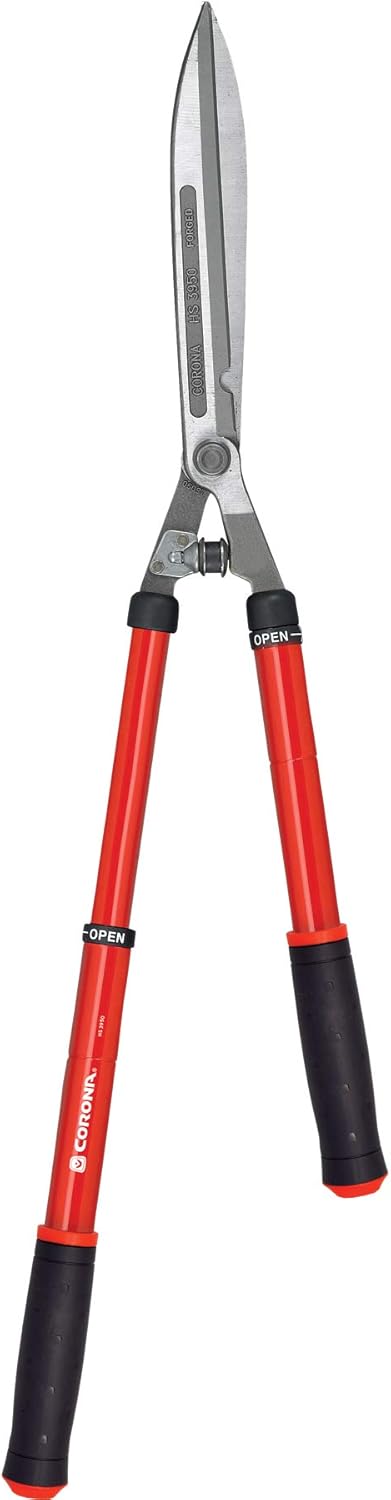
| Cutting width | 10 inches |
|---|---|
| Blade Type | Bypass |
| Blade Material | High Carbon Steel |
| Hand Orientation | Ambidextrous |
| Manufacturer Warranty Description | Lifetime |
The Corona HS 3950 is a pair of extendable bypass hedge shears built for heavier home and light-professional use. It combines a sharp 10-inch precision-ground high carbon steel blade with telescoping alloy-steel handles that extend to increase reach and leverage when shaping hedges and trimming taller shrubs. The ambidextrous design and ergonomic non-slip grips make it comfortable for prolonged use, while the ShockStop bumper reduces impact on wrists and shoulders. Because the blades are resharpenable and the pivot bolt is precision-made, the shears deliver clean cuts and long-term service when properly maintained. Limitations are typical of manual shears: they require physical effort on dense growth and are not suited for large-diameter branches or prolonged commercial workloads where gas or powered hedge trimmers would be faster. For homeowners and landscape pros who value control and clean bypass cuts, these shears offer durable, serviceable performance season after season.
Best for: Buyers who prioritize clean, professional-looking cuts and want a durable, low-maintenance manual tool for regular hedge and shrub shaping in residential or light-professional settings.
Less Ideal for: Contractors or users who need to trim very large hedges quickly or cut thick branches frequently should consider powered hedge trimmers or pruning saws instead.
- Sharp 10-inch high carbon steel bypass blades for clean, precise cuts
- Telescoping alloy-steel handles increase reach and leverage without tools
- Ergonomic non-slip grips and ShockStop bumper reduce user fatigue
- Resharpenable blades and durable construction support long service life
- Manual tool so it requires significant effort on dense or woody branches
- Not intended for very large hedges or continuous commercial trimming
Verdict: Choose these extendable Corona shears if you want a durable manual tool that delivers precise, professional-quality cuts with extra reach.
ARS HS-KR1000 Professional Hedge Shears

| Blade Type | Bypass |
|---|---|
| Blade Material | Alloy Steel |
| Hand Orientation | Ambidextrous |
| Blade Edge | Flat |
The ARS HS-KR1000 is a professional-grade pair of bypass hedge shears built for precise, repeated trimming of hedges and shrubbery. It uses hardened alloy steel blades with a flat edge and a pivot bolt that lets you fine-tune blade alignment for continued sharpness and clean scissor-like cuts. The all-steel construction and balanced design make the tool feel steady in hand and suited to long sessions without feeling flimsy. Typical use is shearing live growth and shaping formal hedges where a clean, healthy cut matters; the ambidextrous handles accommodate either hand and the replaceable blades extend service life. Important limitations are its fixed blade length and non-telescoping handles, which mean this is best for medium-height hedges worked from close range rather than for tall or hard-to-reach branches. It is a specialist, high-performance hand tool that focuses on cut quality and durability rather than reach or ultra-lightweight portability.
Best for: Gardeners who prioritize cutting performance and durability for shaping and maintaining formal hedges and want a tool that produces clean, professional cuts.
Less Ideal for: Casual gardeners who need extendable reach or very lightweight tools for long sessions or high hedges should consider alternatives better suited to those tasks.
- Hardened alloy steel bypass blades deliver clean, scissor-like cuts that promote healthy regrowth
- Pivot bolt allows blade adjustment to maintain sharp alignment over time
- All-steel construction and balanced design for professional feel and durability
- Ambidextrous handles suit both left- and right-handed users
- Replaceable blades extend usable life of the tool
- Fixed-length handles limit reach for tall or distant branches
- Heavier all-steel build may be tiring for users who prefer ultra-light tools
Verdict: Choose the HS-KR1000 when you need a durable, precision hedge shear that delivers consistently clean, professional cuts.
Choosing the Right Professional Hedge Shears: Key Factors to Consider
Blade Material and Edge Geometry
Blade material determines how long an edge will stay sharp and how the tool responds when cutting green wood versus dry stems. High-carbon steels take a keen edge and are easier to re-sharpen, while stainless alloys resist rust in damp climates. The blade geometry matters too. A thin, finely ground edge slices cleanly through soft hedging growth but can chip on harder stems; a slightly thicker bevel is more durable for mixed wood types.
For professional use, you will balance edge retention against corrosion resistance. Consider whether you can routinely sharpen on site and whether the blade steel choice suits the species you prune most often.
Cutting Capacity and Blade Length
Blade length affects both reach and leverage. Longer blades cover more surface area per stroke, speeding work on broad hedges, but they can be harder to control for precision shaping or when working close to structures. Shorter blades offer finer control for detailing and tight spaces.
Also check the maximum recommended cutting diameter. Professional shears are typically optimized for frequent pruning of shoots and small branches up to a specified thickness. If you often encounter thicker stems, a shear with a more robust cutting profile or a bypass design suited to larger stems will save time and reduce the need to switch tools.
Handle Design and Ergonomics
Ergonomics directly affect daily productivity and the risk of repetitive-strain injuries. Handle length, grip shape, and cushioning influence leverage and hand comfort. Long handles increase power for larger cuts but add swing weight. Non-slip grips and slightly offset handles help keep the wrist in a neutral position and reduce fatigue.
Professionals should look for features that allow two-handed leverage when needed and that balance well so the tool does not feel head-heavy. Consider adjustability for hand size and compatibility with gloves used on the job.
Fastener Quality and Mechanical Integrity
The pivot or bolt that holds the blades together governs blade alignment and smoothness of action. A well-designed fastener system maintains consistent blade contact and is easy to adjust in the field. Look for corrosion-resistant pivot hardware and designs that prevent loosening under heavy use.
Shears with replaceable pivot components or bushings extend service life. Poorly secured or low-quality fasteners increase wobble and produce uneven cuts, so this aspect is critical for tools used daily.
Maintenance, Sharpening, and Serviceability
Even the best shears need routine sharpening and adjustment. Consider how easy it is to access the blade edge, whether blade removal is straightforward, and if parts like springs, nuts, or grips are replaceable. Tools designed with serviceability in mind reduce downtime for crews and lower long-term operating costs.
Also evaluate recommended maintenance intervals and whether common field sharpening tools will restore the edge. Designs that tolerate frequent sharpening without losing blade profile are preferable for heavy-use landscapes.
Bypass Versus Anvil Action in Professional Use
Professional hedge shears come in bypass and anvil designs, and the difference affects how they cut live growth. Bypass shears use two blades that pass each other like scissors and give clean, precise cuts on live shoots; they are often the preferred choice for shaping and for plants that need quick healing. Anvil shears close a blade onto a flat surface and are better at crushing through tougher, dry stems or for light deadwood removal.
For commercial pruning where most work is on living hedges, bypass action often supplies the cleanest finish. However, crews that handle mixed deadwood or tougher stems may prefer an anvil style or carry both types to match the task.
- Bypass: cleaner cuts on live growth
- Anvil: better for dead or woody stems
- Some pro crews use both depending on daily cutting needs
Maintaining Sharpness in the Field
Daily sharpening and quick edge touch-ups keep shears cutting efficiently and reduce plant damage. A small whetstone, diamond file, or sharpening rod can restore a burr quickly between clients. Wiping sap and applying a light lubricant after use prevents corrosion and sticky resin build-up.
Train crew members on consistent sharpening angles and on when to replace a blade rather than over-thinning it through repeated grinding. Preventative maintenance preserves blade geometry and prolongs the life of professional tools.
- Carry a compact sharpening kit for on-site touch-ups
- Clean sap and debris after each shift
- Use protective sheaths for transport
Transport, Storage, and Safety Practices
How you transport and store professional shears affects longevity and crew safety. Use rigid cases or holsters that protect the cutting edge and prevent accidental contact. Secure blades during transit to avoid knocking that can chip the edge or misalign the pivot.
For storage, keep shears dry and away from corrosive chemicals. Implement a labeling or assignment system so each crew member maintains their own set and can track service history and sharpening cycles.
- Use blade guards for transport
- Store in dry, ventilated area
- Log maintenance and sharpening dates
Ergonomic Workflows and Reducing Fatigue
Adjusting your workflow and how you hold the shears reduces strain over long jobs. Alternate tasks between detailed shaping and broader trimming to vary muscle use. Use two-handed techniques for long sweeps and switch to shorter, controlled strokes for fine edges.
Also consider rotating crew assignments so no single person performs repetitive cutting all day. Proper posture and tool balance contribute as much to comfort as grip materials or handle shaping.
- Alternate between tasks to reduce repetitive motion
- Use two-handed swings for longer cuts
- Rotate crew roles to spread physical load
Common Repairs and When to Send for Service
Minor issues like loose pivots, dulled edges, or worn grips can often be fixed on site with basic tools and replacement parts. Tightening the pivot and realigning blades restores cutting quality quickly in many cases. Replacing grips and springs can also extend the useful life of a professional shear.
Major problems such as bent blades, deep chips, or stripped pivot threads usually require workshop repair. Keep a plan for spare parts or a service provider to minimize downtime on busy days.
- Carry spares for nuts, bolts, and common springs
- Sharpen before replacing an edge whenever possible
- Send bent or heavily damaged blades to a repair specialist
How We Chose the Best Professional Hedge Shears
We focused on criteria that matter to professional pruning where reliability and repeatable results matter day after day. First, blade construction and edge geometry were prioritized because clean cuts heal faster and reduce disease risk on ornamentals. Second, corrosion and wear resistance were considered to ensure tools stand up to wet conditions and frequent sharpening. Third, ergonomics and handle design were evaluated to limit repetitive-strain injuries during long shifts. Fourth, mechanical integrity and fastener design were reviewed to maintain consistent blade alignment and reduce the need for service. Finally, maintenance and serviceability were weighed so pro crews can sharpen, adjust, or replace parts without lengthy downtime. Products were excluded if they lacked clear specification on blade steel or handle materials, were intended only for light domestic use, or had no evidence of durable construction for frequent commercial use. The final shortlist reflects tools that scored consistently on these measurable dimensions: blade performance, corrosion resistance, ergonomic comfort, mechanical durability, and ease of maintenance.
FAQ
What blade length is best for professional hedge shaping?
Blade length depends on the job. Longer blades cover more area quickly and are efficient on large, linear hedges, while shorter blades give better control for detailed shaping. Many professionals keep two lengths on hand for different tasks.
How often should professional shears be sharpened?
Frequency varies with use and plant material, but touch-ups are often done daily or weekly in heavy use. A full regrind may be needed less frequently depending on how abrasive the wood is and how often you maintain the edge.
Are stainless blades always better for commercial crews?
Stainless resists rust and lowers corrosion maintenance, which is helpful in wet climates, but high-carbon steels can hold a sharper edge longer and are easier to re-sharpen. The best choice depends on your sharpening routine and exposure to moisture.
Can I sharpen professional shears in the field?
Yes. Many crews perform simple edge touch-ups on site with a whetstone or diamond file and carry a light lubricant to protect the blade. Complex repairs or re-profiling are better done in a workshop.
What signs indicate a pivot needs replacement or adjustment?
Wobble between blades, uneven cuts, or a pivot that loosens frequently are signs the fastener or bushings need attention. Consistent misalignment after adjustment suggests worn components that should be replaced to restore cutting quality.
Final Verdict
For professional hedge work prioritize blades that match the plants you trim, robust pivot and fastener design, and handles that reduce fatigue during long shifts. Expect to trade a bit of corrosion resistance for edge retention when you need very sharp finishes, and plan a maintenance routine that keeps edges consistent. Ultimately choose shears that fit your workflow: longer blades for fast coverage, shorter blades for precision, and serviceable construction so the tools stay in peak condition across seasons.
