

Note: This article contains affiliate links. If you click on these links and make a purchase, I may earn a small commission at no extra cost to you. This helps support my research and content. Read my full affiliate disclosure here.
A push seed spreader makes quick work of sowing grass seed, cover crops, or wildflower mixes across lawns, beds, and larger patches. The right spreader helps you get uniform germination, avoid clumps or bare spots, and reduce wasted seed while saving time and back strain. This guide covers six shortlisted push seed spreaders chosen for real garden tasks and common conditions. We evaluated how easy each unit is to set up and push, how consistently it meters different seed sizes, and how well it holds up to outdoor use. Read on for practical buying details that match common planting situations, then review the picks to find the best fit for your yard or beds.
Top Picks at a Glance
| Best Overall The best all-around choice for most situations | Agri-Fab 130-lb Walk-Behind Broadcast Spreader (Model 45-0462) |  |
| Best Quality Built to a higher standard if you want something more solid | EarthWay 2150 Commercial 50 lb Broadcast Fertilizer Spreader |  |
| Best Value The sweet spot between price and what you get | Amazon Basics Broadcast Fertilizer Spreader, Multi-Gear, 5000 sq ft Coverage |  |
| Best Budget The cheapest option that still gets the job done reliably | VEVOR 15 lb Broadcast Push Spreader with 9.8 ft Spread Width |  |
| Highest Rated A top-rated pick with lots of positive feedback | John Deere 130 lb Push Broadcast Spreader |  |
| Most Popular A crowd favorite that many people choose with confidence | Scotts Turf Builder EdgeGuard DLX Broadcast Spreader |  |
Agri-Fab 130-lb Walk-Behind Broadcast Spreader (Model 45-0462)
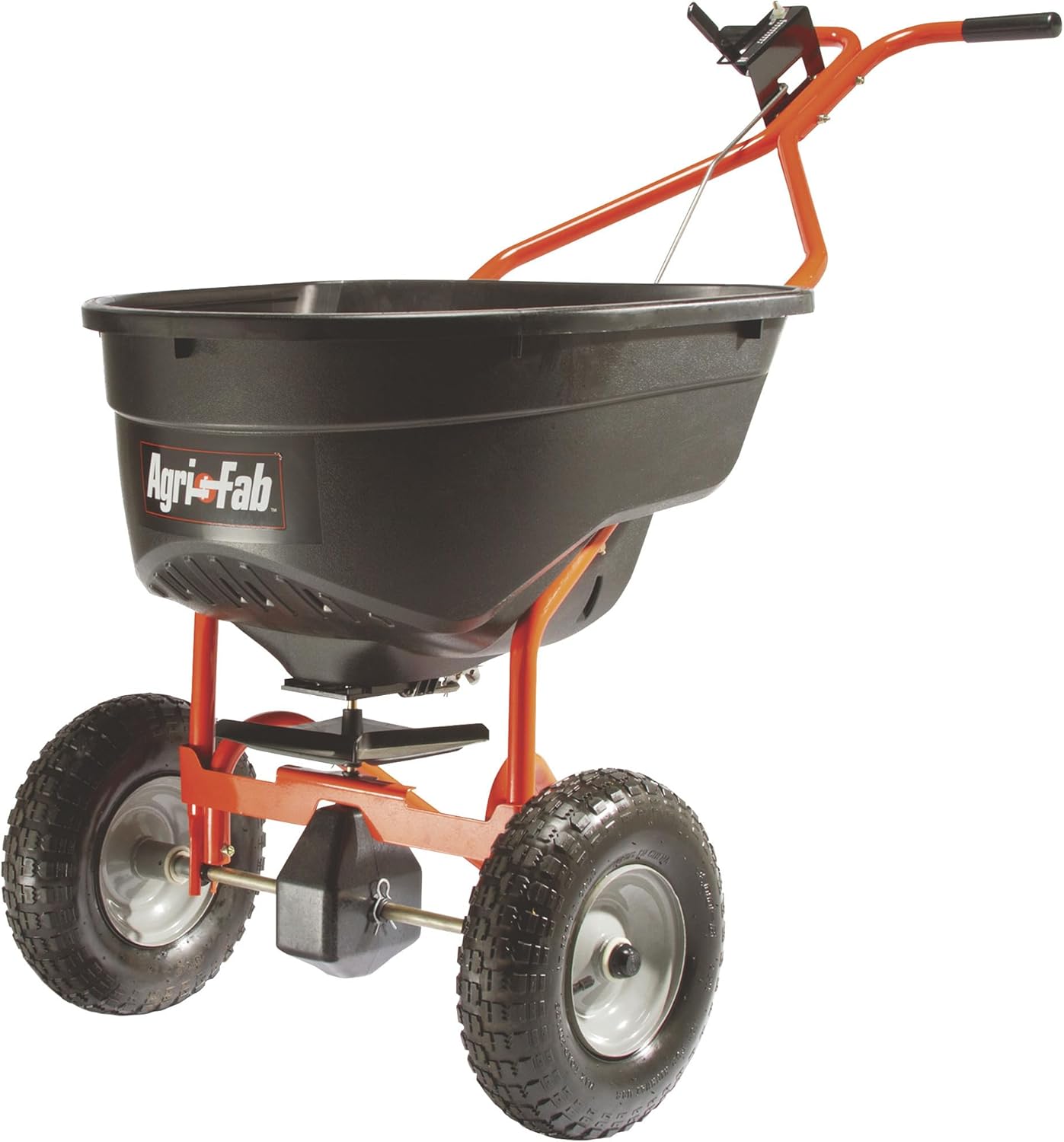
| Weight Capacity Maximum | 130 pounds |
|---|---|
| Number of Wheels | 2 |
| Tire Type | Tubeless |
| Material Type | Poly and steel |
The Agri-Fab 130-lb walk-behind broadcast spreader is a straightforward, high-capacity tool for spreading fertilizer, grass seed, or ice melt over lawns up to about half an acre. It uses a large polyethylene hopper and pneumatic tires to move smoothly over uneven turf, while a direct rod control makes adjusting and engaging the spread pattern simple during use. The wide broadcast pattern covers more ground per pass, reducing time spent spreading compared with lawn-size handheld options. Construction mixes poly and steel for a balance of durability and lighter weight, and the ergonomic handle improves comfort during longer passes. Expect reliable performance for routine residential lawn care, though assembly is required and the unit is a push-style spreader so it is physically demanding on larger sites. Controls are basic rather than precision-calibrated, so granular control for very small application rates may require extra care. For seasonal tasks from spring seeding to winter deicing, this model delivers consistent, no-frills coverage for homeowners focused on efficiency and capacity.
Best for: Homeowners who want a no-nonsense, high-capacity spreader to finish lawn tasks faster and who prioritize durability and ease of use over precision metering.
Less Ideal for: Owners of very large properties who prefer tow-behind or tractor-mounted spreaders and users who need highly precise, small-rate fertilizer application.
- Large 130 lb hopper reduces refills and speeds work on medium lawns
- Pneumatic tires and simple frame roll well over uneven yards
- Direct rod control is easy to use and intuitive while walking
- Polyethylene hopper and steel components provide a durable yet reasonably light build
- Push operation can be tiring on larger properties
- Controls are basic and may require testing to dial in precise spread rates
Verdict: A rugged, high-capacity push spreader that saves time on medium residential lawns by covering large areas with one hopper load.
EarthWay 2150 Commercial 50 lb Broadcast Fertilizer Spreader

| Brand | EarthWay |
|---|---|
| Model Number | 2150 |
| Hopper Capacity | 50 lb |
| Tire Type | 13 inch pneumatic |
| Gearbox | Fully enclosed |
The EarthWay 2150 is a professional-grade broadcast spreader designed to deliver an even application of fertilizer, seed, or ice melt across turf. It is typically used as a push spreader for lawns where accuracy and durability matter. Notable features include EarthWay’s patented 3-hole drop shut off system and side-spread control for an approximately 50/50 spread pattern, a clog-free removable grate, an enclosed gearbox that resists moisture, and large 13 inch pneumatic tires that roll smoothly over uneven turf. The rustproof poly hopper is impact resistant and easy to wash down, and stainless-steel linkage replaces sticky cables for reliable operation. In practice this means fewer missed spots, less product waste, and consistent results across multiple passes. The unit is engineered for longevity with powder-coated steel and a sealed gearbox, but its commercial construction makes it heavier and bulkier than lightweight consumer models and requires storage space. Assembly and calibration take a bit more time up front, but the payoff is precise, repeatable spreading season after season.
Best for: Buyers who prioritize application accuracy and long-term durability for frequent or professional lawn care and who are willing to trade portability for performance.
Less Ideal for: Casual or infrequent users with very small yards who prefer a lightweight, compact spreader that is easier to store and transport.
- Patented 3-hole drop system plus side-spread control for a consistent, even spread pattern
- Fully enclosed gearbox allows use in moist or damp conditions and reduces maintenance
- Large 13 inch pneumatic tires provide smooth movement over rough or uneven lawns
- Rustproof poly hopper with removable grate is clog resistant and easy to clean
- Commercial-grade weight and size make it less convenient to move and store than lightweight spreaders
- Requires initial assembly and calibration to achieve optimal accuracy
Verdict: Choose the EarthWay 2150 when you need a durable, precision spreader that delivers consistent, professional results across uneven lawns.
Amazon Basics Broadcast Fertilizer Spreader, Multi-Gear, 5000 sq ft Coverage

| Coverage per load | 5000 square feet |
|---|---|
| Hopper volume | 0.5 cubic feet |
| Item weight | 8.86 pounds |
| Construction | Steel frame with plastic hopper |
| Operation | Multi-gear precision control |
This Amazon Basics broadcast spreader is a straightforward, value-focused tool for treating small to medium lawns. It features a plastic hopper on a steel frame and a multi-gear control that lets you adjust the opening for different granular materials including seed, fertilizer, salt, and ice melt. Use it for one-pass coverage up to about 5,000 square feet per fill; the pre-installed release cable and simple assembly mean you can get working quickly. The steel frame provides durability for seasonal outdoor use while the plastic bin keeps weight down and resists corrosion. Because it is a broadcast model, it throws material over a wide swath which speeds coverage but requires careful overlap management to avoid uneven application. The unit is best for homeowners who want a reliable, no-frills spreader for routine lawn feeding and winter deicing. If you need pinpoint placement, heavy-duty commercial capacity, or advanced calibration markings for very precise application rates, you will likely want a different style of spreader.
Best for: A practical homeowner who wants a durable, easy-to-use spreader to speed routine fertilizing and occasional ice-melt work without overcomplicating setup or operation.
Less Ideal for: Not a great fit for contractors or landscapers who need high-capacity commercial equipment or for gardeners who require exact, spot-specific placement.
- Multi-gear control for adjustable flow and material types
- Covers up to 5,000 sq ft per load for efficient one-pass work
- Steel frame with plastic hopper resists seasonal wear
- Easy assembly with release cable pre-installed
- Suitable for spread of seed, fertilizer, salt, and ice melt
- Broadcast pattern can make precise, narrow placement difficult
- Less suitable for very large or commercial lawns due to single-load capacity
Verdict: A durable, no-frills broadcast spreader that efficiently treats medium lawns and simplifies routine fertilizing and deicing tasks.
VEVOR 15 lb Broadcast Push Spreader with 9.8 ft Spread Width

| Spreading width | 9.8 ft |
|---|---|
| Hopper capacity | 15 lbs |
| Settings | 30 adjustable settings |
| Tire size | 10 in |
The VEVOR push broadcast spreader is a no-frills tool for homeowners who want accurate, low-effort fertilizer and seed application. It spreads material up to about 9.8 feet wide with 30 adjustable settings so you can dial in coverage for grass seed, granular fertilizer, or ice melt. The 15 lb hopper and detachable handle make filling and storage simple, while the powder-coated steel frame and UV-resistant plastic hopper resist rust and weathering for seasonal use. Large 10 inch tires provide smooth rolling across turf, gravel, and light snow, and key parts arrive preassembled so setup is quick. Expect good control on small to medium lawns and straightforward maintenance, but this unit is built for lighter loads and homeowner use rather than heavy commercial work. If you need very large-capacity or motorized spreading, a tow-behind or larger pro model will be more efficient. For typical lawn fertilizer, seed, and seasonal treatments this spreader balances precision, portability, and cost-effectiveness.
Best for: Homeowners who want a practical, easy-to-use spreader to efficiently apply seed and granular fertilizer across small to medium lawns and prefer compact storage and simple setup.
Less Ideal for: Users who manage large properties, commercial landscapes, or who need motorized or tow-behind high-capacity spreading should consider larger professional models instead.
- Adjustable 30-setting spread control for precise coverage
- 9.8 ft broadcast width speeds up passes on small to medium lawns
- Powder-coated steel frame and UV-resistant hopper improve durability in outdoor conditions
- Large 10 inch tires roll smoothly over grass, gravel, and light snow
- Detachable handle and preassembled components simplify setup and storage
- 15 lb hopper is relatively small for very large yards requiring frequent refills
- Not designed for heavy commercial use or tow-behind capacity
Verdict: A compact, budget-friendly push spreader that delivers adjustable, reliable coverage for routine lawn seeding and fertilizing on small to medium yards.
John Deere 130 lb Push Broadcast Spreader

| Capacity | 130 lbs. |
|---|---|
| Approximate coverage | Up to 25,000 sq ft |
| Spread width | 10 – 12 ft |
| Wheels | 13" x 4" pneumatic tires |
This John Deere push broadcast spreader is built for larger lawns and frequent use. The 130 lb rust-proof poly hopper lets you cover roughly half an acre between refills, while the broadcast plate delivers a 10 to 12 ft spread that speeds application and reduces passes. Control is simple: a direct rod gate and adjustable flow stop let you dial output for seed, fertilizer, weed control products, or ice melt so you get more even coverage and less waste. Durability is focused on practical longevity rather than lightweight portability — heat-treated steel gears are enclosed to resist corrosive materials and large turf-tread pneumatic tires make it easy to push across uneven turf. Assembly is required and the unit is substantial to maneuver compared with compact hand spreaders, but that heft contributes to stability and capacity. For performance-focused gardeners with mid-size to large lawns, it reduces refill frequency and produces consistent spreading; casual users with very small yards may find it larger than necessary.
Best for: Gardeners and property owners who prioritize efficient, consistent coverage across mid-size to large lawns and want a durable spreader that reduces refill interruptions.
Less Ideal for: People with very small yards, limited storage space, or who need a lightweight, highly portable seed spreader.
- Large 130 lb poly hopper reduces refills for up to 25,000 sq ft of coverage
- Wide 10–12 ft broadcast spread speeds application and improves uniformity
- Direct rod control and adjustable flow stop for precise output with different materials
- Enclosed heat-treated steel gears and turf-tread pneumatic tires improve durability and maneuverability
- Substantial size and weight make it less convenient for very small yards or frequent transport
- Some assembly required before first use
Verdict: Choose this spreader if you need high-capacity, consistent broadcast coverage for mid-size to large lawns without frequent refilling.
Scotts Turf Builder EdgeGuard DLX Broadcast Spreader

| Brand | Scotts |
|---|---|
| Item Type | EdgeGuard DLX Broadcast Spreader |
| Additional Features | EdgeGuard Technology, Pre-calibrated |
| Capacity Coverage | Up to 15,000 sq. ft. |
The Scotts Turf Builder EdgeGuard DLX is a straightforward broadcast spreader for homeowners who need even coverage across medium to large lawns. It arrives pre‑calibrated and uses a curved hopper with a dual‑bladed agitator to keep granular seed and fertilizer flowing smoothly while the EdgeGuard side shield blocks product from driveways, flower beds, and sidewalks. Settings are matched to Scotts product recommendations so setup is quick: pick the dial setting, pour in the product, and walk at a steady pace. The large capacity covers up to 15,000 sq. ft. per fill, and the robust hopper and agitator help prevent clumping with common lawn products. Downsides are that it is a broadcast spreader, so fine tuning application rate beyond the preset settings is limited and it requires steady walking speed for uniform results. It is also a single‑model design without specialty attachments for precision corridors or narrow strips. For routine seeding, fertilizing, or winter ice melt, it delivers consistent, reliable performance for the typical homeowner.
Best for: Homeowners who want a reliable, easy-to-use spreader for regular seeding, fertilizing, and winter salt tasks and who value convenience and consistent coverage across medium to large lawns.
Less Ideal for: Users who need highly precise application rates, professional landscapers, or those who work mainly in very tight or narrow planting areas.
- Pre-calibrated dial matched to Scotts product settings for quick setup
- EdgeGuard side shield prevents spread onto sidewalks, driveways, and beds
- Curved hopper and dual-bladed agitator reduce clumping and ensure smooth flow
- Large capacity covers up to 15,000 sq. ft. per fill for fewer refills
- Limited fine-tune control beyond preset calibration for precise application
- Not optimized for very narrow strips or beds where a drop spreader is better
Verdict: A user-friendly, pre-calibrated broadcast spreader that delivers consistent coverage and protects borders, making it a strong all-round choice for home lawn care.
Choosing the Right Push Seed Spreader: Key Factors to Consider
Spread Accuracy and Uniformity
Uniform seed distribution is the core purpose of a push seed spreader. If the metering system clumps or throws unevenly you risk patchy germination and wasted seed. Look for spreaders with clearly marked rate settings and a control mechanism that produces a steady flow across the entire width. A consistent pattern reduces the need for overlapping passes and makes it easier to predict germination density.
Different seeds flow differently, so a spreader that works for fine grass seed may overfeed larger seeds unless the metering is adjustable. Consider whether the spreader offers multiple calibration points or a variable opening you can fine-tune for the seed you use most often.
Hopper Capacity and Refill Convenience
Hopper size affects how long you can work between refills. For small lawns and beds a compact hopper is easier to handle and lighter to push. Larger yards benefit from a higher-capacity hopper to minimize interruptions.
Also consider the hopper opening and shape. Wide openings make refilling less messy, while steep-sided hoppers help seed flow toward the metering mechanism. Removable hoppers or hinged lids simplify cleaning and switching seed types between jobs.
Durability and Weather Resistance
Push spreaders live outdoors and often contact soil and moisture. Corrosion-resistant frames, UV-stable hoppers, and sealed bearing wheels extend a tool's working life. Thin sheet metal frames or exposed fasteners are more likely to rust or loosen over multiple seasons.
Check the construction around high-stress points such as wheel mounts and axle connections. Reinforced attachments and thicker tubing handle bumps and curbs better. Durable parts reduce the frequency of repairs and help maintain accurate spreading as components stay aligned.
Metering Control and Adjustability
Good metering control lets you dial in the correct application rate for different seed types and lawn conditions. Look for spreaders with graduated dials or indexed settings that provide repeatable results. Some designs include adjustable gates or interchangeable plates to fine-tune flow for very small or very large seeds.
A metering system that is easy to access and clean will be used more often. If calibration requires tools or disassembly it becomes less practical for quick jobs and can discourage careful adjustments between seed types.
Wheel Size and Ground Contact
Wheel design affects how smoothly the spreader rolls and how evenly it travels over turf or uneven ground. Larger diameter wheels roll over bumps more smoothly and reduce effort, especially when fully loaded. Wider tires spread load and reduce ruts in soft soil.
Consider the tread and whether wheels have sealed bearings to keep grit out. For rough terrain, stout wheels and a stable axle reduce wobble and help maintain a consistent gait, which directly influences seed distribution uniformity.
Maintenance, Parts, and Longevity
A spreader that is easy to clean and service will perform well season after season. Removable hoppers, accessible metering parts, and common fastener types simplify maintenance. Sealed or easily lubricated bearings extend wheel life.
Confirm that common wear parts like metering plates, agitators, and wheels can be replaced without custom ordering. Designs that require minimal tools for routine tasks will reduce downtime and keep the unit accurate and reliable for future plantings.
Matching Spreader Features to Your Planting Tasks
Different seeding jobs demand different features. For overseeding a lawn you want a spreader that meters fine grass seed at low rates and offers a narrow-to-medium spread width so you can be precise near beds and edges. For establishing cover crops or large-area seeding, prioritize a larger hopper and wider distribution pattern to cover ground faster.
- Overseeding lawns: fine metering, easy control, smaller hopper works well
- Large-area seeding: larger hopper, bigger wheels, wider spread width
- Garden beds and tight spaces: narrower pattern and good maneuverability
Preparing the Site for Best Results
Site prep affects how well seed contacts soil and germinates. Remove debris, rake lightly to loosen compacted topsoil, and correct any severe low spots. For lawns, mow and dethatch if necessary so seed reaches the soil. If you are broadcasting seed, consider light raking or rolling afterward to improve seed-to-soil contact.
- Clear debris and level major bumps before spreading
- Rake or lightly cultipack after spreading when appropriate
- Water gently but consistently to start germination, following seed type recommendations
Calibration Tips for Different Seed Types
Calibrate the spreader before starting a large job. Use a measured area test run to see how much seed is dispensed at a given setting. Adjust until you hit the recommended application rate for the seed. Repeat calibration when switching seed types or after changing settings.
- Test on a driveway or tarp to catch seed for measurement
- Scale the measured output to your target area to verify rate
- Record preferred settings for common seed types you use
Safe Handling and Storage
Empty and clean the hopper before long-term storage to prevent moisture buildup and seed spoilage. Store indoors or under cover to protect metal parts from corrosion and plastic hoppers from prolonged sun exposure. Periodically inspect for loose fasteners and lubricate moving parts according to manufacturer guidance.
- Rinse and dry the hopper after use if seed fines or dust are present
- Store with the handle upright to protect the frame and wheels
- Check and tighten axle and handle mounts seasonally
How We Chose the Best Push Seed Spreader
We prioritized criteria that matter in real-world seeding across lawns, garden beds, and larger turf areas. First, spread accuracy and metering: we looked for units with reliable, adjustable openings and consistent distribution across common seed sizes from fine grass seed to larger cover-crop seed. Second, build quality and durability: durable hopper materials, rust-resistant frames, and solid wheels that resist damage in rough turf were required to ensure seasons of use. Third, ease of use and control: ergonomic handle height, smooth push action, and accessible control knobs or levers make seeding less tiring and more precise. Fourth, hopper capacity and refill convenience: larger hoppers reduce trips to refill while still allowing fine calibration. Fifth, maintenance and parts availability: designs that allow straightforward cleaning, calibration, and replacement of parts scored higher. We excluded units with unrepairable hoppers, unclear calibration markings, or consistently poor distribution in routine garden tests. The final list balances accuracy, longevity, and practical everyday handling for gardeners.
FAQ
What seed types work with a push seed spreader?
Most push spreaders handle fine lawn seed, grass mixes, cover-crop seed, and many small vegetable seeds. Extremely large seeds or fluffy mixes may require reduced settings or special metering plates. Always calibrate for each seed type before broadcasting across the full area.
How do I calibrate a push spreader for accurate rates?
Measure a known area, run the spreader across it at a chosen setting, then collect and weigh the discharged seed. Compare to the recommended pounds per square foot and adjust the setting until the output matches the target rate. Repeat for different seed sizes.
Can I use a push spreader on slopes and uneven ground?
Push spreaders work on gentle slopes and typical lawn undulations, but steep or extremely uneven ground can affect distribution and control. Larger wheels help on rough terrain, and shorter passes with overlap can reduce missed spots. For safety, avoid very steep slopes where pushing the loaded unit could cause loss of control.
How often should I clean and maintain the spreader?
Clean the hopper and metering area after each use to remove fine dust and residues. Inspect wheels and fasteners seasonally and lubricate axles and moving parts if recommended. Regular minor maintenance prevents buildup that could alter metering accuracy over time.
Is a larger hopper always better?
Not always. Larger hoppers reduce refill frequency for big jobs but add weight, making the spreader harder to push and control in tight areas. Match hopper size to the typical job: small yards and garden beds often benefit from a lighter, more maneuverable unit.
Final Verdict
Choose a push seed spreader that balances accurate metering with the durability and handling you need for your typical planting tasks. Prioritize spread accuracy and easy adjustment if you do precision overseeding, or favor hopper capacity and larger wheels for big-area seeding. Regular calibration and basic maintenance keep any spreader working reliably. Focus on the key tradeoffs described above and pick the features that match how and where you plant. With the right balance of control, capacity, and build quality, a push seed spreader will make seeding faster, more even, and less wasteful across seasons.
