

Note: This article contains affiliate links. If you click on these links and make a purchase, I may earn a small commission at no extra cost to you. This helps support my research and content. Read my full affiliate disclosure here.
If you are dealing with a roach infestation, choosing a bait that attacks the whole nest rather than only visible insects makes a big difference. The right roach bait that kills nest works by attracting foragers, getting picked up or fed to nestmates, and leaving residues that keep affecting the colony. In practical garden and home settings, bait behavior, placement options, and persistence determine whether an application actually reduces populations over time. This guide covers our seven shortlisted roach baits that kill nest and explains how we evaluated their reach, safety factors, and longevity. Read on to learn which product traits matter for kitchens, basements, garages, and outdoor-entry points, and how to deploy bait for the best chance of eliminating an active nest.
Top Picks at a Glance
| Best Overall The best all-around choice for most situations | Combat Max Roach Killing Gel, 2.1 oz Syringe |  |
| Best Quality Built to a higher standard if you want something more solid | Syngenta Advion Cockroach Gel Bait, 4 x 30 g Tubes |  |
| Best Value The sweet spot between price and what you get | Leocipoo Roach Gel Bait, 120-Pack |  |
| Best Budget The cheapest option that still gets the job done reliably | Combat Roach Killing Bait Stations, Small & Large Roaches, 6 Count |  |
| Highest Rated A top-rated pick with lots of positive feedback | Combat Large Roach Killing Bait Stations, 2 Pack (8 Stations) |  |
| Most Popular A crowd favorite that many people choose with confidence | Combat Large Roach Killing Bait Stations, 8-Count |  |
| Best Seller A high-volume bestseller chosen again and again | Combat Max Roach Killing Bait, Large Roaches, 8-Count |  |
Combat Max Roach Killing Gel, 2.1 oz Syringe
| Unit Count | 2.1 Ounce |
|---|---|
| Item Form | Gel |
| Active Ingredients | Fipronil |
| Special Features | Fast control; for cracks and crevices |
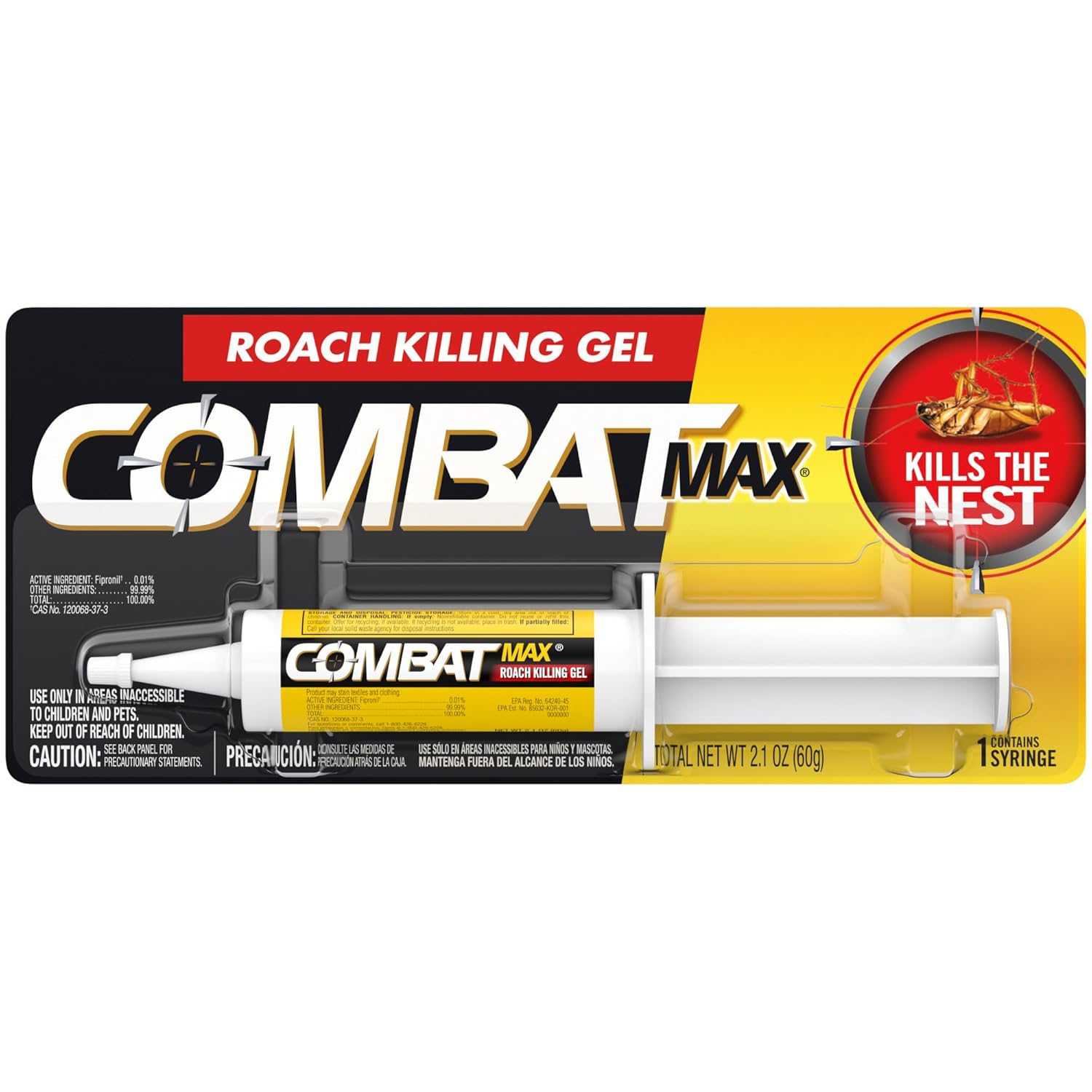
Combat Max Roach Killing Gel is a syringe-applied bait intended for spot treatment of roach activity indoors and in protected outdoor areas. You apply dime-sized spots or short lines of the odorless gel in cracks, crevices, along baseboards and other hiding places; roaches consume the bait, return to the nest, and spread the active ingredient so the infestation is reduced at the source. The formula contains fipronil and is described as fast-acting with residual control up to about three months when kept out of direct sunlight and water. The syringe applicator makes precise placement easy and minimizes mess, and the gel is fume-free so it can be used in kitchens and living areas if applied away from food prep surfaces. Important limitations are that the product requires regular inspection and reapplication when the gel is no longer visible and that outdoor effectiveness drops where sunlight or moisture reach the bait. As with any insecticide, follow safety directions to avoid contaminating food or utensils.
Best for: Buyers who want a proven, targeted gel bait to tackle existing roach problems and prefer solutions that act quickly and provide measurable results backed by widespread use.
Less Ideal for: Those seeking a single, no-maintenance cure or a broad outdoor perimeter treatment exposed to weather should consider alternative methods or professional services.
- Targeted syringe applicator for precise placement in cracks and crevices
- Fipronil-based formula that begins acting within hours and claims long residual control
- Odorless and fume-free so it can be used in occupied spaces when applied correctly
- Requires periodic inspection and reapplication every few months to maintain effectiveness
- Less effective outdoors if exposed to direct sunlight or water which reduces residual action
Verdict: Choose this gel when you need a precise, fast-acting bait that eliminates roaches at the nest and delivers sustained control for up to three months.
Syngenta Advion Cockroach Gel Bait, 4 x 30 g Tubes

| Item Form | Gel |
|---|---|
| Target Species | Insects |
| Active Ingredients | Carboxylate / Indoxacarb 0.6% |
Syngenta Advion Cockroach Gel Bait is a ready-to-use gel designed for targeted crack-and-crevice applications to eliminate common cockroach species, including German, American, and brown-banded roaches. You dispense small spots of gel into hiding places or along runways using the tube tip, which makes it suitable for homes, commercial kitchens, and industrial sites where discreet placement matters. The active ingredient (indoxacarb 0.6%) is incorporated into a high-performing bait matrix that remains attractive to bait-averse roaches, so you can expect faster knockdown in many infestations compared with simple insecticide sprays. It is labeled for use in food handling areas when applied as directed and can be applied both indoors and outdoors. Limitations include the need for careful spot placement for effectiveness and adherence to label directions to keep pets and children safe. This product treats infestations through baiting rather than broad residual contact, so it works best as part of a sanitation and exclusion plan rather than as a sole long-term barrier treatment.
Best for: Homeowners or facility managers who want a targeted, professional-grade bait to reduce active cockroach populations while integrating with sanitation and exclusion practices.
Less Ideal for: People seeking an instant area-wide spray or long-lasting surface barrier should consider alternative control methods or combined treatments rather than a spot-applied gel alone.
- Formulated gel matrix attracts even bait-averse roaches for higher uptake
- Designed for precise crack-and-crevice placement indoors and outdoors
- Labeled for use in food handling areas when applied according to directions
- Includes professional-strength active ingredient (indoxacarb 0.6%)
- Requires correct placement and periodic reapplication to maintain effectiveness
- Not a surface residual barrier so sanitation and exclusion are still necessary
Verdict: Choose this gel bait when you need a professional, spot-applied solution that attracts and controls bait-averse cockroaches in targeted indoor or outdoor locations.
Leocipoo Roach Gel Bait, 120-Pack

| Target Species | Cockroach |
|---|---|
| Included Components | Roach Gel |
This Leocipoo roach gel bait is a pea-dot applicator product designed for targeted indoor use where roaches travel or hide. You open the tube and place small dots of gel behind appliances, inside cabinet corners, under sinks, and along baseboards; placing many small dots rather than a few large globs encourages feeding and keeps the bait working longer. The formula is presented for common indoor species including German, American, Oriental, and Smokybrown roaches, and the 120-count supply is convenient for treating multiple rooms or revisiting hotspots. Practical benefits include precise placement in tight voids that sprays and traps often miss, minimal mess during application, and enough quantity to treat kitchens, bathrooms, garages, and utility areas over several visits. Limitations are that success depends on sanitation and removing competing food and water sources, and repeated reapplication is necessary as bait is consumed or dries; it is also an indoor solution so it will not address outdoor nests directly.
Best for: Buyers who want a practical, no-frills way to reduce indoor roach populations by targeting travel paths and hiding spots across multiple rooms.
Less Ideal for: People who need outdoor or perimeter roach control or a one-time instant knockdown solution should look at alternative products or professional services.
- Precise dot application reaches tight hiding spots sprays and traps miss
- Large 120-count supply covers multiple rooms and repeat treatments
- Formulated for common indoor roach species including German and American roaches
- Simple low-mess use with no traps or bulk stations required
- Requires regular reapplication as bait is eaten or dries
- Effectiveness depends on good sanitation and eliminating competing food and water sources
Verdict: A large 120-pack of targeted gel dots that lets you treat hidden indoor roach hotspots efficiently across a home.
Combat Roach Killing Bait Stations, Small & Large Roaches, 6 Count

| Unit Count | 6 Count |
|---|---|
| Item Form | Baits |
| Target Species | Cockroach |
| Active Ingredient | Hydramethylnon 2.0% |
Combat Roach Killing Bait Stations are compact, mess-free bait units designed to control common household roaches by luring them to eat a Hydramethylnon formulation and carry it back to the nest. You place the child-resistant stations in tight, high-traffic areas like under sinks, behind appliances, and inside cabinets; no activation is required. The product advertises long residual action with continuous killing for up to three months and is odorless and vapor-free, which makes it suitable for use in kitchens and living areas. The main practical benefits are ease of placement, low maintenance, and the so-called ripple effect where poisoned roaches spread bait to others. Limitations are that you get only six stations per pack and they require replacement every three months for ongoing protection, so cost per month should be considered for larger infestations or whole-home coverage. Also these are targeted at roach control only and do not address other pests or eliminate the need for sanitation and exclusion to prevent re-infestation.
Best for: Buyers who want a low-effort, store-and-forget roach control option for targeted areas of the home and prioritize simple setup and safety around living spaces.
Less Ideal for: People facing a heavy, whole-home infestation or who need a multi-pest solution should consider professional treatment or additional products.
- Ready-to-use, no activation or messy application required
- Child-resistant stations with roach-sized entry holes for safer placement
- Odorless and vapor-free formula suitable for kitchens and living areas
- Formulation designed to be carried back to the nest for broader colony control
- Only six stations in the pack, which may be insufficient for larger or severe infestations
- Requires replacement every three months to maintain protection
Verdict: A simple, child-resistant bait station that delivers low-effort roach control for focused areas of the home.
Combat Large Roach Killing Bait Stations, 2 Pack (8 Stations)

| Brand | Combat |
|---|---|
| Unit Count | 2 Count |
| Target Species | Insects |
| Item Weight | 9.6 ounces |
This Combat product is a ready‑to‑use roach bait designed for large roaches, waterbugs, and palmetto bugs. Each pack contains two units with a total of eight child‑resistant bait stations that require no activation—place them where you have seen activity such as under sinks, behind toilets, or behind appliances. The active ingredient, hydramethylnon, is a slow‑acting insecticide that lets foragers carry poisoned bait back to the nest, which helps reduce infestations at the source. Practical benefits include easy placement, low mess, and continuous protection day and night without monitoring or mixing. Limitations are that it is formulated for larger roaches specifically, so effectiveness against smaller species may vary, and because the bait relies on roaches feeding and returning it can take several days to see full population control. Use with care around pets and always keep the stations in places children and pets cannot access despite the child‑resistant design.
Best for: Buyers who prioritize a reliable, low‑effort solution to reduce established roach infestations and who want a product that targets nests rather than only killing visible insects.
Less Ideal for: People needing an immediate knockdown for small roach species or those who prefer non-chemical control methods should consider alternative approaches.
- Slow‑acting hydramethylnon allows foragers to transfer bait to the nest for broader population control
- Child‑resistant bait stations reduce accidental access while remaining easy to place
- No activation or mixing required so units are ready to use immediately
- Designed for placement in common roach hiding spots like under sinks and behind appliances
- Formulated for large roaches so results may be slower or less consistent on smaller species
- May take several days to noticeably reduce visible roaches due to slow‑acting mode of action
Verdict: Choose these Combat bait stations when you want a dependable, ready‑to‑use product that targets roach nests for longer‑term reduction of large roach infestations.
Combat Large Roach Killing Bait Stations, 8-Count

| Unit Count | 8 Count |
|---|---|
| Item Form | Baits |
| Target Species | Insects |
| Active Ingredients | Hydramethylnon 2.0% |
Combat Large Roach Killing Bait Stations are prefilled, child-resistant bait stations designed for use in kitchens, bathrooms, and other indoor hotspots where large roaches appear. You place the small stations along walls, behind appliances, and under sinks; roaches enter, consume the hydramethylnon bait, and carry it back to the nest to kill others. The product advertises up to three months of residual protection when stations are used and replaced as directed. Practical benefits include a mess-free setup with no activation required and compact stations that fit tight spaces. The bait targets larger species such as waterbugs and palmetto bugs and is intended to suppress infestations by eliminating the nest rather than only killing visible roaches. Important limitations are that it contains an insecticide so stations must be kept away from children and pets and that effectiveness depends on correct placement and using all stations; it is not a standalone solution for severe or structural infestations and may need to be combined with sanitation and exclusion measures.
Best for: Practical homeowners who want a low-effort, indoor solution to remove visible large roaches and reduce nests using prefilled bait stations placed in typical infestation spots.
Less Ideal for: People dealing with extensive or structural infestations, or those seeking non-chemical methods, should consider professional pest control or alternative treatments.
- Ready-to-use, no-mess bait stations require no mixing or activation
- Child-resistant station design with roach-sized entry holes for safer indoor use
- Formulated with hydramethylnon to kill roaches that return bait to the nest
- Compact shape fits behind appliances and in corners where roaches travel
- Contains an active insecticide so stations must be kept out of reach of children and pets
- Must be placed correctly and replaced every three months for sustained control
Verdict: Use these ready-to-go, child-resistant bait stations to quietly reduce large roach populations by killing individuals and the nest with minimal setup.
Combat Max Roach Killing Bait, Large Roaches, 8-Count

| Unit Count | 8 Count |
|---|---|
| Target Species | Roach |
| Item Form | Baits |
| Active Ingredients | Fipronil |
Combat Max Large Roach Killing Bait is a pack of eight ready-to-use bait stations formulated to attract and kill large roaches by having exposed insects carry poisoned bait back to the nest. You place the compact, child-resistant stations in typical roach harborage—under sinks, behind appliances, and along baseboards—and they require no setup or gels. The active ingredient, fipronil, works quickly and the manufacturer reports a residual effect designed to provide continuous protection for up to three months. Practical benefits include a mess-free, odorless application and stations sized to let roaches enter while keeping children out. Limitations are that this is a species-targeted bait for larger roaches and will be less effective against other pests or for outdoor perimeter use; heavy infestations may still require integrated measures like sanitation, traps, or professional follow-up. For buyers prioritizing low-effort indoor control, these stations are an easy baseline solution, but expect varying speeds of elimination depending on infestation size and roach behavior.
Best for: Buyers who want an inexpensive, low-effort indoor treatment to reduce visible large roaches and disrupt nearby nests without handling gels or sprays.
Less Ideal for: People dealing with widespread heavy infestations, multiple pest types, or those needing an outdoor perimeter treatment should consider stronger or broader approaches.
- Ready-to-use, no-mess bait stations for quick placement
- Child-resistant exterior with roach-sized entry holes for safer indoor use
- Contains fipronil for fast-acting, colony-level control
- Designed for up to three months of residual protection
- Formulated specifically for large roaches so effectiveness varies with species and population size
- Not intended as a standalone solution for severe infestations or outdoor use
Verdict: A straightforward, budget-friendly indoor bait option that delivers colony-level control of large roaches with minimal setup.
Choosing the Right Roach Bait That Kills Nest: Key Factors to Consider
Bait Transfer Mechanism
A bait that kills an entire nest needs a mechanism for individual roaches to pass the active ingredient to nestmates. Some formulations include delayed-action toxins that let a forager return to the nest before dying, increasing the chance of trophallaxis and contact transfer. Other baits depend on contaminated feces or grooming to move the poison through the colony.
Understanding the transfer mechanism matters because an immediate-kill product might eliminate visible roaches but leave the nest intact. When evaluating baits, look for descriptions of delayed activity or documented secondary mortality that indicate colony-level impact.
Palatability and Attractants
Roaches are selective feeders, and bait attractiveness varies by species, season, and competing food sources. Palatability depends on the bait matrix-sugars, oils, or protein-based carriers-and whether the formulation remains appealing in warm, humid kitchens or cooler basements.
A bait that roaches ignore will not achieve nest control. Consider where roaches are feeding in your home and choose a bait type with attractants suited to those conditions. In heavy infestations, rotating bait matrices can help when a single attractant underperforms.
Longevity and Environmental Persistence
Residual persistence determines how long a placed bait remains effective. In high-traffic or humid areas, soft gels and pastes can dry out or be consumed quickly, while sealed stations or weather-resistant formulations maintain potency longer. Longevity matters for nest control because it increases opportunities for foragers to find bait and transfer it back to the colony.
Also consider how environmental factors like sunlight, moisture, and temperature affect the active ingredient. Longer persistence reduces the need for frequent reapplication but may also increase non-target exposure, so balance durability with safety.
Placement and Application Options
A bait that kills nest must be placed where foragers will encounter it without creating access for children or pets. Products that come in tamper-resistant stations, squeeze tubes for crack injection, or granular forms for outdoors give different placement options. The ability to target cracks, under appliances, and entry gaps improves efficacy.
Think about the layout of your space: kitchens need low-profile stations that fit under cabinets, while basements or garages might benefit from bait designed to tolerate cooler, damper conditions. Application flexibility affects how thoroughly you can treat the likely nest areas.
Active Ingredient Mode of Action
Different active ingredients work by distinct physiological pathways and have different profiles for delayed mortality and secondary transfer. Some chemistries are fast-acting, causing quick knockdown, while others allow prolonged survival for better bait dissemination. Knowing the mode of action helps set realistic expectations for how quickly nest reductions will appear.
Gardeners should consider whether they prefer a delayed-action toxin that promotes transfer or a rapid knockdown to reduce visible roaches quickly. Also consider compatibility with other pest management steps you may be using.
Household Safety and Non-Target Risk
Safety features include tamper-resistant packaging, low volatility of the active ingredient, and formulation choices that reduce attractiveness to pets and children. Baits that come sealed in stations or dispensers limit contact and accidental ingestion, which is important in family homes and where pets roam.
Evaluate label instructions and choose formulations that balance efficacy with minimization of non-target exposure. Proper placement and station use are part of reducing household risk.
Where Roach Nests Are Likely to Be Found
Roaches prefer warm, humid, and dark hiding spots close to food and moisture. Common nest sites include behind appliances, inside wall voids near kitchens and bathrooms, cracks in baseboards, under sinks, and in cluttered storage areas. Outdoors, nests may form in mulch, compost piles, or close to foundation entry points.
Finding likely nest areas helps you concentrate bait placement where foragers travel between food sources and the colony. Inspect at night with a flashlight to confirm movement paths and prioritize those routes for placement of bait stations or gel deposits.
- Check behind and beneath stoves, refrigerators, and dishwashers
- Inspect cupboards, pantry edges, and under sinks where moisture accumulates
- Look for grease marks, droppings, and shed skins as signs of nest activity
- Reduce clutter and secure food to improve bait uptake
Best Placement Practices for Nest Control
Target placement focuses on travel paths and aggregation points rather than random spots. Place bait in cracks, along baseboards, and near water sources where roaches forage. For hidden nests, place multiple small deposits or stations along probable indoor highways to increase encounter rates.
Use tamper-resistant stations in areas accessed by children and pets. For deep cracks and voids, syringe-style gels or tube applicators let you reach sheltered crevices where foragers shuttle food back to the nest.
- Place stations along walls, not in open floor centers
- Avoid placing bait where it will be cleaned or sprayed frequently
- Replace or refresh baits once they dry out or are consumed
Combining Bait with Sanitation and Exclusion
Bait works best as part of an integrated approach. Remove competing food sources by sealing containers, cleaning up crumbs and grease, and managing pet food. Reduce moisture sources by fixing leaks and improving ventilation, which makes bait more attractive relative to other food.
Seal entry points like gaps around pipes and foundation cracks to limit re-infestation from outdoors. While bait targets the nest, sanitation and exclusion reduce the colony's ability to recover and lower the long-term likelihood of new nests forming.
- Store food in sealed containers and clean counters nightly
- Fix plumbing leaks and use dehumidifiers in damp basements
- Caulk gaps and install door sweeps to block entry
When to Reapply and What to Expect
Expect population declines to occur over weeks rather than days when using transfer-based baits. Record bait consumption and check stations weekly. Reapply or replace baits when gel deposits appear dried out or stations are nearly empty.
If visible roaches persist after several weeks, reassess placement and inspect for secondary nest locations. Sometimes additional placements in hidden voids or rotation to a different bait matrix improves results.
- Monitor bait stations weekly for consumption and activity
- Allow at least two to four weeks for colony-level effects to show
- Move or add stations if activity is concentrated in new areas
Outdoor Use Near Entry Points
Outdoor bait placement can reduce the number of roaches entering from foundation cracks, mulch beds, or drains. Use formulations labeled for outdoor use and place them under eaves, in covered stations, or near utility penetrations where foragers travel but rain and sunlight are limited.
Avoid scattering loose bait where pets and wildlife can access it. Concentrated, sheltered placements near likely entry paths give the best chance that foragers will encounter bait and return to indoor nests.
- Place baits in covered, shaded spots close to foundation gaps
- Avoid exposed placements that will wash away in rain
- Check outdoor stations after heavy weather and refresh when needed
How We Chose the Best Roach Bait That Kills Nest
We prioritized baits that demonstrate mechanisms for colony-level control rather than only immediate knockdown. Key evaluation criteria included active ingredient delivery and bait transfer potential, residual persistence under typical indoor conditions, palatability and attractiveness to diverse roach species, and application flexibility for kitchens, basements, and other common infestation sites. We also assessed formulation safety considerations for households with children and pets, and packaging that supports targeted placement and reduced waste. We excluded surface sprays, broad-spectrum foggers, and purely repellent products because they do not reliably enable bait transfer or long-term nest reduction. We focused on practical product forms garden and home users can place near entry points, cracks, and hiding spots. Criteria that actually mattered for selection were bait matrix attractiveness, transfer and delayed-action chemistry, weather and humidity tolerance, ease of targeted placement, and documented longevity or residue life in realistic conditions. Products lacking clear bait-transfer modes or unsuited for indoor placement were not considered.
FAQ
How long does it take to eliminate a roach nest with bait?
It often takes several weeks to see significant reductions because transfer-based baits rely on foragers moving poison back to the nest. Expect to monitor bait stations and activity for two to six weeks depending on infestation size and placement quality.
Are gel baits better than stations for reaching nests?
Gel baits allow precise placement into cracks and voids where nest foragers travel, which can improve reach. Stations are safer for households with children and pets and are easier to maintain. The best choice depends on where the nest is and access limitations.
Can I use bait if I have pets or small children?
Yes, but choose tamper-resistant stations or place gels deep in cracks out of reach. Follow label instructions for safety and avoid leaving loose bait where non-targets can access it. Proper placement minimizes accidental exposure risks.
Will cleaning or spraying near bait reduce its effectiveness?
Cleaning surfaces that remove bait can reduce attractiveness and residual action. Sprays that contact bait can degrade the formulation. Avoid heavy cleaning or pesticide sprays near bait placements and refresh bait if contamination occurs.
Should I rotate bait types if the first one does not work?
Rotation can help if roaches ignore a particular bait matrix or if local populations show reduced palatability. Try different attractant types or placement strategies before concluding a bait is ineffective.
Can outdoor baiting stop roaches from entering my home?
Targeted outdoor baiting near entry points can reduce influx by intercepting foragers before they enter. It is most effective when combined with exclusion and sanitation to reduce attractants that draw roaches inside.
Final Verdict
When your goal is nest-level control, prioritize baits that enable transfer, remain attractive in the specific environment, and allow targeted placement near travel paths. Balance persistence against household safety by using tamper-resistant stations where children and pets are present and gels for hard-to-reach voids. Expect colony reductions to take weeks and plan to monitor and adjust placement as needed. Focusing on bait transfer potential, placement strategy, and sanitation will give you the best chance of reducing or eliminating a roach nest.
