

Note: This article contains affiliate links. If you click on these links and make a purchase, I may earn a small commission at no extra cost to you. This helps support my research and content. Read my full affiliate disclosure here.
If you are dealing with mice or rats in a home, garage, or outbuilding, the rodent poison you pick can determine how quickly the infestation shrinks and how much risk you accept to people, pets, and non-target wildlife. This guide looks at seven shortlisted rodent poisons that are commonly chosen for household infestations and explains the practical tradeoffs you will face in the yard, basement, or attic. We evaluate each option for how well it attracts and kills rodents, the duration of control, and the safety measures required for homes with children or pets. Read on to understand the evaluation criteria and what matters most when selecting a product for your situation.
Top Picks at a Glance
| Best Overall The best all-around choice for most situations | Contrac Blox Bromadiolone Rodenticide, 4 lb |  |
| Best Quality Built to a higher standard if you want something more solid | Neogen Havoc Rodenticide Rat & Mouse Bait Pellets, 8 lb Pail |  |
| Best Value The sweet spot between price and what you get | Neogen Ramik Green Fish‑Flavored Weather‑Resistant Rodenticide Nuggets, 4 lb |  |
| Best Budget The cheapest option that still gets the job done reliably | Tomcat Mouse Killer Refillable Bait Station with 16 Bait Blocks |  |
| Highest Rated A top-rated pick with lots of positive feedback | Farnam Just One Bite II Rat & Mouse Bait Bars, 8 pack |  |
| Most Popular A crowd favorite that many people choose with confidence | Tomcat Bromethalin Bait Chunx Pail, 4.25 lb (1 oz blocks) |  |
| Best Seller A high-volume bestseller chosen again and again | Tomcat Mouse Killer Child & Dog Resistant Disposable Bait Stations, 2-Count |  |
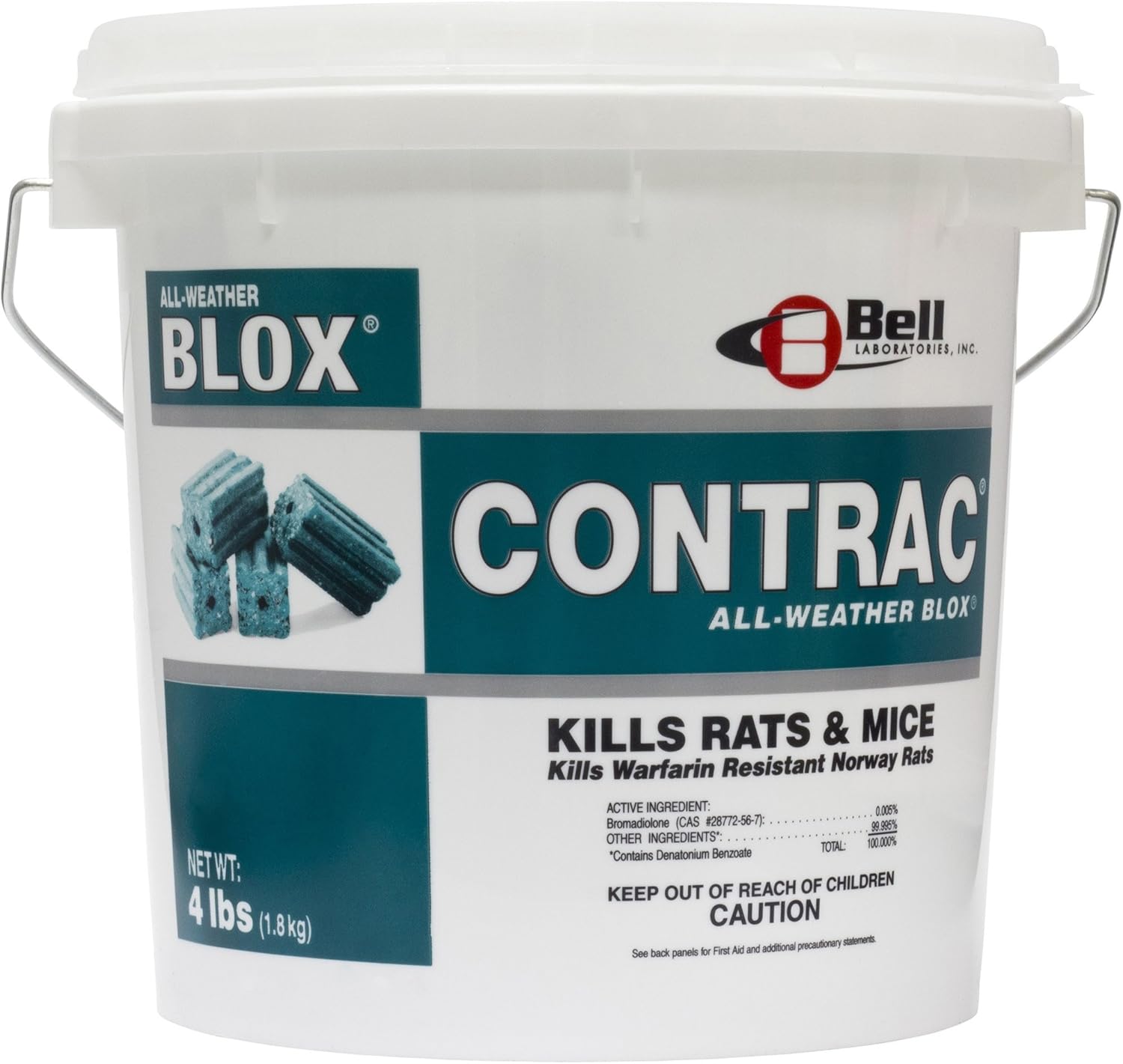
Contrac Blox Bromadiolone Rodenticide, 4 lb
| Active Ingredient | Bromadiolone |
|---|---|
| Target Species | Rat, Mouse |
| Form | 1 oz bait blocks |
| Package Weight | 4 pounds |
Contrac Blox is a professional-style rodent bait made as 1-ounce paraffin-coated blocks with a center hole for easy placement on bait rods or in tamper-resistant stations. It uses bromadiolone, a second-generation anticoagulant that can kill rodents after a single feeding and is formulated to remain palatable in wet or dry conditions, so it works both indoors and in exposed perimeters. Typical use is spacing blocks along runways or inside bait stations and maintaining a continuous supply for 10 to 15 days depending on rats or mice until activity stops. The center hole and solid block form make placement tidy and reduce crumbling compared with loose baits, and the blue color signals nonfood to technicians. Important limitations are that it is a powerful anticoagulant requiring careful placement to avoid non-target exposure and that treatment response is delayed by several days, so monitoring and secure baiting practices are necessary.
Best for: Buyers who need a reliable, professional-strength bait for sustained clean-out and maintenance of mice and rat infestations and who will use secure bait stations and follow label safety steps.
Less Ideal for: Casual hobbyists with small infestations who cannot ensure secure placement or who prefer non-chemical control methods should consider alternative solutions.
- Single-feed bromadiolone formula effective against warfarin-resistant rodents
- Paraffin-coated blocks hold up in wet and dry conditions for outdoor use
- Center hole lets technicians secure blocks on rods or inside tamper-resistant stations
- Solid 1-ounce block form reduces mess and eases placement
- Contains a potent anticoagulant that requires careful, professional-style handling to avoid non-target poisoning
- Not an immediate knockdown; mortality can take several days so monitoring is required
Verdict: Choose Contrac Blox when you want a weatherable, single-feed professional bait that reliably controls rats and mice, including warfarin-resistant populations.
Neogen Havoc Rodenticide Rat & Mouse Bait Pellets, 8 lb Pail

| Item Form | Pellets |
|---|---|
| Target Species | Mouse |
| Active Ingredients | Brodifacoum |
| Unit Count | 128 Fluid Ounces |
Neogen Havoc is a high-potency pellet bait designed for fast control of house mice, Norway rats, and roof rats. It is typically used in place packs indoors and around agricultural buildings within 100 feet of structures; technicians or property owners place the pellets where rodents feed and monitor over several days. The active ingredient, brodifacoum, is a second-generation anticoagulant formulated at 0.005% and combined with attractive bait ingredients to encourage consumption, so infestations often decline within 4 to 5 days after a lethal dose. The product comes in a large pail suitable for treating moderate to heavy infestations and fits into integrated biosecurity or professional pest control plans. Important practical limits are that it is a toxic, single-feed compound requiring careful, restricted placement to protect non-target animals and follow local regulations for anticoagulant use; it is intended for use in and within 100 feet of agricultural and man-made structures, not for general outdoor wildlife areas. Users should prepare to follow label directions and implement bait station or exclusion measures to reduce accidental exposure.
Best for: Buyers who prioritize rapid, professional-grade elimination of rodent infestations around buildings and agricultural structures and who will follow label safety and placement protocols.
Less Ideal for: Homeowners seeking low-toxicity or wildlife-friendly solutions or those who need bait for broad open-yard use should consider alternative methods.
- Second-generation anticoagulant (brodifacoum) enables single-feed lethal control for faster results
- Formulated pellets with attractive bait mix improve palatability to rats and mice
- Large 8 lb pail provides enough material for moderate to heavy infestations or ongoing maintenance
- Labeled for use in and within 100 ft of agricultural and man-made structures, fitting farm and building biosecurity plans
- Contains a highly toxic active ingredient that requires strict placement and handling to avoid non-target poisoning
- Not intended for general open-area wildlife control and restricted to specified structural zones
Verdict: Choose Neogen Havoc when you need a professional, single-feed rodenticide that delivers fast, reliable control around buildings.
Neogen Ramik Green Fish‑Flavored Weather‑Resistant Rodenticide Nuggets, 4 lb

| Item Form | Pellets |
|---|---|
| Target Species | Rats, Mice and Meadow Voles |
| Active Ingredients | Diphacinone |
Neogen Ramik Green nuggets are a fish‑flavored, weather‑resistant rodenticide formulated with diphacinone and sold in a 4 lb bag. You place the pellets where rodent activity is seen or inside approved bait stations; the palatable grain mix encourages feeding and the anticoagulant acts over several days after ingestion. The nuggets are designed for indoor and outdoor use and are marketed as especially suited to wet or damp areas because they resist softening in moisture better than wax baits. Practical users will appreciate the simple pellet form that is easy to distribute in stations or around structures and the familiar single‑ingredient formulation. Important limitations are that this is a first‑generation anticoagulant so multiple feedings are usually required and results can take several days, and it is a toxic pesticide that requires careful handling and secure placement to avoid exposure to children, pets, and non‑target wildlife. Follow label directions and local regulations when using this product.
Best for: Buyers who want a straightforward, proven pellet rodenticide for routine control around buildings and in damp outdoor sites and who prioritize ease of deployment and reliable palatability.
Less Ideal for: People who need an immediate‑action solution, those unwilling to follow pesticide safety rules, or those with uncontrolled access by pets or wildlife should choose different control methods.
- Weather‑resistant pellet form suitable for damp or wet areas
- Fish flavor and food‑quality grain mix increase palatability to rodents
- Simple pellet nuggets are easy to place in bait stations or along runways
- Contains diphacinone, a widely used first‑generation anticoagulant
- Requires multiple feedings and can take several days to produce mortality
- Toxic to non‑target animals and humans so strict placement and handling are necessary
Verdict: A practical, weather‑resistant pellet bait that reliably attracts rodents for routine indoor and outdoor control when used according to label instructions.
Tomcat Mouse Killer Refillable Bait Station with 16 Bait Blocks

| Unit Count | 16 Count |
|---|---|
| Target Species | Rodents |
| Power Source | manual |
| Material Type | Plastic |
The Tomcat Mouse Killer refillable bait station is a straightforward rodent poison system designed for routine mouse control around the home. You load a bait block into the plastic station, place it where activity is visible, and check the clear lid to monitor bait levels and refill as needed. The kit includes a reusable, weather-resistant station plus 16 preformed bait blocks, so you can maintain a continuous bait supply without buying single-use stations. Key practical features are the tamper-resistant housing that helps keep children and pets out, a clear lid for quick visual checks, and simple one-touch setup and disposal of spent blocks. Because the blocks are designed to be effective over multiple feedings, the package covers longer treatment windows before replacement is needed. Limits to consider are that control relies on rodents feeding and leaving the area to die, which can take days, and the product requires careful placement and ongoing monitoring for best results. It is a basic, no-frills solution that emphasizes ease of use and refillable operation.
Best for: Buyers looking for an inexpensive, low-maintenance rodent poison solution who prefer a refillable station they can set and check over time rather than repeatedly replacing disposable traps.
Less Ideal for: People who need immediate removal of visible rodents or who prefer non-toxic capture methods should consider alternative traps or exclusion strategies.
- Reusable, weather-resistant station reduces waste and recurring cost for housings
- Includes 16 bait blocks so you can treat an area for an extended period out of the box
- Child- and dog-resistant design improves safety in family and pet environments
- Clear lid lets you monitor bait without opening the station
- Poison requires rodents to feed and typically die elsewhere, so results are not instantaneous
- Effectiveness depends on correct placement and continued monitoring
Verdict: A budget-friendly, refillable bait station kit that gives long-running rodent control with minimal ongoing housing cost.
Farnam Just One Bite II Rat & Mouse Bait Bars, 8 pack

| Item Form | Bar |
|---|---|
| Target Species | Rat,Mouse |
| Active Ingredients | Bromadiolone |
| Unit Count | 128 Ounce |
Farnam Just One Bite II are preformed bait bars formulated with the anticoagulant bromadiolone to control Norway rats, roof rats, and house mice. The bars have nibble ridges to encourage chewing and are sold as eight individually wrapped one-pound bars intended for use in and around agricultural buildings. In practice the product is applied in bait stations or secured where rodents feed; death is delayed four to five days which reduces bait shyness and can help reach animals that only sample food briefly. The formulation claims effectiveness against warfarin-resistant rats, making it suitable when first-generation baits have failed. Important practical points are the toxicity and need to keep the product away from children, pets, and non-target wildlife, and that proper placement and secure baiting stations are required to meet safety and legal use conditions. For someone prioritizing reliable reduction of established rodent populations, these bait bars offer a potent, ready-to-use option, but they demand careful handling and responsible placement.
Best for: Buyers who need a dependable, professional-strength rodent bait to reduce established rat or mouse populations around outbuildings and agricultural sites and who will follow strict safety and placement practices.
Less Ideal for: Casual homeowners with small indoor infestations, households with children or pets where access cannot be fully controlled, or users unwilling to follow label safety requirements.
- Single-feeding anticoagulant formula effective against warfarin-resistant rats
- Nibble-ridged bar shape encourages chewing for reliable consumption
- Individually wrapped one-pound bars simplify handling and placement
- Designed for indoor and outdoor use around agricultural buildings
- Contains a potent anticoagulant requiring strict safety precautions around children, pets, and wildlife
- Intended primarily for agricultural settings which may limit use in some residential situations
Verdict: A strong, single-feeding bromadiolone bait bar engineered for reliable control of rats and mice around agricultural buildings when used responsibly.
Tomcat Bromethalin Bait Chunx Pail, 4.25 lb (1 oz blocks)

| Item Form | Bar |
|---|---|
| Target Species | Rodents |
This Tomcat pail contains 1 oz bromethalin bait blocks formulated for professional and agricultural rodent control. It is intended for placement inside tamper-resistant bait stations around buildings, garages, basements, and other areas where rodents forage; each block is potent enough that a single feeding can deliver a lethal dose and the manufacturer recommends maintaining bait for at least a week. Notable features include a large 4.25 lb supply of preformed blocks that are easy to handle and compatible with disposable or reusable stations, effectiveness against mice, Norway rats, roof rats, and meadow voles, and suitability for both indoor and above-ground outdoor use when used per label. Practical benefits are fewer baiting trips because each block is measured, convenient restocking from the pail, and a formulation that works on anticoagulant-resistant populations. Important limitations are the need to use tamper-resistant stations for safety and legal compliance, the requirement to keep bait within 100 feet of man-made structures, and restrictions on certain species and uses in some jurisdictions such as California; safe handling and adherence to label directions are essential.
Best for: Buyers who prioritize reliable, professional-grade control of established rodent infestations and who will follow label safety rules and use tamper-resistant stations.
Less Ideal for: Homeowners seeking pet-safe or non-toxic prevention methods or people unwilling to follow strict placement and regulatory requirements should consider non-chemical or lower-toxicity options.
- Pre-measured 1 oz bait blocks for consistent dosing and easier placement
- Large 4.25 lb pail supplies many placements before restocking
- Effective against anticoagulant-resistant Norway rats, roof rats, house mice, and meadow voles
- Designed for indoor or above-ground outdoor use when used in tamper-resistant stations
- Contains a potent single-feed neurotoxin so strict use of tamper-resistant stations and careful handling are required
- Not permitted for some rodent species or uses in certain states, check local restrictions
Verdict: Choose this product when you need a professional-strength, preformed bromethalin bait solution for effective control of mice and rats using tamper-resistant stations.
Tomcat Mouse Killer Child & Dog Resistant Disposable Bait Stations, 2-Count

| Unit Count | 2 Count |
|---|---|
| Target Species | Mouse |
| Included Components | Rodent Trap |
| Item Type Name | for Indoor/Outdoor Use |
Tomcat Mouse Killer disposable bait stations are preloaded mouse bait units intended for indoor and outdoor use in garages, attics, and along walls where mice travel. Each station contains a bait block inside a tamper-resistant plastic housing so you do not need to touch the bait during setup. The clear lid lets you check bait levels and replace stations when needed. The manufacturer says each block can kill multiple mice based on laboratory testing, and the weather-resistant design permits placement in semi-exposed locations. Typical use is to position the stations where you have seen droppings, gnaw marks, or along runs and entry points. Practical benefits include quick setup, reduced handling of toxic bait, and discreet placement in concealed areas. Limitations are that these are disposable single-use stations with only two units in the box, so ongoing infestations will require repeated purchases or a refillable system, and you must keep them out of reach of non-target wildlife despite the tamper-resistant design.
Best for: Buyers who want a low-handling, tamper-resistant solution to treat a small to moderate mouse problem and prioritize safety and convenience over refillable systems.
Less Ideal for: People dealing with large or persistent infestations who prefer reusable stations or professionals who need bulk or continuous baiting options.
- Preloaded and ready to use so no direct handling of bait is required
- Child- and dog-resistant housing reduces accidental access
- Clear lid allows quick visual monitoring of bait level
- Weather-resistant design for indoor or protected outdoor placement
- Only two disposable stations included, so they are not a long-term supply
- Single-use design means recurring replacement costs compared with refillable stations
Verdict: A safe, ready-to-use option for risk-averse homeowners who want tamper-resistant, low-handling mouse bait stations for small to moderate infestations.
Choosing the Right Rodent Poison: Key Factors to Consider
Bait Formulation and Palatability
Rodents often reject unfamiliar flavors, so the bait formulation is critical. Grain-based baits, wax blocks, and soft bait pastes each behave differently in real environments. Palatability affects how quickly rodents feed and whether bait shyness develops after sublethal exposures.
Consider whether the product is likely to remain attractive in damp basements, warm attics, or outdoor sheds. Some formulations dry out or become less appealing over time, reducing effectiveness. Choose a bait type suited to the place where rodents are active to increase the chance of a complete removal.
Active Ingredient and Mode of Action
Different active ingredients kill rodents in different ways and at different speeds. Anticoagulants typically require multiple feedings to be lethal and can lead to delayed mortality, while other chemistries may act faster but carry distinct safety profiles.
Understanding the mode of action helps you plan follow-up and carcass retrieval. Faster-acting poisons may cause rodents to die in open areas where you can remove remains, while delayed-action poisons often result in deaths in hidden spaces, increasing the chance of odors and secondary exposure to scavengers.
Placement, Containment, and Accessibility
Where you place poison matters as much as what you buy. Secure bait stations reduce accidental access by children, pets, and wild animals. For indoor use, tamper-resistant stations keep bait off floors and under control; for outdoor use, consider weatherproof enclosures.
Accessibility also affects efficacy. Place bait along runways, near entry points, and close to nesting or feeding sites. If a product is not compatible with common bait-station types, its real-world safety and usability are reduced.
Non-target Risk and Household Safety
Rodent poisons pose varying risks to non-target animals and humans. Think about pets that might find bait or prey on poisoned rodents and children who could access low or unsecured placements. Some active ingredients are more hazardous in secondary poisoning scenarios.
Mitigation includes using locked stations, choosing formulations that reduce transfer risk, and following label directions for placement and cleanup. Also plan for disposal of uneaten bait and carcasses in a way that minimizes further exposure.
Persistence and Environmental Impact
How long a poison persists in the environment influences both long-term control and ecological risk. Some poisons break down quickly, while others can remain in rodent tissues or soil and pose a threat to scavengers and predators.
If you have outdoor areas with wildlife, chickens, or domestic pets that roam, prefer options with lower persistence or those designed for contained use. Consider weather conditions and the likelihood of rain or flooding that could move bait into unintended areas.
Application Convenience and Label Clarity
Clear instructions and simple application reduce misuse. Products that require tedious mixing, precise measurements, or specialized equipment increase the chance of errors. Look for baits that come ready to place or that include straightforward directions for common household scenarios.
Label clarity also matters for safe storage and post-application actions. A product with explicit carcass-handling and exposure-response guidance supports safer outcomes and more confident use.
When to Use Poison Versus Traps
Poisons and traps each have pros and cons in routine rodent control. Traps provide immediate removal and let you inspect where rodents are active, but they require frequent checking and can be impractical for large or hidden infestations. Poisons can reduce populations without daily attention but may result in rodents dying in inaccessible places.
Choose poison when you need broad area control or when trap placement is limited. Consider traps for small infestations where you want precise removal and minimal non-target risk. It is often effective to combine both approaches: use traps in living spaces and targeted baits in attics, garages, or crawl spaces where contact is limited.
- Traps give immediate confirmation of captures and allow carcass disposal.
- Poisons reduce populations over days and are useful where traps are impractical.
- Combining methods can speed control while limiting non-target exposure.
Safe Placement and Bait Station Best Practices
Secure placement prevents accidental access and improves bait longevity. Install tamper-resistant stations along walls, behind appliances, and near obvious runways where droppings or gnaw marks appear. Mount or weight stations so they cannot be easily tipped by pets or wildlife.
Rotate inspection intervals based on activity. Check stations more frequently if you have pets or children nearby. Replace soaked or moldy bait, and always wear gloves when handling bait and carcasses to reduce contamination risk.
- Place stations with the narrow opening facing the wall to intercept rodent travel paths.
- Use weatherproof enclosures outdoors and raise bait off wet ground.
- Record placement locations so you can find carcasses or exhausted bait later.
Managing Carcass Retrieval and Odor
When poisoned rodents die in hidden spaces, odor can become the most noticeable problem. Locating and removing carcasses quickly prevents odor buildup and reduces secondary exposure to scavengers. Inspect attics, crawl spaces, and wall voids if you detect persistent smells after baiting.
Use personal protective equipment when handling carcasses and place remains in sealed bags for disposal according to local regulations. If retrieval is impossible, improve ventilation and consider odor-neutralizing methods approved for indoor use.
- Inspect likely hiding spots within a week of heavy feeding activity.
- Wear gloves and wash hands thoroughly after handling contaminated materials.
- If you cannot find a carcass, increase ventilation and use absorbent materials to trap odors.
Integrated Pest Management and Long Term Prevention
Poisons are one tool in an integrated pest management strategy. Long-term control requires exclusion work, sanitation, and habitat modification. Seal entry points larger than a quarter inch, store food and pet feed in rodent-proof containers, and remove clutter that provides nesting sites.
Combine targeted baiting with physical changes to make the property unattractive to rodents. Regular monitoring after initial control helps catch reinfestations early and reduces the need for repeated heavy pesticide use.
- Seal gaps in foundations, vents, doors, and around utility lines.
- Maintain clean food storage and remove spilled birdseed or open compost near structures.
- Conduct seasonal inspections to catch new activity early.
Special Considerations for Pets and Livestock
Households with curious dogs, cats, or free-ranging livestock need an extra layer of protection. Pets can access bait stations or scavenge poisoned rodents, creating secondary poisoning risks. Place baits in stations that lock and are tall or narrow enough to exclude companion animals.
For small livestock like chickens, avoid placing baits where birds can access spilled granules. If poultry or other animals roam outdoors, favor containment strategies and consider non-chemical controls when possible.
- Monitor pets for signs of poisoning and know emergency contact procedures.
- Use elevated or locked stations in yards where dogs or livestock roam.
- Remove scavenged carcasses promptly to prevent secondary poisoning.
How We Chose the Best Rodent Poison
We prioritized products that balance effectiveness with real-world safety considerations for households and small properties. Evaluation focused on bait formulation and palatability, because a poison that rodents will not eat will not solve an infestation. We assessed active ingredient potency and time-to-kill characteristics to distinguish fast-acting options from delayed anticoagulant approaches. Containment and delivery also mattered. We looked for options compatible with secure bait stations or tamper-resistant placements to reduce accidental exposure to children, pets, and wildlife. Persistence and environmental fate were reviewed to prefer products that limit long-term risks where possible. Ease of application and clear labeling were part of the selection filters, since complicated mixing or vague directions increase misuse risk. Exclusions: we excluded products intended only for outdoor agricultural use, bulk industrial formulations unsuitable for home use, and items without accessible safety data. The final picks represent a range of formulations and delivery methods that meet these practical safety and efficacy criteria.
FAQ
How long does it usually take for rodent poison to work?
Time to effect depends on the active ingredient. Some products cause death within 24 to 72 hours after sufficient feeding, while anticoagulant formulations often require several days and multiple feedings. Expect to monitor bait consumption for at least a week to judge effectiveness.
Is rodent poison safe to use around pets and children?
Safety varies by formulation and placement. Using locked bait stations and following label directions reduces risk. If you have young children or pets that access treated areas, choose containment-focused approaches and limit baiting to locations they cannot reach.
What should I do if a pet eats bait or a poisoned rodent?
If a pet eats bait or a poisoned rodent, contact a veterinarian or animal poison control resource immediately. Time and symptoms vary by active ingredient, but rapid professional care improves outcomes. Bring the product label or sample if possible to help identify the active ingredient.
Can poisoned rodents cause secondary poisoning in wildlife?
Yes. Scavengers and predators that eat poisoned carcasses can be at risk, especially with persistent active ingredients. Reducing outdoor bait exposure, using contained stations, and removing carcasses promptly minimize secondary poisoning risks.
How do I dispose of unused bait and rodent carcasses safely?
Follow label disposal instructions and local regulations. Generally, place uneaten bait and carcasses in sealed bags and dispose of them in accordance with municipal waste rules. Wear gloves and avoid direct contact, then wash hands and tools thoroughly.
Final Verdict
Selecting a rodent poison requires balancing bait attractiveness and kill characteristics against safety for people, pets, and wildlife. Prioritize formulations that match the infestation setting and that can be secured in tamper-resistant stations. Combine baiting with exclusion and sanitation to reduce the need for repeat treatments. Ultimately, pick the approach that reduces rodent numbers efficiently while keeping non-target exposure low. Focus first on secure placement and clear label guidance, and use poison as one part of a broader prevention plan.
