

Note: This article contains affiliate links. If you click on these links and make a purchase, I may earn a small commission at no extra cost to you. This helps support my research and content. Read my full affiliate disclosure here.
A round soaker hose can transform how you water beds, borders, containers, and vegetable rows by delivering slow, even moisture directly to roots. Choosing the right round soaker hose affects water use, plant health, and how often you need to manage the system. This guide reviews seven top-rated round soaker hoses shortlisted for performance in real garden conditions. We evaluate flow consistency, material durability, ease of installation, and adaptiveness to different garden layouts to help you pick the best option for your site and planting style. Below are concise reviews of our top picks followed by practical guidance on selecting, installing, and maintaining a round soaker hose in various garden situations.
Top Picks at a Glance
| Best Overall The best all-around choice for most situations | Dramm ColorStorm Premium 50 ft Soaker Garden Hose |  |
| Best Quality Built to a higher standard if you want something more solid | MIXC 100ft Thickened Soaker Hose with Copper Connector |  |
| Best Value The sweet spot between price and what you get | MAMIZO 150 ft Soaker Hose Kit with Solid Brass Connectors |  |
| Best Budget The cheapest option that still gets the job done reliably | HZYOUMU 1/2" x 10 ft Round Soaker Hose |  |
| Highest Rated A top-rated pick with lots of positive feedback | Water Right 700 Series Polyurethane Soaker Hose, 25 ft (1/2" ID) |  |
| Most Popular A crowd favorite that many people choose with confidence | Rocky Mountain Goods Heavy-Duty Rubber Soaker Hose, 50 ft |  |
| Best Seller A high-volume bestseller chosen again and again | Gilmour Round Soaker Hose with Heavy Duty Couplings, 3/8 inch x 25 ft |  |
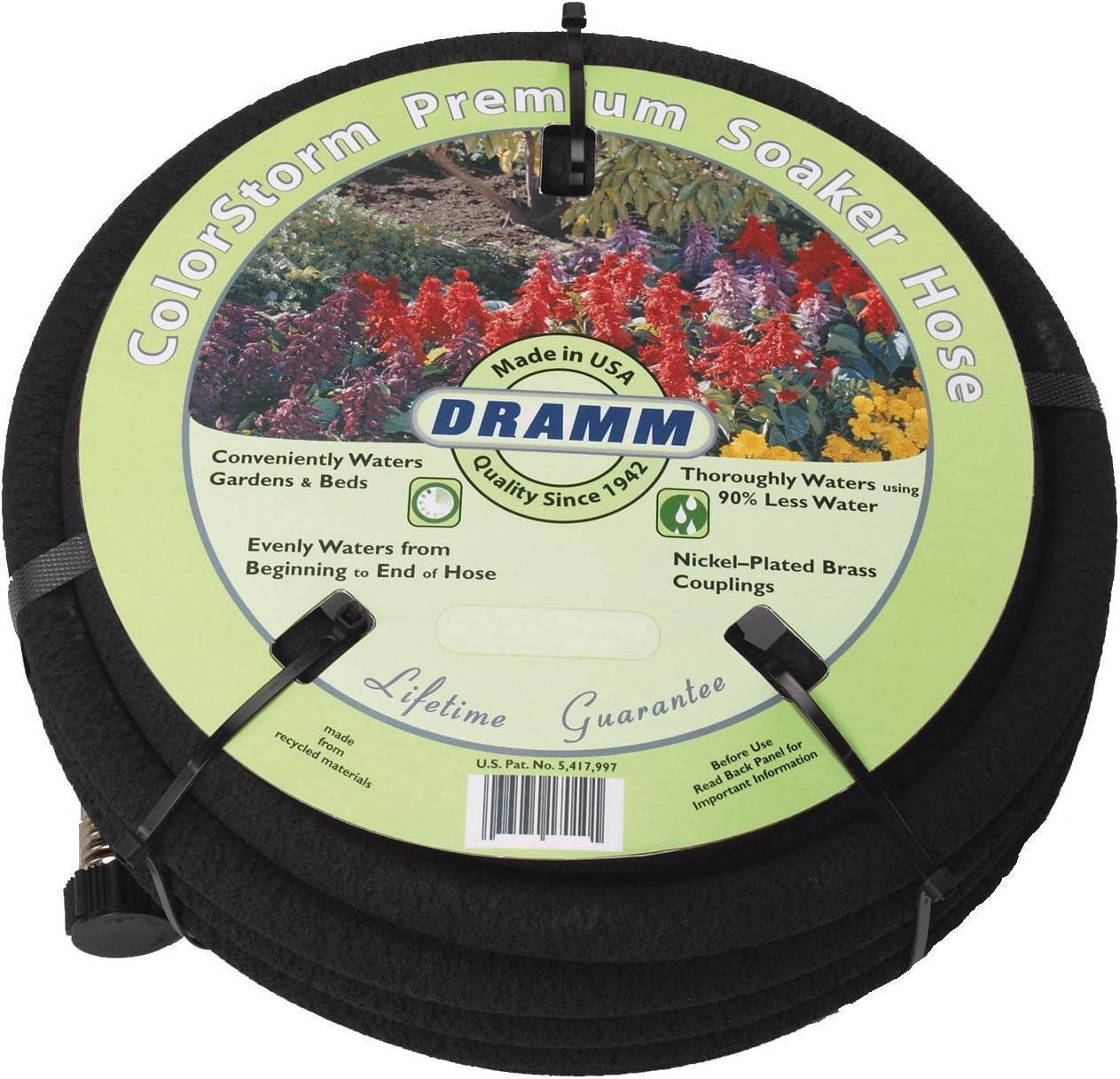
Dramm ColorStorm Premium 50 ft Soaker Garden Hose
| Item Type Name | Soaker Garden Hose |
|---|---|
| Item Length | 50 feet |
| Material Type | Rubber |
| Maximum Pressure | 518 psi |
| Included Components | Hose only |
The Dramm ColorStorm Premium 50 ft soaker hose is a heavy-duty rubber hose built to deliver slow, even watering along beds and borders. It is typically laid along planting rows or buried lightly under mulch and attached to a standard faucet; water soaks out through the hose length to feed roots rather than spraying the surface. Notable features include 50 percent thicker walls to reduce bursty geysering, crush-proof nickel-plated brass couplings for secure connections, and a high maximum pressure rating for durability. The construction and recycled-material content make it abrasion and kink resistant for season-to-season use, and the manufacturer backs it with a lifetime guarantee. Practical benefits are water savings from slow release irrigation, more consistent moisture for flowers and vegetables, and fewer wet leaves that can encourage disease. Important limitations are that soaker hoses require low water pressure and careful layout to achieve uniform coverage, and they are best for fixed beds rather than lawns or frequently reconfigured planting areas.
Best for: Gardeners who want a low-maintenance, water-efficient solution for permanent or semi-permanent flower beds and vegetable rows and who prioritize consistent root-zone moisture.
Less Ideal for: People needing a portable hose for lawn sprinkling, frequent bed rearrangement, or high-pressure tasks like power washing.
- Thicker rubber walls reduce spurting and promote steady seepage
- Crush-proof nickel-plated brass fittings for a reliable, leak-resistant connection
- Designed to use significantly less water than sprinkler watering
- Abrasion- and kink-resistant construction for longer life
- Made from recycled material and supported by a lifetime guarantee
- Requires low flow or pressure regulation to avoid uneven soaking
- Not suited for watering large turf areas or mobile irrigation needs
Verdict: Choose this hose if you want a durable, water-saving soaker that delivers steady root-zone watering for fixed garden beds.
MIXC 100ft Thickened Soaker Hose with Copper Connector

| Unit Count | 100 Feet |
|---|---|
| Nominal Wall Thickness | 1 millimeters |
| Material Type | Brass, Polyvinyl Chloride (PVC) |
| Maximum Pressure | 50 psi |
This MIXC soaker hose is built for steady, low-flow irrigation of vegetable beds and other planted areas. It uses a doubled wall thickness (1 mm) compared with many economy hoses, which reduces punctures and wear when dragged across rough ground. The hose includes brass/copper-style metal connectors and aluminum locking rings that hold fittings tightly and help prevent leak-prone plastic joints. A longer swivel handle on the connector makes attaching and turning the hose easier in tight spaces. In practice you lay it through rows or around raised beds and run low pressure water into it; the built-in seepage holes wet soil slowly and evenly without runoff. Important limitations to plan for are water-pressure sensitivity and recommended run length: the manufacturer advises keeping pressure below 50 psi and testing in 50 ft sections because flow falls off toward the far end. The hose is aimed at routine garden irrigation rather than high-pressure use or very long continuous runs, and you should use the included washers and a pressure regulator for the most reliable performance.
Best for: Gardeners who prefer a durable, low-maintenance soaker hose for regular vegetable bed irrigation and value reliability over lowest cost.
Less Ideal for: People who need to irrigate very large areas from a single long continuous hose run or who require frequent high-pressure flushing for emitters.
- Thicker 1 mm wall resists punctures and abrasion compared with typical 0.5 mm soaker hoses
- Metal (brass/copper) connector and aluminum locking rings reduce connection leaks and breakage
- Long swivel-handle connector eases attachment and prevents hose twisting during use
- Designed for slow, even seepage that minimizes runoff and conserves water
- Recommended maximum pressure and run length limit suitability for long continuous runs without additional supply/pressure management
- Flow can decrease toward the far end of a long lay so multiple sections or splitters may be needed for larger gardens
Verdict: Choose this hose if you want a tougher, leak-resistant soaker hose built for dependable vegetable garden irrigation.
MAMIZO 150 ft Soaker Hose Kit with Solid Brass Connectors

| Material Type | Brass, Rubber |
|---|---|
| Maximum Pressure | 50 psi |
| Included Components | soaker hose, tees, elbows, caps, connectors |
| Item Length | 1800 inches |
This MAMIZO 150 ft soaker hose kit is a long, heavy-duty rubber drip hose intended to supply slow seepage irrigation for gardens, beds and small farms. It connects directly to a standard outdoor faucet using the included 3/4" threaded solid brass connectors and comes with multiple barbed tees, elbows, caps and end fittings so you can route, branch, or cap lines without buying extras. The micro-hole construction releases water along the length to feed roots and can be buried 1–2 inches under soil or mulch to reduce evaporation and save water. Practical benefits include durable recycled rubber construction, rust-resistant end caps and a layout that scales by cutting or joining hoses to cover larger areas. Important limitations are that very long runs can suffer reduced pressure and lower seepage at the far end, so plan runs or add a splitter and keep runs within recommended lengths; the hose also needs sunlight warming or uncoiling to remove storage kinks before first use.
Best for: Buyers who prioritize efficient, hands-off watering and want a long, durable hose they can configure and expand for flower beds, vegetable rows, or small landscapes.
Less Ideal for: People needing pressurized, spray-style coverage or very long continuous runs without adding splitters or multiple supply points.
- Solid brass 3/4" threaded connectors resist leaks and are compatible with standard garden fittings
- Durable recycled rubber construction offers flexibility, elasticity and oxidation resistance
- Includes tees, elbows, caps and connectors to create branching layouts without extra purchases
- Designed for burial under 1–2 inches of soil or mulch to reduce evaporation and deliver water to roots
- Seepage at the far end of a 150 ft run can be noticeably reduced without higher supply pressure or splitters
- Requires uncoiling and warming to remove kinks after tight storage
Verdict: A practical, heavy-duty soaker hose kit that delivers efficient root-level watering and the fittings needed to build a configurable drip layout for beds and small gardens.
HZYOUMU 1/2" x 10 ft Round Soaker Hose

| Material Type | Rubber |
|---|---|
| Unit Count | 10 Feet |
| Maximum Pressure | 60 psi |
| Included Components | soaker hose |
This HZYOUMU 1/2" x 10 ft round soaker hose is a simple, no-frills option for giving plants steady, root-zone moisture. Designed to sit on or just below the soil surface, its evenly spaced seepage holes release water slowly along the 10-foot length, which helps reduce runoff and encourage deeper root growth. The hose uses thicker rubber material intended to resist cracking and wear and includes solid brass 3/4" connectors to minimize common leak points when joining to a faucet or linking multiple lengths. In practice it performs well for vegetable rows, flower beds, and raised planters where you need uniform coverage without complex setup. Expect straightforward installation and easy flexibility for shaping around plants. Limitations are the short 10 ft run if you have larger beds and the fixed seepage rate that may not suit very sandy or very clay soils without flow adjustments from a valve or timer. For basic, water-efficient bed irrigation this hose provides dependable performance for the cost-conscious gardener.
Best for: Gardeners who want a low-cost, easy-to-install solution for consistent root-level watering in small to medium beds and raised planters.
Less Ideal for: Not the best choice for irrigating large landscapes or for users who need adjustable emission rates built into the hose itself.
- Delivers slow, uniform watering along the entire 10 ft length to reduce runoff and encourage deep roots
- Thicker rubber construction for improved resistance to cracking and wear
- Solid brass 3/4" connectors reduce leaks and make linking hoses straightforward
- Only 10 feet long so multiple lengths may be needed for larger beds
- Fixed seepage rate may require external flow control for different soil types
Verdict: A dependable, budget-friendly 10 ft soaker hose that delivers steady root-level watering with durable rubber construction and brass connectors.
Water Right 700 Series Polyurethane Soaker Hose, 25 ft (1/2" ID)

| Material Type | Polyurethane |
|---|---|
| Unit Count | 25 Feet |
| Inner Diameter | 1/2" |
| Maximum Pressure | 150 psi |
| Included Components | End cap, fittings, strain reliefs |
The Water Right 700 Series soaker hose is built for steady, root-level irrigation in vegetable beds and compact garden plots. Install it along rows or weave it through raised beds and connect to a faucet or timer for long, low-pressure runs that soak soil rather than spray foliage. Its 1/2" inner diameter and porous wall produce a consistent weep from end to end, which reduces runoff and promotes deep root growth for vegetables. Polyurethane construction makes the hose light to handle, resistant to kinks and UV damage, and safe for edible gardens because it is free of lead, phthalates, and BPA. The hose comes with end fittings and an end cap so you can section beds and control flow, and the manufacturer recommends a filter if you have hard water to avoid mineral clogging. The main limitations are that a 25 ft length suits small to medium beds only and soaker hoses require careful placement and occasional unclogging compared with emitters or drip tubing for very long runs or precision single-plant feeding.
Best for: Gardeners who prioritize reliable, plant-safe irrigation and want a simple low-pressure solution for small to medium vegetable beds that promotes deep root watering.
Less Ideal for: Large-scale vegetable plots or gardeners who need precise per-plant emitters or very long continuous runs without connectors should consider alternative drip systems.
- Consistent end-to-end seep for even root-zone watering
- Made from drinking-water-safe polyurethane with no lead, phthalates, or BPA
- Resists kinking, cracking, and UV damage for season-to-season durability
- Includes end cap, fittings, and strain reliefs for straightforward installation
- 25-foot length may be too short for larger gardens without joining multiple sections
- Porous wall can clog with hard water minerals if an inline filter is not used
Verdict: Choose this hose if you want a durable, drinking-water-safe soaker hose that delivers consistent, root-focused watering for small to medium vegetable beds.
Rocky Mountain Goods Heavy-Duty Rubber Soaker Hose, 50 ft

| Material Type | Rubber |
|---|---|
| Item Length | 50 Feet |
| Nominal Wall Thickness | 0.125 inches |
| Outside Diameter | 0.5 inches |
This Rocky Mountain Goods soaker hose is a basic, durable option for delivering slow, deep watering to trees, shrubs, and flower beds. Made from recycled rubber, the hose lays along a planting root zone and seeps water evenly through its porous wall, which helps reduce evaporation and encourages deeper root growth. Reinforced quick‑attach fittings let you join additional lengths without special tools, and the included end cap keeps water flow contained when a line is not extended. The nominal wall thickness and rubber construction should resist kinking and hold up seasonally better than thin vinyl alternatives, although heavy clay or shifting soil can abrade any porous hose over time. It is not a pressurized dripper system so you should plan layout and run times manually to avoid overwatering small plants. For trees, place the hose in a ring or spoke pattern to encourage root spread and run it on a timer for consistent soak cycles.
Best for: Buyers who value a low‑risk, sturdy watering solution for established trees and beds and prefer a simple, reliable product that minimizes fuss and maintenance.
Less Ideal for: Those who need precise, adjustable drip emitters for young saplings or potted plants or who want a factory‑built pressureregulated irrigation system.
- Heavy recycled rubber construction for greater durability versus thin vinyl soaker hoses
- Porous wall provides slow, even seepage that promotes deep root watering
- Reinforced quick‑attach fittings allow straightforward extension of multiple lengths
- Includes end cap so unused ends can be closed without extra parts
- Porous soaker design requires manual timing or a separate timer to avoid overwatering
- Will eventually wear from abrasion or long seasonal exposure and may need replacement after several seasons
Verdict: A tough, no‑frills rubber soaker hose that reliably delivers slow, deep watering for trees and beds with easy extension using reinforced fittings.
Gilmour Round Soaker Hose with Heavy Duty Couplings, 3/8 inch x 25 ft

| Material Type | Rubber |
|---|---|
| Included Components | 25' Soaker Hose |
| Maximum Pressure | 60 psi |
| Brand Name | GILMOUR |
The Gilmour 3/8" round soaker hose is a simple, reliable option for targeted root-zone irrigation in raised beds, vegetable plots, and flower borders. It releases water slowly along its length at roughly 1/2 to 1 GPH per foot so plants receive consistent moisture without runoff or evaporation. Typical use is laying the hose along rows or weaving it through beds, covering with mulch or burying shallowly if you prefer a tidy look, and attaching it to a standard garden hose or timer for hands-off scheduling. Notable features include heavy duty push-on plastic couplings that let you cut and join sections, a clog-resistant cover for steadier soaking, and construction from recycled vinyl intended to resist UV and seasonal wear. Practical benefits are water savings and deeper root growth from steady delivery, plus straightforward installation and the ability to expand coverage as your garden changes. Important limitations are the modest flow rate designed for slow irrigation rather than fast filling or sprinkler replacement and the smaller 3/8" diameter that is best for shorter runs and beds rather than very large landscapes.
Best for: Gardeners who want a dependable, low-maintenance way to water raised beds and small-to-medium planting areas with minimal fuss and reliable performance.
Less Ideal for: People needing high-volume watering for large lawns or long-distance runs should consider higher-capacity hoses or dedicated drip systems instead.
- Even, low-rate water delivery that targets plant roots and reduces runoff
- Heavy duty push-on couplings allow cutting and connecting sections for custom layouts
- Compatible with standard hose timers for automated, hands-off irrigation
- Clog-resistant fabric cover and UV-resistant construction for season-to-season durability
- 3/8" diameter and low flow make it less suitable for very large areas or long runs
- Designed for slow soaking so it is not a replacement for high-volume watering tasks
Verdict: Choose this Gilmour soaker hose when you want a risk-free, efficient way to give beds and vegetable gardens consistent root-zone watering with easy installation and timer-ready automation.
Choosing the Right Round Soaker Hose: Key Factors to Consider
Flow Consistency and Pressure Sensitivity
How evenly a round soaker hose distributes water along its length is the most direct influence on plant health. A hose that emits water inconsistently will create wet pockets and dry patches, forcing you to move the hose frequently or water for longer periods. Pressure sensitivity matters because household water pressure varies. Some hoses work well at low pressure but over-deliver at higher pressure, while others require moderate pressure to seep properly. Think about the typical pressure at your spigot and whether you will use a pressure regulator or timer.
Material Durability and UV Resistance
Soaker hoses are often exposed to sun, mulch, soil contact, and foot traffic, so the hose material must resist cracking and abrasion. Hoses with thicker walls or reinforced construction hold up better season-to-season and tolerate being left in place under mulch. UV-stabilized materials slow degradation from sunlight if you plan to leave the hose above ground for extended periods. Durability also affects how easy the hose is to roll up and store; brittle materials can split during handling.
Clog Resistance and Internal Construction
Clogs diminish seepage and create uneven watering. Hoses that rely on finely porous walls can be more susceptible to mineral buildup, especially with hard water, while designs with larger, distributed emitter channels are easier to flush. Consider whether the hose can be backflushed or is compatible with inline filters. Maintenance needs, such as occasional flushing and winter draining, depend on how the internal structure handles sediments and mineral deposits.
Connector Fit and Compatibility
Quick, leak-free connections matter for both setup and long-term use. Standard threaded fittings, compatibility with common timers, and adapters for drip fittings make a hose easier to integrate into an existing irrigation layout. Hose ends that accept barbed fittings or have reinforced ferrules reduce failure points. If you intend to join multiple lengths, check whether couplers and repair pieces are readily available and easy to use without special tools.
Flexibility, Kinking, and Handling
The hose must bend around beds, shrubs, and container groupings without kinking or closing off flow. Flexibility is also important during storage; stiff hoses are harder to coil and more likely to crease. Kink-resistant construction and a pliable wall let you shape the hose into serpentine patterns or ring a planter without interrupting seepage. Handling also affects installation time – lighter, more flexible hoses are easier to lay out and reposition when seasonally adjusting plantings.
Where Round Soaker Hoses Work Best
Round soaker hoses are ideal for long, linear beds, vegetable rows, and borders where you want slow root-zone watering with minimal surface runoff. Their circular cross-section and porous wall design allow you to snake a single length through several plants or loop around raised beds to deliver water where it is most needed.
- Use along the base of perennials and shrubs to reduce wetting foliage
- Lay under a light layer of mulch to reduce evaporation and protect hose material
- Pair with a simple timer for mornings or evenings to maximize uptake and minimize fungal risk
Installation Tips for Reliable Performance
Position the hose close to plant roots and test-run the system before burying or mulching. Run the hose for a short period and walk the length to confirm even seepage. If you notice dry spots, try adjusting spacing, adding a second parallel run, or using a low-pressure regulator to even flow.
Avoid tight bends that create kinks. Use gentle curves and anchor the hose with landscape pins or stakes every few feet to keep it in place. If you plan to connect multiple lengths, install a coupler designed for soaker systems and check for leaks at each joint.
- Flush the hose before first use to remove manufacturing debris
- Install a pressure regulator when using a garden hose faucet with high pressure
- Test run for 10 to 20 minutes and inspect for wet and dry patterns
Winter Care and Storage
Drain and store the hose in a cool, shaded place if freezing temperatures are expected. Water left inside can expand and crack the hose wall. If you prefer to leave the hose in place, disconnect it from water and ensure it is emptied of standing water. Winding the hose loosely prevents creases that can lead to weak points the next season.
- Coil loosely on a reel or in large loops to avoid sharp creases
- Keep out of direct sun during storage to extend material life
- Inspect for small cracks or brittle sections before reusing in spring
Reducing Clogs and Maintenance Routine
Regular flushing is the simplest maintenance step. Periodically disconnect the hose and run water through to push out sediment. If you have hard water, use an inline filter at the spigot to capture mineral particles before they reach the porous wall.
If buildup appears in old hoses, try a soaking flush with mild vinegar solution to dissolve scale, then rinse thoroughly. Replace short damaged sections with repair couplers rather than replacing the entire length to extend usable life.
- Install a screened filter at the faucet for mineral-heavy water
- Backflush with clean water after long idle periods
- Repair localized damage with barbed couplers to restore flow
Pairing Soaker Hoses with Timers and Watering Schedules
A timer simplifies consistent, short-duration runs that match the slow seepage rate of a round soaker hose. Short morning or evening cycles reduce evaporation and let the root zone absorb moisture. Frequency depends on soil type and plant needs: sandy soils need more frequent runs than heavier clay soils.
Monitor soil moisture with a probe or finger test after irrigation sessions to avoid overwatering. Adjust the number and length of cycles seasonally and when plants are establishing versus mature.
- Start with short runs and increase if soil remains dry below the surface
- Use multiple short cycles rather than one long soak to improve penetration
- Check soil 2 to 4 inches down to gauge effectiveness
How We Chose the Best Round Soaker Hose
We focused on attributes that matter when a gardener needs slow, reliable root-zone irrigation from a round soaker hose. First, we assessed flow consistency across typical garden pressures so hoses provide even moisture without frequent adjustments. Second, material durability was evaluated for resistance to UV, abrasion, and long-term cracking since hoses often sit exposed or under mulch. Third, we considered clog resistance and internal construction because emitters or porous walls that block easily reduce effectiveness. Fourth, ease of installation and connector compatibility were weighed to ensure the hose integrates with common spigots, timers, and fittings. Finally, we evaluated flexibility and kink resistance so the hose can follow beds and curves without interrupting flow. We excluded products intended only for sub-surface drip lines or specialty commercial irrigation that do not behave like conventional soaker hoses. We also excluded hoses lacking basic connector compatibility or clear material specs. The final shortlist balances even water delivery, durability, clog resistance, installation ease, and handling for home and small-scale vegetable gardens.
FAQ
Can I leave a round soaker hose under mulch all season?
Often you can leave it under mulch for a season; mulch reduces evaporation and protects the hose from sun. Make sure the hose material is rated for exposure and periodically check for pinholes or crush damage. Drain before winter if freezing conditions occur.
How long should I run a soaker hose each time?
It depends on soil and plant type. Start with 30 to 60 minutes for heavier soils and 15 to 30 minutes for sandy soils, then check moisture 2 to 4 inches down. Adjust run times rather than increasing pressure to even out watering.
Will hard water clog a soaker hose?
Hard water can increase mineral buildup over time, especially in fine-porous-wall designs. Using an inline filter at the spigot and flushing the hose regularly reduces the risk of clogging and prolongs useful life.
Can I connect multiple lengths of round soaker hose together?
Yes, you can join lengths with appropriate couplers made for soaker systems. Keep runs to practical lengths to avoid pressure loss and place couplers where you can access them for maintenance.
Is it better to bury a soaker hose or leave it on top of the soil?
Burying under a thin layer of mulch usually improves water efficiency by reducing evaporation and protecting the hose. On top of soil is fine for temporary setups or containers but expect more surface evaporation and slightly faster wear from sun exposure.
Final Verdict
Choose a round soaker hose by prioritizing how evenly it distributes water and how well it resists UV, abrasion, and clogging. Match the hose flexibility and connector options to your garden layout and planned fittings so installation is simple and reliable. Expect to maintain performance with periodic flushing, pressure regulation, and winter draining. Focus on flow consistency and durability for the most trouble-free root-zone irrigation; that balance will give the best long-term results for beds, rows, and containers.
