

Note: This article contains affiliate links. If you click on these links and make a purchase, I may earn a small commission at no extra cost to you. This helps support my research and content. Read my full affiliate disclosure here.
If you grow herbs, houseplants, or a few seed trays indoors, the right Screw in LED Grow Light can make a noticeable difference in growth and health. These bulbs install into standard fixtures and give targeted light where sunlight is limited. Picking the right option matters because spectrum balance, canopy coverage, and heat output affect plant stretch, flowering, and leaf color in a real home or small grow tent. This guide shortlists seven top-rated screw in LED grow lights and evaluates them against the practical criteria indoor gardeners care about, including spectrum, intensity, heat, and ease of use. Read on to see which features matter for your setup and which tradeoffs to expect before you pick a bulb for your space.
Top Picks at a Glance
| Best Overall The best all-around choice for most situations | SANSI 15W Full Spectrum A19 LED Grow Light Bulb (E26) |  |
| Best Quality Built to a higher standard if you want something more solid | SANSI 24W Full Spectrum 4000K LED Grow Light Bulb |  |
| Best Value The sweet spot between price and what you get | SANSI PAR20 10W Full Spectrum LED Grow Light Bulb (E26), 2-Pack |  |
| Best Budget The cheapest option that still gets the job done reliably | mfxmf A19 Full-Spectrum LED Grow Light Bulb, 9W (2-Pack) |  |
| Most Popular A crowd favorite that many people choose with confidence | Briignite A19 Full Spectrum LED Grow Light Bulb (2-Pack) |  |
| Best Seller A high-volume bestseller chosen again and again | Briignite A19 Full-Spectrum LED Grow Light Bulbs (4-pack) |  |
SANSI 15W Full Spectrum A19 LED Grow Light Bulb (E26)

| Wattage | 15 watts |
|---|---|
| Bulb Base | E26 |
| Color Temperature | 4000 Kelvin |
| Light Source Operating Life | 25000 hours |
| Color Rendering Index | 95 |
This SANSI A19 grow light bulb is a screw-in LED designed to replace a standard lamp bulb while delivering plant-focused, full-spectrum light. It produces natural 4000K daylight with a high CRI for accurate color rendition and a reported PPFD/PPF suitable for small-scale indoor setups. Typical use is simple: screw it into an E26 fixture above seedlings, herbs, or small houseplants and run on a daily schedule to supplement light. Notable features include a ceramic Chip-on-Ceramic (COC) design for improved heat dissipation and longevity, an optical lens to concentrate usable light, and ETL listing plus a five-year protection plan. Practical benefits are easy installation, lower energy draw compared with incandescent equivalents, and eye-friendly daylight that makes plants look natural at home. Limitations to consider are that the bulb is not dimmable, its 60-degree beam and single-bulb output suit close, small footprints rather than wide area coverage, and lifespan claims are typical for LEDs but will depend on operating environment.
Best for: Buyers who want a simple, low-effort upgrade from a household bulb to a plant-focused light for seedlings, herbs, or a few houseplants and prefer plug-and-play installation over complex fixtures.
Less Ideal for: Growers who need wide coverage, adjustable intensity, or multi-bulb professional setups for large shelves or flowering crops should look at higher-output fixtures.
- Full-spectrum 4000K output mimics natural daylight and is easy on the eyes
- Ceramic COC construction for improved heat dissipation and longer service life
- Screws into a standard E26 socket for plug-and-play installation
- High CRI (95) for accurate plant and leaf color rendering
- Not dimmable, so light intensity cannot be adjusted for different growth stages
- 60-degree beam angle and modest PPFD limit effective coverage to small areas
Verdict: A convenient screw-in full-spectrum grow bulb that delivers natural daylight and reliable heat management for small indoor plant setups.
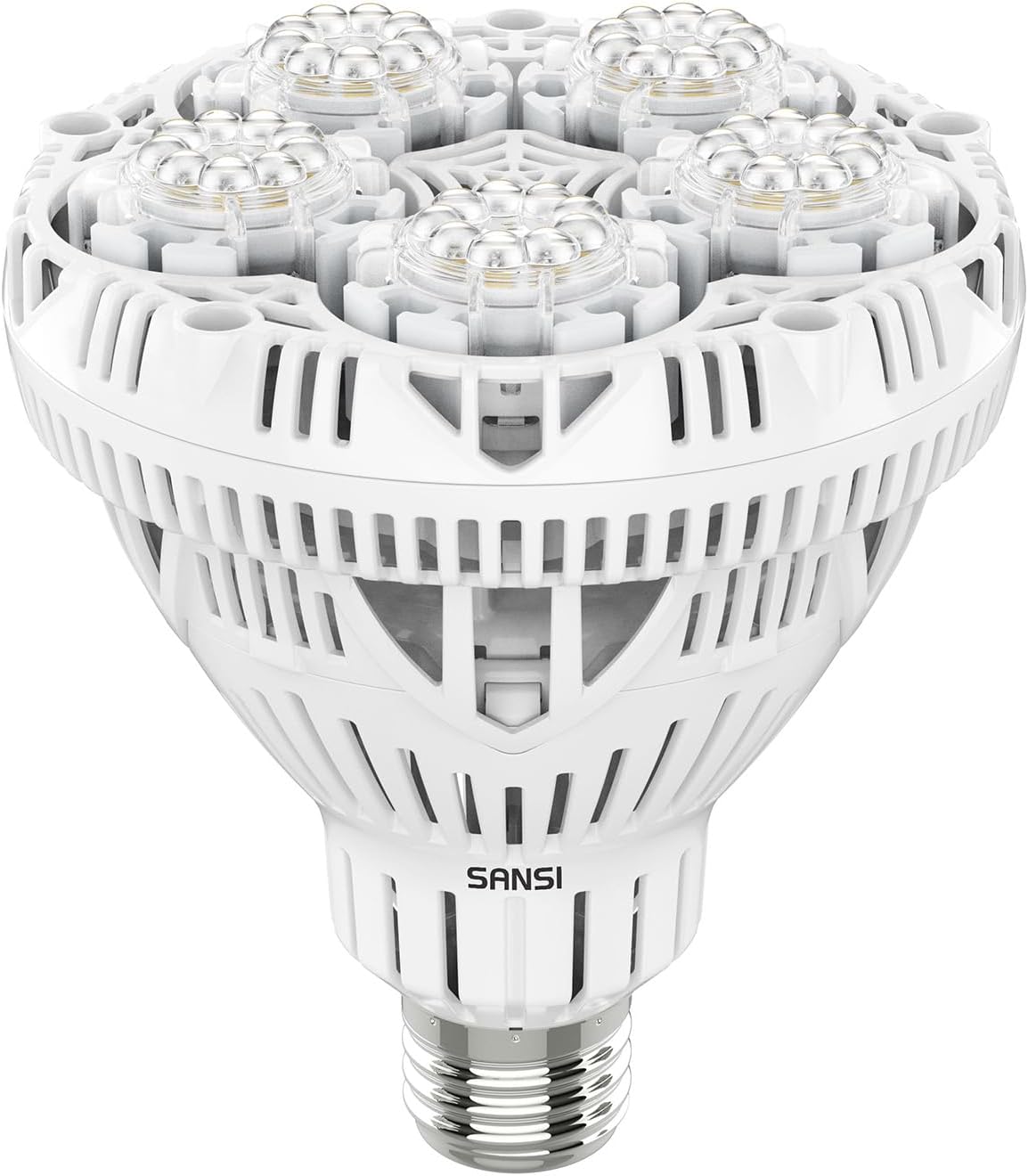
SANSI 24W Full Spectrum 4000K LED Grow Light Bulb
| Wattage | 24W |
|---|---|
| Color temperature | 4000K |
| PPF | 36.2 μmol/s |
| PPFD @1ft | 177.06 μmol/m²/s |
| Rated life | 25,000 hours |
The SANSI 24W full-spectrum LED grow bulb delivers a daylight-balanced 4000K spectrum intended to support every stage of plant growth. It installs like a regular screw-in bulb and uses a patented Chip on Ceramic design to move heat away from the LED junction, which helps the lamp run cooler and sustain light output over time. Measured output figures in the listing indicate a PPF of about 36.2 μmol/s and a PPFD around 177 μmol/m²/s at one foot, making it a practical supplemental fixture for seedlings, herbs, and small container setups. The secondary optical lensing improves light distribution so plants get more usable photons without concentrating heat directly on foliage. Build quality emphasizes safety and longevity with ceramic construction, ETL listing, and a 25,000-hour life estimate backed by a five-year protection plan. Limitations are its modest total photon output compared with larger integrated grow fixtures and the single 4000K spectrum that may not match specialized spectrum needs for flowering optimization.
Best for: Growers who want a high-quality screw-in bulb to reliably supplement light for seedlings, herbs, or small indoor containers and who prioritize long-term performance and safety.
Less Ideal for: Large-scale growers or anyone needing high total light output or specialized bloom/flower spectra for intensive flowering stages.
- Full visible-spectrum output (400–780 nm) for use across all plant growth stages
- Patented Chip on Ceramic design for improved thermal transfer and reliability
- Secondary optical lens increases usable light delivery and even distribution
- ETL listed with a stated 25,000-hour life and five-year protection plan
- Total PPF is modest compared with larger dedicated grow fixtures so coverage area is limited
- Single 4000K spectrum may not satisfy growers seeking tailored veg/flower spectra
Verdict: This screw-in LED grow bulb is a performance-minded choice for growers who need reliable, evenly distributed full-spectrum supplemental light in small indoor setups.
SANSI PAR20 10W Full Spectrum LED Grow Light Bulb (E26), 2-Pack

| Wattage | 10 watts |
|---|---|
| Bulb Base | E26 |
| Color Temperature | 4000 Kelvin |
| Color Rendering Index | 95 |
| Light Source Operating Life | 25000 hours |
The SANSI PAR20 10W grow bulb is a low‑power, full‑spectrum LED intended to give houseplants extra light without the heat or bulk of a fixture. It screws into a standard E26 socket and delivers a 4000K balanced spectrum with a high CRI of 95, making foliage colors appear natural while supporting all growth stages. The 60 degree beam and a reported PPFD/PPF profile concentrate usable light on a small area, so these bulbs work well over single pots, plant shelves, or in desk lamps. Ceramic construction and a claimed 25,000 hour life help with durability and heat management, and the bulbs run on regular AC mains with a simple push‑button control. Limitations are its modest lumen output (about 215 lumens) and narrow beam, so you will need multiple bulbs or closer placement for larger plants or multi‑shelf setups. Also the PAR20 form factor gives less canopy coverage than larger PAR25 or PAR30 grow bulbs. For balanced, low‑maintenance supplemental lighting these bulbs are practical, but plan placement and quantity to match your plant group size.
Best for: Buyers who want an easy, energy efficient supplemental light for a few houseplants or a small plant shelf and value natural-looking foliage under a simple screw‑in solution.
Less Ideal for: People needing high‑coverage lighting for multiple large plants, full grow tents, or commercial propagation should consider higher‑output fixtures instead.
- Full spectrum 4000K light with CRI 95 for natural color rendering and all growth stages
- Standard E26 base fits regular lamps and fixtures for easy setup
- Ceramic COC design and 25,000 hour rated life for improved heat dissipation and durability
- Low 10W power draw provides energy efficient supplemental lighting
- Low lumen output and a 60° beam limit coverage, requiring multiple bulbs for larger setups
- Not optimized for large grow tents or wide canopy applications
Verdict: A compact, energy‑saving full‑spectrum screw‑in bulb that is ideal for supplementing light for a few houseplants or a small shelf.
mfxmf A19 Full-Spectrum LED Grow Light Bulb, 9W (2-Pack)

| Wattage | 9 watts |
|---|---|
| Bulb Base | E26 |
| Incandescent Equivalent Wattage | 100 watts |
| Light Color | Red/Blue |
| White Brightness | 1600 lumens |
These mfxmf A19 grow bulbs are straightforward plug-and-play LEDs that aim to replace a 100W incandescent while using only 9W each. Screw them into any standard E26 socket and position 2–4 feet above seedlings, herbs, or potted vegetables to provide a mix of red (630 nm) and blue (460 nm) wavelengths plus broad spectrum output for general growth. Notable features include 1600 lumens white-brightness equivalent, a claimed 20,000-hour life, and a plastic and aluminum cooling structure to manage heat during long runs. Because they are standard bulb shape and voltage compatible with household fixtures, they work well in small grow tents, windowsill setups, and kitchen herb stations without extra hardware. Limitations are typical for A19 bulbs: light is directional and less intense than purpose-built panel fixtures for dense canopies, and the plastic construction is not as rugged as commercial units. These are a practical, low-energy option when you need simple supplemental lighting or a budget first step into indoor growing.
Best for: Buyers who want an inexpensive, easy-to-install way to add supplemental or starter grow lighting for herbs, seedlings, and small indoor plants without changing fixtures.
Less Ideal for: Users planning a larger canopy, multi-tier grow tent, or high-light crops who need higher intensity, uniform coverage should choose purpose-built grow panels instead.
- Full-spectrum output with dedicated red and blue wavelengths suitable for all growth stages
- E26 A19 form factor installs in standard household sockets with no extra fixtures
- Low power draw at 9W while advertising a 100W incandescent equivalent for energy savings
- Claimed 20,000-hour lifetime and cooling elements to support longer continuous use
- Less concentrated light output than dedicated LED panels, so multiple bulbs needed for larger or dense plantings
- Plastic construction is less durable than metal-bodied professional grow lights
Verdict: A low-cost, easy-to-use full-spectrum bulb solution for beginners and anyone needing simple supplemental indoor lighting.
Briignite A19 Full Spectrum LED Grow Light Bulb (2-Pack)

| Light Type | LED |
|---|---|
| Additional Features | Full Spectrum |
| Bulb Base | E26 |
| Light Output Maximum | 1000 lumens |
| Light Source Operating Life | 30000 hours |
These Briignite A19 grow bulbs are full-spectrum LED replacements that screw into any standard E26 fixture to give indoor plants consistent, natural-looking light. Each bulb outputs about 1000 lumens at roughly 11 to 12 watts, so they act like a 60 to 100 watt incandescent while using far less energy, which is handy for running multiple bulbs on a budget. The 3500–4000K warm daylight color and high CRI make foliage colors appear normal rather than the purple hue of some grow lights, so they work well in living spaces and plant shelves. Built-in features include app control and push-button options and an advertised 25,000 to 30,000 hour operating life. Limitations to note are modest reported PPF compared with purpose-built high‑output grow fixtures and the 180 degree beam, which is better for general room lighting than targeted canopy penetration for dense or tall plants. For small collections, seed starting, or supplementing light in low-light rooms these bulbs are an economical, easy-to-install choice.
Best for: Houseplant owners who need an affordable, plug-and-play light to supplement natural light for a few pots, seedlings, or a small indoor garden while keeping energy costs low.
Less Ideal for: Growers aiming to flower large or dense canopy crops or outfitting multi-tiered grow racks will want higher‑PPF, purpose-built fixtures instead.
- Full spectrum output that looks like natural white light and preserves true foliage color
- Low power draw (around 11–12W) with 1000 lumens brightness for energy-efficient continuous use
- Standard E26 base fits common fixtures for tool-free installation
- High CRI of 90 helps accurate color rendering in living spaces
- Beam angle and lumen-focused design give less concentrated PAR/PPF than dedicated high‑output grow fixtures
- App and push-button controls are basic compared with advanced programmable controllers
Verdict: A low-cost, easy-to-install full-spectrum LED bulb that gives natural-looking light and energy savings for small indoor plant collections.
Briignite A19 Full-Spectrum LED Grow Light Bulbs (4-pack)

| Light Type | LED |
|---|---|
| Wattage | 11 watts |
| Bulb Base | E26 |
| Color Temperature | 3500 Kelvin |
| Light Output Maximum | 1000 lumens |
These Briignite A19 grow bulbs are standard E26 LED replacements that deliver a full-spectrum light (listed at 3500–4000K appearance) and roughly 1000 lumens at 11 watts, so they run cool and are energy efficient compared with incandescent equivalents. They screw into any standard lamp or fixture and are typically used to supplement light for leafy houseplants, herbs, and fruiting vegetables in low-light rooms or during short winter days. Notable features include full-spectrum output that avoids the purple look of many grow lamps, a wide 180 degree beam for even coverage, and an advertised long operating life around 25,000 to 50,000 hours. Practical benefits are simple plug-and-play installation, lower electricity use, and a natural-looking light that blends with home lighting. Important limitations are that these bulbs are non-dimmable and have no built-in timer or adjustable spectrum, so they are best for basic supplemental use rather than a full controlled grow setup; the stated PAR/PPF figures are modest and may not be enough for heavy fruiting or larger grow tents.
Best for: Buyers who want a low-risk, easy-to-use grow light to keep houseplants, herbs, or small veggie starts healthy without rewiring or specialty fixtures.
Less Ideal for: Serious hobbyists or small-scale growers who need dimming, timed cycles, or higher-intensity lights for full-cycle fruiting and larger grow tents should consider purpose-built fixtures instead.
- Full-spectrum output that appears natural indoors rather than purple grow light
- Standard E26 A19 base for easy plug-and-play installation in household fixtures
- High lumen output (about 1000 lm) at low power draw (11 W) for energy savings
- Wide 180 degree beam angle for even coverage across small plant groups
- Non-dimmable and no built-in timer or spectrum control
- Advertised PAR/PPF is modest and may be insufficient for heavy fruiting or dense canopy setups
Verdict: A simple, energy-efficient full-spectrum A19 bulb that lets you supplement houseplant light with minimal setup and a natural-looking output.
Choosing the Right Screw in LED Grow Light: Key Factors to Consider
Light Spectrum
Spectrum determines which wavelengths reach plant leaves and drives different growth stages. Blue-rich output encourages compact, sturdy vegetative growth while red-rich output supports flowering and fruiting. For single-bulb setups used across the plant life cycle, a full-spectrum or combined blue-plus-red balance reduces the need to swap bulbs between phases.
Spectrum claims can be described as "full spectrum," but what matters is usable photosynthetic light in the 400-700 nm range. Look for bulbs that provide balanced peaks in the blue and red regions or offer switchable modes if you plan to run a single lamp through multiple growth stages.
Photosynthetic Output and Intensity
Total light available at the canopy, commonly expressed as PAR or PPFD in test data, determines how productive plants will be under the bulb. Higher intensity is required for fruiting or flowering crops, while seedlings and foliage plants do well with lower levels. Because screw-in bulbs sit close to plants, consider the recommended hanging height and expected coverage area to understand real-world intensity.
For many indoor gardeners using a single screw-in bulb, focus on expected usable area and whether the bulb can deliver adequate light at a realistic distance without causing stretch. If PPFD figures are not provided, use wattage and beam angle as secondary indicators while acknowledging they are imperfect proxies.
Coverage Pattern and Beam Angle
Beam angle determines how light spreads across pots or trays. Narrow beams concentrate photons into a small footprint, raising intensity directly beneath the bulb but leaving edges dim. Wide beams produce broader, more even coverage but with lower intensity per square foot. The layout of your grow area and number of plants should dictate the preferred beam pattern.
In small shelves or single-pot setups, a moderate to narrow beam can be effective when positioned correctly. For multi-pot racks or wider trays, a wider beam or multiple bulbs positioned for overlap will give more uniform results.
Heat Output and Thermal Safety
Although LEDs run cooler than many other lamp types, higher-power screw-in bulbs can still produce heat that affects leaves and small enclosures. Heat management matters for plant safety and for the longevity of the fixture and surrounding materials. Check for reported operating temperatures, any mention of active or passive cooling, and whether the bulb is rated for enclosed fixtures.
When using bulbs in grow tents or close to foliage, allow clearance and monitor leaf edges for heat stress. Consider models with better heat sinks for continuous use or look for lower-wattage options when ventilation is limited.
Socket Compatibility and Build Quality
Screw-in LED grow lights must fit standard fixtures and handle repeated on-off cycles without loose connections. Confirm bulb base type, recommended fixture ratings, and whether the product is safe for use in damp or humid environments if you plan to mist plants or work in a greenhouse-like area.
Durable housings and secure heat sinks extend bulb life. Bulbs with replaceable components are rare, so choose a well-built unit up front to avoid frequent replacements.
Controls and Usability
Easy-to-use features such as built-in timers, dimming, or switchable spectrum modes make daily management simpler. Dimmable bulbs let you adjust intensity for seedlings or mature plants without changing distance. Timer functionality or plug-in timers reduce manual intervention and help maintain consistent photoperiods.
However, added features can increase complexity and sometimes reduce durability. Opt for straightforward controls that match how much hands-on adjustment you plan to do.
Best Uses for Screw In LED Grow Lights
Screw in LED grow lights excel in small-scale situations: single pots on a windowsill, a rack of seed trays, or a compact grow tent. Their simple installation means you can upgrade an ordinary lamp or overhead fixture without rewiring or extra fixtures.
They are particularly useful for supplementing low natural light, providing targeted light where sun does not reach, or running multiple short photoperiods for seedlings and clones. Choose wattage and beam angle according to plant spacing to avoid hotspots or stretched plants.
- Ideal for seedlings, herbs, and low-stature ornamentals
- Good for supplementing light near windows or in enclosed cabinets
- Not a replacement for full-size fixtures in large or high-light flowering grows
Mounting and Placement Tips
Mount bulbs in a stable fixture with the correct socket and keep them level to avoid strain on the base. Position the bulb so the canopy receives even light; a simple adjustable lamp arm can help dial in distance and angle.
Measure distance during a trial run. Start bulbs higher and lower them over a few days while watching for signs of stretch or leaf cupping. For multiple pots, reposition plants or bulbs to find the most uniform spread.
- Start with the manufacturer recommended height and adjust based on plant response
- Rotate plants periodically to counter any uneven coverage
- Use reflectors or light-colored walls to improve efficiency in tight spaces
Managing Photoperiods and Dimming
Most indoor plants benefit from consistent daily light cycles. Use a timer with screw-in bulbs to automate light and dark periods. If the bulb supports dimming or multiple spectrum modes, reduce intensity for seedlings and gradually increase as plants mature.
A smooth ramp up of intensity is not necessary for most hobbyists, but abrupt changes in daily hours can stress some species. Keep notes on how plants respond when altering schedule or intensity so you can reproduce successful routines.
- Timers simplify consistent schedules
- Dimming is useful to avoid moving bulbs when adjusting intensity
- Keep photoperiod changes gradual when possible
Safety and Fixture Considerations
Double-check that fixtures and lamp holders are in good condition and rated for the bulb's wattage. Avoid using bulbs in fixtures marked for lower maximum wattage or in damaged sockets. Ensure proper airflow if running bulbs for many hours in an enclosed cabinet or tent.
Use bulbs with appropriate safety listings for indoor use and avoid placing them near flammable materials. In humid or mist-prone setups, confirm that the product is suitable for damp environments or located where moisture will not contact electrical parts.
- Confirm fixture ratings and socket integrity
- Provide ventilation for longer photoperiods
- Keep bulbs away from direct contact with water or wet foliage
When to Upgrade From a Screw In Bulb
If you expand to multiple medium-to-large plants, target higher light demands, or need uniform coverage across a multi-level rack, consider moving to dedicated strip fixtures or panel lights. Screw-in bulbs are compact and convenient, but their practical coverage and heat handling set limits.
Upgrade when PPFD needs increase beyond what a single or a few bulbs can provide efficiently. Larger fixtures also offer easier spectrum control across a broad canopy and often include integrated cooling suitable for continuous operation.
- Upgrade for heavier flowering crops or denser canopy footprints
- Switch to panels when you need predictable, measured output across larger areas
- Retain screw-in bulbs for supplemental or portable lighting
How We Chose the Best Screw in LED Grow Light
We focused on attributes that directly influence plant health and everyday usability in small indoor setups. Our selection prioritized bulbs designed to fit common screw-in fixtures and deliver usable photosynthetic light rather than decorative glow. We evaluated spectral balance to ensure adequate blue and red output for vegetative and flowering phases, measured or reported light intensity aimed at typical canopy heights, and assessed beam angle and usable coverage for pots, trays, and compact tents. Thermal performance was considered to avoid bulbs that require extra ventilation in small enclosures. Build quality and socket compatibility were reviewed for safety and longevity, and any additional features such as dimming, adjustable spectrum, or timers were noted. We excluded decorative LED lamps with minimal PAR output, full-size fixtures that do not screw into standard sockets, and products lacking basic safety ratings. Our filters yielded seven well-suited screw-in LED grow lights that represent a range of spectrum control, power levels, and form factors appropriate for small-space indoor gardening.
FAQ
How close should I place a screw in LED grow light to my plants?
It usually depends on bulb wattage and beam angle. Start at a moderate distance recommended by the manufacturer and observe plants for stretch or leaf cupping. For many screw-in bulbs, 6 to 18 inches is a common starting range, then adjust based on plant response.
Can I use a screw in LED grow light in an enclosed fixture or cabinet?
Some bulbs are rated for enclosed fixtures while others are not. Enclosed spaces trap heat, so choose a bulb with good heat dissipation or ensure ventilation. If unsure, provide airflow and monitor operating temperature and plant leaves for signs of heat stress.
Are dimmable screw in LED grow lights worth it?
Dimming is helpful if you plan to run the same bulb through seedling and flowering phases or want to reduce intensity without changing bulb height. It adds flexibility but may increase cost and complexity. For simple setups, fixed output bulbs often suffice.
Do I need a full-spectrum bulb for herbs and houseplants?
Full-spectrum bulbs are convenient because they provide a balance of blue and red wavelengths that support general growth. Many herbs and common houseplants thrive under a balanced spectrum, though some growers prefer slightly cooler light for leafy crops and warmer light for flowering.
How many screw in bulbs will I need for a seed tray?
That depends on bulb beam angle, wattage, and tray size. For small trays, one well-placed bulb may be adequate. Larger trays usually need multiple bulbs or a wider beam to avoid uneven growth. Assess coverage by checking light intensity across the tray surface.
Will screw in LED grow lights run hot and harm my plants?
LEDs generally run cooler than many other lamp types, but higher-power screw-in bulbs can still emit noticeable heat. Proper spacing and ventilation prevent leaf scorch. Monitor plants near the bulb and reduce runtime or increase distance if you see heat-related damage.
Final Verdict
Screw in LED grow lights are a practical, low-fuss solution for small indoor gardening tasks. Prioritize a bulb that delivers an appropriate spectrum for your crop, enough usable intensity at the distance you plan to run it, and a beam angle that matches your canopy layout. Consider heat management and socket compatibility to avoid safety or longevity issues. If you need compact, supplemental, or portable lighting, screw-in bulbs offer an economical and flexible choice. When your light needs grow in scale or intensity, plan to transition to larger fixtures that provide measured, uniform output across expanded plantings.
