

Note: This article contains affiliate links. If you click on these links and make a purchase, I may earn a small commission at no extra cost to you. This helps support my research and content. Read my full affiliate disclosure here.
You want weeds out and grass intact. Selecting the right selective herbicide for lawns matters because these products target broadleaf invaders while leaving desirable turfgrass to recover and thicken. The wrong choice can scorch or weaken your lawn, underperform on persistent species, or require inconvenient reapplication timing. This guide covers seven top shortlisted selective herbicides for lawns and explains the performance and safety traits that matter in real lawns, yards, and turf areas. We evaluate turf safety, weed kill spectrum, ease of application, and environmental considerations so you can pick the option that best fits your lawn care routine.
Top Picks at a Glance
| Best Overall The best all-around choice for most situations | PBI Gordon T-Zone Turf Herbicide, 1 Quart |  |
| Best Quality Built to a higher standard if you want something more solid | Tenacity Turf Herbicide, 8 fl oz (Mesotrione) |  |
| Best Value The sweet spot between price and what you get | Ortho WeedClear Lawn Weed Killer Concentrate, 32 fl. oz. |  |
| Best Budget The cheapest option that still gets the job done reliably | Spectracide Weed Stop for Lawns Plus Crabgrass Killer Concentrate, 32 oz |  |
| Highest Rated A top-rated pick with lots of positive feedback | Target 6 Plus (MSMA 48.2%) Turf Herbicide, 2.5 Gallon |  |
| Most Popular A crowd favorite that many people choose with confidence | Ortho WeedClear Lawn Weed Killer Ready-to-Spray, 32 fl. oz. |  |
| Best Seller A high-volume bestseller chosen again and again | Roundup for Lawns Ready-to-Use with Extendable Wand, 1.33 gal. |  |
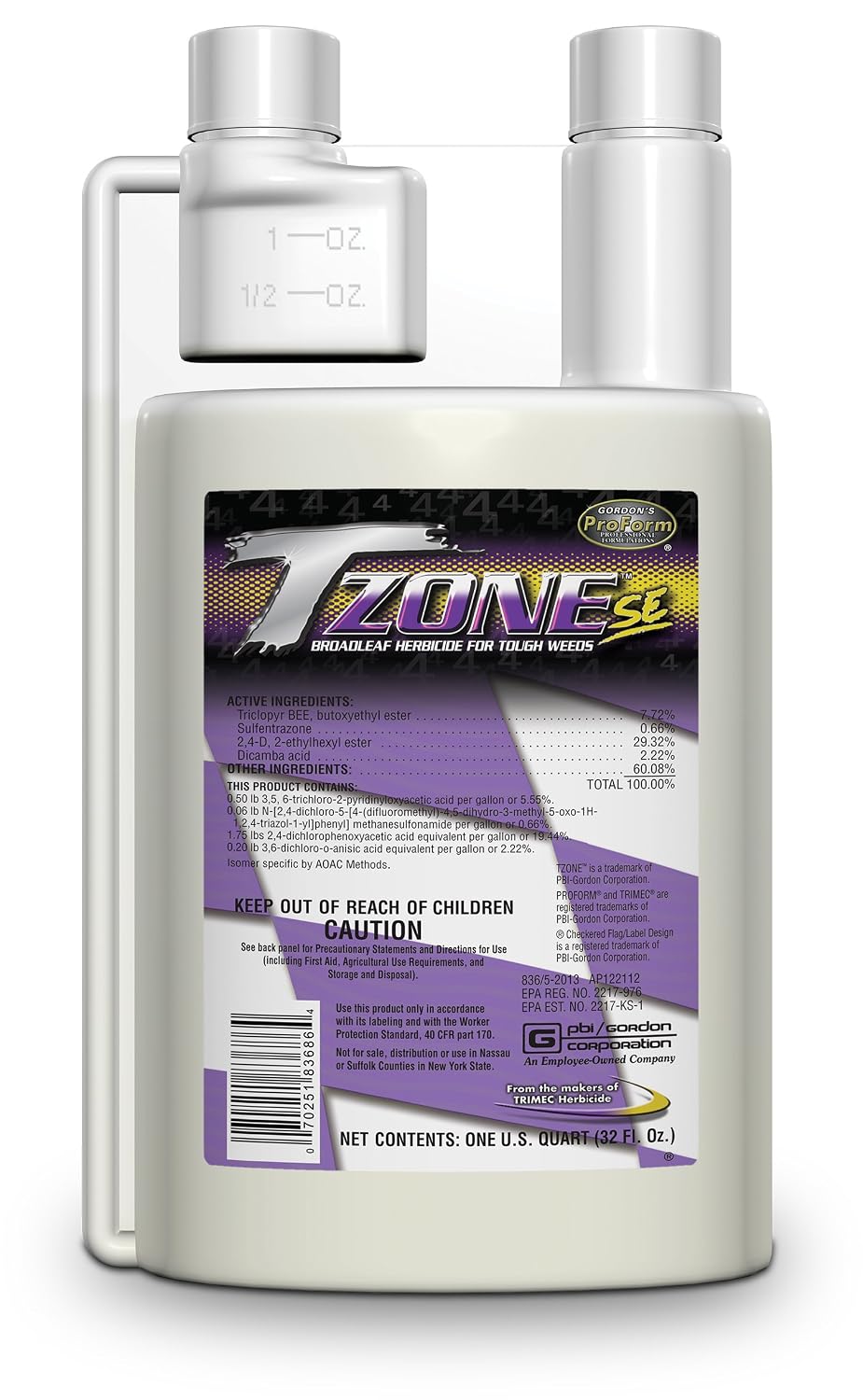
PBI Gordon T-Zone Turf Herbicide, 1 Quart
| Unit Count | 32 Fluid Ounces |
|---|---|
| Item Form | Liquid |
| Coverage | broad-leaf weeds, grassy weeds |
| Active Ingredients | Dicamba, triclopyr |
T-Zone Turf Herbicide is a concentrated liquid selective herbicide intended for use on lawns, golf sites, and commercial turf to control broadleaf weeds and suppress difficult targets like yellow nutsedge. It is typically diluted and applied with a pump sprayer following label rates; users should wear gloves and eye protection during mixing and application. The formula combines triclopyr, dicamba and other actives to give fast visible weed control and to work in cooler temperatures down to about 50°F, which helps with early- or late-season treatments. Practical benefits include flexible use across residential and commercial turf, visible results that reduce repeat treatments, and labeled activity on both broadleaf and some grassy weeds. Important limitations are that it is a chemical control requiring careful handling and strict adherence to label directions, it is selective so some desirable turf species may still be affected if misapplied, and it does not replace cultural practices for long-term weed prevention.
Best for: Homeowners and turf managers who want a reliable selective herbicide for routine and seasonal broadleaf weed control across lawns and commercial turf and who follow label directions carefully.
Less Ideal for: Gardeners seeking organic or non-chemical weed control or those who need an all-in-one product for non-turf ornamental beds should consider alternatives.
- Works on a broad spectrum of broadleaf weeds and offers suppression of yellow nutsedge
- Formulated for turf use so can be used on residential, commercial and golf turf when applied per label
- Effective at cooler temperatures, enabling treatment windows outside peak heat
- Fast visible weed control that can reduce the need for immediate repeat applications
- Contains strong active ingredients that require protective gear and careful handling
- Selective action means improper application can damage desirable turf species
Verdict: Choose T-Zone when you need a proven, turf-formulated selective herbicide that delivers visible control of broadleaf weeds and nutsedge in lawns.
Tenacity Turf Herbicide, 8 fl oz (Mesotrione)

| Unit Count | 8 Fluid Ounces |
|---|---|
| Item Form | Liquid |
| Coverage | 2000 ft^2 per 1sp of product |
| Active Ingredients | Mesotrione |
Tenacity is a liquid turf herbicide formulated around mesotrione that provides both pre-emergent and post-emergent control of a wide range of lawn weeds. It is typically mixed and sprayed across turf to target difficult species such as crabgrass, clover, dandelion, chickweed and nutsedge while leaving desirable grasses unharmed when used as directed. Notable features include systemic action with residual activity and coverage rated at about 2000 ft² per 1 fl oz of product, which makes it efficient for treating moderate areas. The product works best when applied under recommended timing and environmental conditions because its selectivity depends on grass type and application rate. Limitations are that it requires careful calibration of sprayers, adherence to label restrictions for specific turfgrass species, and routine follow-up treatments for severe infestations; it is not a one-application cure-all. Proper storage away from direct sunlight preserves shelf life for several years.
Best for: Gardeners and lawn managers who prioritize visible, long-lasting weed control and are willing to follow label directions and application best practices to protect desirable turf.
Less Ideal for: Casual users looking for a one-off spot treatment or anyone unwilling to check turfgrass compatibility and application rates should consider simpler spot products instead.
- Selective pre- and post-emergent control of both broadleaf and grassy weeds
- Systemic active ingredient (mesotrione) with residual activity for extended control
- High coverage per fluid ounce suitable for treating moderate lawn areas
- Liquid formulation mixes into sprayers for even application
- Requires careful adherence to label for turf compatibility and timing
- Needs proper sprayer calibration and technique to avoid uneven results
Verdict: Choose Tenacity when you need a professional-grade selective herbicide that delivers systemic, pre- and post-emergent control of tough lawn weeds.
Ortho WeedClear Lawn Weed Killer Concentrate, 32 fl. oz.

| Unit Count | 32 Fluid Ounces |
|---|---|
| Coverage | 5000 square_feet |
| Item Form | Spray |
| Active Ingredients | Herbicide |
Ortho WeedClear is a concentrate designed for homeowners who want targeted weed control across a typical yard. You dilute the 32 fl. oz. bottle per label instructions and apply with a tank sprayer or the Ortho Dial N Spray. The formula targets broadleaf and grassy weeds including dandelion, clover and crabgrass and claims visible results in hours and root-level control from a single application. It is rainproof within an hour, covers up to 5,000 sq. ft., and lists compatibility with common northern lawn grasses such as fescues and Kentucky bluegrass when applied at recommended rates. Practical benefits include fast knockdown, economical coverage from a concentrate, and the ability to treat large areas with ordinary sprayers. Important limitations are that the product must be diluted correctly before use and is not labeled for several warm-season grasses or ornamental beds, so careful reading of directions is required to avoid turf damage. Also avoid application in extreme heat for certain grasses and keep people and pets off the treated area until sprays dry.
Best for: Homeowners who prioritize efficient, cost-effective control of listed weeds across a typical lawn and who are comfortable mixing and applying a concentrated herbicide properly.
Less Ideal for: Gardeners who need a ready-to-use spray, want an all-purpose product for ornamentals and beds, or those who manage lawns comprised mainly of grasses excluded on the label.
- Concentrate treats up to 5,000 sq. ft. for economical coverage
- Fast-acting formula with visible results reported within hours
- Rainproof within 1 hour so treatments are less likely to be washed off
- Labeled as safe for many common northern lawn grasses when used as directed
- Not safe for several grass types and not for use on ornamentals or garden beds
- Requires correct dilution and a sprayer which adds a step compared with ready-to-use products
Verdict: Choose Ortho WeedClear when you want a concentrated, fast-acting herbicide that economically treats several thousand square feet of lawn while targeting common broadleaf and grass weeds.
Spectracide Weed Stop for Lawns Plus Crabgrass Killer Concentrate, 32 oz

| Liquid Volume | 32 fluid ounces |
|---|---|
| Coverage | 5000 square_feet |
| Item Form | Liquid |
| Kills | 470+ listed weeds |
This Spectracide concentrate is a straightforward selective herbicide for homeowners who want fast, broad-spectrum weed control without damaging established turf. Mixed with water and applied with a sprayer, it targets broadleaf and grassy weeds by contact and claims visible brown spot results in as little as five hours and rainfast protection in about three hours. A single 32 oz bottle treats up to 5,000 square feet, which makes it a practical choice for small to medium lawns. The label gives clear temperature and reseeding guidance to avoid lawn injury and notes temporary yellowing may occur on Bermudagrass. It is easy to use: mow a few days before treatment, spray until wet, and keep people and pets off the lawn until dry. The main limitations are the temperature restrictions for safe application and the need to follow dilution and timing instructions carefully to prevent turf damage and to wait several weeks before reseeding.
Best for: Homeowners looking for an affordable, easy-to-apply selective herbicide to clear common lawn weeds on small to medium lawns and who are willing to follow label timing and application steps.
Less Ideal for: Those who need a product safe for use during hot periods above the recommended temperatures or who need an herbicide suitable for immediate reseeding or for delicate specialty turf without any risk of discoloration.
- Kills over 470 listed broadleaf and grassy weeds including crabgrass
- Fast visible results in about 5 hours and becomes rainfast in roughly 3 hours
- Covers up to 5,000 sq ft from a single 32 fl oz bottle
- Clear application guidance reduces risk of lawn damage when directions are followed
- Must be applied within a narrow temperature window to avoid turf injury
- Can cause temporary yellowing on Bermudagrass under some conditions
Verdict: A budget-friendly, fast-acting selective herbicide that treats up to 5,000 sq ft and quickly controls a wide range of common lawn weeds when applied as directed.
Target 6 Plus (MSMA 48.2%) Turf Herbicide, 2.5 Gallon

| Active Ingredients | Monosodium acid Methanearsonate MSMA |
|---|---|
| Item Form | Liquid |
| Coverage | Selective: Crabgrass, Dallisgrass, Johnsongrass, Nutsedge, Pigweed, Chickweed |
| Liquid Volume | 2.5 gallons |
Target 6 Plus is a concentrated MSMA-based post-emergent herbicide intended for spot or broadcast application on turf where selective broadleaf and grassy weeds are a problem. It is typically mixed at 2 ounces per gallon of water and applied as a coarse spray to actively growing weeds; that makes it practical for treating larger lawns, golf courses, sod farms, or roadside turf where persistent grasses and nutsedge appear. The product’s strength is its targeted activity against tough species such as crabgrass, dallisgrass, johnsongrass, and nutsedge, so you can suppress problem weeds without killing desirable turf when used as directed. Important features include its high active ingredient concentration and a large 2.5 gallon volume suitable for multiple applications across an acre-scale area. Safety and label directions are crucial because the active ingredient can be harmful if swallowed or absorbed through skin and it must not be used where food is grown. Expect reliable weed control when applying the recommended rates, but follow protective measures and local regulations carefully.
Best for: Homeowners, groundskeepers, or turf managers who prioritize dependable, selective post-emergent control of stubborn grassy and sedge weeds across medium to large turf areas and who follow label safety requirements.
Less Ideal for: Casual gardeners with small ornamental beds, vegetable gardens, or people unwilling to follow pesticide safety rules and local use restrictions should choose a less hazardous option.
- High concentration of MSMA for effective post-emergent control of tough grassy weeds
- Selective coverage labeled for common lawn weeds like crabgrass, dallisgrass, and nutsedge
- Large 2.5 gallon volume supports multiple applications or treatment of large turf areas
- Simple mix rate (2 oz per gallon) and coarse spray application make field use straightforward
- Contains a hazardous active ingredient that requires strict adherence to safety precautions
- Not suitable for use on areas where food is grown or in situations restricted by local regulations
Verdict: Buy this if you need a reliable, high-strength selective post-emergent herbicide for controlling persistent grassy weeds across larger turf areas.
Ortho WeedClear Lawn Weed Killer Ready-to-Spray, 32 fl. oz.

| Unit Count | 32 Fluid Ounces |
|---|---|
| Coverage | 5000 square_feet |
| Item Form | Spray |
| Active Ingredients | 2,4-D; Quinclorac; Dicamba |
Ortho WeedClear Ready-to-Spray is a hose-end lawn herbicide designed for homeowners who want a quick way to target common weeds without mixing concentrates. You attach the bottle to a garden hose, flip the on switch and spray evenly until the turf surface is wet; the formula claims visible results in hours and becomes rainproof after about one hour. The product lists active ingredients including 2,4-D, quinclorac and dicamba, and is labeled for use on many northern lawn grasses and against more than 200 listed weeds such as dandelion, clover and crabgrass. The ready-to-use sprayer makes application fast and convenient for medium-size yards and the stated 5,000 sq ft coverage from a 32 fl oz bottle simplifies planning. Important limitations are the grass types and temperature restrictions in the directions and the need to avoid ornamentals, certain warm-season grasses and entry until sprays are dry; users should follow safety guidance and timing windows to avoid turf injury. For homeowners who prefer an easy hose-applied selective herbicide, this is a practical, well-known option.
Best for: Homeowners who want a proven, easy-to-use selective herbicide for maintaining a typical lawn and value straightforward hose-end application and quick visible results.
Less Ideal for: Gardeners who maintain ornamental beds, sensitive turf species, very small lawns where spot treatments are preferred, or users seeking an organic or non-chemical option.
- Ready-to-spray hose-end applicator makes treatment fast and simple with no measuring
- Formulated to target over 200 listed broadleaf and grassy weeds while being lawn-safe when directions are followed
- Rainproof within about one hour so light showers are less likely to wash it away
- Covers up to 5,000 sq ft from a single 32 fl oz container, suitable for medium lawns
- Contains multiple strong active ingredients that require careful adherence to label restrictions for turf types and temperatures
- Not safe for many ornamental plants and some warm-season grasses so drift or overspray can cause damage
Verdict: A convenient ready-to-use hose-end selective herbicide that makes fast, broad-spectrum weed control easy for typical lawns when used according to the label.
Roundup for Lawns Ready-to-Use with Extendable Wand, 1.33 gal.

| Unit Count | 170.24 Fluid Ounces |
|---|---|
| Liquid Volume | 1.33 gallons |
| Coverage | 5,000 square feet |
| Item Form | Liquid |
| Active Ingredients | Mcpa, Dimethylamine Salt, Quinclorac, Dicamba, Dimethylamine Salt, Satrentrazone |
This ready-to-use Roundup for Lawns is a selective herbicide designed for spot treatment of weeds in northern turfgrasses. It comes as a 1.33 gallon liquid jug with an extendable spray wand that makes treating hard-to-reach patches and individual weeds simple without mixing concentrates. The formula targets a long list of common lawn weeds, including crabgrass, dandelion, clover and yellow nutsedge, and delivers visible effects within hours while being rainproof in about three hours. Typical use is in spring or fall on actively growing weeds when daytime temperatures are between 45°F and 90°F; repeat applications at 21 day intervals can be used for persistent grassy weeds. Practical benefits include broad weed coverage, built-in application reach, and clear directions for homeowner spot treatments. Important limitations are that it is labeled only for listed northern grasses and should not be used on warm-season turf or unlisted species, and treated areas must remain off-limits to people and pets until sprays have dried. The ready-to-use format favors convenience over the economy and flexibility of concentrates.
Best for: Homeowners who want a low-effort, reliable spot-treatment herbicide for typical cool-season lawns and prefer a product that is simple and ready to apply without measuring.
Less Ideal for: People managing large acreage, warm-season turf, or who need a concentrated product for custom dilution rates should look at concentrate formulations instead.
- Ready-to-use formula requires no mixing and is straightforward for homeowner spot treatments
- Extendable spray wand provides continuous spray for easier reach and more precise application
- Starts working quickly with visible results in hours and becomes rainproof in about three hours
- Claims up to 3 months control on listed weeds and targets over 250 weed types
- Labeled only for listed northern grasses, so not suitable for many warm-season lawns
- Ready-to-use jug is less concentrated than refillable options, reducing cost-efficiency for large areas
Verdict: Choose this ready-to-use product when you want a convenient, fast-acting spot herbicide for common weeds in cool-season lawns without mixing or special equipment.
Choosing the Right Selective Herbicide for Lawns: Key Factors to Consider
Weed Spectrum and Target Species
Different selective herbicides control different sets of broadleaf weeds. Some formulations are broad-spectrum against dandelion, clover, plantain, chickweed, and clover, while others are optimized for tougher perennial targets such as white clover or creeping oxalis.
Knowing which weeds dominate your lawn helps you pick a product with the right active ingredients and labeled control claims. A mismatch means repeated spot treatments or poor control even after multiple applications.
Turfgrass Compatibility and Timing
Turf safety varies by grass type and season. Cool-season grasses and warm-season grasses react differently to certain actives, and young or drought-stressed turf is more vulnerable to injury.
Follow label timing for application during active weed growth and when the lawn is healthy. Avoid applying high-strength formulas during heat stress or dormancy to reduce the risk of discoloration or stunting.
Formulation and Application Method
Herbicides come as ready-to-use sprays, concentrated liquids to mix, or hose-end applicators. Concentrates are economical for larger areas but require careful measuring and mixing. Ready-to-use sprayers are convenient for spot treatments and small yards.
Consider nozzle type, sprayer calibration, and whether you need a surfactant. Ease of application affects coverage and the likelihood of treating accurately without drift or missed patches.
Residual Activity and Re-treatment Interval
Some selective herbicides have residual soil activity that prevents new weed emergence for weeks, while others act only on contact. Residual control reduces follow-up treatments but may restrict overseeding or planting for a window after application.
Check label guidance on how long to wait before reseeding or planting flowerbeds near treated turf. Residual products can be helpful for high-traffic lawns with persistent weed germination.
Environmental and Off-target Considerations
Herbicide movement through runoff, drift, or soil leaching can harm adjacent plants, pollinators, and water bodies. Products differ in volatility and mobility, and some require buffer zones or restrictions when applied near water or desirable ornamentals.
Read label precautions, avoid treatment before heavy rain, and take steps to prevent drift and overspray. Consider reduced-risk formulations if pollinator exposure or nearby gardens are a concern.
Regulatory Labeling and Safety Instructions
Labels specify legal use, maximum application rates, required personal protective equipment, and allowed sites. Using a product off-label can cause turf injury and violate regulations.
Always follow application rate, re-entry intervals, and disposal directions. Labels also list first-aid steps and emergency contacts, which is important when treating around pets and children.
When to Treat Vs. When to Wait
Treat actively growing broadleaf weeds for best uptake and control. Applications are most effective when weeds are in the leaf expansion stage rather than fully mature or seed-setting.
Avoid applying during heat waves, drought, or when turf is newly seeded. If the lawn is stressed, wait for recovery to reduce risk of turf injury. Also consider weather forecasts to avoid impending heavy rain which can wash treatments off foliage and into unintended areas.
- Apply in cool mornings with temperatures below label maximums
- Target weeds when leaves are free of dust or moisture for better spray adhesion
- Delay overseeding several weeks after residual herbicide use per label instructions
Spot Treatment Techniques for Patchy Infestations
Spot treating minimizes chemical use and protects adjacent plants. Use a pump sprayer set to a low-pressure, coarse spray to reduce drift and improve coverage on the weed leaves.
For small patches, apply at the lower end of labeled rates and recheck after 7 to 14 days. Repeat only if label allows and when new growth indicates surviving plants.
- Mask nearby flower beds with plastic or cardboard
- Use a shielded sprayer or handheld wand for precise application
- Mark treated areas to avoid double application
Integrating Herbicide Use With Cultural Lawn Care
Selective herbicides are one tool in an integrated lawn program. Complement chemical control with proper mowing height, regular fertilization, aeration, and timely overseeding to promote dense turf that naturally suppresses weeds.
Healthy lawns recover faster from treatments and are less likely to be reinvaded. Adjust mowing height and irrigation schedules after treatment if label guidance suggests modified turf care to promote recovery.
- Mow at recommended heights for your grass species to shade out weeds
- Use core aeration and overseeding in early fall for cool-season grasses
- Maintain balanced fertility to avoid excessive top growth that favors weeds
Minimizing Risk to Pollinators and Water
Apply herbicides when pollinators are least active, such as early morning or late evening. Avoid spraying when nearby flowering plants are in bloom to reduce exposure.
Keep products away from storm drains and standing water. Use buffer zones and avoid application on slopes where runoff is likely. These simple precautions reduce environmental impact while achieving effective weed control.
- Do not apply during windy conditions or when rain is forecast within 24 hours
- Rinse sprayers responsibly and dispose of rinse water as the label requires
- Consider mechanical removal for isolated weeds near pollinator habitat
Dealing With Persistent or Resistant Weeds
Some broadleaf species can be difficult to control and may require repeated treatments, different active ingredients, or a combination of chemical and cultural tactics. Alternate modes of action if multiple treatments are necessary to reduce resistance risk.
For perennial broadleaf weeds, focus on timing when plants are translocating sugars to roots, such as late season, to improve systemic uptake and reduce regrowth.
- Rotate active ingredient groups across seasons
- Combine spot removal and herbicide treatment for tough patches
- Monitor treated sites for regrowth and adjust strategy accordingly
How We Chose the Best Selective Herbicide for Lawns
We focused on attributes that actually affect outcomes in lawns, not marketing claims. Key evaluation criteria included the range of broadleaf weeds controlled and documented activity on common lawn invaders. We assessed turf safety across common cool- and warm-season grasses and examined recommended application windows and dosages that minimize stress on turf. We also evaluated formulation and ease of use, considering ready-to-use versus concentrate formats and compatibility with homeowner sprayers. Residual activity and re-treatment intervals were considered because they affect timing of overseeding and the frequency of applications. Environmental and off-target risk-movement to flower beds, runoff potential, and pollinator exposure-was another filter for inclusion. We excluded nonselective herbicides and products that lack clear lawn labeling or that are intended only for ornamental beds. The final shortlist prioritizes products that deliver broadleaf control while offering practical application guidance and documented turf safety, matching the scoring dimensions used in the guide.
FAQ
Can selective herbicides harm my turf?
They can if applied incorrectly or when turf is stressed. Turfgrass compatibility and proper timing on the label are the main safeguards. Use the recommended rate and avoid application during heat or drought to reduce risk.
How long after treatment can I reseed the lawn?
It depends on the product and whether it has residual soil activity. Labels give specific waiting periods, which can range from a few days to several weeks. Always follow the label for safe overseeding intervals.
Are ready-to-use sprays as effective as concentrates?
Ready-to-use sprays are convenient for small areas but may be less economical for large lawns. Efficacy depends on the active ingredient and correct coverage rather than formulation alone. Concentrates require careful mixing but give flexibility for larger jobs.
Will herbicide drift affect nearby flower beds and vegetables?
Drift can damage sensitive plants. Use low-pressure, coarse nozzles, apply on calm days, and consider shielding to reduce off-target movement. Maintain buffer zones and avoid spraying upwind of valuable beds.
How soon will I see results after applying a selective herbicide?
Many broadleaf weeds show visible symptoms within a few days, with complete dieback taking one to three weeks depending on species and environmental conditions. Systemic products may take longer but often provide more lasting control.
Is it safe to apply herbicide when pets or children use the yard?
Follow label instructions for re-entry intervals and drying times. Keep people and pets off treated turf until sprays have dried and any specified re-entry period has passed. Store products securely and follow first-aid guidance on the label.
Final Verdict
When choosing a selective herbicide for lawns, prioritize a product with the right spectrum for your dominant weeds and clear labeling for your turf type. Balance control strength with turf safety and plan around overseeding and weather to reduce turf stress. Use application technique and integrated cultural practices to minimize repeat treatments and environmental risks. With attention to timing, formulation, and label directions, you can restore a uniform lawn while protecting adjacent plants and pollinators.
