

Note: This article contains affiliate links. If you click on these links and make a purchase, I may earn a small commission at no extra cost to you. This helps support my research and content. Read my full affiliate disclosure here.
If you want more reliable, longer-lasting tulip blooms with less midseason stress, the right slow release fertilizer makes a big difference in how bulbs store energy and flower. You are choosing a product that needs to feed bulbs gently through cool spring growth, avoid salt damage to corms, and support strong foliage for next year. This guide shortlists the top slow release tulip fertilizers gardeners use for consistent bloom timing and bulb health. Below we summarize what matters in a slow-release tulip fertilizer, then walk through practical choices and application tips. Criteria include nutrient balance, release mechanism, and bulb safety to help you pick the best fit for your planting situation.
Top Picks at a Glance
| Best Overall The best all-around choice for most situations | Osmocote Smart-Release Plant Food for Flowers & Vegetables, 4.5 lb |  |
| Best Quality Built to a higher standard if you want something more solid | Osmocote Smart-Release Plant Food Plus Outdoor & Indoor, 8 lb |  |
| Best Value The sweet spot between price and what you get | Osmocote Smart-Release Plant Food Plus Outdoor & Indoor, 1 lb |  |
| Best Budget The cheapest option that still gets the job done reliably | RAINFLOW Slow Release Granular Fertilizer 14-13-13, 11.28 oz |  |
| Highest Rated A top-rated pick with lots of positive feedback | Espoma Bulb-Tone Organic Fertilizer (4 lb) |  |
| Most Popular A crowd favorite that many people choose with confidence | Osmocote Smart-Release Plant Food Flower & Vegetable, 8 lb. |  |
| Best Seller A high-volume bestseller chosen again and again | Scotts All Purpose Flower & Vegetable Continuous Release Plant Food, 3 lb |  |
Osmocote Smart-Release Plant Food for Flowers & Vegetables, 4.5 lb

| Item Form | Granules |
|---|---|
| Specific Uses For Product | Root Development |
| Coverage | Full |
| Target Species | Perennials |
| Mixing Ratio | 1 lb per 40 sq. ft |
Osmocote Smart-Release Plant Food is a granular, controlled-release fertilizer designed to support both top growth and strong root development for edible plants and ornamentals. You apply it to garden beds, containers or around perennials following the mixing ratio (about 1 lb per 40 sq ft) and it releases nutrients gradually so you do not need frequent refeeding during the season. Notable features include a balanced NPK formulation and a four-month feeding period, which simplifies maintenance for busy gardeners and helps steady growth without repeated applications. It is practical for starting vegetable plots, boosting blooms, or maintaining perennial beds, and the granule form works well mixed into potting mixes or top-dressed on soil. Limitations are that it is not a quick foliar fix for acute deficiencies and you must follow the recommended application rates to avoid over-application; also it does not list a specific NPK ratio on the visible spec fields even though packaging describes a balanced formula. For gardeners seeking consistent, low-maintenance feeding across a season, this product reduces the need for regular fertilizing while supporting both flavor and flowering goals.
Best for: Gardeners who want a low-maintenance, season-long fertilizer that supports both edible gardens and ornamental beds without frequent reapplications.
Less Ideal for: Growers who need rapid, targeted nutrient correction or who prefer liquid/foliar feeds for fast response.
- Controlled slow-release granules that feed up to four months
- Formulated for both vegetables and flowering plants so one product covers multiple garden uses
- Easy to apply as a top-dress or mixed into potting soil
- Not intended as a fast-acting corrective for nutrient deficiencies
- Packaging/specs in the provided data do not show a detailed NPK breakdown in the selectable fields
Verdict: Choose this product if you want a reliable, season-long slow-release fertilizer that handles both vegetables and flowers with minimal fuss.
Osmocote Smart-Release Plant Food Plus Outdoor & Indoor, 8 lb

| Item Form | Granules |
|---|---|
| Application Method | Sprinkle |
| Specific Uses For Product | Plant Food |
| Coverage | Full |
| Mixing Ratio | 1 scoop (3 tbsp) per 2 gal pot or 4 sq. ft. |
Osmocote Smart-Release Plant Food Plus is a granular, resin-coated fertilizer designed to deliver steady nutrition for up to six months from a single application. It is applied by sprinkling the recommended scoopful into the top 1 to 3 inches of potting or garden soil and watering in; outdoor rates are halved for indoor plants. The resin coating times nutrient release so plants receive consistent feeding rather than a sudden flush, which the product backs with a no-burn pledge when used as directed. Practical benefits include broad compatibility with vegetables, flowers, shrubs and container plants, long coverage that reduces reapplication frequency, and clear dosing guidance for pots and garden beds. Limitations are that the formula details and ingredient breakdown are not specified on the listing and that granular slow-release products can be slower to correct acute nutrient deficiencies compared with soluble feeds.
Best for: Gardeners who prioritize steady, low-maintenance feeding and want a single, long-lasting application for mixed beds and containers.
Less Ideal for: Growers needing immediate correction of nutrient deficiencies or those who prefer liquid feeds and frequent, adjustable dosing.
- Feeds continuously for up to six months with a single application
- Resin-coated granules control nutrient release to reduce risk of overfeeding
- Suitable for both indoor and outdoor use across many plant types
- Clear application rates for pots and garden beds make dosing straightforward
- Ingredient breakdown is not specified, so exact nutrient ratios beyond '11 nutrients' are not clear
- Not ideal for quickly correcting acute nutrient deficiencies since release is slow
Verdict: Choose this product when you want a reliable, low-maintenance, six-month slow-release fertilizer that works across most garden and container plants.
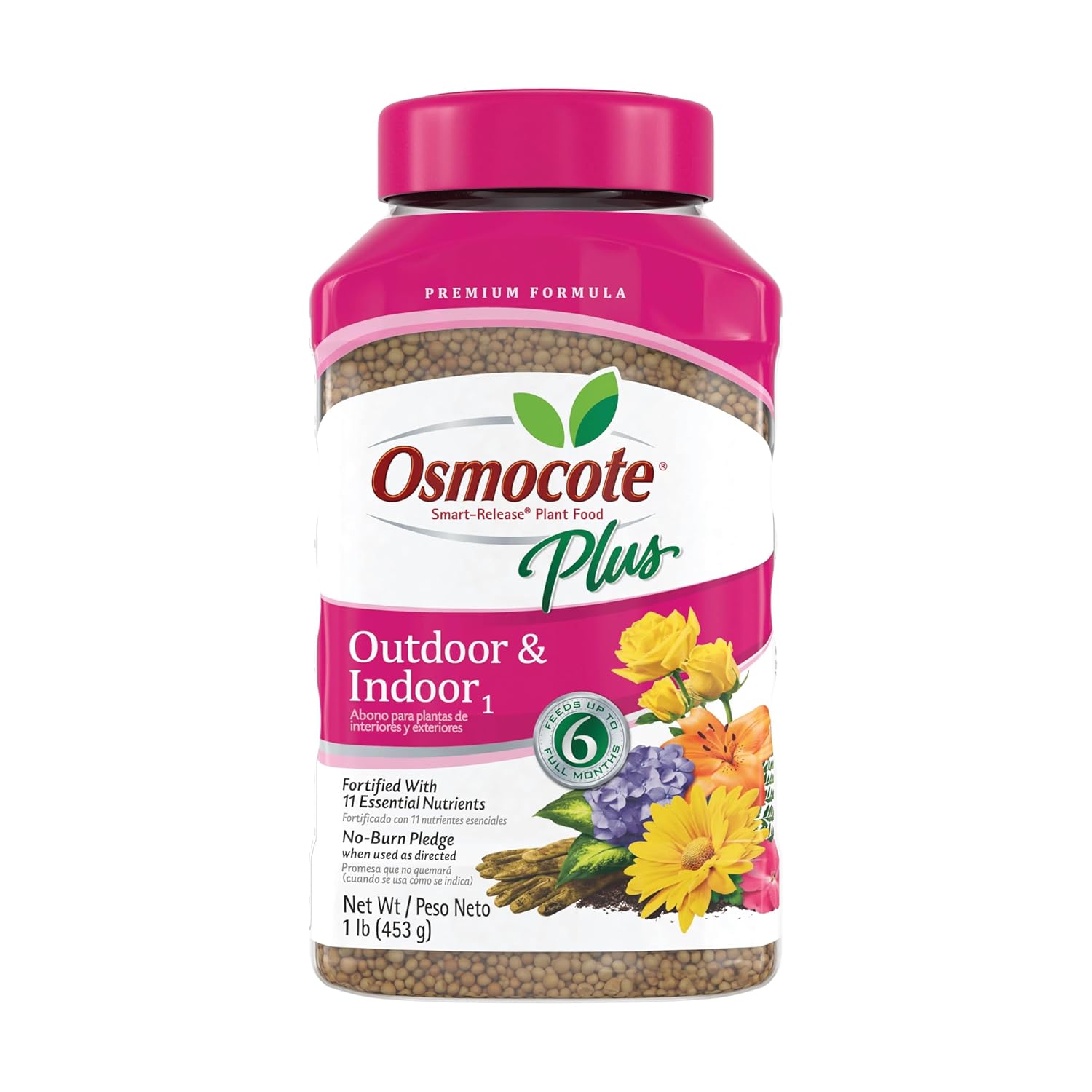
Osmocote Smart-Release Plant Food Plus Outdoor & Indoor, 1 lb
| Item Form | Granules |
|---|---|
| Specific Uses For Product | Plant Food |
| Application Method | sprinkle around the base and work into the soil |
| Unit Count | 16 Ounce |
Osmocote Smart-Release Plant Food Plus is a resin-coated granular fertilizer designed to deliver steady nutrition to a wide range of plants for up to six months from a single application. You apply it by sprinkling the recommended scoop into the top inch or so of potting mix for containers or around plants in garden beds, then watering to activate the coating. The product contains 11 essential nutrients and is formulated to release based on soil temperature, which helps reduce overfeeding and supports consistent bloom and foliage performance in hanging baskets. Its no-burn pledge makes it easy to use at the recommended rates for mixed annuals, trailing plants, and container veggies. Limitations are that coverage is modest from a 1 lb. container so frequent use on many large baskets will require buying more, and release timing still depends on temperature so plants in cool, shaded spots may receive nutrients more slowly than those in warm sun.
Best for: Gardeners who prioritize steady, low-maintenance feeding for hanging baskets and containers and want consistent bloom and foliage without frequent fertilizing.
Less Ideal for: Those who need immediate, short-term nutrient boosts or precise liquid feeding schedules for plants that demand fast correction.
- Resin-coated granules provide controlled release of nutrients for up to six months
- Formulated with 11 essential nutrients suitable for a wide variety of plants
- No-burn pledge when used as directed reduces risk of damaging roots in containers
- Simple sprinkle-and-water application works well for hanging baskets and pots
- 1 lb container covers a limited area so multiple baskets will need additional product
- Release rate depends on temperature so nutrient delivery can be slower in cool conditions
Verdict: An easy, low-maintenance slow-release fertilizer that keeps hanging baskets fed for months with minimal effort.
RAINFLOW Slow Release Granular Fertilizer 14-13-13, 11.28 oz

| NPK ratio | 14-13-13 |
|---|---|
| Form | Granular |
| Release duration | Up to 180 days |
This RAINFLOW slow release granular fertilizer delivers a balanced 14-13-13 NPK formula in an easy-to-spread form that releases nutrients for up to 180 days. It is intended for general garden use and claims suitability for flowers, vegetables, succulents and orchids, so you would apply it around bulbs or established plants and lightly work it into the soil or sprinkle on the surface depending on planting. The slow‑release technology reduces how often you need to fertilize, which is useful if you prefer low-maintenance feeding. Practical benefits include even nutrient supply to support root development, flowering and fruiting, and the small 11.28 ounce size is convenient for trialing on a few beds or pots. Limitations are the small package size for larger gardens and the lack of detailed application rates for specific bulb crops like tulips, so larger projects will require multiple bags and careful measurement to avoid overapplication.
Best for: Budget-minded gardeners looking for an affordable, low-maintenance feed to try on a few tulip beds or container plantings without frequent reapplication.
Less Ideal for: Large-scale gardeners or landscapers who need bulk fertilizer or precise, crop-specific application guidance.
- Balanced 14-13-13 NPK supports flowering and root growth
- Slow‑release formula claims up to 180 days of nutrient delivery reducing reapplication frequency
- Granular form is easy to spread and mix into soil by hand
- Suitable for a variety of plant types from bulbs to succulents
- Small 11.28 oz package is insufficient for larger beds or multi-season use
- No specific application rates for tulips or bulb staging provided
Verdict: A low-effort, balanced slow‑release fertilizer that’s a sensible, budget-friendly choice for feeding small tulip beds and containers.
Espoma Bulb-Tone Organic Fertilizer (4 lb)

| Item Form | Granules |
|---|---|
| Application Method | Sprinkle on soil surface |
| Target Species | bulbs |
| Mixing Ratio | No Mixing Required |
Espoma Bulb-Tone is a ready-to-use granular organic fertilizer designed for planting and feeding bulbous flowers such as tulips, daffodils, and other spring and fall bulbs. You apply it directly in the planting hole for new bulbs or sprinkle on the soil surface around established bulbs and then water it in. The 3-5-3 NPK blend with added calcium and Espoma’s Bio-tone formula supplies balanced nutrients that favor strong root development and vibrant blooms without synthetic inputs. Because it is an organic registered input and contains only organic ingredients, it suits gardeners who prefer natural feeds and want steady, soil-building nutrition rather than quick-release chemical boosts. Limitations are that it is a medium-coverage granular product so it works more slowly than soluble fertilizers and requires correct timing at planting or post-bloom to be most effective. For someone seeking predictable, low-risk bloom support for bulbs, Bulb-Tone is an easy, low-fuss choice.
Best for: Gardeners who prioritize low-risk, organic feeding for bulbous flowers and want an easy-to-apply fertilizer that supports reliable bloom development.
Less Ideal for: Growers who need rapid, soluble nutrient delivery for quick corrections or who prefer concentrated liquid feeds for foliar feeding.
- Organic, registered input suitable for organic gardening
- Ready-to-use granules require no mixing and are simple to apply
- Balanced 3-5-3 formula with added calcium to support blooms and root health
- Can be used at planting or as a surface feed for established bulbs
- Granular, medium-coverage formula releases nutrients more slowly than soluble fertilizers
Verdict: A simple, certified organic granular fertilizer that reliably supports healthy bulbs and better blooms with minimal fuss.
Osmocote Smart-Release Plant Food Flower & Vegetable, 8 lb.

| Item Form | Granules |
|---|---|
| Specific Uses For Product | Root Development |
| Target Species | Perennials |
| Mixing Ratio | 1:22 (1 lb.:1 cubic foot) |
Osmocote Smart-Release Flower & Vegetable is a granular slow-release fertilizer designed to provide steady nutrition to vegetable beds, raised beds, and perennial planting areas for up to four months. It is applied by mixing the measured scoop into the top 1 to 3 inches of soil or broadcasting over mulched areas, with 1 lb treating roughly 40 sq ft. The balanced 14-14-14 NPK formula supports root development and consistent above-ground growth without frequent reapplication. Notable practical benefits include the no-burn reputation that makes it forgiving if you misapply, and the temperature-responsive release that aligns feeding with plant uptake. It comes with an applicator and clear coverage guidance, so it is straightforward to use for typical home gardeners. Limitations are that release rate depends on soil temperature so feeding timing can vary between climates, and as a granular product it requires incorporation into the soil rather than being foliar or water-soluble for quick correction of deficiencies. For gardeners seeking a low-maintenance, season-long feed for edible and ornamental plantings, this performs predictably and safely.
Best for: Home gardeners who want a reliable, low-maintenance fertilizer for vegetable plots, raised beds, and perennial borders and prefer a product that reduces the need for frequent feeding.
Less Ideal for: Growers who need fast corrective feeding or who prefer liquid or foliar fertilizers for immediate nutrient delivery should consider other options.
- Balanced 14-14-14 NPK supports both root and top growth across vegetables and flowers
- Slow-release formula feeds up to four months, reducing reapplication frequency
- Included scoop and clear coverage guidance make application easy and consistent
- Formulation is forgiving and unlikely to burn plants even if over-applied
- Nutrient release depends on soil temperature so timing can vary by climate
- Granular form must be mixed into soil and cannot correct nutrient deficiencies quickly
Verdict: Choose this if you want a dependable, mistake-proof slow-release fertilizer that feeds vegetables and flowers for an entire season.
Scotts All Purpose Flower & Vegetable Continuous Release Plant Food, 3 lb

| Item Form | Granules |
|---|---|
| Application Method | Sprinkle on soil and rake into top 1-3 inches |
| Target Species | All Purpose Flower & Vegetable Continuous Release Plant Food |
| Unit Count | 48 Ounce |
Scotts All Purpose Flower & Vegetable Continuous Release Plant Food is a simple granular fertilizer intended for in-ground flower and vegetable gardens. You apply it by sprinkling the granules around plants, raking them into the top 1 to 3 inches of soil, and watering to start nutrient release. Formulated to feed for up to two months, it supplies steady nitrogen to support root growth and foliage and is recommended for common garden crops including peppers. The bag covers roughly 150 sq. ft., so a single 3 lb package is convenient for small beds or a few pepper plants. Key practical benefits are ease of use, predictable feeding intervals, and reduced need for frequent applications during the growing season. Limitations are that it is an all-purpose formula rather than a pepper-specific mix and its N-P-K profile is not listed on the label data here, so you may want to monitor fruiting and supplement with a bloom-boost fertilizer if you need higher phosphorus for heavy fruit set. Follow label rates to avoid overapplication near crowns.
Best for: Gardeners who want an inexpensive, low-effort fertilizer to maintain steady growth for a few jalapeno plants or a small vegetable bed without frequent feeding.
Less Ideal for: Growers who manage large vegetable plots or who need a nutrient program tailored specifically to maximize pepper fruit set and yield.
- Continuous-release granules feed plants for up to two months, reducing application frequency
- Easy application: sprinkle, rake into topsoil, and water
- Suitable for a wide range of garden plants including vegetables and peppers
- 3 lb bag covers about 150 sq. ft., practical for small gardens or container groups
- All-purpose formula may not provide the specific N-P-K balance jalapenos need for maximum fruiting
- Small bag size means frequent repurchases for larger gardens
Verdict: A budget-friendly, easy-to-use continuous-release fertilizer that keeps jalapeno plants fed for up to two months with minimal fuss.
Choosing the Right Slow Release Tulip Fertilizer: Key Factors to Consider
Nutrient Ratio And Bloom Support
Tulips need a feeding that emphasizes phosphorus and balanced nitrogen rather than a high-nitrogen lawn mix. A formula with adequate phosphorus helps with bloom set and sturdy stems, while moderate nitrogen supports foliage that replenishes the bulb for next season.
When evaluating products, check whether the label lists nutrients that suit spring-flowering bulbs. Excessive nitrogen early in the season can encourage floppy leaves and weaker blooms, while too little phosphorus can limit flower production. Think about how the listed N-P-K will affect both the current season's display and the bulb's stored reserves for the following year.
Release Mechanism And Timing
Slow release options use different technologies: coated granules, organic slow-release materials, or polymer-controlled prills. The goal is a steady nutrient supply during the cool-to-warm part of spring when tulips uptake most nutrients.
A product that releases too quickly can spike salt levels and waste nutrients before the bulbs need them. Conversely, a feed that releases primarily in summer has limited benefit to bulbs that finish growth in late spring. Match the product's release profile to your local spring temperature pattern and planting schedule.
Salt Index And Bulb Safety
Bulb tissues are sensitive to high soluble salt concentrations, which can cause bulb burn and poor emergence. Slow release feeds that have a low salt index or use encapsulation reduce the immediate soluble salt load around the bulb.
If you plant bulbs in containers or dense beds where drainage is modest, pick a product with clear guidance on safe application rates. Lower-salt formulations or organic-based slow release materials are often safer for close-quarter plantings and when bulbs are shallowly planted.
Application Method And Garden Workflow
Consider whether you need a product you can broadcast over a bed, band at planting, or mix into potting media. Granular slow release is convenient for broadcasting and topdressing, while some formulations are better applied at planting time as a band under bulbs.
Ease of measuring, spreading, and incorporating into soil affects how consistently you will apply the correct dose. A product with clear, simple directions and predictable coverage per volume is easier to use across mixed bed sizes and container setups.
Longevity And Cost Per Season
Slow release feeds are chosen to reduce repeat applications. Look at the expected duration of release and whether a single fall or spring application will carry through the active growth period.
Longer longevity reduces labor but requires confidence that nutrients will be available when bulbs need them. For gardeners who prefer a single annual feed, select a product with a demonstrated release window that matches bulb growth. For those who garden in variable climates, an intermediate-release product that allows a top-up can be safer.
When To Apply Slow Release Feed For Tulips
Timing matters more than frequency for bulbs. Apply slow release fertilizer at planting in fall when bulbs are starting root growth or as a light topdressing in late winter to early spring as shoots begin to emerge. Application at planting establishes nutrient availability during root formation and gives bulbs a steady supply as temperatures rise.
If you apply in fall, ensure the product's release profile is slow enough to retain nutrients until spring. For late-winter topdressing, use a feed that is safe on exposed shoots and has low immediate soluble salts to avoid burning young foliage.
- Apply at planting for root uptake over winter if product supports cold-release patterns
- Topdress in late winter for quick access during shoot emergence if product has low salt impact
- Avoid heavy summer applications when bulbs are dormant
Using Slow Release Fertilizer In Containers
Containers concentrate salts and restrict leaching, so choose a slow release feed formulated with low salt impact or use reduced rates compared with in-ground beds. Incorporate granules into the potting mix at planting rather than just broadcasting on the surface when possible.
Monitor moisture and flush containers occasionally with water to prevent salt accumulation. For overwintered container bulbs, a conservative approach to feeding reduces the chance of bulb damage while still delivering nutrients during growth.
- Mix into potting medium for even distribution
- Reduce application rates to account for limited leaching
- Flush containers once or twice during the active season if buildup is suspected
Synchronizing Release With Local Climate
Release rates depend on temperature and moisture. In cooler springs, a product that releases slowly at lower temperatures is preferable because bulbs remain active later into spring. In warmer regions, choose a product that delivers more quickly once soil temperatures rise so nutrients are available during the flowering window.
If your region has erratic springs, pick a middle-ground product or plan for a light supplemental feed if early warmth accelerates growth beyond the product's intended release timing.
- Cold climates: prioritize cold-stable slow release
- Warm climates: prefer faster activation with low salt risk
- Unpredictable springs: consider flexible application plan with potential top-up
Combining Slow Release With Organic Amendments
Organic materials such as compost and well-rotted manure contribute micronutrients, improve soil structure, and provide a modest, prolonged nutrient supply. Combining a mineral slow release fertilizer with organic amendments can create balanced nutrition and enhance bulb health over multiple seasons.
Use compost to improve drainage and water-holding capacity, which helps regulate nutrient release. Avoid fresh manures that are high in soluble salts or nitrogen that could interfere with the controlled feed.
- Add compost to planting hole for long-term soil improvement
- Use organic matter to buffer nutrient release and improve water retention
- Avoid fresh high-salt manures near bulbs
Safety And Environmental Notes
Follow application rates to avoid runoff and nutrient leaching into waterways. Slow release formulations generally lower the risk of runoff compared with quick-release watersoluble feeds, but correct placement and dosing remain important.
Store fertilizers in a dry, secure place and keep them out of reach of children and pets. When applying, wear gloves and avoid inhaling dust from dry granules.
- Place fertilizer where it will not wash into storm drains
- Measure doses carefully to reduce environmental impact
- Clean up spills promptly and store unused material securely
How We Chose the Best Slow Release Tulip Fertilizer
We focused on attributes that matter specifically for spring-blooming tulip bulbs and the way gardeners apply feed to beds and containers. Evaluation prioritized nutrient formulation and timing, release mechanism, salt index and bulb safety, ease of application across beds or containers, and longevity relative to a single spring feed. We also considered physical form and handling for typical planting and maintenance workflows. Products were included only if they are designed for spring bulbs or labeled for tulips and use a slow or controlled release mechanism. We excluded quick-release high-nitrogen granular feeds and mixes formulated solely for lawns or foliage where bulb needs differ. We assessed how each product balances phosphorus for bloom set with modest nitrogen to avoid excessive leafy growth, and whether the release profile matches the cool-to-warm transition of spring. Other filters removed products with unclear ingredient lists or those lacking clear application guidance for bulbs. Editorial selection also weighed gardener-friendly features such as easy spreading, compatibility with bulbs in containers, and whether a product reduces the risk of salt buildup. The scoring labels reflect these priorities so you can compare feed-to-feed on the factors that matter to tulip success.
FAQ
Can I use slow release fertilizer on tulips already sprouting?
Yes, but choose a low-salt product and apply a light topdressing to avoid burning tender foliage. Water lightly after application to move nutrients into the root zone if the label recommends it.
Is fall or spring application better for tulips?
Both approaches work. Fall application supports root development over winter, while late-winter or early-spring topdressing supplies nutrients as shoots emerge. The best choice depends on the product release profile and your local climate.
How much slow release fertilizer should I use around bulbs?
Follow label rates but err on the conservative side for containers and tightly spaced beds. Overapplication increases salt risk and can harm bulbs. Measuring by area or container volume yields more consistent dosing than eyeballing.
Will slow release fertilizer reduce my need to feed later in the season?
Often yes. A properly formulated slow release product can supply nutrients throughout the active growth period so repeat feeding is unnecessary. Check the specified longevity and plan supplemental feeds only if growth suggests a deficiency.
Can I mix slow release fertilizer with bulb planting amendments?
You can incorporate slow release granules into the planting hole or mix with potting medium. Keep granules a short distance from direct contact with the bulb to avoid localized salt exposure and follow recommended application depths.
Final Verdict
For healthy, reliable tulip displays, prioritize a slow release fertilizer that matches the seasonality of bulb growth: balanced nutrients with emphasis on bloom-supporting phosphorus, a release profile tuned to your local spring temperatures, and a low salt impact for bulb safety. Consider how you plant and maintain bulbs when choosing form and application method so the feed integrates with your workflow. Weigh tradeoffs between longevity and timing. If you want low-effort annual feeding, choose a product with a release window covering the entire spring. If your climate is variable, a moderate-release feed with the option for a light supplemental application offers better control and reduces risk to bulbs.
