

Note: This article contains affiliate links. If you click on these links and make a purchase, I may earn a small commission at no extra cost to you. This helps support my research and content. Read my full affiliate disclosure here.
If you split firewood for a stove, fireplace, or weekend bonfire, a compact chainsaw changes the job from chore to manageable task. A Small Chainsaw for Firewood offers lighter weight, easier handling, and enough cutting capacity for rounds and small logs without the bulk of full-size saws. This guide covers the top shortlisted small chainsaws for typical firewood tasks, focusing on usable bar length, consistent power delivery, and user safety features. You will find practical notes on what to expect from a smaller saw in a real yard or woodlot and which product traits make the biggest difference for daily use.
Top Picks at a Glance
| Best Overall The best all-around choice for most situations | EGO POWER+ CS1611 16" Cordless Chainsaw with 56V 2.5Ah Battery and Charger |  |
| Best Quality Built to a higher standard if you want something more solid | SEESII 16- and 12-Inch Cordless Electric Chainsaw with Dual 5.0Ah Batteries |  |
| Best Value The sweet spot between price and what you get | SEESII 12-inch Cordless Chainsaw with Two 4.0Ah Batteries |  |
| Highest Rated A top-rated pick with lots of positive feedback | RazEdg 40V Brushless 12-Inch Cordless Chainsaw |  |
| Best Seller A high-volume bestseller chosen again and again | Supstable Mini Cordless Chainsaw with 6" and 8" Bars, Brushless 1000W |  |
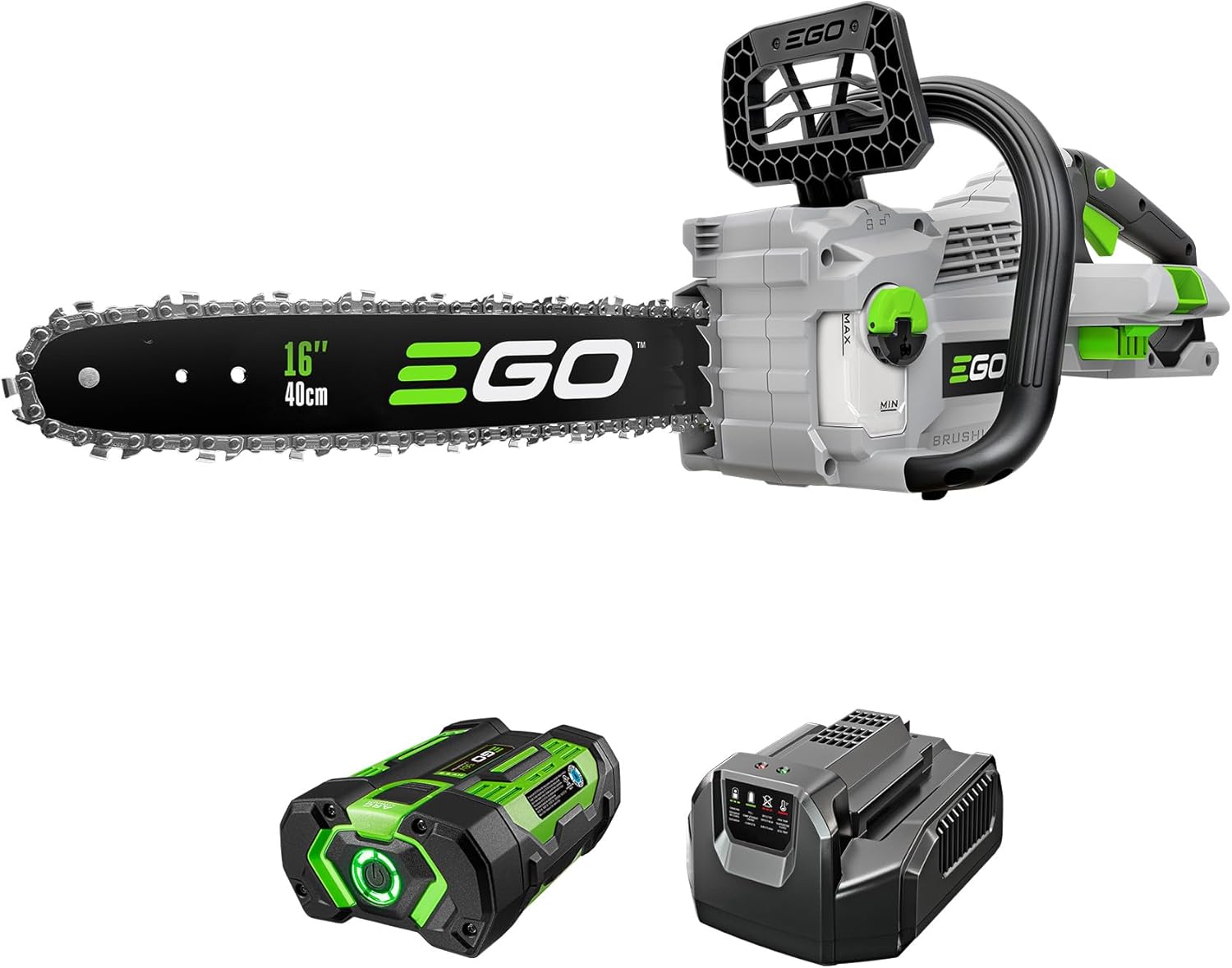
EGO POWER+ CS1611 16" Cordless Chainsaw with 56V 2.5Ah Battery and Charger
| Power Source | Battery Powered |
|---|---|
| Horsepower | 2.3 |
| Chain Length | 16 inches |
| Included Components | 2.5Ah Battery and Standard Charger |
| Chain Speed | 20 m/s |
The EGO POWER+ CS1611 is a battery-powered 16-inch chainsaw built to give prosumer-level cutting performance without gas. It uses a high-efficiency brushless motor rated as a 40CC equivalent and runs on the included 56V 2.5Ah ARC Lithium battery, which the manufacturer says delivers up to about 130 cuts through a 4×4 on a single charge. Notable features include a 20 m/s chain speed for efficient cuts, a tool-free chain-tensioning dial for quick on-the-job adjustments, automatic oiling with a spill-free reservoir, metal bucking spikes for secure cutting, and an IPX4 weather resistance rating. In real use this means quieter, low-maintenance operation compared with gas saws, fast setup between cuts, and enough runtime for routine property work like limb removal, small tree felling, and firewood prep. Limitations are battery runtime for very heavy or continuous commercial use and the saw’s 16-inch bar, which restricts maximum cut diameter compared with larger pro gas models.
Best for: Buyers wanting a low-maintenance, gas-free alternative that still delivers near-gas power for regular property maintenance, pruning, and medium-duty cutting tasks.
Less Ideal for: Users who need long uninterrupted runtime for commercial logging or must cut very large-diameter timber should consider larger gas or higher-capacity battery systems.
- Brushless motor with 40CC gas-equivalent power for strong cutting performance
- Includes 56V 2.5Ah battery and charger so it is ready to use out of the box
- Tool-free chain tensioning lets you adjust the chain quickly on site
- Automatic oiling with a spill-free reservoir keeps the chain lubricated during work
- IPX4 weather resistance and metal bucking spikes add durability and control in outdoor conditions
- 16-inch bar limits maximum cut diameter compared with larger pro chainsaws
- Runtime depends on battery capacity and may be insufficient for long, continuous heavy-duty jobs
Verdict: A ready-to-use cordless chainsaw that gives near-gas power and easy on-the-job adjustments, ideal for homeowners and pros doing regular medium-duty cutting.
SEESII 16- and 12-Inch Cordless Electric Chainsaw with Dual 5.0Ah Batteries

| Power Source | Battery Powered |
|---|---|
| Horsepower | 1600 watts |
| Chain Speed | 42 ft/s |
| Included Components | 12" spare chain and guide bar, 16" chainsaw, 2×5.0Ah batteries, 2× fast chargers |
This SEESII cordless chainsaw is a versatile battery-powered saw aimed at homeowners who need a reliable tool for cutting firewood, pruning, and storm cleanup. It ships with both 12-inch and 16-inch guide bars so you can switch to the compact bar for pruning and tight spots or use the longer bar for thicker logs. The 1600W brushless motor and 42 ft/s chain speed deliver strong, smooth cuts while the dual 18V 5.0Ah batteries extend runtime and come with two fast chargers to minimize downtime. Practical features include a tool-free chain tensioning knob, an automatic oiler with a translucent 150ml tank, and several safety elements such as a chain brake, safety lock switch, and hand guard. The saw runs quieter than comparable gas models, which is helpful in neighborhood settings. Important limitations are that it requires both batteries installed to reach rated performance and battery runtime will vary with log size and cutting conditions, so expect shorter sessions on dense hardwoods compared with gas alternatives.
Best for: Homeowners and small-property owners who want an easy-to-use cordless chainsaw for regular firewood cutting, pruning, and storm cleanup and who prioritize simpler maintenance and quieter operation over maximum continuous runtime.
Less Ideal for: Users who need prolonged, heavy-duty logging or frequent cutting of large hardwoods where gas-powered saws or higher-capacity battery rigs are required.
- Includes both 12-inch and 16-inch guide bars for pruning and heavier cuts
- Dual 18V 5.0Ah batteries with two fast chargers for extended runtime and quicker recharge
- 1600W brushless motor and 42 ft/s chain speed for efficient, lower-maintenance cutting
- Tool-free chain tensioning and automatic oiling with a visible 150ml tank for easy upkeep
- Multiple built-in safety features including a chain brake, safety lock switch, and hand guard
- Designed to run with both batteries installed so it is not usable on a single battery
- Actual runtime depends heavily on wood hardness and cutting style and may be less than advertised for large logs
Verdict: A convenient dual-bar cordless chainsaw with strong brushless power and dual batteries that makes cutting firewood and routine yard cleanup easy for homeowners.
SEESII 12-inch Cordless Chainsaw with Two 4.0Ah Batteries

| Power Source | Battery Powered |
|---|---|
| Horsepower | 1200 watts |
| Chain Speed | 34.8FT/S |
| Chain Length | 12 inches |
| Included Components | 2 × 4.0Ah batteries, charger, spare chain, gloves, goggles, blade cover, oil bottle, screwdriver |
The SEESII 12-inch cordless chainsaw is built for routine homeowner tasks like pruning, storm cleanup, and cutting small logs for firewood. Its 1200W brushless motor and up to ~39 ft/s chain speed deliver efficient cutting while brushless design reduces internal wear. The kit includes two 4.0Ah batteries that together offer roughly 50+ minutes of runtime and enough cuts through 4×4 wood to finish common jobs without constant recharging. Practical features that matter day-to-day include a 150 ml automatic oiler to keep the bar and chain lubricated, tool-assisted chain tensioning for easy maintenance, and dual safety protection with a chain brake and start lock. The saw is lighter and more maneuverable than gas models, and its cordless electric operation removes fuel mixing and exhaust. Limits to know: the 12-inch bar caps maximum log diameter, so it is not intended for heavy commercial felling, and real-world runtime will vary with cut type and user technique. For homeowners who value straightforward performance and lower upkeep, this is a capable cordless option.
Best for: Homeowners and garden keepers who want a low-maintenance, cordless saw for pruning, cutting firewood, and general yard cleanup and who prioritize practical runtime and easy upkeep.
Less Ideal for: Professionals or landowners who need to fell large trees or perform heavy continuous cutting should choose a larger bar or gas/pro-level model.
- Brushless 1200W motor for efficient cutting with less internal wear
- Two 4.0Ah batteries included to extend uninterrupted runtime for typical homeowner jobs
- 150 ml automatic oiling reduces manual lubrication and extends chain life
- Tool-assisted chain tensioning and included screwdriver make routine maintenance simple
- Built-in chain brake and safety lock add protection during operation
- 12-inch bar limits the maximum log diameter and heavy-duty felling capability
- Actual runtime and number of cuts depend on wood density and cutting technique
Verdict: A practical, low-upkeep cordless chainsaw that gives homeowners the runtime and convenience to handle pruning, storm cleanup, and small firewood jobs without gas or complex maintenance.
RazEdg 40V Brushless 12-Inch Cordless Chainsaw

| Power Source | Battery Powered |
|---|---|
| Horsepower | 1800 watts |
| Chain Speed | 72 ft/s |
| Chain Length | 12 inches |
The RazEdg 40V brushless chainsaw is a compact cordless saw aimed at homeowners and pros who need reliable, controlled cutting for pruning, limbing, and small firewood. Powered by a 10,000 RPM brushless motor that drives a 12" bar at about 22 m/s chain speed, it delivers predictable cuts while the automatic oiler keeps the chain lubricated for consistent performance. Tool-free tensioning and a side-mounted knob make chain changes and adjustments fast on the job, and safety features such as an instant chain brake and two-step trigger lock reduce accidental starts and help manage kickback. The included 40V battery promises up to 50 minutes of typical runtime, which is useful for extended yard work without frequent recharges. Limitations are its 12" bar length and residential focus, so it is not intended for large timber or heavy commercial logging where longer bars and higher continuous power are required. For routine maintenance, landscaping, and light firewood tasks it balances convenience and dependable cutting performance.
Best for: Buyers who prioritize dependable, low-maintenance cordless performance for pruning, limbing, and routine firewood tasks and want easy upkeep and safety features on site.
Less Ideal for: Professionals who regularly cut large timber or run full-day commercial logging shifts should choose a larger bar length and higher continuous-power model instead.
- Brushless 10,000 RPM motor provides stable, efficient cutting power
- Automatic oiler maintains chain lubrication for consistent performance
- Tool-free chain tensioning allows quick adjustments without tools
- Dual safety systems with instant chain brake and two-step trigger lock
- 12-inch bar limits capability for large-diameter logs and heavy commercial work
Verdict: A reliable, low-maintenance cordless chainsaw focused on safe, consistent cutting for pruning and light firewood tasks.
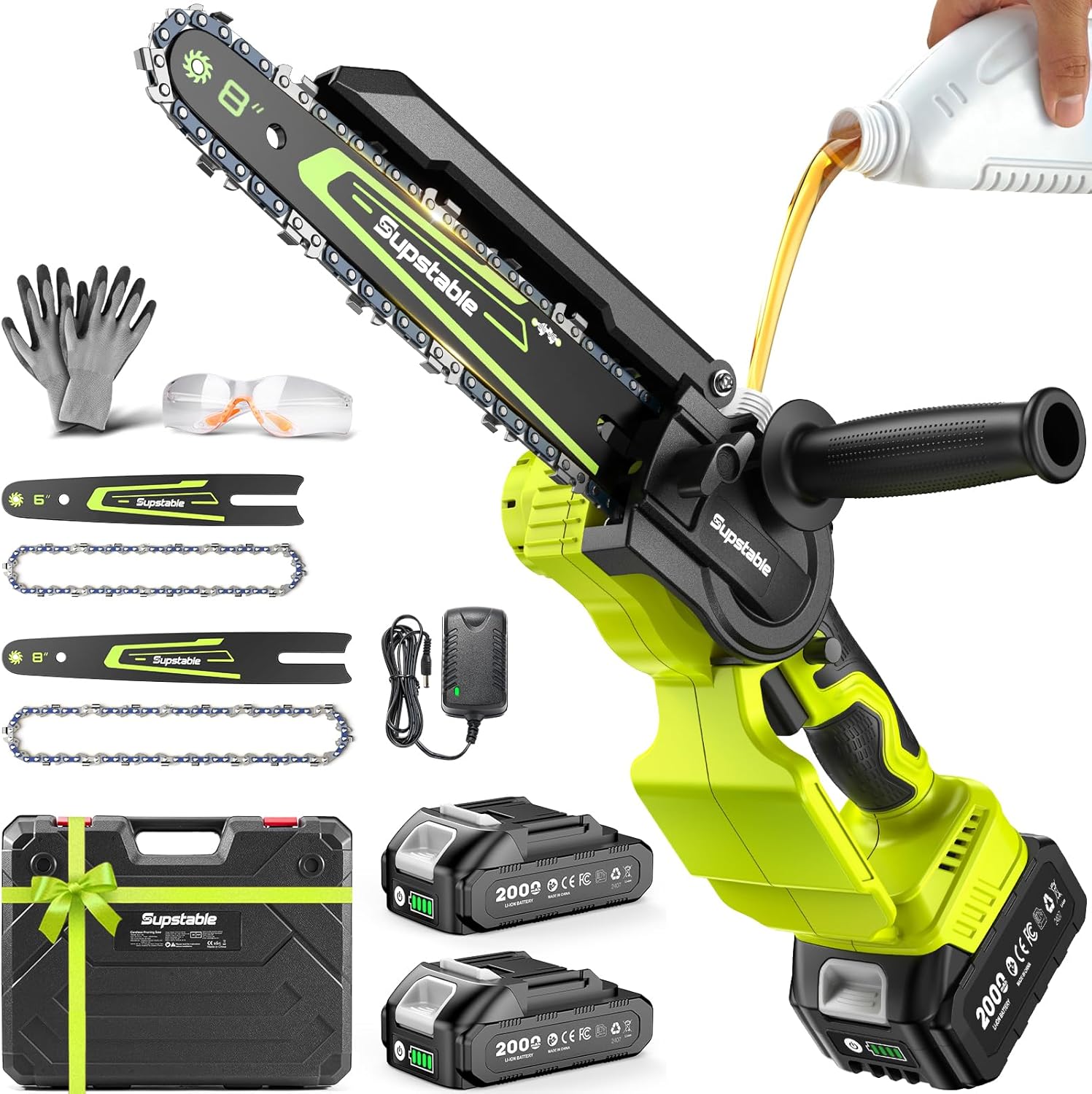
Supstable Mini Cordless Chainsaw with 6" and 8" Bars, Brushless 1000W
| Power Source | Battery Powered |
|---|---|
| Horsepower | 1000 watts |
| Chain Speed | 32ft/s |
| Included Components | 2 batteries and charger, 6" & 8" guide bars, case, gloves, goggles |
| Manufacturer Warranty Description | 2 Year Manufacturer Warranty |
This Supstable mini cordless chainsaw is a lightweight, two-size kit aimed at routine pruning, branch trimming, and small firewood cutting around the yard. It uses a 1000W brushless motor and offers quick switching between the included 6" and 8" guide bars so you can choose a shorter bar for precision pruning or the longer bar for slightly larger cuts. The kit includes two 2.0Ah batteries, a charger, a hard case, gloves, goggles, and an auto-oiler system to keep the chain lubricated during extended sessions. In practice the tool is easy to handle for users who want to avoid full-size gas or corded saws: it is light, has a non-slip auxiliary handle, and features a safety lock and debris baffle. Expect cordless convenience for small- to medium-duty yard work but not for heavy logging; runtime depends on task intensity and the 2.0Ah batteries are best for shorter jobs or swapping with a charged spare. The included safety kit and auto-oiler reduce maintenance and make it a practical choice for hobbyist gardeners and weekend DIYers.
Best for: Buyers who prioritize a compact, easy-to-use cordless saw for routine yard maintenance and occasional firewood or DIY cuts, and who value convenience and low maintenance over industrial cutting power.
Less Ideal for: Contractors or users who need long continuous runtime or to fell large trees should choose a full-size or higher-capacity professional chainsaw instead.
- Two interchangeable guide bars (6" and 8") for both precise pruning and larger branch cuts
- 1000W brushless motor for smoother power delivery and lower vibration
- Includes two batteries and a fast charger for extended runtime between charges
- Auto-oiler system reduces chain maintenance and keeps cutting consistent
- Comes with a hard case and basic safety gear for immediate, safer use out of the box
- 2.0Ah batteries provide limited runtime under heavy load compared with larger-capacity packs
- Not intended for heavy logging or very large-diameter trees due to bar length and battery capacity
Verdict: If you want a lightweight, low-maintenance cordless saw for regular pruning and small firewood jobs, this two-bar Supstable mini chainsaw is a practical, ready-to-use option.
Choosing the Right Small Chainsaw for Firewood: Key Factors to Consider
Cutting Capacity and Power Delivery
A small chainsaw must still produce steady cutting force to slice through rounds without bogging down. For firewood work, look beyond peak power numbers and consider how the saw responds under load. A tool that stalls when meeting a knot or thicker section forces you to make multiple passes and increases wear. Consistent chain speed, good chain sharpness retention, and the ability to maintain RPM under moderate load matter more than raw peak horsepower for typical backyard logs.
Also consider torque at low engine or motor speeds. Higher low-end torque helps push the chain through denser wood and reduces the need to force the saw with your arms. For electric options, sustained amperage and thermal management affect how long you can cut before pauses are required.
Bar Length Versus Maneuverability
Bar length determines the largest log you can cut in a single pass, but longer bars add weight and reduce maneuverability. Small chainsaws for firewood typically use shorter bars that fit in tight woodpiles and allow cutting close to the ground or against obstacles. Assess what log diameters you usually cut at home and choose a bar length that handles most of them in one pass without making the saw unwieldy.
Shorter bars also let you make safer cuts when working from ladders, benches, or inside small stacks. If you occasionally encounter larger rounds, plan for a sawing technique that uses progressive cuts rather than relying solely on a single long bar.
Ergonomics and Weight
Comfortable handles, balanced weight distribution, and low overall mass reduce fatigue during repetitive cutting. For firewood, you may make dozens of cuts in a session, so a saw that feels light in the hands and does not pull forward or to one side will help preserve accuracy and reduce the chance of mistakes. Assess the grip shape, trigger placement, and whether vibration dampening is built in.
Consider how the saw will be carried across uneven ground and how easy it is to swap hands for different cuts. A tool that is slightly heavier but better balanced can feel easier to control than a lighter, awkwardly weighted unit.
Maintenance Access and Chain Care
Chainsaw chains need regular sharpening, tension checks, and occasional replacement, and the bar requires cleaning and lubrication. A small chainsaw that offers tool-free or easy access to the chain, quick tensioning systems, and a reachable oil fill will save time and keep the tool cutting well. Neglecting maintenance reduces cutting efficiency, increases fuel or battery drain, and shortens component life.
Look for features like transparent oil windows, captive bar nuts, and clear chain guides that simplify routine tasks. Also factor in how straightforward it is to remove the bar and chain for sharpening or to replace a worn-out chain.
Safety Features and Kickback Reduction
Working with chainsaws for firewood often involves awkward positions and reactive cutting. Features that reduce the risk of kickback and allow quick stopping of the chain are essential. Effective chain brakes, low-kickback chain designs, and front-hand guards help protect you during common cutting scenarios. Also evaluate chain catcher designs and anti-vibration systems that keep hands steady.
Good safety design also means predictable control responses. A saw with sudden or hard-to-modulate throttle behavior increases the chance of mistakes. Clear labeling, easy-to-reach on/off controls, and a fail-safe stopping system are important for everyday firewood work.
Fueling, Battery Life, and Runtime Practicalities
Decide whether you need the convenience of a battery-powered unit or the runtime flexibility of a fuel-powered saw. For short sessions and lighter rounds, battery models offer quieter operation and less maintenance. For longer stints or thicker rounds, gas saws provide uninterrupted cutting until refueling. Consider how long a fully charged battery runs at typical cutting loads and how fast it recharges if you plan continuous work.
Also think about fuel mixing or battery management logistics. Battery packs add weight at the back of the saw, which changes balance. A saw designed to accept commonly available battery sizes or that has quick-swap capability will keep you cutting with fewer interruptions.
Practical Cutting Techniques for Small Chainsaws
Using a compact saw means adapting your cutting approach. For larger rounds, use progressive cuts from multiple angles rather than overreaching with a single long bar. Position the log on a secure chopping block to keep the chain clear of dirt and to reduce dulling.
When cutting near the ground, support the log so the bar does not pinch. Start shallow cuts and let the chain do the work; forcing the saw increases vibration and reduces control. For cross-cutting, consider a series of shallow passes to prevent binding.
- Stabilize logs on a raised block to protect the chain
- Use the upper quadrant of the bar tip to avoid kickback-prone positions
- Keep a steady, controlled feed rate instead of forcing the saw
Routine Maintenance Checklist
A short maintenance routine keeps a small chainsaw performing reliably. Check chain tension before each session, verify the chain oil level, and inspect the air intake and cooling fins for debris. For gas engines, follow the spark plug and fuel filter service schedule.
Sharpen the chain regularly; a dull chain increases cutting time and stresses the motor. Clean out sawdust and resin from the bar groove and sprocket area to prevent accelerated wear.
- Check chain tension and oil level before each use
- Sharpen or replace chain when cuts become slow or ragged
- Clean bar groove and ventilation paths after heavy use
Choosing Between Electric and Gas Small Chainsaws
Electric small chainsaws excel for light, quick jobs and produce less noise and vibration. Battery models are especially convenient for easy start-up and lower maintenance. Consider typical session length and whether battery swap capability will match your workflow.
Gas-powered small chainsaws are better suited to longer cutting sessions or when you encounter thicker, wetter wood that demands sustained power. They require more maintenance but avoid runtime limits tied to battery life.
- Electric: quieter, lower upkeep, best for short sessions
- Gas: longer continuous runtime, better for heavier logs
- Match power delivery to typical log size and session length
Storage, Transport, and Safe Handling
Store the saw in a dry location with the chain tension relieved and bar cap on to prevent damage. For gas saws, drain or stabilize fuel if storing long term. Keep spare chains and basic tools together for field maintenance.
Transport in a closed vehicle compartment or secured in a truck bed with the chain guarded. When carrying the saw, use the built-in handle and avoid awkward one-handed carries that increase risk of bumping the chain.
- Relieve chain tension for long-term storage
- Use a bar cover during transport
- Carry with the engine or motor off and the chain brake engaged
Accessories That Make Firewood Work Easier
A few well-chosen accessories can improve efficiency and safety. A sharpening file or a small bench grinder keeps chains cutting sharply. Chain oil with good adhesion prevents excessive bar wear. A sturdy chopping block and log cradle speed workflows and protect the chain from ground debris.
Also consider vibration-reducing gloves and hearing protection, especially for longer sessions. Replacement chains sized to your bar let you swap a dull chain quickly and keep downtime low.
- Hand file kit or sharpener for on-the-go chain maintenance
- Quality bar oil to reduce wear
- Chopping block or cradle to raise logs off the ground
How We Chose the Best Small Chainsaw for Firewood
We selected these small chainsaws for firewood using criteria that reflect real-world cutting tasks rather than lab numbers. Priority went to saws that deliver reliable power through a range of log diameters, measured by engine or motor responsiveness and sustained cutting speed. Bar length and chain profile were used to judge practical cutting capacity for household firewood rounds. Ease of use was a major filter, covering starting systems, weight distribution, and intuitive controls to minimize fatigue during repeated cuts. Durability factors included bar and chain construction, sprocket life, and maintenance access for chain tensioning and cleaning. Safety features such as chain brake effectiveness, low-kickback chains, and clear vibration damping were also required for inclusion. We excluded large professional-grade saws and specialty forestry equipment that exceed compact weight or bar-length expectations. Tools that lacked basic maintenance access or omitted fundamental safety features were also excluded. The final list balances cutting capability, handling, and long-term serviceability for gardeners and homeowners who process firewood regularly.
FAQ
What bar length is best for a small chainsaw used to cut firewood?
Bar length depends on the typical log diameter you cut. For most home firewood tasks, a short bar that handles 8 to 12 inch rounds is sufficient. If you frequently encounter larger logs, plan progressive cuts or use a slightly longer bar while accepting added weight and reduced maneuverability.
How often should I sharpen the chain when processing firewood?
Sharpening frequency depends on wood type and cutting conditions. For regular hardwood rounds, you may need to sharpen after every few hours of cutting; for softer or seasoned wood, less often. Inspect cut quality and increase sharpening when cuts become ragged or the saw pulls to one side.
Are battery small chainsaws powerful enough for firewood?
Battery saws can handle many firewood tasks, especially if you match battery capacity to session length. They are best for shorter sessions and smaller rounds. For extended cutting or very dense wood, gas models generally provide longer continuous power.
How can I reduce kickback risk when cutting firewood?
Use proper cutting technique, avoid the very tip of the bar, and keep the chain sharp. A chain brake and low-kickback chain design add protection. Stabilize the log and maintain a steady feed rate to minimize sudden chain jumps.
What maintenance tasks are most important for long-term chainsaw reliability?
Regularly check and adjust chain tension, maintain chain sharpness, keep the bar groove and sprocket area clean, and ensure consistent chain lubrication. For gas engines, follow the spark plug and fuel system service intervals to avoid performance loss.
Final Verdict
For firewood tasks, prioritize a small chainsaw that balances usable cutting capacity with comfortable handling. Focus on cutting power under load, an appropriate bar length for the logs you cut most, and features that reduce operator fatigue. Tradeoffs are common: longer bars increase reach but add weight, and gas units offer runtime at the cost of more maintenance. Choose the saw whose strengths match your typical session length and log sizes, and keep a routine maintenance plan to preserve cutting performance.
