

Note: This article contains affiliate links. If you click on these links and make a purchase, I may earn a small commission at no extra cost to you. This helps support my research and content. Read my full affiliate disclosure here.
A smart garden sprinkler changes watering from a chore into a background task that protects plants and conserves water. The right unit adapts spray patterns, schedules, and run times to your yard layout and weather conditions so you avoid dry patches, runoff, and overtreatment. This guide highlights seven top smart garden sprinklers shortlisted for real-world yard use. We tested for coverage flexibility, connectivity reliability, and ease of seasonal setup. Below you will find clear evaluation criteria and practical notes to help you pick a model that fits your lawn size, irrigation goals, and technical comfort level.
Top Picks at a Glance
| Best Overall The best all-around choice for most situations | Rachio 3 Smart Sprinkler Controller — 8-Zone Wi‑Fi Irrigation Controller |  |
| Best Quality Built to a higher standard if you want something more solid | AIPER IrriSense 2 Smart Sprinkler System |  |
| Best Value The sweet spot between price and what you get | GoveeLife H5901 Smart WiFi Sprinkler Timer with Gateway (1‑Outlet) |  |
| Best Budget The cheapest option that still gets the job done reliably | YoLink Smart Sprinkler Hose Timer with Flow Meter (YS4103) |  |
| Highest Rated A top-rated pick with lots of positive feedback | Insoma Solar WiFi Water Timer with Independent Solar Panel and Type‑C Backup |  |
| Most Popular A crowd favorite that many people choose with confidence | Orbit B-hyve Smart Sprinkler Controller, 6-Zone (57946) |  |
| Best Seller A high-volume bestseller chosen again and again | Orbit B-hyve XD 4-Port Smart Hose Watering Timer |  |
Rachio 3 Smart Sprinkler Controller — 8-Zone Wi‑Fi Irrigation Controller

| Zones | 8 Zones |
|---|---|
| Voltage | 120 volts |
| Display Type | LED |
| Operating Temperature | 4 °F |
The Rachio 3 is an app-first sprinkler controller designed to simplify in-ground irrigation for typical home lawns. You mount the indoor controller, hook into existing zone wires and the transformer, then use the Rachio app to create adaptive schedules that automatically skip watering for rain, freeze, wind, or saturated soil. Notable features include dual-band Wi‑Fi for reliable connectivity, Weather Intelligence that adjusts run times seasonally, a Quick Run button to water zones on demand, and integrations with Alexa, Google Home and IFTTT. Practical benefits include reduced water waste, easier establishment of new turf with grow-in schedules, and remote control when you are away. Setup is pitched as a 30-minute DIY job and the unit supports common 8- and 16-zone systems. Important limitations are that the controller is indoor rated unless you buy a weatherproof enclosure for outdoor installs and well systems may need a pump to maintain pressure with automated schedules. The product is strong for homeowners who want automated, weather-aware watering without fiddling with dial timers.
Best for: Homeowners who want a reliable, hands-off sprinkler controller that reduces water use and automates seasonal adjustments with easy app control.
Less Ideal for: People who need an outdoor-rated controller out of the box or who prefer completely mechanical plug-and-play timers without app dependence.
- Adaptive Weather Intelligence that skips watering for rain, freeze, wind and saturation
- App-based schedules with Quick Run for on-demand manual watering
- Works with Alexa, Google Home and IFTTT for voice and smart-home control
- Dual-band Wi‑Fi improves connectivity and remote control reliability
- Indoor-rated unit requires a separate weatherproof enclosure for outdoor mounting
- May need an external pump for some well systems to maintain required pressure
Verdict: Choose the Rachio 3 if you want an easy-to-setup, app-driven controller that saves water with intelligent, weather-aware schedules.
AIPER IrriSense 2 Smart Sprinkler System

| Maximum Flow Rate | 6.8 gpm |
|---|---|
| Model Number | WAW1 |
| Number of Packs | 1 |
The IrriSense 2 combines a controller, sprinkler, electric valve, and nutrient feeder into a single unit designed to cover up to 4,800 sq. ft. It is typically used as a stand-alone smart irrigation solution for lawns, beds, and small garden plots where you want precise, plant-specific watering without installing a full in-ground system. Key features include on-device mapping for up to 10 irrigation zones, EvenRain technology for uniform gentle spray, weather-adaptive scheduling with rain detection, and a built-in nutrient solution compartment. In practice the device simplifies setup and daily operation: the 15-minute install and app-driven maps let you target thirsty areas or reduce soak time for delicate beds, and the weather-adaptive logic helps cut water use. Limitations to consider are dependence on local water pressure to reach the stated range and a single integrated unit rather than separate fixed heads, which makes it best for portable or temporary setups rather than hardwired permanent systems.
Best for: Gardeners who prioritize performance and precision watering for lawns and mixed planting areas and who want fast installation and app-driven control rather than a full in-ground system.
Less Ideal for: Homeowners seeking a permanent, hardwired irrigation network with multiple fixed heads or those with consistently low municipal water pressure are better served by a traditional installed system.
- All-in-one design replaces controller, valve, sprinkler, and feeder for quick 15-minute setup
- Plant-specific multi-zone mapping for up to 10 custom irrigation maps
- EvenRain technology provides gentle, uniform spray that improves absorption
- Weather-adaptive scheduling with built-in rain detection reduces unnecessary watering
- Maximum spray range and performance depend on site water pressure and wind conditions
- Single integrated unit is less suitable for permanent underground sprinkler systems
Verdict: Buy the IrriSense 2 if you want a high-performance, plug-and-play smart sprinkler that delivers precise, plant-specific multi-zone watering with weather-adaptive controls.
GoveeLife H5901 Smart WiFi Sprinkler Timer with Gateway (1‑Outlet)

| Gateway range | 1640 ft |
|---|---|
| Watering schedules | Up to 10 |
| Watering modes | Continuous, Intermittent, Custom |
| Ingress protection | IP67 |
| Material type | Brass, Plastic |
The GoveeLife H5901 is a WiFi sprinkler timer sold with a gateway that turns a garden spigot into an app‑controlled irrigation station. It links wirelessly to a gateway with long range so multiple timers across a yard can be managed from the Govee Home app and via Alexa or Google Assistant. The unit uses brass inlet/outlet fittings and an IP67 rated housing for reliable outdoor use, and supports three watering modes plus up to 10 schedules so you can set different programs for lawns, beds, or seed flats. The app provides weather‑adaptive adjustments and charts of recent run times, which helps avoid overwatering and simplifies seasonal changes. Practical limits to note are the need for a 2.4 GHz WiFi gateway and the valve minimum operating pressure requirement, so very low pressure systems or incompatible faucet threads could prevent proper operation. Setup and occasional firmware updates to the gateway are needed to keep devices synced, but once configured the system offers convenient, centralized control for a varied garden layout.
Best for: Gardeners who want to streamline irrigation across multiple zones with smart automation and weather‑aware scheduling, and who prioritize durable outdoor hardware and centralized remote control.
Less Ideal for: People with very low household water pressure, nonstandard faucet threads, or those who prefer a simple mechanical timer without a gateway or app dependency.
- Weather‑adaptive scheduling that adjusts for rain, temperature, and humidity
- Brass connectors and IP67 housing for durable, outdoor‑ready installation
- App and voice control with clear usage charts for tracking watering history
- Supports up to 10 distinct schedules and three modes for flexible irrigation plans
- Gateway offers long range and can connect many devices to cover large yards
- Requires the included gateway and a 2.4 GHz WiFi network to access remote features
- Not suitable for very low water pressure systems due to minimum valve start pressure
Verdict: If you want reliable, weather‑adaptive remote control of multiple garden zones with durable outdoor hardware, the GoveeLife H5901 delivers a practical, centralized solution.
YoLink Smart Sprinkler Hose Timer with Flow Meter (YS4103)

| Brand | YoLink |
|---|---|
| Model Number | YS4103 |
| Watering Modes | Duration Mode, Volume Mode |
| Range | Up to 2,034 feet (LoRa) |
| Flow Meter | Built-in real-time flow and total usage |
The YoLink YS4103 is a smart sprinkler hose timer designed to automate outdoor watering for lawns, gardens, and small farms. It offers two main modes: Duration Mode for simple timed runs and Amount Mode to deliver a specified volume of water, which is helpful for delicate plantings or established turf. The built-in flow meter tracks real-time flow and cumulative usage, and the app stores up to 180 days of logs so you can review patterns and spot overwatering. Scheduling is flexible with daily, weekly, odd/even and custom cycles, and ECO mode delays runs when local weather data indicates rain. Connectivity uses LoRa for long open-air range, so devices can work well across larger properties without relying on local Wi-Fi. Important limitations are that the unit needs a YoLink Hub to access app features and automations and it is not waterproof, so it must be mounted in a protected enclosure. For buyers on a budget this delivers advanced metering and smart scheduling, but plan for the additional hub and a sheltered installation.
Best for: Practical gardeners and homeowners who want accurate water tracking and programmable smart schedules to cut waste while keeping costs down.
Less Ideal for: People who need a completely standalone, weatherproof timer without buying an additional hub or those who prefer simple, no-app mechanical timers.
- Two watering modes (duration and volume) for flexible control of run time or precise water delivery
- Built-in flow meter provides real-time flow and total usage tracking
- Weather-aware ECO mode delays watering during rain to save water
- Long-range LoRa connectivity up to 2,034 feet supports larger properties without Wi-Fi
- Requires a separate YoLink Hub for app features and automations
- Not waterproof and must be installed in a protected location
Verdict: Choose this timer if you want precise water metering and flexible smart schedules on a budget and can add the required YoLink Hub.
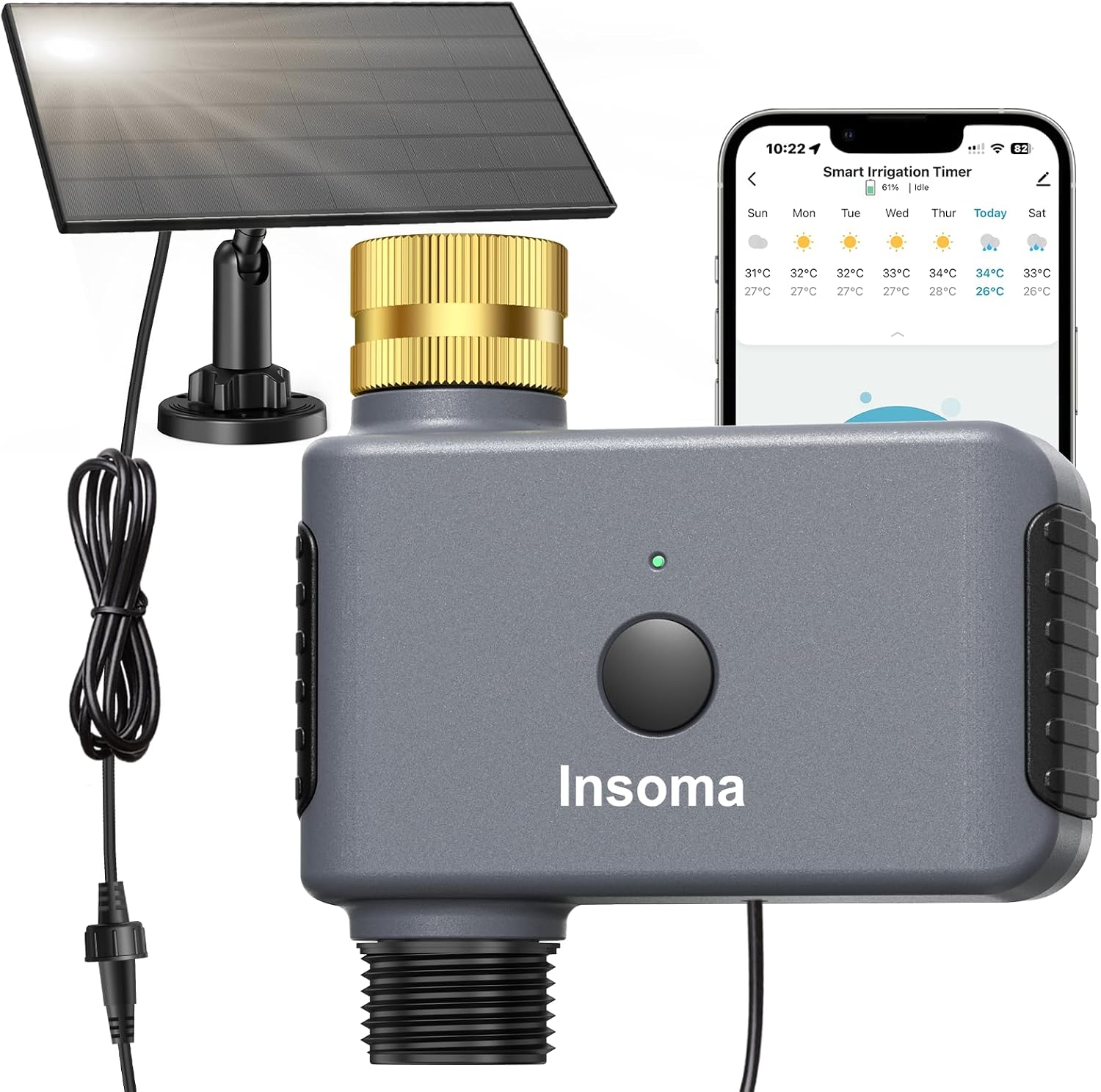
Insoma Solar WiFi Water Timer with Independent Solar Panel and Type‑C Backup
| Power | Solar panel with Type‑C backup |
|---|---|
| WiFi | Direct 2.4GHz connection |
| Number of settings | 20 |
| Water inlet | Brass, 116 PSI |
| Waterproof rating | IPX6 |
This Insoma solar WiFi water timer is built for dependable, hands-off garden irrigation. It connects directly to your 2.4GHz WiFi network so you can create and manage up to 20 watering schedules from the Smart Life app or with Alexa and Google Assistant. The timer uses a separate solar panel with a 3 m cable so you can mount the panel in full sun while keeping the valve at the faucet, and a Type‑C port provides backup charging on cloudy stretches to avoid unexpected downtime. Construction features a brass inlet rated to 116 PSI, IPX6 weatherproofing, UV‑resistant coating, and rust‑proof ABS for long outdoor life. The unit supports manual runs from 1 minute to 24 hours, plus rain delay options and cycle/soak modes for flexible watering plans. The practical compromise is that it requires a 2.4GHz WiFi network for remote control and relies on app/cloud services for advanced features, so fully local control without WiFi is limited. For gardeners who value low-maintenance, reliable scheduling and solar-assisted power, this timer delivers consistent performance.
Best for: Gardeners who prioritize a low-maintenance, dependable automatic timer and want remote app or voice control to keep irrigation running reliably without frequent battery changes.
Less Ideal for: People with no reliable 2.4GHz WiFi at the faucet or those who need wholly local, hub-free control without any cloud-dependent features.
- Independent solar panel with 3 m cable lets you position the panel for optimal sunlight while the valve stays at the faucet
- Direct 2.4GHz WiFi connection removes need for a separate hub and enables remote scheduling via the Smart Life app
- Type‑C backup charging avoids disposable batteries and reduces mid‑season power failures
- Durable build with brass inlet rated to 116 PSI, IPX6 waterproofing, UV-resistant coating, and rust-proof ABS
- Requires a 2.4GHz WiFi network for full remote control which limits use in properties without suitable WiFi
- Advanced features depend on the app and cloud services rather than offering full local-only control
Verdict: Choose this timer if you want a weatherproof, low-maintenance smart hose timer that uses solar power plus Type‑C backup to keep irrigation schedules running reliably.
Orbit B-hyve Smart Sprinkler Controller, 6-Zone (57946)

| Item Type Name | B-hyve Smart 6-Zone Indoor/Outdoor Sprinkler Controller, Compatible with Alexa |
|---|---|
| Voltage | 110 volts |
| Display Type | LCD or LED |
| Operating Temperature | 75 °C |
The Orbit B-hyve 6-zone smart sprinkler controller centralizes irrigation scheduling and weather-based adjustments so you can automate a typical home lawn or garden without daily intervention. Install it on an indoor wall or outdoors in its weatherproof enclosure, connect it to your Wi-Fi and the free B-hyve app, then program zone run times, start times, and seasonal schedules from your phone. The controller uses local weather data to skip or reduce watering during rain and to increase watering in dry spells, which helps prevent overwatering and conserves water. It also supports voice control through common smart assistants for one-off zone commands. Practical strengths are straightforward programming via console or app, solid multi-zone support for small to medium yards, and a clear LCD/LED display. Limitations are that this model covers six zones only and requires a stable 2.4 GHz Wi-Fi network for remote control, so larger systems or sites with poor Wi-Fi may need a different model or additional hardware.
Best for: Homeowners who want reliable, water-saving automatic irrigation for a small to medium yard and who prefer managing schedules from a smartphone with occasional voice control.
Less Ideal for: Large properties that need more than six independent zones or users without consistent home Wi-Fi coverage should consider higher-capacity or hub-based systems.
- WeatherSense adjusts schedules using local weather to reduce overwatering
- App and on-unit controls let you program and change schedules remotely
- Weatherproof indoor/outdoor enclosure supports flexible mounting locations
- Supports voice control with common smart assistants for simple commands
- Supports only up to six zones which may be too few for larger landscapes
- Requires a reliable home Wi‑Fi network for full remote functionality
Verdict: Choose this controller if you want a straightforward, weather-smart way to automate and conserve water across up to six irrigation zones.
Orbit B-hyve XD 4-Port Smart Hose Watering Timer

| Brand Name | Orbit |
|---|---|
| Item Type Name | Sprinkler Timer |
| Number of settings | 6 |
| Material Type | Plastic |
The Orbit B-hyve XD 4-Port Smart Hose Watering Timer turns a single outdoor faucet into a four-zone irrigation hub that is aimed at homeowners who want reliable, automated watering without constant fuss. Each of the four outlets can be scheduled independently using the B-hyve mobile app over Bluetooth, and the device supports remote smart functions when paired with an optional Wi-Fi hub. WeatherSense automatically adjusts watering based on local conditions and drought alerts so the system reduces overwatering during rainy or cool periods. The unit is rated IPX-5 for outdoor durability and includes a simple on-device interface for local programming when a phone is not handy. Practical benefits include consolidated control of multiple garden areas, water savings from weather-based adjustments, and straightforward Bluetooth setup for nearby control. Limitations to note are the dependency on a Wi-Fi hub for full remote/Wi-Fi features and that more advanced networked automation requires that additional accessory. For risk-averse buyers the proven brand, WeatherSense automation, and weatherproof design provide reassuring reliability for a smart sprinkler solution.
Best for: Homeowners who want a low-maintenance, dependable smart sprinkler that automates multiple garden zones and prioritizes water-efficient schedules and simplicity.
Less Ideal for: Users who need full cloud-based remote control out of the box or who require integration with wider smart-home systems without adding the Wi‑Fi hub.
- Four independently programmable outlets for separate zones
- WeatherSense adjusts schedules automatically using local weather data
- Bluetooth control with on-device programming for local access
- IPX-5 rated for outdoor use so it tolerates typical yard conditions
- Full remote Wi-Fi control requires purchasing and pairing a separate Wi‑Fi hub
Verdict: Buy this if you want a durable, water‑saving four-port smart hose timer that automates multiple zones with reliable weather-based scheduling.
Choosing the Right Smart Garden Sprinkler: Key Factors to Consider
Coverage Patterns and Range
Coverage pattern affects how evenly water reaches lawns, beds, and borders. Look for sprinklers with adjustable arc, radius, and nozzle options so you can fine-tune spray to match irregular beds, narrow planting strips, and larger turf areas. Multiple pattern settings reduce overlap and dry spots when you place heads or units strategically.
Range matters for how many sprinklers you need and where to place them. Longer radius nozzles cover more area but may increase drift and evaporation on windy days. For mixed landscapes, choose a system that offers both short-throw and long-throw nozzles or easy nozzle swaps to tailor output to each zone.
Connectivity and Control Options
Reliable wireless or wired connectivity determines whether schedules and weather-based adjustments actually happen. Consider whether the unit uses Wi-Fi, a bridge/hub, Bluetooth, or a proprietary mesh. Wi-Fi gives remote control without extra hardware but can be affected by distance and interference. Bridges add reliability across longer runs but increase setup complexity.
Control interfaces range from phone apps to web dashboards and voice assistant integration. Prioritize apps that show zone-level run history, let you create flexible schedules, and provide manual zone triggers. Also check how the device handles lost connections and whether it defaults to a safe fallback schedule when offline.
Weather Integration and Sensors
Smart watering only saves water if the controller reacts to current conditions. Look for built-in or compatible weather integration that adjusts run times based on local forecasts, soil moisture, or rainfall sensors. Evapotranspiration-based adjustments are useful for seasonally changing needs across the growing year.
Rain and freeze sensors prevent unnecessary runs that waste water and can harm plants. Soil moisture sensors give the most precise control but require installation in each zone. Decide if automatic weather adjustments or manual override suits your gardening style and plant sensitivity.
Installation, Zoning, and Compatibility
Installation complexity varies from plug-and-play aboveground units to hardwired in-ground systems. Evaluate whether you will DIY the setup or need professional help. Check compatibility with existing valves, piping, and low-voltage irrigation systems if integrating into an established layout.
Zoning flexibility is crucial. Systems that let you control multiple independent zones or multiple heads within a zone simplify watering diverse plant types. Also consider physical mounting options, whether heads are pop-ups or fixed risers, and how easy it is to add or move heads as your garden changes.
Durability and Seasonal Maintenance
Outdoor irrigation equipment faces sun, freezing temperatures, and debris. Choose materials and seals rated for UV exposure and winterizing. Corrosion-resistant fittings and robust valve housings extend service life in wet soils and coastal conditions.
Think about seasonal maintenance tasks: blowing out lines, removing nozzles for winter storage, and checking valve diaphragms. Systems designed for easy part replacement and accessible control modules reduce downtime and long-term upkeep.
Water Use Efficiency and Regulatory Compliance
Water-efficiency features directly lower irrigation waste and can help meet local watering restrictions. Features to look for include cycle-and-soak scheduling, pressure regulation, flow monitoring, and leak detection. Flow monitoring can alert you to broken pipes or stuck heads so you can fix issues before plants are overwatered.
Also verify that the system supports local watering ordinances, such as odd-even day schedules or restricted hour limits. Choosing a controller that can be set to comply with municipal rules avoids fines and simplifies long-term yard management.
Matching Sprinkler Type to Yard Layout
Different smart sprinkler designs suit different landscapes. Aboveground oscillators and rotary sprinklers are easy to move and good for irregular temporary areas. Pop-up in-ground heads offer a cleaner look for permanent lawns and integrate better with zoned irrigation. Consider how often you rearrange planting beds or add hardscape when choosing between movable and fixed heads.
- Aboveground units work well on patios, temporary lawns, and rental properties.
- In-ground pop-up heads provide uniform coverage for established turf and hide when not in use.
- Movable smart units simplify seasonal zone changes but may require more manual repositioning.
Smart Scheduling Strategies for Plant Health
Create schedules that match plant water needs rather than watering every zone the same. Group turf areas separately from shrubs and flower beds and build shorter cycles with soak pauses to reduce runoff on slopes. Use early-morning schedules to minimize evaporation and fungal risk when possible.
- Zone by plant type and sun exposure.
- Use cycle-and-soak for slopes and clay soils.
- Adjust frequency seasonally rather than just duration.
Integrating Soil and Rain Sensors
Adding soil moisture probes or rain shutoff sensors gives you feedback that weather forecasts alone cannot. Place soil sensors at root depth in representative spots for each zone. If a system supports both soil probes and weather-based adjustments, use the probes to fine-tune baseline schedules and let weather data make larger seasonal shifts.
- Install probes where roots are densest, not in shaded microclimates.
- Prioritize a system that supports wired or wireless sensors to match your layout.
- Check calibration recommendations to avoid over- or under-watering.
Maintenance Checklist for Multi-Season Reliability
Set a simple seasonal checklist to keep a smart sprinkler reliable year after year. Include valve and nozzle inspection in spring, a mid-season check of app connectivity and run logs, and a winterization plan to remove or blow out water from exposed lines. Keep spare nozzles and common fittings on hand to fix minor leaks quickly.
- Inspect nozzles and heads for clogging each spring.
- Verify app firmware and connectivity before the high-use season.
- Schedule blowout or drainage before freezing weather.
Common Installation Pitfalls to Avoid
Avoid placing heads where hardscape or trees block spray patterns. Check for utility lines before digging and confirm pipe pressure to ensure nozzles operate as expected. Overlapping too many spray patterns is a common cause of wasted water and muddy spots; plan head spacing based on manufacturer throw recommendations and real-world tests.
- Map zone boundaries before installing heads.
- Test each head individually to confirm arc and radius.
- Account for wind and adjust placement for prevailing conditions.
How We Chose the Best Smart Garden Sprinkler
We focused on features and real-garden performance that matter when automating outdoor watering. Selection began with devices designed specifically for garden and lawn irrigation rather than general-purpose outdoor timers. We prioritized units offering adjustable coverage patterns, consistent wireless or wired connectivity, and robust scheduling tied to local weather data. Key evaluation criteria included spray coverage and pattern control, connectivity and app reliability, water-conservation features such as sensor or weather integration, build quality and weather resistance, and ease of installation and seasonal maintenance. We excluded products intended only for indoor potted plants, novelty sprayers, or devices lacking adjustable run-time or pattern options. We also filtered out units with unclear documentation or limited replacement-part availability. Final picks represent devices that balance reliable in-ground or aboveground coverage with meaningful smart controls you can actually use in a home garden. Each choice was judged against the scoring measures listed below to keep recommendations practical and actionable for gardeners.
FAQ
How do smart sprinklers save water compared with manual timers?
Smart sprinklers usually adjust schedules based on weather forecasts, soil moisture, or evapotranspiration. That reduces unnecessary runs after rain or during cool periods, so water use often drops compared with fixed timers that run the same program regardless of conditions.
Will a smart sprinkler work with my existing irrigation valves?
Often yes. Many smart controllers and smart-enabled heads are designed to integrate with standard low-voltage irrigation valves. Check whether the device expects direct valve control or requires a bridge, and confirm compatibility with your valve wiring and zone count.
Can I run a smart sprinkler system without Wi-Fi?
Some smart devices offer local control via Bluetooth or a local hub that does not rely on continuous cloud connectivity. However remote management and weather-based updates typically require Wi-Fi or a bridge. Evaluate how important remote access is before choosing a model that is strictly local-only.
How should I adjust schedules for a slope or clay soil?
Use shorter cycle-and-soak intervals to allow water to infiltrate and avoid runoff. Break a standard watering duration into multiple shorter passes with soak pauses in between. Clay soils benefit from slower, deeper watering to prevent surface pooling.
Are soil moisture sensors worth installing?
Soil moisture sensors provide more accurate, zone-specific feedback than weather data alone and can prevent overwatering in areas with different soil types or microclimates. They add installation work but often pay back quickly through water savings and healthier plants.
What maintenance do smart sprinklers need during winter?
In cold climates, blow out exposed lines or drain systems to prevent freeze damage. Remove aboveground controllers indoors if they are not rated for freezing temperatures, and store detachable sensors and batteries in a dry place to extend life.
Final Verdict
Prioritize coverage adjustability, reliable connectivity, and water-conservation features when choosing a smart garden sprinkler. Consider how your yard is zoned, the local climate, and whether you prefer a simple app-driven setup or a system that supports soil sensors and detailed flow monitoring. Balance installation effort against long-term convenience: movable aboveground units suit flexible spaces while in-ground pop-ups integrate best with permanent lawns. Focus on the features that reduce waste and fit your maintenance habits to choose confidently.
