

Note: This article contains affiliate links. If you click on these links and make a purchase, I may earn a small commission at no extra cost to you. This helps support my research and content. Read my full affiliate disclosure here.
Picking the right smart watering timer changes how you manage irrigation across containers, flower beds, vegetable patches, and lawns. A good timer automates schedules, prevents overwatering, and adapts to seasonal changes so you spend less time running hoses and more time gardening. This guide shortlists seven top-rated smart timers and explains the technical and practical features that matter in real garden use. We evaluate each option for connectivity reliability, ease of programming, and how well it controls water delivery for different planting situations. Read on to find the right smart irrigation controller for your outdoor setup.
Top Picks at a Glance
| Best Overall The best all-around choice for most situations | Orbit B-hyve XD 2‑Port Smart Hose Watering Timer |  |
| Best Quality Built to a higher standard if you want something more solid | Rachio Smart Hose Timer with WiFi Hub (1 Valve + Hub) |  |
| Best Value The sweet spot between price and what you get | GoveeLife H5901 Smart WiFi Sprinkler Timer with Gateway (1‑Outlet) |  |
| Best Budget The cheapest option that still gets the job done reliably | XINYIELE Programmable Smart Sprinkler Timer (1 Outlet) |  |
| Highest Rated A top-rated pick with lots of positive feedback | Grillum Smart WiFi Bluetooth Dual-Outlet Hose Timer |  |
| Most Popular A crowd favorite that many people choose with confidence | Orbit B-hyve XD 4-Port Smart Hose Watering Timer | 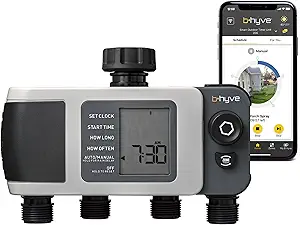 |
| Best Seller A high-volume bestseller chosen again and again | Rachio 3 Smart Sprinkler Controller, 8-Zone |  |
Orbit B-hyve XD 2‑Port Smart Hose Watering Timer

| Brand Name | Orbit |
|---|---|
| Item Type Name | Sprinkler Timer |
| Item Highlight | Dual Outlet Irrigation Control, App Controlled, Weatherproof |
| Number of settings | 5 |
The Orbit B-hyve XD 2-Port Smart Hose Watering Timer automates outdoor watering for two separate hose lines, letting you run independent schedules for different garden zones. It is typically attached to an outdoor faucet and either programmed directly on the device or via the B-hyve mobile app over Bluetooth, with additional remote smart features unlocked when paired to Orbit’s Wi‑Fi hub. Key features include dual outlets for simultaneous but independent watering, WeatherSense weather-based adjustments that reduce unnecessary watering, and an IPX5 weatherproof housing suited to outdoor use. In practice this means less manual watering and smarter timing that responds to rainfall and local drought alerts. The unit is battery powered for easy installation and has a simple app workflow for scheduling. Important limitations are that full remote control and some WaterSense benefits require purchasing Orbit’s separate Wi‑Fi hub, and advanced users who need multi-zone central irrigation support should consider larger zone controllers instead.
Best for: Homeowners who want a straightforward, weather-aware smart timer to automate watering for a couple of distinct garden areas without running wires or complex controllers.
Less Ideal for: People managing large, multi-zone irrigation systems or those who need built-in Wi‑Fi remote control without buying an additional hub.
- Dual independent outlets let you water two areas with separate schedules
- WeatherSense automatically adjusts run times based on local weather data
- Bluetooth app control for local programming with optional Wi‑Fi hub for remote access
- IPX5 weatherproof design suitable for outdoor installation
- Full smart, remote features require a separately sold Wi‑Fi hub
- Limited to two outlets so not ideal for larger multi-zone irrigation systems
Verdict: A practical two-outlet smart hose timer that saves water with weather-aware scheduling and easy app control for typical home gardens.
Rachio Smart Hose Timer with WiFi Hub (1 Valve + Hub)

| Included components | Smart Hose Timer Valve, WiFi Hub, Hub power supply and quick start guide |
|---|---|
| Number of settings | 3 |
| Material Type | Plastic |
| Manufacturer | Rachio |
The Rachio Smart Hose Timer replaces manual dial timers with app-based control and a small WiFi hub so you can schedule and run hose watering from anywhere. Installation is designed to be quick: attach the valve to a faucet, power the hub, and pair the valve in the Rachio app. The system supports weather-based scheduling and rain skips to avoid unnecessary runs, plus flow monitoring and low-battery alerts to flag leaks or failures. You can trigger instant watering from the valve button or the app, and expand the system by adding up to eight valves on a single hub. Practical benefits include automated, efficient watering that adapts to local conditions and remote control for precise irrigation. Limitations are that the valves require AA batteries and the hub needs a 2.4 GHz WiFi network, so it is not fully plug-and-play in locations without compatible WiFi or readily accessible batteries. The kit is focused on smart scheduling and diagnostics rather than heavy-duty commercial plumbing applications.
Best for: Gardeners who prioritize reliable, efficient irrigation and want remote, weather-aware control of hose watering for performance-driven yard care.
Less Ideal for: People without accessible 2.4 GHz WiFi at their faucet or those who prefer a fully wired or commercial-grade irrigation solution.
- App control with remote scheduling and instant run from phone
- Weather-based scheduling and rain skips reduce wasted water
- Flow monitoring and low-battery alerts help detect leaks or failures
- Expandable system supports up to eight valves per WiFi hub
- Requires a WiFi hub and 2.4 GHz network which may limit installation locations
- Valve operation depends on AA batteries that are not included
Verdict: Choose this kit if you want a performance-focused, weather-aware hose timer that gives remote control and diagnostics with room to expand.
GoveeLife H5901 Smart WiFi Sprinkler Timer with Gateway (1‑Outlet)

| Gateway‑device range | 1640 ft |
|---|---|
| Water pressure operating range | 7.25–116.03 PSI |
| Number of schedules | 10 |
| Watering modes | Continuous, intermittent, custom |
| Material type | Brass, Plastic |
The GoveeLife H5901 is a smart hose timer kit designed to replace a manual spigot with app-based, scheduled watering and basic water‑usage reporting. It installs on a standard 3/4‑inch threaded spigot and pairs to the included gateway so you can control the timer from anywhere within the gateway range. The system offers three watering modes (continuous, intermittent, custom) and up to 10 schedules, plus weather‑adaptive adjustments that skip rain or increase runtime in heat and low humidity. Brass inlet fittings and an IP67-rated housing aim to reduce leaks and stand up to outdoor conditions. The app shows charts of recent watering and supports Alexa and Google voice commands for hands‑free starts. Important limitations: the gateway requires 2.4 GHz Wi‑Fi, the valve needs a minimum starting pressure to operate properly, and only one outlet is controlled per timer so multi‑zone gardens require multiple units or devices.
Best for: Gardeners who prioritize reliable, data‑driven irrigation and want automated, weather‑responsive schedules controlled remotely or by voice.
Less Ideal for: People with multi‑zone irrigation needs who do not want to deploy multiple timers or those limited to 5 GHz‑only home networks.
- Weather‑adaptive scheduling that adjusts runtimes based on local rain and temperature data
- Gateway supports long range and multiple devices so you can centralize control across a property
- Brass connectors and IP67‑rated body reduce risk of leaks and stand up to outdoor exposure
- Up to 10 programmable schedules and three watering modes for flexible irrigation plans
- App provides watering charts and integrates with Alexa and Google Assistant for voice control
- Requires the separate gateway and 2.4 GHz Wi‑Fi which may limit some network setups
- Only a single water outlet per timer so larger multi‑zone systems need extra units or a different controller
Verdict: Choose this timer when you want a weather‑adaptive, remotely managed irrigation solution built for outdoor durability and centralized control.
XINYIELE Programmable Smart Sprinkler Timer (1 Outlet)
| Number of settings | 10 |
|---|---|
| Battery Type | AAA |
| Material Type | Plastic |
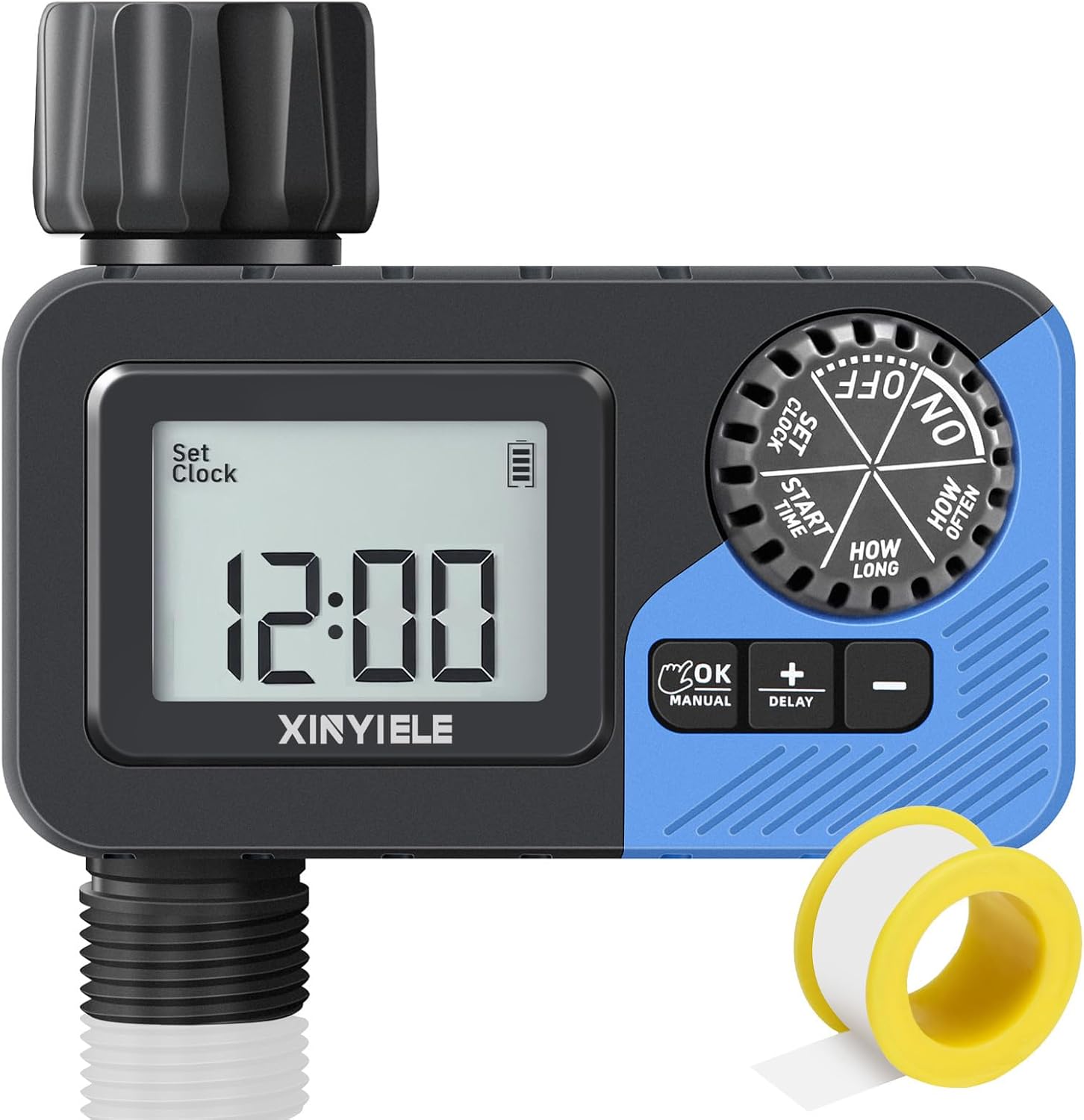
The XINYIELE programmable smart sprinkler timer automates one hose outlet so you can set start times, watering durations from 1 minute up to 3 hours 59 minutes, and repeat intervals that range from hourly schedules to once every seven days. It is typically mounted at an outdoor spigot and runs on two AAA batteries, while the large LCD makes it straightforward to check and adjust settings. Notable features include a built-in metal filter for basic debris protection, an IP54-rated housing and rubber-gasketed battery cover for splash resistance, and an advertised long cycle life. For everyday garden and small-lawn irrigation it delivers precise, hands-off watering and simple setup guided by the included manual. Limitations to expect are single-outlet control only, reliance on batteries rather than mains power, and a plastic body that is adequate for normal outdoor use but not heavy-duty commercial wear.
Best for: Buyers who want an inexpensive, no-frills way to automate a single spigot for flower beds, small lawns, or container gardens and prefer simple setup and clear controls.
Less Ideal for: Not a good fit for users who need multi-zone control, Wi-Fi integration, or a hardwired power option for large landscapes or automated smart-home setups.
- Flexible scheduling with start time, duration from 1 minute to 3h59m, and multiple frequency options
- Clear, easy-to-read LCD that simplifies setup and battery monitoring
- IP54 splash-resistant housing and rubber-gasketed battery cover for outdoor durability
- Built-in metal filter to reduce debris entering the timer
- Controls only one outlet so larger irrigation systems need multiple units or a different controller
- Runs on AAA batteries which require periodic replacement for uninterrupted operation
Verdict: A budget-friendly, easy-to-use single-outlet timer that gives reliable automated watering for small gardens without complexity.
Grillum Smart WiFi Bluetooth Dual-Outlet Hose Timer

| Outlets | 2 independent outlets |
|---|---|
| WiFi | 2.4 GHz |
| Battery | 4 AA batteries |
| Waterproof Rating | IP55 |
The Grillum Smart WiFi Bluetooth Dual-Outlet Hose Timer provides two independently controlled watering zones so you can run separate schedules for lawn, beds, or containers. It connects directly to a 2.4 GHz WiFi network and pairs with a smartphone app for setting up to 10 programs per outlet, choosing normal or cycle-and-soak modes, and applying rain delays when needed. Voice control via Alexa or Google Assistant adds hands-free start and stop commands. The unit is powered by four AA batteries and is built for outdoor use with a brass female thread, metal threads, an internal metal filter, and IP55 splash protection. In practice this makes it a reliable choice for routine irrigation where you need dependable schedules and basic automation without a hub. Limitations include the 2.4 GHz-only WiFi requirement and battery power rather than mains or solar, so long-term use requires periodic battery changes and placement within range of your router.
Best for: Gardeners who prioritize a dependable, low-maintenance irrigation solution for multiple zones and want simple app and voice control to automate regular watering.
Less Ideal for: Those who need wired power, advanced sensor integration, or support for 5 GHz WiFi should consider a different model.
- Two independent outlets allow separate schedules for different zones
- App control with multiple program modes and rain delay for flexible irrigation
- Works with Alexa and Google Assistant for voice operation
- Durable fittings and IP55 protection for outdoor reliability
- Only supports 2.4 GHz WiFi which can limit placement relative to the router
- Runs on four AA batteries so it requires periodic battery replacement
Verdict: A practical, reliability-focused dual-zone smart timer that automates routine watering with robust fittings and straightforward app and voice control.
Orbit B-hyve XD 4-Port Smart Hose Watering Timer
| Brand Name | Orbit |
|---|---|
| Item Type Name | Sprinkler Timer |
| Number of settings | 6 |
| Material Type | Plastic |
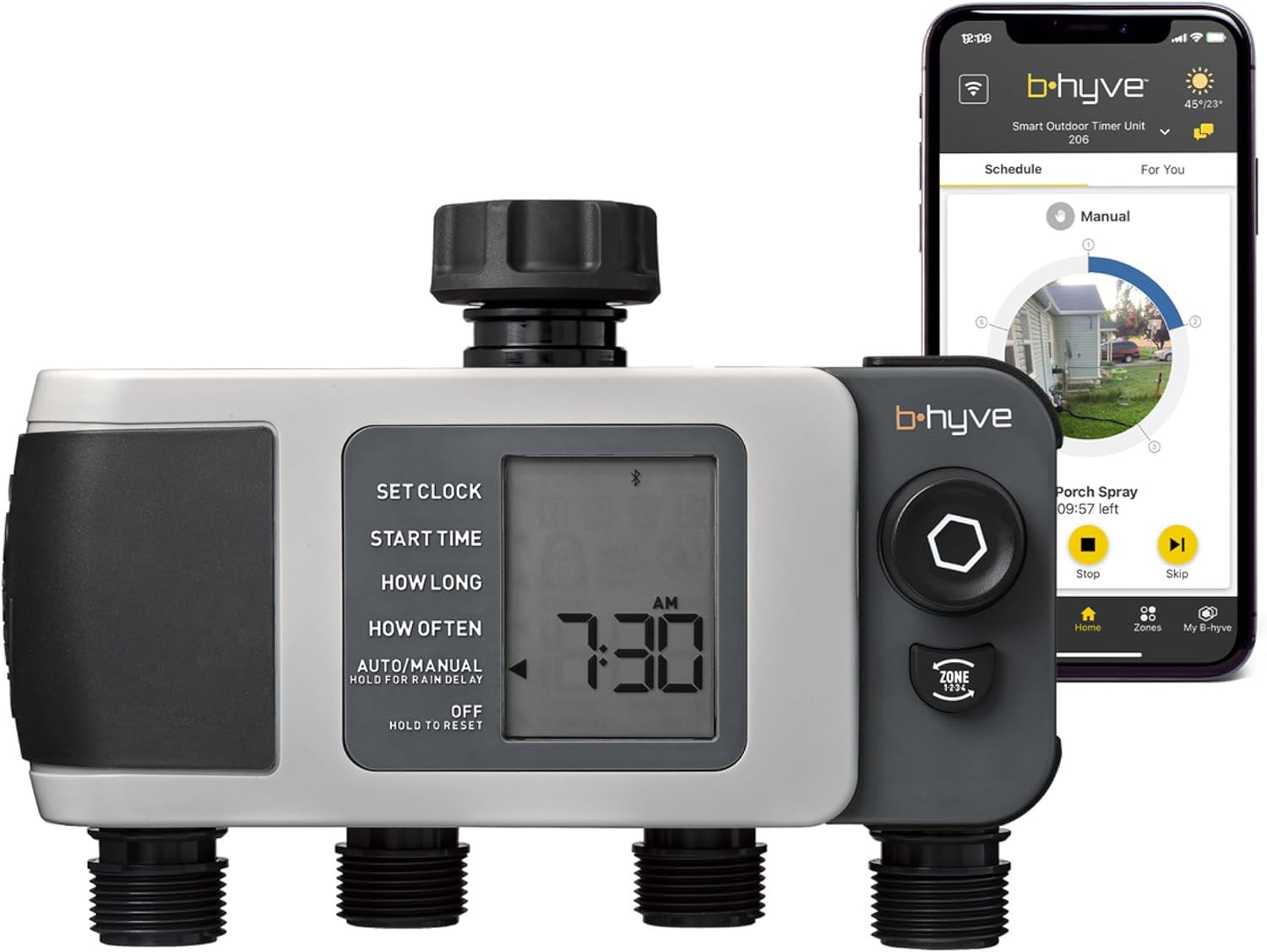
The Orbit B-hyve XD 4-Port Smart Hose Watering Timer turns a single outdoor faucet into a four-zone irrigation hub that is aimed at homeowners who want reliable, automated watering without constant fuss. Each of the four outlets can be scheduled independently using the B-hyve mobile app over Bluetooth, and the device supports remote smart functions when paired with an optional Wi-Fi hub. WeatherSense automatically adjusts watering based on local conditions and drought alerts so the system reduces overwatering during rainy or cool periods. The unit is rated IPX-5 for outdoor durability and includes a simple on-device interface for local programming when a phone is not handy. Practical benefits include consolidated control of multiple garden areas, water savings from weather-based adjustments, and straightforward Bluetooth setup for nearby control. Limitations to note are the dependency on a Wi-Fi hub for full remote/Wi-Fi features and that more advanced networked automation requires that additional accessory. For risk-averse buyers the proven brand, WeatherSense automation, and weatherproof design provide reassuring reliability for a smart sprinkler solution.
Best for: Homeowners who want a low-maintenance, dependable smart sprinkler that automates multiple garden zones and prioritizes water-efficient schedules and simplicity.
Less Ideal for: Users who need full cloud-based remote control out of the box or who require integration with wider smart-home systems without adding the Wi‑Fi hub.
- Four independently programmable outlets for separate zones
- WeatherSense adjusts schedules automatically using local weather data
- Bluetooth control with on-device programming for local access
- IPX-5 rated for outdoor use so it tolerates typical yard conditions
- Full remote Wi-Fi control requires purchasing and pairing a separate Wi‑Fi hub
Verdict: Buy this if you want a durable, water‑saving four-port smart hose timer that automates multiple zones with reliable weather-based scheduling.
Rachio 3 Smart Sprinkler Controller, 8-Zone

| Item Highlight | 8 Zones, App Control, Rain Skips, Local Weather Scheduling |
|---|---|
| Voltage | 120 volts |
| Display Type | LED |
| Operating Temperature | 4 °F |
The Rachio 3 Smart Sprinkler Controller gives you app-first control of an existing 8-zone irrigation system and uses local weather data to adjust watering automatically. You set schedules in the Rachio app for iOS or Android, then let the controller skip runs for rain, freeze, wind or saturated soil and make seasonal adjustments so you do not overwater. Typical use is straightforward: mount the indoor unit, wire it to zone valves, connect Wi-Fi and configure zones in the app; Quick Run buttons let you manually water a zone from the controller when needed. Notable features include dual-band Wi-Fi, compatibility with Alexa, Google Home and IFTTT, LED status display and grow-in scheduling for new lawns. Practical benefits are reduced water use, simpler remote management, and easier setup compared with legacy dial timers. Limitations: the unit is indoor rated so outdoor installs require a weatherproof enclosure and some advanced setups such as well systems may need a pump for proper pressure. The controller also relies on the app for detailed schedule edits rather than full on-device programming.
Best for: Homeowners who want to reduce water use and move away from manual dial timers, and who prefer a proven smart-home controller with easy app-based setup and integrations.
Less Ideal for: People who need a fully outdoor-rated controller without adding an enclosure or who want complete on-device programming without using a smartphone app.
- Weather Intelligence automatically skips watering for rain, freeze, wind and saturation
- App-based scheduling with Quick Run and grow-in options simplifies remote control
- Works with voice assistants and IFTTT for smart-home integration
- Fast DIY install that fits most existing 8-zone systems
- Indoor-rated unit requires a separate weatherproof enclosure for outdoor mounting
- Relies on the mobile app for most scheduling tasks rather than full on-device controls
Verdict: Choose the Rachio 3 if you want a reliable, app-driven 8-zone controller that cuts wasted watering with automatic weather-aware schedules.
Choosing the Right Smart Watering Timer: Key Factors to Consider
Connectivity and App Stability
How a smart timer connects and how stable that connection remains determines whether scheduled events run on time. Wi-Fi range, support for dual-band networks, and the app's responsiveness affect daily use. A flaky app can force manual overrides that defeat the convenience of automation.
Also consider whether the timer supports local control or requires cloud access. Cloud-only systems can add latency and dependency on an external service, while local-capable devices may offer faster, more reliable execution during network outages. Check whether the manufacturer publishes requirement details so you can match the device to your home router and garden placement.
Scheduling Options and Zone Control
Different plants and lawn areas need different schedules. A good smart timer lets you program multiple zones or programs with independent run times and repeat cycles. Look for features such as seasonal adjustments, cycle-and-soak for heavy soils, and custom weekdays versus interval scheduling.
Advanced scheduling can include weather-based adjustments, sunrise/sunset offsets, or moisture-sensor integration. These capabilities reduce water waste and help plants receive the right amount of moisture without constant manual changes. Ensure the timer's scheduling complexity matches your garden layout to avoid unnecessary babysitting.
Valve Compatibility and Flow Management
Smart watering devices must control water reliably whether they are attached to a hose, hose bib, or an automated valve manifold. Verify that the timer can work with the valves in your system and that it offers accurate run-time control to avoid under- or over-watering. Some timers support multiple valves or require a specific valve type.
Flow management features such as adjustable flow rates, maximum run-time limits, and surge protection help prevent leaks, ruptured lines, or wasted water. If you plan to run multiple zones in sequence, look for clear documentation on flow and pressure recommendations.
Power Source and Battery Life
Power options range from replaceable batteries to rechargeable packs and wired power. Battery-powered units offer flexibility in placement but require monitoring and periodic changes. Rechargeable or mains-powered controllers reduce maintenance but may be limited by cable routing and outdoor outlet availability.
Check typical battery life under realistic use patterns and whether low-battery alerts are pushed to your phone. Also consider how easy it is to swap batteries under wet or dirty outdoor conditions and whether the device can safely retain schedules during power changes.
Weather Resistance and Outdoor Durability
Smart timers live outdoors and need to tolerate sun, temperature swings, moisture, and occasional splashes. Look for IP ratings or manufacturer guidance on safe operating conditions. UV-resistant enclosures, gasketed access points, and corrosion-resistant fittings increase service life in exposed locations.
Durability also affects long-term cost and reliability. A well-sealed timer that resists condensation and dust will keep electronics dry and interfaces responsive, reducing the chance of failures during peak watering seasons.
Ease of Installation and Physical Fit
Installation complexity affects whether you can set up the timer yourself or need help. Consider how the unit mounts to a hose bib or irrigation manifold, the type of connectors used, and whether adapters are required. Clear, weatherproof labeling and straightforward wiring or hose hookups make installation quicker and less error-prone.
Also think about physical size and placement: bulky units may block nearby valves or create awkward hose bends. A compact, modular design that fits into your existing system with minimal adapters usually reduces frustration and points of failure.
Matching Timers to Different Garden Setups
Container gardens, raised beds, and in-ground lawns present different irrigation challenges. Containers dry out faster and benefit from shorter, more frequent cycles, while lawns often need longer runs less frequently. Choose a timer that supports the specific cycle patterns your planting requires.
If you run multiple types of planting areas, look for a controller that supports separate programs or zones so you can tailor watering to each area without manual changes.
- Containers: short, frequent cycles or moisture sensor integration
- Raised beds: cycle-and-soak options help water penetrate dense soils
- Lawns: longer run times with fewer days per week
Using Weather Data and Sensors
Many smart timers adjust schedules using local weather forecasts or direct input from moisture sensors. Weather-based reductions can prevent watering before rain or reduce runtime during cool periods. Sensor integration provides real-time soil moisture feedback for the most precise control.
When selecting a system, confirm what weather sources it uses and whether on-site sensors are supported. Local sensors usually give more accurate results for small gardens than distant forecast data.
- Forecast-based adjustments reduce manual edits but depend on forecast accuracy
- Soil moisture sensors offer site-specific control and can suspend schedules when moisture is adequate
Battery Maintenance and Power Best Practices
If you choose a battery-powered timer, plan for regular checks and look for low-battery notifications. Keep spare batteries on hand and choose units with easy access to the battery compartment, ideally under a weatherproof cover.
For permanent installations, consider routed power or rechargeable options so you do not lose automation during busy gardening seasons. Make sure any wired power complies with outdoor electrical safety standards and that wiring is protected from moisture.
- Inspect battery compartment seals annually
- Store spare batteries in a cool, dry place near your irrigation setup
Troubleshooting Common Connectivity Issues
Weak Wi-Fi signals are a frequent cause of missed commands. Place the timer within reliable range of your router or use a dedicated garden access point. Check whether the unit supports 2.4 GHz networks, which typically have better range than 5 GHz.
If the app shows lost connection, try power cycling the timer and your router, and confirm firmware is current. For cloud-dependent devices, beware of temporary outages and learn how the timer behaves during service interruptions.
- Confirm network band and signal strength before final mounting
- Keep firmware updated and note the device's reconnect behavior
Planning a Seasonal Watering Calendar
A seasonal plan simplifies scheduling. Start with baseline runs for spring green-up, reduce frequency during cool or rainy months, and increase deep watering during peak heat. Many timers let you create seasonal programs or apply global percentage adjustments to all zones.
Track plant responses after schedule changes for a season to fine-tune run times. Small incremental adjustments are better than large swings that risk drought stress or root rot.
- Use percentage adjustments to quickly adapt the whole garden
- Log changes and plant responses to refine schedules year over year
How We Chose the Best Smart Watering Timer
We started by focusing on features that directly affect daily watering and long-term garden health. Key evaluation criteria included connectivity and app reliability, because a stable wireless link and clear interface determine whether schedules actually run when you need them. Scheduling flexibility and program complexity were measured so timers work for mixed planting zones, raised beds, and containers. Valve and flow control capability was tested on documentation and spec sheets to ensure accurate run times and compatibility with common hose or irrigation systems. Power and durability were considered for outdoor use, including battery life, weather resistance, and onboard fail-safes. Installation and compatibility covered physical fit to hose bibs, sprinkler valves, and common quick-connect fittings. We excluded products without clear irrigation control features or those that only provide basic on/off timing without remote scheduling. Final selections prioritized devices that balance reliable connectivity, nuanced scheduling, and robust outdoor performance.
FAQ
Can a smart watering timer work without an internet connection?
Often it depends on the model. Some timers retain schedules and run locally even if the internet is down, while others rely on cloud services for schedule execution. Check the product documentation for local-run capability and failover behavior.
Will a smart timer save water in my garden?
Smart timers can reduce water use by enabling precise schedules, weather adjustments, and sensor integration. Actual savings depend on how well the initial schedule is set up and whether sensors or weather features are used to avoid unnecessary runs.
Are smart watering timers compatible with soil moisture sensors?
Many smart controllers support external moisture sensors, but compatibility varies. Confirm that the timer accepts the sensor type you plan to use and whether the system allows sensor-based overrides of scheduled runs.
How do I know what battery life to expect?
Battery life depends on usage patterns, connectivity activity, and whether the device uses energy-saving modes. Manufacturers often publish typical battery life estimates based on average weekly cycles. Look for low-battery alerts and easy battery access when choosing a unit.
Can a smart timer control multiple zones or valves?
Many smart timers support multi-zone control either directly or through connection to valve manifolds. Verify the number of independent programs and how the device sequences zones to match your irrigation layout.
What happens during freezing temperatures?
Cold weather can damage outdoor plumbing and electronic housings. Some timers include freeze protection features or wiring options for controlled shutdowns. In cold climates, consider removing or winterizing the timer and associated hoses to prevent damage.
Final Verdict
A Smart Watering Timer is most useful when it matches your garden's watering patterns, connectivity environment, and power preferences. Prioritize devices with reliable connectivity and flexible scheduling if you manage mixed planting areas, and choose robust outdoor enclosures if the unit will be exposed. Balance battery convenience against the maintenance of replaceable batteries, and favor models that support sensors or weather adjustments if water conservation is important. With the right priorities, you can pick a timer that automates routine chores while protecting plant health and saving water.
