

Note: This article contains affiliate links. If you click on these links and make a purchase, I may earn a small commission at no extra cost to you. This helps support my research and content. Read my full affiliate disclosure here.
A good soaker garden hose turns regular watering into a slow, steady soak that reaches roots without wasting water. For beds, borders, containers, or slopes, the right hose changes how often you need to walk the garden and how evenly plants establish roots. This guide narrows the field to seven shortlisted soaker hoses that suit common garden situations from raised beds to mixed perennial borders. We evaluated each option for key gardener concerns like water flow control, durability in outdoor conditions, and ease of layout and repair. Read on to see which features matter most and how different hoses perform in typical yard and container setups.
Top Picks at a Glance
| Best Overall The best all-around choice for most situations | MIXC Thickened Flat Soaker Hose — 200 ft with Brass/Copper Connectors |  |
| Best Quality Built to a higher standard if you want something more solid | Water Right 700 Series Polyurethane Soaker Hose, 25 ft (1/2" ID) |  |
| Best Value The sweet spot between price and what you get | Hourleey Flat Soaker Hose 100 ft – Linkable Dual-Layer Drip Hose |  |
| Best Budget The cheapest option that still gets the job done reliably | Winisok 50 ft Soaker Hose (50 ft x 2 Pack) |  |
| Highest Rated A top-rated pick with lots of positive feedback | Friyvilo 50 ft Flat Soaker Hose with Consistent Drip Irrigation |  |
| Most Popular A crowd favorite that many people choose with confidence | Gilmour 50' Flat Weeper Soaker Hose |  |
| Best Seller A high-volume bestseller chosen again and again | Gilmour 75' Flat Weeper Soaker Hose |  |
MIXC Thickened Flat Soaker Hose — 200 ft with Brass/Copper Connectors

| Item Length | 200 feet |
|---|---|
| Nominal Wall Thickness | 1 millimeters |
| Material Type | Brass, Polyvinyl Chloride (PVC) |
| Maximum Pressure | 50 psi |
This MIXC soaker hose is built for heavy garden use where durability and reliable seepage matter. It delivers slow, even irrigation through built-in pore holes while its 1 mm wall thickness and reinforced aluminum rings around the connector reduce punctures and connection leaks common to thinner hoses. Typical use is laying the flat hose along beds or under mulch and running water at moderated pressure so moisture seeps out evenly; the long swivel handle makes attaching and turning the hose easier without kinking. Practical benefits include resistance to sun damage and abrasion, sturdier metal joints that outlast plastic fittings, and compatibility with standard watering setups when pressure is kept within the recommended range. Limitations are that the manufacturer advises shorter runs for consistent flow so you may need multiple sections or a splitter for large areas, and performance depends on keeping pressure near the suggested 30–50 psi to avoid reduced flow at the far end or risk of burst under sustained high pressure. Installers should use the provided washers and consider a regulator for best results.
Best for: Gardeners who prioritize durable, maintenance‑free irrigation for vegetable beds and flower borders and want a soaker hose that stands up to rough use and sun exposure while providing steady seepage.
Less Ideal for: Those who need a single long uninterrupted run beyond 100–200 feet or have very high water pressure without a regulator should consider alternative drip systems or pressure-rated tubing.
- Thicker 1 mm wall resists punctures and UV degradation compared with thinner soaker hoses
- Metal (brass/copper) connector assemblies reduce leak-prone failures at joints
- Long swivel handle eases connection and prevents twisting or kinking during use
- Flat profile lays neatly along beds and under mulch for discreet, even watering
- Manufacturer recommends limiting continuous run length which may require extra hose or splitters for larger gardens
- Maximum recommended pressure (50 psi) means you should use a pressure regulator to avoid damage
Verdict: Choose this hose if you want a heavier‑duty soaker line with metal connectors that reduces leaks and holds up to sun and abrasion for reliable garden irrigation.
Water Right 700 Series Polyurethane Soaker Hose, 25 ft (1/2" ID)

| Material Type | Polyurethane |
|---|---|
| Unit Count | 25 Feet |
| Inner Diameter | 1/2" |
| Maximum Pressure | 150 psi |
| Included Components | End cap, fittings, strain reliefs |
The Water Right 700 Series soaker hose is built for steady, root-level irrigation in vegetable beds and compact garden plots. Install it along rows or weave it through raised beds and connect to a faucet or timer for long, low-pressure runs that soak soil rather than spray foliage. Its 1/2" inner diameter and porous wall produce a consistent weep from end to end, which reduces runoff and promotes deep root growth for vegetables. Polyurethane construction makes the hose light to handle, resistant to kinks and UV damage, and safe for edible gardens because it is free of lead, phthalates, and BPA. The hose comes with end fittings and an end cap so you can section beds and control flow, and the manufacturer recommends a filter if you have hard water to avoid mineral clogging. The main limitations are that a 25 ft length suits small to medium beds only and soaker hoses require careful placement and occasional unclogging compared with emitters or drip tubing for very long runs or precision single-plant feeding.
Best for: Gardeners who prioritize reliable, plant-safe irrigation and want a simple low-pressure solution for small to medium vegetable beds that promotes deep root watering.
Less Ideal for: Large-scale vegetable plots or gardeners who need precise per-plant emitters or very long continuous runs without connectors should consider alternative drip systems.
- Consistent end-to-end seep for even root-zone watering
- Made from drinking-water-safe polyurethane with no lead, phthalates, or BPA
- Resists kinking, cracking, and UV damage for season-to-season durability
- Includes end cap, fittings, and strain reliefs for straightforward installation
- 25-foot length may be too short for larger gardens without joining multiple sections
- Porous wall can clog with hard water minerals if an inline filter is not used
Verdict: Choose this hose if you want a durable, drinking-water-safe soaker hose that delivers consistent, root-focused watering for small to medium vegetable beds.
Hourleey Flat Soaker Hose 100 ft – Linkable Dual-Layer Drip Hose

| Material Type | Nylon |
|---|---|
| Item Length | 100 feet |
| Maximum Pressure | 150 psi |
| Included Components | Soaker Hose, Stake |
The Hourleey Flat Soaker Hose is a 100 foot, linkable drip hose intended for garden beds and landscaped rows where steady, low-volume watering is needed. It delivers water through evenly spaced holes along a dual-layer PVC and nylon construction so moisture soaks into the root zone instead of spraying the surface. Typical use is laying the hose along beds, staking it in place, connecting multiple lengths end-to-end, and running at the recommended working pressure for even output. Notable features include a kink-resistant flat profile that tucks under mulch, a fabric cover to resist clogging, and stakes for straightforward placement. Practical benefits are clear water savings when compared with open hoses and less hand-watering for seedlings and vegetables. Important limitations are that it is meant for cold water only and performs best within the suggested 60–80 PSI range; pressure outside that range can affect drip consistency. Also the flat profile may be harder to repair than standard round soaker hoses if punctured.
Best for: Gardeners who prioritize efficient, low-maintenance irrigation for beds or vegetable rows and want a product that can be extended and tucked under mulch for consistent root watering.
Less Ideal for: People who need a hose for frequent high-pressure or hot-water tasks or who prefer a round, easily repairable soaker hose for heavy-duty rough use.
- Delivers water directly to roots for efficient irrigation and reduced evaporation
- Linkable end-to-end design makes it easy to extend coverage across beds
- Dual-layer PVC and nylon construction offers kink resistance and durability
- Fabric-covered design helps reduce clogging and allows under-mulch placement
- Requires appropriate water pressure to maintain even drip performance
- Not rated for use with hot water
Verdict: Choose this hose if you want a water-saving, linkable soaker system that delivers steady root-zone irrigation across long garden beds.
Winisok 50 ft Soaker Hose (50 ft x 2 Pack)

| Item Length | 50 feet |
|---|---|
| Nominal Wall Thickness | 0.125 inches |
| Outside Diameter | 0.75 inches |
| Maximum Pressure | 60 psi |
| Item Weight | 2 kg |
This Winisok soaker hose is a simple drip-irrigation solution for watering garden beds, lawns, and raised planters. It is constructed with a PVC inner tube reinforced by fabric and a cloth cover so it resists leaks and can lie buried or run along the soil surface. The hose connects with standard 3/4" threaded fittings so you can attach it to an outdoor faucet or link several lengths to cover larger beds. It is meant to operate under moderate pressure and the manufacturer warns to keep pressure below 60 psi; in practice you start with low pressure and increase slowly to prevent kinks and ensure even seepage. The hose is lightweight and flexible, making it easy to position and store, and its uniform water seepage can reduce surface evaporation and cut watering time. Expect typical limitations of economical PVC soakers: it will be less puncture resistant than heavy rubber hoses and may require occasional repositioning or protection from sharp objects to avoid damage.
Best for: Buyers who want an affordable, easy-to-deploy drip option to save water and automate watering for garden beds and small lawns. Good for gardeners prioritizing cost and simplicity over heavy-duty durability.
Less Ideal for: People needing a rugged, long-term underground irrigation backbone or frequent commercial use should choose heavier-duty tubing or professional drip lines instead.
- Delivers slow, uniform seepage to hydrate roots and reduce surface evaporation
- Cloth-covered PVC construction improves leak resistance compared with simple porous tubing
- Standard 3/4" threaded fittings allow easy connection to faucets and to chain multiple lengths
- Flexible and lightweight for easy placement, burial, and storage
- Not rated for high-pressure use and can kink if water pressure is raised too quickly
- PVC construction is less durable against punctures and abrasion than heavier rubber options
Verdict: An inexpensive, easy-to-use soaker hose that cuts watering time and water loss, making it a smart budget choice for home garden beds and small lawns.
Friyvilo 50 ft Flat Soaker Hose with Consistent Drip Irrigation

| Material Type | Polyvinyl Chloride (PVC) |
|---|---|
| Maximum Pressure | 114 psi |
| Included Components | 1X Soaker Hose |
| Item Weight | 1.5 pounds |
The Friyvilo 50 ft flat soaker hose is built for steady root-zone watering and simple DIY drip setups. Lay it on the soil, partially bury it 1–2 inches, or suspend it over plants and attach the standard 3/4-inch threaded connector to a faucet or timer for automated schedules. Its double-layer construction (PVC inner layer and fabric-reinforced outer layer) resists sunlight and abrasion while the perforated design provides consistent seepage directly to the soil, which reduces evaporation and runoff compared with sprinklers. The flat, lightweight profile expands when pressurized and collapses for compact storage, making handling and seasonal stowing easy. Important limitations are that it is a passive soaker system requiring adequate upstream pressure and that a 50 ft length may need additional connectors or splitters to cover larger plots; also the PVC construction can become stiff in very cold weather. For gardeners seeking a reliable, low-tech way to keep roots moist, this hose delivers predictable performance with minimal setup and maintenance.
Best for: Gardeners who prioritize dependable, low-maintenance irrigation for beds and rows and want a simple system that connects to timers for regular root watering.
Less Ideal for: People who need high-pressure sprays, adjustable misting patterns, or large-area coverage without multiple hose runs should consider alternative irrigation methods.
- Delivers slow, even drip irrigation that targets plant roots to reduce evaporation and runoff
- Double-layer PVC and fabric reinforcement improves resistance to sun damage and abrasion
- Standard 3/4-inch threaded connectors work with timers and common faucet fittings for automated watering
- Flat, lightweight design expands under pressure and collapses for compact storage and easy handling
- Passive soaker design depends on appropriate upstream pressure and does not provide adjustable spray patterns
- Single 50 ft length may require additional connectors to cover larger or irregularly shaped beds
- PVC material can stiffen in cold temperatures which may make handling and storage harder
Verdict: Choose this hose if you want a straightforward, durable soaker hose that provides consistent root-zone watering and works with timers for reliable automatic irrigation.
Gilmour 50' Flat Weeper Soaker Hose
| Material Type | Vinyl |
|---|---|
| Item Length | 50 feet |
| Nominal Wall Thickness | 0.0625 inches |
| Outside Diameter | 0.63 inches |
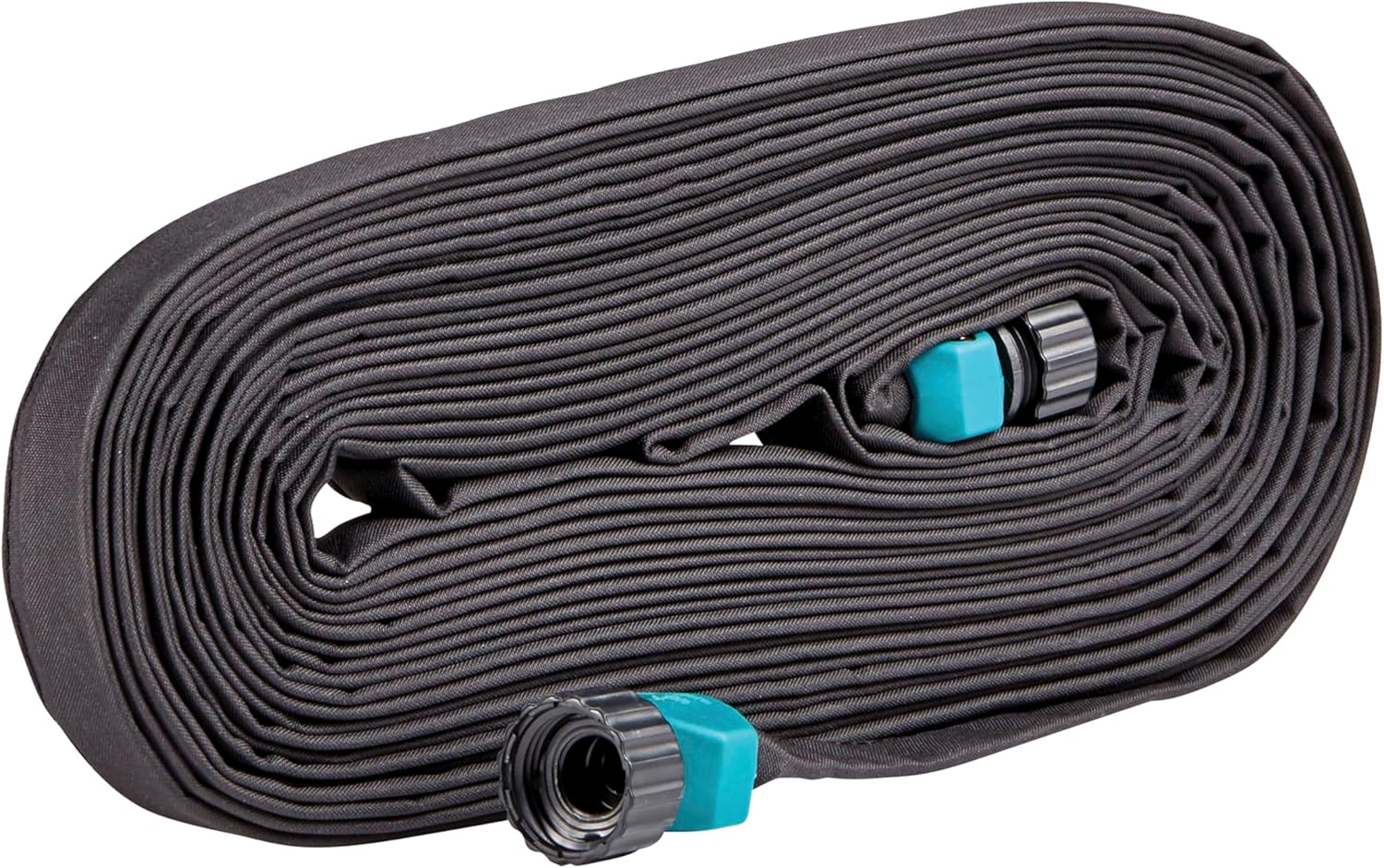
The Gilmour 50' Flat Weeper Soaker Hose is a lightweight, vinyl soaker hose that waters plants by seeping moisture through a fabric jacket directly into the soil. It is typically laid along planting rows or buried shallowly under mulch so water reaches roots without wetting foliage or pathways. Notable features include a clog-resistant fabric cover and a flat profile that makes rolling and winter storage simple. Being made from 100% recycled vinyl and described as UV resistant, it is intended for repeated seasonal use and can be linked to additional hoses to create a longer DIY drip system. Practical benefits are water savings from targeted delivery and easier placement in narrow beds where sprinklers would waste water. Limitations to expect are the usual for vinyl soaker hoses: it is not intended for high-pressure use and can be punctured by sharp tools or heavy foot traffic, and performance depends on even water pressure along the length so very long runs may deliver uneven soaking without splitters or a faucet regulator.
Best for: Gardeners who prioritize reliable, water-efficient irrigation for beds and vegetable rows and who prefer a simple, low-tech solution that is easy to install and store.
Less Ideal for: People who need high-pressure irrigation, frequent heavy-duty use, or a permanent buried drip system should consider reinforced or commercial-grade drip tubing instead.
- Delivers water directly to roots through a fabric jacket for efficient, low-waste watering
- Clog-resistant fabric cover helps maintain consistent seepage over time
- Flat, flexible design rolls up for compact, easy seasonal storage
- Made from recycled vinyl and marketed as UV resistant for seasonal durability
- Not designed for high-pressure applications and can give uneven watering on very long runs
- Vinyl construction can be damaged by sharp objects or heavy foot traffic
Verdict: A straightforward, water-saving soaker hose that makes efficient root watering and seasonal storage easy for home garden beds.
Gilmour 75' Flat Weeper Soaker Hose

| Material Type | Vinyl |
|---|---|
| Item Length | 75 inches |
| Item Weight | 2 pounds |
| Included Components | Pack of 1 Gilmour 870751-1001 Hose Flat Soaker, 75' |
The Gilmour 75' flat weeper soaker hose is a lightweight, flexible soaker that distributes water through a fabric-covered jacket so moisture seeps into the soil rather than spraying the surface. It is typically laid along foundation beds, under mulch, or at the base of shrubs and vegetables and can be left in place for seasonal irrigation. The flat profile makes it easy to position in tight beds and to roll up for compact storage. Its vinyl construction and fabric cover are described as clog resistant and durable for repeated seasonal use, and multiple lengths can be linked to extend coverage for longer foundation runs. Expect slow, steady water delivery that can save water compared with overhead watering and reduce runoff near foundations. Limitations include the need to monitor pressure and run time to avoid overwatering in clay soils and the lack of built-in emitters for precise, measured flow per foot, so spacing and layout require some trial and adjustment for uniform moisture.
Best for: Buyers who want a simple, low-maintenance method to water foundation plantings and garden beds efficiently and who prefer a solution that is easy to install and store seasonally.
Less Ideal for: Those seeking a precision drip system with rated emitters per foot or homeowners who need a heavy-duty hose to withstand frequent foot traffic or burial without protective sleeving.
- Delivers water directly to root zone for efficient, low-evaporation watering
- Flat, flexible design is easy to lay in narrow foundation beds and rolls up compactly for storage
- Clog-resistant fabric cover helps maintain consistent seepage
- Can be linked to additional hoses to extend coverage for longer runs
- No integrated flow regulation or per-foot emitter specification for exact uniformity
- Made of vinyl which can wear faster than reinforced rubber in high-traffic areas
Verdict: A straightforward, easy-to-install soaker hose that efficiently waters foundation beds with minimal fuss and compact storage.
Choosing the Right Soaker Garden Hose: Key Factors to Consider
Emission Uniformity
How evenly water seeps from the hose along its entire length determines whether plants at the far end get the same moisture as those near the faucet. A hose with inconsistent porosity will overwater the first few feet and leave the remainder dry, forcing you to move or overlap runs.
Uniform emission matters most in long runs and sloped beds. Test a hose on a short stretch before committing to a long layout, and look for hoses that report controlled pore sizes or come with manufacturer guidance on recommended run length.
Material and UV Resistance
Soaker hoses live in the sun, on gravel, and under mulch, so the material must resist UV breakdown and abrasion. Hoses made from thicker, UV-stabilized rubber or reinforced fabric maintain porosity and resist cracking across seasons.
Consider how the hose will be stored between uses; hoses that dry cracked or become brittle will leak faster. If your garden gets strong afternoon sun, choose hoses advertised with UV resistance or plan to cover runs with mulch or a shade cloth to extend life.
Flow Control and Compatibility
Soaker hoses need predictable delivery rates and should work with household spigots and inline valves. Fine-grain flow control allows you to dial back pressure and avoid channeling where water runs on the surface instead of soaking in.
Compatibility with standard garden fittings and availability of threaded or barbed connectors is important when combining hoses or attaching to timers and splitters. Confirm thread type and whether adapters are included or commonly available.
Installation Flexibility
How easy it is to route, anchor, and conceal the hose affects how quickly you can set up watering patterns. Flexible hoses that bend without kinking are simpler to shape around plants and under trellises, while stiffer hoses hold a layout better in windy sites.
Also consider whether the hose lies flat under mulch and how it behaves when buried shallowly. Some hoses crush flat and block flow; others maintain a rounded profile that preserves seepage when covered.
Repairability and Connectors
Inevitably a hose will be cut, nicked, or need a custom length. Hoses that accept simple barbed repair fittings or come with patch kits keep a hose in service longer. Being able to splice in a short replacement section or swap end fittings avoids throwing away a largely usable length of hose.
Check whether connectors are easy to clamp and whether replacement parts are standard garden-hose sizes. Durable crimp or clamp fittings perform better than friction-fit connectors in high-use areas.
Water Use Efficiency
Soaker hoses are often chosen to reduce surface runoff and evaporation, but efficiency varies by pore design and run layout. A hose that emits slowly and directly into the root zone will use less water than frequent surface watering or overhead sprinklers.
Efficiency also depends on soil type. Sandy soils need more frequent shorter sessions, while heavy clays need longer, slower applications to avoid pooling. Plan valve timing based on soil and plant needs rather than treating all hoses the same.
Best Uses By Garden Situation
Different garden layouts and plants demand different soaker strategies. For shallow-rooted annual beds and containers, short flexible runs that are easy to move and replace are best. In long perennial borders, hoses that maintain consistent emission over longer lengths and that can be easily spliced are preferable.
- Raised beds: shorter runs, frequent shallow soak sessions.
- Long borders: choose hoses rated for longer continuous runs and monitor end-of-run moisture.
- Sloped sites: run hoses along contour lines and consider shorter segmented runs to avoid channeling.
How To Install And Lay Out A Soaker Hose
Start by sketching bed shapes and dividing long beds into runs that match the hose's recommended length. Lay the hose along plant roots, not around stems, and anchor with landscape pins to prevent movement. Covering the hose with 1 to 2 inches of organic mulch reduces evaporation and protects the hose from sun damage while keeping water headed into the soil.
Adjust flow with an inline valve or the faucet until you see slow, even seepage. If water pools at the start of the run, reduce pressure or shorten the run. For beds with mixed water needs, use multiple parallel runs with separate valves so each plant group gets appropriate timing.
- Anchor hoses every few feet to keep placement steady.
- Test new layouts with short watering cycles and inspect moisture distribution.
- Use splitters to isolate different bed zones for tailored schedules.
Seasonal Care And Storage
Drain and store hoses in a shaded spot during freezing months to prevent damage from trapped water. If you cannot drain the system fully, lift the hose into a frost-free container. Inspect the hose each spring for soft spots, blocked pores, or cracks before reinstalling.
Regularly clean visible debris and flush the hose occasionally to remove mineral deposits that can block pores. Repair small cuts with standard hose repair kits and replace connectors that show corrosion or heavy wear.
- Flush with clean water to clear mineral buildup.
- Store coiled in shade when not in use for extended periods.
- Replace damaged fittings promptly to prevent uneven flow.
Adapting Soaker Hoses For Containers And Pots
Soaker hoses can be used with container groups if you run short segments and control pressure carefully. For pots, cut short pieces and loop them inside sauced groupings so water is delivered directly to potting mix without excess runoff.
Because containers dry faster, schedule more frequent but shorter watering cycles. Use a pressure regulator when connecting to a long run that also feeds containers to prevent oversaturation.
- Use short lengths or dedicated small-diameter hoses for individual pots.
- Place hose segments near the center of the pot to encourage root zone delivery.
- Monitor containers closely during heat waves and adjust run times.
How We Chose the Best Soaker Garden Hose
We focused on practical garden-use criteria relevant to everyday watering tasks. Key evaluation dimensions included how precisely a hose controls seepage and flow, the material durability against UV, abrasion, and kinking, and how easy each hose is to install, splice, or repair in an active garden. We also considered hose porosity and uniformity of water emission across typical lengths so a hose will deliver even moisture from start to finish. Excluded from the list were hoses designed primarily for high-pressure spraying, temporary decorative drippers, or models requiring specialized fittings that most gardeners do not already own. We prioritized items that work with common garden spigots and basic fittings, and that offer clear maintenance paths such as patch kits and replaceable connectors. The selection emphasizes real-world longevity and consistent watering performance over novelty features. Final selection balanced measured flow consistency, build quality, and practical usability so the recommended set covers a range of beds, soil types, and installation styles. Each shortlisted hose met minimum standards for emission uniformity and repairability before being included.
FAQ
Can I bury a soaker garden hose under mulch or soil?
Yes. Many soaker hoses work well under 1 to 2 inches of mulch to reduce evaporation and protect the hose. Avoid burying deeply or compacting heavy soil directly over the hose as that can restrict seepage and make repairs harder.
How long should a single soaker hose run be?
Recommended run length depends on hose porosity and pressure, but shorter runs give more uniform results. If you see pooling near the faucet and dryness at the far end, split the bed and run a second hose to even distribution.
Will hard water clog a soaker hose?
Hard water can deposit minerals that slowly block pores. Flushing the hose periodically and using slightly higher initial pressure during cleaning cycles helps clear deposits. If clogging becomes chronic, consider shorter runs and rinsing sections individually.
Can I attach a timer to a soaker hose?
Yes, timers are frequently used to automate soaker hose schedules. Use a timer compatible with your faucet threads and set short, frequent cycles to let water soak in rather than run off. Test settings and adjust for soil type and plant needs.
How do I repair a cut or nick in a soaker hose?
Small cuts can be fixed with a simple splice kit or by cutting out the damaged section and joining the two ends with a barbed connector and clamps. Keep a few standard repair fittings on hand to minimize downtime.
Final Verdict
Choose a soaker hose that matches your bed lengths, soil type, and installation style. Prioritize emission uniformity and repairability if you have long runs or mixed plantings, and favor UV-resistant materials in sunny gardens. For containers and short beds, flexible, easy-to-splice hoses give the best control. Balance water efficiency against installation convenience: slower, evenly emitting hoses save water but may need more careful layout and pressure control. With the right match of hose type and run planning you can cut watering time and support stronger root development across the garden.
