

Note: This article contains affiliate links. If you click on these links and make a purchase, I may earn a small commission at no extra cost to you. This helps support my research and content. Read my full affiliate disclosure here.
Keeping the planting strip next to your house evenly moist without overwatering the foundation matters for plant health and for preventing water intrusion. A soaker hose designed for foundation beds delivers slow, uniform seepage along its length so roots get steady moisture while surface runoff is minimized. This guide covers seven shortlisted soaker hoses optimized for use along house foundations and patios, and explains the practical tradeoffs that matter in yards and narrow beds. We evaluate water delivery consistency, build durability, and installation ease to help you pick the right option for your yard layout and soil type.
Top Picks at a Glance
| Best Overall The best all-around choice for most situations | Gilmour 75' Flat Weeper Soaker Hose |  |
| Best Quality Built to a higher standard if you want something more solid | STYDDI 1/2" x 25 ft Rubber Soaker Hose with Brass Connectors |  |
| Best Value The sweet spot between price and what you get | Hourleey Flat Soaker Hose 100 ft – Linkable Dual-Layer Drip Hose |  |
| Best Budget The cheapest option that still gets the job done reliably | Gilmour 25 ft Flat Weeper Soaker Hose |  |
| Highest Rated A top-rated pick with lots of positive feedback | Friyvilo 50 ft Flat Soaker Hose with Consistent Drip Irrigation |  |
| Most Popular A crowd favorite that many people choose with confidence | Gilmour 50' Flat Weeper Soaker Hose |  |
| Best Seller A high-volume bestseller chosen again and again | Rocky Mountain Goods 50 ft Soaker/Weeper Hose with Pressure Reducers |  |
Gilmour 75' Flat Weeper Soaker Hose

| Material Type | Vinyl |
|---|---|
| Item Length | 75 inches |
| Item Weight | 2 pounds |
| Included Components | Pack of 1 Gilmour 870751-1001 Hose Flat Soaker, 75' |
The Gilmour 75' flat weeper soaker hose is a lightweight, flexible soaker that distributes water through a fabric-covered jacket so moisture seeps into the soil rather than spraying the surface. It is typically laid along foundation beds, under mulch, or at the base of shrubs and vegetables and can be left in place for seasonal irrigation. The flat profile makes it easy to position in tight beds and to roll up for compact storage. Its vinyl construction and fabric cover are described as clog resistant and durable for repeated seasonal use, and multiple lengths can be linked to extend coverage for longer foundation runs. Expect slow, steady water delivery that can save water compared with overhead watering and reduce runoff near foundations. Limitations include the need to monitor pressure and run time to avoid overwatering in clay soils and the lack of built-in emitters for precise, measured flow per foot, so spacing and layout require some trial and adjustment for uniform moisture.
Best for: Buyers who want a simple, low-maintenance method to water foundation plantings and garden beds efficiently and who prefer a solution that is easy to install and store seasonally.
Less Ideal for: Those seeking a precision drip system with rated emitters per foot or homeowners who need a heavy-duty hose to withstand frequent foot traffic or burial without protective sleeving.
- Delivers water directly to root zone for efficient, low-evaporation watering
- Flat, flexible design is easy to lay in narrow foundation beds and rolls up compactly for storage
- Clog-resistant fabric cover helps maintain consistent seepage
- Can be linked to additional hoses to extend coverage for longer runs
- No integrated flow regulation or per-foot emitter specification for exact uniformity
- Made of vinyl which can wear faster than reinforced rubber in high-traffic areas
Verdict: A straightforward, easy-to-install soaker hose that efficiently waters foundation beds with minimal fuss and compact storage.
STYDDI 1/2" x 25 ft Rubber Soaker Hose with Brass Connectors

| Length | 25 foot |
|---|---|
| Diameter | 1/2 inch |
| Connector thread | 3/4" GHT |
| Soak rate | 5–8 L/min at 60 PSI |
This STYDDI soaker hose delivers slow, consistent watering by seeping water through tiny pores along a recycled rubber tube, making it suitable for foundation watering where controlled moisture is important. It hooks to a standard 3/4" GHT garden connection and includes a removable rust-resistant end cap so you can extend the line or cap it for localized watering. The recycled rubber construction resists kinking and lies flat for easy placement along a foundation or under mulch, while solid brass couplings reduce the risk of leaks and corrosion over time. The hose soaks at roughly 5 to 8 liters per minute at 60 PSI, which supports even wetting of soil without flooding close to foundation walls. Limitations to note are the single 25 ft length per unit and a 1/2" diameter, so larger properties will require multiple runs and connectors; pressure and flow performance can vary with source water pressure and hose layout. For performance-focused users wanting efficient, low-maintenance root-zone irrigation for house foundations and nearby planting beds, this hose is a practical, durable choice.
Best for: Homeowners who prioritize controlled, efficient watering for foundation protection and nearby planting beds and who will layout and manage multiple hose runs as needed.
Less Ideal for: People who need a single long-run solution for large properties or those who prefer automated zone-based drip systems with timers and emitters.
- Recycled rubber body resists kinks and lies flat for easy placement
- Solid brass couplings reduce corrosion and provide durable, leak-resistant connections
- Removable rust-resistant end cap allows easy extension or isolation of runs
- Designed to seep water slowly for efficient root-zone irrigation and reduced runoff
- Only 25 feet per unit requires multiple hoses and fittings for larger foundations
Verdict: Choose this hose when you need a durable, slow-release irrigation line that delivers consistent, water-efficient wetting for foundation edges and nearby beds.
Hourleey Flat Soaker Hose 100 ft – Linkable Dual-Layer Drip Hose

| Material Type | Nylon |
|---|---|
| Item Length | 100 feet |
| Maximum Pressure | 150 psi |
| Included Components | Soaker Hose, Stake |
The Hourleey Flat Soaker Hose is a 100 foot, linkable drip hose intended for garden beds and landscaped rows where steady, low-volume watering is needed. It delivers water through evenly spaced holes along a dual-layer PVC and nylon construction so moisture soaks into the root zone instead of spraying the surface. Typical use is laying the hose along beds, staking it in place, connecting multiple lengths end-to-end, and running at the recommended working pressure for even output. Notable features include a kink-resistant flat profile that tucks under mulch, a fabric cover to resist clogging, and stakes for straightforward placement. Practical benefits are clear water savings when compared with open hoses and less hand-watering for seedlings and vegetables. Important limitations are that it is meant for cold water only and performs best within the suggested 60–80 PSI range; pressure outside that range can affect drip consistency. Also the flat profile may be harder to repair than standard round soaker hoses if punctured.
Best for: Gardeners who prioritize efficient, low-maintenance irrigation for beds or vegetable rows and want a product that can be extended and tucked under mulch for consistent root watering.
Less Ideal for: People who need a hose for frequent high-pressure or hot-water tasks or who prefer a round, easily repairable soaker hose for heavy-duty rough use.
- Delivers water directly to roots for efficient irrigation and reduced evaporation
- Linkable end-to-end design makes it easy to extend coverage across beds
- Dual-layer PVC and nylon construction offers kink resistance and durability
- Fabric-covered design helps reduce clogging and allows under-mulch placement
- Requires appropriate water pressure to maintain even drip performance
- Not rated for use with hot water
Verdict: Choose this hose if you want a water-saving, linkable soaker system that delivers steady root-zone irrigation across long garden beds.
Gilmour 25 ft Flat Weeper Soaker Hose

| Material Type | Vinyl |
|---|---|
| Item Length | 25 feet |
| Unit Count | 1 Count |
| Manufacturer | Lawn and Garden LLC |
The Gilmour 25 ft Flat Weeper Soaker Hose is a simple, budget-friendly soaker designed to deliver water at the root zone. Its fabric-covered vinyl body seeps water from all sides, making it useful for foundation watering, garden beds, and narrow planting strips where targeted, low-volume irrigation is needed. The flat profile makes it easy to lay along foundation lines or tuck under mulch and convenient to roll up and store when the season ends. Made from recycled vinyl with a clog-resistant jacket, it resists UV exposure and can be linked to other hoses to extend coverage for longer runs. Because it relies on system pressure and surface placement, expect slower soak rates than pressurized drip tubing and occasional pressure variability along long lengths. It is not a timed automatic system by itself, so pairing it with a simple timer or a pressure-regulating valve is recommended for consistent foundation watering. Overall this hose gives reliable, water-efficient root watering on a modest budget with straightforward setup and storage.
Best for: Buyers wanting an inexpensive, easy-to-use solution for watering foundation beds and narrow planting strips who prioritize straightforward installation and low water waste.
Less Ideal for: Those who need precise, pressurized drip irrigation for long runs or fully automated commercial-style systems should consider professional drip tubing or emitters instead.
- Delivers water directly to roots for efficient foundation and bed watering
- Flat, flexible design is easy to position and rolls up compactly for storage
- Clog-resistant fabric jacket provides more consistent seepage
- Can be linked with additional hoses to expand coverage
- Water output varies with house pressure and hose length, so long runs may water unevenly
- Requires manual setup or an external timer for automated schedules
Verdict: A no-frills, cost-conscious soaker hose that delivers targeted root watering along foundations and beds with simple setup and compact storage.
Friyvilo 50 ft Flat Soaker Hose with Consistent Drip Irrigation

| Material Type | Polyvinyl Chloride (PVC) |
|---|---|
| Item Length | 600 inches |
| Maximum Pressure | 114 psi |
| Included Components | 1X Soaker Hose |
The Friyvilo 50 ft flat soaker hose is made for slow, direct watering of garden beds, vegetable rows, and shrub borders. It lays flat on the soil or can be buried 1 to 2 inches to keep moisture near roots and can also be suspended above plants for targeted delivery. The hose uses a double-layer PVC core with a fabric-reinforced outer layer to resist sun damage and abrasion, and standard 3/4-inch threaded connectors let you attach it to a faucet, timer, or additional lengths for a custom layout. In practice it expands when pressurized and returns flat for compact storage, which makes handling and seasonal stowing easier. It operates effectively at modest water pressure and the built-in leak-proof gaskets at connectors reduce drip at junctions. Expect consistent, water-efficient irrigation that reduces evaporation compared with sprinklers, though long continuous runs will require planning for even pressure distribution and occasional flushing to prevent clogging from sediment.
Best for: Buyers who prioritize a dependable, low-maintenance way to keep soil consistently moist across garden beds and vegetable rows and who want a setup that works with timers for routine irrigation.
Less Ideal for: Gardeners needing high-pressure spray coverage, very long single-line installations without pressure control, or those who require decorative above-ground hoses for landscapestyle watering.
- Direct root watering reduces evaporation and runoff compared with overhead sprinklers
- Double-layer PVC with fabric reinforcement improves resistance to sunlight and abrasion
- Standard 3/4-inch threaded connectors work with timers and splitters for automated or expanded systems
- Flat, lightweight design expands under pressure and coils compactly for easy storage
- Long runs may need pressure management or multiple supply points for completely even output
- Susceptible to clogging from sediment if supply water is not filtered or the line is not flushed
Verdict: Choose this hose when you want a simple, water-efficient soaker line that pairs with timers and can be buried or laid on beds for reliable root watering.
Gilmour 50' Flat Weeper Soaker Hose
| Material Type | Vinyl |
|---|---|
| Item Length | 50 feet |
| Nominal Wall Thickness | 0.0625 inches |
| Outside Diameter | 0.63 inches |
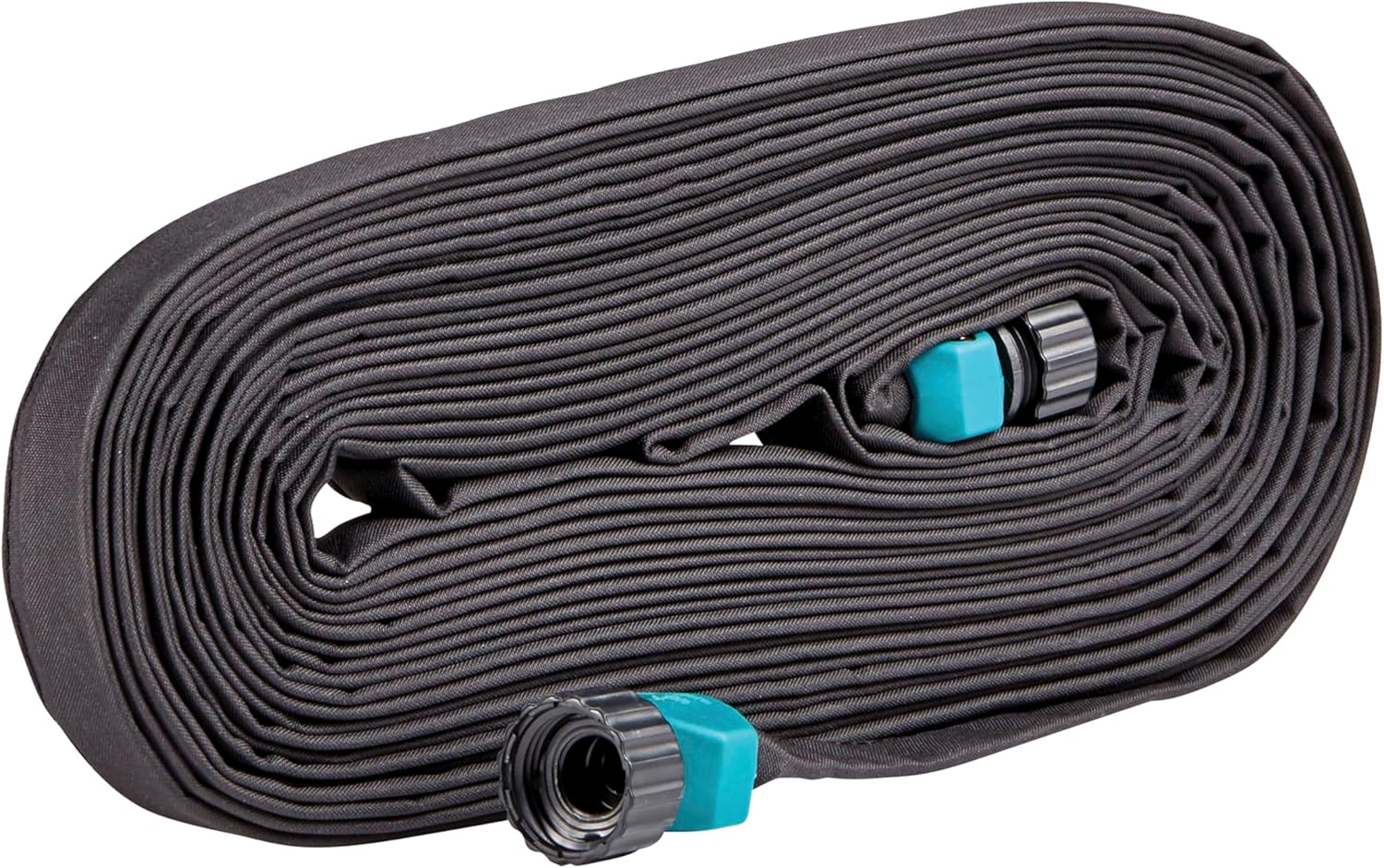
The Gilmour 50' Flat Weeper Soaker Hose is a lightweight, vinyl soaker hose that waters plants by seeping moisture through a fabric jacket directly into the soil. It is typically laid along planting rows or buried shallowly under mulch so water reaches roots without wetting foliage or pathways. Notable features include a clog-resistant fabric cover and a flat profile that makes rolling and winter storage simple. Being made from 100% recycled vinyl and described as UV resistant, it is intended for repeated seasonal use and can be linked to additional hoses to create a longer DIY drip system. Practical benefits are water savings from targeted delivery and easier placement in narrow beds where sprinklers would waste water. Limitations to expect are the usual for vinyl soaker hoses: it is not intended for high-pressure use and can be punctured by sharp tools or heavy foot traffic, and performance depends on even water pressure along the length so very long runs may deliver uneven soaking without splitters or a faucet regulator.
Best for: Gardeners who prioritize reliable, water-efficient irrigation for beds and vegetable rows and who prefer a simple, low-tech solution that is easy to install and store.
Less Ideal for: People who need high-pressure irrigation, frequent heavy-duty use, or a permanent buried drip system should consider reinforced or commercial-grade drip tubing instead.
- Delivers water directly to roots through a fabric jacket for efficient, low-waste watering
- Clog-resistant fabric cover helps maintain consistent seepage over time
- Flat, flexible design rolls up for compact, easy seasonal storage
- Made from recycled vinyl and marketed as UV resistant for seasonal durability
- Not designed for high-pressure applications and can give uneven watering on very long runs
- Vinyl construction can be damaged by sharp objects or heavy foot traffic
Verdict: A straightforward, water-saving soaker hose that makes efficient root watering and seasonal storage easy for home garden beds.
Rocky Mountain Goods 50 ft Soaker/Weeper Hose with Pressure Reducers

| Unit Count | 50 Feet |
|---|---|
| Material Type | Polyvinyl Chloride (PVC), Vinyl |
| Maximum Pressure | 30 psi |
| Included Components | Soaker Hose, 3 Pressure Reducing Discs |
This Rocky Mountain Goods 50 ft soaker hose delivers steady, low-pressure watering by weeping water along its entire length, making it suitable for vegetable beds, flower borders, and container lines. It is used by laying the hose where plants need moisture and running water at the recommended 25 to 30 psi; three pressure-reducing discs are included to prevent spraying if your water pressure is high. The double-layer PVC core with a fabric cover is built for durability and helps the hose resist kinks and wear compared with single-layer designs. Because it waters at the root zone it reduces surface evaporation and can cut water use relative to overhead watering. Important limitations are that it is not a replacement for a regular hose for filling buckets or running sprinklers, and performance depends on correct pressure and even placement along beds. For someone who wants a reliable, straightforward drip-style option, this hose is a practical choice for routine garden irrigation.
Best for: Gardeners who want a reliable, low-maintenance way to keep vegetable beds and perennial borders evenly watered with minimal oversight and water waste.
Less Ideal for: People who need a multipurpose high-pressure hose for washing, filling, or operating sprinklers should choose a standard garden hose instead.
- Even low-pressure watering along the entire length reduces evaporation and targets roots
- Double-layer PVC with fabric cover improves durability and resists kinking
- Includes three pressure-reducing discs to manage higher household water pressure
- 50-foot length covers medium garden beds without multiple connections
- Not suitable as a regular hose for high-pressure tasks like filling containers or running sprinklers
- Requires correct placement and pressure setting to avoid uneven wetting or surface spraying
Verdict: A durable 50-foot soaker hose built to deliver consistent low-pressure watering and reduce water use for home gardens.
Choosing the Right Soaker Hose for House Foundation: Key Factors to Consider
Watering Uniformity Along the Foundation
Even seepage matters when the hose runs along a house foundation because uneven output can create dry spots or puddles next to the building. A hose with consistent pore spacing or engineered emission channels delivers predictable moisture along its entire length, which helps the root zone develop evenly and reduces the risk of surface runoff toward the foundation.
For long runs you may need to zone the irrigation or split the run to maintain even pressure. Pay attention to how manufacturers describe output per foot or meter, and consider placement so the hose sits near the root zone rather than on top of mulch where surface evaporation is higher.
Material Durability and UV Resistance
Hoses placed at foundation edges face abrasion from gravel, mulch, and edging, plus direct sun exposure. Thicker wall construction or embedded fabric reinforcement slows wear and punctures. UV-resistant materials last longer exposed to sunlight and temperature swings, reducing the chance of brittle cracks that cause leaks.
Also consider how the hose handles freezing cycles and wet-dry expansion. Some lightweight porous hoses deteriorate quickly under repeated outdoor stress, so durability matters for minimizing maintenance and avoiding buried leaks that are hard to locate.
Performance Under Low Water Pressure
Many residential taps and timer valves supply relatively low pressure compared with dedicated irrigation systems. A foundation soaker hose should operate effectively at low pressure to provide steady seepage without needing a pressure regulator or pump. Hoses designed for low-pressure delivery will have emission ports or porous materials calibrated to flow at household pressure ranges.
If your water source is particularly weak, plan shorter runs or split the layout into multiple circuits so each segment receives sufficient pressure for even output.
Flexibility, Kinking, and Routing
Foundation beds are often narrow and include corners, downspout splash areas, and plantings you must route around. A hose that remains flexible when warm and does not kink when bent around obstacles makes installation simpler and reduces points of stress that can wear through the material.
Look for hoses that lie flat under mulch and can be pinned or staked without splitting. Flexible hoses also make seasonal removal or repositioning easier if you need to change planting layouts.
Connection Options and End Sealing
Reliable connectors and end seals prevent leaks where the hose meets a faucet, timer, or coupling. For foundation runs, secure connections mean less water loss near the house and a tidy installation. Check whether the hose accepts standard barbed fittings, quick-connect adapters, or specialized end caps. Some hoses require clamps or ferrules for a watertight joint, while others use integrated fittings for faster setup.
Also consider how easily you can repair or replace sections. A hose that accepts common repair fittings makes it simpler to patch a worn spot without replacing the entire run.
Compatibility With Mulch and Soil Types
The surface and soil where the hose will lie affect both performance and longevity. Coarse gravel or sharp-edged rock can abrade the hose, while heavy clay soils retain moisture differently than sandy soils and may require different spacing or runtime. Mulch helps reduce evaporation and can protect the hose from UV, but very fine mulch can clog some porous materials or sit differently over emission ports.
Plan hose placement so it contacts the root zone and consider a shallow burial or a protective strip of landscape fabric where abrasion risk is high. Factor soil infiltration rates into watering duration to avoid saturation against the foundation.
Planning the Layout Along a Foundation
Measure the planting strip and note any downspouts, vents, or utility access points before placing a soaker hose. Shorter runs keep pressure loss low, so divide long foundation edges into two or more circuits if necessary. Route the hose close to the house where root density is highest but maintain enough distance to prevent direct contact with siding or foundation vents.
Use stakes or landscape fabric pins to hold the hose in place and cover with a thin layer of mulch to reduce evaporation and protect the hose from UV. Leave access to hose connections and valves so you can winterize or inspect the system without disturbing the planting bed.
- Plan for pressure drop on runs longer than 25 to 30 feet.
- Avoid placing hose directly under downspout outlets that can deliver concentrated flow.
- Keep hose a few inches away from foundation vents or weep holes.
Installation Tips for Even Moisture
Before burying or covering a soaker hose, run a short test with the planned water source to check uniformity. Mark any dry spots and adjust the hose spacing or add a second parallel run where needed. Typical spacing is one continuous line for narrow strips, or two staggered lines for wider beds.
Set timers for short, frequent cycles rather than long single events to encourage deep root growth without saturating the soil adjacent to the foundation. Monitor soil moisture after initial runs and adjust duration as plants establish and seasons change.
- Test-run the hose for 10 to 15 minutes to reveal pressure-related unevenness.
- Use mulch to conserve moisture but avoid piling it high against the house.
Maintaining and Winterizing Your Foundation Soaker Hose
At season end, disconnect and drain hoses to prevent freeze damage. If you leave the hose in place, flush it thoroughly and store it coiled away from sharp edges. Inspect regularly for abrasion or pinhole leaks and repair short sections with standard repair fittings.
Check connections and clamps each spring. Replace brittle connectors and reseal ends if seepage occurs near joints. Regular maintenance reduces the chance of water pooling against foundation walls and extends the hose lifespan.
- Flush and drain before temperatures drop below freezing.
- Inspect for wear annually, especially at high-contact points.
Adjusting Runtime for Soil and Plant Needs
Different soil types and plantings require different runtimes. Sandy soils drain quickly and may need more frequent, shorter cycles, while clay soils hold water longer and need shorter overall durations. Established shrubs and trees near foundations often need less frequent irrigation than new transplants.
Use a simple soil probe or dig small test holes to check moisture at root depth after irrigation. Adjust timer settings seasonally, reducing cycles in rainy months and increasing them during hot, dry spells.
- Short, frequent cycles help wet the root zone without runoff.
- Monitor soil moisture rather than relying on fixed schedules alone.
Protecting Hoses From Common Foundation Hazards
Gravel, edging stones, and foot traffic are common causes of hose abrasion. Where those hazards exist, add a protective layer such as thin landscape fabric or a narrow strip of rubber under the hose. This approach reduces wear without raising the hose away from the root zone.
Avoid nailing or stapling hoses to structures, and route them to minimize exposure to mower blades or tripping areas. When crossing driveways or paths, consider removable sections or short buried runs using appropriate burial-rated materials.
- Use protective underlay in high-abrasion spots.
- Create clear routing to reduce accidental damage from tools and foot traffic.
How We Chose the Best Soaker Hose for House Foundation
We focused on features that matter when running a soaker hose directly beside a house foundation. Key evaluation criteria included watering uniformity over long runs, the hose material's resistance to abrasion and UV, and whether the hose tolerates the low water pressure common in residential irrigation setups. We also looked at flexibility and kink resistance for routing around corners and plantings, and accessory compatibility for secure connections and end-caps. Durability tests in real gardens often fail because of soil abrasion and sun exposure, so we favored hoses made from thicker walls or reinforced fabric layers that slow degradation. Excluded items included porous drip tape intended for buried applications, decorative micro-spray products that do not provide seepage along a continuous line, and hoses not rated for outdoor UV exposure. In short, we filtered for hoses built to give steady, low-flow seepage, hold up to foundation-edge conditions, and attach cleanly to common garden fittings. These same dimensions form the basis for the scoring metrics used in each product card.
FAQ
How close should a soaker hose sit to the foundation?
Place the hose close enough to reach the root zone, typically a few inches to a foot from the foundation depending on plant spacing. Keep it off direct contact with siding or weep holes and avoid clog-prone depressions where water could pool.
Can I bury a soaker hose near the foundation?
A shallow burial under a thin layer of mulch or soil can protect the hose from UV and foot traffic, but avoid deep burial that hides leaks. Shallow coverage also helps maintain seepage efficiency and makes inspection and repair easier.
Will a soaker hose cause water damage to my foundation?
Properly installed soaker hoses deliver slow, even moisture that soaks into the root zone rather than running off. The risk to foundations rises when hoses are placed where water pools or when runtimes are excessive. Monitor soil saturation and adjust placement and schedule to prevent standing water.
How long should I run the hose each session?
Run times depend on soil type and plant needs, but start with short cycles of 20 to 40 minutes and check moisture at root depth. Sandy soils may need more frequent shorter cycles, while clay soils need less frequent shorter sessions to avoid saturation.
Do I need a pressure regulator for a foundation soaker hose?
Many soaker hoses work well at typical household pressures, but if your supply is high-pressure or you see uneven output, a regulator helps ensure steady seepage and prevents damage. Low-pressure installations sometimes require dividing long runs rather than adding a regulator.
Final Verdict
Selecting a soaker hose for use along a house foundation means balancing even water delivery with durable construction and installation practicality. Prioritize hoses that perform at low household pressure, resist abrasion and UV, and accept secure connections so you can route them neatly along narrow beds. Consider run length, soil type, and seasonal maintenance when planning the layout. Focus on uniform seepage, protection from physical wear, and easy repairability. That approach minimizes risks to the foundation while keeping plants healthy and reduces long-term maintenance for a tidy, reliable foundation irrigation setup.
