

Note: This article contains affiliate links. If you click on these links and make a purchase, I may earn a small commission at no extra cost to you. This helps support my research and content. Read my full affiliate disclosure here.
Choosing the right soil conditioner for lawns matters because turf health depends on more than seed and fertilizer. Soil structure, compaction, and organic matter determine how well grass roots access air, water, and nutrients. The right conditioner eases watering stress, reduces runoff, and creates a rooting environment that supports thicker, greener turf. This guide shortlists seven top soil conditioners for lawns and explains how we judged them. We evaluate products by how they change soil physical properties and how they affect nutrient and water management, so you can pick the option that matches your lawn's soil type and maintenance routine.
Top Picks at a Glance
| Best Overall The best all-around choice for most situations | Nature's Wonder Plant & Turf Booster Organic Soil Conditioner (60 oz) |  |
| Best Quality Built to a higher standard if you want something more solid | The Andersons BioChar DG Organic Soil Amendment (10 lb) |  |
| Best Value The sweet spot between price and what you get | Stateside 20% Humic Acid Soil Conditioner for Lawns, 64 fl oz |  |
| Best Budget The cheapest option that still gets the job done reliably | Live Earth Humate Soil Conditioner Granules, 3 × 5 lb Bags (15 lb) |  |
| Highest Rated A top-rated pick with lots of positive feedback | The Andersons HumiChar Organic Soil Amendment with Humic Acid and Biochar (40 lb) |  |
| Most Popular A crowd favorite that many people choose with confidence | Simple Lawn Solutions Liquid Soil Loosener, 32 oz |  |
| Best Seller A high-volume bestseller chosen again and again | Farmer's Secret Soil Revitalizer Organic Liquid Compost (32 oz) |  |
Nature's Wonder Plant & Turf Booster Organic Soil Conditioner (60 oz)

| Item Form | Liquid |
|---|---|
| Specific Uses For Product | Soil Conditioning |
| Target Species | plants, flowers, lawns, trees |
| Liquid Volume | 60 fluid ounces |
| Mixing Ratio | 1:2 or 1:3 |
Nature's Wonder Plant & Turf Booster is a concentrated liquid biostimulant and soil amendment intended to boost the effectiveness of fertilizers and improve overall soil and plant health. You dilute the concentrate (manufacturer suggests about 3 oz per gallon or mixing ratios of 1:2 to 1:3) and add it to your regular watering or fertilizing routine every few weeks. Key features include an OMRI-listed organic formulation with fulvic/humic-type compounds that help increase nutrient availability, improve water movement through the plant, and reduce transplant shock. For lawns it can enhance drought tolerance and make fertilizer applications more efficient; for beds and containers it aids seed starting, transplanting, and maintenance. The product is non-GMO and produced in the USA. Practical downsides are that it is a concentrate so you must measure and dilute correctly and results depend on how it is combined with your existing fertilization program; it is not a standalone fertilizer and will not supply macronutrients on its own.
Best for: Homeowners and gardeners who want an organic booster to improve soil biology and make their fertilizer and watering efforts more effective for lawns and mixed garden plantings.
Less Ideal for: People looking for an all-in-one fertilizer solution or those who prefer single-application granular products rather than a liquid concentrate.
- OMRI listed organic biostimulant that supports organic lawn and garden programs
- Concentrated formula stretches a single bottle across many applications
- Improves nutrient uptake and water mobility to reduce wilting and boost growth
- Useful for multiple tasks including seed starting, transplanting, and routine maintenance
- Not a fertilizer so it must be used alongside regular nutrient sources
- Requires accurate dilution and regular application schedule for best results
Verdict: A concentrated OMRI-listed liquid booster that helps lawns and garden plants use fertilizer and water more efficiently, making it a smart organic add-on to regular turf care.
The Andersons BioChar DG Organic Soil Amendment (10 lb)

| Unit Count | 160 Ounce |
|---|---|
| Brand Name | The Andersons |
| Volume | 10 liters |
The Andersons BioChar DG is a dispersible granule biochar designed to integrate quickly into garden soil and established lawns without digging or heavy work. You apply it by spreading the uniform, low-dust granules over beds, lawns, or compost and watering to activate the dispersible technology so particles move past thatch and mulch into the root zone. The product’s strength is its long-lasting carbon content that holds water, nutrients, and beneficial microbes, which helps seed germination, supports seedlings, and improves soil structure over time. Practical benefits include easier application compared with chunky or dusty biochars, reduced mess, and compatibility with seeding, planting, or compost additions. Important limitations are regulatory restrictions in some states and a need to water after application for the granules to disperse; results build gradually rather than providing an immediate nutrient boost. For gardeners focused on long-term soil health this is a low-maintenance way to increase soil carbon and moisture retention.
Best for: Gardeners who want a low-maintenance, long-term soil improvement for garden beds and established lawns and prefer an easy-to-apply amendment that supports microbial activity and moisture retention.
Less Ideal for: Those needing a fast, short-term fertilizer response or a product suitable where local regulations prohibit its use should look for alternative amendments.
- Dispersible granule technology allows particles to move past thatch or mulch when watered, avoiding raking or tilling
- Low-dust, spherical granules make spreading cleaner and easier than chunkier biochar products
- Long-lasting carbon structure that helps retain water and nutrients and supports beneficial microbes
- Can be used on established lawns, seedings, garden beds, and added to compost to speed decomposition and reduce odor
- Not permitted for sale or use in some states, limiting availability and compliance
- Benefits are gradual and require watering to disperse granules rather than providing an immediate nutrient spike
Verdict: A convenient, low-dust biochar amendment that improves long-term soil water and nutrient retention with minimal labor thanks to dispersible granule technology.
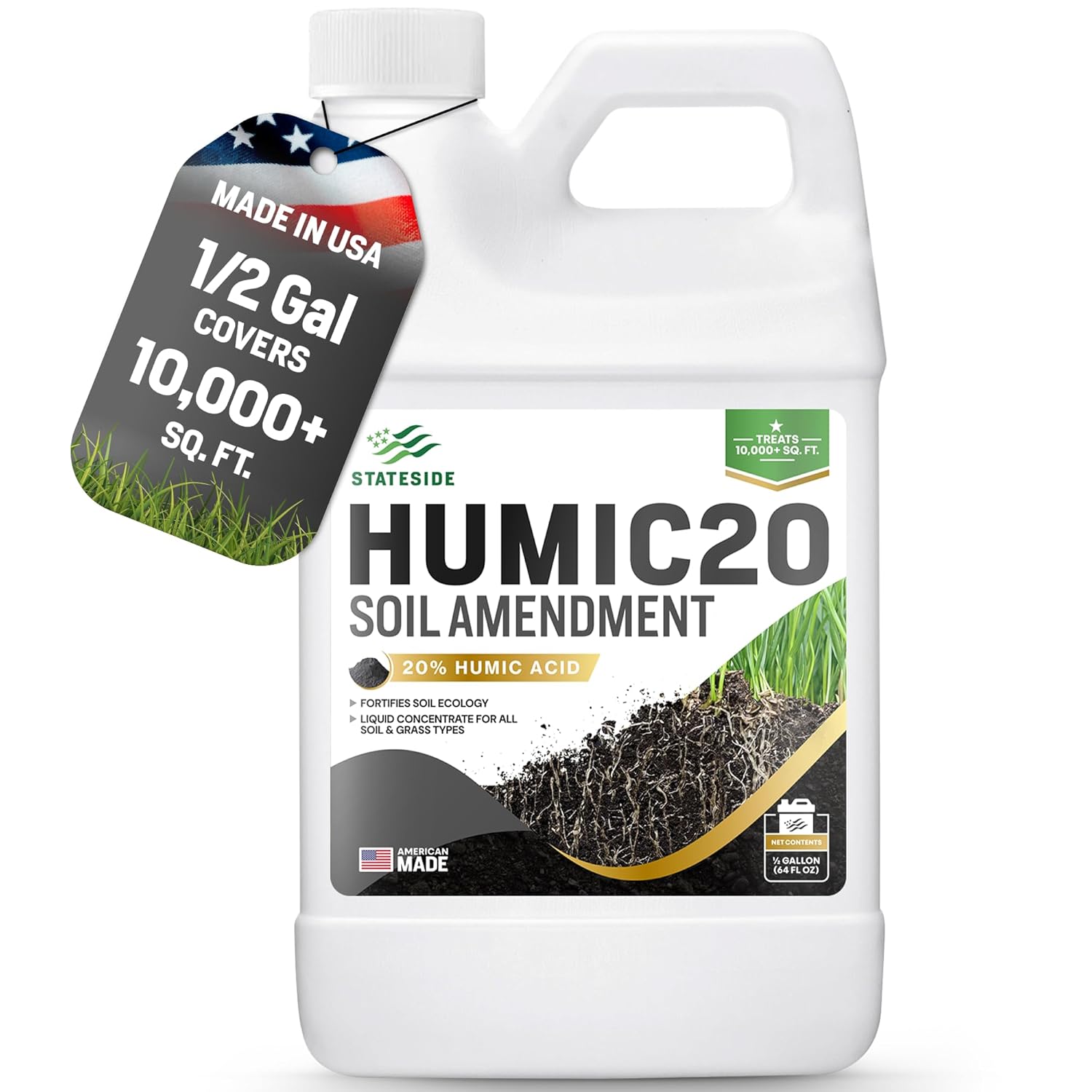
Stateside 20% Humic Acid Soil Conditioner for Lawns, 64 fl oz
| Unit Count | 64 Fluid Ounces |
|---|---|
| Ingredients | 20% Humic Acid |
| Included Components | Bottle |
This 64-ounce Stateside humic acid concentrate is a straightforward soil conditioner aimed at improving soil structure and encouraging stronger root growth in lawns. It is typically diluted and applied across turf to help bind soil particles, increase aeration and drainage, and create conditions that support beneficial microbes. The 20% humic acid formulation is presented as versatile for sandy, clay, silty, and loam soils and is marketed with coverage guidance that makes it easy to plan applications for large areas. Practical benefits include improved nutrient access for roots, better soil crumb structure that reduces compaction, and compatibility with common lawn fertilizers. Important limitations are that results depend on correct dilution and application frequency and that this product is a soil conditioner rather than a primary fertilizer, so it will not supply significant NPK nutrients on its own. Users should follow safety guidance when handling concentrates and set expectations that visible turf responses may take weeks as soil biology and structure improve.
Best for: Homeowners who want a practical, system-level improvement to lawn soil rather than a quick green-up, and who plan applications across medium to large turf areas.
Less Ideal for: People seeking an all-in-one fertilizer or immediate visible greening after a single application should consider dedicated lawn fertilizers instead.
- 20% humic acid concentrate designed to improve soil structure and aeration
- Clear coverage guidance for planning applications over large lawn areas
- Works across various soil types including sandy, clay, silty, and loam
- Supports root development and beneficial soil microbes when used as directed
- Does not provide primary nutrients like nitrogen phosphorus or potassium
- Requires correct dilution and repeat applications for best results
Verdict: Choose this humic acid concentrate when you want a practical soil conditioner that improves structure and root health across a variety of lawn soils.
Live Earth Humate Soil Conditioner Granules, 3 × 5 lb Bags (15 lb)

| Item Form | Granules |
|---|---|
| Specific Uses For Product | Soil Conditioning |
| Coverage | Full |
| Target Species | lawns, turf, vegetable gardens, flowers, trees, shrubs |
This humate soil conditioner supplies concentrated humic and fulvic acids in granular form to improve soil organic matter and nutrient retention. It is typically broadcast or raked into soil for lawns, raised beds, vegetable gardens, trees, and shrubs; the product page lists application rates for new and established turf, garden beds, and trees so you can match the dose to your soil type. Because it is OMRI-listed and made from mined humic shale, it functions as a gentle, low-risk soil amendment that can be applied before or after fertilization without burning plants. Practical benefits for heavy clay include improved structure, increased water infiltration and retention, and enhanced microbial activity that helps roots establish. The format of three 5 lb bags makes it easy to handle and apply in small yards or raised beds. Limitations are that humates work gradually and are not a quick fix for severely compacted clay where mechanical loosening or larger-volume organic amendments may be needed, and recommended application rates for large areas can require significant material to see major change.
Best for: Home gardeners looking for an affordable, low-risk organic amendment to improve clay soil structure and boost plant root development in small to medium beds and lawns.
Less Ideal for: Gardeners who need immediate structural correction of heavily compacted clay or who prefer a single high-volume compost or tillage solution for large acreage.
- Contains humic and fulvic acids that improve nutrient retention and soil biology
- OMRI-listed natural source suitable for organic gardens and safe around kids and pets
- Granular bags are easy to spread by hand or with a spreader and can be raked into beds
- Includes application guidance for turf, vegetables, trees, and shrubs
- Effects are gradual and require repeat applications to build measurable organic matter
- Not a substitute for mechanical tilling or large-volume compost when correcting severely compacted clay
Verdict: A budget-friendly organic humate conditioner that steadily improves clay soil structure and nutrient holding capacity for home gardens.
The Andersons HumiChar Organic Soil Amendment with Humic Acid and Biochar (40 lb)

| Unit Count | 640 Ounce |
|---|---|
| Brand Name | The Andersons |
| Ingredients | Humic Acid, Wood Biochar, Leonardite, Proprietry Binding Agent, Water |
| OMRI Listed | Yes |
HumiChar is a granular organic soil amendment designed to boost soil structure and long-term health by combining high-concentration humic acid with granulated biochar. It is typically applied as a topdressing or blended into existing soil when dressing lawns, mixed into planting holes, or used alongside a regular fertilizer program. The dispersible granule formulation reduces dust and breaks down more quickly than raw biochar, so you get some immediate benefits from humic acids while the biochar contributes lasting carbon and improved soil porosity. The product is OMRI listed and formulated to be blended with fertilizers or used on its own, which makes it practical for routine lawn maintenance. Important limitations are regulatory: it is not for sale in California or Oregon, and the label warns of inhalation and skin contact risks so you should wear a mask and gloves during application. For someone who prioritizes steady, science-backed soil improvement, this product offers a low-maintenance way to strengthen soil over multiple seasons.
Best for: Homeowners and lawn care pros who want a reliable, low-maintenance amendment to strengthen soil biology and structure as part of a regular lawn dressing program.
Less Ideal for: Buyers who need an immediate fertilizer-style nutrient boost or who cannot comply with regional sale restrictions should consider other products or local alternatives.
- Contains 30% humic acid for more immediate soil nutrient mobilization
- 43% granulated biochar provides long-term carbon and improved soil structure
- Dispersible granule formulation reduces dust and breaks down efficiently
- OMRI listed so it fits organic lawn and garden programs
- Not available for sale in California or Oregon due to regulatory restrictions
- Contains fine particles that require protective equipment during application
Verdict: Choose HumiChar when you want a dependable organic amendment that delivers immediate humic benefits and durable biochar-driven soil improvement for lawn topdressing.
Simple Lawn Solutions Liquid Soil Loosener, 32 oz

| Item Form | Liquid |
|---|---|
| Specific Uses For Product | Lawn |
| Application Method | Sprayer |
| Coverage | 32000 |
| Target Species | Lawn Grass |
Simple Lawn Solutions Liquid Soil Loosener is a 32-ounce concentrated treatment intended to improve vertical water movement and reduce compaction across lawns. You apply it with a separate sprayer and it is typically used either before mechanical or core aeration or on its own to help standing water drain and to increase water infiltration. The product covers a very large area per bottle and is described as suitable for all common grass types, so it is practical for homeowners who want to treat broad lawn areas without repeated applications. Key features are its concentrated formula, compatibility with standard sprayers, and guidance to water it in for best performance. Important limitations are that it should be applied at least four weeks before seeding because it can affect germination and that you must supply your own spray equipment and follow the watering recommendation. For managing compacted soil and improving drainage on established lawns this liquid treatment is straightforward and easy to integrate into a regular turf care routine.
Best for: Homeowners who want a low-effort way to reduce compaction and improve drainage across established lawns and who prioritize treatments backed by frequent positive user experiences.
Less Ideal for: Those establishing new seed beds, overseeding soon after treatment, or users who need a product that can be applied without any external spray equipment.
- Concentrated 32-ounce formula covers a large area, reducing frequency of repurchase
- Formulated to improve vertical drainage and water infiltration in compacted soils
- Works alone or as a supplement to mechanical or core aeration
- Suitable for all common lawn grass types, making it versatile for many yards
- Must be applied at least four weeks before seeding because it can affect germination
- Requires a separate sprayer and post-application watering for best results
Verdict: A concentrated, easy-to-use liquid treatment that helps loosen compacted lawns and improve drainage when applied and watered in correctly.
Farmer's Secret Soil Revitalizer Organic Liquid Compost (32 oz)

| Item Form | Liquid |
|---|---|
| Specific Uses For Product | Organic |
| Application Method | spray/pour |
| Coverage | 32,000 square feet |
| Mixing Ratio | 1:128 |
Farmer's Secret Soil Revitalizer is a concentrated liquid amendment that uses activated humics to improve soil structure, stimulate microbial activity, and make nutrients more available to plants. It is mixed at 1 ounce per gallon of water and can be applied with a watering can, sprayer, irrigation system, or as a foliar feed for houseplants. For clay soils the product's humic-rich formula helps loosen compacted particles over time and supports biological activity that improves drainage and root penetration. It is OMRI listed and made from organic sources, so it is suitable for edible gardens and safe around children and pets when used as directed. The effects are gradual rather than immediate because it works by rebuilding soil biology rather than supplying fast-release NPK, so gardeners should expect cumulative improvement after several applications every 2 to 4 weeks. Coverage claims are high for the bottle size, so plan dosing carefully if treating a large lawn or landscape.
Best for: Gardeners who want a low-risk, soil-first approach to improve compacted or nutrient-poor soils and are willing to use a repeat feeding schedule to build long-term soil health.
Less Ideal for: People seeking rapid green-up or instant high-amount nutrient feeds for heavy-feeding annuals or lawns should consider a supplemental synthetic fertilizer instead.
- OMRI listed organic formula safe for edible gardens when diluted as directed
- Activated humics increase microbial activity and long-term soil structure improvement
- Versatile application options: watering can, sprayer, hose-end or irrigation
- Concentrated mixing ratio (1:128) stretches one bottle over many applications
- Not a fast-acting synthetic fertilizer so visible results take multiple applications
- Coverage per bottle may be optimistic for large yards, requiring multiple bottles for whole-lawn use
Verdict: Use this organic, humic-rich liquid if you want to rebuild clay soil biology and structure over time rather than chase quick fertilizer results.
Choosing the Right Soil Conditioner for Lawns: Key Factors to Consider
Soil Type Compatibility
Different conditioners behave differently in sand, silt, and clay. A coarse, mineral-based conditioner can open up heavy clay by increasing larger pore spaces, while one with fine organic particles may be better at improving water-holding in sandy soils.
Matching the conditioner to your native soil prevents over-amending and avoids creating layers that impede root growth. Test a small area first when changing amendment type.
Particle Size And Texture
Particle size determines how a conditioner modifies pore size distribution. Larger particles create macropores that improve aeration and drainage. Finer particles fill small voids and hold water, which can be useful in fast-draining lawns but risky in compacted clays.
Look for information about screen size or particle range and consider whether the conditioner will mix with topsoil and existing turf without forming a crust or hardpan.
Organic Content And Nutrient Effects
Organic matter increases cation exchange capacity and slowly releases nutrients as it decomposes, improving fertility over time. High-organic conditioners also support beneficial soil biology, which aids nutrient cycling and disease suppression in the root zone.
Consider the carbon to nitrogen ratio and whether the conditioner will temporarily tie up nitrogen during decomposition. Combining conditioners with a starter fertilizer or adjusting your fertilization schedule can prevent short-term nitrogen stress.
Effect On Drainage And Compaction
A primary reason to use a soil conditioner on lawns is to relieve compaction and improve water infiltration. Some conditioners physically break up compacted layers, while others increase resilience through improved organic structure.
Evaluate whether the product is intended for surface application, topdressing, or deeper incorporation. For severe compaction, conditioners used alongside mechanical aeration are often more effective than surface-only applications.
Longevity And Maintenance Needs
Some conditioners produce immediate, short-term changes while others alter soil over seasons. Mineral amendments can remain beneficial for years, while organic materials break down and require reapplication to maintain benefits.
Plan for follow-up maintenance based on the product's expected lifespan. Consider how often you are willing to topdress or reapply and whether the conditioner fits into your annual lawn care schedule.
Application Method And Labor
Ease of spreading, incorporation requirements, and compatibility with common lawn equipment affect the practicality of a conditioner. Bulk, heavy materials require more labor or mechanized assistance, while bagged, lightweight products may be easier to distribute evenly.
Also factor in whether the conditioner needs to be tilled or can be worked in with aeration tines. Clear application instructions make it simpler to get consistent results across a typical residential or community lawn.
When To Condition A Lawn
Use a conditioner when you notice poor drainage, thin or patchy turf, or hard, compacted soil that resists root growth. Seasonal timing matters: late spring through early fall is best for active root growth, while fall applications give conditioners time to integrate before winter dormancy.
If you aerate annually, apply the conditioner immediately afterward so the material can move into the holes and the root zone. Avoid conditioning when the lawn is waterlogged, since working wet soils can worsen compaction.
- Signs to condition: puddling after rain, shallow roots, excess thatch combined with firmness
- Best timing: active growth periods or after aeration
Topdressing Vs Incorporation
Topdressing spreads a thin layer of conditioner across the surface and is useful for incremental improvement and for leveling. Incorporation places the material deeper and may be necessary for severe compaction or when using heavy mineral amendments.
Combine topdressing with regular mowing and watering to help finer particles work into the turf. For deeper problems, core aeration followed by applying conditioner into the holes gives faster improvement to the rooting zone.
- Topdressing: less labor, gradual benefit
- Incorporation: more labor, faster change to soil structure
How Conditioners Interact With Fertility Plans
Soil conditioners can change nutrient dynamics by altering cation exchange capacity and microbial activity. Organic amendments slowly release nutrients and support beneficial microbes, while mineral conditioners mainly change physical properties without adding plant-available nutrients.
Adjust fertilizer timing if using a high-carbon organic conditioner to avoid temporary nitrogen immobilization. When in doubt, test soil before and after major amendments to track pH and nutrient availability.
- Test soil to guide fertilizer adjustments
- Stagger heavy organic amendments and nitrogen applications
Using Conditioners With Overseeding And Repair
When overseeding, apply a light layer of conditioner to improve seed-to-soil contact and moisture retention. A fine-textured organic conditioner can hold moisture for germination without smothering seedlings.
For repair work, place conditioner in the seedbed or mix with topsoil to create a friable medium for new roots. Avoid burying seed under a heavy crust of coarse material that can inhibit emergence.
- Light, even coverage improves germination
- Match particle size to seedbed needs
Environmental And Turf Safety Considerations
Choose conditioners that do not introduce contaminants or excessive salts to the root zone. Some mineral amendments can alter pH; know how that interacts with your turf species. Organic materials should be well-composted to reduce weed seeds and pathogens.
Consider runoff and nearby water features. Conditioners that reduce surface runoff and increase infiltration help protect local waterways by keeping nutrients on-site rather than washing them away.
- Check for salt content, pH effects, and weed seeds
- Prefer composted organics or certified low-salt mineral products
How We Chose the Best Soil Conditioner for Lawns
We selected options that address the real-world problems lawns face: compaction, poor drainage, shallow rooting, and low organic matter. Editorial filters prioritized materials and formulations shown to alter soil texture or increase pore space, plus those suitable for turfgrass use. Evaluation focused on specific, measurable dimensions: particle size and how it affects soil aeration; organic matter percentage and its role in nutrient and water retention; compatibility with common turf fertilizers and seeding; and ease of application across typical lawn sizes. We also considered longevity of effect and whether the conditioner helps reduce compaction over multiple seasons. Excluded items included products intended solely for ornamental beds, heavy landscape amendments that change grade, or specialty lab blends not practical for lawn-scale use. Our goal was to highlight conditioners a homeowner or groundskeeper can reasonably apply to improve lawn rooting environment and drainage.
FAQ
How often should I apply a soil conditioner to my lawn?
It depends on the product. Organic conditioners typically require reapplication every 1 to 3 years as they decompose. Mineral-based conditioners can last longer but may still benefit from periodic topdressing every few seasons.
Can I apply a soil conditioner without aerating first?
You can, but aeration improves effectiveness by creating channels for the conditioner to reach the root zone. For surface-only issues, topdressing without aeration still helps gradually. For compaction, combine aeration with application.
Will a soil conditioner change my soil pH?
Some mineral conditioners can affect pH, so check product specs. Most well-composted organic conditioners have minimal immediate pH impact, but testing before and after application is a good practice.
Is a high-organic-content conditioner always better?
Not always. High-organic materials improve biology and water retention but can tie up nitrogen while decomposing. Sandy soils benefit from organic matter more than heavy clays, where particle size and mineral amendments may be more effective.
Can I use a soil conditioner when overseeding?
Yes. Use a fine-textured conditioner or light topdressing to improve seed contact and moisture. Avoid burying seed under a thick, coarse layer that could block emergence.
Final Verdict
Pick a soil conditioner that matches your lawn's specific problems and your maintenance capacity. Prioritize matching particle size to your soil type, balancing organic benefits against potential short-term nutrient demands, and planning application timing around aeration and seeding. For most homeowners, combining aeration with a targeted conditioner and following up with routine maintenance produces the best long-term turf improvement. Focus on the criteria discussed here to choose the approach that will yield deeper roots, better drainage, and a more resilient lawn.
