

Note: This article contains affiliate links. If you click on these links and make a purchase, I may earn a small commission at no extra cost to you. This helps support my research and content. Read my full affiliate disclosure here.
Choosing the right soil for bonsai trees has a bigger impact than most beginners expect. The wrong mix holds too much water, suffocates roots, or breaks down quickly and compacts. The right soil keeps tiny root systems healthy by providing crisp drainage, steady moisture, and some nutrient-holding capacity. This guide looks at six shortlisted soil options for bonsai trees and explains why each made the cut. We evaluated mixes for particle size, drainage, water retention, and long-term stability so you can pick the right foundation for your tree type and watering habits.
Top Picks at a Glance
| Best Overall The best all-around choice for most situations | Tinyroots Premium Bonsai Soil Blend (2.25 qt) – Akadama, Red Lava Rock & Pumice |  |
| Best Quality Built to a higher standard if you want something more solid | Tinyroots Akadama Bonsai Soil, Sifted Fine Grain (5mm), 2.25 qt |  |
| Best Budget The cheapest option that still gets the job done reliably | Doter Bonsai Soil Mix, 1 qt Ready-to-Use Organic Potting Mix |  |
| Highest Rated A top-rated pick with lots of positive feedback | Avalution Bonsai Soil Mix, 3 QT |  |
| Most Popular A crowd favorite that many people choose with confidence | Perfect Plants Bonsai Soil — 2 qt Organic All-Purpose Potting Mix |  |
| Best Seller A high-volume bestseller chosen again and again | The Bonsai Supply All-Purpose Bonsai Soil Mix (2 qt) |  |
Tinyroots Premium Bonsai Soil Blend (2.25 qt) – Akadama, Red Lava Rock & Pumice
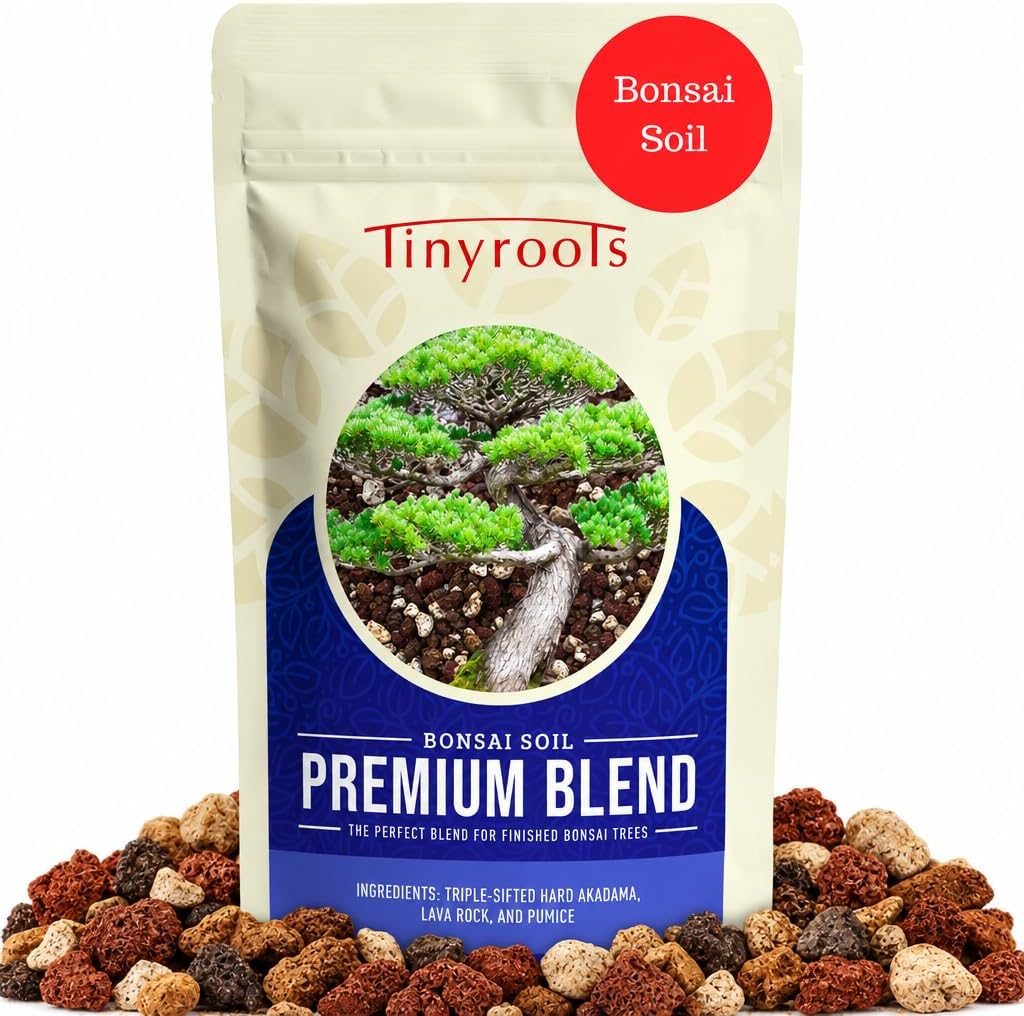
| Volume | 2 quarts |
|---|---|
| Unit Count | 72 Ounce |
| Blend components | Akadama, Red Lava Rock, Pumice |
| Style Name | Houseplant,Potting,Soil Mix |
This Tinyroots Premium Bonsai Soil is a pre-mixed, double-sifted blend of akadama, red lava rock and pumice designed for finished bonsai and houseplants. It is typically used when repotting or topping up bonsai; the mix is ready to use straight from the resealable pouch so you can pot quickly without additional amendments. The akadama helps with moisture retention and structure while the pumice and lava rock increase aeration and drainage, which supports healthy root development and reduces overwatering risk. The product is presented in a small, nursery-sized volume that makes it convenient for a few trees or for experimenting with mixes. Important limitations are the small 2.25 quart volume, which means multiple bags are needed for larger collections, and the fixed particle composition, so growers who prefer very specific particle sizes or custom ratios may still want to sieve or blend further. For general-purpose bonsai maintenance and for growers who value convenience, this is a practical, high-quality option.
Best for: Balanced hobbyists who want a reliable, ready-made bonsai substrate for repotting and routine maintenance without mixing components themselves.
Less Ideal for: Collectors with many trees or professional nurseries that need bulk quantities or custom soil formulas should look for larger volumes or component-grade aggregates instead.
- Pre-mixed and double-sifted for consistent particle distribution and ready use
- Blend of akadama, pumice, and red lava rock balances moisture retention and drainage
- Resealable pouch preserves the remaining soil between uses
- Formulated specifically for bonsai to support root development and aeration
- Small 2.25 quart volume requires multiple bags for several trees or larger pots
- Fixed blend may not suit growers who want bespoke particle ratios or very fine customization
Verdict: A convenient, pre-sifted akadama-pumice-lava mix that delivers reliable drainage and root support for hobby bonsai without any prep work.
Tinyroots Akadama Bonsai Soil, Sifted Fine Grain (5mm), 2.25 qt

| Unit Count | 83.8 Ounce |
|---|---|
| Item Type Name | 5MM |
| Manufacturer | New England Bonsai Gardens |
| Volume | 2 quarts |
Tinyroots Akadama is a fine-grain volcanic bonsai substrate intended for growers who prioritize root health and reliable drainage. The product is pre-sifted through 1/8 then 1/16 inch mesh to remove dust and fines, producing a uniform 5mm particle size that promotes aeration and prevents compaction around delicate roots. Use it as a standalone medium for conifers, deciduous bonsai, or as a top layer for potted succulents and cacti; the soil darkens when wet so you can judge watering needs visually. Practical benefits include steady moisture regulation, improved oxygen flow to roots, and a clean, consistent texture that makes repotting and root work easier. Limitations are the small bag size and light weight, so it is best for individual trees or small batches rather than large-scale reuse, and pure Akadama may require blending with pumice or lava for long-term use in very wet climates. For growers focused on performance and predictable root conditions, this sifted Akadama delivers professional-style results in a compact package.
Best for: Serious bonsai growers and hobbyists who want a performance-oriented, well drained substrate for individual trees and precise watering control.
Less Ideal for: Gardeners who need large volumes of potting mix for many plants or those seeking an all-in-one, low-maintenance commercial potting soil.
- Uniform 5mm particle size from double sifting reduces dust and prevents compaction
- Good drainage and aeration that support healthy root development
- Darkens when wet to provide a simple visual watering indicator
- Suitable for bonsai, succulents, and cacti as a performance-focused substrate
- Small 2.25 quart / 2 pound bag limits quantity for multiple trees or large pots
- Pure Akadama can break down over time and may need mixing with harder aggregates in wet conditions
Verdict: Choose this sifted Akadama when you want a predictable, high-performance bonsai substrate that improves drainage and helps you water with confidence.
Doter Bonsai Soil Mix, 1 qt Ready-to-Use Organic Potting Mix

| Brand Name | Doter |
|---|---|
| Unit Count | 32 Ounce |
| Item Type Name | Garden soil |
| Volume | 1 quarts |
| Style Name | Japanese |
This 1 qt Doter bonsai soil mix is a pre-mixed potting medium aimed at small bonsai, seedlings, and repotting tasks. It is sold ready to use so you can fill a small pot or top-dress plants without blending components. The formulation emphasizes drainage and aeration while retaining moisture long enough to reduce watering frequency, which helps prevent root rot in compact containers. In practice it works well for beginners or collectors who need a convenient, small-quantity mix for Japanese-style and other small bonsai. Notable features are its organic-focused blend and a balanced texture that supports root development and foliage vigor without adding fertilizers separately for a short period. Limitations are its small 1 qt volume and basic nutrient profile, so you will need larger quantities or supplemental feeds for multiple trees or longer-term potted specimens. Also serious hobbyists who custom-mix specific ratios of pumice, akadama, or lava rock may find this premix less adjustable than raw components.
Best for: Budget-minded bonsai owners who want a convenient, ready-made soil for small pots, starter trees, or occasional repotting without mixing their own components.
Less Ideal for: Experienced bonsai growers who prefer to custom-blend specific inorganic components or anyone repotting multiple or larger trees who needs bulk soil.
- Ready-to-use 1 qt bag saves time mixing components for small pots or repotting
- Formulation balances drainage and moisture retention to reduce overwatering risk
- Organic blend supports root development and short-term plant health
- Compact size is convenient for trying a new mix or working with single trees
- Only 1 quart volume is insufficient for multiple trees or large repots
- Basic nutrient profile means you will need to fertilize for long-term growth
Verdict: A low-cost, ready-to-use 1 qt bonsai mix that makes repotting and trying a new soil easy for single small trees.
Avalution Bonsai Soil Mix, 3 QT

| Brand Name | Avalution |
|---|---|
| Unit Count | 35.27 Ounce |
| Item Highlight | Perlite, Lava Rock, Pine Bark, Diatomite, Clay Pebbles |
| Style Name | Bonsai Soil Mix |
This ready-to-use bonsai soil mix is designed to give bonsai roots a stable, well-aerated medium without any home mixing. The blend combines perlite, black lava rock, pine bark, diatomite, and clay pebbles into consistently sized particles that promote quick drainage while retaining enough moisture to avoid rapid drying. In practice it makes repotting and root inspections easier because it resists compaction and stays loose around root systems. That helps reduce risks from overwatering and improves oxygen access for healthier root growth. The mix is versatile enough for most indoor bonsai, as well as succulents and cacti, so it suits growers who want a single reliable substrate for multiple plants. Limitations are that the bag size is modest at 3 quarts so frequent repotting or larger trees will require multiple bags, and there is no nutrient amendment included so you will still need to fertilize for long-term feeding.
Best for: Growers who prioritize a dependable, easy‑to‑manage substrate that promotes root health and reduces overwatering risk for indoor bonsai and similar container plants.
Less Ideal for: Gardeners looking for an all‑in‑one potting mix with built‑in fertilizers or those repotting large outdoor bonsai where bulk soil quantities are required.
- Well‑draining mix with perlite and lava rock to reduce waterlogging
- Consistent chunky texture that resists compaction and eases root inspection
- Includes moisture‑holding diatomite to balance dryness and drainage
- Ready to use straight from the bag with no additional mixing required
- Small 3 quart unit means multiple bags needed for larger trees or frequent repotting
- No added fertilizer or long‑term nutrient component included
Verdict: A consistent, ready‑to‑use bonsai soil that reliably improves drainage and root aeration for indoor bonsai and succulents.
Perfect Plants Bonsai Soil — 2 qt Organic All-Purpose Potting Mix

| Unit Count | 64 Fluid Ounces |
|---|---|
| Item Type Name | Bonsai Soil |
| Volume | 2 quarts |
| Brand Name | PERFECT PLANTS |
Perfect Plants Bonsai Soil is a small-batch, ready-to-use potting mix designed for bonsai and other small container trees. The mix is intended to balance water retention with drainage so roots do not sit waterlogged while still receiving steady moisture. You typically use it to repot a single bonsai or to top-dress a small container; the resealable 2 quart bag is convenient for storage and occasional touch-ups. The product highlights all-natural ingredients and claims to sweeten soil and encourage root health, which is useful for conifers such as junipers, cedars, redwoods, and pines. Practical benefits include easier weekly watering management for containerized trees and a nutrient base that supports new growth without immediate additional amendments. Limitations are the small quantity — the 2 quart supply fits one small pot and requires frequent repurchase for multiple trees — and the description does not list precise particle composition or pH, so advanced bonsai growers who need exact grit mixes or custom drainage ratios may need to amend it with additives like akadama, pumice, or coarse grit.
Best for: Buyers who want an easy, ready-made organic mix for one or a few bonsai trees and prefer a product with positive user feedback and predictable performance.
Less Ideal for: Experienced bonsai hobbyists who custom-blend their own soil by grit and pH specifications or collectors with many trees who need bulk quantities.
- Formulated for bonsai and small container trees to balance moisture and drainage
- All-natural ingredients intended to provide nutrients and encourage root growth
- Resealable heavy-duty bag keeps remaining soil fresh between uses
- Small-batch mixing suggests consistent quality across bags
- Only a 2 quart supply so not economical for multiple or large bonsai collections
- No detailed particle size, composition, or pH information provided for precise mix control
Verdict: A convenient, organic 2‑quart bonsai mix that delivers balanced moisture control and basic nutrient support for one small container tree.
The Bonsai Supply All-Purpose Bonsai Soil Mix (2 qt)

| Style Name | Bonsai-specific, fast-draining, nutrient-rich potting mix |
|---|---|
| Unit Count | 64 Ounce |
| Ingredients | Pumice, Calcined Clay, Pine Bark Fines, Black Lava |
| Volume | 2 quarts |
This ready-to-use bonsai soil mix is formulated to give potted trees the drainage and aeration they need while still holding enough moisture and nutrients for healthy growth. Typical use is straightforward: open the resealable pouch, fill or top-dress bonsai pots, and repot without having to measure or blend multiple components. The mix lists pumice, calcined clay, pine bark fines and black lava, which together improve drainage, reduce compaction and provide stable pore space for roots. Benefits include consistent particle-based structure that speeds drying after watering and better oxygen flow around roots, which helps prevent root rot in container settings. The small 2 quart bag is convenient for small repots or top-dressing but means multiple bags are required for larger collections. Also, the blend is a general-purpose bonsai mix rather than species-specific, so growers who need a very coarse or custom formula for maples or pines may want to adjust particle sizes themselves.
Best for: Buyers who prefer a low-risk, ready-made bonsai soil that performs reliably for routine repotting and top-dressing and who want to avoid mixing components themselves.
Less Ideal for: Experienced bonsai growers who prefer to custom-blend particle sizes or need very large volumes for multiple full repots.
- Pre-mixed formula saves time and removes guesswork when repotting
- Fast-draining ingredients reduce risk of waterlogging and root rot
- Stable particle mix (pumice, lava, calcined clay, pine bark) resists compaction
- Resealable pouch preserves mix between uses
- Small 2 quart volume requires multiple bags for several trees or full repots
- Not tailored to species-specific needs so may need amendment for certain bonsai types
Verdict: A dependable, ready-to-use fast-draining bonsai mix that simplifies repotting and reduces the risk of overwatering for casual and cautious bonsai owners.
Choosing the Right Soil for Bonsai Trees: Key Factors to Consider
Particle Size Distribution
Particle size determines how quickly water moves through the pot and how much oxygen reaches roots. Bonsai soils typically combine several distinct sizes so fine particles hold some moisture while coarser grains create air pockets. A mix with mostly uniform medium particles will behave differently than a graded mix with a clear range from fine to coarse.
When you choose soil, think about the tree species and the container. Shallow pots favor mixes that drain quickly and do not retain heavy moisture near the surface. Larger or deeper containers can tolerate slightly more fine material because there is more total volume for roots to explore.
Drainage and Aeration
Good drainage prevents root rot by allowing excess water to escape and by keeping pore space filled with air between waterings. Aeration is especially critical in bonsai because root systems are compact and need oxygen to function.
Assess a mix by how fast surface water disappears and whether the soil stays loose or compacts. Inorganic components such as pumice, lava rock, or fired clay are reliable ways to maintain long-term aeration because they do not decompose and collapse over seasons.
Water Retention Behavior
Water retention describes how long the soil holds accessible moisture for the plant. Too fast and the tree dries between waterings; too slow and the roots sit in soggy conditions. The best soils for bonsai strike a balance so you can establish a predictable watering rhythm based on pot size, climate, and species.
Water retention is influenced by both particle mix and organic content. Small amounts of well-stable organic matter can help retain moisture without creating waterlogging, but excessive organic material will break down and change the mix dynamics over time.
Long-Term Structural Stability
Over months and years, some soils compact as organic particles decompose or fines migrate. Compaction reduces aeration and changes drainage, forcing repotting sooner than expected. Look for mixes containing non-degradable aggregates that retain pore space through wetting and drying cycles.
Stability also affects how frequently you need to repot and how the root mass develops. More stable mixes support healthier, more easily pruned root systems because they maintain consistent physical properties.
Nutrient Holding and Amendment Needs
Most bonsai soils are designed to provide structure rather than complete nutrition. Soil that holds a modest amount of nutrients reduces the need for frequent feeding, but many growers prefer to control fertilizer independently. Understand whether a mix contains organic material or slow-release nutrients and plan amendments accordingly.
Consider how easy the mix is to top-dress or integrate with fertilizers. Highly inert mixes may require more attention to feeding, while mixes with organic components can mask nutrient deficiencies but will also change form over time.
pH and Chemical Neutrality
Soil pH affects nutrient availability and root function. Many bonsai species tolerate a neutral to slightly acidic range, so a chemically neutral substrate avoids surprise nutrient lockups. Some common bonsai components are naturally near neutral, but mixes that include composted organics may lean different directions.
If you grow species with specific pH needs, such as acid-loving conifers, check the expected pH or test the mix. Chemical neutrality also reduces the chance of salt buildup and helps you interpret fertilizer behavior more predictably.
Why Bonsai Soil Differs From Regular Potting Mix
Bonsai soil is focused on physical structure first, not on holding lots of organic matter. Regular potting mixes are formulated to retain water and support rapid seedling growth, which is the opposite of what many bonsai trees need. A bonsai substrate emphasizes good drainage and steady aeration so small root systems stay healthy in shallow containers.
That difference changes how you water, fertilize, and repot. Expect a bonsai mix to dry faster on the surface and to require more frequent but measured watering cycles. The goal is a stable root environment that supports sculpting and health rather than rapid volume growth.
- Inorganic aggregates maintain pore space through seasons
- Smaller particle blends allow controlled moisture without waterlogging
- Regular potting soil often compacts in shallow bonsai pots
Matching Soil Type to Bonsai Species and Climate
Different tree species and climates demand different water behavior. Tropical species usually tolerate and sometimes prefer slightly higher moisture, while deciduous trees from temperate zones and many conifers want faster drainage. Local humidity and rainfall also influence how a mix performs outside.
Adjust your soil choice to where you keep the tree. For an outdoor bonsai in a wet climate, favor coarser mixes with higher drainage. For indoor tropical bonsai, a bit more water retention and organic content can reduce stress between waterings.
- Tropical indoor bonsai: modest organic content, moderate drainage
- Outdoor temperate bonsai: coarse, fast-draining mixes
- Conifers: very free-draining, low-organic substrates
How to Test and Amend a Soil Mix at Home
Before using a new mix, test a small sample in a shallow pot. Water thoroughly and observe how long it takes to drain and how the moisture profile changes over a few days. Check whether the surface quickly dries while the lower layers stay moist or whether fines hold water too long.
If a mix needs adjustment, you can add pumice or lava rock to improve drainage, sift to remove excessive fines, or incorporate a small proportion of organic material to increase moisture retention. Make changes conservatively and retest to avoid creating a mix that requires constant watering.
- Sieve the mix to remove very fine dust or fines
- Add 10 to 30 percent coarse aggregate to speed drainage
- Use small test pots to validate changes before repotting prized trees
Repotting Schedule and Soil Longevity
How long a bonsai soil remains effective depends on its composition and your climate. Inert, inorganic-heavy mixes can last several years without major structural change. Mixes with higher organic content will decompose faster and usually need replacing or refreshing during repotting.
Plan repotting frequency around the tree species and the soil's behavior. Younger trees that grow rapidly may be repotted more often to manage root development, while mature specimens in stable, coarse mixes can go longer between repottings.
- Inspect root ball condition annually for compacted or waterlogged soil
- Top-dress annually to refresh small amounts of organic matter if needed
- Expect higher-organic mixes to require repotting more frequently
Practical Watering Tips for Bonsai Using Structured Mixes
With well-draining bonsai soil, watering becomes more predictable. Water thoroughly until excess runs from the drainage holes, then allow the upper portion of the mix to dry before the next watering. How quickly that happens depends on pot size, exposure, and the mix itself.
Use consistent checks rather than a strict schedule. Stick your finger into the surface or use a moisture meter to judge when the tree needs water. Adjust routines seasonally and when the tree is under stress from styling or root work.
- Water until runoff, then monitor surface dryness
- Reduce frequency in cooler, lower-light periods
- Increase watering for young trees or after repotting
How We Chose the Best Soil for Bonsai Trees
We focused on factors that actually affect bonsai root health and day-to-day care. Our selection process prioritized soil mixes that offer consistent drainage, predictable water retention, and particle stability so the mix does not collapse after a few waterings. We tested descriptions and specifications against standard bonsai practices for particle size distribution and porosity. We also checked ingredient transparency, whether mixes include inorganic components like akadama, pumice, or lava rock, and the presence of organic material that impacts decomposition rate. Exclusions: mixes that appeared formulated only for general potting or houseplants without clear particle breakdown were excluded. Extremely specialist substrates with very rare materials were also set aside unless they offered clear, repeatable benefits. Evaluation criteria included particle size and composition, drainage and aeration, water retention behavior, long-term structural stability, and nutrient content or amendment suitability. Those are the dimensions that reliably change how a bonsai grows, how often you water, and how the root system develops.
FAQ
Can I use regular potting soil for bonsai in a pinch?
You can use potting soil temporarily, but it usually retains too much moisture and compacts in shallow pots. If you must, mix in coarse inorganic material and monitor your tree closely until you can repot into a proper bonsai substrate.
How often should I repot bonsai when using a stable inorganic mix?
With a mostly inorganic, stable mix, repotting intervals can be longer, often several years for mature trees. Younger, vigorous trees may still need attention every one to three years depending on root growth.
Is a single universal bonsai soil suitable for all species?
No single mix is ideal for every species and climate. A universal-style mix can work as a starting point, but tailoring drainage and organic content to species needs and local conditions usually yields better results.
Should I add fertilizer differently depending on the soil mix?
Yes. Inert, low-organic mixes require more regular fertilization because they hold fewer nutrients, while mixes with organic components release nutrients as they break down. Adjust frequency and formulation based on the mix and season.
How can I tell if my bonsai soil has compacted?
Signs include poor drainage, water pooling on the surface, slow drying, and visibly reduced pore space when you examine the root ball. Compacted soil often leads to root-bound conditions and slower growth.
Final Verdict
Choose bonsai soil that matches your species and the local climate first, then tune particle mix and organic content to your watering habits. Prioritize mixes that maintain pore space through wetting and drying cycles, because structural stability has the biggest long-term effect on root health. Focus on predictable drainage and moderate water retention rather than trying to find a one-size-fits-all mix. With the right balance you will water less anxiously, repot less often, and support a healthier bonsai overall.
