

Note: This article contains affiliate links. If you click on these links and make a purchase, I may earn a small commission at no extra cost to you. This helps support my research and content. Read my full affiliate disclosure here.
Choosing the right soil can make the difference between a bountiful vegetable patch and a season of struggling plants. For gardeners growing edibles in beds, containers, or raised planters, soil affects root development, water retention, and how often you need to feed crops. This guide focuses on soils for growing vegetables and presents seven top shortlisted options suited to common garden situations. We evaluated mixes for nutrient density, drainage and moisture balance, and suitability across planting methods. Read on to understand what matters for your garden type and why these factors determine plant health and harvest size.
Top Picks at a Glance
| Best Overall The best all-around choice for most situations | Espoma Organic Vegetable & Flower Garden Soil (1 cu ft) |  |
| Best Quality Built to a higher standard if you want something more solid | Coast of Maine Tomatoes & Veggies Organic Planting Soil, 20 qt |  |
| Best Value The sweet spot between price and what you get | Miracle-Gro Organic Outdoor Potting Mix (16 qt) |  |
| Best Budget The cheapest option that still gets the job done reliably | Miracle-Gro Indoor Potting Mix for Seed Starting, 8 qt. (2-Pack) |  |
| Highest Rated A top-rated pick with lots of positive feedback | FoxFarm Happy Frog Potting Soil, Container Garden, 2 cu ft (with 2 Plant Tags) |  |
| Most Popular A crowd favorite that many people choose with confidence | Miracle-Gro Potting Mix, 16 qt. (2-Pack) |  |
| Best Seller A high-volume bestseller chosen again and again | Back to the Roots Premium Organic Potting Mix, 6 Quart |  |
Espoma Organic Vegetable & Flower Garden Soil (1 cu ft)

| Brand Name | Espoma |
|---|---|
| Unit Count | 1536 Ounce |
| Volume | 1 cubic feet |
| Style Name | Peat Moss |
Espoma Organic Vegetable & Flower Garden Soil is a ready-to-use planting mix intended to be blended into native garden soil at planting or transplanting time. The mix contains peat moss, earthworm castings, alfalfa meal, kelp meal, feather meal and a proprietary mycorrhizae blend to support root development and microbial activity. In practice you scoop and mix it into planting holes or raised beds to lighten heavy soils, improve moisture retention in sandy soils, and give seedlings a nutrient-rich start without synthetic fertilizers. The notable benefits are its organic ingredient list and inclusion of mycorrhizae and amendments that encourage early root growth and vigor. Because it is a 1 cubic foot bag it is easy to handle for small beds, containers, or targeted soil improvements, but larger gardens will need multiple bags and mixing effort. Also the product lists peat moss as a primary component which is useful for structure and water retention but may not suit gardeners avoiding peat for sustainability reasons.
Best for: Gardeners who want an easy organic amendment to boost transplant success and build soil biology in small vegetable beds or containers.
Less Ideal for: Large-scale growers or those seeking peat-free mixes for sustainability should consider bulk alternatives or peat-free products.
- Organic ingredient blend including earthworm castings and plant meals for gentle nutrient release
- Includes endo and ecto mycorrhizae to support root establishment
- Good for improving texture and moisture retention when mixed into native soil
- Single 1 cu ft bag is convenient for small beds, containers, or spot improvements
- Small 1 cubic foot volume means multiple bags are required for larger vegetable beds
- Contains peat moss, which some gardeners avoid for sustainability reasons
Verdict: Choose this mix if you want a small, organic planting amendment that adds nutrients and mycorrhizae to help vegetables establish quickly.
Coast of Maine Tomatoes & Veggies Organic Planting Soil, 20 qt

| Brand | Coast of Maine |
|---|---|
| Volume | 20 quarts |
| OMRI Listed | Yes |
Coast of Maine Tomatoes & Veggies planting soil is an organic 20 quart mix formulated to give vegetables a nutrient-rich start in garden beds, raised beds, and containers. The blend uses composted manure, peat moss, aged bark and ocean-derived inputs such as seaweed and lobster meal to improve structure, water retention and biological activity. In practice it works well for transplanting seedlings, top-dressing containers, or filling small raised beds where you want steady growth without heavy, compacted soil. Notable features include OMRI listing, a lightweight texture that makes handling easier, and ingredients intended to support microbes and root development. Because it is a specially blended planting mix rather than a complete long-term garden amendment, expect to supplement larger in-ground plots with additional compost or fertilizer over the season for sustained production. The 20 qt bag is convenient for spot applications and container gardening but will not replace bulk topsoil for full beds.
Best for: Vegetable gardeners who prioritize organic, performance-focused mixes for containers, transplants, and small raised beds and want a convenient, biologically active soil to jump-start crops.
Less Ideal for: Growers needing large volumes to fill full in-ground beds or those who want a single-product season-long fertility solution should look for bulk compost or complete soil amendments.
- OMRI-listed organic formula with ocean and land-sourced amendments
- Lightweight texture that is easy to lift and useful for containers and transplanting
- Blend supports moisture retention, drainage and improved soil structure
- Contains composted manure and seaweed to encourage microbial activity and root growth
- 20 quart bag is small for filling full in-ground beds and best for containers or spot use
- Not a complete season-long amendment for large vegetable plots without additional compost or fertilizer
Verdict: Choose this organic planting mix when you need a ready-to-use, microbe-friendly soil that reliably boosts container and small-bed vegetable performance.
Miracle-Gro Organic Outdoor Potting Mix (16 qt)

| Volume | 16 qt |
|---|---|
| Feeds up to | 2 months |
| OMRI Listed | Yes |
| Intended use | Outdoor container plants |
Miracle-Gro Organic Outdoor Potting Mix is a ready-to-use soil blend designed for outdoor container gardening. It is formulated with responsibly sourced peat and upcycled green waste, and includes a quick-release natural fertilizer that feeds plants for up to two months. Typical use is filling pots, loosening the plant root ball, setting the plant, topping up with mix, and watering thoroughly. The OMRI listing makes it suitable for organic vegetable and herb containers, and a single 16 qt bag is sized to fill roughly one 12-inch pot. Practical benefits include improved moisture retention versus plain garden dirt, built-in short-term nutrition for new transplants, and a product crafted for local retail distribution. Limitations are that the nutrient boost is temporary so you will need additional feeding for an ongoing vegetable crop, and peat-based mixes can compact over time so repotting or amendment every six to twelve months is recommended. Also the bag volume is modest for larger raised beds or multi-pot vegetable setups, so plan quantities accordingly.
Best for: Gardeners who want a convenient, certified-organic potting mix to get outdoor vegetable and herb containers off to a strong start and who prioritize ease and reliability over bulk sourcing.
Less Ideal for: Growers planning to fill many large pots, raised beds, or who prefer peat-free mixes should consider larger-volume or different-formulation soils targeted to those needs.
- OMRI listed for use in organic container gardening
- Contains quick-release natural fertilizer that feeds up to two months
- Formulated for outdoor containers to retain moisture and resist sun and wind stress
- Made with responsibly sourced peat and upcycled green waste
- Fertilizer effect is short term so additional feeding is needed for long-season vegetables
- Bag size (16 qt) is small for gardeners with multiple pots or larger beds
Verdict: A convenient OMRI-listed outdoor potting mix that gives vegetable and herb containers an easy organic nutrient boost and reliable moisture retention.
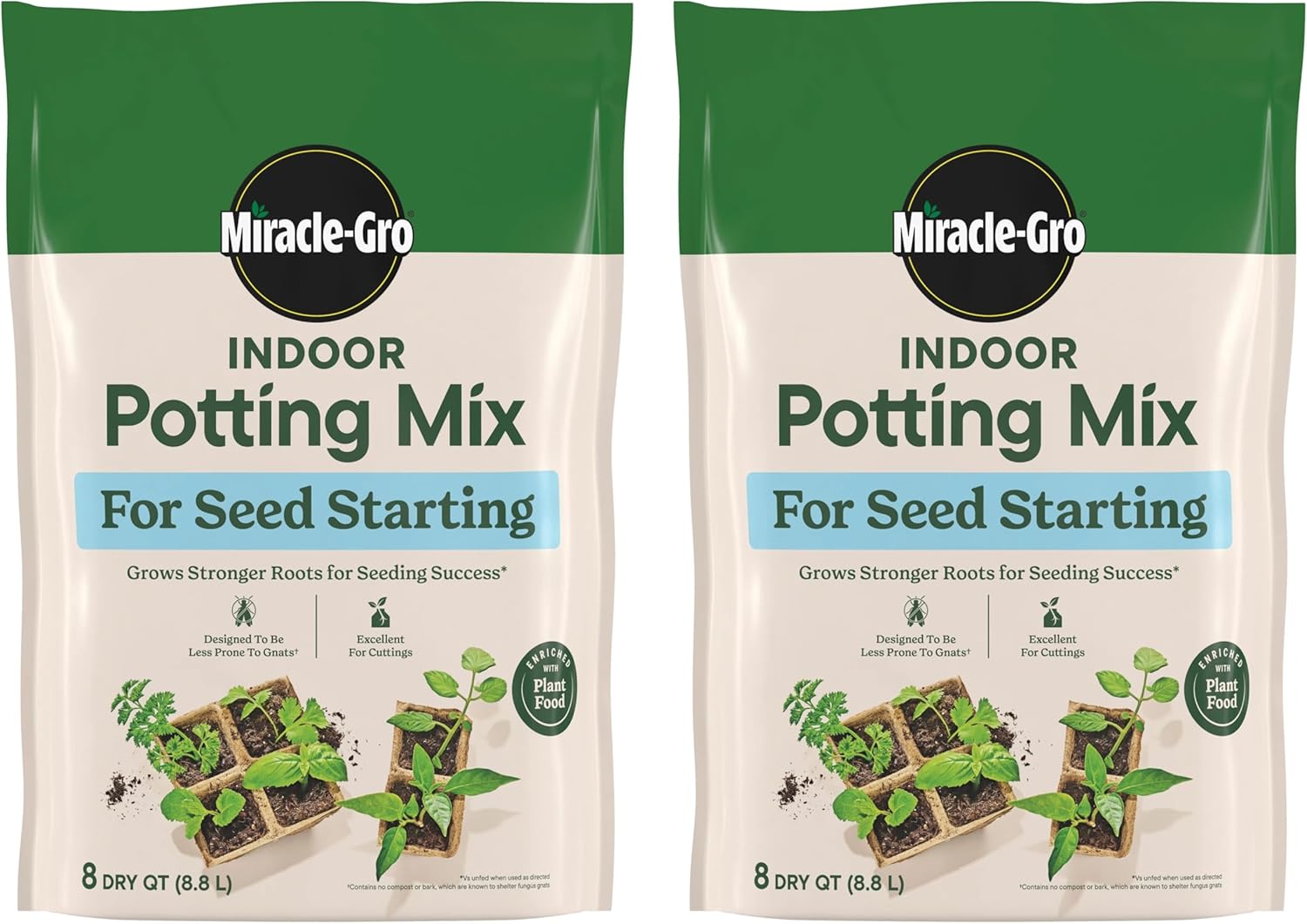
Miracle-Gro Indoor Potting Mix for Seed Starting, 8 qt. (2-Pack)
| Number of Packs | 2 |
|---|---|
| Unit Count | 512 Ounce |
| Item Type Name | Potting Mix |
| Item Highlight | For Starting Vegetable, Flower, and Herb Seeds Indoors |
Miracle-Gro Indoor Potting Mix for Seed Starting is a lightweight, ready-to-use medium designed to give seeds and cuttings a strong start. You use it in cell trays or small containers to germinate vegetable, flower, and herb seeds or to root leaf and stem cuttings; the manufacturer says one 8 qt. bag fills about three 72-cell trays. The mix is enriched with plant food to support early root development and deliberately excludes compost and bark, which reduces the likelihood of fungus gnat problems in indoor setups. That makes it especially convenient for indoor seed flats and crowded propagation benches where disease or pest pressure can be an issue. Practical benefits include consistent texture for even moisture retention and the convenience of a pre-mixed, fed medium so you can sow immediately. Limitations are that it is formulated for starting and propagation rather than for long-term vegetable container soil, so you will want to transplant seedlings into a more substantial potting mix or amend before final planting outdoors.
Best for: Gardeners who want an inexpensive, no-fuss seed-starting mix to get vegetable seedlings and cuttings going indoors and move them to larger pots or beds later.
Less Ideal for: Growers looking for a one-bag solution for mature container vegetables or for amending garden beds should choose a full-strength potting mix or garden soil instead.
- Lightweight, consistent texture that eases seed germination and rooting of cuttings
- Enriched with plant food to support early root development without immediate fertilizing
- Formulated without compost or bark to reduce fungus gnat habitat in seed trays
- Ready-to-use so seeds and cuttings can be planted immediately
- Designed for seed starting and cuttings rather than as a long-term growing medium for mature vegetables
Verdict: A budget-friendly, ready-to-use seed-starting mix that helps vegetable seedlings and cuttings establish strong roots indoors.
FoxFarm Happy Frog Potting Soil, Container Garden, 2 cu ft (with 2 Plant Tags)

| Brand Name | FoxFarm |
|---|---|
| Item Highlight | Amended Container Blend with Soil Microbes, Earthworm Castings, Bat Guano, and Aged Forest Products |
| Unit Count | 600 Ounce |
| Volume | 2 cubic feet |
| Style Name | Container Garden |
FoxFarm Happy Frog Potting Soil is a premixed container blend designed to give potted vegetables and other container crops a nutrient-rich, biologically active growing medium. It is used straight from the bag to fill planters, grow bags, or large pots and contains amendments such as earthworm castings, bat guano, aged forest products, and a custom soil microbe mix to support root development and nutrient uptake. For vegetable growers this means quicker establishment and stronger vegetative growth without needing an immediate extra soil amendment. The mix is pH adjusted for nutrient availability and includes two plant tags to track varieties and planting dates. Practical considerations are that it is sold in a 2 cubic foot bag, so larger vegetable plantings will require multiple bags and handling of heavy bags. Also, while the blend is nutrient-rich at planting, long-season heavy feeders may still need periodic fertilization during the growing cycle. Overall it is a convenient, reliable choice for container vegetable gardeners who want a high-quality starting medium that promotes healthy root growth.
Best for: Vegetable gardeners who grow in containers and prioritize a consistent, biologically active potting mix that promotes reliable establishment and steady growth.
Less Ideal for: Growers planting directly in ground beds or those who prefer to custom-blend their own soil and nutrient program should consider other options.
- Ready-to-use mix formulated specifically for containers, saving prep time
- Contains beneficial amendments (earthworm castings, bat guano, aged forest products) for immediate nutrient availability
- Includes a blend of soil microbes and mycorrhizal-friendly ingredients to improve root efficiency
- pH adjusted to support nutrient uptake and early plant vigor
- Pack size is modest so multiple bags are needed for several large containers or a full season of heavy-feeding vegetables
- Does not replace periodic fertilization for long-season or high-demand vegetable crops
Verdict: A dependable, microbe-rich potting mix that gets container vegetables off to a strong start.
Miracle-Gro Potting Mix, 16 qt. (2-Pack)

| Feeds Plants | Up to 6 months |
|---|---|
| Number of Packs | 2 |
| Volume | 16 quarts |
| Ingredients | Sphagnum Peat Moss, Peat, Perlite, Compost, Fertilizer |
Miracle-Gro Potting Mix is a general-purpose container soil intended for outdoor pots, hanging baskets, and planters used for vegetables, herbs, annuals and perennials. Each bundle contains two 16-quart bags and the mix combines sphagnum peat, perlite, compost and fertilizer so containers drain quickly while supplying nutrients that claim to feed plants for up to six months. In practice this makes potting up seedlings, repotting established plants, or refreshing container soil simple and quick, and it helps reduce how often you need to add fertilizer during a growing season. The fast-draining texture supports root aeration but may dry faster in small or shallow pots, so more frequent watering can be necessary depending on heat and pot material. Ingredients are standard for commercial potting mixes and the product is aimed at convenience and reliable results rather than tailoring nutrient ratios for specific vegetable types, so heavy-feeding crops may still benefit from supplemental feeding or periodic soil replacement for best yields.
Best for: Gardeners who want a convenient, reliable potting mix for outdoor containers and value products with widespread positive feedback and predictable performance.
Less Ideal for: Growers who need a custom nutrient profile for heavy-feeding vegetable varieties or those planning to amend large in-ground garden beds.
- Formulated for containers with perlite for improved drainage and root aeration
- Includes fertilizer that feeds plants for up to six months reducing early-season feeding
- Ready-to-use mix simplifies potting, repotting, and refreshing container soil
- Packaged as two 16-quart bags convenient for multiple pots or a seasonal refresh
- Not formulated for in-ground beds so it should not be used as a direct garden soil replacement
Verdict: A convenient, fast-draining potting mix that reliably feeds outdoor container vegetables and herbs for several months, making seasonal container gardening easier.
Back to the Roots Premium Organic Potting Mix, 6 Quart

| Unit Count | 192 Fluid Ounces |
|---|---|
| Item Highlight | Peat-free potting soil for outdoor plants, indoor plants, vegetables, herbs and flowers |
| Item Type Name | 100% Organic Potting Mix | Premium Blend |
| Manufacturer | Back to the Roots |
| Volume | 6 quarts |
Back to the Roots Premium Organic Potting Mix is an all‑purpose, peat‑free blend aimed at home gardeners growing vegetables, herbs and ornamental plants. The bagged mix combines organic plant food with upcycled plant matter and wood fines, and includes yucca extract to help regulate moisture and dolomitic limestone to moderate pH. For everyday use it works well in containers, raised beds top‑ups and small garden plots where you want a reliable, ready‑to‑use medium without sourcing multiple amendments. Practical advantages include lighter environmental impact from no imported peat and a formulation that supports seed starting through mature plants. Limitations to note are the small 6‑quart volume, which means multiple bags are required for larger beds, and the product is a general potting mix rather than a vegetable‑specific, high‑fertility soil amendment, so heavy‑feeding crops may need extra compost or fertilizer over time.
Best for: Buyers who want an easy, low‑risk organic potting mix for container vegetables, herbs and casual raised‑bed gardening and who prioritize eco‑friendly ingredients and consistency.
Less Ideal for: Gardeners preparing large in‑ground vegetable beds or those growing high‑demand crops who prefer a concentrated, fertilizer‑rich soil amendment.
- Peat‑free organic formula made from upcycled plant matter and wood fines
- Includes yucca extract to improve moisture retention and distribution
- Dolomitic limestone helps buffer pH for a more balanced growing medium
- Ready‑to‑use blend suitable for containers, seed starting and small raised beds
- Small 6‑quart bag requires multiple units for larger vegetable beds
- Not formulated as a heavy‑feeding vegetable amendment so additional fertilizer or compost may be needed
Verdict: A reliable, peat‑free organic potting mix that makes it simple and low risk to start vegetables and herbs in containers or small beds.
Choosing the Right Soil for Growing Vegetables: Key Factors to Consider
Organic Matter and Nutrient Supply
Organic matter is the foundation of productive vegetable soil. It supplies slow-release nutrients, improves cation exchange capacity and supports a stable nutrient pool that plants can access over weeks and months. High organic content also increases water-holding capacity while buffering temperature swings around roots.
For gardeners, organic matter reduces the need for constant feeding and helps heavy-feeding crops like tomatoes, squash and brassicas perform more consistently. Consider how much compost or well-aged manure is already available in your garden and choose a soil that complements that baseline rather than doubling up on one ingredient.
Drainage Versus Water Retention
Vegetables need both moisture and oxygen at the root zone. Soils that hold too much water cause root stress and disease, while soils that drain too quickly force frequent irrigation and can limit nutrient uptake. The ideal vegetable soil balances free-draining channels with fine organic particles that retain plant-available water.
Think about your local rainfall, how often you can water, and whether crops will be in containers or beds. Containers and raised beds dry faster and benefit from mixes with greater water retention, while in-ground plots often need better-percolating soils to avoid waterlogging in wet seasons.
Texture and Tilth for Root Development
Soil texture, meaning the relative proportions of sand, silt and clay plus organic particles, determines how easily roots can grow and explore the soil. A loose, crumbly tilth allows roots to penetrate and access nutrients without mechanical resistance. It also helps seedlings establish quickly and supports consistent aeration.
When evaluating soils, look for a mix that is not too dense or compacted out of the bag and that breaks apart into crumbs when worked. That characteristic indicates the mix will cultivate a friendly root environment without frequent mechanical loosening.
Biological Health and Microbial Support
Healthy vegetable soils host a diversity of microbes that cycle nutrients, suppress pathogens and improve soil structure. Soils containing well-composted organic matter, worm castings or inoculated microbial starters can jump-start biological activity in new beds or containers.
Microbial life matters more than marketing claims. Gardeners should prefer soils with clear compost content or explicit references to biological inputs. Sterilized or inert mixes may be useful in specific situations but usually require more active amendment to sustain vegetable crops over a season.
Suitability for Containers Versus In-Ground Beds
Where you grow vegetables changes the ideal physical properties of the soil. Container mixes need to be lighter, resist compaction, and hold water without becoming waterlogged. In-ground soils benefit from heavier organic content that integrates with existing subsoil but still requires good drainage.
Assess the depth of your containers, the material of raised beds, and how long plants will remain in place. A single soil that performs well both in containers and in beds is convenient, but gardeners with many containers may prefer a purpose-formulated container mix to reduce watering frequency.
pH and Nutrient Balance
Most vegetables prefer a slightly acidic to neutral pH range. Soil pH affects nutrient availability and microbial activity. A balanced soil will either fall in that range naturally or be easy to adjust with lime or sulfur if needed.
Consider whether your garden has known pH issues or whether you plan to grow pH-sensitive crops like blueberries. For typical vegetable plots, choose soils that list neutral starting pH and a baseline nutrient analysis or clear recommendations for starter feeding.
Matching Soil to Your Vegetable Types
Different vegetables stress the soil in different ways. Root crops need loose, stone-free tilth to develop properly, while heavy feeders such as tomatoes and corn demand sustained nutrient release. Leafy greens perform well in soils with higher nitrogen availability and steady moisture.
When planning, divide your garden by crop groups and select soils or amendments that match those groups. A deeper, nutrient-rich mix benefits long-season fruiting crops, while quick-draining, lighter mixes help early spring salad greens that need fast warming and steady moisture.
- Root vegetables: prioritize loose texture and stone-free mixes
- Leafy greens: favor steady moisture and moderate nitrogen
- Fruiting crops: choose sustained nutrient supply and good drainage
Preparing New Beds and Amending Existing Soil
For new beds, start with a base of good-quality topsoil blended with generous compost to establish organic matter and microbial life. Work the blend to a depth that accommodates the crop root depth and incorporate coarse materials where drainage needs improving.
For existing beds, test the soil and add targeted amendments rather than replacing the entire profile. Compost, aged manure and well-mixed leaf mold are effective ways to rebuild structure and nutrient cycling without major excavation.
- Test existing soil pH and basic nutrients before heavy amendment
- Use compost and organic matter to improve structure gradually
- Avoid overworking wet soil to prevent compaction
Container Growing Tips for Vegetables
Containers require a tailored approach because they hold a limited volume of soil that heats and dries faster. Pick mixes designed to retain some moisture while remaining airy. Include a layer of drainage media at the bottom if your container lacks drainage holes.
Plan for more frequent fertilizer inputs since nutrients leach faster from container mixes. Choose slow-release or liquid feeding schedules depending on crop and season to maintain steady growth without salt build-up.
- Use containers with drainage and breathable mixes
- Top-dress or feed regularly to replace leached nutrients
- Select crop-appropriate container sizes for root development
Seasonal Management: Winter and Summer Considerations
Soil behavior changes with the season. In summer, higher temperatures increase evaporation and plant demand, so soils with higher water-holding capacity and mulching strategies help reduce irrigation frequency. In winter, cold soils slow microbial activity and nutrient turnover, so plan fall additions to compost rather than heavy late-season fertilizer.
Mulch and cover crops can stabilize moisture and feed soil biology between seasons. Choose winter cover crops that match your climate and till them in or cut them down before planting in spring to provide a flush of organic matter.
- Mulch to conserve moisture and moderate temperature
- Plant cover crops to rebuild organic matter over winter
- Adjust feeding schedules for slower winter microbial activity
Testing and Monitoring Soil Performance
A simple soil test for pH and major nutrients gives actionable data and prevents unnecessary amendments. Monitor how soils perform during the season: watch for signs of poor drainage, compaction, nutrient deficiency and salt accumulation in containers.
Keep records of what you add each season and the crop responses. Over time you will refine your soil choices and amendment schedule for stronger yields and healthier plants.
- Conduct pH and nutrient tests every 2 to 3 years
- Observe plant symptoms to spot deficiencies early
- Document amendments and outcomes to guide future choices
How We Chose the Best Soil for Growing Vegetables
We prioritized attributes that have direct, repeatable effects on vegetable growth in real gardens. The selection process began with mixes and soils intended for edible planting, then filtered out blends formulated for ornamental bedding or single-use amendments. Each candidate was assessed on measurable, gardener-relevant dimensions: organic matter and nutrient profile, water retention versus drainage balance, texture and tilth for root penetration, biological health and microbial activity potential, and suitability for container versus in-ground use. We also considered ease of amendment and longevity in a season when determining practical usefulness. Exclusions included soils with ingredients not suitable for edible gardens, professional-only blends unsuitable for home gardeners, and products lacking clear ingredient or composition information. The final list favors soils that give clear starting performance in vegetable production while remaining adaptable to seasonal feeding and amendment.
FAQ
Can I use garden soil in containers for vegetables?
Garden soil can be used in containers but it often compacts and drains poorly. Mixing garden soil with compost and coarse material or using a purpose-formulated container mix improves aeration and water management.
How often should I amend vegetable beds with compost?
Adding a thin layer of compost once or twice a year is usually sufficient for maintenance. Heavily cropped beds may benefit from a more generous annual top-dressing in spring or fall to rebuild organic matter.
What pH is best for most vegetable gardens?
Most vegetables prefer a slightly acidic to neutral pH, roughly 6.0 to 7.0. Testing your soil will show whether adjustments are needed and which amendments to use to shift pH gradually.
How can I improve drainage in a heavy or clay soil?
Incorporate coarse organic matter such as compost and aged bark, and create raised beds where possible to improve drainage. Avoid working clay soil when it is wet to prevent compaction, and consider deep double-digging only when necessary.
Do I need to fertilize soils labeled for vegetables?
Many soils formulated for vegetables contain starter nutrients but still need follow-up feeding during the growing season. The timing and type of fertilizer depends on crop needs and whether nutrients are being leached by irrigation or heavy rainfall.
Final Verdict
Prioritize soils that balance organic matter and drainage for dependable vegetable production. Think about where you will plant-containers versus in-ground beds-and choose a mix that matches the water and root-space demands of your crops. Focus on soil texture, biological support and moisture behavior rather than marketing claims. With the right soil and a plan for seasonal amendments, you will set the foundation for healthier plants and larger harvests.
