

Note: This article contains affiliate links. If you click on these links and make a purchase, I may earn a small commission at no extra cost to you. This helps support my research and content. Read my full affiliate disclosure here.
Getting the right soil for soil blocking makes the difference between fragile seedlings and strong transplants. Soil-blocking relies on a mix that packs firmly, retains enough moisture to bind the block, and still drains so roots can breathe. The mixes shortlisted here represent the top options gardeners use for small-scale seed starting and greenhouse propagation. This guide explains why the right texture and moisture balance matter, summarizes the evaluation criteria used to pick these top mixes, and points out the practical tradeoffs you should weigh when choosing a soil for soil blocking.
Top Picks at a Glance
| Best Overall The best all-around choice for most situations | Vermont Compost Company Fort Vee Organic Potting Mix (20 qt) |  |
| Best Quality Built to a higher standard if you want something more solid | FoxFarm Ocean Forest Potting Soil, 12 Quart |  |
| Best Value The sweet spot between price and what you get | Legigo Coco Coir Pellets Seed Starter — 50 Pack |  |
| Best Budget The cheapest option that still gets the job done reliably | Back to the Roots Organic Seed Starting Mix — Expanding 12 Quart Block |  |
| Highest Rated A top-rated pick with lots of positive feedback | Vermont Compost Company Fort Vee Organic Potting Soil Mix, 40 Quart (2 Pack) |  |
| Most Popular A crowd favorite that many people choose with confidence | Back to the Roots Organic Expanding Coco Coir Potting Soil Brick (10 lb) |  |
| Best Seller A high-volume bestseller chosen again and again | Miracle-Gro Indoor Potting Mix for Seed Starting, 8 qt. (2-Pack) |  |
Vermont Compost Company Fort Vee Organic Potting Mix (20 qt)

| Brand Name | Vermont Compost Company |
|---|---|
| Unit Count | 640 Fluid Ounces |
| Model Number | Fort Vee 45 Qt |
| Style Name | Garden,Peat Moss,Potting,Potting Soil Mix,Soil Mix,Vermiculite |
| Volume | 20 quarts |
Fort Vee is a living, compost-based potting mix designed specifically for seed starting and soil blocking as well as potting up trays and plugs. It combines composted manure and plant materials with peat moss, vermiculite, screened rock, and nutrient amendments like blood meal, bone meal and kelp to give transplants sustained nutrition and good texture. In practice the mix holds its shape well in soil blocks and withstands repeated waterings without collapsing, which makes it convenient for growers who use blocks or small cells. The nutrient-rich formula suits heavier-feeding seedlings such as tomatoes and peppers and reduces the need for early fertilizing. Important limitations are that it is a concentrated, organic mix intended for starting and potting rather than long-term in-ground use, and users should handle it with care to avoid inhaling dust and wash hands after use.
Best for: Gardeners who want an all-purpose organic starting mix that reliably forms soil blocks and supports nutrient-hungry seedlings for indoor or outdoor transplanting.
Less Ideal for: People looking for a finished garden topsoil or a low-nutrient mix for plants that require very lean conditions should choose a different product.
- Compost-based formula provides sustained nutrition for seedlings and transplants
- Holds shape well for soil blocks and repeats watering without collapsing
- Includes water-retaining vermiculite and coconut coir for consistent moisture
- Contains organic amendments (blood meal, bone meal, kelp) to support heavy feeders
- Formulated for starting and potting rather than long-term bed soil
- Contains dusty components that require caution to avoid inhalation
Verdict: Choose Fort Vee when you need an organic, nutrient-rich mix that reliably holds its shape for soil blocking and produces vigorous transplants.
FoxFarm Ocean Forest Potting Soil, 12 Quart

| Item Form | Granules |
|---|---|
| Specific Uses For Product | Dry Fertilizer |
| Coverage | 4.8 sq ft |
| Mixing Ratio | 1:1 |
FoxFarm Ocean Forest is a pre-mixed potting soil that combines aged forest products, sandy loam and sphagnum peat moss with organic amendments like fish meal, crab meal and earthworm castings. It is sold ready to use straight from the bag for planting in containers, seed starting or top dressing; the manufacturer recommends no additional nitrogen fertilizer for the first 30 days. The mix has a light, aerated texture that promotes drainage while still retaining moisture, and the built-in micronutrients make it practical for growers who want strong early growth without immediate feeding. Practical benefits include easy pot filling, good root zone aeration for roses in containers, and built-in organic fertility to support blooms. Limitations to consider are that the bag is best for containers or small beds only and heavier feeders may need supplemental feeding after the initial month; users should also follow handling precautions to avoid skin or eye irritation.
Best for: Gardeners who want a high-quality, nutrient-rich potting medium to get container roses or plant starts off to a strong, flowering start and prefer a ready-made organic blend.
Less Ideal for: Large in-ground rose beds or landscapers needing bulk soil amendments should look for bulk garden soil or custom rose mixes instead.
- Ready-to-use out of the bag so you can pot immediately
- Organic amendments (fish meal, crab meal, earthworm castings) supply early nutrients
- Light, aerated texture that supports drainage and root development
- pH adjusted for optimal nutrient uptake per product description
- Pack size (12 qt) covers a small area and may require multiple bags for several roses
- No long-term feeding provided after the first 30 days so additional fertilizer is needed for sustained heavy bloom
Verdict: Choose this soil if you want a ready-made, organically amended potting mix that jump-starts container roses and seedlings with good drainage and early fertility.
Legigo Coco Coir Pellets Seed Starter — 50 Pack

| Material | Coconut Coir |
|---|---|
| Quantity | 50 pcs |
| Item Type Name | Garden Soil |
| Style Name | Coco Coir,Potting |
These Legigo coco coir pellets are compressed discs that swell into a loose, airy planting medium when soaked, making them convenient for starting seeds and propagating cuttings. Typical use is simple: drop individual pellets into a tray or small container, add water to expand, shape the surface, and plant seeds; when seedlings are ready you can transplant the whole pellet into a larger pot with minimal root disturbance. Notable features include neutral pH and low electrical conductivity which suit a wide range of plants, natural nutrients like potassium and magnesium, and good water retention combined with aeration to encourage stronger root development. The pellets are compact for storage and expand quickly so you only hydrate what you need. Limitations are that they are a single-component medium so heavier feeding or mixing with perlite or compost may be needed for long-term potting, and exact water amounts can require a little trial to avoid overly wet or dry pellets.
Best for: Gardeners who value efficient, space-saving seed starting and want a predictable, low-mess medium for propagating seedlings and cuttings.
Less Ideal for: Growers who need a ready-to-use, nutrient-rich potting mix for mature plants or who prefer all-in-one soils that do not require later amendments.
- Compresses small for easy storage and expands quickly when watered
- Neutral pH and low EC make it safe for most seedlings and cuttings
- Light, airy texture promotes root aeration while retaining moisture
- Can be planted directly into final containers to minimize root disturbance
- Single-component medium with limited nutrients for long-term growth
- Requires occasional mixing with amendments for improved drainage or fertility
Verdict: A compact, low-mess seed-starting medium that expands on demand and simplifies germination and transplanting for efficient soil blocking workflows.
Back to the Roots Organic Seed Starting Mix — Expanding 12 Quart Block

| Volume | 12 quarts |
|---|---|
| Item Type Name | Seed Starting Mix |
| Unit Count | 384 Fluid Ounces |
| OMRI Listed | Yes |
| Peat Free | Yes |
This compressed seed starting mix is a coir-based block that expands to 12 quarts of loose, ready-to-use seedling soil after adding water. It is designed for starting seeds, potting up seedlings, and amending small pots for herbs, vegetables, and flowers. Notable features include an OMRI-listed organic formulation, balanced pH and low electrical conductivity to support nutrient uptake, and compact storage compared with bulky soil bags. In practice the block is easy to hydrate and fluffs up quickly, producing a light, airy medium with good water retention and aeration for root development. The convenience of a single expanding block and beginner-friendly handling makes it a reliable choice for cautious gardeners who want predictable results without mixing multiple ingredients. Limitations are that it is a single-purpose starter mix rather than an all-in-one fertilized potting soil and larger projects will need multiple blocks, so plan quantities ahead.
Best for: Practical gardeners who want a reliable, easy-to-use organic starter medium for small-scale seed trays, pots, and indoor seedlings and who prioritize predictable, low-fuss results.
Less Ideal for: Gardeners needing a ready-to-use, fertilized all-purpose potting soil for large container gardens or immediate long-term container plantings should consider an enriched potting mix instead.
- Expands to 12 quarts from a compact compressed block for easy storage and transport
- OMRI-listed organic and peat-free formulation suitable for organic growing
- Neutral pH and low electrical conductivity support seedling nutrient uptake
- Light, fluffy texture promotes good aeration and root development
- Simple to hydrate and use, friendly for beginners and low-effort setups
- Sold as a bare starting mix without added fertilizer for later stages
- Single block size requires purchasing multiple units for larger seed batches
Verdict: A compact, OMRI-listed organic seed starter that reliably expands into a light, neutral-pH medium for predictable, beginner-friendly seed starting.
Vermont Compost Company Fort Vee Organic Potting Soil Mix, 40 Quart (2 Pack)

| Brand | Vermont Compost Company |
|---|---|
| Volume | 40 quarts |
| Style Name | Garden,Peat Moss,Potting,Potting Soil Mix,Soil Mix,Vermiculite |
| Unit Count | 1280 Ounce |
This Fort Vee organic potting soil is a compost-heavy mix designed for seed starting, transplants, and container vegetables that need a nutrient boost. It is intended for indoor and outdoor use in trays, soil blocks, and pots and is blended from composted manure and plant materials with sphagnum peat moss, vermiculite, coconut coir, and mineral amendments to improve structure and nutrients. In practice the mix holds its form well for transplanting and gives heavy-feeding crops like tomatoes and peppers a strong start thanks to added blood meal, kelp meal, and bone meal. It is easy to use straight from the bag with no extra amendments required for short-term container growth, and the composition should help with moisture retention while still draining better than plain compost. Important limitations are typical of rich mixes: it is a starter or container medium rather than a final garden topsoil, and the nutrient level may require adjustment or dilution before long-term use in beds or for very young seedlings sensitive to strong fertilizer salts.
Best for: Gardeners who want a reliable, ready-made organic potting mix to start and grow nutrient-hungry vegetables in containers or for transplanting to the garden.
Less Ideal for: People seeking a low-nutrient seed-starting medium for delicate micro-seedlings or gardeners who need bulk topsoil for bed building rather than a concentrated potting mix.
- Compost-based formula supplies organic nutrients useful for heavy-feeding vegetables
- Includes moisture-holding and aeration components like vermiculite and coconut coir
- Pre-mixed with mineral and biological amendments (bone meal, blood meal, kelp) for immediate plant support
- Designed to hold form for soil blocks, trays, and pots which eases transplanting
- High nutrient content makes it stronger than basic seed mixes and may be too rich for very small seedlings
- Formulated as a potting/starting mix rather than a finished garden soil for permanent beds
Verdict: A dependable, nutrient-rich organic potting mix that gives tomato seedlings and other heavy feeders a strong, ready-to-use start in containers.
Back to the Roots Organic Expanding Coco Coir Potting Soil Brick (10 lb)

| Item Highlight | 10 lb compressed coco coir brick; peat-free; OMRI Listed |
|---|---|
| Item Type Name | Coconut Coir |
| Volume | 2 cubic feet |
| Ingredients | Coconut Coir |
| Style Name | Expanding Potting Soil |
This compressed coco coir brick provides a lightweight, peat-free potting medium that expands when you add water to create loose, airy substrate for containers and seed flats. It is typically used by hydrating the 10 lb block to about 2 cubic feet of coir and then using it alone for potted plants, mixing it into garden soil to improve drainage and aeration, or blending with compost for starting seeds. Notable features include OMRI listing for organic use, a balanced pH suited to a wide range of plants, and compact storage before expansion which saves space. Practical benefits are improved root aeration and water retention compared with heavy garden loam, easier handling than bulky bags, and versatility across vegetables, herbs, and ornamentals. Important limitations are that coco coir is a soilless substrate and does not supply significant nutrients on its own so you will need to add fertilizer or compost for long-term potted herbs like rosemary, and the product requires time and a water source to expand before use.
Best for: Buyers who prioritize low-risk, easy-to-handle, organic potting media and want a versatile base for container herbs and seed starting without dealing with heavy bags.
Less Ideal for: Gardeners who want a ready-to-plant, nutrient-rich potting mix out of the box or those who prefer soil with built-in slow-release fertilizer.
- Peat-free OMRI listed organic coco coir suitable for organic growing
- Expands from a compact brick to about 2 cubic feet for easy storage and transport
- pH balanced and airy texture that improves drainage and root aeration
- Versatile use: can be used alone, for seed starting, or mixed into existing soil
- Provides little inherent fertility so supplemental feeding or compost is needed for nutrient-hungry plants
Verdict: A compact, peat-free coco coir brick that expands into an airy, pH-balanced base ideal for low-risk organic container gardening and seed starting when paired with fertilizer or compost.
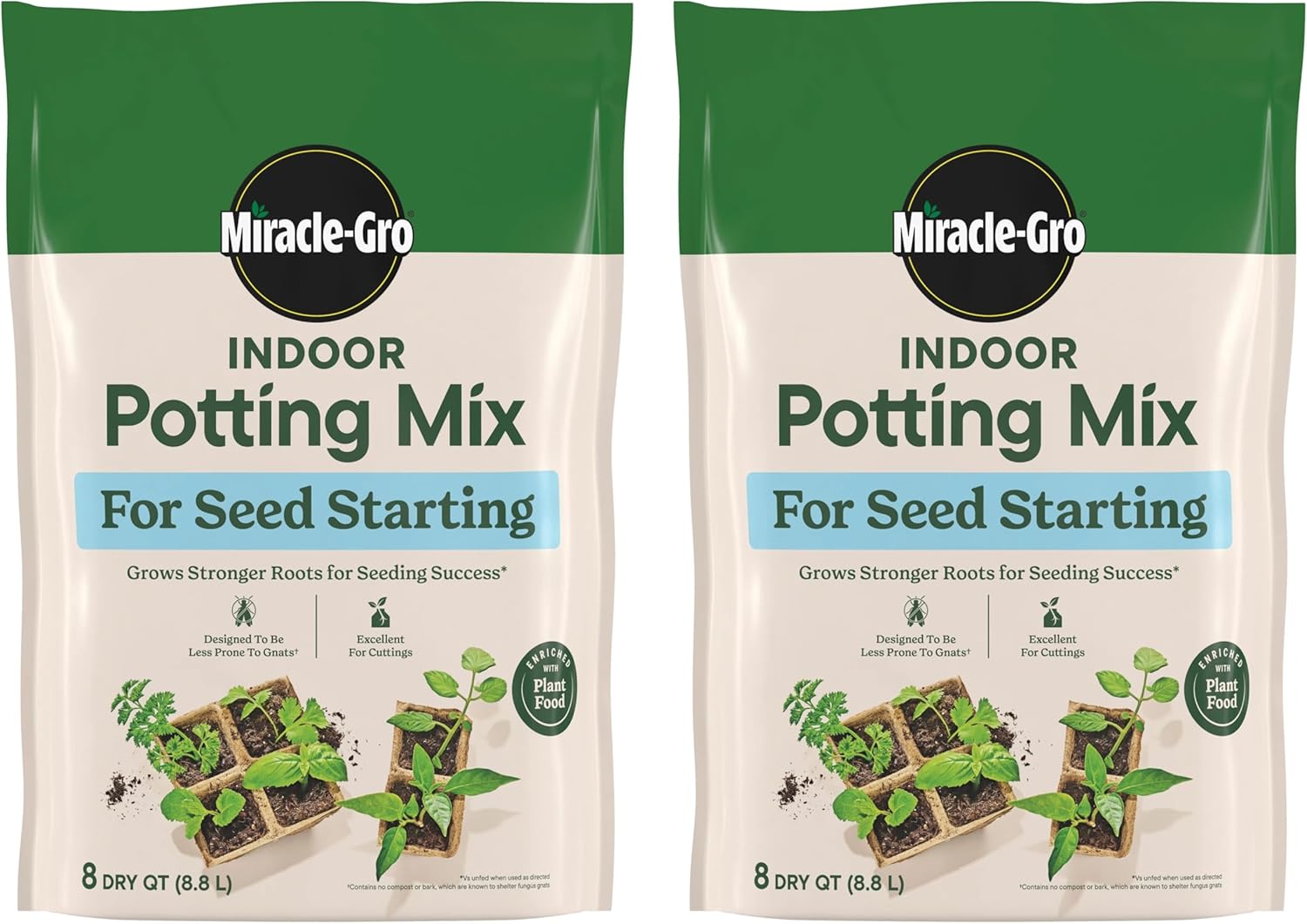
Miracle-Gro Indoor Potting Mix for Seed Starting, 8 qt. (2-Pack)
| Brand Name | Miracle-Gro |
|---|---|
| Item Type Name | Potting Mix |
| Number of Packs | 2 |
| Volume | 8 quarts |
This two-pack of Miracle-Gro Indoor Potting Mix is designed specifically for starting seeds and rooting cuttings indoors. The blend is lightweight and pre-enriched with plant food so seedlings get a nutrient boost during early root development, and the manufacturer says it yields stronger roots compared with unfed mixes when used as directed. It is intended for vegetables, flowers, and herbs and works well in cell trays and small containers; one 8 qt. bag will fill roughly three 72-cell trays. Notably, the formula omits compost and bark, which helps lower the chance of fungus gnat infestations in damp seed-starting setups. Use it by filling trays or pots, keeping the mix evenly moist, and shielding newly sown seeds from direct sun until germination. Important limitations are standard for enriched mixes: it contains fertilizer (so handle carefully) and it is a seed-starting medium rather than an all-purpose potting soil for mature plants, so you will likely transplant seedlings into a different mix or amend soil later.
Best for: Buyers who want a low-effort, indoor seed-starting medium that supports faster root development and reduces common pest risks while following proven seed-starting practices.
Less Ideal for: Gardeners who need a permanent potting soil for mature container plants or who prefer fully organic, compost-rich mixes should consider alternatives.
- Lightweight, ready-to-use formula tailored for seed germination and cuttings
- Pre-enriched with plant food to support early root and seedling growth
- Excludes compost and bark to reduce habitat for fungus gnats
- Comes as a two-pack so you have enough mix for multiple trays
- Contains fertilizer which requires careful handling and storage
- Intended for seed starting so not formulated as long-term potting soil for mature plants
Verdict: A practical, low-risk seed-starting mix that boosts early root growth and reduces fungus gnat risk, making it a reliable choice for indoor vegetable seedlings.
Choosing the Right Soil for Soil Blocking: Key Factors to Consider
Particle Texture and Cohesion
Particle size and the mix of fines to larger components determine whether a block forms cleanly and resists crumbling. A higher proportion of fine peat or coco coir helps particles bind, while some coarse component gives internal structure. If the texture is too coarse the block will fall apart when lifted; if it is too fine the block may compact excessively and restrict root air pockets.
When choosing a soil for soil blocking, look for descriptions of particle distribution or components that gardeners report pack well. You will often need to adjust moisture slightly depending on humidity and how tightly you press the blocker into the mix.
Moisture Retention Versus Drainage
Soil blocks must hold enough moisture to stay intact between waterings but also shed excess water so roots do not become waterlogged. Materials like peat moss and coco coir retain moisture and help cohesion, while perlite or fine grit improve drainage and aeration. The ideal balance depends on your watering cadence, container environment, and whether you use bottom heat or a greenhouse.
Too-retentive mixes increase the risk of damping-off diseases and root rot. Too-draining mixes collapse sooner and require more frequent watering. Consider your routine and environmental control when selecting a mix.
Disease Resistance and Sanitation
Seed-starting is vulnerable to fungal diseases and soil-borne pathogens. Sterile or pasteurized base materials reduce initial pathogen load. Some mixes include components that suppress disease or have been processed to remove weed seeds. Clean handling, fresh trays, and avoiding standing water are equally important.
When sourcing soil for soil blocking, prioritize mixes with a reputation for cleanliness or that explicitly state they are intended for seed starting. Avoid recycled outdoor soils or bagged garden soils unless they are specified as sterilized for propagation.
Nutrient Level and Starter Fertility
Soil blocks usually need only light fertility because seedlings are small; too much initial fertilizer can burn young roots. Some gardeners prefer a low-fertility base so they can add controlled feedings later, while others want a lightly amended mix to reduce early fertilization steps. Check whether a mix is labeled for seed starting or contains starter charge nutrients.
Consider whether you plan to transplant quickly or grow seedlings longer in blocks. Longer-term growth benefits from more reserve fertility, while short-term germination favors a cleaner, minimal-nutrient medium.
Workability and Dust Control
How easy a mix is to handle affects your setup and cleanliness. Dusty mixes create a mess and can be irritating when filling multiple trays. A mix that becomes muddy when wet signals poor drainage or excess fines. Workability also covers how readily the mix compacts in the blocker and releases from the tool without sticking.
If you work indoors or in a small greenhouse, choose mixes noted for low dust and predictable compaction. Some gardeners dampen mixes and sieve them to improve consistency before blocking.
Adjusting Mixes for Different Seeds
Different seeds have different moisture and rooting habits. Fine-seeded crops like lettuce and herbs germinate best in a lighter, more moisture-retentive surface layer while larger, taproot-prone plants need a mix with better aeration for deeper root penetration. You can tailor a base soil for soil blocking by adding small amounts of perlite for aeration or a bit more coco coir for water-holding capacity.
Experiment in small batches: make two or three test blocks, sow a few seeds, and monitor how long the blocks stay intact and how the seedlings respond. That quick trial helps you dial in the exact moisture and amendment proportions for the particular crop and environment.
- Increase perlite for carrot and brassica seedlings to improve drainage.
- Add a pinch more coir or peat for tiny-seeded crops to help blocks hold moisture.
- Avoid large bark chips that prevent tight compaction.
Preparing and Moistening Mix for Blocking
Preparing the mix correctly is as important as the actual components. Mix should be evenly damp, not waterlogged. A good test is to squeeze a handful: it should hold shape briefly and crumble when prodded. If water beads, it is too wet; if it powders, it needs more moisture.
Work in small batches and keep the unused mix covered so it does not dry out. When filling the blocker, press firmly and release smoothly to form a clean block. Practice with a few blocks to find the right tamping force for your chosen mix.
- Use warm water if working in a cool space to improve compaction.
- Sieve out oversized pieces to avoid air gaps.
- Store pre-moistened mix in a sealed container to maintain consistency.
Watering and Transplant Timing for Blocks
Watering technique affects block integrity and seedling health. Use a fine spray to wet the surface without eroding the block. Bottom watering can be effective once roots begin to fill the block, but avoid prolonged soaking that can break blocks apart.
Transplant when roots hold the block together and have produced a healthy white root mass at the block edges. For many crops, that is one to three true leaves after germination. If you keep plants longer in blocks, ensure the mix has enough nutrients or plan to start feeding.
- Mist daily if your environment is dry until seedlings establish.
- Reduce handling until roots stabilize the block to prevent collapse.
- Harden seedlings gradually before moving outdoors to reduce transplant shock.
Common Troubleshooting Tips
If blocks crumble when lifted, the mix is either too dry or lacks fine material for cohesion. Rehydrate the mix and add a small amount of finer-textured component next time. If blocks stay soggy, increase coarse elements or improve drainage in your tray setup.
Damping-off shows as sudden collapse of seedlings. Improve air circulation, avoid overwatering, and use a cleaner base medium. Replace old seed-starting mix rather than reusing it repeatedly, and sanitize trays between uses.
- Adjust moisture incrementally; large swings cause inconsistent results.
- Run small germination tests before a big sowing.
- Keep an eye on humidity and ventilation to prevent fungal issues.
How We Chose the Best Soil for Soil Blocking
We focused on attributes that directly affect seed-starting success with soil blocks. Key evaluation criteria included particle texture and cohesion, which determine how well a mix forms and holds a clean-edged block; moisture retention versus drainage balance, to keep blocks intact without waterlogging; nutrient content and starter fertility, because some gardeners prefer a lightly amended medium while others want a bare, controllable base; pH stability and disease-suppression factors, including inert components and any known pathogen risks; and handling characteristics, such as dust levels and how easy the mix is to compact in a blocker. We excluded mixes formulated primarily for in-ground beds, potting soil with heavy bark chunks, and any media clearly designed only for long-term container culture rather than seed starting. Products were filtered for suitability with hand and mechanical soil blockers and for consistency across small batches. The criteria above reflect what gardeners actually need to form, water, and plant from soil blocks reliably.
FAQ
Can I use regular garden soil for soil blocking?
Usually garden soil is too heavy and variable for reliable soil blocks. It often contains large particles, weed seeds, and microbes that can cause disease. A seed-starting mix or a specifically prepared blend gives more predictable cohesion and sanitation.
How wet should soil be when forming blocks?
The mix should be evenly damp but not dripping. It should hold together when squeezed and crumble when prodded. If water beads or runs, it is too wet; if it powderizes, add small amounts of water and mix thoroughly.
Do I need to add fertilizer to soil for soil blocking?
It depends on how long you intend to keep seedlings in blocks. Short-term germination often requires minimal nutrients, while longer growth benefits from a light starter nutrient charge or scheduled feedings after the first true leaves develop.
How can I reduce disease risk when using soil blocks?
Start with clean, seed-starting-grade media or pasteurized components, sanitize flats and tools, avoid overwatering, and provide good air circulation. Replace mix periodically rather than reusing it indefinitely.
Will soil blocked seedlings need different transplant care?
Transplant care is similar but handle blocks gently to avoid breakage. Plant the entire block into the new medium, matching moisture levels to reduce shock, and ensure the root ball has adequate contact with surrounding soil for quick root spread.
Final Verdict
Choose a soil for soil blocking by prioritizing particle texture and the moisture-drainage balance that fits your environment and watering routine. Think about disease resistance and whether you want a low-fertility base or a lightly amended starter mix depending on how long seedlings stay in blocks. Accept tradeoffs: mixes that hold extremely well may need more deliberate watering, while looser mixes dry faster and require more frequent attention. Focus on handling characteristics and sanitation to reduce failures, and run small tests to confirm a mix works with your seeds and setup before committing to a large batch.
