

Note: This article contains affiliate links. If you click on these links and make a purchase, I may earn a small commission at no extra cost to you. This helps support my research and content. Read my full affiliate disclosure here.
Picking the right soil moisture meter matters for healthy indoor plants because small changes in watering can mean the difference between lush growth and root rot. A good meter helps you water by need rather than schedule, which is especially useful for mixed collections, seasonal changes, or busy households. This guide covers seven shortlisted soil moisture meters for houseplants selected for common indoor situations. We evaluate each on accuracy, ease of use, probe design, and durability so you can match a meter to your plant mix and pot types. Read on to see which meters best fit your watering style and home setup.
Top Picks at a Glance
| Best Overall The best all-around choice for most situations | XLUX 2-Pack Long Probe Soil Moisture Meter (Battery-Free) |  |
| Best Quality Built to a higher standard if you want something more solid | Vegetronix Professional Digital Soil Moisture Meter with Dielectric Probe |  |
| Best Value The sweet spot between price and what you get | Hathdia 3-in-1 Soil Moisture Meter (Single Probe) |  |
| Best Budget The cheapest option that still gets the job done reliably | Censinda Soil Moisture Meter (single probe, no battery) |  |
| Highest Rated A top-rated pick with lots of positive feedback | Aenncci 2-in-1 Soil Test Kit — Soil Moisture and pH Meter |  |
| Most Popular A crowd favorite that many people choose with confidence | XLUX T10 Plant Soil Moisture Meter (Battery-Free) |  |
| Best Seller A high-volume bestseller chosen again and again | XLUX T10 Soil Moisture Meter (2-Pack) |  |
XLUX 2-Pack Long Probe Soil Moisture Meter (Battery-Free)

| Item Weight | 0.32 ounces |
|---|---|
| Manufacturer | Fangtan Co., Ltd |
| ASIN | B09PBGLM3N |
This two-pack of XLUX soil moisture meters is a straightforward tool for checking moisture in houseplant pots and deeper garden containers. Each meter uses a long single probe to reach further into soil without digging up roots, and the large analog dial shows one of ten moisture levels instantly when inserted. Because it is battery-free it is low maintenance and ready to use out of the box, and the simple plug-and-read design makes it easy to spot over- or under-watering. Practical benefits include using the longer probe to test moisture near root zones in taller pots and avoiding frequent calibration or power concerns. Limitations are the analog readout, which gives broad moisture bands rather than precise percentages, and the single metal probe can corrode over time if not cleaned and stored dry. This is a no-frills, budget-friendly tester best used as a quick check alongside observation and watering habits rather than a laboratory-grade instrument.
Best for: Houseplant owners who want a quick, low-maintenance tool to check moisture in deeper pots and make better watering decisions without fuss.
Less Ideal for: People who need highly precise digital readings or continuous logging for research or professional horticulture.
- Long 5.5-inch probe reaches deeper soil and root zones in taller pots
- Battery-free analog design requires no power or calibration
- Large, easy-to-read dial with ten moisture levels for quick checks
- Two meters in the pack let you test multiple plants without moving devices
- Analog scale gives broad bands rather than precise moisture percentages
- Single metal probe needs drying and cleaning to avoid corrosion over time
Verdict: A simple, battery-free long-probe moisture meter that gives fast, easy-to-read checks for houseplants in deeper pots.
Vegetronix Professional Digital Soil Moisture Meter with Dielectric Probe
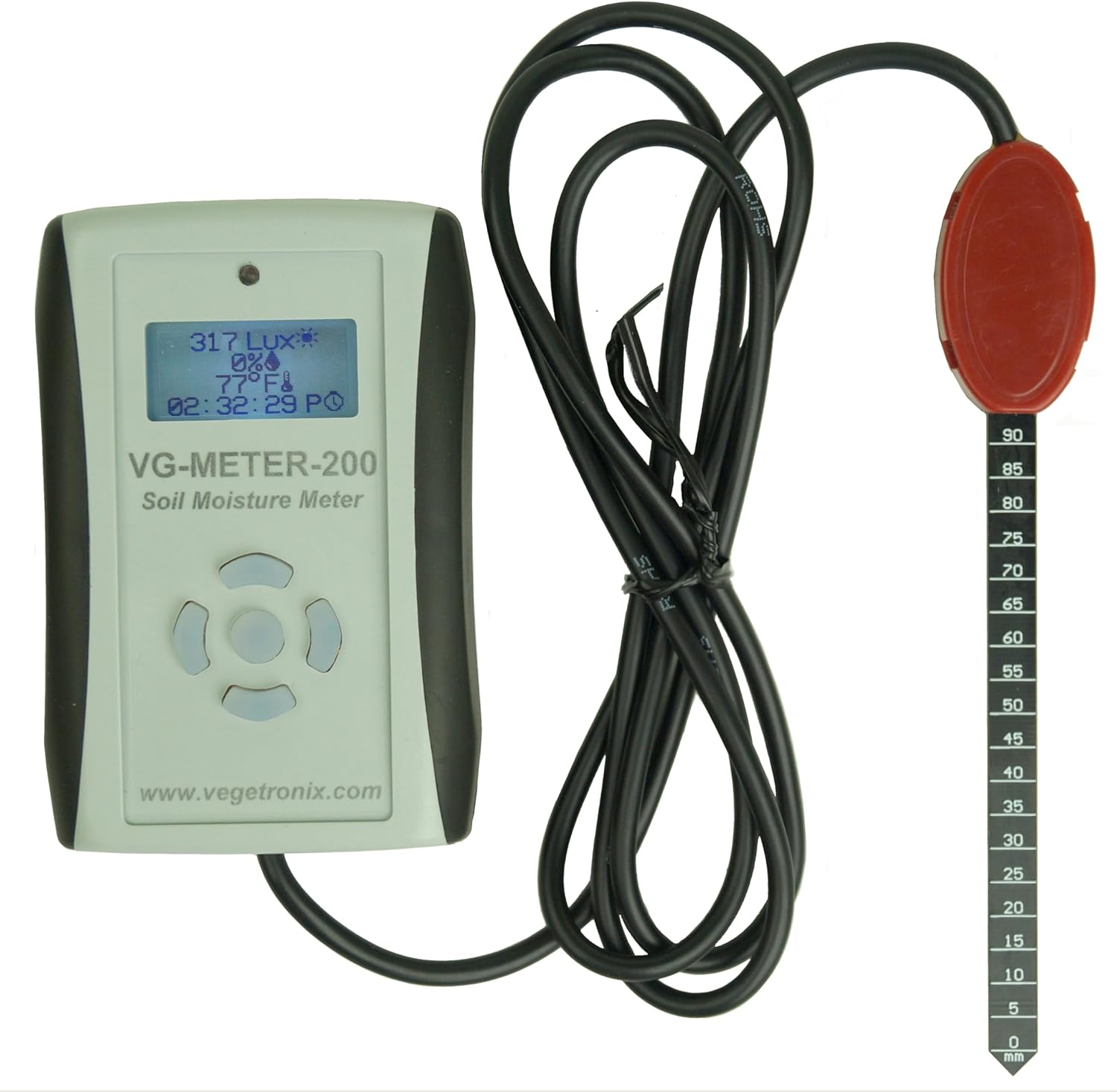
| Range | 0 to 100% VWC |
|---|---|
| Probe length | 4 inches |
| Cable length | 4 ft (1.2 meter) |
| Power | 2 AA batteries |
| Additional sensors | Ambient temperature and light (lux) |
This handheld meter measures soil volumetric water content (0 to 100% VWC) with a dielectric probe that is insensitive to salts and will not corrode, making it more reliable than cheap galvanic probes for precise readings. The slender nonmetal probe and 4 foot cable let you sample pots without disturbing roots and read the backlit graphical display from standing height. In practice it works well for indoor houseplants where repeatable, salt-resistant moisture measurements matter; the unit also reports ambient temperature and light (lux), which helps correlate watering with environmental conditions. The rugged rubberized case, long battery life on two AA cells, and included carrying bag make it convenient for frequent use. Important limitations are that the probe is single-point so you must sample multiple locations for larger or mixed-media pots, and it does not provide automated logging or wireless connectivity, so you record readings manually.
Best for: Houseplant owners who want precise, repeatable moisture readings and care about accurate VWC measurements unaffected by salts or fertilizers.
Less Ideal for: If you need continuous monitoring, automated logging, or multi-sensor coverage for large containers or garden beds, a connected sensor system would be a better choice.
- Dielectric nonmetal probe gives accurate VWC readings and is insensitive to soil salts and pH
- Probe will not corrode and has a slim footprint that minimizes root disturbance
- Backlit graphical display shows moisture, temperature and light for quick, clear readings
- 4 foot probe cable lets you insert the probe and read the meter without stooping
- Rugged rubberized case and optimized battery life make it durable for regular use
- Single-point probe requires multiple samples for larger pots or heterogeneous soils
- No data logging or wireless output for tracking readings over time
Verdict: Choose this meter when you want professional, salt-insensitive VWC readings and a durable handheld tool for precise houseplant watering decisions.
Hathdia 3-in-1 Soil Moisture Meter (Single Probe)

| Brand Name | Hathdia |
|---|---|
| Function | Moisture |
| Probe Length | 7.6 inches |
| Applications | Indoor and outdoor |
| Number of Items | 1 |
This Hathdia single-probe soil moisture meter is a basic analog hygrometer designed to tell you when to water plants. You push the 7.6-inch probe into potting mix or garden soil to the root zone and the dial pointer shows a moisture level instantly, so it is useful for houseplants, larger pots, and quick spot checks outdoors. Its main selling points are its simplicity and no-battery operation, which make it very portable and always ready to use. The probe sensitivity gives fast feedback and the compact, lightweight body is easy to move between containers. Limitations are the single fixed probe and analog dial, which provide qualitative readings rather than precise numerical moisture percentages and are not suited for continuous monitoring. The meter is intended for soil only and should not be used submerged in water or pushed against stones. For gardeners who want a low-cost, no-friction way to avoid over- or under-watering, this is a convenient tool; users who need logged data, high precision, or multi-point sensing should look elsewhere.
Best for: Gardeners on a tight budget who need a straightforward, low-maintenance tool to check soil moisture for houseplants and container gardens. It fits buyers who prefer simple, immediate answers over technical features.
Less Ideal for: People who need precise, logged, or multi-point moisture data such as researchers, growers of sensitive crops, or those wanting smartphone connectivity should consider digital alternatives.
- No batteries required so it is always ready and low maintenance
- Long probe suitable for reaching root zones in larger pots and planters
- Lightweight and portable for quick spot checks indoor or outdoor
- Simple analog dial gives immediate, easy-to-read feedback
- Analog pointer gives qualitative rather than exact numeric moisture values
- Single probe cannot measure multiple depths or locations simultaneously
Verdict: A very affordable, no-battery moisture meter that gives immediate, easy-to-read soil moisture feedback for everyday houseplant and container gardening.
Censinda Soil Moisture Meter (single probe, no battery)

| Battery Description | No batteries needed |
|---|---|
| Probe Length | 6.7inch |
| Moisture Range | 1-10 (1-3 Dry, 4-7 Nor, 8-10 Wet) |
| Upper Temperature Range | 40 °C |
This Censinda soil moisture meter is a straightforward analog tester: push the single metal probe into potting mix near the roots and read the moisture scale (1–10 with ranges for dry, normal, and wet). It requires no batteries and gives an immediate indication so you can avoid overwatering common houseplants. The 6.7 inch probe reaches root-level soil in most pots and the printed scale simplifies watering decisions for beginners. Because it is mechanical, it is lightweight and portable and works anywhere without power. Limitations are its simplicity: it provides relative moisture only, no digital readout or temperature data, and the exposed metal probes can corrode if left in wet soil or used in very rocky or compacted mixes. The meter also needs cleaning after use and should not be forced into hard soils where the probe could bend. For casual plant owners on a tight budget who want a quick way to check pot moisture, this is a practical low-cost tool with easy, no-fuss operation.
Best for: Houseplant owners who prioritize a low-cost, easy-to-use tool to reduce overwatering and make watering decisions quickly without gadgets or batteries.
Less Ideal for: Collectors who need precise, repeatable digital measurements, multi-sensor monitoring, or a meter safe for frequent continuous in-soil deployment.
- No batteries required so it works immediately and costs nothing to operate
- Clear 1–10 moisture scale that maps to dry, normal, and wet for quick decisions
- 6.7 inch probe length reaches typical potting root zones for most houseplants
- Lightweight and portable for moving between pots and easy storage
- Analog readout gives relative moisture only, not precise numeric humidity or temperature
- Probes can corrode or be damaged if left in wet soil or used in very hard, rocky substrates
Verdict: A tiny, no-frills moisture meter that reliably prevents overwatering for budget-minded houseplant owners.
Aenncci 2-in-1 Soil Test Kit — Soil Moisture and pH Meter

| Battery | None required |
|---|---|
| Functions | Soil moisture and pH |
| Use | Indoor and outdoor |
This compact 2-in-1 soil tester combines a moisture meter and pH meter in a single battery-free probe, making it a simple tool for routine checks in pots, garden beds, lawns, and raised beds. You insert the probe into the soil (recommended deeper than 4 inches) and read both values on the large dual dial without switching modes, which is convenient for quick spot checks across multiple plants. The single sturdy probe and high-sensitivity sensors aim to minimize root disturbance while delivering fast readings, and the lack of batteries means no ongoing power maintenance. Practical strengths are its ease of use, portability for moving between indoor and outdoor areas, and clear visual dials that work for inexperienced users. Important limitations are that the device is a spot-check instrument rather than a laboratory-grade meter and it requires correct insertion depth and periodic cleaning of the probe for consistent results. Expect reliable everyday guidance for watering and basic pH awareness rather than precision soil analysis for professional testing.
Best for: Buyers who prioritize a dependable, low-maintenance tool for routine plant care and want quick, easy checks of soil moisture and pH across indoor and outdoor plants.
Less Ideal for: Users seeking highly precise, lab-level soil analysis or continuous monitoring solutions for research or commercial production.
- Two measurements in one probe for simultaneous moisture and pH checks
- Battery-free design eliminates the need for replacements or charging
- Large dual dial makes readings easy to see at a glance
- Single sturdy probe designed to reduce root damage during use
- Not a lab-grade instrument so values are best used for general guidance
- Requires insertion to the correct depth and regular probe cleaning for consistent readings
Verdict: A simple, maintenance-free two-in-one probe meter that delivers fast, reliable spot checks of soil moisture and pH for everyday plant care.
XLUX T10 Plant Soil Moisture Meter (Battery-Free)

| Battery Description | No batteries required |
|---|---|
| Mounting Type | Tabletop |
| Upper Temperature Range | 45 °C |
| Temperature Reading Accuracy | ±0.5 °C |
The XLUX T10 is a straightforward analog soil moisture meter designed to give instant moisture readings without batteries. You use it by inserting the slim 304 stainless steel probe into the potting mix or garden bed down to the root zone, then read the large color-coded dial that marks Dry, Moist, and Wet. Its single narrow probe minimizes root disturbance compared with thicker dual-prong meters, making it useful for potted houseplants and smaller garden beds. The tabletop mounting and protective sleeve help preserve the probe between uses, and the unit requires minimal maintenance beyond wiping the probe clean after each short test. Limitations to note are that it provides a general moisture level rather than precise soil moisture percentage and is intended for temporary tests only, so it is not a continuous-monitoring solution; accuracy can also vary by soil type and insertion depth. For gardeners who want a low-cost, low-effort way to remove guesswork from watering, the T10 offers reliable, easy-to-read results for everyday use.
Best for: Buyers who want a simple, low-maintenance tool to quickly check whether potted plants or small garden beds need water and who value easy-to-read, proven devices backed by many users.
Less Ideal for: If you need digital precision, continuous logging, or professional soil-moisture profiling for large-scale landscapes, this basic analog tester will be insufficient.
- Battery-free operation for instant readings without maintenance
- Slim single 304 stainless steel probe reduces root damage
- Large color-coded dial that is easy to read at a glance
- Protective sleeve included to prevent probe abrasion during storage
- Provides qualitative moisture ranges rather than numeric moisture percentage
- Designed for short, temporary tests only and not for continuous monitoring
Verdict: A no-fuss, battery-free moisture meter that gives quick, readable root-zone moisture guidance for everyday indoor and small garden plant care.
XLUX T10 Soil Moisture Meter (2-Pack)

| Battery Description | No batteries required |
|---|---|
| Number of Items | 2 |
| Item Highlight | Anti-rust 304 SST probe, single-probe immediate read |
The XLUX T10 is a straightforward analog soil moisture meter sold as a two-pack for spot-checking moisture in pots and garden soil. It uses a single stainless steel probe and a large dial marked in three zones plus ten scales so you can instantly tell if soil is dry, moist, or wet. Because it is battery-free and mechanical, there is nothing to charge or replace and it is easy to hand to less experienced gardeners. Typical use is pushing the probe into the root zone for a few seconds, reading the dial, then wiping the probe clean. The single-probe design limits root disturbance and the 304 stainless probe resists rust better than untreated metal. Important limitations are that it is not designed for continuous in-ground monitoring, should not be left in soil for more than a few minutes, and is less effective in very compacted or rocky soils. It reports relative moisture rather than precise volumetric measurements, so use it as a quick, practical guide rather than a scientific moisture profile.
Best for: Buyers who want a low-maintenance, easy-to-use tool to confirm whether houseplants or garden pots need water and prefer a simple reliable indicator over technical precision.
Less Ideal for: People who need continuous logging, laboratory-level moisture accuracy, or reliable readings in very compacted or rocky soil should choose a different sensor type.
- Battery-free operation requires no maintenance or replacements
- Large, easy-to-read dial with clear dry/moist/wet zones
- Single stainless steel probe reduces root disturbance and resists rust
- Sold as a two-pack for checking multiple pots or locations
- Not intended for continuous monitoring and should not be left in soil
- Gives relative moisture levels rather than precise numeric measurements
Verdict: A no-fuss, battery-free moisture meter that delivers quick, easy dry/moist/wet readings for cautious gardeners who want straightforward guidance.
Choosing the Right Soil Moisture Meter for Houseplants: Key Factors to Consider
Probe Length and Shape
Probe length determines whether the meter reads where the roots actually grow. Many houseplants are in shallow pots, while others like tall planters or tree-form houseplants have deeper root zones. Choose a probe long enough to reach the root ball without bottoming out on the pot base. Probe shape also matters: narrow, tapered probes penetrate compacted mix more easily and reduce disturbance to roots, while blunt or thick probes can displace soil and give inconsistent contact.
For mixed collections you may need multiple probe lengths or an adjustable approach. Remember that very long probes risk hitting drainage holes and can bend in soft plastic pots, so balance reach with probe strength.
Measurement Method and Accuracy
Different meters use resistive probes, capacitive sensors, or moisture scales calibrated for potting mix. Resistive probes can be accurate in many soils but may give variable readings in soils with high fertilizer or salt content. Capacitive sensors are less affected by salts and often provide more consistent moisture trends. Accuracy at the depth where roots live is more important than surface or pot-side readings.
Seek meters that specify the sensing depth or provide calibration guidance. Understand that no small handheld meter perfectly models every mix, but consistent, repeatable readings are what let you refine a watering routine.
Readout Type and Indoor Visibility
Readouts range from simple color or dial gauges to digital screens with numerical values and backlight. For indoor use, clarity under varied lighting conditions is important. A clear, unambiguous readout helps you decide at a glance whether to water, drain, or wait. Analog color zones can be quick but sometimes lack nuance; digital displays provide numbers you can track over time.
Consider whether you prefer a simple go/no-go indicator or want to log exact percentages. Buttons, displays, and icons should be legible at normal viewing distances from typical plant stands and shelves.
Durability and Corrosion Resistance
Soil meters face repeated wet-dry cycles and contact with acidic or fertilized potting mixes that accelerate corrosion. Probes and housings made from corrosion-resistant metals or coated finishes last longer and maintain accuracy. Plastic housings should resist water ingress and not become brittle with heat or sun exposure near windows.
Look for meters with replaceable probes or a reputation for holding calibration. A durable meter reduces the need to replace the tool mid-season, which is important for gardeners who rely on consistent moisture readings.
Ease of Use and Maintenance
A useful houseplant meter fits into your care routine without hassle. That means a weight and shape comfortable for single-handed use, a probe that pushes into potting mix without requiring excessive force, and minimal setup or calibration. Maintenance includes cleaning probes after use and storing the meter where probes will not bend or corrode.
Meters that require frequent recalibration or complicated settings add friction. For busy plant owners, simple operation and easy cleaning make it more likely the tool will be used consistently.
Suitability for Different Potting Mixes
Indoor mixes vary from peat-heavy blends to chunky, well-draining mixes with bark and perlite. Some meters respond differently depending on particle size and aeration. In chunky mixes, probes may make poor contact and give lower readings than the actual moisture around roots. In very dense mixes, probes may read wetter than the surrounding air pockets indicate.
Choose a meter that either performs reliably across common indoor mixes or offers guidance on how to interpret readings in different substrates. Understanding how your meter behaves in your specific mix will help you translate its readings into correct watering actions.
How to Use a Moisture Meter with Potted Plants
Insert the probe to the depth of the majority of the root mass, usually two thirds down in most pots. Avoid pushing the probe against the pot wall or into drainage holes as that can give artificially dry or wet readings.
Take readings from several spots around the root ball rather than relying on a single point. This helps account for moisture gradients caused by uneven watering or compacted areas. Record or note the readings so you can spot drying trends between waterings.
- Wipe probes dry and clean between uses to prevent cross-contamination and corrosion
- Wait a day after watering to check if your soil drains quickly; immediate readings can show transient saturation
- Use consistent insertion depth and location each time to build useful trends
Interpreting Readings for Different Plant Types
Different species have different moisture preferences. Succulents and cacti prefer lower readings and longer dry periods, while ferns and some tropicals want consistently higher moisture levels. Use the meter as a guide, not a strict rule, and combine readings with visual cues like leaf turgor and new growth.
For plants in barky or chunky mixes, calibrate your interpretation by comparing meter values to how the mix feels by hand and how the plant responds after watering. Over time you will develop target reading ranges appropriate to each plant.
- Expect succulents to show lower moisture values than tropical houseplants
- For seedlings and cuttings, err on the side of slightly higher moisture until roots establish
- Adjust targets seasonally; many plants need less water in cooler, lower-light months
Common Mistakes and How to Avoid Them
Relying on a single shallow reading often leads to overwatering. Surface moisture evaporates faster, so a wet top layer does not always mean the root zone is saturated. Taking a deeper measurement reduces this risk.
Failing to consider pot size and drainage can mislead readings. In pots with poor drainage, meters will often read wet for longer. Improve drainage and then use the meter to decide when to water rather than waiting for complete drying that may harm roots.
- Do not leave probes inserted permanently; prolonged contact can corrode some metals
- Avoid comparing absolute numbers from different meter types; watch trends with the same device
- Clean probes after checking heavily fertilized or amended soils to avoid buildup
Combining a Meter with Other Care Practices
A moisture meter complements, but does not replace, other plant care practices. Pair readings with pot weight checks, which are especially useful for large pots, and visual inspections of foliage and soil surface.
Consider using the meter to establish baseline watering routines for each plant, then adjust based on seasonal changes, potting mix, and plant growth. Over time, you will rely less on the meter for every watering and more for verification when conditions change.
- Use meter readings to fine-tune watering frequency rather than dictate every action
- Combine with humidity and light monitoring for sensitive species
- Use consistent watering methods to make meter readings more predictive
Maintenance Tips to Extend Meter Life
Rinse and dry metal probes after each use and store the meter where probes are protected from bending or corrosion. Avoid leaving meters in direct sunlight or high heat near windows when not in use.
If your meter has removable probes, check threads and seals for wear periodically. Replace or repair parts that show corrosion or loose connections to maintain accuracy.
- Keep a small soft cloth or brush handy to remove potting mix from probes
- Avoid harsh cleaners; mild soap and water is usually sufficient
- Store meters upright or in a protective sleeve to prevent accidental damage
How We Chose the Best Soil Moisture Meter for Houseplants
We shortlisted meters using criteria that reflect typical houseplant care needs rather than outdoor landscaping demands. Accuracy in measuring moisture at root depth was a primary filter because shallow readings can mislead indoor watering decisions. Probe design and length were next, since houseplants live in pots of varied depth and root structures. We prioritized meters with clear, reliable readouts that are easy to interpret under indoor lighting, plus controls or markings that help gardeners act confidently. Durability and corrosion resistance were important because many meters are exposed to repeated soil moisture cycles. We also considered safety for delicate roots, preferring probes and housings that minimize root damage. Meters were excluded if they relied solely on surface humidity or ambient sensors, lacked meaningful calibration information, or used one-size-fits-all probe lengths unsuitable for typical indoor pots. Our evaluation focused on these concrete, product-specific dimensions to reflect real-world usability and longevity in houseplant care.
FAQ
How deep should I insert a moisture meter into a potted plant?
Insert the probe to about two thirds of the pot depth or to the level of the main root mass. This gives a reading that reflects the root zone rather than surface moisture.
Can a moisture meter damage delicate roots?
A single gentle insertion is unlikely to cause harm, but repeatedly probing in the same spot or using overly thick probes can disturb roots. Vary insertion points and use tapered probes for minimal disruption.
Why do different meters give different moisture values in the same pot?
Meters use different sensing methods and probe designs, and potting mixes vary in conductivity and particle size. Use one meter consistently to track trends rather than comparing absolute numbers between devices.
Should I leave the probe in the soil between checks?
Do not leave probes inserted permanently. Prolonged placement can accelerate corrosion and may introduce pathogens. Remove, clean, and store the meter between uses.
How often should I check moisture with a meter?
For most houseplants, check when you would normally consider watering or every few days for high-maintenance species. Reduce frequency for plants that prefer long dry periods and increase checks after repotting or heavy fertilizing.
Can moisture meters be used in all potting mixes?
Most meters work across common indoor mixes, but chunky or very well-draining substrates can give lower readings because probes may not contact moist pockets. Learn how your meter reads in each mix and interpret values accordingly.
Final Verdict
A moisture meter for houseplants can remove guesswork from indoor watering, but the best results come from matching probe design, sensing method, and readout style to your plants and pots. Prioritize meters that provide reliable root-zone readings, resist corrosion, and are easy to use so you will actually consult them regularly. Balance meter data with visual cues and pot weight checks, and accept some tradeoffs between convenience and precision. With consistent use and proper care, a good meter becomes a practical part of indoor plant maintenance that helps you avoid both overwatering and underwatering.
