

Note: This article contains affiliate links. If you click on these links and make a purchase, I may earn a small commission at no extra cost to you. This helps support my research and content. Read my full affiliate disclosure here.
When rats are active around your home, barn, or garden shed, the right sticky trap can stop activity quickly with minimal fuss. You want a product that reliably holds a captured rodent, resists drying or failure, and is simple to position in tight runways or behind equipment. This guide covers our shortlisted top sticky traps for rats selected for real-world use around houses, garages, and small structures. We evaluate each pick on durability, adhesive strength, baiting options, and ease of placement so you can choose the best option for your situation. Read on for practical tips about where to place traps and how to use them safely before the product list.
Top Picks at a Glance
| Best Overall The best all-around choice for most situations | Catchmaster Rat & Mouse Glue Traps, 6-Pack (Large Heavy Duty) |  |
| Best Quality Built to a higher standard if you want something more solid | Catchmaster Rat & Mouse Glue Traps, 12-Pack (Large Heavy Duty) |  |
| Best Value The sweet spot between price and what you get | Catchmaster Extra Sticky Glue Traps, 60-Count Foldable Glue Boards |  |
| Best Budget The cheapest option that still gets the job done reliably | Tomcat Super Hold Glue Traps, Rat Size (2 per pack) |  |
| Highest Rated A top-rated pick with lots of positive feedback | Tomcat Glue Boards with Eugenol, 36 Boards |  |
| Most Popular A crowd favorite that many people choose with confidence | Catchmaster Rat & Mouse Glue Traps, 10-Pack Heavy Duty Sticky Trays |  |
Catchmaster Rat & Mouse Glue Traps, 6-Pack (Large Heavy Duty)

| Unit Count | 6 Count |
|---|---|
| Target Species | Rat, Mouse, Snake |
| Material Type | Plastic |
| Power Source | manual |
| Number of Pieces | 6 |
Catchmaster large glue traps are ready‑to‑use sticky trays that capture rats, mice, and snakes without baiting. You peel the trays apart, set them along runways such as baseboards, under sinks, or in closets, and check them daily; the manufacturer recommends spacing traps about 4 to 6 feet apart. The product uses an extra‑strength adhesive formulated to stay tacky in cool, damp areas and can last up to a year in normal conditions. Because the trays are disposable plastic, they are simple to deploy and stack for storage. They require no poison or spring mechanism, so they are a lower‑mess option for homeowners who want to avoid killing methods that need cleanup. Limitations are that stuck animals remain alive and require humane disposal, and the traps must be kept out of reach of children and pets or used inside enclosed placements. Also these are single‑use trays, so recurrent infestations will need repeated purchases.
Best for: Homeowners who prefer a low‑contact, chemical‑free indoor rodent control method and want simple, ready‑to‑set traps for monitoring and containing infestations.
Less Ideal for: People who need quick lethal control without handling trapped animals or those with young children or pets at frequent risk of accessing unset areas should consider enclosed or alternative solutions.
- Ready to use with no baiting required
- Extra‑strength adhesive that stays effective in cool or humid indoor spots
- Large tray surface covers common rodent pathways
- Disposable plastic trays are easy to store and stack
- Works without poisons or spring mechanisms
- Single‑use design means ongoing replacement for persistent problems
- Does not humanely kill trapped animals and requires removal and disposal
Verdict: A simple, chemical‑free ready‑to‑use glue tray that offers discreet indoor rodent monitoring and containment for cautious homeowners.
Catchmaster Rat & Mouse Glue Traps, 12-Pack (Large Heavy Duty)

| Unit Count | 12 Count |
|---|---|
| Target Species | Rat, Mouse, Snake |
| Power Source | manual |
| Material Type | Plastic |
These Catchmaster glue traps are ready-to-use adhesive trays designed to catch rats, mice and snakes without baiting. Each pack contains 12 large plastic trays coated with a thick, water-resistant glue that the brand says endures normal indoor conditions for up to a year. Typical placement is along baseboards, under sinks and along pathways every 4 to 6 feet; the trays stack for neat storage and are usable in cool or humid spaces where some adhesives fail. Practical benefits include no setup or mechanical parts, suitability where snap traps or poisons are unwanted, and relatively discreet placement in kitchens, closets and garages. Important limitations are that the traps are lethal and can distress people or pets if contacted, they require daily checking and disposal of trapped animals, and they are single-use disposable boards so ongoing cost and waste should be expected. Use vegetable or food-grade mineral oil to remove adhesive if accidental contact occurs.
Best for: Buyers who prioritize safe, low-technology pest control and want a predictable, no-bait solution for indoor rodent problems; suited to homeowners who prefer monitoring and removal over poisons or spring traps.
Less Ideal for: People who cannot tolerate handling trapped animals or who need a reusable, nonlethal capture method should consider live-catch or electronic alternatives.
- Ready-to-use with no baiting or assembly required
- Extra-strength, thick adhesive formulated to remain tacky in cool or humid conditions
- Large tray size covers more pathway area per trap and stacks for tidy storage
- Suitable for indoor use where poisons or snap traps are undesirable
- Single-use disposable trays generate recurring cost and waste
- Lethal, messy captures require prompt checking and humane disposal
Verdict: A straightforward, ready-to-use glue tray pack that offers a predictable indoor rodent solution where baits or snap traps are not acceptable.
Catchmaster Extra Sticky Glue Traps, 60-Count Foldable Glue Boards

| Unit Count | 60 Count |
|---|---|
| Target Species | Mouse |
| Number of Pieces | 60 |
| Material Type | Glue |
These Catchmaster glue traps are heavy-duty adhesive boards sold in a 60-count pack and intended for fast, pesticide-free mouse and insect control indoors. Each board is foldable so you can lay it flat along baseboards, fold it into a U-shape, or form a tunnel to reach narrow gaps behind appliances. The adhesive is extra-strong and pre-baited to attract rodents, and the perforations let you tear off individual boards for flexible placement. In practice the traps work well for monitoring and capturing mice in homes, commercial spaces, and sensitive areas where poisons or snap traps are undesirable. They are simple to set and disposable, and when left in normal conditions a board can remain effective for up to a year. Key limitations are that glue boards require careful placement to avoid contact with pets and children and can be messy to remove; cleaning adhesive off surfaces or skin needs oil or solvent. These are a performance-focused option for fast, non-toxic capture but demand cautious handling and periodic checks to maintain cleanliness and safety.
Best for: Buyers who prioritize fast, non-toxic capture and need a high-performance, ready-to-use monitoring or control solution for indoor rodent problems.
Less Ideal for: Households with curious pets or small children where traps cannot be reliably kept out of reach should consider alternative containment-style traps.
- Bulk 60-count pack supplies multiple rooms or long-term monitoring
- Foldable design allows flat, U-shape, or tunnel placement for tight spaces
- Extra-strong adhesive with bait attractant improves capture rates
- Perforated sheets make it easy to separate individual boards for targeted use
- Adhesive can stick to unintended surfaces and requires oil or solvent for cleanup
- Not safe to leave where children or pets can contact the glue
Verdict: Choose these Catchmaster glue boards if you want a high-adhesion, ready-to-use bulk solution for quickly monitoring and capturing mice without pesticides.
Tomcat Super Hold Glue Traps, Rat Size (2 per pack)

| Unit Count | 2 Count |
|---|---|
| Target Species | Mouse |
| Material Type | Plastic |
| Number of Pieces | 2 |
Tomcat Super Hold Glue Traps are ready-to-use disposable pads formulated to catch and contain rats, mice and a range of indoor pests. You place the flat trap along walls, in cupboards or in other rodent pathways; the high-contrast, professional-strength glue grips and holds animals so you can discard the entire pad without handling the pest. The traps come in a compact two-count pack and are made of plastic-backed pads that can be set flat or folded to fit tight spaces. Practical benefits include immediate usability with no bait required, a visible glue color that makes catches easy to spot, and a pesticide-free approach that works around food prep areas. Important limitations are that each pad is single-use and disposal can be unpleasant, the pack count is small so recurring infestations will need repeat purchases, and glue traps are indoor-only and not humane for users seeking catch-and-release methods.
Best for: Buyers who want an inexpensive, no-setup indoor solution to stop visible rat activity quickly and prefer a pesticide-free product they can deploy immediately.
Less Ideal for: People who need reusable or humane live-capture options or those who prefer outdoor perimeter control methods should consider alternatives.
- Ready to use straight from the box for quick deployment
- Super-hold glue formulation designed to securely trap rodents
- High-contrast glue color makes catches easy to see
- Can be set flat or folded to fit corners and tight spaces
- Single-use disposable pads require replacement after each catch
- Can be distressing to handle during disposal
Verdict: A straightforward, budget-friendly ready-to-use glue trap that reliably catches and holds rats for quick indoor control.
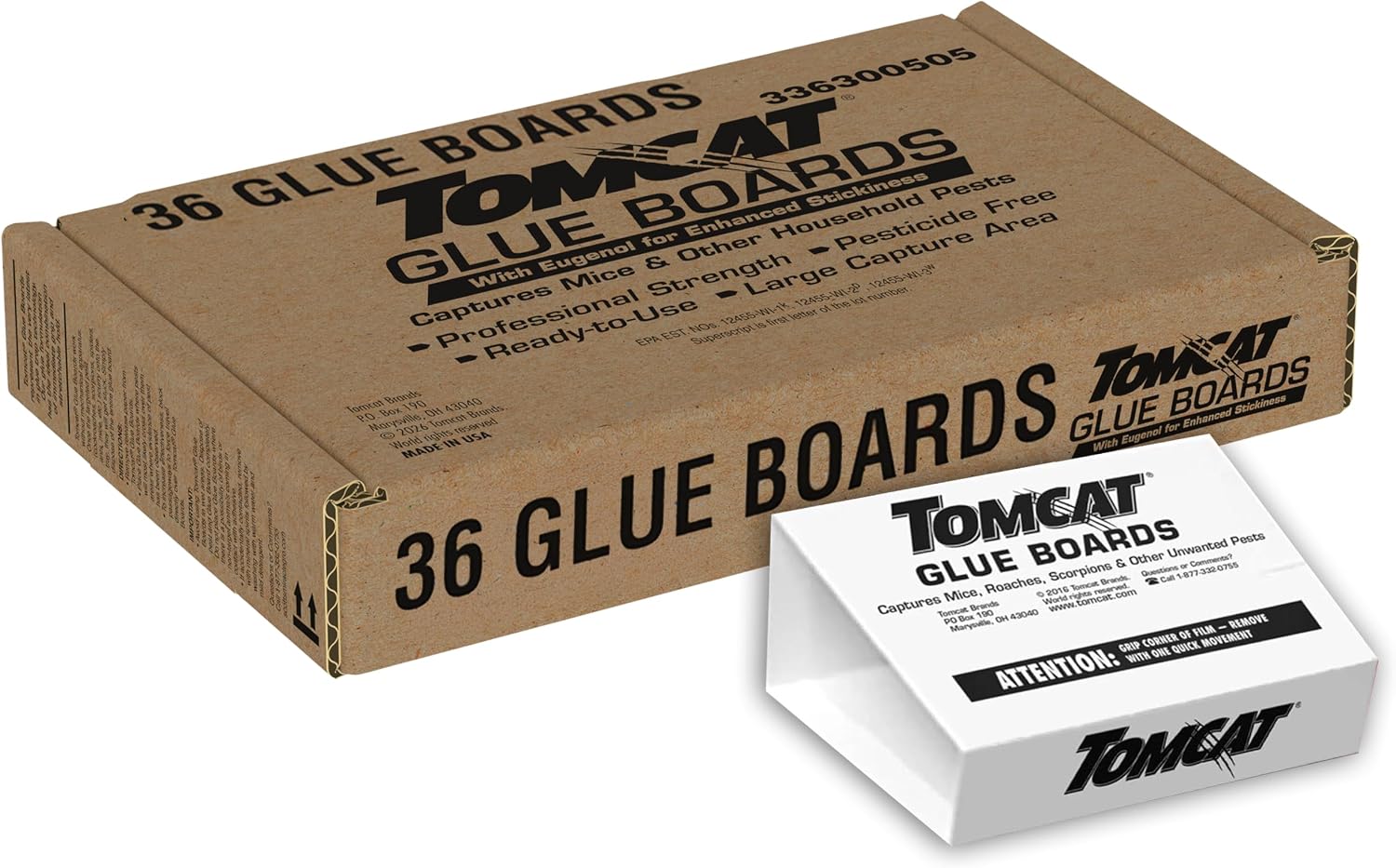
Tomcat Glue Boards with Eugenol, 36 Boards
| Package quantity | 36 Boards |
|---|---|
| Intended use | Indoor mouse and insect traps |
| Adhesive type | Eugenol enhanced glue |
These Tomcat glue boards use a professional-strength eugenol-based adhesive to trap mice, cockroaches, spiders and similar pests without bait or pesticides. They arrive ready to use and can be laid flat along walls, tucked inside cupboards, or used as covered traps to hide the glue while keeping pets and children away. The adhesive is described as high-grip and stretchable, which helps secure struggling rodents and insects quickly. Because the boards are pesticide-free and disposable, they are convenient for short-term spot control and monitoring activity in kitchens, basements, garages or near entry points. Important limitations are that glue boards are primarily for small rodents and crawling insects, they do not kill instantly so trapped animals must be disposed of carefully, and they are not suited for outdoor exposure or for use where larger rats are present and may escape the surface area. For reliability-focused buyers who want a simple, no-chemical indoor solution, these offer a straightforward, effective option when placed correctly.
Best for: Buyers who prioritize reliable, low-effort indoor pest control and want a pesticide-free method to monitor and trap small rodents and crawling insects in kitchens, basements and garages.
Less Ideal for: Those needing heavy-duty rat control for larger persistent rats, long-term outdoor baiting strategies, or humane live-capture solutions should consider alternative methods.
- Professional-strength eugenol adhesive for immediate grip
- Ready-to-use disposable boards with no bait or pesticides
- Can be used flat or as covered traps to reduce non-target contact
- Works on a range of crawling pests and small rodents
- Not appropriate for large rats or outdoor use
- Does not provide an instant kill so trapped animals require careful disposal
Verdict: A dependable, ready-to-use glue board option for indoor spot control and monitoring of small rodents and crawling pests.
Catchmaster Rat & Mouse Glue Traps, 10-Pack Heavy Duty Sticky Trays

| Unit Count | 10 Count |
|---|---|
| Material Type | Plastic |
| Target Species | Rat, Mouse, Snake |
| Power Source | manual |
Catchmaster's 10-pack of large glue traps is a ready-to-use, non-toxic option for catching mice and rats without bait or snap traps. Each plastic tray has an extra-strength adhesive designed to remain tacky in normal indoor conditions and in humid or damp spots, so you can set traps along baseboards, under sinks, or in closets and check them daily. The trays are disposable and stackable for storage and claim up to a year of shelf life in normal conditions. Practical benefits include no baiting required, suitability for locations where poisons are undesirable, and a straightforward cleanup option using vegetable or mineral oil if glue contacts skin or pet fur. Limitations are inherent to glue traps: they require regular monitoring, can be distressing to handle caught animals, and are not ideal for fully outdoor, exposed placements. They also do not provide a kill mechanism, so users who prefer rapid dispatch may want a different approach.
Best for: Buyers looking for a proven, low-maintenance indoor rodent control method that minimizes chemicals and relies on a reputable adhesive solution and broad customer acceptance.
Less Ideal for: People who want immediate lethal control, need outdoor-exposed placement, or are uncomfortable with potentially handling trapped animals should consider other trap types.
- Extra-strength adhesive stays tacky in normal and humid indoor conditions for reliable trapping
- Ready to use with no baiting required, simplifying setup along baseboards and pathways
- Disposable plastic trays stack for compact storage and claimed long shelf life
- Suitable where poisons or snap traps are not allowed, offering a non-chemical control option
- Does not humanely dispatch pests and can require uncomfortable handling of live or struggling animals
- Not intended for exposed outdoor use in direct weather, limiting placement options
Verdict: A reliable, ready-to-use glue-tray solution for indoor rodent control when you want a chemical-free option backed by proven adhesive performance.
Choosing the Right Sticky Trap for Rats: Key Factors to Consider
Adhesive Holding Strength
The glue is the primary function of a sticky trap for rats. Strong adhesive must hold the weight and struggling motion of an adult rat without the animal breaking free. Overly viscous or weak glues will fail quickly, especially with larger rodents.
Adhesive strength affects where you can place the trap. A very strong glue may allow placement on vertical surfaces or under shelving where rats travel, while a weaker glue limits you to flat, low-runway spots. Consider how long the adhesive remains tacky once a trap is exposed to air and dust, because field conditions reduce holding performance over time.
Pad and Backing Durability
The pad or backing supports the adhesive and must not tear, bend, or come apart when a rat struggles. A flimsy board will fold or delaminate and allow the captured animal to escape. Durable backing also simplifies carrying and disposal without awkward sagging.
Look for pads designed to resist bending and with edges that keep adhesive from oozing out. Heavier-duty boards are easier to position in narrow runways or wedge behind appliances. Durability matters for repeated placements in the same area and when traps may be knocked by pets or tools.
Moisture and Dust Resistance
Sheds, basements, and outdoor eaves can be dusty or damp. Dust quickly reduces tackiness while moisture can dilute some adhesives. Traps that include protective covers or are formulated to resist contamination retain effectiveness longer in these environments.
If you expect to place traps in moist or dusty spots, choose products whose adhesive remains tacky after exposure. Consider using sheltered placements when possible and check traps more often in harsher environments so adhesive failure does not waste an otherwise good placement.
Baiting and Placement Options
Rats are neophobic and often require careful baiting and trap positioning. Some sticky traps provide bait wells or edges designed to hold a peanut-sized bait securely without covering adhesive. Others rely on scent-only attractants that sit beside the adhesive.
Placement options matter because rats follow walls and prefer tight edges. Traps designed to sit flush against baseboards or to be mounted vertically allow you to place them directly in runways. Think about whether you need a trap that can be hidden behind clutter, attached to a post, or positioned along shelving where rats travel.
Safety and Ease of Handling
Anyone deploying sticky traps should consider how to handle and dispose of them while minimizing contact. Traps with folding covers, built-in handles, or disposable liners reduce the need to touch adhesive or a captured animal. Clear disposal procedures and packaging that contains the carcass make the process less unpleasant.
Ease of handling also ties to how quickly you can check and replace traps. Busy gardeners and homeowners benefit from traps that are simple to set, check, and remove with a gloved hand or tongs. This reduces the chance of accidental contact and speeds up maintenance of a control program.
Non-Target and Pet Safety
Sticky traps can capture non-target animals if placed in unsupervised locations. Consider whether the trap design allows you to restrict access by pets or wildlife, such as placing traps inside box-type housings or behind barriers that only rats can access.
Take steps to avoid placing traps where children, birds, or household pets could explore. A trap that can be mounted or enclosed reduces the risk of accidental captures and makes the control method safer for multi-use properties.
Where to Place Sticky Traps for Best Results
Rats travel along walls and in narrow runways. Position traps flush against baseboards, behind appliances, inside dark corners, and along fence lines where droppings or rub marks appear. Place traps perpendicular to the runway so a rodent must cross the adhesive surface.
Check placements daily in active infestations because a trapped animal can attract other rats or predators. In outdoor or semi-sheltered spots, use a sheltered cavity or a simple enclosure to keep moisture and debris off the adhesive, extending trap life.
- Place traps in pairs along suspected travel routes to increase encounter chances
- Avoid open floor centers where non-targets or pets might contact traps
- Use gloves or tongs to place and remove traps to avoid human scent transfer
Baiting Tips That Work With Sticky Traps
Use small, high-value baits such as peanut pieces, nut butter, or small bits of meat placed beside the adhesive rather than smeared on it. Smearing bait directly into adhesive can reduce tackiness and be less effective.
Pre-baiting without adhesive can help in neophobic populations. Place small bait morsels along the target runway for a few nights to build confidence, then switch to traps once rats are regularly visiting the area.
- Secure baits in a small cup or well when possible so they do not smear adhesive
- Rotate bait types if rats ignore a trap; diet changes seasonally
- Keep bait amounts small to avoid alarming wary rodents
Managing Hygiene and Disposal
Check traps at least daily in active infestations to remove trapped animals promptly. Prompt removal reduces odors and secondary attraction by other pests. Wear disposable gloves and place a captured rodent into a sealed bag for disposal.
Consider using a disposable liner or folding trap design that allows you to cover adhesive and contain the carcass before placing it in waste. Clean the area where a trap was set with a mild disinfectant if fluids have contacted surfaces.
- Never touch a captured rodent with bare hands
- Seal used traps in a double bag if required by local disposal recommendations
- Wash or dispose of gloves after handling traps
Using Traps As Part of an Integrated Rodent Plan
Sticky traps are one control tool among several. Combine trapping with sanitation, exclusion work to seal entry points, and removal of food sources to reduce future pressure. Traps deal with current activity but will not prevent reinfestation if attractants remain.
Monitor activity over time and adapt placement. If you see fresh droppings or new chew marks after removing trapped animals, expand trap coverage and revisit exclusion and sanitation steps to break the population cycle.
- Conduct a quick property sweep to find entry and food sources before heavy trapping
- Use traps to monitor population levels after exclusion repairs are made
- Rotate trap locations and bait to avoid learned avoidance by intelligent rodents
Legal and Ethical Considerations
Laws and recommendations vary by location concerning the humane treatment and disposal of rodents. Check local guidance for humane handling and disposal requirements. Some areas recommend quick euthanasia methods if a trapped animal is alive and suffering, handled only by trained personnel.
Where possible choose methods and placements that minimize prolonged suffering. If a trapped animal is alive and struggling, consult local wildlife or pest-control guidance for appropriate next steps.
- Avoid leaving live animals exposed for long periods
- Keep traps out of reach of children and pets to reduce accidental harm
- Document placements and check times if required by local regulations
How We Chose the Best Sticky Trap for Rats
We prioritized practical performance that matters in everyday rodent control situations. Key evaluation criteria included adhesive retention under load, board or pad durability, resistance to dust and moisture, and options for safe baiting or placement. We also considered ease of handling and deployment for tight or awkward locations, and how simple traps are to check and dispose of while minimizing direct contact. We excluded disposable or toy-style sticky pads not rated for rat-sized pests and products designed only for insects. We also filtered out traps that rely solely on chemical attractants without physical capture capability. The final shortlist focuses on traps that balance strong holding power with durable construction, workable baiting features, and straightforward deployment in indoor and sheltered outdoor spots. Testing-wise we relied on spec readability and real-garden handling characteristics rather than laboratory metrics. The chosen criteria reflect what gardeners and homeowners will notice first: whether a trap actually holds a rat, how it stands up in a shed or near a foundation, and how safely and cleanly it can be managed during use.
FAQ
Will sticky traps work on adult rats or only smaller rodents?
Sticky traps designed and rated for rats can hold adult animals, but effectiveness depends on adhesive strength and backing durability. Use traps specified for rat-sized pests and position them so the animal crosses the adhesive surface.
How often should I check sticky traps once set?
Check traps at least once daily in active infestations and every few days in low-activity areas. Frequent checks reduce the chance of captured animals attracting predators or creating sanitation issues.
Can moisture ruin a sticky trap?
Yes. Moisture and dust can reduce tackiness and shorten the effective life of a trap. Place traps in sheltered locations or use coverings to protect adhesive in damp environments and check more often when conditions are wet.
Are sticky traps safe around pets and children?
Sticky traps can pose risks to pets and children if placed in accessible areas. Use enclosed placements, mounting options, or avoidance strategies to keep non-targets away and always supervise areas where traps are used.
What bait is best with sticky traps for rats?
High‑value baits such as small amounts of peanut butter, nuts, or meat are effective when placed beside but not smeared into adhesive. Secure baits in a small container or well to prevent contaminating the adhesive.
Final Verdict
Choose a sticky trap for rats by prioritizing adhesive holding strength and a durable backing that resists bending and tearing. Match your trap choice to the placement environment, selecting products with moisture resistance or protective covers for damp or dusty spots. Balance baiting strategy and placement with safety measures to protect pets and family. Use traps as one element of a broader rodent control plan that includes sanitation and exclusion work. Prioritize traps that make handling and disposal straightforward so you can maintain an effective, low-contact control routine.
