

Note: This article contains affiliate links. If you click on these links and make a purchase, I may earn a small commission at no extra cost to you. This helps support my research and content. Read my full affiliate disclosure here.
Thick grass changes how a string trimmer behaves. Denser stalks and more sap create extra drag, demand stronger line, and expose winding or bump-feed mechanisms to faster wear. Choosing the right string trimmer head for thick grass matters because the wrong head means repeated stops to rewind line, broken spools, or inefficient cuts that tear rather than shear. This guide covers seven shortlisted trimmer heads built to handle heavy turf. We focus on feed reliability, line durability, and ease of maintenance so you can pick the option that keeps your trimming moving and reduces downtime. Read on for practical factors and setup tips before the product list.
Top Picks at a Glance
| Best Overall The best all-around choice for most situations | Grass Gator 4680 Brush Cutter Head with Metal Blades |  |
| Best Quality Built to a higher standard if you want something more solid | Milwaukee Easy Load Replacement Trimmer Head (49-16-2714) |  |
| Best Value The sweet spot between price and what you get | WEED WARRIOR Autowinder II Universal Bump Feed Trimmer Head |  |
| Best Budget The cheapest option that still gets the job done reliably | Grass Gator 5600 Fixed 4-Line Replacement Trimmer Head |  |
| Highest Rated A top-rated pick with lots of positive feedback | Husqvarna T25 Tap Advance Replacement String Trimmer Head |  |
| Most Popular A crowd favorite that many people choose with confidence | WEED WARRIOR Push-N-Load 3-Blade Replacement Trimmer Head |  |
| Best Seller A high-volume bestseller chosen again and again | Husqvarna T35 Professional Tap Advance Straight Shaft Trimmer Head (537388101) |  |
Grass Gator 4680 Brush Cutter Head with Metal Blades

| Power Source | gasoline-powered |
|---|---|
| Brand Name | Grass Gator |
| Model Number | 4680 |
| Included Components | string-trimmer-replacement-parts |
The Grass Gator 4680 is a bolt-on bladed trimmer head designed to replace a standard string head on straight-shaft gas trimmers to deliver true brush-cutting power. It comes preloaded with three solid metal blades and is intended for use on 25cc+ gasoline trimmers, so you use it when reclaiming overgrown patches, cutting dense weeds, or tackling small saplings that nylon line cannot handle. Installation is straightforward and the universal fit covers the vast majority of straight-shaft models, which makes it easy to swap in for heavy clearing tasks. The steel blades and commercial-grade construction provide aggressive cutting and durability under demanding use, but it requires a more powerful engine and produces more vibration and noise than line heads. It is not suitable for delicate edging or close work around obstacles and you should expect faster wear of blades when used on rocky ground. For heavy clearing where speed and cutting strength matter, this head delivers a substantial upgrade over bump-feed string heads.
Best for: Gardeners and landscapers who prioritize power and productivity for reclaiming overgrown areas and cutting heavy brush with a straight-shaft gas trimmer.
Less Ideal for: Homeowners who need precision edging, quiet operation, or use battery/electric trimmers should choose a line head or a lighter cutting attachment instead.
- Commercial-grade steel blades provide strong cutting power for heavy brush and thick weeds
- Universal bolt-on design fits most straight-shaft gasoline trimmers, simplifying installation
- Preloaded with three metal blades so it is ready for immediate use out of the box
- Built for demanding clearing tasks and long-lasting performance under heavy use
- Requires a 25cc+ gas trimmer for safe and effective operation
- Not suitable for fine trimming, edging, or work near hard obstacles where damage risk is high
Verdict: If you need a rugged, bolt-on upgrade to turn a straight-shaft gas trimmer into a true brush cutter, this head delivers the cutting power professionals want.
Milwaukee Easy Load Replacement Trimmer Head (49-16-2714)

| Power Source | Battery Powered |
|---|---|
| Cutting width | 40 centimeters |
| Item Type Name | REPL EASYLD TRIMMER HEAD |
The Milwaukee Easy Load replacement trimmer head is built for fast servicing and dependable field performance. It uses a bump-feed mechanism and accepts up to 25 ft of 0.080-inch or 20 ft of 0.095-inch line so you can reload in under 30 seconds and get back to work. Designed for landscape maintenance needs, it clears up to 16 inches in a single pass and emphasizes wear resistance for longer life. Typical use is as a direct replacement on compatible Milwaukee M18 Fuel string trimmers to restore reliable feeding and cutting width without rebuilding the whole tool. Notable features are the easy-load spooling, compatibility with professional trimmers, and a robust construction aimed at resisting abrasion. The main practical benefits are reduced downtime during line changes and a durable head that holds up under frequent use. Limitations are that it is made specifically for certain Milwaukee models and uses a bump-feed system rather than an automatic or proprietary quick-change cartridge, so check model compatibility before buying.
Best for: Maintenance-minded homeowners and professional landscapers who prioritize reliable, durable replacement parts that minimize downtime during frequent trimming.
Less Ideal for: Casual users who want a universal or tool-agnostic head or those who prefer cartridge-style, tool-free line swaps for very quick replacement.
- Very fast line loading — accepts 25 ft of 0.080 or 20 ft of 0.095 line loaded in under 30 seconds
- Bump-feed mechanism familiar to pros and easy to operate in the field
- Designed for heavy wear resistance to extend service life under frequent use
- Clears up to 16 inches in a single pass for efficient trimming coverage
- Compatible primarily with specific Milwaukee M18 Fuel trimmer models and may not fit other brands
- Uses a bump-feed system rather than a cartridge-style quick-change head
Verdict: Buy this trimmer head if you need a rugged, fast-to-reload replacement that restores professional-grade feeding and wear resistance to compatible Milwaukee M18 Fuel trimmers.
WEED WARRIOR Autowinder II Universal Bump Feed Trimmer Head

| Power Source | gasoline-powered |
|---|---|
| Cutting width | 16 inches |
| Speed | 7000 rpm |
| Size | 2 Line |
| Recommended Uses For Product | trimming and edging grass with gas-powered curved or straight shaft trimmers |
The WEED WARRIOR Autowinder II is a universal bump-feed replacement head that replaces worn or broken trimmer heads on many gas-powered curved and straight-shaft string trimmers. It uses an autowinder mechanism so you crank the bump knob to wind fresh line into the spool and it accepts line diameters between 0.080" and 0.105" for flexible cutting performance. In practice the head speeds reloads because you do not need to open the housing to change line, and the bump-feed delivers quick line advance during use to reduce downtime. The head is marketed as a heavy-duty unit for regular edging, trimming, and weed cutting around lawns and landscape features. It is a universal fit intended to work with a wide range of brands, which helps if you replace multiple trimmers or want one spare head. Limitations to note are that it is designed for gas trimmers primarily, and full compatibility with every cordless model is selective so confirm fit with your trimmer; you will also still need to follow safety steps when changing line.
Best for: Buyers who want a low-fuss, replaceable trimmer head that reduces line-change hassle and works across several common trimmer brands for routine lawn maintenance.
Less Ideal for: People who only use lightweight battery trimmers not listed among supported models or who need an OEM-specific head guaranteed to match one exact model.
- Autowinder design lets you reload line without disassembling the head, saving time.
- Bump-feed advances line quickly during use to minimize interruptions.
- Accepts common line sizes (0.080"–0.105") for flexible cutting performance.
- Universal fit covers most gas trimmers and many popular cordless models, reducing compatibility worries.
- Primarily intended for gas trimmers so compatibility with some cordless models is limited.
- Does not include multiple spools or extra line in the package.
Verdict: Choose this Autowinder II head if you want a quick, tool-free line reload and a reliable bump-feed that works with most gas trimmers.
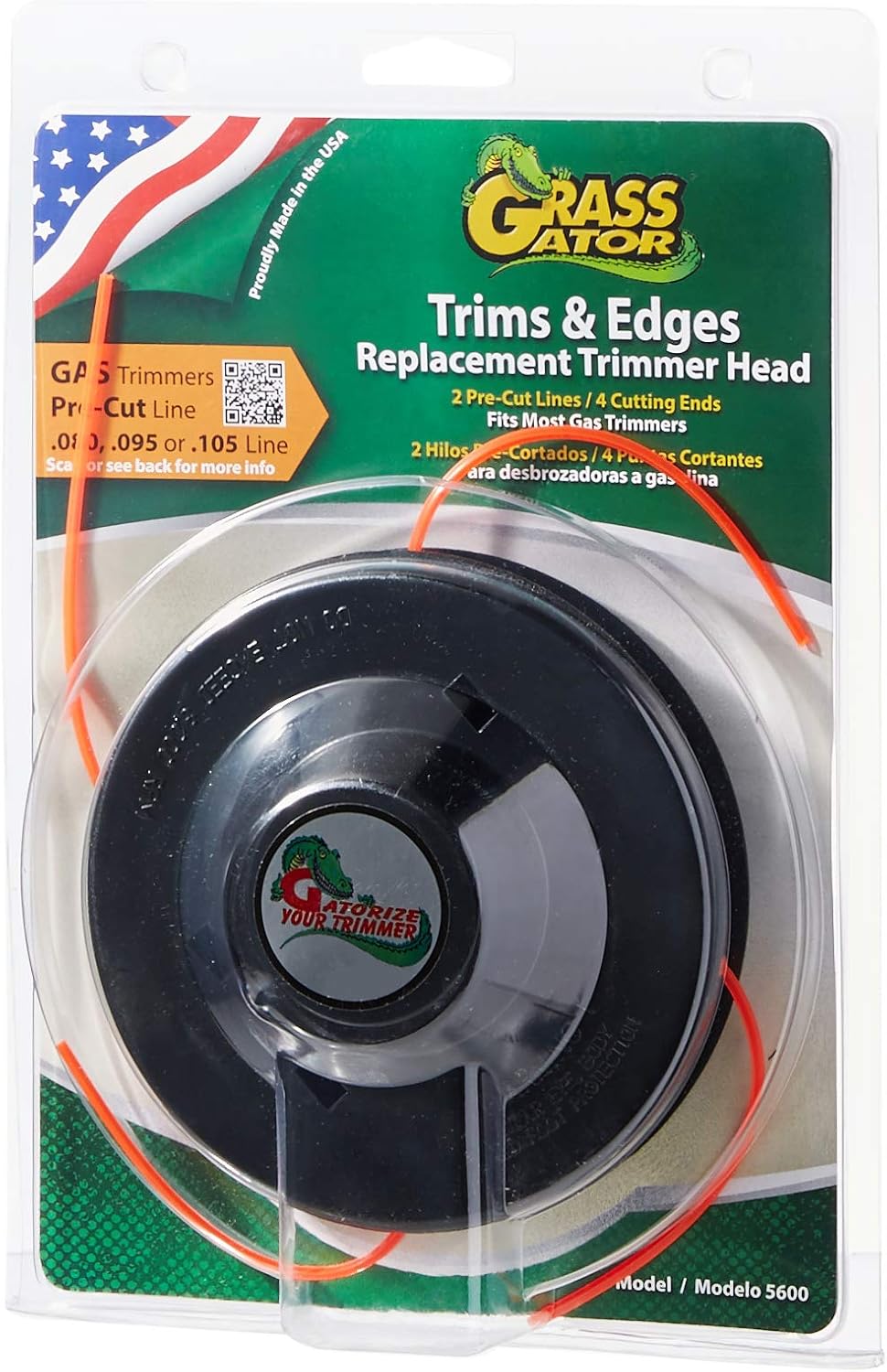
Grass Gator 5600 Fixed 4-Line Replacement Trimmer Head
| Power Source | gasoline-powered |
|---|---|
| Speed | 8000 rpm |
| Included Components | Trimmer head, 2 pieces of .095 lines, adapter, hardware kit, and instructions |
The Grass Gator 5600 replaces a bump-feed trimmer head with a fixed 4-line system preloaded with five-point .095" shaped line to boost cutting power and reduce reloading time. It is typically used as an upgrade on gas trimmers and compatible electric models with removable bump heads to get more aggressive cuts without bumping to feed line. Notable features include a universal mounting approach that fits an estimated 99% of gas trimmers, the ability to accept line from .065" to .105" diameter, and tool-free reloading that eliminates spool winding and tangles. In real use it delivers cleaner edges and faster trimming in thick grass and weeds, and the pre-shaped line gives more cutting edges per pass. Important limitations are that it is not compatible with clip-on or permanent auto-feed heads and users must observe the 8,000 RPM safety limit; heavier-duty commercial trimmers running very high RPMs may not be suitable. Installation and reloads are straightforward, making it a practical performance upgrade for homeowners who want a low-fuss, more powerful trimmer head.
Best for: Homeowners who want a straightforward, low-maintenance upgrade to get stronger cutting performance from a standard gas or removable-bump electric trimmer without dealing with spool winding.
Less Ideal for: Professional landscapers who use high-RPM commercial trimmers or users with trimmers that have clip-on or fixed auto-feed heads should look for a different head designed for those systems.
- Preloaded five-point .095" shaped line increases cutting edges for tougher grass
- Fixed 4-line design removes need for spool winding and bump-feeding
- Fits an estimated 99% of gas trimmers and many removable-bump electric heads
- Accepts a range of line diameters from .065" to .105" so you can tailor performance
- Not compatible with clip-on or permanently auto-feed heads
- Manufacturer states a maximum safe speed of 8,000 RPM, limiting use on very high-speed commercial trimmers
Verdict: A simple universal upgrade that gives homeowners a more powerful, no-spool trimming head for thicker grass and fewer reload hassles.
Husqvarna T25 Tap Advance Replacement String Trimmer Head

| Power Source | manual |
|---|---|
| Cutting width | 2 centimeters |
| Style Name | T25 |
| Pre-wound line size | .080 or .095 inch |
The Husqvarna T25 Tap Advance replacement head is a straightforward upgrade for homeowners who want faster line changes and fewer reload hassles. It installs like a standard trimmer head and ships pre-wound with TitaniumForce line, so you can get back to edging and trimming without spending time spooling. The split-spool design and open eyelets reduce tangling and line welding, and arrows on the spool show winding direction to avoid mistakes. Two key slots lock line ends in place which speeds reassembly and keeps the line from unraveling when you replace the cap. It works with Husqvarna 100 and 200 series straight and curved shaft trimmers and accepts .065 to .095 inch line, giving flexibility for light to medium lawn work. The head favors convenience over heavy-duty brush cutting, so expect good performance on grass, weeds, and light overgrowth but not for dense brambles or thick saplings. For a homeowner focused on quick maintenance and fewer interruptions, this head delivers reliable everyday trimming with minimal fuss.
Best for: Homeowners and DIYers who value fast, low-friction maintenance for everyday lawn trimming and want a replacement head that simplifies reloading and reduces downtime.
Less Ideal for: Landscapers or users who need a head built for heavy brush, thick woody stems, or commercial continuous use should consider more heavy-duty or brush-capable heads.
- Tap-advance design with pre-wound line reduces time spent reloading
- Split spool and open eyelets minimize tangling and line welding
- Arrows and key slots simplify correct winding and secure the line
- Compatible with a range of Husqvarna 100–200 series trimmers and accepts .065 to .095 inch line
- Designed for light to medium trimming rather than heavy brush cutting
- Compatibility limited to specific Husqvarna series, so may not fit all trimmers
Verdict: Choose the Husqvarna T25 head if you want a hassle-free, pre-wound replacement that speeds reloading and cuts down on tangles for routine lawn trimming.
WEED WARRIOR Push-N-Load 3-Blade Replacement Trimmer Head

| Power Source | Battery Powered |
|---|---|
| Included Components | trimmer head, universal fit hardware kit |
| Number of Items | 1 |
| Item Type Name | Weed Warrior 14867B Push-N-Load 3 Blade Head |
The WEED WARRIOR Push-N-Load 3-Blade head replaces a standard bump-feed or fixed-line spool with a blade-style cutting head designed for heavier vegetation. It installs using the supplied universal hardware and adapters so it fits most gas and battery trimmers. The head ships with multiple serrated nylon blades that push into the post and lock in place, which makes changing blades quick and keeps downtime low when working through patches of dense weeds or light brush. The glass-filled nylon head housing is built to resist abrasion and the serrated blade edges slice through tough grass better than standard line. Expect better bite on thick stems and fewer reloads, but blades will blunt over time and need periodic replacement, and this head is not a substitute for a dedicated brush cutter when tackling saplings or very woody stems. For users who want faster clearing than line provides without heavy metal blades, it is a practical midweight option.
Best for: Buyers who want a hassle-minimizing upgrade from line for clearing heavy weeds and light brush and who value fast blade changes and proven user feedback.
Less Ideal for: Landscapers or homeowners who need to remove woody stems, saplings, or very dense brush should pick a metal-blade brush cutter instead.
- Universal-fit hardware and adapters simplify installation on most gas and cordless trimmers
- Push-N-Load blade system lets you replace blades quickly without disassembling the head
- Serrated nylon blades provide stronger cutting performance on thick grass and weeds than standard trimmer line
- Glass-filled nylon head offers improved abrasion resistance for longer service life
- Nylon blades will dull with heavy use and require replacement more often than metal blades
- Not intended for heavy woody brush or small saplings where a metal brush cutter is needed
Verdict: A practical, easy-to-install blade head that gives noticeably better cutting on heavy weeds and light brush while keeping blade changes fast.
Husqvarna T35 Professional Tap Advance Straight Shaft Trimmer Head (537388101)

| Power Source | manual |
|---|---|
| Cutting width | 71.3 centimeters |
| Compatible line diameters | .065" to .105" |
| Prewound line length | 28 feet (.095" line) |
The Husqvarna T35 Professional Tap Advance is a straightforward replacement trimmer head designed for straight-shaft gas trimmers. It installs in place of the OEM head and is typically used for routine edging, trimming around obstacles, and cutting back heavy grass and weeds. Notable features include a prewound spool with 28 feet of .095" Titanium Force line, a split-spool design that reduces tangling and line welding, and an easy-to-reload cap that removes without turning the trimmer upside down. The head accepts .065" to .105" line gauges, so you can tailor cutting aggressiveness and line life to the job. In practice the tap-advance feed keeps downtime low, the split spool makes reloading and field service less fiddly, and the open eyelet eases manual feeding when needed. Limitations are that it is intended for straight-shaft trimmers only and the included line gauge may be heavier than required for very fine ornamental work, so choose a thinner line if you need a finer cut.
Best for: Gardeners who want a robust, low-maintenance replacement head for heavy trimming and routine yard cleanup on straight-shaft trimmers and who value quick reloads and reliable line feed.
Less Ideal for: People who own curved-shaft trimmers or who need a very fine cutting finish for ornamental beds should look at heads designed specifically for those tools or lighter line options.
- Prewound spool with 28 feet of .095" line reduces initial setup time
- Split-spool design minimizes tangles and line welding
- Tap-advance feed and open eyelet make line feeding and on-the-job reloading easy
- Fits a wide range of line diameters (.065" to .105") for flexible cutting performance
- Built for straight-shaft trimmers only, not compatible with curved-shaft models
- Included .095" line may be overkill for delicate trimming around ornamentals
Verdict: Choose the Husqvarna T35 if you need a durable, easy-to-reload trimmer head that reduces tangles and keeps you trimming longer between reloads.
Choosing the Right String Trimmer Head for Thick Grass: Key Factors to Consider
Line Type And Diameter
The kind of cutting line you use is the single biggest determinant of performance in thick grass. Thicker, twisted, or braided lines cut through dense stems better and resist snapping when they hit grit or branches. Many heads accept lines from 0.080 inch up to 0.125 inch; larger diameters deliver more cutting force but demand a head and trimmer powerful enough to spin them.
Check compatibility before buying and plan on using heavy-duty line for sustained work. The right diameter reduces the number of passes you need and lowers the stress on the feed mechanism, which is crucial when working long patches of overgrown turf.
Feed Mechanism Design
How the head advances new line affects uptime. Bump-feed designs are common, but models with more positive advance mechanisms or automatic spring-loaded feeds often hold up better under heavy load. A feed that requires frequent, forceful bumping is more likely to jam or underfeed when cutting dense material.
Also consider whether the spool locks or ratchets in place under tension; a secure spool prevents backlash and line tangle when the head is overloaded. Simpler, tool-free disassembly for reloading makes field maintenance faster and reduces time wasted wrestling with jammed line.
Material Strength And Construction
Heads made from reinforced nylon, fiber-glass-filled polymers, or metal-reinforced hubs resist cracking and deformation when they encounter rocks, roots, or compacted clumps. The material choice influences the head's ability to survive repeated impacts and exposure to moisture and plant sap.
A sturdier construction can add a bit of weight, but the tradeoff is longer service life and less frequent replacement. Look for robust locking mechanisms for the spool and corrosion-resistant fasteners if you expect to work in damp or wet conditions.
Compatibility With Trimmer Power And Shaft Type
A heavy-duty head only performs as well as the trimmer spinning it. High-diameter line and more aggressive heads increase load on the motor and drive shaft. Confirm that your trimmer's horsepower or motor rating matches the head's recommended line sizes and that adapters are available if your shaft type differs.
Using an underspecified trimmer can lead to overheating, reduced rpm, and a subpar cut. Conversely, an overbuilt trimmer with a weakly attached head invites wobble and premature wear. Proper matching keeps feed consistent and extends both trimmer and head life.
Ease Of Maintenance And Replacement Parts
Frequent reloading, occasional spool swaps, and replacing wear parts are normal when trimming thick grass. Heads that let you change line without tools, or that use widely available spools and springs, minimize downtime. Consider how easy it is to access and service components in the yard rather than in a workshop.
Availability of replacement caps, springs, and spools matters over a season. If parts are complicated or proprietary, a minor failure can bench the head for days. Choose designs with simple internals and clear user access.
Balance Between Cut Quality And Efficiency
A head that tears rather than shears will leave ragged edges and force extra follow-up work. Look for heads that support stiffer line profiles which slice cleanly when paired with adequate speed. Clean cuts reduce disease risk in some grasses and produce a neater result on lawns and pathways.
At the same time, consider how many passes you need to achieve the desired finish. Aggressive cutting line may shorten component life, so weigh the tradeoff between immediate cut quality and longer-term durability based on how often you trim.
Preparing Your Trimmer For Heavy Grass
Before you tackle dense patches, check the trimmer head mounting, shaft alignment, and the condition of the drive coupling. Tighten loose hardware and replace cracked adapters to prevent wobble, which accelerates wear on both line and head. Inspect your trimmer's air intake and cooling fins if it is gas powered; overheating during heavy cutting shortens engine life.
Switch to the highest-quality line you plan to use and spool it correctly according to the head's instructions. Spool tension and even winding matter under load; loose winding can cause bulging and feed failure. Finally, practice a short strip of heavy grass to verify feed behavior and rpm under load so you can adjust technique or line size before working a large area.
- Check mounting bolts and adapters for tightness
- Use recommended line diameter for your trimmer's power
- Test a short area to confirm feed reliability before starting a large job
Line Installation Tips For Tough Turf
Properly installing line saves time and prevents mid-job failures. When winding line, maintain even tension and avoid overlapping layers that create pressure points. If the head accepts two lines, match lengths and wind them symmetrically to preserve balance.
In some heads, pre-bending the line slightly reduces feed resistance when it leaves the spool. Keep spare, pre-cut lengths of heavy-duty line in a dry container so you can reload quickly. Replace worn lines proactively rather than waiting for breaks during a long trimming session.
- Wind line with consistent tension
- Keep spare pre-cut lengths handy
- Match dual-line lengths for balance
Techniques For Cutting Dense Clumps
Approach thick clumps at a steady pace; rushing often leads to bogging and broken line. Make shallow, multiple passes instead of a single aggressive swipe. Angle the head so the line meets stems near the soil surface where they are weakest.
When you hit woody or rooty material, reduce throttle momentarily to let rpm recover and avoid burning out the line. If a head consistently struggles on certain patches, consider switching to a stiffer line profile or trimming the area in stages, using a string trimmer for bulk removal and finishing with shears or a mower where appropriate.
- Use shallow, multiple passes
- Angle the head to target stems near the base
- Reduce throttle briefly on heavy impacts to protect line
Maintaining Feed Mechanisms In The Field
After a session, clear debris from the head and spool cavity to prevent grit build-up that causes jamming. For bump-feed models, check the tip and spring for wear and replace weak springs. Lubricate moving parts only if the manufacturer allows it; excess grease attracts grass and dirt and can worsen feeding problems.
If you encounter frequent tangles, disassemble the spool and inspect the winding pattern and any broken line remnants. Carry a small tool kit for quick spring or cap swaps so you can get back to work without returning to the shop.
- Brush out spool cavity after each use
- Carry a small field kit with replacement springs and caps
- Avoid lubricants unless specified by the manufacturer
How We Chose the Best String Trimmer Head for Thick Grass
We started by identifying features that directly affect performance in heavy, dense turf. Key evaluation areas included how the head feeds and secures cutting line under load, the types and diameters of compatible line, and the head's resistance to clogging and breakage when working through thick stems or wet grass. Durability under repeated impacts and exposure to sap and debris was another filter. We favored heads built from tougher polymers or reinforced components and mechanisms that simplify field repairs. Ease of reloading and the frequency of required adjustments were scored because frequent rewinds are the main productivity drain during long trimming tasks. Compatibility and versatility were also important. We included heads that fit a wide range of trimmer shafts or come with straightforward adapter kits. Heads that forced uncommon line sizes or required complex tools for maintenance were excluded. We omitted any designs that rely solely on very thin line or on features known to fail quickly in heavy vegetation. The final list balances feed reliability, line strength, build robustness, usability, and compatibility.
FAQ
Will thicker line always cut thick grass better?
Thicker line generally delivers more cutting force and resists breakage, but it also increases load on the trimmer. It usually helps, but you must match line diameter to the trimmer's power and the head's capacity.
How often should I replace the spool or feed spring?
Frequency depends on use and conditions. Heavy, frequent trimming in abrasive or woody turf may require replacing springs or spools seasonally. Inspect components regularly and replace them when you see visible wear or feeding problems.
Can I use metal blades instead of a trimmer head for really overgrown areas?
Metal blades can be effective for heavy brush and very coarse growth, but they change the tool's behavior and require proper guards and compatible mounts. For many gardeners, upgrading to heavier line and a robust head is a safer first step.
Is automatic feed better than bump-feed for thick grass?
Automatic feeds can reduce interruptions, but they are not universally superior. Some automatic systems struggle under constant heavy load or with bulky line. Choose based on proven durability and how the mechanism performs with heavier line.
How should I store spare line to keep it usable?
Keep spare line in a cool, dry place away from direct sunlight. Coil it loosely or store pre-cut lengths in a sealed container to prevent deformation and UV damage, which weaken line over time.
Final Verdict
When choosing a string trimmer head for thick grass, prioritize feed reliability and line compatibility over convenience features. A head that accepts heavier, stiffer line and that has a secure, easy-to-service spool will save time and frustration in dense turf. Expect tradeoffs: heavier line and sturdier heads increase load on the trimmer and may shorten some components' life, so match the head to your trimmer's power and keep basic replacement parts on hand. Focus on durability, simple maintenance, and a feed mechanism you trust to finish the job with fewer interruptions.
