

Note: This article contains affiliate links. If you click on these links and make a purchase, I may earn a small commission at no extra cost to you. This helps support my research and content. Read my full affiliate disclosure here.
If you manage large lawns, acreage, or commercial turf, the right tow behind broadcast spreader saves time and improves application accuracy. A poorly chosen spreader leaves striping, missed zones, and uneven material use that forces extra trips and uneven turf results. This guide covers six shortlisted tow behind broadcast spreaders suited to large properties and heavy workloads. We focus on capacities, distribution patterns, control over drop rates, and durability so you can match a machine to how, where, and how often you plan to spread. Read on for the practical factors that separate dependable units from those that create more work.
Top Picks at a Glance
| Best Overall The best all-around choice for most situations | Agri-Fab 185 lb Tow-Behind Broadcast Spreader (45-0547) |  |
| Best Quality Built to a higher standard if you want something more solid | EarthWay T150 150 lb Tow-Behind Broadcast Spreader |  |
| Best Value The sweet spot between price and what you get | GarveeLife Tow-Behind Broadcast Spreader, 130 lb Capacity |  |
| Best Budget The cheapest option that still gets the job done reliably | Takywep 80 lb Tow-Behind Broadcast Spreader with 10" Pneumatic Tires |  |
| Highest Rated A top-rated pick with lots of positive feedback | MAXSA 150 lb Tow-Behind Broadcast Spreader with 30 Adjustable Settings |  |
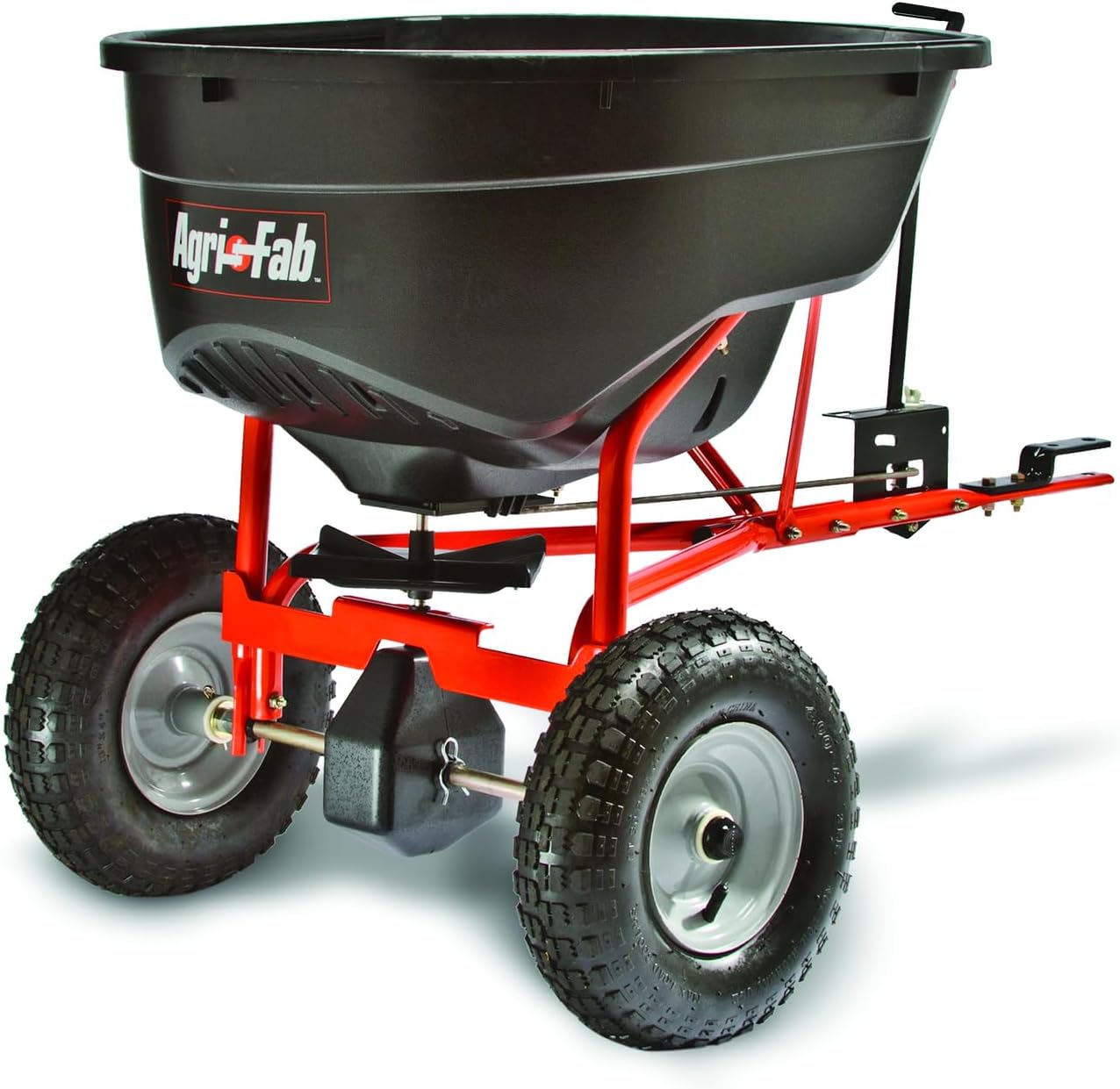
| Most Popular A crowd favorite that many people choose with confidence | Agri-Fab 130 lb Pull-Behind Broadcast Spreader (Model 45-0463) |  |
Agri-Fab 185 lb Tow-Behind Broadcast Spreader (45-0547)

| Weight capacity maximum | 185 pounds |
|---|---|
| Spread width | Up to 12 ft |
| Tire type | Pneumatic Tires |
| Material type | Metal, Polypropylene (PP) |
The Agri-Fab 185 lb tow-behind broadcast spreader is designed to handle larger lawn jobs without frequent refills. You hitch it to a riding mower or ATV, load seed, fertilizer, salt, sand or ice melt into the rustproof poly hopper, set the flow with the seat-accessible on/off rod, and tow across the lawn for up to 12 ft of broadcast coverage. Heat-treated steel gears and a poly spreader plate aim to give durable, consistent operation while 13 x 5 in pneumatic turf tires smooth towing over uneven ground. The large 185 lb capacity is useful for roughly one acre per fill, cutting the number of passes and time spent refilling. Expect some assembly out of the box and basic maintenance of the gearbox and tires for long life. The spread pattern is broad but broadcast spreaders are inherently less precise than drop-style units, so careful calibration is needed for even application of granular products. Overall it is a practical, heavy-duty option for routine lawn and property maintenance when you need to cover medium to large areas efficiently.
Best for: Buyers who need a robust, low-maintenance spreader to cover medium to large lawns quickly and prefer convenience features like seat-mounted flow control.
Less Ideal for: Not the best choice for small lawns or applications that require very precise, spot-by-spot granular placement or very lightweight, occasional use.
- Large 185 lb hopper reduces frequency of refills for up to about one acre of coverage
- On/off flow control reachable from the mower seat for convenient operation
- Rustproof polypropylene hopper and spreader plate resist corrosion for year-round use
- Heat-treated steel gears and pneumatic turf tires improve durability and smooth towing over uneven terrain
- Broadcast spread pattern is less precise than a drop spreader so calibration and overlap are required
- Some assembly required before first use
Verdict: Choose this Agri-Fab model when you want a heavy-duty tow-behind spreader that covers up to an acre per fill and simplifies larger lawn jobs with seat-mounted control.
EarthWay T150 150 lb Tow-Behind Broadcast Spreader

| Capacity | 150 lb |
|---|---|
| Item model number | T150 |
| Recommended tow speed | 3 mph |
The EarthWay T150 is a tow-behind broadcast spreader built for heavier jobs where accuracy and durability matter. It carries up to 150 pounds of material and is commonly used behind garden tractors or ATVs to apply fertilizer, seed, compost, or salt across larger lawns and acreage. Notable features include precise flow control for consistent application and patented side spread control to limit material drifting onto sidewalks or beds. The extended wheelbase, steel rod calibration, and non-skid tires contribute to stable towing and repeatable spread patterns at recommended speeds around 3 mph. Practical benefits are even distribution over wide swaths, less need for multiple passes, and reduced waste near borders thanks to the side spread adjustment. The unit is purpose-built rather than compact, so it requires a tow vehicle and storage space, and some optional accessories such as the handle conversion kit are sold separately. If you need a robust, accurate pull-behind spreader for routine, performance-focused lawn care, the T150 delivers dependable results.
Best for: Buyers who prioritize performance and accuracy for medium to large lawns and want a durable tow-behind spreader that produces consistent results with less rework.
Less Ideal for: Gardeners with very small yards, those who need a handheld or push spreader, or buyers who lack a compatible tow vehicle should consider smaller, self-contained options.
- 150 lb capacity suitable for large lawns and repeated applications
- Precise flow control enables consistent application rates
- Patented side spread control reduces overspread onto paths and beds
- Extended wheelbase and non-skid tires improve towing stability
- Requires a tractor or ATV and space for storage when not in use
- Some useful accessories, like the handle conversion kit, are not included
Verdict: Choose the EarthWay T150 when you need a heavy-capacity, accurate tow-behind spreader that delivers consistent, professional-style application across larger lawns.
GarveeLife Tow-Behind Broadcast Spreader, 130 lb Capacity

| Capacity | 130 lbs |
|---|---|
| Tire type | 10" pneumatic tires |
| Frame | Powder-coated steel |
The GarveeLife tow-behind broadcast spreader is a straightforward, work-focused machine for covering medium to large lawns and driveways. It mounts to a lawn tractor, ATV, or UTV via a durable tow bar and uses a powder-coated steel frame and rust-resistant poly hopper to resist corrosion in seasonal outdoor use. The adjustable flow handle and spreader plate let you control material output and achieve even coverage up to about 10 feet wide, making it usable for seed, fertilizer, ice melt, and sand. Ten-inch pneumatic tires give good traction and a smoother roll across uneven turf or gravel. Practical additions like a waterproof cover and sieve help keep materials dry and prevent clumping. Downsides are that it is a simple mechanical spreader without powered agitation, so very wet or compacted material may still clog, and assembly or hitching can take a little time for first-time users. For routine lawn maintenance and winter deicing this spreader performs the basic tasks reliably.
Best for: Buyers who want a practical, no-frills tow-behind spreader to cover medium to large lawns and driveways efficiently and reduce repeated trips to refill.
Less Ideal for: People who need a motorized or high-capacity commercial spreader for continuous heavy use or those who only have a small hand-push spreader need.
- Rust-resistant poly hopper and powder-coated steel frame resist corrosion for seasonal outdoor use
- Adjustable flow control and spreader plate deliver even distribution up to about 10 feet wide
- 10" pneumatic tires provide stable rolling and traction over uneven turf and gravel
- Large 130 lb capacity hopper reduces refill trips for larger yards
- No powered agitation system, so very wet or compacted materials can clog
- Requires hitching and some initial assembly which may be awkward for a single user
Verdict: A durable, easy-to-use tow-behind spreader that handles seed, fertilizer, and ice melt for homeowners who want efficient coverage without fancy electronics.
Takywep 80 lb Tow-Behind Broadcast Spreader with 10" Pneumatic Tires

| Hopper capacity | 80 lb (30 L) |
|---|---|
| Tire size | 10 in pneumatic |
| Frame material | Powder-coated carbon steel |
| Compatible tow | Riding mowers, ATVs, UTVs via pin-style hitch |
| Control | Adjustable rate-control lever |
The Takywep 80 lb tow-behind broadcast spreader is a basic, workmanlike machine for seeding, fertilizing, and winter de-icing on medium to large lawns. It mounts to riding mowers, ATVs, UTVs, and similar equipment using a pin-style hitch and rolls on large 10-inch pneumatic tires that handle uneven turf and light mud with less slipping. The rust-resistant poly hopper holds 80 pounds of granular material to reduce refills, and an accessible rate-control lever lets you dial coverage from light seed to heavier fertilizer or ice melt. A powder-coated carbon steel frame provides structural strength for regular seasonal use. Expect straightforward setup and operation but limited refinement: the unit is utilitarian rather than precision-engineered, and assembly and parts fit may require basic mechanical patience. For homeowners who want a simple tow-behind spreader that covers ground quickly without specialty features, this model delivers reliable performance for routine lawn and winter maintenance.
Best for: Buyers who want an affordable, no-frills tow-behind spreader to cover medium to large lawns quickly and handle seasonal seeding, fertilizing, and de-icing while keeping costs down.
Less Ideal for: Professional contractors or users who need precise commercial-grade calibration, premium fit and finish, or advanced spread pattern controls should consider higher-end models.
- Large 80 lb poly hopper reduces frequency of refills for bigger jobs
- 10" pneumatic tires improve traction and roll smoothly over uneven ground
- Adjustable rate-control lever for quick changes between seed, fertilizer, and ice melt
- Powder-coated carbon steel frame resists weather and adds durability
- Basic design with limited refinement in fit and finish compared with higher-end models
- Tow hitch and assembly may require time and basic tools to install properly
Verdict: A straightforward, budget-friendly tow-behind spreader that covers large lawns efficiently with a high-capacity hopper and all-terrain tires.
MAXSA 150 lb Tow-Behind Broadcast Spreader with 30 Adjustable Settings

| Capacity | 150 LBS |
|---|---|
| Flow settings | 30 adjustable |
| Spreading width | 9.8 FT |
The MAXSA tow-behind broadcast spreader is built for heavy-duty, year-round property care. It mounts to ATVs, UTVs or tractors for tow use and can also be pushed by hand, giving flexibility for different jobs. The 150 lb hopper reduces refills on larger lawns and small farms, while 30 adjustable flow settings and a 9.8 ft spread width make it straightforward to dial in consistent coverage for seed, fertilizer, herbicide or ice melt. Construction uses a powder-coated steel frame, corrosion-resistant aluminum gears and 13-inch pneumatic tires, which together improve durability and make it roll well over grass, gravel, and uneven ground. Assembly is tool-free and the design is compact enough for garage storage. Expect practical limitations typical of broadcast spreaders: it is designed for granular materials only and spotty application can still occur at the outer edges if you do not overlap passes carefully. Overall this model suits buyers who need a robust, low-maintenance spreader that handles large loads and rough terrain reliably.
Best for: Buyers who prioritize a dependable, low-maintenance spreader for regular property upkeep and want a unit that tolerates rough terrain and large loads without frequent refilling.
Less Ideal for: People who need a precision drop spreader for small beds, narrow strips, or liquid applications should consider a different tool.
- Large 150 lb hopper reduces the frequency of refills on medium to large properties
- Thirty adjustable flow settings and 9.8 ft spread width enable precise and even coverage
- Powder-coated steel frame and aluminum gears resist corrosion for long-term outdoor use
- 13-inch pneumatic tires provide smoother rolling over lawns, gravel, and uneven surfaces
- Designed for granular materials only and not suitable for liquids or very coarse products
- Wide broadcast action can cause edge overlap issues if passes are not planned carefully
Verdict: If you need a rugged, high-capacity tow-behind spreader that delivers consistent, adjustable coverage across large lawns and rough terrain, this MAXSA model is a reliable pick.
Agri-Fab 130 lb Pull-Behind Broadcast Spreader (Model 45-0463)
| Weight Capacity Maximum | 130 pounds |
|---|---|
| Spread Width | 10-12 ft |
| Tire Type | Pneumatic |
| Material Type | Alloy Steel, Polypropylene (PP), Rubber |
The Agri-Fab 130 lb pull-behind broadcast spreader is built for straightforward, dependable lawn care on larger yards. It mounts to most riding mowers with a universal hitch and holds up to 130 pounds, letting you cover roughly half an acre per fill to reduce interruptions. The wide 10 to 12 foot spread pattern and enclosed gear box promote more even dispersal and protect internal parts from dirt and moisture. A simple steel-rod flow control is reachable from the tractor seat so you can change application rates without stopping. The construction combines a poly hopper with alloy steel frame tubing and pneumatic tires for durability and smoother towing over uneven ground. Expect easy seasonal use for grass seed, fertilizer, granular lawn treatments, and salt. The main limitations are that it is a basic broadcast design, so very precise banding or ultra-fine calibration for specialty seed mixes may require additional passes or a different spreader type, and some assembly is required before first use.
Best for: Homeowners or property managers who want a reliable, no-nonsense tow-behind spreader to cover medium to large lawns efficiently and with minimal fuss.
Less Ideal for: Gardeners who need highly precise application patterns or small-plot users who prefer a handheld or walk-behind drop spreader for tight spaces.
- Large 130 lb hopper covers up to about 25,000 sq ft per fill to reduce refills on bigger lawns
- Universal hitch fits most riding mowers and lawn tractors for quick hookup
- Wide 10–12 ft spread width delivers even coverage with fewer passes
- Enclosed gear housing and steel frame improve durability and protect moving parts
- Seat-accessible steel-rod flow control lets you change settings without dismounting
- Broadcast design is less suited to precision banding or very narrow applications
- Requires assembly before first use
Verdict: A durable, easy-to-use tow-behind spreader that reliably covers larger lawns with fewer refills and minimal operator adjustments.
Choosing the Right Tow Behind Broadcast Spreader: Key Factors to Consider
Hopper Capacity and Refill Frequency
Hopper size directly affects how often you must stop to refill. Larger hoppers reduce the number of passes required for big properties and make long sessions more efficient. When capacity is too small you spend more time walking back to a spreader or stopping the tractor, which increases total job time and can interrupt spread pattern continuity.
Also consider how the hopper shape influences flow. Wide, sloped hoppers feed more evenly and resist bridging for many granular materials. A practical hopper design paired with a capacity that matches your typical job size cuts interruptions and keeps application rates consistent.
Spread Consistency and Pattern Control
How evenly a spreader distributes material matters most for appearance and effective application. Broadcast spreaders that throw an uneven fan leave light and heavy strips that require overlap or rework. Look for spread patterns that offer adjustable fan width or deflectors so you can tune coverage to the material and working speed.
Uniform spread reduces wasted seed, fertilizer, or salt and helps maintain consistent turf health. Consider how easily you can calibrate and test the pattern in a small trial pass to set the best overlap for a given product.
Agitation, Metering, and Material Compatibility
The internal agitation system keeps material moving and prevents bridging, especially with moist or irregular granules. Metering controls how much material is released per distance traveled. Together these systems determine whether the spreader will reliably handle fertilizers, lime, seed blends, or salt.
Some metering systems offer fine incremental settings for precise low-rate applications, while others are optimized for bulk products. Match the agitation and metering style to the materials you commonly use to avoid blockages and inconsistent application.
Tow Stability and Hitching Options
Towing dynamics affect accuracy and operator comfort. A well-designed hitch and frame keep the spreader level at speed, preventing plumes of material to one side and reducing bounce that can change application rates. Wider wheelbases and heavier-duty frames improve stability on slopes and uneven ground.
Check hitch compatibility with your tractor, ATV, or tractor-style mower and whether the spreader allows for quick attachment or needs more involved setup. Ease of mounting and a stable tow relationship reduce operator fuss and help maintain a steady spread pattern.
Rate Adjustment, Calibration, and Controls
Accurate rate settings make it simple to follow product application guidelines. Look for clearly marked rate dials, indexed settings, or calibrated charts that translate product rates into spreader settings. Easy-to-reach controls that can be adjusted from the tractor seat speed up operational changes.
Calibration is the process that confirms your chosen setting delivers the intended rate on the ground. Spreaders that are straightforward to calibrate let you verify output quickly and adjust for different materials or speeds without guesswork.
Durability and Serviceability
A spreader working across large areas sees more hours and more wear. Materials like coated steel, heavy-gauge frames, and sealed bearings extend service life in outdoor conditions. Consider how easily wear parts such as agitators, metering plates, and tires can be replaced.
Serviceability also includes access to common maintenance points and whether the unit's design makes winter storage and off-season servicing simple. Machines that are easy to maintain reduce downtime and extend usable life.
Matching Spreader Size to Property and Tractor
Choose a spreader sized for the average job, not the occasional extreme. If you mostly treat a few acres at a time, a mid-capacity unit reduces unnecessary bulk. For multi-acre properties or commercial use, larger hoppers cut refilling frequency and keep the tow vehicle working efficiently.
- Estimate how many acres or square feet you routinely cover per session.
- Consider towing capacity of your tractor or ATV when upsizing.
- Factor in material density since heavy products reduce effective hopper capacity.
Setting Up for Accurate Application
Before treating a whole area, perform a short calibration run with the material you will use. Mark a distance, collect the dispensed material from a set pass, and weigh or measure it to confirm the rate. Use that data to set the spreader dial and determine proper overlap for even coverage.
- Calibrate for each material type and moisture condition.
- Adjust tractor speed and spreader setting together; faster travel requires different settings.
- Record settings for future repeatability on similar jobs.
Material Types and Flow Characteristics
Different granules behave differently. Light, flaky materials can throw farther but may drift in wind, while coarse or moist granules may bridge and need stronger agitation. Match the spreader's agitation and plate design to the products you apply most often to avoid clogging and rate drift.
- Use deflectors or narrow fan settings in windy conditions.
- Avoid overfilling hoppers with damp product that can compact.
- Consider material sieving or pre-mixing to improve flow consistency.
Maintenance That Keeps Spread Consistent
Regular maintenance preserves spread accuracy. Clean hoppers after each use to prevent cross-contamination, check bearings and drive linkages for wear, and lubricate controls as directed. Replace worn metering parts promptly to prevent rate creep and uneven distribution.
- Rinse salt or corrosive materials out before storage.
- Inspect tires and wheel bearings for wear before heavy jobs.
- Keep a simple calibration kit on hand: a container, scale, and distance markers.
Safety and Environmental Considerations
Be mindful of where material is landing. Avoid spreading when wind will carry product into gardens, water features, or neighbor properties. Use appropriate personal protective equipment when handling chemical fertilizers or salt and follow label guidance for application rates and buffer zones.
- Check local regulations for fertilizer or salt application near waterways.
- Plan passes to minimize overlap in sensitive zones.
- Store materials securely to prevent runoff or contamination.
How We Chose the Best Tow Behind Broadcast Spreader
We evaluated units with a gardener-focused, task-first approach. Capacity and hopper design mattered because larger hoppers reduce refill time on big properties. Spread pattern and control received strong weight since consistent distribution reduces overlap and material waste. Drive and agitation systems were assessed to understand how reliably granular material moves without clogging or bridging. Frame and hitch durability were inspected for towing stability and long-term field use. Ease of rate adjustment and calibration was part of the filter because simple, repeatable settings make accurate applications easier. We excluded small push or hand-held broadcast spreaders and products intended only for broadcast use on small lawns. We also excluded units with unclear capacity specs or inconsistent dispensing mechanisms. The final selection prioritizes machines that balance roomy hoppers, reliable agitation and metering, robust towing hardware, and straightforward calibration to handle repeated use on large lawns, acreage, or commercial turf.
FAQ
How do I calibrate a tow behind broadcast spreader?
Choose a set distance and drive a normal pass while collecting material from the spreader. Weigh or measure the collected material and compare it to the manufacturer's rate table or the target application rate. Adjust the metering setting and retest until the measured output matches the desired rate.
Can I use the same spreader for seed, fertilizer, and salt?
Often you can, but effectiveness depends on the metering and agitation systems. Fine seeds and coarse salts behave differently, so recalibrate and clean the hopper between materials to prevent clogs and cross-contamination. Some spreaders handle a broader range of materials than others.
What tractor speed should I use when spreading?
Recommended speed varies with spreader design and material, but usually a steady, moderate speed gives the most consistent pattern. Faster speeds increase throw distance but can change the delivered rate, so always calibrate at the working speed you plan to use.
How do I prevent material bridging in the hopper?
Choose a hopper with a sloped floor and active agitation if you frequently use moist or irregular products. Keeping the hopper from overfilling and using agitator accessories or gentle tapping during operation can help maintain flow.
Is it necessary to empty the hopper before winter storage?
Yes. Removing all residual material prevents corrosion, contamination, and moisture-related clumping. Clean the hopper, dry it, and perform basic maintenance before storing in a sheltered spot until the next season.
Final Verdict
Pick a tow behind broadcast spreader that matches the scale of your work and the materials you apply most often. Prioritize hopper capacity, reliable agitation and metering, and a stable tow frame to reduce refills, prevent clogging, and maintain even coverage across large areas. Tradeoffs are inevitable: larger hoppers increase weight and require a sturdier tow vehicle, while finer metering systems can be more complex to calibrate. Focus on the features that reduce downtime and improve application repeatability to choose with confidence.
