

Note: This article contains affiliate links. If you click on these links and make a purchase, I may earn a small commission at no extra cost to you. This helps support my research and content. Read my full affiliate disclosure here.
Picking the right tree growth fertilizer affects how quickly young trees root and how well established specimens recover from stress. Whether you are planting new saplings, renovating a landscape, or trying to thicken a mature canopy, fertilizer choice influences root development, disease resistance, and leaf vigor in real garden settings. This guide presents seven shortlisted Tree Growth Fertilizers that suit different planting situations and application preferences. We evaluated options against practical criteria gardeners care about, including nutrient formulation, ease of application, longevity, and soil compatibility. Read on to match a fertilizer to your soil, watering routine, and tree species.
Top Picks at a Glance
| Best Overall The best all-around choice for most situations | Jobe's Slow Release Tree & Shrub Fertilizer Spikes, 15 Count |  |
| Best Quality Built to a higher standard if you want something more solid | Farmer's Secret Fruit Tree Booster Liquid Fertilizer (32 oz) |  |
| Best Value The sweet spot between price and what you get | Miracle-Gro Fruit & Citrus Plant Food Spikes, 12 Count (10-15-15) |  |
| Best Budget The cheapest option that still gets the job done reliably | Jobe's Slow Release Tree and Shrub Fertilizer Spikes, 5 Count |  |
| Highest Rated A top-rated pick with lots of positive feedback | Jobe's Organics Tree & Shrub Fertilizer Spikes, 16-4-4, 30 Count (2-Pack) | 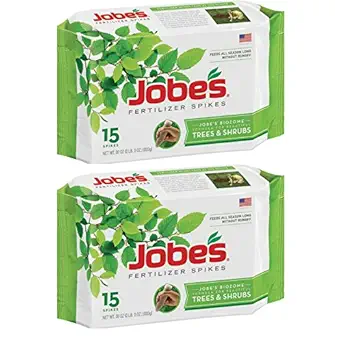 |
| Most Popular A crowd favorite that many people choose with confidence | Miracle-Gro Tree & Shrub Plant Food Spikes, 12 Spikes |  |
| Best Seller A high-volume bestseller chosen again and again | TPS NUTRIENTS Lemon Tree Fertilizer Liquid Plant Food, 8 oz |  |
Jobe's Slow Release Tree & Shrub Fertilizer Spikes, 15 Count

| NPK | 16-4-4 |
|---|---|
| Application method | Insert spikes into soil |
| Coverage | 15 fertilizer spikes |
| Target species | Tree and Shrub |
Jobe's Slow Release Tree and Shrub Fertilizer Spikes are pre-formed sticks designed to feed roots where trees and shrubs need nutrients most. You insert the spikes around the dripline once in early spring and again in late fall; the slow-release formula supplies nitrogen, phosphate, and potash over the growing season without mixing or measuring. The kit contains 15 spikes, each intended to reduce runoff and mess compared with granular or liquid feeds, and the 16-4-4 NPK is aimed at promoting leaf and shoot growth while supporting root development. Practical benefits include simple, low-effort application, reduced risk of overfertilizing, and targeted delivery to active roots. Important limitations are the fixed nutrient ratio and dosing schedule, which give less control than granular programs for adjusting fertility to specific tree species or soil tests, and the spikes must be placed correctly around the dripline to be effective. For typical landscape trees and shrubs this is a convenient, low-maintenance option but not a substitute for a tailored fertilization plan when precise nutrient management is required.
Best for: Gardeners who want a simple, low-effort way to maintain general tree and shrub vigor without frequent feeding or mixing, and who prefer targeted root-zone application.
Less Ideal for: Those managing trees with specific nutrient deficiencies, performing soil-test–driven programs, or needing flexible seasonal feeding schedules should consider adjustable granular or liquid fertilizers instead.
- Pre-measured spikes for easy, low-mess application around the root zone
- Slow-release 16-4-4 formula supplies nutrients through the season
- Designed to reduce runoff and minimize smells or surface residue
- Suitable for twice-yearly use in spring and fall for maintenance feeding
- Fixed NPK and dosing provide less flexibility than granular or liquid fertilisers
- Requires correct placement at the dripline and a hammered insertion which can be awkward in compacted soil
Verdict: Choose these spikes if you want a low‑effort, season‑long root feeding solution to maintain healthy tree and shrub growth with minimal fuss.
Farmer's Secret Fruit Tree Booster Liquid Fertilizer (32 oz)

| Item Form | Liquid |
|---|---|
| Specific Uses For Product | Fruit Tree Care |
| Coverage | 1 teaspoon per gallon |
| Target Species | Apple, Banana, Peach |
| Liquid Volume | 32 fluid ounces |
This concentrated liquid formula is designed to give fruit trees a fast, readily available dose of the macronutrients and trace minerals they need during early season growth. You dilute one teaspoon per gallon and apply weekly along the drip line or as a foliar spray; the label also recommends higher rates for young trees and up to 10 teaspoons per feeding for mature trees. Notable features include a phosphorus‑rich mix aimed at expanding root systems, compatibility with watering cans, sprayers, and irrigation, and a long shelf life. In practice the product is easy to use, economical because a 32 oz bottle stretches across many feedings, and useful for gardeners who want quicker uptake than granular fertilizers provide. Limitations are that it is a general all‑purpose formula rather than a season‑tailored program, so you may want to switch to a lower nitrogen formula once fruiting begins, and results will still depend on correct dilution and consistent weekly application.
Best for: Gardeners focused on maximizing tree vigor and fruit yield who want a fast‑acting, easy to apply liquid feed and are willing to follow a weekly feeding schedule.
Less Ideal for: Those who prefer a granular slow‑release program or need a multi‑product, stage‑specific fertility plan tailored to bloom and post‑harvest periods.
- Super‑concentrated so a small dose covers many feedings
- Phosphorus‑focused blend to support root development and fruiting
- Can be applied to soil or foliage and works with sprayers or irrigation
- Simple, repeatable dilution rate and clear directions for young and mature trees
- Single general formula may not be optimal for every stage of the season or for tailoring N‑P‑K ratios
Verdict: Choose this concentrated liquid if you want a simple, fast‑acting fertilizer that boosts root growth and supports higher fruit production.
Miracle-Gro Fruit & Citrus Plant Food Spikes, 12 Count (10-15-15)

| Item Form | Sticks |
|---|---|
| Specific Uses For Product | Fruit & Citrus Tree Care |
| Application Method | Insert spikes into the ground |
| Mixing Ratio | 10:15:15 |
| Number of Items | 12 |
These Miracle-Gro Fruit & Citrus Plant Food Spikes are preformed fertilizer sticks intended to deliver NPK 10-15-15 nutrients directly to the root zone of fruit, citrus, and palm trees. Use is straightforward: water to soften soil, space spikes around the dripline, and drive them below the surface once in early spring and again in mid-fall. The spikes release nutrition at the root zone so feeding is low maintenance and targeted, which helps encourage leaf vigor and improved fruiting compared with unfed trees. The package contains 12 spikes and the label includes a chart to match spike count to dripline size, making it easy to plan coverage. Limitations are that they are seasonal only and not suited for quick corrective feeding during summer stress, and they require soft, workable soil to insert properly. For gardeners who prefer set-and-forget seasonal feeding, these spikes simplify routine tree maintenance, but they are not a substitute for more frequent soluble feeds when rapid correction is needed.
Best for: Home gardeners who want a low-maintenance, seasonal feeding solution to support steady tree growth and improved fruiting without frequent mixing or measuring.
Less Ideal for: Gardeners needing fast corrective feeding during heat stress or those who prefer precise, frequent liquid fertilizing schedules for high-performance or container-grown trees.
- Targeted root-zone nutrition that feeds trees where they take up nutrients
- Simple, low-effort application with seasonal twice-a-year schedule
- Contains balanced 10-15-15 NPK suited to support fruit production and foliage
- Label includes a placement chart to help match spike count to a tree's dripline
- Not designed for rapid correction or more frequent summer feedings
- Requires soft, moist soil to drive spikes fully below the surface
Verdict: A simple twice-a-year root-zone feeding option that keeps fruit and citrus trees healthy with minimal effort.
Jobe's Slow Release Tree and Shrub Fertilizer Spikes, 5 Count

| NPK | 15-3-3 |
|---|---|
| Item Form | Sticks |
| Application Method | Insert spikes into the ground |
| Unit Count | 5 Count |
| Target Species | Tree and Shrub |
Jobe's Slow Release Tree and Shrub Fertilizer Spikes deliver a season-long supply of nutrients directly to the root zone using pre-measured sticks you hammer into the soil around the dripline. Intended for use twice a year in early spring and late fall, the 15-3-3 formula (feather meal, bone meal, sulfate of potash) releases nitrogen and other nutrients slowly to support foliage growth and root development without frequent feeding. The spikes remove guesswork about how much to apply and avoid surface runoff or messy granular spreading, which is convenient for small yards or a few specimen trees. Because the pack contains only five spikes, it is best for homeowners treating a handful of trees rather than large landscapes. Also the spikes must be spaced around the dripline and not placed close to the trunk, and they provide only one season of feed per insertion so repeat applications are necessary. For gardeners who want a low-effort, targeted feeding method, these spikes make maintenance easy, but they are not a replacement for a full fertilization program on many large trees.
Best for: Homeowners who want an inexpensive, low-effort way to feed a few trees or shrubs with targeted root-zone nutrition and minimal ongoing maintenance.
Less Ideal for: Those managing large landscapes, many trees, or looking for a single-product complete fertilization program should consider bulk granulars or professional services instead.
- Pre-measured slow-release formula reduces the risk of overfertilizing
- Direct root-zone placement minimizes runoff and surface mess
- Easy twice-yearly application with spikes—low time commitment
- Balanced NPK 15-3-3 suitable for encouraging leafy growth in acid-loving trees and shrubs
- Small 5-count pack limits usefulness for larger properties or many trees
- Provides seasonal feeding only and requires reapplication each year
Verdict: A simple, low-cost way to give a few trees or shrubs reliable, root-targeted nutrition with minimal effort.
Jobe's Organics Tree & Shrub Fertilizer Spikes, 16-4-4, 30 Count (2-Pack)

| Item Form | Sticks |
|---|---|
| Application Method | Insert spikes around each tree's dripline |
| Target Species | Trees and shrubs |
| Mixing Ratio | 16:4:4 |
Jobe's Organics Tree & Shrub Fertilizer Spikes are pre-measured sticks you push into the soil around a tree's dripline to provide steady feeding through the growing season. Designed for deciduous trees and shrubs, each spike releases a 16-4-4 N-P-K formula slowly below the surface so roots can absorb nutrients with minimal runoff or mess. Use is simple: place the recommended number of spikes around the dripline in early spring and again in late fall for seasonal feeding. The slow-release delivery reduces the need for frequent applications and lowers the chance of burning roots. Because the spikes are solid sticks there is no mixing or measuring, which saves time and keeps application consistent across multiple specimens. The main limitations are reduced flexibility in dosing for very small or very large trees and the need to buy replacement spikes each season rather than a granular product you can meter more precisely. For gardeners who prioritize straightforward, low-maintenance feeding that reliably reaches tree roots, these spikes are a practical option.
Best for: Buyers who want a no-fuss, reliable seasonal feeding method for established trees and shrubs and who prefer set-and-forget lawn care solutions.
Less Ideal for: Gardeners who need highly precise nutrient control for individual specimens or who prefer bulk granular or liquid fertilizers for custom dosing.
- Slow-release formula delivers nutrients below the surface to active roots with minimal runoff
- Very easy to apply with no mixing or measuring required
- Pre-measured sticks provide consistent dosing across applications
- Not adjustable for precise dosing on unusually small or very large trees
- Requires seasonal repurchasing rather than a reusable or bulk dosing option
Verdict: If you want a dependable, low-effort way to feed trees and shrubs all season, these pre-measured slow-release spikes make seasonal care easy and consistent.
Miracle-Gro Tree & Shrub Plant Food Spikes, 12 Spikes

| NPK ratio | 15-5-10 |
|---|---|
| Application method | Place around drip line and drive into soil |
| Coverage | 12 spikes per season |
| Target species | trees, shrubs, evergreens, acid-loving plants |
Miracle-Gro Tree & Shrub Plant Food Spikes are pre-measured fertilizer sticks meant to deliver slow-release nutrients directly to the root zone of trees and shrubs. You water the soil around the drip line, space the spikes around the drip line at least 3 feet apart, and drive them below the soil surface by stepping on them or using a rubber mallet. Each package contains 12 spikes with a 15-5-10 NPK ratio, which supports leafy growth and general vigor for deciduous, flowering and evergreen trees as well as acid-loving plants like hydrangeas and azaleas. The main practical benefits are simplicity and targeted feeding: spikes remove mixing and measuring, reduce surface runoff, and provide season-long nutrition when applied in early spring and mid-fall. Limitations include the once-or-twice-a-year application schedule, so they are not a quick fix for severe nutrient deficiencies, and they require soil that is soft enough to insert spikes. Heavy feeders or trees with very compacted soil may need supplemental feeding or soil preparation for best results.
Best for: Buyers who value low-effort, reliable seasonal feeding for established trees and shrubs and prefer products with a strong user track record.
Less Ideal for: Gardeners needing fast corrective feeding, those with very compacted or rocky soil where spikes cannot be driven, or people managing many small container plants.
- Pre-measured spikes simplify feeding and remove guesswork
- Delivers nutrients directly to the root zone for efficient uptake
- Slow-release formula provides season-long feeding when applied as directed
- Suitable for a wide range of trees, shrubs and acid-loving plants
- Applied only once in spring and once in fall so not ideal for rapid correction of nutrient deficiencies
- Requires soil soft enough to drive spikes below the surface
Verdict: An easy, low-effort way to give established trees and shrubs dependable, slow-release nutrition with minimal measuring or mess.
TPS NUTRIENTS Lemon Tree Fertilizer Liquid Plant Food, 8 oz

| Item Form | Liquid |
|---|---|
| Application Method | Watering can, hose end sprayer, or leaf misting |
| Target Species | Lemon Trees |
| Liquid Volume | 8 fluid ounces |
| Mixing Ratio | 1:200 |
This 8 oz liquid lemon tree fertilizer is made to feed lemon and other citrus trees with a fast-absorbing formula you dilute at 1:200 and apply by watering can, hose-end sprayer, or leaf misting. It is typically used through the growing season on potted patio trees and in-ground specimens to encourage stronger roots, fuller shoots, and improved fruit development. Notable features include a liquid delivery for quick uptake, a mixing ratio printed on the label, and suitability for both Meyer and dwarf varieties. Practical benefits are easier application across planting situations, medium coverage that suits small to medium yards or containers, and focused support for fruiting and foliage health. Limitations are the small 8 oz volume, which will require frequent replacement for larger trees or repeated seasonal use, and the product does not list nutrient analysis on the available details so buyers cannot directly compare NPK numbers. For cautious gardeners looking for a targeted citrus feed, this product delivers straightforward, easy-to-use nutrition with quick absorption.
Best for: Gardeners who prefer a simple, citrus-specific liquid feed for patio or container lemon trees and want an easy-to-apply product that promotes fruiting and healthy growth.
Less Ideal for: Owners of large established orchards or those who want a granular slow-release program for seasonal feeding should consider higher-volume or differently formulated options.
- Liquid formula for fast absorption and flexible application methods
- Designed specifically for lemon and citrus trees including potted and in-ground plants
- Clear mixing ratio (1:200) simplifies dosing
- Supports root development, shoots, and fruit production per product claims
- Small 8 oz bottle may not last long for larger trees or repeated seasonal feeding
- No explicit NPK or full nutrient breakdown listed in the provided details
Verdict: A convenient, citrus-focused liquid feed that makes it easy to support root health and fruiting on patio and container lemon trees.
Choosing the Right Tree Growth Fertilizer: Key Factors to Consider
Nutrient Ratio and Formulation
The ratio of nitrogen, phosphorus, and potassium determines whether a fertilizer favors root growth, leaf development, or overall vigor. For encouraging root establishment you want formulations with adequate phosphorus and lower nitrogen in the early stages so energy is directed below ground rather than into excessive top growth. Micronutrients such as iron, manganese, and zinc matter for chlorophyll production and stress resilience. Slow-release or controlled-release nitrogen helps prevent flushes of soft growth that are vulnerable to pests and winter damage.
Also consider whether nutrients are water-soluble or coated for time release. Water-soluble fertilizers give a rapid supply but require more frequent application and careful timing around rainfall. Coated or organic sources tend to feed over weeks or months, reducing application frequency and the risk of nutrient burn.
Root-Stimulating Additives
Many tree-focused fertilizers include biological or mineral additives intended to accelerate root establishment. Beneficial fungi such as mycorrhizae improve nutrient and water uptake by extending the effective root network. Humic and fulvic acids can improve soil structure and nutrient exchange, aiding root growth in compacted or poor soils. Seaweed extracts and certain amino acids provide trace compounds that assist cellular activity during transplant stress.
These additives are not magic but can make a measurable difference in difficult soils or when planting bare-root or container trees. Check product labels for guaranteed live counts or concentrations and beware of vague marketing language that does not list active biological ingredients.
Application Method and Timing
How a fertilizer is applied affects root response and labor required. Granular formulations spread around the root zone are simple for landscape trees and often paired with slow-release chemistry. Water-soluble formulas applied through the soil or via root drench deliver quick availability for stressed trees but need monitoring to avoid leaching. Tree stakes, injection systems, and deep-root feeders place nutrients closer to active roots and can be useful for established trees with compacted surface soils.
Timing matters: apply transplant-focused formulas at planting and again after initial establishment, whereas maintenance feeds are best scheduled outside of dormancy and heavy stress periods. Always follow label guidance on rates and frequency to avoid overfertilization.
Soil Type and pH Compatibility
Soil texture and pH change nutrient availability and the effectiveness of a fertilizer. Sandy soils drain quickly and may need more frequent, lower-dose applications to keep nutrients in the root zone. Clay soils hold nutrients but may require products that improve structure to enhance root penetration. Soil pH alters the availability of micronutrients, so a fertilizer rich in iron or chelated micronutrients can help in alkaline soils prone to iron chlorosis.
Before choosing a fertilizer, test your soil for texture, organic matter, and pH. That data helps you choose a formulation and application schedule that matches how your soil holds and releases nutrients to roots.
Longevity and Release Profile
The release profile determines how often you need to reapply and how steady nutrient availability is. Quick-release products deliver a short-term nutrient boost that is useful for correcting deficiencies or giving a recently planted tree a rapid start. Slow-release or polymer-coated fertilizers feed over months and reduce the risk of nutrient burn and leaching, which is especially important near water bodies or in sandy sites.
Consider the maintenance schedule you can realistically keep. If you prefer infrequent applications, choose a longer-duration formula and adjust rate accordingly. For high-value specimens where timing is critical, staggered applications with a mix of quick and slow-release products can be effective.
Environmental and Safety Considerations
Fertilizer choice affects the surrounding landscape and local waterways. High-solubility products can move with irrigation or rain and contribute to nutrient runoff. If you garden near streams, ponds, or storm drains, favor lower-leaching formulations and use precise application methods. Also consider salt content and the potential for root burn around young trees. Organic sources and formulations with lower soluble salt indices tend to be gentler on roots and soil life.
Personal and pet safety matters when applying concentrated products. Choose formulations with clear handling instructions and consider whether you need add-on protective equipment or specific application tools to minimize exposure.
Planting Vs Maintenance Feeding
Newly planted trees have different nutrient needs than established specimens. At planting you want to encourage roots to explore the new soil, so choose formulas and application methods that focus on root development rather than top growth. A single targeted application at planting, combined with soil amendments and good watering, can set a strong trajectory for the first growing season.
Maintenance feeding for mature trees emphasizes sustaining canopy health and correcting deficiencies identified by leaf analysis. Frequency and rate are usually lower than for young transplants, and many gardeners prefer slow-release options applied annually or every growing season.
- Use higher-phosphorus or root-targeted formulations at planting.
- Switch to balanced or maintenance feeds once establishment is complete.
- Adjust frequency based on soil test results and tree vigor.
How to Read Labels and Guaranteed Analysis
Labels can be dense, but the guaranteed analysis gives the core nutrient information you need. The three-number N-P-K format tells you the percentage of nitrogen, available phosphate, and soluble potash. Look beyond that to micronutrient listings and any claims about biological ingredients.
Also check application rates, recommended timing, and whether the product is suited for use on trees rather than turf or ornamentals. Labels should provide clear instructions for broadcast, drench, or deep-root application methods and specify any safety precautions.
- Compare N-P-K to your planting goals: higher phosphorus for roots, controlled nitrogen for steady growth.
- Confirm presence and concentration of beneficial additives if root stimulation is a priority.
- Follow labeled rates to avoid burn and environmental runoff.
Addressing Common Soil Problems
Compacted soils, low organic matter, and imbalanced pH are common reasons trees struggle despite fertilization. Fertilizer helps but does not replace the need to improve physical soil conditions. Aeration, adding organic matter, and correcting pH can make fertilizers more effective by improving root access to nutrients and water.
If iron chlorosis or other micronutrient deficiencies are evident, targeted foliar treatments or soil-applied chelated micronutrients can be more effective than broad-spectrum fertilizers. A soil test will indicate specific deficiencies and guide product choice and complementary soil amendments.
- Use compost or organic matter to improve structure before relying on fertilizer alone.
- Aerate compacted planting areas or use deep-root feeding for established trees.
- Match micronutrient treatments to soil test results to avoid unnecessary applications.
Application Tools and Techniques
Simple tools like a spreader or a watering can work well for many home gardeners, but certain techniques improve uptake. Deep-root feeders or spikes place nutrients near active root zones, which can be helpful in compacted or mulched landscapes. Soil drench applications allow water-soluble fertilizers to move into the root zone effectively when applied slowly and evenly.
Even distribution across the root spread is important. When in doubt, apply fertilizers across the dripline rather than only near the trunk. For new plantings, apply around the root ball area as directed.
- Place granular products evenly across the root zone, not in concentrated piles.
- Use deep-root feeding for trees with poor surface soil conditions.
- Water after application when product instructions call for it to move nutrients into the soil.
Seasonal Timing and Climate Considerations
Local climate affects when to fertilize. In temperate zones, feed trees during active growth to support canopy development and root extension. Avoid heavy nitrogen applications late in the season in cold climates because that can promote tender growth susceptible to frost. In warm climates, split applications may be preferable to maintain steady nutrient supply.
Consider seasonal rainfall patterns. In areas with heavy spring rains, choose slow-release options or time quick-release applications to avoid nutrient loss through leaching.
- Apply establishment feeds at planting and early in the growing season.
- Use split or slow-release feeds in regions with intense rainfall or hot growing seasons.
- Delay major fertilization in late season to reduce winter damage risk.
How We Chose the Best Tree Growth Fertilizer
We selected products based on attributes that directly affect tree establishment and long-term health. Primary evaluation criteria included nutrient composition and ratios relevant to root versus shoot growth, the presence and quality of micronutrients, and whether formulations include components that enhance root development such as mycorrhizae or humates. We also scored application method and ease, because a fertilizer that is difficult to apply correctly is less useful for many gardeners. Longevity and release profile were considered so options suited both quick-start needs and longer-term feeding. Compatibility with common soil types and pH ranges guided selection, as did safety for surrounding lawn and plants. We excluded products aimed solely at lawns, ornamental beds, or indoor houseplants unless they were explicitly formulated for trees. Products that rely on unverified claims without clear ingredient lists or application directions were also left out. The final list balances formulations suited for new transplants, established landscape trees, and low-maintenance applications.
FAQ
When should I apply tree growth fertilizer after planting?
Apply a transplant-focused fertilizer at planting or immediately after backfilling when labels allow. A follow-up feeding after several weeks can help once the tree has begun to settle, but avoid repeated heavy nitrogen doses that encourage top growth over roots.
Can I use garden fertilizer designed for lawns on trees?
Often lawn fertilizers have high nitrogen and may not provide the right balance for trees. Using lawn products can encourage excessive foliage growth and stress roots. Choose products formulated for trees or adjust timing and rate based on soil tests and tree needs.
How does soil testing change my fertilizer choice?
Soil tests reveal pH, nutrient levels, and organic matter, which guide whether you need macronutrients, micronutrients, or pH amendments. Testing prevents unnecessary applications and helps you match formulation and application rate to the specific deficiencies in your planting site.
Are organic tree fertilizers better than synthetic options?
Organic and synthetic fertilizers each have tradeoffs. Organic sources often improve soil biology and release nutrients slowly, while synthetics offer precise nutrient ratios and quicker correction of deficiencies. The best choice depends on your timeline, soil condition, and environmental priorities.
How much fertilizer should I use around a mature tree?
Amount depends on the product concentration and root zone size. Apply across the tree's root spread according to label rates rather than concentrating near the trunk. For mature trees, lower, less frequent doses are usually safer than heavy applications.
Will fertilizer help a tree with yellowing leaves?
Yellow leaves can indicate nutrient deficiencies, poor drainage, pest pressure, or root problems. A soil or leaf test helps determine whether fertilizer will help. Targeted micronutrient treatments can correct specific deficiencies more effectively than general feeding.
Final Verdict
Choose a tree growth fertilizer by matching formulation and application method to your planting situation and soil. Prioritize nutrient balance that favors root development for new plantings, and select release profiles and additives that fit your maintenance schedule and environmental constraints. Balance the need for rapid correction with long-term soil health to support steady root extension and canopy resilience. With the right priorities you can confidently pick an option that improves establishment without creating maintenance headaches or environmental risks.
