

Note: This article contains affiliate links. If you click on these links and make a purchase, I may earn a small commission at no extra cost to you. This helps support my research and content. Read my full affiliate disclosure here.
Picking the right Turf Builder fertilizer makes a tangible difference in how quickly a lawn greens up, how long feeding lasts, and how much maintenance you need to do. Whether you want faster recovery after winter, season-long color, or fertilizer that fits a specific application method, the right formula affects that outcome in the real yard. This guide covers seven shortlisted Turf Builder fertilizer options chosen for common lawn situations and mowing routines. We evaluate each pick on measurable gardener concerns like nutrient profile, spreader compatibility, and application convenience to help you pick the best fit.
Top Picks at a Glance
| Best Overall The best all-around choice for most situations | Scotts Turf Builder Triple Action 3-in-1 Lawn Fertilizer and Weed Control, 33.94 lb |  |
| Best Quality Built to a higher standard if you want something more solid | Scotts Turf Builder Weed & Feed (42.87 lb) |  |
| Best Value The sweet spot between price and what you get | GreenView Fairway Formula Lawn Fertilizer, 33 lb (covers 10,000 sq. ft.) |  |
| Best Budget The cheapest option that still gets the job done reliably | GreenView Lawn Food 22-0-4, 16 lb bag |  |
| Highest Rated A top-rated pick with lots of positive feedback | Supply Solutions Lawn and Turf Granular Fertilizer 21.4-7-14.1 (25 lb) |  |
| Most Popular A crowd favorite that many people choose with confidence | Scotts Turf Builder Lawn Food, 37.5 lb. |  |
| Best Seller A high-volume bestseller chosen again and again | Scotts Turf Builder Weed & Feed5 Granular Lawn Fertilizer (33.95 lb) |  |
Scotts Turf Builder Triple Action 3-in-1 Lawn Fertilizer and Weed Control, 33.94 lb

| Item Form | Granule |
|---|---|
| Coverage | All-purpose |
| Active Ingredients | Pendimethalin, 2,4-D, Dicamba |
| Unit Count | 543.04 Ounce |
Scotts Turf Builder Triple Action combines weed control, crabgrass prevention, and fertilizer into one granular product aimed at simplifying spring lawn care. You apply it with a broadcast spreader to a wet lawn when broadleaf weeds like dandelions are actively growing, let the granules settle for 24 hours, then water to activate the pre-emergent layer that blocks crabgrass germination. The formula contains pendimethalin plus 2,4-D and dicamba to target a broad list of lawn weeds while providing nutrients to strengthen turf. Its main benefits are convenience and broad coverage — one 33.94 lb bag treats about 12,000 sq ft — and it works on most common turf species. Important limitations to note are safety and timing: active ingredients require care around children and pets until dusts settle, it will not kill established crabgrass, and correct application timing and watering are essential for prevention to work. For best results use a calibrated spreader and follow label directions for temperature and grass type compatibility.
Best for: Buyers who prioritize measurable lawn performance and want a single product to reduce steps in spring lawn care, particularly homeowners managing medium to large cool- or warm-season lawns.
Less Ideal for: Those who need a solution for existing crabgrass patches, have very small decorative turf areas, or prefer organic-only products should consider alternative targeted treatments.
- Three functions in one bag: fertilizer, broadleaf weed killer, and crabgrass pre-emergent
- Large coverage per bag suitable for medium to large lawns (up to 12,000 sq ft)
- Granular form works with standard broadcast spreaders for even application
- Contains multiple active ingredients for control of a wide range of listed weeds
- Instructions and recommended use timing are provided to optimize performance
- Does not control existing crabgrass since pre-emergent only prevents germination
- Contains herbicides that require keeping people and pets off treated area until granules settle
- Effectiveness depends on correct timing, watering, and spreader calibration
Verdict: Choose this if you want a performance-focused, all-in-one granular treatment that feeds turf while preventing crabgrass and controlling common broadleaf weeds.
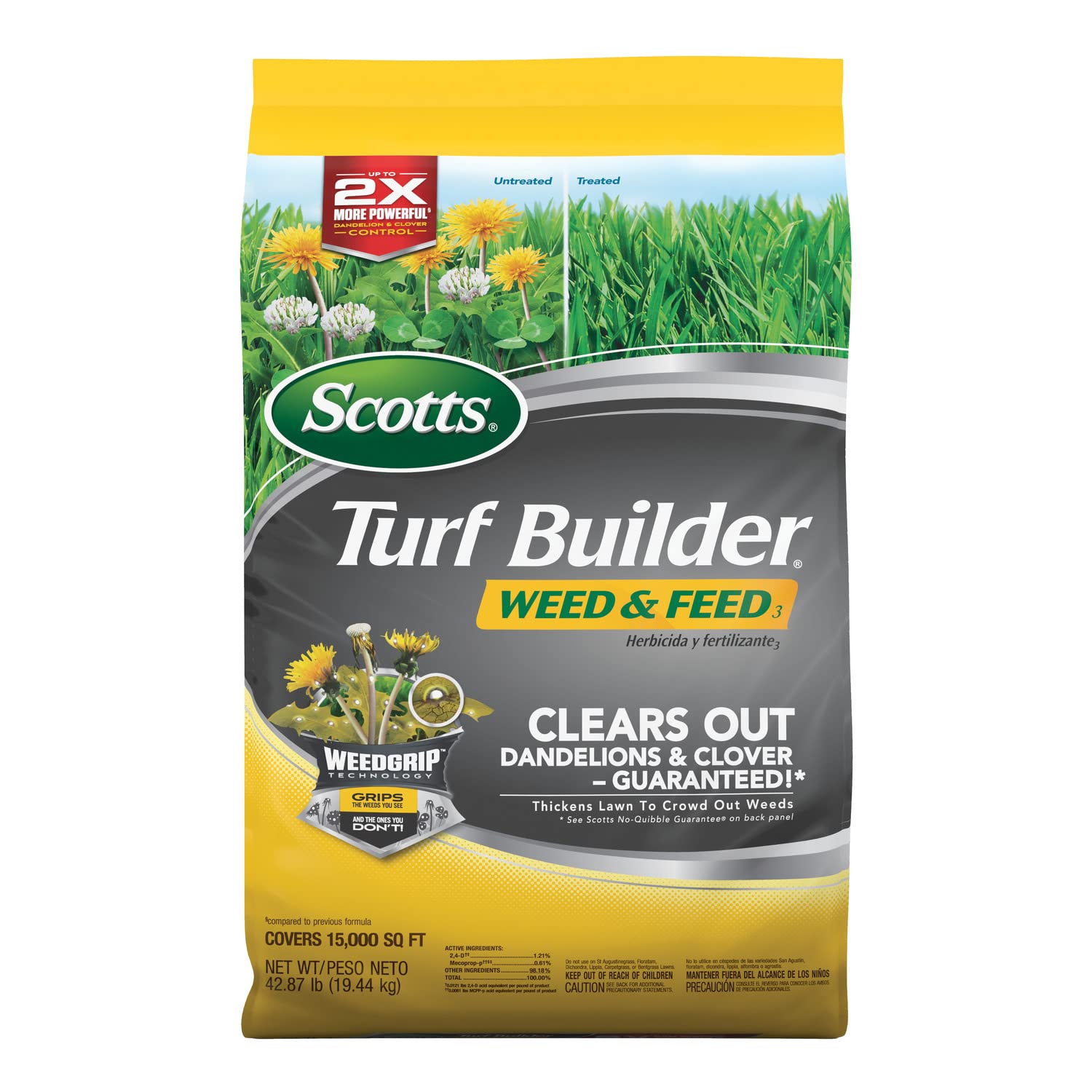
Scotts Turf Builder Weed & Feed (42.87 lb)
| Item Form | Granule |
|---|---|
| Coverage | 15000 square_feet |
| Active Ingredients | 24-D Mecoprop-p |
Scotts Turf Builder Weed & Feed is a granular lawn treatment that kills broadleaf weeds while feeding grass to encourage thicker turf. It is applied with a spreader when weeds are actively growing and temperatures are between 60°F and 90°F; the label recommends applying to a wet lawn so granules stick to weed leaves and waiting 24 hours before watering. The formula uses WeedGrip technology and lists active ingredients including 2,4-D and Mecoprop-p, and the 42.87 lb bag covers about 15,000 square feet. In practice this product is straightforward to broadcast across medium to large lawns and gives visible reduction of common weeds like dandelions and clover while supplying nutrients to help crowd out future weeds. Important limitations are application timing and grass restrictions: do not use on St. Augustinegrass, bentgrass, carpetgrass, dichondra, or lippia, and do not apply if rain is expected within 24 hours. Also keep people and pets off treated turf until dust settles. For homeowners who follow label directions, it is an efficient one-step option for late spring weed control and feeding.
Best for: Homeowners who want a single product to both reduce common broadleaf weeds and feed a cool- or warm-season lawn and who prefer a proven brand with clear label instructions and wide user adoption.
Less Ideal for: People with lawns made of excluded grass types or those needing immediate spot treatment for individual weeds should consider alternatives designed for those specific situations.
- Combines selective broadleaf weed control and fertilizer in one application
- Large bag covers up to 15,000 sq. ft., suitable for medium to large lawns
- WeedGrip technology helps granules adhere to weed leaves for better control
- Granular form is compatible with common broadcast or drop spreaders
- Not safe for several grass types including St. Augustine and bentgrass
- Requires specific temperature and moisture conditions for best results
Verdict: A convenient, proven one-step weed-and-feed for homeowners who want broadleaf weed control plus lawn feeding across large yards.
GreenView Fairway Formula Lawn Fertilizer, 33 lb (covers 10,000 sq. ft.)

| Coverage | 10,000 sq. ft. |
|---|---|
| Item Form | Granules |
| Specific Uses For Product | Root Development, Seed Development, Soil Conditioning |
| Mixing Ratio | 27-0-5 |
GreenView Fairway Formula is a granular lawn fertilizer formulated to deliver steady nitrogen feeding without causing surge growth. It combines an immediate-release portion with a high proportion of slow-release nitrogen to feed turf for up to 12 weeks, making it suitable for routine spring or in-season applications when grass is actively growing. Typical use is broadcast application with a spreader for established lawns or raked into the seedbed for new lawns, and one bag claims coverage for about 10,000 sq ft. Notable features include a phosphate-free mix to reduce runoff concerns, a 27-0-5 N-P-K profile, and safety guidance to avoid hand spreading or applying before heavy rain. Practical benefits are longer intervals between applications, reduced risk of burning from controlled-release nutrients, and stronger, thicker turf and color. Limitations are that it is a straight nitrogen-focused formula (no weed control or broad-spectrum nutrient balance) and it requires careful spreading and watering to avoid off-target loss near hard surfaces or waterways.
Best for: Homeowners who want a practical, lower-maintenance fertilizing plan that prioritizes steady nitrogen feeding and fewer seasonal applications for medium to large lawns.
Less Ideal for: If you need simultaneous weed or crabgrass control, a combined fertilizer-plus-herbicide product would be a better choice; not for those who prefer a multi-nutrient or custom lawn program.
- Long-lasting feeding with up to 12 weeks of controlled-release nitrogen
- Covers up to 10,000 sq ft from a single 33 lb bag for fewer applications
- Phosphate-free formula reduces potential impact on waterways
- Suitable for all grass types and usable anytime turf is actively growing
- Does not include weed or crabgrass control
- Requires a spreader for even application and careful sweeping from hard surfaces
Verdict: Choose this fertilizer if you want a phosphate-free, high slow-release nitrogen formula that feeds lawns steadily for up to 12 weeks and reduces how often you need to apply.
GreenView Lawn Food 22-0-4, 16 lb bag

| NPK | 22-0-4 |
|---|---|
| Form | Granules |
| Coverage | 5,000 sq. ft. |
| Application | Broadcast or drop spreader |
GreenView Lawn Food is a granular, broadcast-applied lawn fertilizer designed to boost root development, speed spring green-up, and maintain deeper green color through an eight-week controlled-release formula. You apply it with a broadcast or drop spreader over up to 5,000 sq. ft., and the MESA controlled-release nitrogen delivers both immediate and slow-release nutrition so you get quicker green-up without a surge of excessive top growth. The zero-phosphate 22-0-4 blend focuses on nitrogen and potassium to improve drought resistance and nutrient uptake in established turf. Practical benefits for summer care include longer feeding intervals, better water retention from improved root vigor, and fewer repeat applications compared with quick-release products. Limitations are that it is not a starter fertilizer for new seed because it contains no phosphorus and it requires a spreader for even coverage; hand spreading is discouraged. Also the 16 lb bag suits small to medium lawns rather than large properties where multiple bags would be needed.
Best for: Homeowners who want a low-maintenance summer feed that reduces how often you need to reapply and prioritizes steady green-up and root health.
Less Ideal for: Those establishing new lawns from seed or managing large commercial turf areas who need phosphorus or high-coverage bulk quantities.
- Controlled-release MESA nitrogen gives up to 8 weeks of feeding for fewer applications
- Applicable with common broadcast or drop spreaders for even coverage
- Zero-phosphate formula aligns with lawn-use restrictions and protects waterways
- 22-0-4 NPK focuses on root development and drought resilience
- Not suitable as a phosphorus-containing starter fertilizer for new seed
- 16 lb bag covers about 5,000 sq. ft. so larger lawns will need multiple bags
Verdict: A convenient, controlled-release summer lawn food that keeps small to mid-size lawns greener longer with fewer applications.
Supply Solutions Lawn and Turf Granular Fertilizer 21.4-7-14.1 (25 lb)

| Item Form | Granules |
|---|---|
| Specific Uses For Product | Plant Growth, Root Development, Seed Development, Soil Conditioning |
| Coverage | 5lbs per 1000 feet |
| Mixing Ratio | 21.4-7-14.1 |
This granular fertilizer is designed as an all-purpose turf builder for home lawns and vegetable or fruit beds. Spread it with a broadcast or drop spreader following the bag settings, water the area consistently, and it supplies high nitrogen for quick green-up alongside phosphorus and potassium to support roots and stress resistance. The formula includes iron and several micronutrients so color improvement and deeper rooting are realistic within weeks on actively growing grass. It is supplied in a resealable bag that makes storage straightforward. Expect reliable, fast results when applied to actively growing lawns and kept moist after application. Limitations are that the high nitrogen content means timing matters — avoid application during dormancy or drought and follow safety instructions to prevent burn. Coverage guidance is given as 5 lbs per 1,000 sq ft, so larger properties will need multiple bags and careful spreader calibration to get even results.
Best for: Gardeners who prioritize dependable, fast-visible improvement in lawn color and density and who plan applications during active growing periods with routine watering.
Less Ideal for: Those managing very large lawns who want fewer applications or liquid feeding, or gardeners needing a low-nitrogen maintenance feed during dormancy.
- High nitrogen formulation for noticeable quick greening and vigorous top growth
- Includes iron and multiple micronutrients for improved color and turf health
- Resealable bag and granule form make storage and application with a spreader easy
- Suitable for all grass types and also labeled safe for fruits and vegetables
- High nitrogen concentration requires correct timing and watering to avoid burning turf
Verdict: Choose this fertilizer when you want a reliable, fast-acting granular turf builder that produces noticeable greening and stronger roots.
Scotts Turf Builder Lawn Food, 37.5 lb.

| Item Form | Granules |
|---|---|
| Specific Uses For Product | Lawn |
| Coverage | 15000 |
| Mixing Ratio | 32:0:4 |
Scotts Turf Builder Lawn Food is a granular, all-purpose lawn fertilizer formulated to thicken and green lawns while building deeper roots. It is used by broadcasting with a spreader or dropping with a drop spreader; Scotts gives specific spreader settings for easy, repeatable application. The bag covers a large area so it is convenient for whole-yard spring feeding routines. Practical benefits include improved root strength and better nutrient and water uptake compared with unfed turf, plus flexible timing since it can be applied to wet or dry grass and lightly watered in for faster greening. The product is pesticide-free and intended for any grass type, so it can fit into a seasonal program for warm-season grasses like Zoysia. Limitations are that it is a straight lawn food without weed control or insect ingredients, so you will need separate products for weeds or pests, and handling a 37.5 lb bag can be bulky for small yards or single-application needs.
Best for: Homeowners who want a straightforward, high-coverage spring fertilizer to strengthen and green their Zoysia lawn as part of a planned feeding routine.
Less Ideal for: Gardners who need one-step weed and feed or combined pest control solutions or those with very small lawns who prefer smaller package sizes.
- Covers up to 15,000 sq. ft. from one 37.5 lb. bag
- Formulated to build stronger roots and improve nutrient uptake
- Can be applied to wet or dry lawns and used with common spreaders
- Pesticide-free lawn food suitable for any grass type
- Does not include weed or insect control so additional products may be required
- Large bag size may be awkward for small properties or single applications
Verdict: A simple, high-coverage lawn food that reliably builds root strength and greens Zoysia when used as part of a seasonal feeding plan.
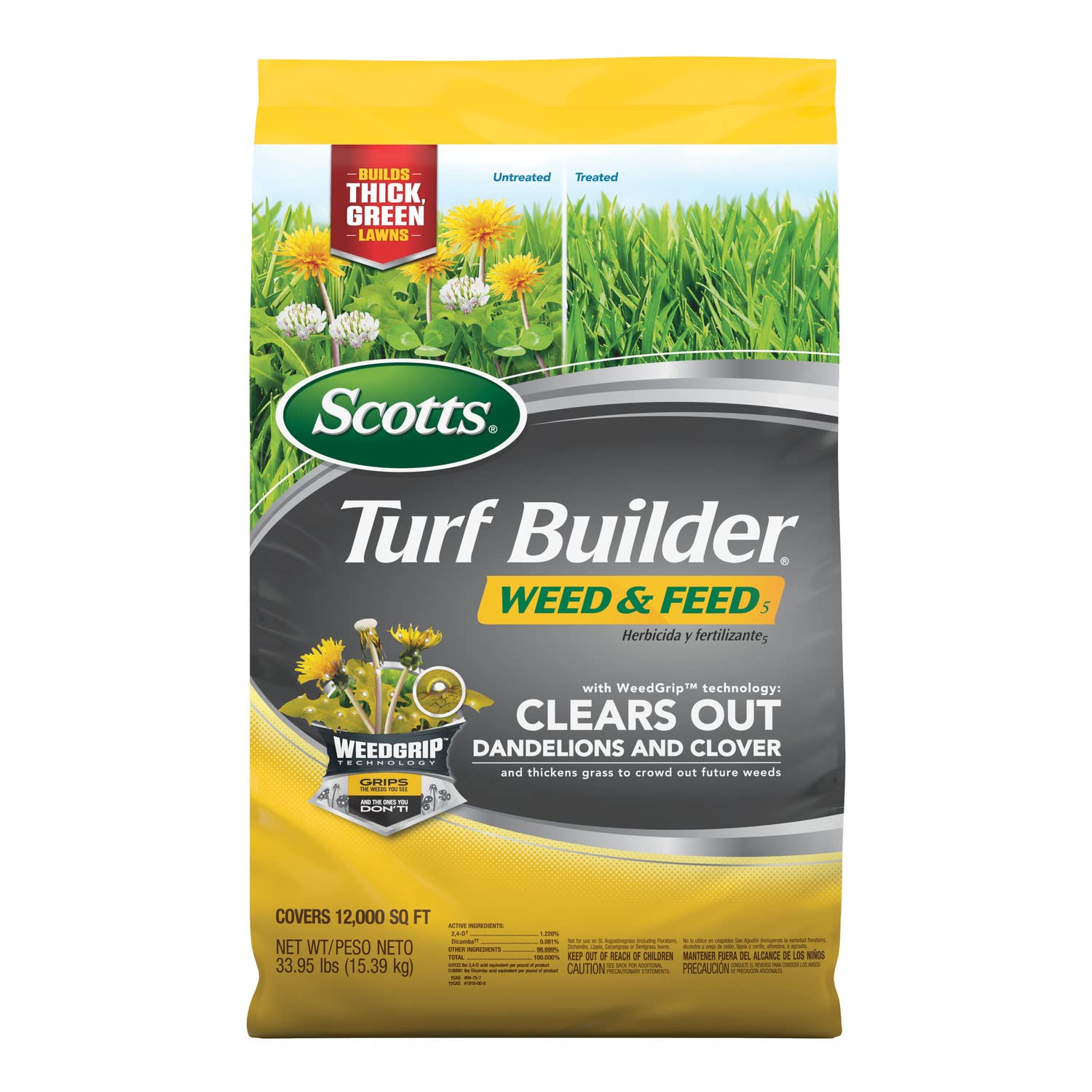
Scotts Turf Builder Weed & Feed5 Granular Lawn Fertilizer (33.95 lb)
| Item Form | Granule |
|---|---|
| Coverage | 12000 square feet |
| Active Ingredients | 2.4‑D and Dicamba |
| Unit Count | 1 Count |
Scotts Turf Builder Weed & Feed5 is a combined granular weed killer and lawn fertilizer intended for use when broadleaf weeds are actively growing and daytime temperatures are between 60°F and 90°F. You apply it to a wet lawn with a broadcast, drop, or hand spreader (Scotts publishes spreader settings) and then avoid watering for 24 hours to let granules stick to weed leaves. The formula uses WeedGrip technology and active ingredients 2,4‑D and dicamba to target common lawn weeds such as clover and dandelion while the fertilizer portion delivers nitrogen and potassium to thicken turf. A single 33.95 lb. bag is sized to cover about 12,000 square feet, making it convenient for medium to large yards. Important limits: do not use on St. Augustine, bentgrass, dichondra, carpetgrass, or lippia and do not apply if rain is expected within 24 hours; the product can also require keeping people and pets off treated turf until dust settles. For homeowners seeking a combined weed control plus feeding step, this simplifies late‑spring applications, but those with excluded grass types or who need precise spot treatments should consider alternatives.
Best for: Homeowners with warm‑season Bahia and other listed grass types who want a single late‑spring application to control broadleaf weeds while feeding the lawn and prefer products with established brand usage guidance.
Less Ideal for: Anyone growing St. Augustine, bentgrass, dichondra, carpetgrass, or lippia or gardeners who need spot treatments, organic options, or year‑round fertilization plans.
- Kills a wide range of listed broadleaf lawn weeds including clover and dandelion using WeedGrip technology
- Feeds lawn while treating weeds so it both reduces weeds and promotes thicker turf
- Large 33.95 lb. bag covers up to 12,000 sq ft, suitable for medium to large lawns
- Published application guidance and spreader settings make it straightforward to apply evenly
- Not safe for use on several turf types including St. Augustine and bentgrass
- Requires dry window after application and restriction on people and pets until dust settles
- Contains synthetic herbicides that require careful handling and label compliance
Verdict: A convenient, proven weed‑and‑feed option for Bahia and other compatible lawns that combines broadleaf weed control with feeding in one late‑spring application.
Choosing the Right Turf Builder Fertilizer: Key Factors to Consider
Nutrient Balance and N-P-K Ratio
The N-P-K mix drives what the fertilizer actually does in the lawn. Nitrogen is the primary driver of greener, lusher growth while phosphorus and potassium support root development and stress resilience. Look for a ratio that matches your seasonal goal: higher nitrogen for spring and early summer color, more potassium for stress tolerance in summer and fall.
Beyond the headline ratio, check for secondary nutrients such as iron and micronutrients. Iron can boost color without excessive growth, and micronutrients fill subtle deficiencies that leave lawns looking dull. A well-labeled product makes it easy to match formulation to your soil test results and desired outcome.
Release Profile and Feeding Duration
Fertilizers are sold as quick-release, slow-release, or a blend of both. Quick-release sources give fast greening but wear off sooner and can increase mowing frequency. Slow-release formulas provide steadier nutrients over weeks, reducing the risk of a sudden growth surge and lowering the chance of burn when applied correctly.
Choose a release profile that fits your maintenance habits. If you want rapid improvement before an event, a quick-release or blended product can be useful. For lower-maintenance feeding and steadier color, prioritize products with a higher share of controlled- or slow-release nitrogen.
Application Method and Spreader Compatibility
How you apply fertilizer affects coverage uniformity and ease of use. Granular Turf Builder fertilizers must match your spreader settings-broadcast or drop spreaders deliver different patterns and you should pick a product that lists spreader recommendations. Some formulations flow better and resist bridging in hopper boxes, which matters if you treat large areas or have an older spreader.
Also consider ease of cleanup and whether the product needs to be watered in. Products that require immediate watering increase water use but can reduce burn risk; those tolerant of delayed watering offer more flexibility in scheduling.
Coverage Rate and Efficiency
Coverage rate tells you how many square feet a bag treats at the recommended application rate. A product that covers more area per bag can be more convenient for larger yards, but only if it also delivers the nutrient levels you need. Evaluate labeled application rates and how many passes with a spreader are needed for uniform coverage.
Efficiency also includes how evenly granules distribute. Clumping or inconsistent particle sizes can cause patchy results. Look for products with consistent particle form and clear spreader settings to reduce overlap and missed strips on your lawn.
Turf Safety and Burn Risk
High-soluble nitrogen sources can burn grass if overapplied or left on leaf blades in hot, dry conditions. Products intended for home lawns usually include guidance to minimize burn, but formulation still matters. Slow-release components and properly sized granules reduce immediate salt shock to turf.
Consider your climate and recent weather when choosing an application rate and timing. For sensitive or newly seeded areas, choose gentler formulations or reduced application rates to protect young grass. Always follow label guidance for maximum application per season to avoid stress and potential turf injury.
Seasonal Timing and Turf Goals
Different fertilizers suit different seasonal goals. Early-season applications focus on recovery and green-up, mid-season feeds maintain color, and late-season formulas emphasize root development and winter hardiness. Matching a Turf Builder formulation to the season helps you get the most benefit from each application.
If you have specific goals like overseeding, dethatching, or dealing with shade, adjust your fertilizer choice and timing accordingly. Some formulations pair better with overseeding because they are less likely to scorch new grass, while others are optimized for established lawns needing a quick color boost.
When to Apply in Your Lawn Calendar
Timing fertilizer applications around the active growth period for your grass species yields the biggest benefit. Cool-season turf benefits most from early spring and fall feeds, while warm-season grasses respond best to late spring and summer applications once growth has started.
Avoid heavy nitrogen applications during extreme heat or drought to reduce burn risk. Instead, plan lighter, slow-release treatments or irrigate before and after applying to help uptake and reduce stress.
- Plan feeds for active growth windows, not dormancy
- Use slow-release during hot spells to avoid surges
- Water lightly after application when label recommends
How to Match Product to Spreader Type
Check product labeling for spreader settings and particle size guidance before purchase. Broadcast spreaders cover faster but can create overlap if not used carefully, while drop spreaders are more precise for edges and narrow strips.
When treating a mixed lawn with obstacles, consider doing a perimeter pass with a drop spreader and the main area with a broadcast spreader to balance precision and efficiency.
- Look for products with recommended spreader settings
- Test a small patch to dial in spreader calibration
- Avoid overfilling the hopper to reduce bridging
Adjusting Rates for Overseeding and Repairs
When overseeding, reduce the application rate or choose a gentler formulation to protect delicate seedlings. Heavy feeding can harm new grass and reduce germination rates. Follow guidelines for starter-type approaches when establishing new turf.
For spot repairs or small patches, apply at a reduced rate and water more frequently to support seedling establishment without risking burn on surrounding established turf.
- Use lower rates or starter formulations when seeding
- Avoid top-dressing with the same fertilizer rate used on established turf
- Stagger small-area treatments to limit stress
Storage, Handling, and Environmental Care
Store fertilizers in a cool, dry place out of reach of children and pets, and keep them in their original packaging to preserve label instructions. Moisture exposure can cause clumping and change application behavior.
Be mindful of runoff and avoid applying before heavy rain. Proper timing reduces nutrient loss to stormwater and helps meet local environmental guidelines. Sweep any granules off driveways and sidewalks back onto turf to prevent wash-off into drains.
- Keep bags sealed and stored dry
- Avoid applications before forecasted heavy rain
- Sweep off hard surfaces to prevent runoff
Interpreting Labels and Application Math
Labels provide the N-P-K percentage, recommended rate per 1,000 square feet, and directions for watering. Learn to calculate coverage so you know how many bags you need and can avoid overlapping passes. For example, dividing the bag's coverage figure by your lawn size gives a quick estimate of required bags.
Follow label maximums per season to prevent overapplication. If you use multiple products in a season, add the total applied nitrogen to stay within safe limits for your turf type.
- Calculate coverage before applying to avoid waste
- Check maximum seasonal nitrogen on the label
- Adjust rates based on soil test results
How We Chose the Best Turf Builder Fertilizer
We evaluated products that specifically fit the Turf Builder category and shortlisted options based on measurable, garden-relevant dimensions. Primary evaluation criteria included nutrient formulation and release profile, which determines immediate greening versus slow release feeding; application and spreader compatibility, since many home lawns are treated with broadcast or drop spreaders; and coverage efficiency, meaning how evenly a product distributes nutrients across a typical yard. Additional filters included safety and turf tolerance for common cool- and warm-season grasses, and storage and handling ease for seasonal gardeners. We excluded broad or ambiguous lawn fertilizers not labeled as Turf Builder formulations, and any products lacking clear nutrient breakdowns or application instructions. The final selections prioritize clear labeling, gardener-friendly application, predictable release behavior, and compatibility with typical lawn care workflows.
FAQ
How often should I apply a Turf Builder fertilizer?
Frequency depends on the product's release profile and your turf type. Slow-release formulations often need only two to three applications per growing season, while quick-release products may be used more frequently. Check label guidance and avoid exceeding recommended seasonal nitrogen totals.
Can I use Turf Builder fertilizer on newly seeded lawns?
New seedlings are more sensitive to high soluble nitrogen. Use a starter-friendly formulation or reduce the application rate and water lightly to protect germination. Some Turf Builder formulations are designed to be safe around new seed when used at reduced rates.
Will Turf Builder fertilizers burn my grass?
Burn risk depends on the formulation, application rate, and weather. High-soluble nitrogen increases burn potential in hot, dry conditions, while slow-release blends reduce that risk. Always apply at the labeled rate and irrigate when recommended to minimize burn risk.
Do I need to water in after spreading Turf Builder granules?
Some formulations require light watering to activate nutrients and reduce burn risk; others are tolerant of delayed watering. The label will specify whether irrigation is needed and how soon after application it should occur.
How do I choose the right N-P-K for my lawn?
Match the N-P-K to your seasonal goal and soil test results. Higher nitrogen formulations promote quick green-up, while balanced or potassium-forward mixes support stress tolerance. A soil test helps determine if phosphorus or micronutrients are necessary.
Can Turf Builder products be used on all grass types?
Many Turf Builder formulations suit both cool- and warm-season grasses, but timing and rate adjustments may be required. Always follow species-specific guidance and adjust application windows to match your grass's active growth periods.
Final Verdict
Prioritize the fertilizer attributes that align with your lawn goals: choose nutrient ratios for the outcomes you want, match release profile to your maintenance cadence, and confirm spreader compatibility for even coverage. Account for turf safety by adjusting rates and timing around weather and new seed. Focus on predictable release behavior and clear labeling when narrowing choices. If you keep those tradeoffs in mind, you can select a Turf Builder fertilizer that fits your schedule and delivers steady, healthy turf results.
