

Note: This article contains affiliate links. If you click on these links and make a purchase, I may earn a small commission at no extra cost to you. This helps support my research and content. Read my full affiliate disclosure here.
Centipede grass has modest fertility needs and slow growth, so using the right weed-and-feed fertilizer matters more than packing on nitrogen. The wrong product or timing can stress the lawn, encourage thatch, or damage desirable turf. This guide looks at seven shortlisted weed-and-feed options suited for centipede grass and explains how each meets the needs of a low-maintenance, warm-season lawn. We focus on application timing, nutrient ratios that suit centipede, and herbicide selectivity so you can pick a product that reduces broadleaf weeds without overstimulating growth. Below are the top picks and the criteria we used to evaluate them, followed by practical guidance for application and care.
Top Picks at a Glance
| Best Overall The best all-around choice for most situations | Fertilome Centipede Weed & Feed 15-0-15, 16 lb |  |
| Best Quality Built to a higher standard if you want something more solid | The Andersons Premium Weed and Feed 24-0-16 (18 lb) |  |
| Best Value The sweet spot between price and what you get | Ferti-Lome Centipede Weed & Feed Lawn Fertilizer 15-0-15 (2 × 16 lb bags) |  |
| Best Budget The cheapest option that still gets the job done reliably | Scotts Turf Builder Liquid Lawn Food Plus Weed Control, 32 fl. oz. |  |
| Highest Rated A top-rated pick with lots of positive feedback | Scotts Turf Builder WinterGuard Fall Weed & Feed, 11.43 lb |  |
| Most Popular A crowd favorite that many people choose with confidence | Scotts Turf Builder Weed & Feed5 Granular Lawn Fertilizer (33.95 lb) |  |
| Best Seller A high-volume bestseller chosen again and again | Scotts Turf Builder Weed & Feed 3, Granular Lawn Fertilizer and Weed Killer, 14.29 lb |  |
Fertilome Centipede Weed & Feed 15-0-15, 16 lb

| Item Form | Granules |
|---|---|
| Coverage | 5000 square feet |
| Target Species | Lawn Grass |
| Unit Count | 256 Ounce |
This is a two-in-one granular weed-and-feed designed specifically for centipede grass: it delivers slow-release nitrogen plus a Trimec-based broadleaf herbicide and added iron. Typical use is a spring and fall application to pre-moistened turf or dew-covered grass, with no watering for 24 hours afterward; one bag covers about 5,000 square feet and the manufacturer recommends only two applications per year. The formulation targets 200+ broadleaf weeds including dandelions, chickweed, and dollarweed while feeding the lawn to help improve color and vigor. Practical benefits include simplified maintenance since you combine feeding and broadleaf control in a single step and the slow-release nitrogen reduces burn risk compared with fast-release fertilizers. Limitations are typical for selective weed-and-feed products: it is intended for centipede and similar lawns only, it will not control grassy weeds or crabgrass, and timing and moisture rules must be followed to avoid reduced effectiveness or turf injury.
Best for: A homeowner who wants a low-effort, combined feeding and broadleaf control solution for a centipede lawn and prefers a product that reduces application frequency.
Less Ideal for: People managing lawns with mixed grass types, heavy grassy-weed pressure, or those needing a crabgrass preventer should look for specialized herbicides or separate weed control products.
- Combines slow-release nitrogen with post-emergent broadleaf control to feed and weed in one application
- Formulated specifically for centipede lawns to reduce risk of turf injury when used as directed
- Covers up to 5,000 square feet per bag which suits small to medium yards
- Controls a wide range of common broadleaf weeds including dandelions and chickweed
- Does not control grassy weeds or crabgrass so separate products may be needed
- Requires precise timing and dry period after application for best results
Verdict: If you have a centipede lawn and want one product to both feed and control common broadleaf weeds with only a couple of applications per year, this is a practical, low-effort choice.
The Andersons Premium Weed and Feed 24-0-16 (18 lb)

| Item Form | Granule |
|---|---|
| Coverage | 5,000 sq ft |
| Unit Count | 288 Ounce |
| Active Ingredients | Herbicide, Iron, Nitrogen, Sulfur |
The Andersons Premium Weed and Feed 24-0-16 is a granular lawn product designed to kill broadleaf weeds while feeding turf with a mix of quick- and slow-release nitrogen plus iron for deeper greening. You apply it with a rotary or drop spreader to a dry lawn, following the label spreader settings and the two-step application schedule for best control. It targets over 250 broadleaf weeds and lists compatibility with St. Augustine and other common warm- and cool-season grasses, making it useful for seasonal lawn program maintenance. Practical benefits include combined weed control and extended feeding in one pass and improved lawn color from added iron. Important limitations are geographic restrictions and the need to follow the two-application procedure and post-application watering to activate herbicide; it is also not suitable for dichondra or carpet grass. For performance-focused users, correct spreader calibration and adherence to timing will determine results more than the product alone.
Best for: Homeowners who prioritize visible lawn performance and want a combined weed-control plus feeding product for regular seasonal maintenance of St. Augustine and similar grasses.
Less Ideal for: People managing sensitive or restricted lawns such as dichondra or carpet grass or those located in states where this product is not approved.
- Combines herbicide and fertilizer so you kill weeds while feeding grass in one application
- Includes both quick- and slow-release nitrogen for immediate green-up and longer-lasting feeding
- Contains iron for deeper, faster greening of turf
- Covers up to 5,000 sq ft per bag, suitable for medium-sized yards
- Not approved for sale or use in some states which limits availability
- Requires specific spreader settings and a two-step application schedule for full effectiveness
Verdict: Choose this product if you want a single granular treatment that controls broadleaf weeds and delivers both quick and extended feeding for a noticeably greener St. Augustine lawn.
Ferti-Lome Centipede Weed & Feed Lawn Fertilizer 15-0-15 (2 × 16 lb bags)

| Item Form | Granules |
|---|---|
| Application Method | Broadcast or drop spreader |
| Target Species | Lawn Grass |
| Mixing Ratio | 15:0:15 |
This granular weed-and-feed combines a slow-release 15-0-15 fertilizer with iron to help thicken turf and improve color on centipede and other warm-season lawns. It is applied with a broadcast or drop spreader, making it practical for routine seasonal feeding across larger areas; the two 16 lb bags are marketed to cover up to about 10,000 sq ft in total. The slow-release nitrogen promotes steadier growth rather than a quick flush, which helps avoid spiking maintenance needs, and the added iron aids in a deeper green appearance. As a value bundle from a hardware-brand label it is useful for homeowners who want a straightforward, no-frills feed-and-weed step that fits into scheduled lawn care. Limitations to note are that the formulation lists 15-0-15 without a labeled herbicide mix on the product page, so users seeking a specific prepackaged broadleaf weed control should verify weed-control claims before use; also the product is designed for warm-season lawns and is not intended for cool-season turf varieties. Follow label directions and spreader calibration for even application and avoid off-target application to ornamentals.
Best for: Homeowners who want a simple, low-fuss seasonal feed to maintain centipede and other warm-season lawns and who prioritize steady growth and color improvement over targeted weed control.
Less Ideal for: Gardeners who need a confirmed, specific broadleaf or grassy weed treatment or those managing cool-season turf should choose a product formulated and labeled for those needs.
- Slow-release 15-0-15 formula provides steady nutrient availability for consistent growth
- Includes iron to help deepen lawn color without additional supplements
- Granular form works with standard broadcast or drop spreaders for easy application
- Two-bag bundle supplies a practical quantity for multiple feedings or larger lawns
- Product description emphasizes fertilizer formula but does not clearly list specific herbicide ingredients or labeled weed-control spectrum
Verdict: Choose this granular 15-0-15 value bundle if you want a straightforward slow-release feed that supports steady growth and improved color on centipede and other warm-season lawns.
Scotts Turf Builder Liquid Lawn Food Plus Weed Control, 32 fl. oz.

| Unit Count | 32 Fluid Ounces |
|---|---|
| Item Form | Liquid |
| Coverage | 2000 square feet |
| Included Components | Scotts Turf Builder Liquid Lawn Food Plus Weed Control |
This Scotts Turf Builder product combines a liquid fertilizer with a contact weedkiller in a reusable hose‑end applicator, so you can feed your lawn and spot‑treat many broadleaf weeds in one quick pass. It is used by connecting the bottle to a garden hose, spraying evenly across actively growing turf, then shutting off and disconnecting the hose. Notable features include a translucent bottle for visible application, a refillable sprayer designed for future refills, and a formula labeled for common grasses such as bluegrass, fescue, and rye. In practice it saves time compared with separate fertilizer and weed treatments and can cover a typical small lawn in about ten minutes. Expect weeds to curl within days and plan for a repeat application in 3 to 4 weeks for stubborn plants. Limitations are that it is labeled only for listed turf grasses and should not be used in garden beds or on unlisted lawn types, and you must avoid watering for 48 hours after application and not use when temperatures exceed 85°F.
Best for: Homeowners who want a fast, low‑effort way to both feed their lawn and control common weeds without separate products, especially for small to medium sized lawns and routine seasonal maintenance.
Less Ideal for: People with mixed planting areas, vegetable or flower beds, or those with unlisted grass types who need a more targeted herbicide or a granular slow‑release fertilizer.
- Two-in-one formula feeds grass while controlling many common broadleaf weeds
- Hose‑end applicator makes coverage fast and simple for small to medium lawns
- Translucent bottle and reusable sprayer reduce guesswork and support refills
- Covers approximately 2,000 square feet per 32 fl. oz. bottle
- Only approved for listed turf grasses and can harm plants outside those uses
- Must avoid watering for 48 hours after application and limit use in high heat
Verdict: A quick, convenient 2‑in‑1 hose‑on solution for homeowners who want to feed their turf and control common lawn weeds in one easy application.
Scotts Turf Builder WinterGuard Fall Weed & Feed, 11.43 lb

| Item Form | Granule |
|---|---|
| Coverage | 4000 square feet |
Scotts Turf Builder WinterGuard is a fall granular weed-and-feed formulated to kill common broadleaf weeds such as clover and dandelion while feeding cool- and warm-season grasses. It is applied with a broadcast or drop spreader to a moist lawn on a calm day when temperatures are between 60°F and 90°F. Notable features include WeedGrip Technology to improve granule adhesion to weed leaves, instructions tuned for Scotts spreaders, and coverage sized for about 4,000 square feet per 11.43 lb bag. In practice it simplifies a seasonal task by combining weed control and fertilization in one application, which helps build root strength and recover summer stress heading into winter. Important limitations are that it is labeled for specific grass types only and must not be used on St. Augustinegrass, bentgrass, or several groundcover species, and you must avoid watering for 24 hours after application for best effect. For homeowners who want a dependable, single-step fall treatment for typical lawn weeds, this performs as advertised; those with unsupported grass types or very large lawns will need a different product or multiple bags.
Best for: Homeowners who prioritize a reliable, low-effort fall solution to eliminate clover and other broadleaf weeds while feeding their lawn for winter hardiness.
Less Ideal for: Properties planted with unsupported turf species or buyers who need coverage for very large lawns without buying multiple bags.
- Kills over 50 listed lawn weeds including clover and dandelion
- Combined fertilizer and weed control saves an extra application
- WeedGrip Technology helps granules stick to moist weed leaves for better uptake
- Clear application guidance for use with Scotts spreaders and recommended timing
- Labeled for specific grass types only and should not be used on St. Augustinegrass, bentgrass, or certain groundcovers
Verdict: Choose this product if you want a dependable one-step fall treatment that both kills clover and feeds your lawn to build stronger roots for spring.
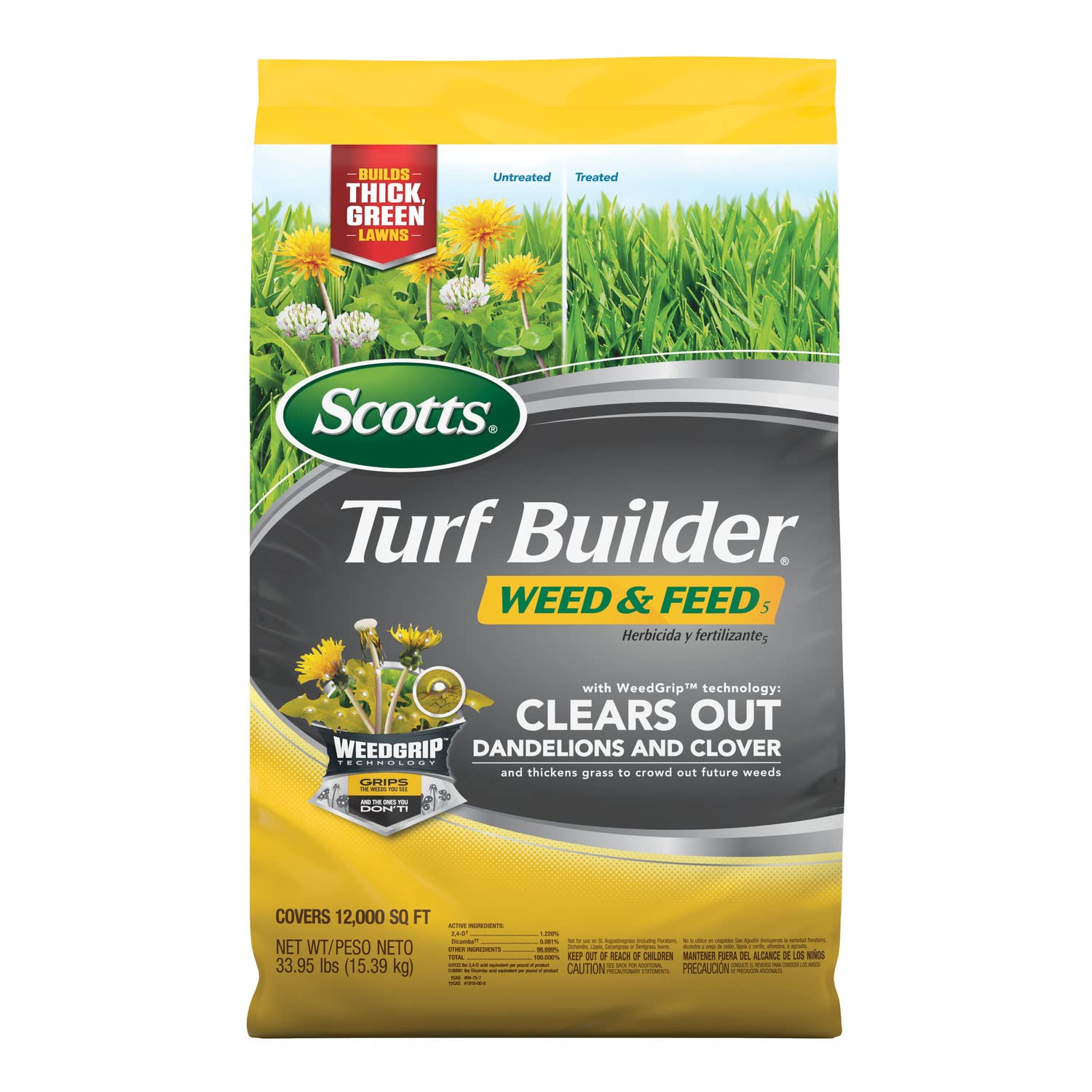
Scotts Turf Builder Weed & Feed5 Granular Lawn Fertilizer (33.95 lb)
| Item Form | Granule |
|---|---|
| Coverage | 12000 square feet |
| Active Ingredients | 2.4‑D and Dicamba |
| Unit Count | 1 Count |
Scotts Turf Builder Weed & Feed5 is a combined granular weed killer and lawn fertilizer intended for use when broadleaf weeds are actively growing and daytime temperatures are between 60°F and 90°F. You apply it to a wet lawn with a broadcast, drop, or hand spreader (Scotts publishes spreader settings) and then avoid watering for 24 hours to let granules stick to weed leaves. The formula uses WeedGrip technology and active ingredients 2,4‑D and dicamba to target common lawn weeds such as clover and dandelion while the fertilizer portion delivers nitrogen and potassium to thicken turf. A single 33.95 lb. bag is sized to cover about 12,000 square feet, making it convenient for medium to large yards. Important limits: do not use on St. Augustine, bentgrass, dichondra, carpetgrass, or lippia and do not apply if rain is expected within 24 hours; the product can also require keeping people and pets off treated turf until dust settles. For homeowners seeking a combined weed control plus feeding step, this simplifies late‑spring applications, but those with excluded grass types or who need precise spot treatments should consider alternatives.
Best for: Homeowners with warm‑season Bahia and other listed grass types who want a single late‑spring application to control broadleaf weeds while feeding the lawn and prefer products with established brand usage guidance.
Less Ideal for: Anyone growing St. Augustine, bentgrass, dichondra, carpetgrass, or lippia or gardeners who need spot treatments, organic options, or year‑round fertilization plans.
- Kills a wide range of listed broadleaf lawn weeds including clover and dandelion using WeedGrip technology
- Feeds lawn while treating weeds so it both reduces weeds and promotes thicker turf
- Large 33.95 lb. bag covers up to 12,000 sq ft, suitable for medium to large lawns
- Published application guidance and spreader settings make it straightforward to apply evenly
- Not safe for use on several turf types including St. Augustine and bentgrass
- Requires dry window after application and restriction on people and pets until dust settles
- Contains synthetic herbicides that require careful handling and label compliance
Verdict: A convenient, proven weed‑and‑feed option for Bahia and other compatible lawns that combines broadleaf weed control with feeding in one late‑spring application.
Scotts Turf Builder Weed & Feed 3, Granular Lawn Fertilizer and Weed Killer, 14.29 lb

| Item Form | Granule |
|---|---|
| Coverage | 5000 square_feet |
| Active Ingredients | 2,4-D 1.220%, Mecoprop 0.081% |
Scotts Turf Builder Weed & Feed3 is a granular lawn product that combines a fertilizer with broadleaf weed control for routine lawn maintenance. It is applied with a broadcast or drop spreader to a wet lawn when daytime temperatures are between 60 and 90°F, and it uses WeedGrip technology to help granules stick to weed leaves for better uptake. In practice it kills common weeds such as dandelion and clover while delivering nutrients to thicken grass, so treated areas often green up and look fuller over a few weeks. The package covers about 5,000 sq. ft. and manufacturer instructions recommend avoiding certain grass types and keeping people and pets off the lawn until dust settles. Important limitations are that it is not safe for some turf species and must not be watered for 24 hours after application; timing and correct spreader settings affect results. For homeowners wanting a combined feed-and-weed treatment for standard lawns, it simplifies two tasks into one application, but it requires following the label closely for safe and effective use.
Best for: Homeowners seeking a straightforward, combined fertilizer and weed-control treatment to maintain and thicken common cool- and warm-season turf in a typical yard.
Less Ideal for: Specialist turf managers, owners of sensitive turf varieties (listed on the label), or those who need spot treatment only rather than whole-lawn applications.
- Combines fertilizer and broadleaf weed control in one granular product
- WeedGrip formulation helps granules adhere to weed leaves for improved herbicide contact
- Covers approximately 5,000 sq. ft. per 14.29 lb bag, suitable for many small to medium lawns
- Clear application guidance for use with common spreaders and specific temperature/wetting windows
- Contains active herbicide ingredients not appropriate for all turf types and must be avoided on listed grasses
- Requires strict timing and no watering for 24 hours after application to be effective and safe
Verdict: A practical one-step weed-and-feed for typical lawns that feeds turf while targeting common broadleaf weeds across a 5,000 sq. ft. area.
Choosing the Right Weed and Feed Fertilizer for Centipede Grass: Key Factors to Consider
Appropriate Nitrogen Level
Centipede grass grows slowly and is sensitive to excessive nitrogen. Choosing a weed-and-feed with a mild to moderate nitrogen percentage helps maintain a healthy green without promoting a flush of tender growth that needs frequent mowing.
Higher nitrogen formulations can force rapid top growth, increase mowing frequency, and may predispose the turf to insects or disease. Look for products that specify a controlled-release nitrogen source or a lower N number in the analysis to match centipede's steady growth habit.
Herbicide Safety and Spectrum
The active ingredients determine which weeds are controlled and whether the product is safe on centipede. Some broadleaf herbicides are labeled for use on centipede, while others can cause yellowing or decline. Check that the herbicide spectrum includes the common broadleaf weeds you have and that the label explicitly allows application to centipede grass.
Selective herbicides that target common lawn weeds without harming turf are preferable. Avoid products with aggressive post-emergent mixes unless the label shows compatibility with centipede and provides clear rate and timing guidance.
Release Profile and Feeding Schedule
Controlled-release nitrogen delivers nutrition steadily over weeks, reducing growth surges and lowering stress on centipede turf. Rapid-release fertilizers give a quick green-up but can overstimulate slow-growing lawns and demand more water and mowing.
Consider how often you want to apply fertilizer. A product with a predictable multi-week release reduces application frequency and the chance of overfertilizing. Also account for your climate and seasonal growth patterns so nutrient release aligns with active growth periods.
Timing and Local Climate
Centipede is a warm-season grass that responds best to fertilization during active growth in late spring and summer. Applying weed-and-feed too early in the spring or late in the fall can be ineffective or harmful.
Coordinate application with weed life cycles and turf growth. Pre-emergent timing controls certain annual weeds, while post-emergent herbicides work on established broadleaf species. Choose formulations and schedules that match your local frost dates and rainfall patterns to optimize control and minimize runoff risk.
Application Accuracy and Equipment
Even coverage matters. Uneven spread results in patchy color, burn spots, or poor weed control. Granule size, uniformity, and whether a product requires a specific spreader setting affect how easy it is to apply correctly.
Use a calibrated broadcast or drop spreader and follow label rates closely. Consider how large your lawn is and whether you can realistically apply the product evenly. Some products provide clear spreader charts which reduce guesswork and risk of turf stress from overapplication.
Soil Testing and Potassium Needs
Centipede often prefers lower fertility but can benefit from adequate potassium for stress tolerance, especially in sandy or low-organic soils. A soil test reveals existing nutrient levels and informs whether a weed-and-feed's potassium component will correct deficiencies or exceed what is needed.
Relying on a combined weed-and-feed without testing can mask potassium imbalances. If a soil test shows low potassium, choosing a formulation with higher K can improve drought and cold tolerance. If levels are already adequate, avoid excess that offers no benefit and risks nutrient runoff.
When to Apply for Best Results
Timing your application to match both turf and weed activity is essential. For centipede grass, plan treatments during the warm-season growth window when the turf is actively producing new leaves so it can recover quickly from herbicide activity and take up nutrients.
Pre-emergent and post-emergent herbicides serve different purposes. Use a product labeled for pre-emergent control in early spring if annual grassy weeds are a problem. For existing broadleaf weeds, apply a post-emergent-containing weed-and-feed during active weed growth but avoid stressful weather such as extreme heat or drought.
- Avoid applications right before a hard frost or during heat waves.
- Water lightly if the label recommends activation, but do not overwater immediately after application unless directed.
- Do not mow 24 to 48 hours before or after application unless label instructions differ.
Preparing the Lawn Before Treatment
Mow to a normal height a day or two before applying so herbicide contacts more leaf surface. Remove debris and thatch if it is excessive, because thick thatch can block granules from reaching the soil and foliage where they are effective.
Address irrigation so soil is neither waterlogged nor bone dry at time of application. Many weed-and-feed products require a specific amount of moisture to activate the fertilizer portion without washing herbicide away.
- Calibrate your spreader using a test area and follow the product's spreader setting chart.
- Mark sprinkler heads or sensitive beds to prevent accidental contamination during watering after application.
Combining Cultural Practices with Weed-and-Feed
Weed-and-feed is one tool among many. Improving mowing practices, overseeding thin areas, and correcting soil pH through lime or sulfur can reduce weed pressure long term. A healthy dense centipede stand competes better with weeds and requires fewer chemical interventions.
Addressing compaction, irrigation scheduling, and thatch control helps the fertilizer portion work more effectively. Cultural practices often extend the interval between needed chemical treatments and improve overall lawn resilience.
- Raise mower height slightly for centipede to shade weed seedlings.
- Use spot treatments for isolated weed outbreaks rather than blanket applications when possible.
Environmental and Safety Considerations
Follow label directions to reduce risk of runoff into storm drains and waterways. Avoid applying before heavy rain forecasts and consider buffer zones around ponds, streams, and permeable surfaces.
Store and handle products according to instructions to protect children, pets, and beneficial insects. Use personal protective equipment recommended on the label and clean equipment after use to prevent cross-contamination with other garden products.
- Sweep granules off driveways and sidewalks back onto the lawn to avoid wash-off.
- Consider targeted spot applications for small lawns to reduce total chemical use.
Adjusting Applications for Small or Patchy Lawns
Small yards or patchy centipede stands need careful rate adjustments and precise application to avoid overfeeding or herbicide stress. Measure lawn area accurately and apply the recommended rate for your square footage rather than guessing.
For very small patches, dilute product appropriately and consider using granular spreader settings for small areas or applying by hand with care. Spot treating weeds with a non-weed-and-feed herbicide or hand removal combined with a light fertilizer can be less risky for delicate centipede turf.
- Treat only problem areas at reduced rates when full-lawn application is unnecessary.
- Keep a log of application dates and weather to fine-tune timing in subsequent seasons.
How We Chose the Best Weed and Feed Fertilizer for Centipede Grass
We selected products that match centipede grass physiology and common lawn care routines. Evaluation emphasized nutrient ratios appropriate for low-to-moderate fertility needs, such as low to moderate nitrogen with sufficient potassium for stress tolerance. Herbicide spectrum and labeled safety for centipede turf were crucial; we prioritized options whose active ingredients are commonly recommended for broadleaf control without known toxicity to centipede when used as directed. Application timing and release profile were key filters. Slow-release or controlled-release nitrogen sources reduce rapid top growth and lower mowing and watering demands, so products with measured release characteristics scored higher. Ease of application, including granule consistency and spreader calibration guidance, was considered because accurate rates reduce the risk of turf injury. Coverage per bag and recommended application windows for centipede climate zones were also weighed. We excluded any formulations with herbicide labels that specifically prohibit use on centipede grass or that require off-label turf use. Products lacking clear nutrient analysis or without manufacturer application guidance for warm-season lawns were removed. The final shortlist balances safe weed control, modest fertility aligned with centipede needs, predictable release behavior, and straightforward application.
FAQ
Can I use a standard weed-and-feed on centipede grass?
Often yes if the product label lists centipede grass among labeled turf types. Always read the label because some herbicide mixes can harm centipede. Choose a product with a nutrient balance and herbicide spectrum appropriate for warm-season, slow-growing turf.
How long after application will I see weed control?
Results vary by herbicide type and weed species. Post-emergent broadleaf control can show visible decline within 7 to 21 days. Pre-emergent actions prevent new seedlings and will not affect established weeds, so timing is important for expected outcomes.
Will weed-and-feed make centipede grow too fast?
It can if the product has a high quick-release nitrogen component. Selecting a formulation with controlled-release nitrogen or a lower N percentage helps avoid excessive top growth in centipede, reducing mowing and stress.
Can I apply weed-and-feed during drought?
Usually you should avoid applying during drought or extreme heat because the turf is already stressed. Applying when centipede is actively growing and soil moisture is adequate reduces the risk of herbicide injury and helps plants recover from treatment.
How often should I apply weed-and-feed to centipede grass?
Frequency depends on the product release profile and local growing conditions. Many formulations are designed for a spring or early summer application with repeat treatments spaced according to label intervals. Rely on soil tests and observed turf response to decide whether additional applications are necessary.
Do I need a soil test before using weed-and-feed?
A soil test is recommended because centipede has specific nutrient preferences. Testing helps determine whether the potassium and other nutrients in a combined product address actual deficiencies or whether separate amendments are a better fit.
Final Verdict
Choose a weed-and-feed that matches centipede grass needs by prioritizing a modest nitrogen level, a herbicide mix labeled safe for centipede, and a controlled-release feeding profile. Timing and even application are just as important as product choice, so plan treatments for active growth periods and calibrate your spreader to avoid hot spots. Weigh the tradeoffs between quick green-up and turf stress. When in doubt, favor gentler, slow-release formulations and pair chemical control with cultural practices like proper mowing, irrigation, and soil testing to maintain a healthy centipede lawn over the long term.
