

Note: This article contains affiliate links. If you click on these links and make a purchase, I may earn a small commission at no extra cost to you. This helps support my research and content. Read my full affiliate disclosure here.
Choosing the right weed and feed matters because it combines fertilizer and weed control in a single application, and the wrong choice can leave bare patches or uncontrolled weeds. In lawns where timing, turf type, and weed pressure vary, you need a product that matches your soil fertility goals and targets the weeds you actually have. This guide shortlists seven top Weed and Feed products suited to common home-lawn situations. We explain the practical differences in nutrient formulations, herbicide spectrum, application timing, and safety considerations so you can select the product that fits your lawn care calendar and turf species. Read on for the criteria we used and what to prioritize before applying.
Top Picks at a Glance
| Best Overall The best all-around choice for most situations | Scotts Turf Builder Weed & Feed5 Granular Lawn Fertilizer (33.95 lb) |  |
| Best Quality Built to a higher standard if you want something more solid | The Andersons Surge Weed & Feed 16-0-9 Granular Lawn Fertilizer (40 lb) |  |
| Best Value The sweet spot between price and what you get | GreenView Weed & Feed Lawn Fertilizer, 39 lb — Covers 15,000 sq. ft. |  |
| Best Budget The cheapest option that still gets the job done reliably | Spectracide Weed & Feed 20-0-0 Ready-to-Spray, 32 oz |  |
| Highest Rated A top-rated pick with lots of positive feedback | Scotts LawnPro Weed Control Plus Lawn Fertilizer, 14.63 lb |  |
| Most Popular A crowd favorite that many people choose with confidence | Scotts Turf Builder Weed & Feed 42.87 lb |  |
| Best Seller A high-volume bestseller chosen again and again | Scotts Turf Builder Weed & Feed3 Granular Lawn Fertilizer, 14.29 lb |  |
Scotts Turf Builder Weed & Feed5 Granular Lawn Fertilizer (33.95 lb)
| Item Form | Granule |
|---|---|
| Coverage | 12000 square feet |
| Active Ingredients | 2.4-D, Dicamba |
| Unit Count | 1 Count |
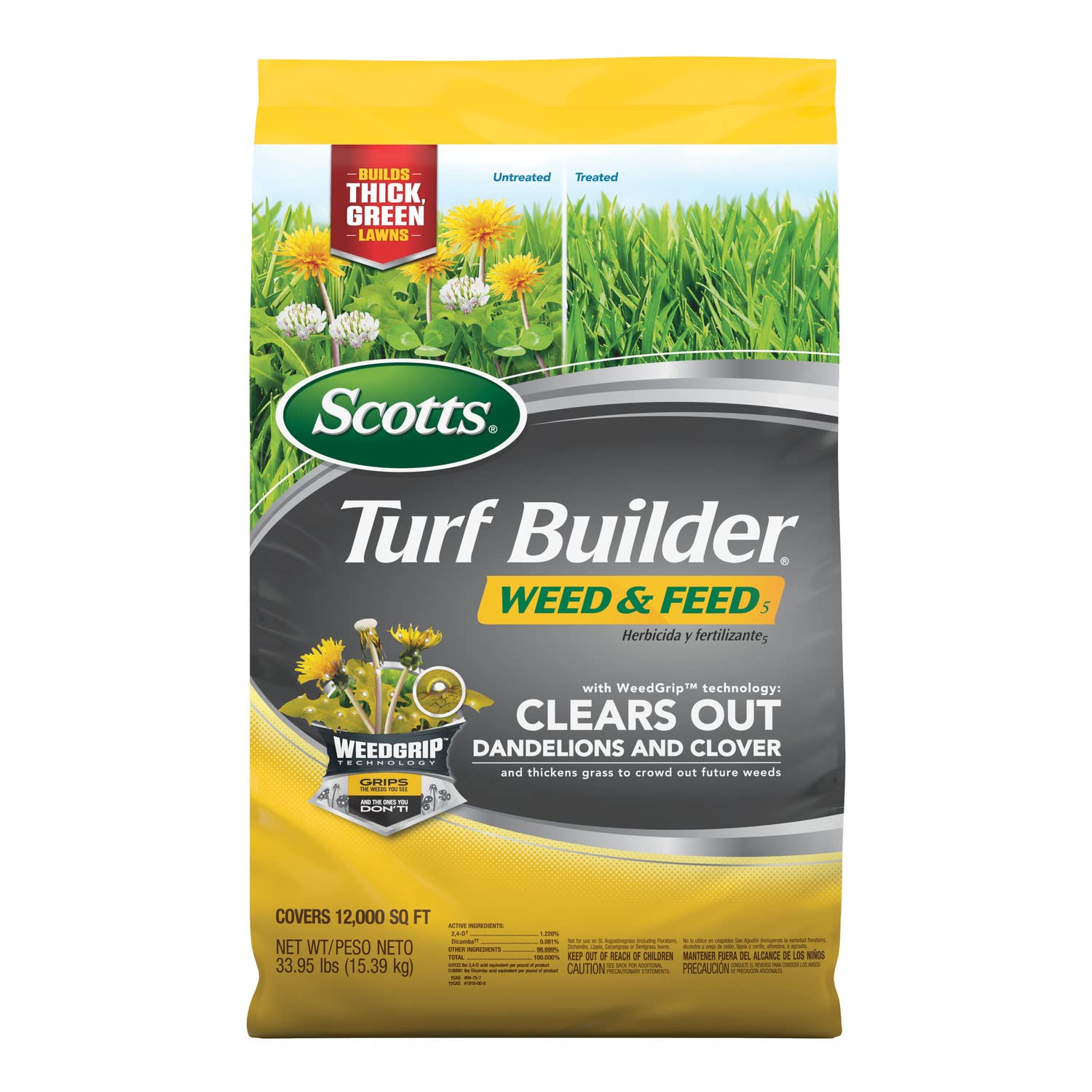
Scotts Turf Builder Weed & Feed5 combines broadleaf weed control with a lawn fertilizer in a single granular treatment. You apply it with a broadcast, drop, or hand-held spreader when weeds are actively growing and temperatures are between 60 and 90°F, ideally to a wet lawn so granules stick to weed leaves. The formula lists 2,4-D and dicamba as active ingredients and claims control of more than 50 named weeds such as dandelion and clover while delivering nitrogen and potassium to promote thicker grass. A single 33.95 lb bag treats about 12,000 sq. ft., making it practical for average to large yards. Use of a Scotts spreader is recommended for even distribution and the label requires no watering for 24 hours after application. Important limitations: it must not be used on several warm-season and specialty grasses including St. Augustine, bentgrass, dichondra, carpetgrass, or when pets and people may contact the lawn before dust settles. For homeowners looking for a simple combined treatment, this product reduces steps, but you should follow label restrictions and timing for safe, effective results.
Best for: Homeowners who want a straightforward, time-saving product to both kill common broadleaf weeds and feed their lawn across a typical front or back yard.
Less Ideal for: Gardeners who maintain sensitive turf varieties, small ornamental lawns, or who prefer non-chemical or targeted spot treatments should consider alternatives.
- Combines weed control and fertilizer in one application to save time
- Covers up to 12,000 sq. ft. from a single 33.95 lb bag, suitable for medium to large lawns
- Controls a wide list of common broadleaf weeds including dandelion and clover
- Granular form works with standard spreaders for even application when directions are followed
- Contains synthetic herbicides (2,4-D and dicamba) so it is not suitable for use near sensitive plants or where herbicide drift is a concern
- Label disallows use on several grass types, limiting compatibility with some warm-season and specialty lawns
Verdict: A convenient all-in-one granular Weed & Feed that treats common lawn weeds while feeding turf, ideal for homeowners wanting a simple, broad solution.
The Andersons Surge Weed & Feed 16-0-9 Granular Lawn Fertilizer (40 lb)

| Item Form | Granule |
|---|---|
| Coverage | 16000 square_feet |
| Unit Count | 640 Ounce |
| Active Ingredients | Herbicide |
The Andersons Surge Weed and Feed is a professional four‑way granular treatment that combines herbicide action with a 16-0-9 fertilizer to feed lawns while eliminating broadleaf weeds. It is applied with a broadcast spreader to established turf when broadleaf weeds are actively growing; best results come from mowing 1–2 days before application, applying to a damp lawn so granules adhere, and avoiding irrigation for at least 24 hours afterward. The product claims control of more than 250 common weeds and uses relatively small granules for wider coverage per square inch. In practice this means you can treat a large yard quickly and expect both greening and weed suppression over the season, including cooler spring and fall windows. Important limitations are that it is not suitable for certain turf types such as Floratam St. Augustine, dichondra, carpetgrass, creeping bentgrass, or lawns with desirable clovers, and you must follow timing and watering instructions to avoid reduced effectiveness or damage to new grass. For a homeowner focused on strong seasonal performance, this delivers broad control and fertilizer in one application.
Best for: Buyers who prioritize strong, season‑long weed control and want a professional‑grade product that also feeds established lawns and can treat a large area efficiently.
Less Ideal for: People with sensitive or excluded turf species, newly seeded/sodded lawns, or those who prefer spot treatments rather than whole‑lawn broadcast applications.
- Combines broadleaf weed control with fertilizer (16-0-9) for two functions in one application
- Covers up to 16,000 square feet, suitable for medium to large lawns
- Small granule size increases coverage per square inch for more uniform application
- Formulated to work through a wide part of the growing season, including cooler spring and fall conditions
- Not safe for specific turf types including Floratam St. Augustine, dichondra, carpetgrass, and creeping bentgrass
- Requires careful timing and withholding irrigation for at least 24 hours to be effective
- Not recommended for newly seeded or recently sodded lawns without reduced rates and waiting periods
Verdict: Choose this if you want a professional, large‑area weed‑and‑feed that delivers broadleaf control plus fertilizer in a single application.
GreenView Weed & Feed Lawn Fertilizer, 39 lb — Covers 15,000 sq. ft.

| NPK | 27-0-4 |
|---|---|
| Form | Granule |
| Coverage | 15000 sq ft |
| Active Ingredient | Nitrogen |
GreenView Weed & Feed is a single-application lawn treatment that combines controlled-release nitrogen with a broadleaf herbicide to feed turf and reduce weeds in one pass. Applied with a broadcast spreader at the recommended rate, the granules stick best when applied to a moist lawn on calm days so the weed-control ingredient contacts leaf tissue. Notable features include MESA controlled-release nitrogen for steady feeding up to eight weeks and labeled control of more than 250 weeds such as dandelion and clover. The practical benefit is less frequent feeding combined with simultaneous weed reduction, which saves time for routine lawn care and supports deeper roots for heat and drought resilience. Important limitations are that it is for established lawns only and is not suitable for certain turf types and newly seeded areas, and it requires post-application watering and a two-day no-mow window. Users should follow the label rates and grass-type restrictions to avoid damage or ineffective weed control.
Best for: Homeowners who want a time-saving, combined fertilizer and herbicide to maintain established lawns with fewer visits to the yard and predictable green-up.
Less Ideal for: People establishing new lawns, overseeding, or caring for turf types excluded on the label should choose a product formulated for seedlings or compatible grass species.
- MESA controlled-release nitrogen feeds lawns consistently for up to 8 weeks
- Targets and controls over 250 common broadleaf lawn weeds
- Large 39 lb bag covers up to 15,000 sq ft, reducing application frequency
- Zero phosphate formulation helps reduce harmful runoff
- Not safe for newly seeded lawns or certain turf types listed on the label
- Requires careful timing and watering after application for best results
Verdict: Buy this if you want one product that feeds established lawns for up to eight weeks while cutting back broadleaf weeds in a single application.
Spectracide Weed & Feed 20-0-0 Ready-to-Spray, 32 oz

| Unit Count | 32 Fluid Ounces |
|---|---|
| Item Form | Spray |
| Coverage | 7500 square_feet |
| Active Ingredients | Nitrogen |
Spectracide Weed & Feed 20-0-0 is a hose-end, ready-to-spray formula designed to kill common broadleaf weeds while fertilizing your lawn with a 20 percent nitrogen feed. You connect the QuickFlip sprayer to a garden hose and apply when weeds are actively growing; the product label recommends watering the lawn 1–2 days before treatment and avoiding application above 85°F. It lists control for dandelion, chickweed, clover, plantain and other broadleaf weeds and claims coverage up to 7,500 square feet. The main practical benefits are convenience and speed since no mixing is required and the hose-end applicator lets you treat large areas quickly. Important limitations are safety precautions and timing: it can irritate skin and eyes, should not be used before seeding or on lawns that will be reseeded for six months, and should not be applied in very hot weather or when rain is expected within 24 hours. For routine spring or fall spot or whole-lawn treatments this delivers a straightforward combination of weed control and feeding with minimal setup.
Best for: A homeowner who wants a low-effort, affordable way to tackle common broadleaf weeds and feed an established lawn across a medium to large yard.
Less Ideal for: People planning to seed, sod, or renovate lawns within six months or those who prefer organic or non-chemical weed control methods.
- Ready-to-spray hose-end applicator for fast coverage across large lawns
- Dual-action formula kills broadleaf weeds while delivering nitrogen to green the turf
- Treats up to 7,500 sq ft, suitable for medium to large yards
- No mixing required which reduces application errors and saves time
- Contains chemicals that can irritate skin and eyes and requires protective gear
- Not safe for recently seeded or soon-to-be-seeded areas and has temperature/application timing limits
Verdict: A convenient ready-to-spray weed-and-feed that quickly treats large established lawns while delivering a nitrogen boost.
Scotts LawnPro Weed Control Plus Lawn Fertilizer, 14.63 lb

| Item Form | Granules |
|---|---|
| Specific Uses For Product | Treating lawns with broadleaf weeds |
| Coverage | Full |
| Target Species | lawn grasses |
This granular weed-and-feed combines a fertilizer with an herbicide aimed at controlling dandelions and other broadleaf weeds while promoting denser, greener turf. You apply it to established lawns following package rates and timing as part of a seasonal program; spreaders make coverage straightforward and the granules feed lawns as weeds are suppressed. Notable features include full-coverage granules formulated specifically for lawn grasses and clear exclusions that warn against use on dichondra, St. Augustinegrass, creeping bentgrass, bahia, and centipedegrass. The practical benefit is a two-in-one treatment that reduces the number of products and applications needed to maintain a typical cool- or warm-season turf. Important limitations are the crop restrictions, which make it unsafe for several popular grass types, and the usual safety precautions for fertilizers with herbicide, such as keeping children and pets away during and immediately after application. Expect best results when incorporated into a consistent annual lawn care plan.
Best for: Gardeners who want a reliable, program-style weed-and-feed to simplify seasonal lawn maintenance and prioritize consistent turf improvement.
Less Ideal for: Owners of lawns made of dichondra, St. Augustinegrass, creeping bentgrass, bahia, or centipedegrass should avoid this product and choose a formula labeled safe for those grasses.
- Combines weed control and fertilization in one granular product for fewer applications
- Formulated to kill common broadleaf weeds such as dandelions
- Designed for full lawn coverage and to encourage thicker green turf
- Clear labeling of grass types where the product should not be used
- Not safe for use on several grass varieties including St. Augustine and centipedegrass
- Contains herbicide-grade ingredients that require careful handling and pet/child precautions
Verdict: A dependable two-in-one granular weed-and-feed for gardeners who want to reduce steps and maintain thicker, greener turf on compatible lawns.
Scotts Turf Builder Weed & Feed 42.87 lb
| Item Form | Granule |
|---|---|
| Coverage | 15000 square_feet |
| Active Ingredients | 24-D Mecoprop-p |
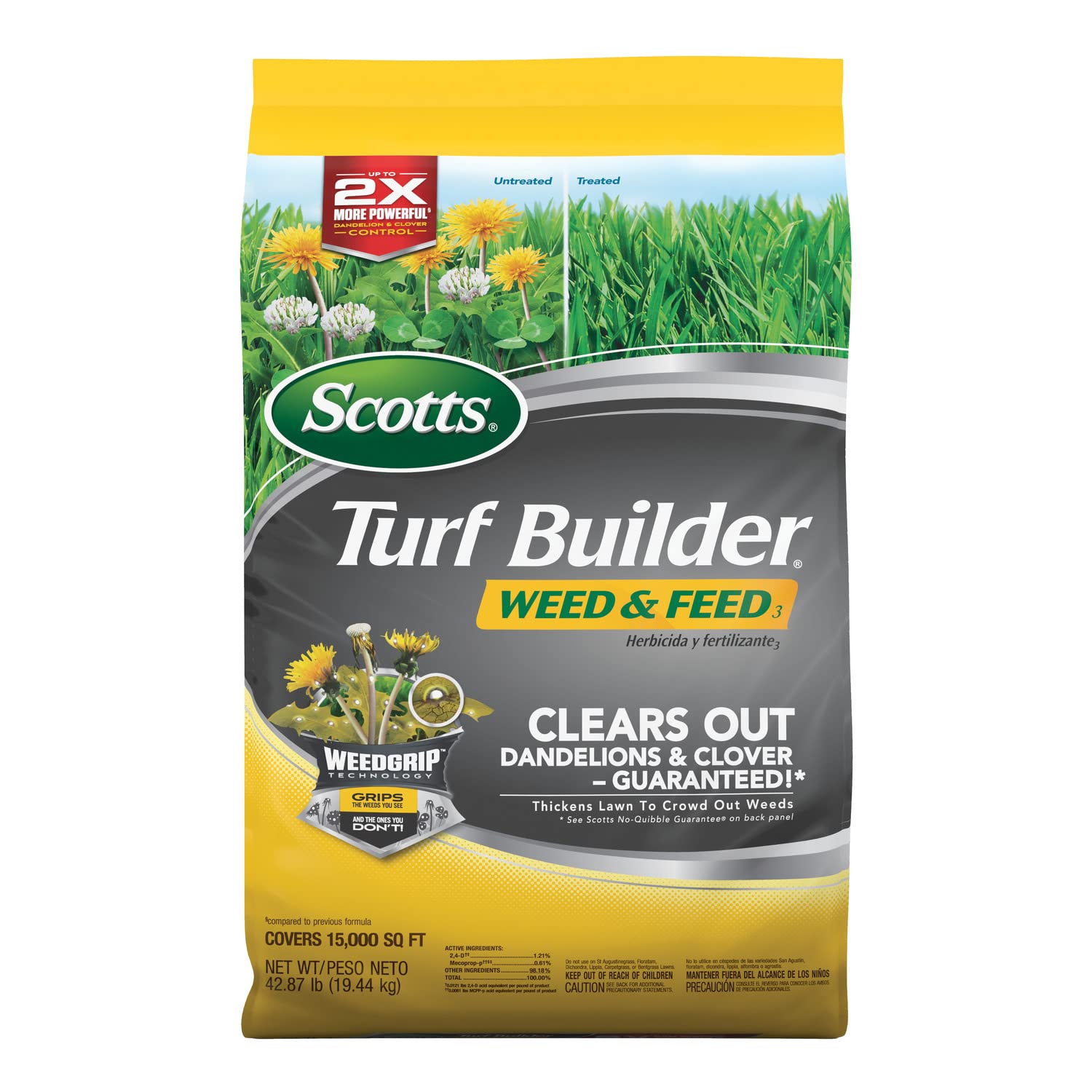
Scotts Turf Builder Weed & Feed is a granular combination product designed to kill broadleaf weeds such as dandelion and clover while feeding lawn grass to promote thicker turf. It is applied with a broadcast or drop spreader to a moist lawn when daytime temperatures are between 60 and 90°F and left unwatered for 24 hours to let the granules stick to weed leaves. Notable features include WeedGrip Technology and coverage for up to 15,000 sq. ft. in a single 42.87 lb bag, which makes it convenient for medium to large yards. The fertilizer element helps grass green up and crowd out future weeds, while the herbicide targets more than 50 listed weed species. Limitations include clear grass-type restrictions — do not use on St. Augustine, Bentgrass, Carpetgrass, Dichondra, or Lippia — and the product requires careful timing and adherence to label safety instructions to avoid harm to sensitive turf or accidental exposure. For best results use a calibrated spreader and follow the application window and re-entry precautions on the label.
Best for: Homeowners who want a one-step seasonal treatment to both reduce broadleaf weeds and feed an established lawn across a medium to large yard and who follow product labels closely.
Less Ideal for: People with sensitive or restricted grass types, those who need an all-season or crabgrass-preventing solution, or gardeners who prefer non-chemical weed control methods.
- Kills many common broadleaf weeds while simultaneously fertilizing the lawn
- Covers up to 15,000 sq. ft. from a single 42.87 lb bag, reducing product handling
- WeedGrip Technology promotes granule adhesion to weed foliage for better control
- Granular form works with standard broadcast or drop spreaders for even application
- Not safe for several grass types including St. Augustine and Bentgrass
- Requires specific temperature and moisture conditions and 24-hour no-water window after application
- Contains herbicides that require caution around children, pets, and sensitive plants
Verdict: Choose this if you want a proven, single-application granular product that both kills common broadleaf weeds and feeds a large lawn to promote thicker turf.
Scotts Turf Builder Weed & Feed3 Granular Lawn Fertilizer, 14.29 lb

| Item Form | Granule |
|---|---|
| Coverage | 5000 square_feet |
| Active Ingredients | 2,4-D 1.220%, Mecoprop 0.081% |
Scotts Turf Builder Weed & Feed3 combines selective broadleaf weed control with lawn fertilizer in a single granular bag for homeowners who want a straightforward seasonal treatment. It is applied with a broadcast or drop spreader to a wet lawn when temperatures are between about 60 and 90°F so the granules stick to weed leaves and the active ingredients (2,4-D and mecoprop) can work. The product advertises control of more than 50 listed weeds including dandelion and clover while also feeding your lawn to encourage thicker turf that helps crowd out future weeds. Practical benefits include a simple single-step application, clear spreader settings recommended by the manufacturer, and coverage suited to small to medium lawns. Important limitations are that it must not be used on certain grass types such as St. Augustine or bentgrass and you should keep people and pets off the treated lawn until dust settles and avoid watering for 24 hours after application. For risk-averse buyers, following label directions closely and choosing the right grass types is essential for predictable results.
Best for: Homeowners who prefer a low-effort, single-application solution to reduce visible broadleaf weeds and thicken established lawns while following label directions closely.
Less Ideal for: Gardens with sensitive turf varieties listed on the label or owners who need an all-season or crabgrass-specific program should consider other targeted products.
- Combines weed control and fertilizer in one application for time savings
- Targets common broadleaf weeds including dandelion and clover
- Manufacturer provides specific spreader settings for consistent application
- Covers up to 5,000 sq. ft. per bag, suitable for small to mid-size lawns
- Contains herbicides that are not safe for all grass types and must be avoided on St. Augustine and bentgrass
- Requires specific temperature and moisture conditions and 24-hour no-water window for best efficacy
Verdict: A simple, single-step weed-and-feed that reliably kills common broadleaf weeds while fertilizing established lawns when used exactly as directed.
Choosing the Right Weed and Feed: Key Factors to Consider
Nutrient Formulation and Release Type
The ratio of nitrogen, phosphorus, and potassium influences how the lawn responds after application. A higher proportion of quick-release nitrogen gives an immediate green-up, while a larger slow-release component sustains color over weeks and reduces mowing surges.
Release type also affects burn risk and feeding frequency. Controlled-release formulas lower the chance of scorch in warm conditions and reduce nutrient loss from leaching. Consider your soil test results and mowing schedule when matching a nutrient formulation to your lawn.
Herbicide Active Ingredients and Weed Spectrum
Different active ingredients control different groups of weeds. Some weed-and-feed products target a broad range of common broadleaf weeds like clover, dandelion, and chickweed, while others include compounds effective against certain grassy weeds or tough perennials.
Read label-described weed lists and ensure the product covers the species you see. Herbicide strength and selectivity determine whether your turf species can tolerate the treatment and how many applications are allowed per season.
Timing and Seasonal Use
Weed emergence patterns and turf growth cycles guide when to apply. Spring-applied weed-and-feed can suppress overwintered broadleaves and boost early growth, while fall applications focus on storing energy and controlling late-season weeds.
Temperature windows on the label are critical; many products require active weed growth and moderate temperatures to work. Applying outside those windows reduces effectiveness and increases the chance of turf stress.
Turf Type Compatibility and Safety
Cool-season grasses and warm-season grasses respond differently to fertilizer and herbicide combinations. Labels will specify tolerated species and advise against use on newly sodded or recently seeded lawns.
Consider pets, children, and edible-adjacent areas. Labels include re-entry intervals and whether the product is safe near garden beds. Choosing a product with clear safety guidance helps reduce risk during and after application.
Application Method and Spreadability
Even coverage is essential to avoid striping or patchy weed control. Granular products differ in particle size and flowability; some are formulated for multipurpose drop or broadcast spreaders.
Look for instructions on spreader settings and overlap technique. Ease of application also includes packaging that pours cleanly and labels that give tested spreader calibration numbers to simplify application for backyard gardeners.
Environmental Considerations and Runoff Risk
Fertilizer and herbicide runoff can harm waterways. Products with lower soluble phosphorus or slow-release nitrogen reduce immediate runoff risk, while timing applications before heavy rain increases the chance of loss.
Follow buffer zone guidance and avoid application before forecasted heavy precipitation. Consider soil health practices like aeration and core cultivation to improve nutrient uptake and reduce the need for frequent applications.
Matching Product Choice to Lawn Goals
Decide whether your priority is quick visual improvement, long-term turf vigor, or targeted weed suppression. If you want fast green color for an upcoming event, a higher quick-release nitrogen component will show results faster but may require more frequent mowing. For sustained improvement and fewer follow-up applications, favor products with a significant slow-release nitrogen fraction.
- Target color and density: choose more quick-release for immediate color.
- Weed-first approach: pick a product with a broad herbicide spectrum and label confirmation for the weeds present.
- Maintenance feeding: select higher slow-release nitrogen to reduce reapplications.
When to Avoid a Combined Product
A combined weed-and-feed is convenient, but some situations call for separate fertilizer and herbicide treatments. New lawns, recent seedings, or stitched sod installations often react poorly to herbicides and need fertility-only applications until the turf establishes. Heavy thatch or waterlogged soils can also reduce herbicide uptake, making separate spot treatments more effective.
- New seed or sod: delay herbicides until turf is well established.
- Spot infestations: treat stubborn patches with targeted herbicide rather than broadcast application.
- Soil or thatch issues: correct cultural problems first for reliable control.
Spreader Setup and Application Technique
Calibrating your spreader and following overlap patterns minimizes streaking and missed swaths. Use the manufacturer's recommended spreader setting when provided on the product label, and walk at a steady pace with uniform overlap to deliver even coverage. If the granules are coarse, test a small swath before full application to confirm flow and pattern.
- Use cross-pattern passes for uniform distribution.
- Keep dry hands and avoid compacting granules when loading the spreader.
- Rake or sweep stray granules off hard surfaces immediately to prevent runoff.
Post-Application Care
Watering and mowing after treatment affect both fertilizer uptake and herbicide performance. Many products instruct against mowing immediately before or after application to avoid removing treated leaf tissue. Light watering may be required to activate soluble fertilizers or herbicides, but follow label timing to prevent washing the product away. Avoid heavy irrigation and limit traffic on treated areas until the product has absorbed or until the recommended re-entry interval has passed.
- Follow label guidance on watering and mowing windows.
- Avoid heavy irrigation for 24 to 48 hours unless label recommends activation.
- Keep pets and children off the lawn per the specified re-entry time.
Integrated Lawn Care with Weed-and-Feed
Use weed-and-feed as one element in a broader lawn program that includes aeration, overseeding, and regular mowing. Proper soil testing and periodic lime applications can correct underlying nutrient imbalances so the combined product performs better. Timing your cultural practices around weed-and-feed applications amplifies results and reduces reliance on repeat treatments.
- Coordinate aeration and overseeding with feeding windows for best establishment.
- Address soil pH when indicated by testing to improve nutrient availability.
- Maintain mowing height appropriate for your turf species to reduce weed competition.
How We Chose the Best Weed and Feed
Our selection focused on practical performance and gardener-relevant specs that affect real-world results. We evaluated nutrient profile and releasing behavior to ensure the fertilizer side supports steady green-up without causing excessive top growth or burning. Herbicide spectrum and label indications were examined to confirm which broadleaf weeds and annual grassy invaders each product controls and at which turf heights they are effective. Application timing and seasonality mattered because many weed-and-feed products are formulated for spring or fall use; we preferred options with clear timing windows and flexible application temperatures. Granule size and spreader compatibility were checked to reduce the risk of uneven coverage and streaking. Safety and turf tolerance were assessed with attention to common cool- and warm-season grasses and to pet and child re-entry guidance. We excluded specialty fertilizers that are not packaged with an herbicide or that require calibration beyond standard broadcast spreaders. Products lacking clear label directions for the home gardener or with narrow weed lists were not included. The final picks balance dependable nutrient delivery, an effective weed-control spectrum, ease of application, and sensible safety notes.
FAQ
Can I apply weed-and-feed to a newly seeded lawn?
Usually not. Most weed-and-feed products are labeled as unsafe for new seed or recently sodded lawns because herbicides can damage young grass. Wait until the turf has established according to label timing or use a fertilizer-only product until the new grass is mature.
How often should I apply a weed-and-feed product?
Frequency depends on the formulation and label directions. Many home-use products are intended for one or two applications per growing season, with timing tied to spring or fall windows. Avoid repeating applications more often than the label allows to prevent turf stress and herbicide overuse.
Will weed-and-feed harm my flower beds or vegetable garden?
If granules land in garden beds they can damage desirable plants. Sweep or blow granules off hard surfaces immediately and avoid applying too close to non-target planting areas. Follow label buffer zone recommendations to protect adjacent beds and edible crops.
What should I do if rain is forecast after application?
Check the product label for rain-activation guidance. Some products require light watering to activate while others advise waiting for a rain-free period to prevent runoff. If heavy rain is likely, postpone application to avoid washing away granules and increasing environmental risk.
Can I use weed-and-feed on all grass types?
No. Labels specify turf species tolerance. Some herbicides are safe on many cool-season grasses but can injure warm-season varieties, and vice versa. Always confirm your grass type is listed as tolerant before applying.
Is spot-treating better than broadcast application for small weed patches?
Often yes. For isolated infestations, spot-treating with a targeted herbicide reduces chemical use and limits risk to surrounding turf. Broadcast weed-and-feed is more efficient for widespread weed pressure but can be overkill for a few scattered plants.
Final Verdict
Weed-and-feed products can save time by combining fertilization and weed control, but the best option depends on turf type, timing needs, and the specific weeds you face. Prioritize nutrient release style and herbicide spectrum that match your lawn goals, and pay close attention to label timing, turf compatibility, and safety instructions. If you have recent seedings, sensitive ornamentals nearby, or only localized weed problems, consider separating fertilizer and herbicide treatments. For established lawns with broadleaf pressure and a clear application window, a well-matched weed-and-feed simplifies maintenance and supports healthier turf when used as part of an integrated lawn care plan.
