

Note: This article contains affiliate links. If you click on these links and make a purchase, I may earn a small commission at no extra cost to you. This helps support my research and content. Read my full affiliate disclosure here.
If you keep gravel paths, driveways, or decorative beds tidy, choosing the right weed and grass killer for gravel matters. Gravel surfaces concentrate roots near the topsoil and make mechanical removal messy and slow. The right product will kill unwanted growth without lingering harm to nearby plantings or staining stone. This guide shortlists the top seven options for gravel use and explains how we judged them across real garden concerns like persistence, ease of application, and surface safety. Read on to find the approach that fits your gravel area and maintenance style.
Top Picks at a Glance
| Best Overall The best all-around choice for most situations | Natural Armor Farm & Agricultural Weed Killer, 128 fl oz |  |
| Best Quality Built to a higher standard if you want something more solid | Ortho GroundClear Year Long Vegetation Killer with Comfort Wand, 1.33 gal |  |
| Best Value The sweet spot between price and what you get | Image Herbicides Noxall Weed & Grass Killer Granules, 10 lb |  |
| Best Budget The cheapest option that still gets the job done reliably | Ortho GroundClear Super Weed & Grass Killer with Comfort Wand, 0.5 gal | 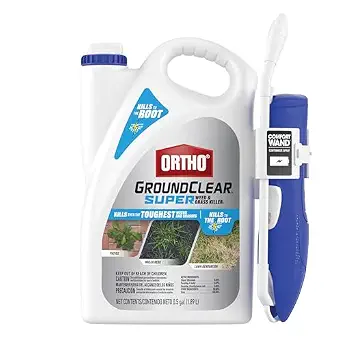 |
| Highest Rated A top-rated pick with lots of positive feedback | Roundup Dual Action 365 Weed & Grass Killer Plus 12 Month Preventer, 1 gal. |  |
| Most Popular A crowd favorite that many people choose with confidence | Spectracide Weed & Grass Killer with AccuShot Power Sprayer, 1.33 Gal |  |
| Best Seller A high-volume bestseller chosen again and again | Roundup Weed & Grass Killer4 with Pump 'N Go 2 Sprayer, 1.33 gal |  |
Natural Armor Farm & Agricultural Weed Killer, 128 fl oz

| Item Form | Liquid |
|---|---|
| Unit Count | 128 Fluid Ounces |
| Liquid Volume | 128 fluid ounces |
Natural Armor Farm & Agricultural Weed Killer is a concentrated, non-selective liquid designed for large outdoor jobs where fast, dependable control of weeds and grasses is required. Sold in a 128 fl oz refill, the formula targets broad areas such as fence lines, pathways, gravel lots, and around barns or parking areas and is intended for spot treatments up to roughly 1,000 sq ft from this size. It is glyphosate-free, so it provides strong vegetation control without that active ingredient, and the manufacturer highlights rapid visible results when applied on warm, dry, sunny days. Practical benefits include a commercial-strength approach suited to property managers, growers, and homeowners with extensive outdoor space and clear instructions for use around people, pets, and livestock areas when applied as directed. Limitations are that it is non-selective so it will damage desirable plants if oversprayed and will perform best under the recommended weather conditions, which means slower results in cool or wet weather. Users should plan applications carefully and protect nearby vegetation they want to keep.
Best for: Buyers who need a powerful, glyphosate-free solution for managing weeds and grasses across large outdoor properties and who plan applications carefully to protect desirable vegetation.
Less Ideal for: Gardeners who want selective control within planted beds or those managing only small ornamental container gardens should consider more targeted products.
- Commercial-strength, concentrated formula designed for large outdoor areas
- Glyphosate-free option for users avoiding that ingredient
- Fast-acting visible results under warm, dry conditions
- Suitable for use around farms, nurseries, ranches and other people or livestock properties when used as directed
- Non-selective formula will kill desirable plants if it contacts them
- Performance depends on weather so cooler or wet conditions may slow results
Verdict: Choose this concentrated, glyphosate-free farm-grade formula when you need fast, large-area weed and grass control without glyphosate.
Ortho GroundClear Year Long Vegetation Killer with Comfort Wand, 1.33 gal

| Unit Count | 170.24 Fluid Ounces |
|---|---|
| Coverage | 400 square feet |
| Item Form | Spray |
| Liquid Volume | 1.33 gallons |
| Active Ingredients | Imazapyr, Isopropylamine salt 0.09% Pelargonic Acid and related fatty acids |
Ortho GroundClear Year Long is a ready-to-use vegetation killer designed for spot treatment of driveways, sidewalks, gravel and other areas where you do not want any plants. The bottle includes a comfort wand for targeted spraying and the fast-acting formula begins to show visible results within an hour. It is rainproof in one hour and the manufacturer claims up to 12 months of vegetation prevention from a single application when used as directed. Active ingredients include imazapyr and pelargonic acid, which provide both quick contact action and longer-term root control. The product covers about 400 square feet and is best applied on sunny days when weeds are actively growing. Important limitations are that it is intended only for areas where no vegetation is wanted and should not be used near desirable plants or lawns, and users must follow safety directions to avoid skin or eye contact. For a buyer wanting a straightforward, no-mix sprayer for hardscape weed control, this is a practical, low-effort option.
Best for: Homeowners who need a simple, no-mix solution to clear and keep hardscape, gravel, and unplanted areas weed-free with minimal effort and follow-up.
Less Ideal for: Gardens, lawns, or anyone who needs selective weed control near desirable plants should avoid this product and choose a more targeted herbicide or spot-treat method.
- Ready-to-use spray with attached comfort wand for precise application
- Fast-acting formula with visible results in about an hour
- Rainproof after one hour so light rain is less likely to wash it away
- Claims up to one year prevention of regrowth from a single application
- Treats approximately 400 square feet per bottle
- Not selective and will kill any vegetation it touches, so careful targeting is required
- Formulation contains persistent active ingredient (imazapyr) that restricts use around desirable plants
Verdict: A convenient, no-mix wand sprayer that quickly kills weeds on hardscapes and prevents regrowth for up to a year, ideal for hands-off hardscape weed control.
Image Herbicides Noxall Weed & Grass Killer Granules, 10 lb

| Item Form | Granule |
|---|---|
| Coverage | 1000 square_feet |
| Unit Count | 160 Ounce |
| Active Ingredients | Dichlobenil |
Image Herbicides Noxall is a ready-to-use granular vegetation killer designed for long-term bare-ground control in places like gravel walks, driveways, along fences, around buildings, and under decks. You spread the granules over unwanted vegetation and the active ingredient, dichlobenil, kills weeds and grasses down to the root and helps prevent regrowth for up to a year when applied as directed. Its granular form makes it easy to apply without mixing, and the stated 1000 sq ft coverage for a 10 lb bag helps plan treatments for small to medium areas. Because it is nonselective, it is meant only for locations where you want no plants to grow rather than spot-treating turf or beds. Timing matters: recommended applications are late fall through early spring, with regional adjustments in colder climates. Practical buyers will appreciate the simplicity and long residual control, while those needing selective or quick green-up solutions will need a different product.
Best for: Buyers who want a low-effort, long-lasting solution to keep gravel and other hardscape areas free of weeds for extended periods and who prioritize durability of results over selective treatment.
Less Ideal for: Gardeners who need to preserve nearby plants, spot-treat lawns, or who prefer an organic or selective herbicide option should consider alternatives.
- Nonselective granular formula kills weeds and grasses down to the root
- Provides up to one year of residual weed prevention when used as directed
- Ready-to-use granules require no mixing or special equipment
- Suitable for hardscape areas like gravel walks, driveways, and under decks
- Nonselective action will kill or prevent any vegetation, so it cannot be used near desirable plants
- Contains dichlobenil which requires careful timing and adherence to label directions for safe and effective use
Verdict: A simple, ready-to-use granular herbicide built to keep gravel and other no-growth areas reliably weed-free for up to a year.
Ortho GroundClear Super Weed & Grass Killer with Comfort Wand, 0.5 gal

| Unit Count | 64 Fluid Ounces |
|---|---|
| Item Form | Spray |
| Coverage | Broad spectrum coverage |
| Liquid Volume | 0.5 gallons |
Ortho GroundClear Super Weed & Grass Killer is a ready-to-use spray intended for spot treatment of weeds and grasses in landscape beds, along walkways, driveways, and around structures. The bottle’s attached Comfort Wand delivers a continuous spray for targeted application, which helps avoid overspray on nearby plants. The formula combines a contact ingredient for rapid burn-down with systemic actives that penetrate to the root, so you can see visible effects within hours and full control in days to a couple of weeks. It is rainfast in about 15 minutes, so treatments hold up quickly after application. Practical benefits include ease of use without mixing, broad-spectrum control of common tough weeds, and suitability for prepping areas for renovation. Important limitations are that it is nonselective so care is required near desirable plants, it should not be used on edible crops, and protective gear is recommended during application because of the herbicidal strength.
Best for: Homeowners who want an easy, no-mix solution to remove persistent weeds from landscape beds, hardscapes, and around structures and who prioritize quick, visible results with precise application.
Less Ideal for: Gardners maintaining vegetable beds, pollinator or mixed planting areas where nonselective chemistry risks desirable plants, or users seeking an organic or granular spot-treatment method.
- Ready-to-use spray needs no mixing and the attached Comfort Wand enables targeted continuous application
- Dual-action formula gives quick visible burn-down and systemic root kill for longer control
- Rainfast in 15 minutes so treatments are less likely to wash off in light showers
- Nonselective herbicide that can damage desirable plants if not applied carefully
- Not labeled for use on edible crops so unsuitable for vegetable gardens
Verdict: Choose this ready-to-use spray when you need fast, targeted knockdown and root-level control of tough weeds in landscape beds without mixing or special equipment.
Roundup Dual Action 365 Weed & Grass Killer Plus 12 Month Preventer, 1 gal.

| Unit Count | 128 Fluid Ounces |
|---|---|
| Item Form | Spray |
| Coverage | 300 square feet |
| Active Ingredients | Triclopyr; Fluazifop-P-Butyl; Imazapic; Diquat Dibromide |
This one-gallon Roundup Dual Action 365 combines fast-acting contact herbicides with a longer-lasting residual to both kill visible weeds and prevent new growth for up to a year when applied correctly. It is intended for non-lawn areas such as cracks in driveways, sidewalks, patios, gravel and under decks. The Comfort Wand one-touch continuous spray makes treating a contiguous area less fatiguing and helps deliver an even application. Visible wilting can appear within hours and treated areas become rainproof in roughly 30 minutes. The label stresses spraying the entire target area, not just individual plants, because the preventer works by creating an invisible soil barrier. Practical limits include use only on non-lawn surfaces and adherence to label rates and reapplication intervals; it is not suitable for spot-spraying near desirable plants or for use on turf you want to keep. If you need a fast, long-lasting solution for clearing and keeping paved and gravel areas weed-free, this product streamlines both tasks in a single application.
Best for: Buyers who want a straightforward, long-lasting solution to clear and keep paved, gravel, and other non-lawn areas weed-free with minimal repeated effort.
Less Ideal for: Gardeners who need selective control inside lawns, around flower beds, or who prefer an organic or nonchemical approach should consider other products or methods.
- Kills existing broadleaf and grassy weeds and many tough species.
- Provides up to 12 months of prevention when the entire area is treated.
- Comfort Wand with one-touch continuous spray reduces hand fatigue and promotes even coverage.
- Fast visible results in hours and becomes rainproof in about 30 minutes.
- Formulated only for non-lawn areas so it will damage desirable turf and plants if misapplied.
- Requires treating the entire area to establish the preventive barrier rather than only spot-treating visible weeds.
Verdict: If you need a single product that quickly kills weeds and then prevents new growth for up to a year in non-lawn areas, this is a convenient, long-lasting option.
Spectracide Weed & Grass Killer with AccuShot Power Sprayer, 1.33 Gal

| Unit Count | 170 Fluid Ounces |
|---|---|
| Item Form | Spray |
| Coverage | 1 gallon |
| Active Ingredients | Diquat Dibromide 0.12%, Fluazifop-p-butyl 0.06%, Dicamba 0.04% |
Spectracide Weed & Grass Killer pairs a concentrated non-selective formula with a battery-powered AccuShot sprayer to clear weeds from driveway cracks, patios and around foundations. The product is used by aiming and spraying foliage until leaves are covered; the active ingredients move through the leaf to the root and can show visible die-back in as little as three hours. The AccuShot wand is extendable and provides continuous spray without manual pumping, which improves accuracy for narrow cracks and reduces hand fatigue during larger jobs. It is rainproof within 15 minutes, so treated areas are protected quickly. Practical benefits include fast results that let you replant or resume use of the area within a day and a reusable sprayer for follow-up applications. Important limitations are that the herbicide is non-selective so it will kill any plant it contacts, it requires careful handling and PPE to avoid skin or eye exposure, and the sprayer runs on four AA batteries that must be replaced periodically. Follow label directions to avoid runoff into water.
Best for: Buyers who want a fast, no-nonsense solution for weeds growing in driveways and hard surfaces and who prioritize tools with clear user feedback and proven results.
Less Ideal for: Gardeners who need a selective lawn-safe treatment, people unwilling to follow pesticide safety precautions, or those treating areas adjacent to water features.
- AccuShot battery-powered wand gives continuous spray for accurate application in tight cracks
- Formula moves through foliage to kill weeds down to the root with visible results in about three hours
- Rainproof after 15 minutes so treatments are not easily washed away by brief showers
- Covers approximately 300 square feet per gallon, suitable for multiple crack-treatment sessions
- Non-selective herbicide will damage any desirable plants it contacts
- Sprayer requires four AA batteries and occasional replacement to maintain function
- Product is toxic to aquatic life and must not be used near water or allowed to run off
Verdict: A fast-acting, easy-to-aim non-selective herbicide with a battery-powered wand that is well suited to reliably clear weeds from driveway cracks and other hard surfaces.
Roundup Weed & Grass Killer4 with Pump 'N Go 2 Sprayer, 1.33 gal

| Unit Count | 170 Fluid Ounces |
|---|---|
| Item Form | Spray |
| Coverage | 300 Square_Feet |
| Active Ingredients | Triclopyr, Triethylamine Salt, Fluazifop-P-Butyl, Diquat Dibromide |
This packaged Roundup kit combines a 1.33 gallon formulated weed-and-grass killer with a Pump 'N Go 2 sprayer, letting you treat patches of weeds and grassy intruders without mixing chemicals or carrying a separate sprayer. The extendable wand and up to 10 minutes of continuous spray make targeted application around flower beds, patios, gravel, and edges easier and reduce bending. The formula claims visible results in hours, becomes rainproof in about 30 minutes, and permits replanting within the stated window. Practical benefits include convenience of an integrated sprayer, good coverage for small to medium areas, and a broad activity spectrum against dandelions, crabgrass, clover, and other common broadleaf weeds. Important limitations are safety precautions and restricted access after application since it is an herbicide that can harm desirable plants and requires protective clothing and keeping people and pets away until dry. Also, this product is for spot and surface treatments rather than long-term lawn renovation or nonchemical weed control approaches.
Best for: Buyers who want a convenient, ready-to-use herbicide for spot-treating visible weeds and grass around hardscapes and landscape beds and who prefer an integrated sprayer to simplify application.
Less Ideal for: People seeking organic, nonchemical weed control or a product for large-scale lawn renovation should consider alternative methods or professional services.
- Includes Pump 'N Go 2 sprayer with extendable wand for accurate, continuous spray
- Ready-to-use formulation so no measuring or mixing is required
- Produces visible results in hours and is rainproof in about 30 minutes
- Designed for use around beds, patios, driveways, gravel, and edging
- Contains potent active ingredients that require safety precautions and restrict access to treated areas
- Not suitable for nonchemical or preventive long-term weed management
Verdict: If you want a no-mixing, spot-treatment herbicide with a built-in sprayer for quick, targeted weed control, this all-in-one Roundup kit is a practical choice.
Choosing the Right Weed and Grass Killer for Gravel: Key Factors to Consider
Kill Mode and Active Ingredient
Different products kill weeds in different ways, either by burning foliage, blocking photosynthesis systemically, or disrupting root growth. On gravel you often need a product that translocates to the root to prevent rapid regrowth from fragmented crowns or deep rhizomes. Understanding whether a formulation is contact-only or systemic helps set expectations for regrowth and how many treatments you will need.
Active ingredient properties affect persistence and nearby plant risk. Systemic chemistries tend to give longer control but can move in runoff or splash. Choose a mode that matches the species you face: annual weeds respond quickly to contact herbicides while perennial grasses and broadleaf weeds usually need systemic action for lasting control.
Residual Control and Return Intervals
Residual activity determines how long treated gravel stays weed-free. Some products offer short-term contact control that leaves the soil active for only a few days, requiring repeat treatments. Others bind to soil particles and provide weeks of suppression. On gravel, however, soil horizons are thin and products may behave differently than in garden beds, so expected residual times can shrink.
Consider how often you want to re-treat and whether you need a product that allows prompt replanting of adjacent borders. Longer residuals reduce maintenance frequency but increase the chance of affecting desirable plants if product moves off the gravel surface.
Surface Compatibility and Staining Risk
Gravel comes in many compositions and colors, and some sprays can leave visible residues or cause temporary darkening of stones. Pigmented formulations or those with dye markers may help you see treated areas but can also stain. Evaluate whether a product has known staining or surface residue issues, and whether the label advises rinsing or avoiding splash onto decorative stone or masonry.
Surface compatibility also covers how granules or wettable powders sit on gravel and whether they will be dislodged by foot traffic, wind, or rain. Choose formulations designed to stay where applied to preserve both appearance and efficacy.
Application Method and Precision
Precision matters on gravel because desirable plants or lawn edges often border the area. Products come as ready-to-use sprays, concentrates for spot mixing, granules, and foam applicators. Sprays with narrow nozzles or adjustable stream settings enable targeting cracks and joints while minimizing overspray. Granules reduce drift but may distribute unevenly on loose surfaces.
Consider how comfortable you are with handheld sprayers, pump-up equipment, or granule spreaders, and whether the product allows controlled application in tight areas without contacting ornamental plantings.
Weather Sensitivity and Rainfastness
On gravel, exposure to rain and irrigation is inevitable. Rainfastness measures how quickly a product resists wash-off after application. Highly rainfast products reduce the risk of immediate loss of efficacy during a passing shower, while less rainfast options require precise timing to avoid dilution or runoff.
Plan treatments during stable weather windows and check label recommendations for minimum dry periods after application. Also consider how runoff might affect nearby soil or plantings and choose products with predictable behavior under wet conditions.
Safety Around Nearby Plants and Animals
Gravel areas often sit next to garden beds, lawn, or planters. Drift, splash, and runoff can move herbicide to desirable vegetation or pet areas. Look for information on volatility, residual uptake by roots of nearby plants, and measures to reduce off-target movement like buffer distances or use of shielded applicators.
If pets or children use the area, check re-entry intervals and recommended precautions. Non-chemical controls can be combined with spot treatments to reduce overall chemical use and limit exposure risks.
Best Application Techniques for Gravel Areas
Successful control on gravel is as much about application technique as product choice. Use a targeted approach: apply directly to foliage and crowns in cracks or joints rather than broadly broadcasting across loose stone. Narrow-stream or low-pressure nozzles let you reach plant bases without producing fine drift.
When treating large expanses, work in short swaths and keep an eye on wind and sun. For spot problems, consider low-volume, undiluted spot sprays or foam applicators that cling to foliage. After application, avoid disturbing the gravel for the recommended period so the product can be absorbed.
- Aim for calm, dry weather and avoid treating before expected rain.
- Use a shield or cardboard to protect adjacent beds during spraying.
- Clean equipment thoroughly after use to avoid cross-contamination.
Combining Mechanical and Chemical Control
Mechanical removal lowers the load of large perennial roots and makes chemical treatments more effective. Pull easily accessible weeds or rake to expose crowns before applying a systemic product so translocation is more complete. For very dense matting, remove top growth and treat regrowth.
A combined approach also reduces the total amount of chemical applied. Use chemical spot treatments for regrowing roots or persistent grasses after initial mechanical control to keep gravel tidy with fewer applications.
- Hand-pull or use a long-handled tool for deep-rooted perennials, then spot-treat remaining crowns.
- Repeat mechanical and chemical cycles on a schedule based on residual control duration.
Protecting Adjacent Plants and Hardscapes
Buffering desirable plants from spray or runoff protects their roots and foliage. Lay down plastic sheeting or wet towels to shield soil and low plants while you treat gravel. Avoid applying products on slopes where runoff could carry residues into garden beds.
For hardscape surfaces like concrete or pavers, check for staining recommendations and rinse any accidental overspray promptly. Be especially cautious near newly planted shrubs or shallow-rooted ornamentals.
- Create a physical barrier when spraying near beds.
- Rinse accidental overspray from pavers or stone as directed on the label.
Timing Treatments for Season-long Control
Seasonal timing affects how long gravel stays clean. Early-season treatments that target seedlings prevent dense stands from establishing, while late-season treatments can weaken perennial root systems and reduce winter survival. Plan follow-up treatments based on the product's residual profile and the species you are targeting.
For perennial grasses and tough volunteers, expect multiple passes across the growing season. Use more persistent options sparingly and focus on spot treatments to limit environmental exposure.
- Treat seedlings in spring for easier control.
- Use late-season applications to reduce overwintering root reserves in perennials.
Non-chemical Alternatives and Integrated Options
If you prefer to minimize chemical use, consider hot-water, steam, or mechanical edging as primary measures. These methods can be effective on cracks and joints and have no residual chemical risk. Mulching or laying geotextile fabric beneath decorative gravel can prevent many weeds from establishing in the first place.
Integrated strategies often combine non-chemical barriers with occasional targeted chemical spot treatments for the most persistent species. This reduces overall chemical inputs while maintaining neat gravel areas.
- Use weed membrane when relaying gravel to reduce future weed pressure.
- Apply thermal treatments for small areas or high-traffic paths where chemicals are undesirable.
How We Chose the Best Weed and Grass Killer for Gravel
We evaluated products based on factors that reflect how weed control performs on gravel over a season. Important evaluation criteria included speed of visible kill, residual activity in shallow soils typical of gravel beds, compatibility with porous surfaces to avoid staining or residue, and the accuracy of application systems for spot treatment. We also considered environmental exposure-how the product behaves when rain, runoff, or irrigation hit gravel-and the clarity of label directions for safe use around nearby ornamentals. We excluded products intended strictly for turf renovation or agricultural broadcast use, since those do not match small-area gravel applications. Products lacking clear guidance on gravel or hardscape use were not shortlisted. The picks therefore favor formulations and applicators that allow precise, effective treatments on gravel without unnecessary spread or uptake by adjacent desirable plants.
FAQ
Can I use a regular garden weed killer on gravel?
Often you can, but product suitability depends on application method and label directions. Regular garden herbicides designed for spot treatment may be fine if they allow precise application and are safe for nearby plantings. Check label guidance about use on hardscape or gravel and follow precautions to avoid runoff.
How soon after applying should I expect weeds to die on gravel?
Visible browning or wilting can appear within a few hours to a week depending on the active ingredient and species. Contact products act faster on foliage, while systemic products may take several days as the chemistry moves to roots. Expect longer timelines for perennials.
Will weed killer stain or darken gravel?
Some formulations, especially those with dyes or oil carriers, can temporarily darken stone or leave residues. Many product labels note staining potential and provide cleanup steps. Test a small, inconspicuous area first if surface appearance is a concern.
Is it safe to use weed killer on gravel near flower beds?
It can be safe if you prevent drift, runoff, and root uptake by following label buffers and using precise application methods. Use shields, avoid treating before heavy rain, and allow adequate dry time to reduce the chance of affecting nearby plants.
How often will I need to retreat gravel areas?
Retreatment intervals depend on product residual, weather, and the species present. Short-residual contact options may require multiple spot applications through the season, while longer-residual systemic products can extend control for weeks. Monitor regrowth and schedule follow-ups accordingly.
Final Verdict
Choosing the right weed and grass killer for gravel is about matching kill mode, application precision, and residual behavior to your site. Prioritize products that allow accurate targeting, have predictable rainfastness, and carry clear guidance about surface safety to avoid harming nearby plantings. For most gravel areas, combine thoughtful technique with spot treatments rather than broad application. That approach balances effective control with lower non-target risk and helps you keep paths and beds tidy with fewer surprises.
