

Note: This article contains affiliate links. If you click on these links and make a purchase, I may earn a small commission at no extra cost to you. This helps support my research and content. Read my full affiliate disclosure here.
If you grow Bahia grass, selecting the right weed control product matters for turf health and long-term lawn appearance. Bahia is a heat- and drought-tolerant warm-season grass with different tolerance levels than common turf types, so some herbicides can damage grass while others selectively remove broadleaf weeds and sedges. This guide shortlists six top options for controlling weeds in Bahia grass and explains how we evaluated turf safety, mode of action, and application timing. Expect practical notes on when to treat, how to avoid burn, and what to expect after application.
Top Picks at a Glance
| Best Overall The best all-around choice for most situations | BioAdvanced Season Long Lawn Weed Killer + Preventer for Southern Lawns, 10 lb |  |
| Best Quality Built to a higher standard if you want something more solid | Southern Ag Lawn Weed Killer with Trimec, 16 oz |  |
| Best Value The sweet spot between price and what you get | Spectracide Weed Stop for Lawns Plus Crabgrass Killer Concentrate, 32 oz |  |
| Best Budget The cheapest option that still gets the job done reliably | Spectracide Weed Stop for Lawns Concentrate, 32 oz Ready-to-Spray |  |
| Highest Rated A top-rated pick with lots of positive feedback | Quali-Pro MSM Turf Herbicide, 8 oz |  |
| Most Popular A crowd favorite that many people choose with confidence | Scotts Weed Control for Lawns, 14 lb. Granules |  |
BioAdvanced Season Long Lawn Weed Killer + Preventer for Southern Lawns, 10 lb

| Item Form | Granule |
|---|---|
| Coverage | 4000 square feet |
| Unit Count | 160 Ounce |
| Active ingredients | Dicamba acid 0.088%, Penoxsulam 0.041%, Indaziflam 0.027% |
This granular formula is designed for one-application, season-long control on southern warm-season turf. Applied with a rotary or drop spreader and followed by light watering, it starts working quickly to stop weed growth and delivers residual activity for up to six months against many listed broadleaf and grassy weeds including crabgrass. The product is targeted for established southern species named on the label and covers about 4,000 sq ft per 10 lb bag. Practical advantages include easy broadcast application, broad spectrum control of common lawn weeds, and a built-in preventer so you do not need separate preemergent treatments for much of the season. Important limitations are the label restrictions on which grasses and states are approved and the need to follow safety and timing instructions precisely to avoid turf damage or off-target effects; it is not a spot spray and is intended for full-lawn broadcast use. Expect best results when applied to actively growing weeds and on the specific grass types listed by the manufacturer.
Best for: Homeowners with established southern warm-season lawns who want a single broadcast application to suppress common broadleaf weeds and prevent crabgrass across a full lawn.
Less Ideal for: Gardeners with non-southern or small patch problem lawns, or those who need a spot-treatment solution or live in states excluded on the label.
- One-application granules that provide up to six months of weed control and prevention
- Covers approximately 4,000 square feet per 10 lb bag for whole-lawn treatment
- Formulated specifically for southern warm-season lawns with broadleaf and grassy weed control
- Easy to apply with a rotary or drop spreader and activated by light irrigation
- Label-restricted to listed southern turf species and excluded states so not universally applicable
- Not intended for spot treatment of small patches and can cause off-target damage if misapplied
Verdict: A convenient granular one‑application solution for southern warm‑season lawns that gives broadleaf and crabgrass control plus up to six months of prevention.
Southern Ag Lawn Weed Killer with Trimec, 16 oz

| Item Form | Spray |
|---|---|
| Coverage | 400 square feet |
| Liquid Volume | 16 fluid ounces |
| Active Ingredients | Mecoprop, 2,4-D, Dicamba |
Southern Ag Lawn Weed Killer with Trimec is a 16 ounce spray concentrate that mixes with water for spot or broadcast application to turf. It combines three active ingredients (mecoprop, 2,4-D and dicamba) and is labeled for use on nine common turf types, including St. Augustine, and controls most broadleaf weeds when applied as a uniform spray or via a hose-end sprayer. Typical use is mixing 1 to 1.5 ounces per gallon to cover about 400 square feet and applying with a fan nozzle while avoiding drift onto shrubs and trees. The product’s strengths are its documented turf compatibility guidance and a formulation that targets broadleaf weeds effectively across warm- and cool-season lawns. Limitations to note are the safety precautions required for handling, the potential for off-target damage from drift, and that it is not intended for some improved southern varieties. For buyers who want an economical, general-use herbicide for St. Augustine, this is a practical choice; those needing selective control for sensitive cultivars should check the label closely before use.
Best for: Budget-minded homeowners who need a straightforward, multi-ingredient broadleaf herbicide for treating common weeds in St. Augustine and other typical lawn grasses.
Less Ideal for: Those managing sensitive or improved turf cultivars that require very selective products or professional lawn care services.
- Contains a three-way active ingredient mix (mecoprop, 2,4-D, dicamba) for broadleaf weed control
- Labeled for use on St. Augustine and eight other common turf types
- Concentrated formula covers about 400 sq ft per recommended rate for efficient coverage
- Compatible with conventional sprayers and hose-end applicators for flexible application
- Requires careful handling and drift avoidance to prevent damage to nearby shrubs and trees
- Not recommended for certain improved southern varieties of turf
Verdict: A cost-effective, three-way broadleaf herbicide that provides reliable weed control for St. Augustine and other common turf types when used according to label directions.
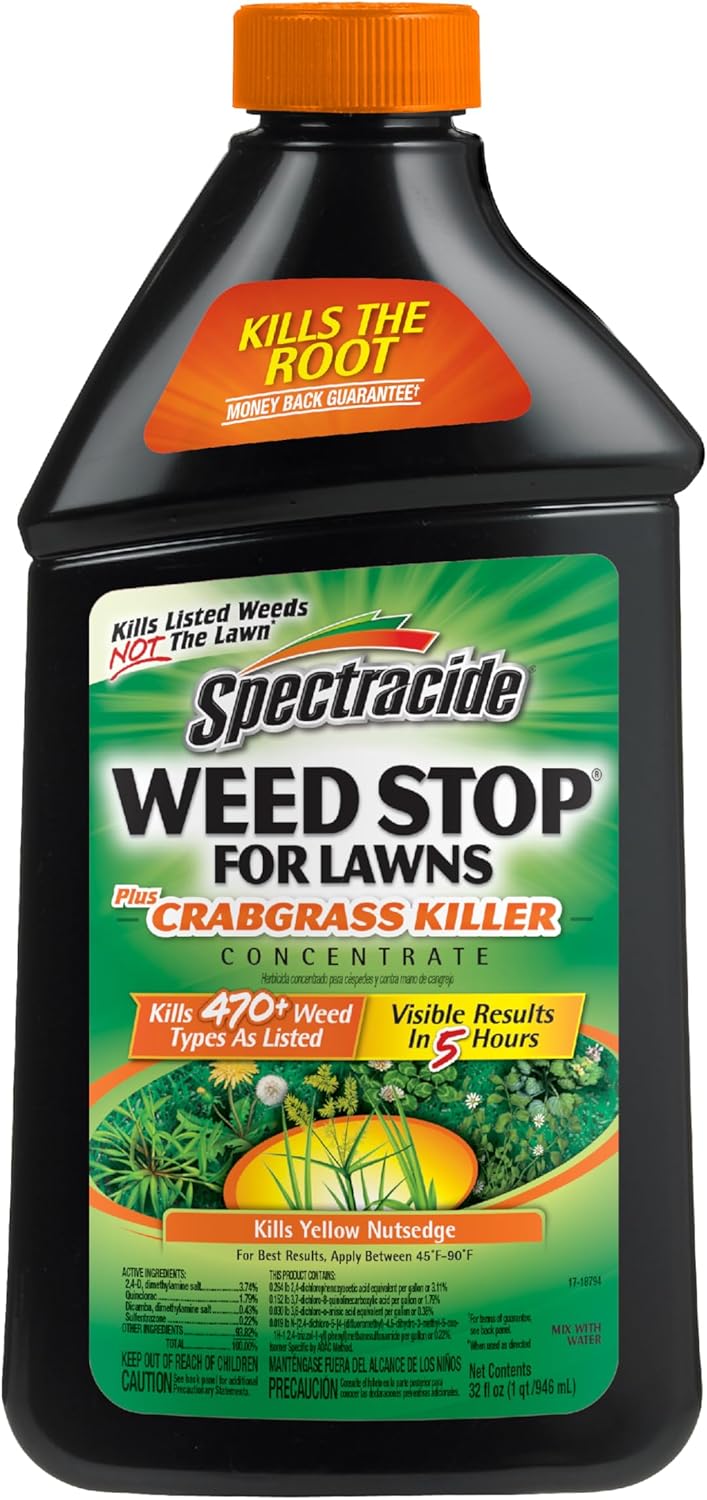
Spectracide Weed Stop for Lawns Plus Crabgrass Killer Concentrate, 32 oz
| Unit Count | 32 Ounce |
|---|---|
| Coverage | 5000 square_feet |
| Item Form | Liquid |
| Kills | 470+ listed weeds |
Spectracide Weed Stop Plus Crabgrass Killer is a ready-to-dilute concentrate designed to target grassy and broadleaf weeds across a typical yard. Mix and apply with a sprayer and the formula kills by contact down to the root with visible dieback in about 5 hours and becomes rainfast in roughly 3 hours. The 32 ounce bottle covers up to 5,000 square feet, making it a practical choice for treating whole lawns. Directions note best performance between 45 and 90 degrees daytime temperature and caution against treating Bermudagrass in very hot conditions to avoid temporary discoloration. Practical benefits include fast visible results, broad-spectrum control that includes dandelion and clover, and the convenience of a concentrated product that stretches across a larger area than ready-to-use sprays. Important limitations are the temperature restrictions for safe application, the need to let treated areas dry before people or pets return, and observing reseeding intervals after treatment. For routine crabgrass control on established lawns, this concentrate balances effectiveness and coverage for cost-conscious buyers.
Best for: Buyers who want an economical, concentrated treatment to control crabgrass and a wide range of weeds across a whole lawn and who are comfortable mixing and applying a spray product.
Less Ideal for: People with newly seeded lawns, very small patch treatments who prefer ready-to-use bottles, or those who cannot avoid applying during hotter daytime temperatures.
- Concentrated formula treats up to 5,000 sq ft from a 32 oz bottle
- Kills over 470 listed broadleaf and grassy weeds including crabgrass
- Visible results in about 5 hours and becomes rainfast in approximately 3 hours
- Designed to kill weeds down to the root when used as directed
- Must follow temperature limits to avoid lawn injury, particularly on Bermudagrass
- Requires mixing and a separate sprayer rather than being ready-to-use
Verdict: A budget-friendly concentrate that delivers fast, broad-spectrum crabgrass and weed control for established lawns while covering a large area per bottle.
Spectracide Weed Stop for Lawns Concentrate, 32 oz Ready-to-Spray

| Coverage | 8,000 square feet |
|---|---|
| Liquid Volume | 32 fluid ounces |
| Item Form | Liquid |
| Active Ingredients | 2,4-D, Mecoprop-P, Dicamba, Sulfentrazone |
Spectracide Weed Stop for Lawns is a hose-attach ready-to-spray concentrate designed to control broadleaf weeds across common turf types. It kills by contact and down to the root, listing over 460 weeds such as clover, dandelion and chickweed, and promises visible browning in around three hours. The QuickFlip sprayer makes treatment fast for larger yards and the formula is labeled for use on bluegrass, fescue, Bermuda and perennial rye, though you should avoid zoysiagrass coming out of dormancy and not spray above 90°F. Practical benefits include quick application without mixing and one-hour rainproofing so treatments are less weather-dependent. Important limitations are temperature restrictions for safe use, the need to keep people and pets off the lawn until dry, and the usual reseeding wait time of three to four weeks. For homeowners focused on routine clover control, this product offers a straightforward, time-saving option, but follow label directions closely to protect desirable turf and nearby plants.
Best for: Homeowners who want an inexpensive, no-mix solution to knock back clover and other broadleaf weeds quickly across a typical lawn and value fast application.
Less Ideal for: Gardens that need constant reseeding, very young lawns or yards with delicate ornamentals close to treatment areas should consider more targeted options.
- Ready-to-spray QuickFlip hose attachment speeds up application for medium to large lawns
- Kills broadleaf weeds including clover, dandelion and chickweed with visible results in about three hours
- Rainproof in one hour which reduces the chance of losing treatment to light rain
- Works on a variety of common turf types when used as directed
- Should not be applied when daytime temperatures exceed 90°F which limits use in hot weather
- Requires waiting 3–4 weeks before reseeding treated areas
Verdict: A convenient ready-to-spray concentrate that quickly controls clover and other broadleaf weeds for budget-minded homeowners who want fast, low-effort treatments.
Quali-Pro MSM Turf Herbicide, 8 oz

| Unit Count | 8 Ounce |
|---|---|
| Item Form | Liquid |
| Coverage | Weed control on ornamental turf |
| Liquid Volume | 8 fluid ounces |
| Active Ingredients | Herbicide |
Quali-Pro MSM Turf Herbicide is a concentrated 8 oz liquid designed to control broadleaf and grassy weeds on ornamental and commercial turf such as lawns, parks, cemeteries and golf-course areas. It is typically mixed and applied according to the product label over established turf; the formulation targets a wide range of common turf weeds so a single product can simplify maintenance. Practical benefits include a focused formulation for turf applications and a shelf life of up to three years when stored properly, which supports dependable performance over time. Because it is a professional-strength herbicide, users must follow label directions closely for dilution rates, application timing, and safety precautions to avoid turf damage or off-target effects. The product is sold in a small, concentrated bottle so it is convenient to store and transport but requires accurate measuring and mixing before use. This makes it a good choice for groundskeepers and experienced homeowners who want a reliable, turf-specific weed control option but less suitable for casual users seeking ready-to-use convenience.
Best for: For homeowners, groundskeepers, or turf managers who prioritize a dependable, turf-specific herbicide and are comfortable mixing and applying concentrated products according to label instructions.
Less Ideal for: Not a good fit for casual gardeners who want a plug-and-play ready-to-use spray or those unwilling to follow professional application and safety procedures.
- Formulated specifically for weed control on ornamental and commercial turf
- Concentrated 8 oz bottle is easy to store and can treat multiple areas when mixed correctly
- Shelf life up to three years when stored as directed supports long-term reliability
- Requires precise measuring and dilution before use rather than ready-to-use convenience
- Professional-strength formulation requires strict adherence to label and safety precautions
Verdict: Choose this concentrated turf herbicide if you need a reliable, turf-specific product that professionals and careful homeowners can mix and apply for consistent weed control.
Scotts Weed Control for Lawns, 14 lb. Granules

| Item Form | Granule |
|---|---|
| Coverage | 5000 square_feet |
| Active Ingredients | 1.108% 2,4-D, 0.167% Mecoprop-p, 0.071% Dicamba |
Scotts Weed Control for Lawns is a ready-to-use granular broadleaf weed killer intended for residential turf. You broadcast it over actively growing weeds in spring or early fall using a spreader, avoid watering for 1 to 2 days so the granules contact leaves, then water thoroughly to move the product into the root zone. The formula contains 2,4-D, Mecoprop-p, and Dicamba and is labeled to control common targets such as dandelion, clover, chickweed, and ground ivy. Practical benefits include easy application with a recommended Scotts spreader, single-bag coverage of 5,000 sq. ft., and a fast contact action that works down to the root. Important limitations are the species exclusions and turf cautions — it must not be used on certain grasses (Dichondra, Carpetgrass, Floratam St. Augustine, Creeping Bentgrass) or where desirable clover grows, and care is needed to follow spreader settings and post-application watering instructions. For a balanced homeowner wanting straightforward, granular broadleaf control on compatible lawns, this is a convenient option.
Best for: Homeowners who want a simple, granular solution to reduce common broadleaf weeds across a medium-sized lawn and prefer an easy spreader-applied product.
Less Ideal for: People managing sensitive turf varieties listed on the label or those who need a weed product safe for lawns with desirable clover or specialized grass species.
- Controls over 200 broadleaf weed species including dandelion and clover
- Covers up to 5,000 sq. ft. from a single 14 lb. bag
- Granular form is easy to apply with a spreader and avoids mixing
- Starts working on contact and is formulated to kill to the root
- Not safe for several turf types and must be avoided where desirable clover exists
- Requires careful timing, spreader settings, and 1–2 days without rain or watering after application
Verdict: A convenient, spreader-ready granular formula for homeowners who need reliable broadleaf weed control on compatible lawns up to 5,000 sq. ft.
Choosing the Right Weed Killer for Bahia Grass: Key Factors to Consider
Turf Safety And Selectivity
Bahia grass is more tolerant of heat and drought than many cool-season turfs but can be sensitive to some herbicide chemistries. Always check whether the active ingredient is labeled safe for Bahia or for warm-season grasses with similar stress tolerances. A product that lists Bahia specifically or cites centipede, bermudagrass, or zoysia in the label is a safer bet.
Selectivity matters because nonselective or high-rate broadleaf herbicides can cause yellowing or permanent thinning. When in doubt, choose a product with documented low risk at recommended rates, and plan spot treatments rather than whole-lawn broadcast applications to reduce turf exposure.
Mode Of Action: Contact Versus Systemic
Contact herbicides scorch foliage quickly but often require thorough coverage and repeat applications to kill perennial weeds from the roots. Systemic herbicides move within the plant and can control deep-rooted perennial weeds with fewer treatments, but they may act more slowly and sometimes stress turf if applied at the wrong time.
For Bahia lawns, consider a mix of approaches: contact products for small annual broadleaves and systemic options for established perennials like clover or plantain. Understanding mode of action helps you plan follow-up treatments and avoid resistance from repeated use of the same chemistry.
Application Timing And Turf Stress
Timing affects both effectiveness and turf safety. Apply most selective herbicides when weeds are actively growing and temperatures are moderate. Avoid treating during peak heat, drought stress, or immediately before heavy fertilization because stressed Bahia grass is more prone to injury.
Late spring through early fall is often the effective window for Bahia, but follow label directions closely. Some products require waiting until the grass has broken dormancy or until soil temperatures reach a specific range for best weed control and minimal turf damage.
Coverage, Spot Treatment, And Mixing Practicalities
Coverage quality determines results with contact products. For spot treatments, a ready-to-use spray or a hose-end applicator can limit the treated area and reduce risk to healthy grass. Concentrates can be economical for larger areas but require careful measuring, mixing, and rinsing.
Also consider nozzle selection and water volume recommendations on the label. Good coverage with the right spray pattern often beats simply using higher rates. Ease of cleaning equipment and the need for surfactants or adjuvants also affect real-world performance.
Control Spectrum And Weed Types
Identify the weeds in your Bahia lawn before choosing a product. Some herbicides excel at broadleaf weeds but do not control sedges or grassy weeds. If you have a mix of weeds, you may need a tank mix or two separate treatments spaced over several weeks.
Knowing whether a product controls common Bahia invaders such as dollarweed, clover, oxalis, or sedges will save time and reduce unnecessary turf exposure. Check label lists for targeted species rather than relying on generic 'broadleaf' claims.
Re-treatment Interval And Recovery Expectations
Different chemistries require different retreatment schedules. Contact products often require follow-up applications within a few weeks, while systemic products may show visible control only after several weeks and may not need repeat treatments as quickly.
Plan for visible turf response and recovery time. Some products cause temporary discoloration that fades as grass regrows. Factor in mowing restrictions after application and any irrigation or rainfast periods to avoid washing off active ingredients.
When To Treat Bahia Lawn Weeds
Treating at the right time maximizes control and minimizes turf stress. For most selective herbicides, target weeds when they are actively growing and not under severe heat or drought. Early spring through early fall is usually best for active weed growth, but avoid midday heat and treat during calm weather to reduce drift.
- Spot-treat young, actively growing weeds for best results.
- Delay application if forecasted temperatures exceed label recommendations.
- Avoid treatment during drought; water the lawn lightly a day or two before if allowed by label.
Application Techniques That Protect Turf
Good technique reduces injury risk. Use spot treatments or a targeted sprayer for isolated weeds rather than broadcasting across the entire lawn. Measure and mix concentrates carefully and follow the label for spray volume and nozzle type to ensure even coverage without overapplication.
- Use a nozzle that produces a medium to coarse spray to limit drift.
- Apply in the early morning or late afternoon to reduce evaporation.
- Rinse equipment thoroughly after use to prevent cross-contamination.
Managing Tough Weeds And Sedge Problems
Sedges and some perennial weeds respond poorly to generic broadleaf herbicides. For these, look for products or combinations that list sedge control on the label or plan for a sequential treatment strategy. Cultural measures like improving drainage and mowing at the recommended height can also reduce sedge pressure over time.
- Identify whether the problem is grassy weeds, broadleaf weeds, or sedges before choosing a treatment.
- Combine chemical control with improved cultural practices for lasting results.
Spot Treatment Plans For Small Yards And Lawns
Small lawns benefit from spot treatments that limit herbicide exposure to healthy Bahia grass. Ready-to-use sprayers or pump-up bottles let you apply a precise amount to individual weeds. For larger infestations, map out treatment zones and treat one area at a time to monitor turf response.
- Treat no more than a few isolated areas per week to monitor for turf injury.
- Record product, rate, and weather conditions to refine future treatments.
Post-Application Care And Mowing
Follow label instructions for rainfast times and mowing restrictions. Mowing too soon after application can remove treated foliage and reduce effectiveness or increase turf stress. Light watering after the agreed rain-free period may help dilute surface residues, but do not water until the label allows it.
- Wait the label-recommended interval before mowing.
- Avoid heavy fertilization for at least a week after treatment unless label allows it.
How We Chose the Best Weed Killer for Bahia Grass
We prioritized products and approaches that address the particular biology and stress tolerance of Bahia grass. Evaluation focused on criteria that gardeners can verify before buying or applying: active ingredient type and selectivity, labeled turf safety on Bahia or similar warm-season grasses, recommended application windows and rates, and documented effectiveness against common Bahia invaders such as dollarweed, clover, oxalis, and sedges. We excluded general broadcast herbicides with broad nonselective labels and products without explicit turf guidance because these carry high risk of turf injury. We also filtered out formulations that require specialized licensing or commercial-only application. The selection favored products with clear contact versus systemic action information, established re-treatment intervals, and guidance for use under heat or drought stress. We considered formulation stability, ease of mixing and application, and whether the product allowed spot treatments to limit exposure to healthy turf. The scoring labels below reflect these same practical decision points.
FAQ
Can I use the same weed control product I used on other warm-season grasses on Bahia?
Often you can, but not always. Some products that are safe on bermudagrass or zoysia may have different effects on Bahia. Always check the label for Bahia or similar warm-season grasses and follow the specified rates and timing.
Will a contact herbicide prevent weeds from returning?
Contact herbicides kill exposed foliage fast but often do not eliminate the root system of perennial weeds. Repeat treatments or a follow-up systemic product may be necessary for long-term control.
Is it safe to treat Bahia grass during summer heat?
Treating during peak heat increases the risk of turf injury. Many labels recommend avoiding applications during extreme heat or drought. If treatment is necessary, choose a cooler part of the day and ensure the lawn is not stressed beforehand.
How soon can I mow after applying a selective herbicide?
Mowing intervals vary by product. Some labels allow mowing after 24 to 48 hours, while others recommend waiting several days. Check the product label and avoid scalping the lawn when mowing after treatment.
Do I need to add a surfactant or adjuvant?
Some herbicides perform better with a nonionic surfactant, particularly contact products that need better leaf coverage. Follow label guidance because some products already include an adjuvant and adding more can increase turf risk.
Can cultural practices reduce the need for herbicides in Bahia lawns?
Yes. Proper mowing height, targeted irrigation, overseeding thin areas, and improving soil drainage reduce weed pressure. Strong, dense turf naturally suppresses many weeds and lowers reliance on chemical controls.
Final Verdict
Prioritize turf safety and choose a product that lists Bahia grass or similar warm-season turfs on the label. Match the herbicide mode of action to the weeds you have: use contact products for small annuals and systemic options for established perennials or deep-rooted weeds. Plan applications for times when Bahia is actively growing but not heat- or drought-stressed, and favor spot treatments to protect healthy turf. Balancing application timing, proper coverage, and realistic expectations for recovery will give you the best results and minimize the chance of damaging your Bahia lawn.
